Nuclear power a very bad option for the Philippines
Greenpeace: Proposal to add nuclear to country’s energy mix ‘plain irresponsible, irrational’ Gaea Katreena Cabico (Philstar.com) – March 4, 2020 MANILA, Philippines — The inclusion of nuclear power in the Philippines’ energy mix will only bring more problems and debt to Filipinos, an environmental organization said as it urged the government to reject the proposal of the Energy department.
Energy Secretary Alfonso Cusi sought President Rodrigo Duterte’s nod for a proposed executive order to add nuclear power to the country’s energy sources, Malacañang said Tuesday.Presidential spokesperson Salvador Panelo said Cusi claimed that tapping nuclear power can help solve the country’s energy gap.’
According to environmental group Greenpeace Philippines, there is no rational reason for the Energy department to push a nuclear power agenda.
“Nuclear power is the most dangerous source of electricity and throughout their life cycle, nuclear plants contribute significantly to climate change. In other parts of the world, nuclear facilities are being decommissioned and phased out from energy plan,” Greenpeace campaigner Khevin Yu said.
From the 1960s until the mid 1980s, Ferdinand Marcos adopted a nuclear energy program and built the Bataan Nuclear Plant, called by critics the “monster” of Morong town. It was mothballed after President Corazon Aquino assumed office in 1986 due to safety concerns.
Nuclear power a costly option
Yu also said that nuclear is the most costly option for power generation.
In 2003, the Massachusetts Institute of Technology estimated the cost of a plant without financing would be US$2,000 per kilowatt. In their updated study released in 2009, the estimated cost was at US$4,000.
“Nuclear power will bring more problems and debt to the Filipino people,” Yu said, adding that pushing it as an energy source is “plain irresponsible and irrational.”
Safety concerns
Another big issue is the absence of safe and permanent storage of radioactive spent fuel, Yu said.
In 2018, Philippine Nuclear Research Institute Director Carlo Arcilla stressed the need to put forward radioactive waste management for discussion.
“It’s (nuclear power development) like putting up a mansion without toilets if you’re not talking of radioactive wastes,” Arcilla said then.
Duterte in 2018 said safety should be the priority when deciding whether to tap nuclear energy for the power needs of Filipinos.
Focus on renewable energy instead……https://www.philstar.com/headlines/2020/03/04/1998107/greenpeace-proposal-add-nuclear-countrys-energy-mix-plain-irresponsible-irrational
Veterans groups not happy -France wants to abolish the National Commission for Monitoring the Consequences of Nuclear Tests.
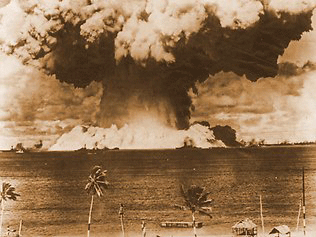 Dismay over plans to scrap French nuclear monitoring commission, https://www.rnz.co.nz/international/pacific-news/410780/dismay-over-plans-to-scrap-french-nuclear-monitoring-commission 2 March 2020 Nuclear test veterans groups in French Polynesia have reacted with dismay at reports that Paris wants to abolish the National Commission for Monitoring the Consequences of Nuclear Tests.
Last week, the French publication Canard Enchaine reported that as part of administrative changes and cost-cutting measures, dozens of commissions would be disestablished.
The commission is the body bringing together state authorities, representatives of the French Polynesian government and veterans associations to work on the list of radiation-induced illnesses deemed to be relevant for compensation.
The head of the group Moruroa e tatou Hiro Tefaarere has told the broadcaster La Premiere the move was inadmissible yet not surprising for the Macron government.
He said the French president on one hand described colonialism as a crime against humanity and on the other everything was suppressed which would recognise the consequences of the tests.
France carried out more than 190 nuclear weapons tests in the Pacific and until 2010 maintained that they were clean and posed no threat to human health.
Algeria and French Polynesia suffer from France’s 30 years of nuclear bomb testing
But Jean-Claude Hervieux has other memories. He joined the French testing efforts in Algeria as an electrician. He remembers a nuclear test in 1962 that did not go according to plan.
Radioactive dust and rock escaped from underground. Hervieux and others observing the testing ran for shelter. Two French ministers were among them. The group washed themselves in a military housing area to decontaminate.
France held more than 200 nuclear tests until a later president, Jacques Chirac, ended testing in 1996. Most tests took place in French Polynesia. But 17 took place in Algeria between 1960 and 1966, ending four years after Algeria’s independence from France.
Brahim Oumansour is a North Africa expert at the French Institute of International Relations in Paris. He said, “It’s part of the whole issue of decolonization and Algerians in general asking for recognition of colonization crimes.” He added that official recognition and financial compensation for the Algerian tests could cost millions of dollars.
Hervieux spent 10 years working on nuclear test areas in Algeria and later French Polynesia. Now 80 and living in France’s Lyon area, he says he is physically fine. But he used to receive some questionable radioactive testing results from the French government……
France’s nuclear compensation commission, CIVEN, said more than 1,600 claims have been filed under a 2010 French law that finally recognized health problems related to the testing.
Only about one-third have met the requirements needed to receive financial benefits. The requirements include about 24 possible radiation-related cancers. Almost all the claims came from France and French Polynesia. Of the 51 claims from Algeria, only one has been compensated…. https://learningenglish.voanews.com/a/questions-remain-as-france-marks-60-years-since-nuclear-tests-/5287541.html
Polynesian MP calls on France for “vast project” to withdraw radioactive waste in Mururoa
|
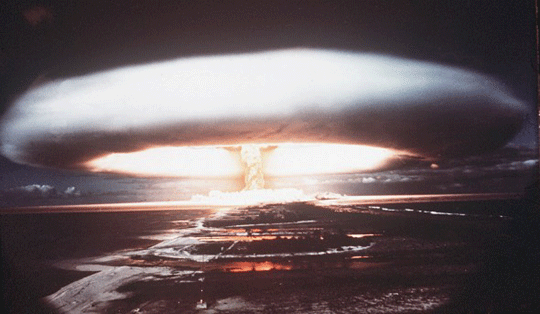
Polynesia: MP Moetai Brotherson asks Macron for a “vast project” to withdraw radioactive waste in Mururoa, 8 Feb 2020 https://la1ere.francetvinfo.fr/polynesie-depute-moetai-brotherson-demande-macron-vaste-projet-retrait-dechets-radioactifs-mururoa-798235.html [machine translate] The deputy of Polynesia Moetai Brotherson asked in a letter to Emmanuel Macron, who will be in April in the Polynesian archipelago, that he undertakes on “a vast project of withdrawal and reprocessing of all radioactive waste and residues from the Moruroa nuclear tests “.
From 1966 to 1996, the Mururoa and Fangataufa atolls were the scene of 193 nuclear tests , which had effects on the health and the environment of the populations. The head of state is expected to visit Polynesia in mid-April, when two summits are being held, “France-Oceania” and “One Planet Summit”.
” Mr. President, rather than ostrich, the French Republic would be honored to commit today to an ambitious and vast project to withdraw and reprocess all radioactive waste and residues from the tests Moruroa nuclear “, explains the deputy attached to the communist group in the Assembly and representative of Tavini Huiraatira, Polynesian separatist party, in a letter which AFP had a copy on Friday. Threats of collapse
He recalls that nuclear tests, ” especially in their underground part, generated a quantity of radioactive waste and residues “. ” Today, a significant proportion of this waste is stored in wells several hundreds of meters deep drilled in the coral ring of Moruroa, or worse, at the bottom of its lagoon, in particular at a place called ‘Colette bench ‘ “.
But ” cracks in the base of the atoll “, “induced by underground tests in particular “, threaten ” collapse part of the atoll. It appears that both the containment wells, as the Colette bank are precisely in the endangered area “,
“Dramatic message”For the Polynesian deputy, not to commit to the depollution of the site ” would be to send a dramatic message to the Polynesians, to the Peoples of the Pacific, but also to the People of France, in particular to his youth who wants to see (…) real strong actions in favor of the environment “. Moetai Brotherson underlines that ” the biggest investment made by the State in French Polynesia in recent years is the TELSITE geomechanical surveillance project of Moruroa. The billions invested still come to underline the reality of this collapse, real sword of Damocles, for the Polynesians first, for the Pacific region then, for the reputation of the French Republic finally
|
|
Australian bushfire smoke across the Pacific shows how French nuclear tests spread radiation
fallout from nuclear tests affected islands such as Tahiti. Smoke from Australia this month drifted over the south of French Polynesia after crossing New Zealand.
Mr Temaru said this was more than proof that fallout from France’s atmospheric nuclear weapons tests at Moruroa spread while France maintained they didn’t affect Tahiti.
He again called on France to tell the full truth about this dark chapter of history.
Until 1974 France detonated 46 atomic bombs over Moruroa and Fangataufa before continuing the tests with underground blasts.
France maintained until a decade ago that its nuclear tests were clean and posed no risk to human health.
A law brought in in 2010 offered compensation but its criteria were widely seen as too narrow because most applications by those suffering poor health were thrown out.
Its revision was changed again, leaving veterans organisations still dismayed. Mr Temaru made the comments as his Tavini Huiraatira party campaigned for the March municipal election.
However, Mr Temaru is yet to say whether he will seek re-election to the mayoralty of Faaa which he has held since 1983.
Among the candidates known so far are two assembly members of the ruling Tapura Huiraatira party.
New Zealand veterans await nuclear radiation genetic testing study
|
New Zealand veterans await nuclear radiation genetic testing study, https://www.rnz.co.nz/news/national/406922/new-zealand-veterans-await-nuclear-radiation-genetic-testing-study 8 Jan 2029Veterans deployed to the Mururoa Atoll will wait another two months to find out whether their children and grandchildren may be genetically impacted by nuclear radiation.
A Mururoa Nuclear Veterans Group teamed up with Otago University last year to produce a study about whether the families of veterans deployed to Mururoa Atoll in 1973, may have been affected by their parents’ exposure to radiation. University of Otago researcher David McBride is leading the study and said “the public need to know” what veterans had been facing and he hoped this study could help them in their quest for more support for their families. About 145 people participated in the study which took six weeks. It is now being peer reviewed for the New Zealand Medical Journal. “When and if our study is peer reviewed favourably then published, I’m hoping that’s not going to take too long,” he said. He said he suspected the veterans group would have to wait until March or April at the latest. “One of the most out-of-the-ordinary things you can have is exposure to nuclear radiation,” he said. “It certainly was a traumatising experience and they are right inthe fact that they may have passed defect onto their children and grandchildren.” |
|
Thorium and uranium pollution from Rio Tinto’s Madagascar mine
Concerns about radioactive contamination dog Rio Tinto’s Madagascar mine, MONGABAY, by Malavika Vyawahare on 31 December 2019
|
|
|
||||

U.S. Congress Demands Investigation Into the U.S.’s Nuclear Coffin, The Runit Dome
|
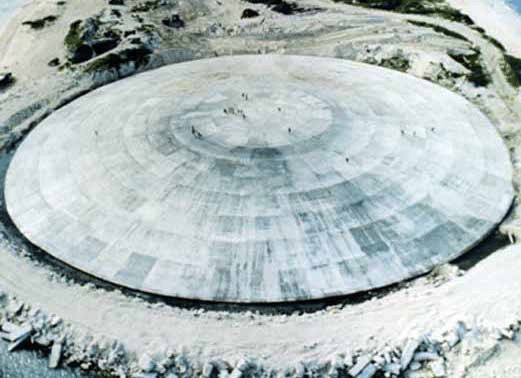
Congress Demands Investigation Into the U.S.’s Nuclear Coffin, The Runit Dome is leaking radioactive waste into the Pacific Ocean. https://www.popularmechanics.com/military/weapons/a30338371/congress-investigation-runit-dome-nuclear-waste/
Dec 27, 2019
|
|
Seafloor mapping reveals the degradation of ocean floor by Bikini nuclear bomb tests

Bikini Seafloor Hides Evidence of Nuclear Explosions, Seafloor mapping has revealed a crater and several shipwrecks persisting 73 years after the world’s first underwater nuclear test. Eos, Amanda Heidt 28 Dec 19
Seventy-three years after serving as the site of the world’s first underwater nuclear test, the seafloor around the Bikini Atoll remains scarred by finely detailed craters and littered with derelict ships.
Today, an interdisciplinary team of scientists is using sonar to assess the complex submarine environment. The results provide a sobering assessment of humanity’s capacity to alter nature…..
Unleashing the Power of the Atom
In the aftermath of World War II, the U.S. Navy chose the Bikini Atoll for a series of controlled nuclear explosions. Between 1946 and 1958, 23 confirmed tests were conducted throughout the area.
Trembanis and his team studied Able and Baker, a pair of tests conducted in July 1946 as part of Operation Crossroads. Both Able and Baker involved plutonium fission bombs with a yield of between 21 and 23 kilotons, but they were deployed differently……….
Clustering around a laptop, Trembanis and his team witnessed the real-time rendering of an underwater crater more than 800 meters across—big enough to fit three Roman Colosseums. ….
Littered throughout the atoll are the husks of strategically placed ships—decommissioned dreadnaughts, aircraft carriers, and submarines meant to bear the brunt of the Able and Baker explosions. …..
Even independent of their place in nuclear history, the Pilotfish and other Bikini shipwrecks attest to the long-lived effects of human activities on the environment.
As old ships decompose, they become ecological burdens, and researchers found that several wrecks on the Bikini seafloor are leaching plumes of oil. Trembanis and his team looked at sketches from surveys the National Park Service conducted in the late 1980s and saw the degradation of the past 40 years……. https://eos.org/articles/bikini-seafloor-hides-evidence-of-nuclear-explosions
Philippines prone to natural disasters, but still contemplates nuclear power
Philippines seeks to relaunch nuclear power ambitions, Country prone to natural disasters eyes potential suppliers including Russia and US, Ft.com 27 Dec 19. The Philippines plans to revive its long-discontinued nuclear energy programme to combat the threat of a future power supply crunch — a prospect likely to raise safety concerns in a country prone to typhoons and earthquakes. The country is working with the International Atomic Energy Agency to meet the UN watchdog’s safety and other requirements, and investigating potential suppliers from Russia, South Korea, China and the US, said Alfonso Cusi, the energy secretary.
Devastating array of craters on the ocean floor, from nuclear tests
Enormous Craters Blasted in Seafloor by Nuclear Bombs Mapped for the First Time, Live Science, By Mindy Weisberger – Senior Writer 11 Dec FRANCISCO — Today, all seems quiet in the remote Bikini Atoll, a chain of coral reef islands in the central Pacific. But more than 70 years ago, this region’s seafloor was rocked by powerful atomic bombs detonated by the U.S. Army.
For the first time, scientists have released remarkably detailed maps of this pockmarked seabed, revealing two truly massive craters. This new map shows that the seabed is still scarred by the 22 bombs detonated at Bikini Atoll between 1946 and 1958.
The map was presented yesterday (Dec. 9) at the annual meeting of the American Geophysical Union.
During the 1946 nuclear weapons test known as “Operation Crossroads,” the U.S. wanted to test the impact of nuclear bombs on warships. To that end, the Army assembled more than 240 ships — some of which were German and Japanese — that held different amounts of fuel and munitions, then deployed two nuclear weapons to destroy them, researcher Arthur Trembanis, an associate professor with the College of Earth, Ocean, and Environment at the University of Delaware, said in the presentation.
At the time of the tests, Trembanis said, comedian Bob Hope joked grimly:
“As soon as the war ended, we found the one spot on Earth that had been untouched by war and blew it to hell.”……….
But as powerful as the early atomic tests were, they were dwarfed by the later blasts caused by hydrogen and fusion bomb tests in the 1950s. The researchers investigated a crater that was 184 feet (56 m) deep and had an unusual oblong shape; they determined that it was a composite crater from multiple blasts: “Castle Bravo,” a 15-megaton bomb that was the largest ever detonated by the U.S., and “Castle Romeo,” the first deployed thermonuclear bomb.
These tests left behind a uniquely devastating array of shipwrecks and craters, and the first detailed map of their aftermath will help scientists to tell this untold story and connect to “a moment at the dawn of the nuclear age,” Trembanis said. “Our new findings provide insights into previously unknown conditions at Bikini and allow us to reflect on the lasting consequences from these and other tests.” https://www.livescience.com/mapping-reveals-bikini-atoll-nuclear-craters.html
As the Runit nuclear waste dome crumbles, Marshall Islanders want honesty and justice
‘People want justice’: Marshalls’ fury over nuclear information US withheld– https://www.rnz.co.nz/international/programmes/datelinepacific/audio/2018723289/people-want-justice-marshalls-fury-over-nuclear-information-us-withheld From Dateline Pacific, 21 November 2019
|
The caretaker president of the Marshall Islands says it’s unconscionable that the United States kept secret key information about its nuclear tests for decades. New details reveal the US withheld information about the nuclear waste it left behind when the Marshall Islands gained independence, and the extent of the tests it carried out. Now, a dome that contains hundreds of tonnes of nuclear waste is at risk of crumbling into the ocean. But with Washington increasingly jittery about China, the small Pacific country’s finding it might now have some leverage to get something done. TRANSCRIPTEnewetak was once a paradise – a long atoll in the clear blue waters of the north Pacific, white sand and thick green palms. Today, it’s rutted with scars, after the US detonated dozens of nuclear bombs on, in and above it in the 1940s and ’50s. Whole islands were vaporised, deep craters carved into the coral. Jack Ading is a senator from Enewetak. His family was forced to move for the tests, and then allowed to return in the 1980s. “It appears that when we moved back to Enewetak in the 1980s after we were assured by the US government that it was safe. We were actually subjecting ourselves to a risk that we were never warned about.” Government documents reveal that beyond the nuclear blasts, the US also tested biological weapons, including an aerosol bacteria. Jamie Tahana reports. TRANSCRIPTEnewetak was once a paradise – a long atoll in the clear blue waters of the north Pacific, white sand and thick green palms. Today, it’s rutted with scars, after the US detonated dozens of nuclear bombs on, in and above it in the 1940s and ’50s. Whole islands were vaporised, deep craters carved into the coral. Jack Ading is a senator from Enewetak. His family was forced to move for the tests, and then allowed to return in the 1980s. “It appears that when we moved back to Enewetak in the 1980s after we were assured by the US government that it was safe. We were actually subjecting ourselves to a risk that we were never warned about.” Government documents reveal that beyond the nuclear blasts, the US also tested biological weapons, including an aerosol bacteria. But this was kept secret when the people from Enewetak were allowed to return, and other documents show that people were subjected to tests and experiments about the lingering effects of radiation. Last week, the Los Angeles Times also uncovered that the US didn’t tell the Marshallese it had shipped 130 tonnes of soil from its atomic testing grounds in Nevada in 1958 and dumped it at Enewetak. The caretaker president of the Marshall Islands, Hilda Heine, says the new details are disturbing. “To say the least you would have thought that all that information would have been shared with the Enewetak people before they went back to Enewetak. It is unbelievable that such information was held back, and as a result people have gone back and lived there for many years.” The nuclear waste from the era is stored in a pile at the end of the island of Runit, covered in a concrete dome. But a recent study by the Marshall Islands Nuclear Commission found the dome is now at risk of collapsing, and as rising seas erode beneath it, much of that waste is seeping into the lagoon. The commission’s chair, Rhea Moss-Christian, says information about the dome and the testing era was withheld throughout the independence process, while a compact of free association was negotiated in the 1980s. “We signed the compact in 1986 on the understanding that we had all the information we needed to have. It’s pretty hard for us to see this information, to have the level of detail that we now have, and to think that any of those previous agreements could stand.” The Marshall Islands has sought US help to clean up contamination and to shore up the dome, but American officials have declined, saying it’s on Marshallese land and, therefore, is the Marshall Islands’ responsibility. Ms Moss-Christian says that’s ridiculous. “How can it be that this radioactive waste and structure that we didn’t ask for. How can it be that this is ours and ours to deal with?” A Nuclear Claims Tribunal formed by the two countries in 1988 concluded that the US should pay $US2.2 billion in claims and settlements. But documents from both the Nuclear Commission and a 2010 US House inquiry show only $4 million has been paid. Last month, the Marshall Islands parliament – the Nitijela – endorsed a Nuclear Commission strategy which calls for, among other things, full compensation, better healthcare, and environmental protections. The US maintains it is upholding its responsibilities. It says it’s paid nearly a billion dollars, which has gone towards resettlement, rehabilitation and healthcare costs for affected communities, and that it’s funding tests of the water and atmosphere around the Runit dome. But Giff Johnson, the editor of the Marshall Islands journal and an author of books about the nuclear legacy, says that’s not enough. “People want justice for Marshall Islanders. The US government has to step up and address issues that it has addressed for American victims but is ignoring out here.” For the Marshall Islands, a smattering of atolls in the North Pacific – population 53,000 – it might be an opportune time to twist a superpower’s arm. Washington is increasingly nervous about a growing Chinese presence, and the compact of free association – which guarantees relations and funding from the US – expires in three years. Having initially maintained there won’t be a replacement compact, Washington is now keen to open talks for a new one, and has sent a string of high-ranking officials for visits. The caretaker president, Hilda Heine – who a few months ago was invited to the White House to meet President Donald Trump – says that could bode well. “The geopolitical situation in the Pacific is really helpful to the cause of the Marshall Islands. The US is now paying more attention to the Marshall Islands, so our issues around climate change, around our nuclear legacy, I think those will come to the forefront of our discussions going forward with the United States.” Whatever comes from those discussions, the people of Enewetak want more than they’re getting now. |
|
The climate crisis is tied up in the dangers of nuclear weapons in ways that nobody predicted
The Climate Crisis Just Went Nuclear https://www.esquire.com/news-politics/politics/a29760935/marshall-islands-nuclear-waste-climate-change/ In the Marshall Islands, local residents are reaping what the United States sowed—which includes tons and tons of nuclear and biological waste from Cold War testing.BY CHARLES P. PIERCE
The climate crisis is the one issue that touches all the other issues. For example, the climate crisis is tied up in the dangers of nuclear weapons in ways that nobody predicted, but that the Los Angeles Times spent some time and money examining. Back in the 1950s and 1960s, the United States set off 67 nuclear bombs in and around the Marshall Islands. This had predictable results: there were now lagoons where there were none before; some islands simply aren’t there any more, and there was a lot of deadly stuff left behind. Which brings us to the climate crisis.
Here in the Marshall Islands, Runit Dome holds more than 3.1 million cubic feet — or 35 Olympic-sized swimming pools — of U.S.-produced radioactive soil and debris, including lethal amounts of plutonium. Nowhere else has the United States saddled another country with so much of its nuclear waste, a product of its Cold War atomic testing program.
U.S. authorities later cleaned up contaminated soil on Enewetak Atoll, where the United States not only detonated the bulk of its weapons tests but, as The Times has learned, also conducted a dozen biological weapons tests and dumped 130 tons of soil from an irradiated Nevada testing site. It then deposited the atoll’s most lethal debris and soil into the dome. Now the concrete coffin, which locals call “the Tomb,” is at risk of collapsing from rising seas and other effects of climate change. Tides are creeping up its sides, advancing higher every year as distant glaciers melt and ocean waters rise.
When people talk about environmental justice, this is what they’re talking about.
Officials in the Marshall Islands have lobbied the U.S. government for help, but American officials have declined, saying the dome is on Marshallese land and therefore the responsibility of the Marshallese government. “I’m like, how can it [the dome] be ours?” Hilda Heine, the president of the Republic of the Marshall Islands, said in an interview in her presidential office in September. “We don’t want it. We didn’t build it. The garbage inside is not ours. It’s theirs.” … They blame the United States and other industrialized countries for global climate change and sea level rise, which threaten to submerge vast swaths of this island nation’s 29 low-lying atolls.
The history behind all this is as tawdry as you might have expected it to be—an endless litany of lies, deception, and bureaucratic three-card monte, all of it designed to dodge any responsibility for the nightmares past, present, and future.
Over the last 15 months, a reporting team from the Los Angeles Times and Columbia University’s Graduate School of Journalism made five trips to the Marshall Islands, where they documented extensive coral bleaching, fish kills and algae blooms — as well as major disease outbreaks, including the nation’s largest recorded epidemic of dengue fever. They interviewed folk singers who lost their voices to thyroid cancers and spent time in Arkansas, Washington and Oregon, where tens of thousands of Marshallese have migrated to escape poverty and an uncertain future.
Over the last 15 months, a reporting team from the Los Angeles Times and Columbia University’s Graduate School of Journalism made five trips to the Marshall Islands, where they documented extensive coral bleaching, fish kills and algae blooms — as well as major disease outbreaks, including the nation’s largest recorded epidemic of dengue fever. They interviewed folk singers who lost their voices to thyroid cancers and spent time in Arkansas, Washington and Oregon, where tens of thousands of Marshallese have migrated to escape poverty and an uncertain future.
One example: The United States did not tell the Marshallese that in 1958, it shipped 130 tons of soil from its atomic testing grounds in Nevada to the Marshall Islands. U.S. authorities also didn’t inform people in Enewetak, where the waste site is located, that they’d conducted a dozen biological weapons tests in the atoll, including experiments with an aerosolized bacteria designed to kill enemy troops. U.S. Department of Energy experts are encouraging the Marshallese to move back to other parts of Enewetak, where 650 now live, after being relocated during the U.S. nuclear tests during the Cold War. But many Marshallese leaders no longer trust U.S. assurances of safety.
Can’t imagine why they’d think that.
Adding to the alarm is a study published this year by a team of Columbia University scientists showing levels of radiation in some spots in Enewetak and other parts of the Marshall Islands that rival those found near Chernobyl and Fukushima. Such discoveries could give Marshallese leaders fresh ammunition to challenge the 1986 compact, which is up for renegotiation in 2023, and also to press the United States to honor property and
health claims ordered by an international tribunal. The tribunal, established by the two countries in 1988, concluded the United States should pay $2.3 billion in claims, but Congress and U.S courts have refused. Documents show the U.S. paid just $4 million.
And what in the hell was this?
A decade later, in 1968, teams from the Department of Defense set up a new experiment. This time, they were testing biological weapons — bombs and missiles filled with bacteria designed to fell enemy troops. According to a 2002 military fact sheet and Ed Regis, the author of “The Biology of Doom,” U.S. government scientists came to Enewetak with “their boats and monkeys, space suits and jet fighter planes” and then sprayed clouds of biologically enhanced staphylococcal enterotoxin B, an incapacitating biological agent known to cause toxic shock and food poisoning and considered “one of the most potent bacterial superantigens.” The bacteria were sprayed over much of the atoll — with ground zero at Lojwa Island, where U.S. troops were stationed 10 years later for the cleanup of the atoll.
I don’t know what happens when the dome gives way, but I feel confident in saying a) it won’t be good, and b) we won’t hear about it for a couple of years, at least.
Philippines not prepared for the dangers of nuclear energy
 Philippines unprepared for nuclear energy: Senate energy panel chair, https://news.abs-cbn.com/business/11/06/19/philippines-unprepared-for-nuclear-energy-senate-energy-panel-chair, Katrina Domingo, ABS-CBN News, Nov 06 2019 MANILA – The Philippines is “not ready” to use nuclear power as an energy source, a senator said Wednesday, adding more should be done to prepare for potential risks.
The Department of Energy announced recently its plan to draft a national nuclear program, which the Senate Energy Committee, chaired by Sen. Sherwin Gatchalian, will investigate.
“Saan natin itatapon ang nuclear waste? Pag may leakage ano ang gagawin natin? Meron ba tayong capability? Handa ba tayo in case of a nuclear leak?” he told reporters.
(Where will we dump nuclear waste? What will we do in case of a leak? Do we have the capability? Are we ready in case of a nuclear leak?)
The DOE should be more transparent about the benefits of harnessing nuclear power before it drafts a nationwide plan. Coal and solar are cheaper alternatives, he said.
“Nuclear energy is a very controversial source of energy dahil ang risk ay napakataas (because the risk is very high),” he said.
The government is eyeing the deployment of modular nuclear plants to some islands where electricity supply is low, Energy Sec. Alfonso Cusi earlier said.
The Philippines also signed a memorandum with Russia’s state-owned Rosatom for a pre-feasibility study for nuclear power plants. President Rodrigo Duterte “wants to learn more” about nuclear power, which could lower electricity prices and stabilize supply, Cusi said.
“We are hungry for power and we will tap any sources that would satisfy our own needs now,” he said.
One small nation shows how to be nuclear- free and climate friendly – theme for November 19

Citizen Advocacy: The Achievements of New Zealand`s Peace Activism, Asia Pacific Journal Pinar Temocin and Noriyuki Kawano, October 1, 2019 Volume 17 | Issue 19 | Number 2Abstract
Aotearoa New Zealand provides an important example of successful citizen activism in the form of anti-nuclear peace advocacy. The collective efforts by peace actors over several decades resulted in the successful demand for a nuclear-free nation. This paper highlights the widespread participation and political support that facilitated the process and assesses its achievements.
Introduction New Zealand, a small and isolated country, is a rare example of a nation achieving nuclear-free status. The peace-seeking nation unified around an anti-war narrative, and moved from activism based on public awareness and engagement to the passage of laws that eliminated nuclear weapons through a number of stages: from the first generation of movements against the atomic bomb after 1945 to the response to French nuclear testing in the late 60`s to US and UK nuclear warship visits in the 70`s and the early 80`s. As part of this shift, the US-led military alliance with Australia and New Zealand (ANZUS) was redefined by New Zealanders from a guarantee of security to a threat that posed a security dilemma. As this essay shows, social consciousness and activism was ultimately successful in bringing fundamental change. The Labor Party, in particular, played a critical role in translating strong public participation on the part of a broad section of the population into a significant policy outcome: `the creation of a peaceful and nuclear-free nation`.
This mobilization involved persistent and substantial public pressure over decades. Public pressure to change the nation’s foreign policy also included opposition to involvement in the United States-led coalition in the Korean and Vietnam wars. As these wars came to an end, the matter of nuclear testing became a hot-button election issue forcing each political party to adopt a policy on nuclear weapons. The anti-nuclear argument was placed within a broader moral vision. New Zealand peace advocates problematized the threatening conditions and demanded a solution under the narratives of a `democratic, egalitarian, decolonized, independent, non-violent, non-militarist nation which is intrinsically based on `a peaceful nation`. A peaceful nation for them required a nuclear-free approach in its domestic and foreign policies. To achieve this, they organized actively, coordinated professionally, sustained effective campaigns, and engaged in the policy-formation and shaping process.
Since the end of the 60s, successful protest movements have established new modes of political participation in advanced democracies.1 In some democratic societies including New Zealand, social movements have benefitted from tolerant political structures. Their success depends further on specific configurations of resources, trustworthy institutional arrangements, and historical precedents for social mobilization that facilitate the development of protest movements.2
Strong democracies are conducive to positive engagements and interactions between citizen and the state. The strengthening of practices of participation, responsiveness to a majority, and the development of inclusive and cohesive societies are powerful components of the democratic decision-making process. Therefore, citizen participation in governance with a responsive, open, and tolerant state can produce positive effects based on popular consensus……https://apjjf.org/2019/19/Temocin.html
 New Zealand passes historic zero carbon bill with near unanimous bipartisan support – The New Zealand parliament has passed landmark legislation that enshrines the country’s commitment to the Paris Agreement into law, and will see the country achieve zero net carbon dioxide emissions by 2050 ….. https://reneweconomy.com.au/new-zealand-passes-historic-zero-carbon-bill-with-near-unanimous-bipartisan-support-33500/
1 This Month

of the week – Shut Down Drone Warfare!


Tell the Ukrainian Government to Drop Prosecution of Peace Activist Yurii Sheliazhenko

Petition to revoke the licensing of the Near Surface Nuclear Disposal Facility (NSDF) at Chalk River. https://www.ourcommons.ca/petitions/en/Petition/Details?Petition=e-7247
To see nuclear-related stories in greater depth and intensity – go to https://nuclearinformation.wordpress.com
-
Archives
- March 2026 (244)
- February 2026 (268)
- January 2026 (308)
- December 2025 (358)
- November 2025 (359)
- October 2025 (376)
- September 2025 (257)
- August 2025 (319)
- July 2025 (230)
- June 2025 (348)
- May 2025 (261)
- April 2025 (305)
-
Categories
- 1
- 1 NUCLEAR ISSUES
- business and costs
- climate change
- culture and arts
- ENERGY
- environment
- health
- history
- indigenous issues
- Legal
- marketing of nuclear
- media
- opposition to nuclear
- PERSONAL STORIES
- politics
- politics international
- Religion and ethics
- safety
- secrets,lies and civil liberties
- spinbuster
- technology
- Uranium
- wastes
- weapons and war
- Women
- 2 WORLD
- ACTION
- AFRICA
- Atrocities
- AUSTRALIA
- Christina's notes
- Christina's themes
- culture and arts
- Events
- Fuk 2022
- Fuk 2023
- Fukushima 2017
- Fukushima 2018
- fukushima 2019
- Fukushima 2020
- Fukushima 2021
- general
- global warming
- Humour (God we need it)
- Nuclear
- RARE EARTHS
- Reference
- resources – print
- Resources -audiovicual
- Weekly Newsletter
- World
- World Nuclear
- YouTube
-
RSS
Entries RSS
Comments RSS
 nuclear-news