Fears huge nuclear dump buried under concrete dome could be unleashed into the sea
Rory McKeown March 25, 2026,
https://metro.co.uk/2026/03/25/climate-change-unleash-huge-nuclear-dump-buried-concrete-dome-sea-27664599/
A Pacific Island is sitting atop a nuclear time bomb that could pollute the oceans for centuries.
Scientists have discovered that a concrete structure built to contain radioactive waste from Cold War-era testing is showing signs of deterioration.
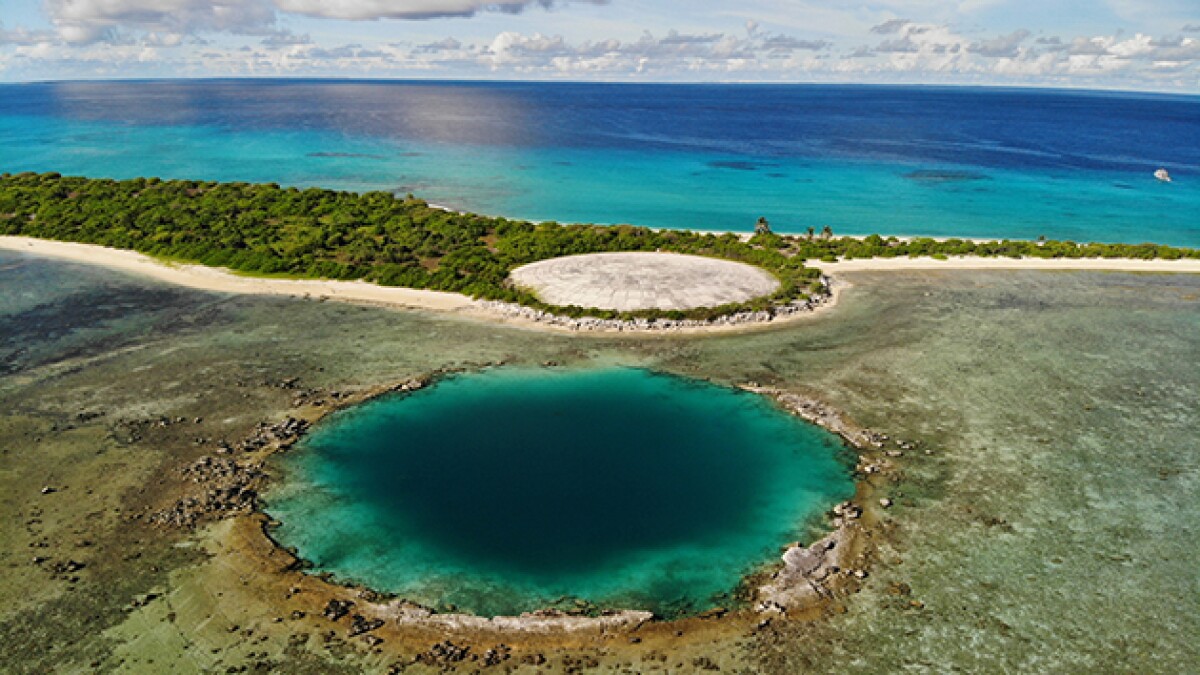
The site, known as Runit Dome, sits on Runit Island in the Enewetak atoll in the Marshall Islands.
Although Runit itself is uninhabitable, the atoll is home to around 300.
The dome sits close to the ocean’s edge and rising sea levels and shifting groundwater bring seawater into close contact.
It dates back to a period of intensive nuclear testing. Between 1946 and 1958, the United States conducted 67 nuclear tests across Enewetak Atoll and Bikini Atoll, displacing more than 300 Marshallese people.
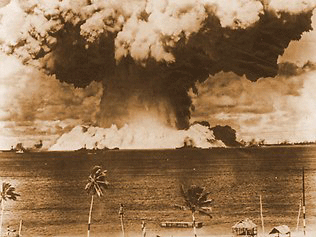
One test in particular, an 18-kiloton explosion known as “Cactus”, destroyed part of Runit Island and sent a mushroom cloud approximately six kilometres into the sky.
The Crater created by the Cactus explosion on May 5, 1958. It was later used as a burial pit to inter 84, 000 cubic meters of radioactive soil (Picture: US Defense Special Weapons Agency/Cover Media)
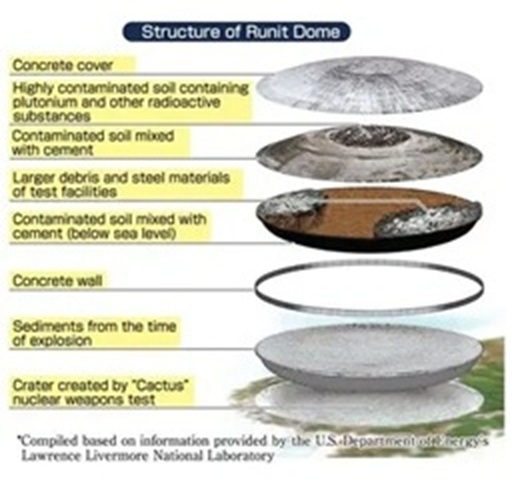
In the late 1970s, the 10 metre deep crater left by the blast was used to store more than 120,000 tonnes of radioactive soil and debris collected from across the atoll.
The site was then sealed with an 18-inch (46cm) concrete cap, forming what is now known as the Runit Dome.
More than five decades later, the structure is showing visible signs of ageing. Cracks have appeared across its surface, and groundwater is able to flow beneath it.
Researchers say this water moves in and out with the tides, potentially carrying radioactive material into the surrounding lagoon. Studies have also indicated that the dome is not watertight.
Ivana Nikolic-Hughes, of Columbia University and president of the Nuclear Age Peace Foundation, observed cracks during a visit in 2018 while measuring radiation levels.
‘These results provide further demonstration of the continuing impact of radioactive fallout on the Marshall Islands and will inform future work to understand how the presence of this isotope might affect current inhabitants and potential resettlement,’ she writes.
American officials have said the structure is not at immediate risk of collapse.
But experts have warned that some of the radioactive elements involved pose extremely long-term risks. Plutonium-239, used in nuclear weapons, remains hazardous for more than 24,000 years.
Arjun Makhijani, president of the Institute for Energy and Environmental Research, said no concrete structure could be expected to last even a fraction of that time.
He noted that cracks have already appeared within decades, highlighting the challenge of containing radioactive material over such long timescales.
‘There are already cracks in it in less than 50 years,’ he told Australian broadcaster ABC.
Scientists say the dome illustrates a broader problem. Certain places we regard as being safe spaces to dump toxic waste, may become less so due to climate change. If sea levels rise and rain increases, water and food supplies change.
This Infamous Radioactive ‘Tomb’ Is Leaking, And Experts Are Worried
20 March 2026, ByJess Cockerill, https://www.sciencealert.com/this-infamous-radioactive-tomb-is-leaking-and-experts-are-worried
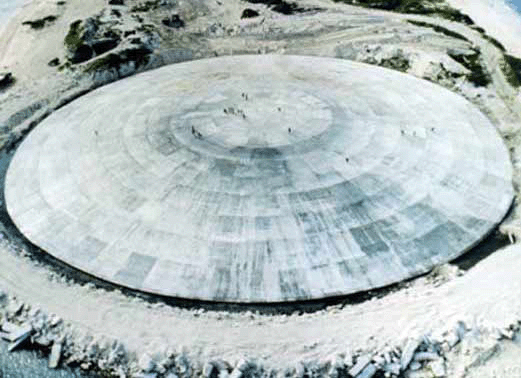
A gaping hole was left on a small island in the Pacific Ocean when the United States military released an 18-kiloton nuclear blast in 1958, known as the ‘Cactus‘ test.
After the blast took place on the Marshall Island’s Runit Island, the military filled it in with contaminated soil and debris, creating a ‘tomb’ of nuclear waste known now as the Runit Dome.
Almost 50 years after the dome’s construction, experts are concerned that cracks in the concrete-capped radioactive landfill indicate just how vulnerable the site is to rising seas encroaching upon the narrow island’s shores.
The 115-meter (377 feet)-wide dome, built between 1977 and 1980 as part of military cleanup efforts, rests above more than 120,000 tons of material that were contaminated by US nuclear testing across Enewetak Atoll, including lethal quantities of plutonium.
The dome was intended as a temporary solution to contain material left behind by the nuclear tests, some of which exceeded the magnitude of Hiroshima and Nagasaki 1,000 times over.
But since its construction, groundwater has penetrated the otherwise-unlined crater, beneath which there lies a bed of porous coral sediment. So far, this is the main source of leaks, but there are concerns that layers of the dome intended to sit above sea level are not going to stay above water much longer.
In 2020, following a major report by the Los Angeles Times, Woods Hole Oceanographic Institute marine radioactivity expert Ken Buesseler pointed out that radioactive leaks from the Runit Dome are, so far, “relatively small,” in an interview for the institute’s journal
“As long as the plutonium stays put under the dome, it won’t be a large new source of radiation to the Pacific Ocean,” Buesseler told journalist Evan Lubofsky at the Los Angeles Times.
“But a lot depends on future sea-level rise and how things like storms and seasonal high tides affect the flow of water in and out of the dome. It’s a small source right now, but we need to monitor it more regularly to understand what’s happening, and get the data directly to the affected communities in the region.”
Columbia University chemist Ivana Nikolic-Hughes has been involved in ongoing research into the persistent contamination of the Marshall Islands following nuclear testing, and recently told journalist Kyle Evans at the Australian Broadcasting Corporation that she saw the dome’s cracks first-hand while taking soil samples on the island back in 2018.
In her research, Nikolic-Hughes has found elevated radiation levels and significant quantities of five radionuclides in soil samples from the island, outside the dome.
This could be evidence of the nuclear tomb leaking – though it may also be the result of the haphazard nature of the cleanup efforts, which also resulted in much waste being dumped into the lagoon.
Either way, the presence of plutonium-239, a component of nuclear weapons that remains dangerous for more than 24,000 years, warrants grave concerns about its vulnerability to rising sea levels and climate change.
“Given that sea levels are rising and there’s indications storms are intensifying, we worry the integrity of the dome could be in jeopardy,” Nikolic-Hughes told Evans.
“Runit is about 20 miles from where people live and they use the lagoon, so the implications are potentially devastating.”
In 2024, the US Department of Energy’s Pacific Northwest National Laboratory conducted an investigation into the potential impacts of climate change on the Runit Dome site, finding that storm surges and gradual sea level rise would indeed be the biggest factor in spreading radionuclides through the atoll.
Most of Runit Island sits just 2 meters (6.5 feet) above sea level.
Viewed from above, it is easy to imagine what an impact just 1 meter of extra water could do to the atoll and Runit Island’s crumbling nuclear tomb. That is the amount of sea level rise climate scientists predict for the Marshall Islands by 2100.
Related: Parts of The Marshall Islands Are Now More Radioactive Than Chernobyl, Study Finds
Nikolic-Hughes and her fellow researcher Hart Rapaport have previously urged the United States to take responsibility for proper cleanup of nuclear waste on the islands, as one part of ensuring a safe future for Marshallese residents.
As United Nations special rapporteur Paula Gaviria Betancur said back in 2024: “Legacies of nuclear testing and military land requisitions by a foreign power have displaced hundreds of Marshallese for generations, while the adverse effects of climate change threaten to displace thousands more.”
The long half-life of France’s nuclear tests in Polynesia
Only in the years since the programme ended has the true impact come to light. While the French military measured radiation levels after each explosion, the data was kept secret until victims’ associations won a legal battle to have it partially declassified in 2013.
“Every family in French Polynesia has a lot of cancer. It’s just not one. Some have, as we say, cocktails of cancer,”
Thirty years ago this week, on an island in the South Pacific, France conducted its final nuclear test – ending a programme that exposed thousands of people to radiation over decades. The islands of French Polynesia are still living with the fallout.
31/01/2026 By:Jessica Phelan, https://www.rfi.fr/en/france/20260131-the-long-half-life-of-france-s-nuclear-tests-in-polynesia
“It started with my grandmother. She had thyroid cancer during the Nineties. Then her first child, my auntie, had thyroid cancer too.”
Hinamoeura Morgant-Cross was a child in Tahiti when France last exploded a nuclear bomb. She has few memories of the years when her home was a testing ground, but they have changed the course of her life.
“My mum had thyroid problems… And also, my sister had thyroid problems. She has to take medication for the rest of her life. My auntie also got breast cancer a few years ago.
“And I have had chronic myeloid leukaemia since I was 24 years old.”
France tested nuclear weapons in Polynesia for 30 years. The explosions started in 1966, after France had already tested several bombs in the Algerian Sahara.
After Algeria claimed independence, France moved the tests to its colony in the South Pacific. They continued until 27 January 1996 – more than three years after the United States’ final test, four since the United Kingdom’s and five since the Soviet Union’s.
France chose two uninhabited atolls as its test sites, Moruroa and Fangataufa, which between them took the impact of 193 explosions – the biggest around 200 times more powerful than the bomb the US dropped on Hiroshima.
At least 41 took place in the open air, before tests were moved underground in 1975. Mushroom clouds drifted over the ocean, carrying radiation to populated islands – including Tahiti, more than 1,200 kilometres away.
Only in the years since the programme ended has the true impact come to light. While the French military measured radiation levels after each explosion, the data was kept secret until victims’ associations won a legal battle to have it partially declassified in 2013.
“Around 20 boxes” of documents out of thousands were released in that first batch, according to Patrice Bouveret of the Observatoire des Armements, a Lyon-based campaign group that helped make them public. But the information was enough for journalists and researchers to map a far broader pattern of exposure than France had ever publicly acknowledged.
One 1974 test alone exposed an estimated 110,000 people to more than the annual “safe” dose of radiation, according to a 2021 investigation led by public-interest newsroom Disclose.
The revelations pushed French President Emmanuel Macron to order the opening of all archives – with the exception of details that might suggest how to build a nuclear device. Tens of thousands of documents have since been released and continue to lay bare the gap between what French authorities knew about the risks, and what they told those most affected.
‘Cocktails of cancer’
“Every family in French Polynesia has a lot of cancer. It’s just not one. Some have, as we say, cocktails of cancer,” says Morgant-Cross, today a member of the French Polynesian parliament and an anti-nuclear campaigner.
“But it’s hard for them to think that it can be related to the nuclear tests because of the decades of French propaganda saying that French nuclear tests are clean.”
Visiting Tahiti in September 1966, president Charles de Gaulle declared that all precautions had been taken to ensure the tests would “not cause any inconvenience whatsoever to the dear people of Polynesia”.
Nearly three decades later, president Jacques Chirac – who ordered France’s final nuclear tests in 1995-96, reversing a moratorium that had halted the programme since 1992 – was still insisting that they had “strictly no ecological consequences”.
For years, Polynesians were told their lifestyle and eating habits were to blame for health problems, according to Morgant-Cross. She only made the connection between her family’s history of cancer and the nuclear tests, she says, when she met survivors in other countries.
Seeing the list of diseases that research has linked to radiation exposure, she realised the thyroid cancer that afflicted her relatives, as well as her own rare form of leukaemia, were among them.
“These aren’t illnesses that show up immediately after an explosion,” says Bouveret. “It’s not like a week later you get sick. They develop a long time afterwards.”
In 2023, France’s National Institute of Health and Medical Research, Inserm, used declassified military data to estimate how much radiation thyroid cancer patients had been exposed to and calculate what role it played. Researchers said nuclear tests “are most likely responsible for a small increase in the incidence of thyroid cancers in French Polynesia” – though they warned the estimated doses were probably inaccurate.
The difficulty of proving harm to health has been a barrier to compensation. France introduced a law in 2010 allowing victims to claim reparations from the state, but the criteria to qualify – which include demonstrating exposure to a certain level of radiation – have proved hard to meet.
Only 1,026 people had successfully claimed by the end of 2024, Bouveret says – 607 in mainland France, 417 from Polynesia and two from Algeria. “It’s ridiculous when you consider the number of people who have been impacted by these diseases.”
A bill to reform the law is before the French parliament. It would also bind the state to cover the costs of treating illnesses caused by radiation – estimated at some €855 million, and currently borne by French Polynesian social security.
A society upended
The broader consequences of France’s nuclear tests are even harder to quantify.
The programme kicked off massive construction, drawing islanders to help build military bases and research stations. Many stayed to work at the new sites, concentrating the population and shifting labour away from traditional fishing and farming.
Corals were flattened to make way for ships, which may have contributed to a dramatic rise in ciguatera – a type of food poisoning caused by eating fish sickened by toxins from plankton found on damaged reefs.
“They really poisoned our main food,” says Morgant-Cross. “We eat fish from breakfast to dinner.” Today the archipelago is largely dependent on food shipped in from elsewhere, and like other parts of overseas France, suffers from high cost of living.
As de Gaulle promised, the nuclear programme brought economic opportunities – but they depended on jobs and money provided by the French state, binding Polynesia ever more tightly to France.
Bouveret believes that helped stymie the archipelago’s aspirations to independence. Now, given the costs of caring for nuclear victims and containing the lingering radiation on Moruroa and Fangataufa, he says separating from France looks “extremely difficult”.
For Morgant-Cross, the first step is to “decolonise minds” and help Polynesians fathom the damage done. While she was at school in the 1990s, she recalls, children were still taught “we should be grateful” for the nuclear tests.
Things have changed since then, but confronting the past remains difficult – and not only for the generation who remember when speaking out could cost people their jobs or lead to arrest.
“As a mother of two boys, I really hope that they don’t have the burden of this issue like myself,” she says.
“I felt some trauma, but without understanding where it came from. And I understood with my grandmother, when I saw the fear in her eyes… I saw how guilty she felt because of the leukaemia that I have. She felt that if she had protested more, maybe I would not be sick today.
“It’s really traumatic for our people.”
Listen to a version of this story on the Spotlight on France podcast, episode 139.
Catholic diocese urges prayer, public witness against proposed nuclear plant in northern Philippines.
A northern Philippine diocese has urged Catholics to gather for prayer and public witness as it reiterates its opposition to a proposed nuclear power plant in Labrador town, Pangasinan province.
Jan 02, 2026, By Mark Saludes, Herald Malaysia Online,
In a video message circulated ahead of the gathering, Fr. Ed Inacay of the Diocese of Alaminos called on residents to take part in a Holy Mass on Sunday, Jan. 4, 2026, at 8 a.m. at St. Isidore Parish, to be presided over by Bishop Napoleon Sipalay Jr.
The priest said the Mass is linked to the Church’s discernment on the proposed nuclear facility and reflects the diocese’s opposition to the project.
“It is good that we reflect on this and pray over this plan, and I encourage you to join our bishops, especially here in our diocese, our beloved bishop, where the Diocese of Alaminos does not agree with the construction of a nuclear power plant here in our town of Labrador,” he said.
Caritas Philippines expressed support for the Diocese of Alaminos and urged the public to “demand an energy policy that prioritizes human safety, ecological integrity, and the constitutional right to a balanced and healthy environment.”
In a video message released on Jan. 2, Caritas Philippines president Bishop Gerardo Alminaza of San Carlos, warned that nuclear energy “remains a perilous energy source that poses long-term risks to our communities and our ‘common home.’”…………………..
In December 2025, Catholic dioceses across the country expressed collective opposition to the proposed construction of a nuclear power plant in Western Pangasinan, citing moral responsibility, environmental risk, and the protection of life as central concerns.
In a pastoral letter, the bishops, particularly those of the Metropolitan See of Lingayen-Dagupan, said the proposal came as communities were still recovering from Typhoon Uwan, which left the province under a state of calamity and affected more than 233,000 people.
The bishops said the Philippines’ vulnerability to earthquakes and typhoons, its location along the Pacific “Ring of Fire,” and the lack of a secure, long-term solution for radioactive waste make nuclear facilities an “unacceptable risk,” especially in disaster-prone areas.
They warned that nuclear energy carries “irreversible, long-term risks” that outweigh projected benefits and said radioactive waste, which remains deadly for thousands of years, would impose a burden on future generations.
Drawing from the experiences of bishops in Japan after the Fukushima nuclear disaster, the prelates said nuclear power generation is fundamentally incompatible with a vision of society that respects all life.
Echoing Pope Francis, the bishops stressed prudence, human safety, and environmental protection over immediate economic gains, urging government officials and the public to pursue renewable energy paths that safeguard communities, ecosystems, and the common good.—licas.news https://www.heraldmalaysia.com/news/catholic-diocese-urges-prayer-public-witness-against-proposed-nuclear-plant-in-northern-philippines/86844/2
Hawai‘i Has a Rare Opportunity to Reclaim Land From the US Military
The US military is abusing Hawaiian land. Will residents be able to exert Indigenous sovereignty and get it back?
By Christine Ahn & Davis Price , Truthout, December 22, 2025
Since 1964, the U.S. military has leased roughly 47,000 acres of land from the State of Hawai‘i — for a token $1. The leases, which account for 18 percent of military lands in Hawai‘i, are set to expire in 2029, offering Hawai‘i a rare opportunity to reclaim land from the war machine. As the expiration date looms, Hawai‘i residents are at a crossroads: remain a staging ground for U.S. imperialism or pivot toward community well‑being, environmental sustainability, and economic self‑determination.
But that decision may arrive sooner than 2029: Allegedly faced with pressure from federal officials to fast-track lease renewals by the end of this year, Democratic Gov. Josh Green signed a statement of principles in September with Army Secretary Dan Driscoll expressing the intention to “explore the feasibility of land use that aligns national security and Army readiness needs with the State’s priorities for public benefit.” A month later, Green sent Driscoll a proposal for a $10 billion plan that included a “community benefits” package. He argued that this sum would be favorable should the Army pursue “condemnation,” the use of eminent domain to seize Hawai‘i’s land for “national security.”
Native Hawaiian groups swiftly condemned the move in a September 2 statement signed by 40 organizations. They opposed fast-tracking the leases and pointed out that Green and Driscoll sidestepped federal and state statutes that require a thorough review — a process the Army and Navy had already failed to complete earlier that year.
After mounting pressure from the Office of Hawaiian Affairs, state legislators, and numerous environmental and civic organizations, Green walked back the end-of-year deadline and extended the negotiation timeline into 2026. Still, the episode highlighted how easily the U.S. military can bypass democratic debate in the name of “national security,” and how vital it is for the public to have informed discussions about the military’s impact on Hawai‘i.
How Hawai‘i Became Occupied
The U.S. military controls roughly 254,000 acres across Hawai‘i, making it the most militarized state per capita in the country. On O‘ahu alone, the military occupies 86,000 acres, or 25 percent of the island. These lands were part of the “ceded” territories illegally seized from the Hawaiian Kingdom.
Once a sovereign nation, Hawai‘i was the starting point for America’s century of imperialism and conquest in the Pacific. In the late-19th century, American missionaries and plantation owners, seeking to avoid U.S. tariffs on Hawaiian sugar, conspired with the U.S. Navy to orchestrate a coup to overthrow Queen Lili‘uokalani in 1893.
Although the coup was condemned by President Grover Cleveland as illegal, in 1898 President William McKinley signed the Newlands Resolution, illegally annexing Hawai‘i as a U.S. territory through a joint congressional resolution, bypassing the legally required two-thirds majority in the Senate to ratify a treaty between two nations.
After annexation, the provisional government reclassified Crown and government lands as “public” property and transferred them to the U.S. Interior Department………………………………………………………………………………………………………………………………………………………………………………………..Native Hawaiian advocates are building momentum toward a shift in the governance of resources in Hawaiʻi, which has been dominated by extractive and abusive industries, such as the military, for too long. While large‑scale stewardship projects exist, they are often treated as side ventures, and lack long‑term capital investments, like roads or schools. Investing in regenerative economies, Lee argues, could create thousands of place‑based jobs in restoration, farming, and renewable energy. “We’d keep more money circulating locally instead of leaking out, building real security from the inside out,” Lee explains. “Hawai‘i’s resilience is national security.”
By engaging in informed public debate about the economic, environmental, and cultural costs of the military’s footprint — and exploring repurposing the military’s footprint for community-driven, sustainable uses — Hawai‘i can transform from a base preparing for war into a beacon of peace, resilience, and Indigenous innovation. https://truthout.org/articles/hawaii-has-a-rare-opportunity-to-reclaim-land-from-the-us-military/
The ‘Nuclearity’ of the Marshall Islands, and the Threat of US Testing
By Bea Paduano
ICAN Australia and Bea Paduano, Dec 09, 2025, https://icanaustralia.substack.com/p/the-nuclearity-of-the-marshall-islands?utm_source=post-email-title&publication_id=6291617&post_id=181019673&utm_campaign=email-post-title&isFreemail=true&r=1ise1&triedRedirect=true&utm_medium=email
This article explores how nuclearity exposes unequal power, why some lives are protected, and others sacrificed, and how these dynamics still matter today as talk of renewed US nuclear testing re-enters global politics. To avoid repeating the devastation imposed on the Marshall Islands, strong international support for the Treaty on the Prohibition of Nuclear Weapons (TPNW) is crucial.
Between 1946 and 1958, the United States tested sixty-seven nuclear weapons in the Republic of the Marshall Islands—turning entire atolls into fallout zones and reshaping life for generations. Seen through Gabrielle Hecht’s lens of nuclearity, which asks who decides what counts as “nuclear”, the Marshall Islands become one of the most nuclear places on Earth—yet they’re rarely recognised as such.
What is Nuclearity?
Historian Hecht describes nuclearity as a “technopolitical spectrum that shifts in time and space” that shapes “the degree to which something counts as ‘nuclear’.”1
In simple terms, nuclearity is a lens that reveals who has the power to declare something nuclear—or to deny it—even in the face of clear harm. Nuclearity isn’t only about radiation; it is shaped by history, geography, politics and power, and by the decisions that determine which harms are acknowledged and which are ignored.2
The Marshall Islands: a Nuclear Frontier
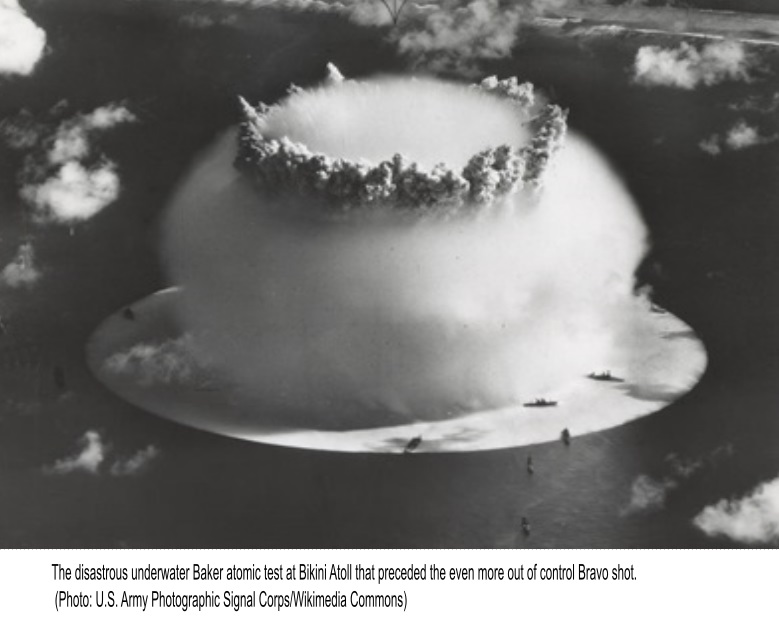
Japan seized the Marshall Islands during World War One to secure a strategic position in the Pacific, occupying them until the United States took control in 1944 during World War Two. After the war, the US turned the islands into a nuclear testing ground, beginning with Bikini and Enewetak in 1946. Over the next twelve years, the United States conducted sixty-seven atmospheric, underwater, and airburst tests that vaporised entire atolls, and exposed the whole country to severe radioactive fallout. The Castle Bravo test—the largest in US history—released an explosive yield equivalent to more than seven thousand Hiroshima bombs.
US officials justified these tests as being “for the good of mankind and to end all wars”.3 In other words, the Marshall Islands became a “display case for flexing military muscle” at the expense of the Marshallese people.4
Health, Identity and Culture
The health impacts of nuclear testing on the Marshall Islands were—and remain—catastrophic. Thyroid and other cancers, blood and metabolic disorders, cataracts, stillbirths, miscarriages, and birth defects have all been recorded and continue to affect Marshallese communities.5 The US Atomic Energy Commission’s Health and Safety Laboratory once described the atoll of Utirik as “by far the most contaminated place in the world.”6
Radioactive fallout poisoned staple foods, led to unexpected deaths, and weakened immune systems—patterns still seen in Marshallese communities today. Due to contamination, traditional foods became unsafe, and people were forced to give up practices that carry memory and meaning.
The damage is also cultural. Marshallese identity is deeply tied to land and water. In her poem Tell Them, Marshallese poet Kathy Jetnil-Kijiner writes, “we are nothing without our islands.”7 Nuclear testing destroyed homelands and forced many Marshallese into exile, severing connections to land, knowledge, and practices tied to fishing, food, and ceremony.8
Colonialism, “Remoteness,” and Power
Colonialism has long shaped understandings of remoteness, helping powerful states distance themselves from responsibility.9 This is evident in the US nuclear testing program in the Marshall Islands, where the construction of “remoteness” positioned the Marshallese at the margins. The US commission concluded that testing should take place overseas and away from US population centres until the health implications could be established.10 The location was chosen by spreading out maps and looking for sites considered remote.11 In his assessment of six nuclear testing sites, Jacobs concludes that it is no coincidence that all sites used were considered “remote.”12
The Marshall Islands were not only seen as geographically distant, but also racially distant, drawing on colonial ideas of eugenics. Eisenbud, Director of the AEC’s Health and Safety Laboratory in New York, justified the testing by claiming the Marshallese people were “more like us than the mice.”13 Their race and classification as “other” helped justify the testing and reveal the colonial underpinnings of the global nuclear order. Those considered racially inferior and physically remote have repeatedly been subjected to the harms of nuclear weapons testing. These colonial legacies maintain power dynamics and legitimise nuclear testing on Marshallese land and people.
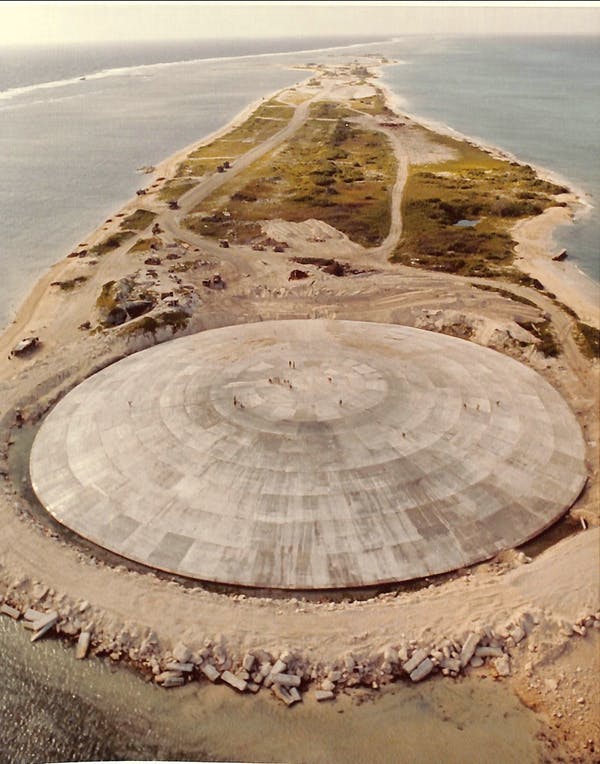
The legacy of this history can be seen in the Runit Dome, the concrete cap covering nuclear waste on Enewetak. As the dome cracks and leaks into the sea, it adds to the already devastating implications of climate change for the Marshall Islands. As sea levels rise, the future of the Marshall Islands remains uncertain.
Who Decides What Counts as ‘Nuclear’?
Hecht’s concept of nuclearity helps explain how authorities can declare certain areas “safe” while people continue to live with radiation and illness.14 Nuclearity does not equate to radioactivity; it is constructed, fluid and changeable, and can be made and unmade by those with the power to define it.
The Bravo test is one example. Communities from Bikini and Enewetak were relocated south before the detonation, yet radioactive fallout still hit the newly inhabited islands. Although the US government claimed that the wind unexpectedly changed, research found that they had six hours’ notice.15 Similar patterns are found in French nuclear testing on the Gambier Islands.16 The US government also imposed arbitrary restrictions such as fishing bans in certain areas of the islands—restrictions that, as Jacobs notes, were not respected by the fish.17 This shows the continued construction of what is considered “nuclear” in specific areas and at specific times, despite ongoing radioactivity.
Kathy Jetnil-Kijiner refers to this denuclearisation in the line: “it’s not radioactive anymore, your illnesses are normal, you’re fine.”18 Despite such claims, the US government restricted visitors from other countries from travelling to the Marshall Islands and restricted the movement of islanders during the tests.19 In this sense, the US government constructed a claim that certain areas would be safe but only for certain individuals, “denuclearising” areas and people despite significant radiation exposure. This draws on Hecht’s concept of nuclearity—that nuclearity “is not the same for everyone, and it is not the same at all moments in time.” 20
Recent US Discussions on Nuclear Testing
These issues are not confined to history. As we watch the current global situation unfold, this article urges us to pay attention to what is considered nuclear and what is not. Donald Trump has suggested that the US should resume nuclear testing to match or surpass other states. Whether this would involve full-scale detonations or ultra-low-yield tests, the political effect is similar: signalling that nuclear threats are back on the table.
Even the discussion of testing changes nuclearity. It designates potential testing sites, shapes perceptions of risk and acceptability, and reinforces harmful colonial power dynamics. Despite no US tests being conducted for decades, and considerable work and commitment to the Comprehensive Nuclear-Test-Ban Treaty (CTBT), this rhetoric threatens the nuclear taboo.
The TPNW, promoted by ICAN, prohibits the testing of nuclear weapons. At the time of writing, seventy-four countries have ratified the treaty. A strong global commitment against testing is needed to confront the harms to health, identity and culture that stretch across past, present and future.
The Marshall Islands illustrate what nuclearity looks like in practice: cancers and contaminated reefs, cracked domes, displaced communities and cultural loss that continues across generations. As talk of renewed nuclear testing returns, we must consider not only where the next “dangerous” place might be, but whose lives will again be treated as expendable.
We cannot allow others to quietly determine what—and who—counts as nuclear.
About the Author
Bea Paduano is a recent graduate of International Relations from the University of Leeds and was a participant in the ICAN-Hiroshima academy 2025 cohort. Her interests include the legacies of social and political injustice, specifically of nuclear testing and migration studies.
References ……………………………………………………………….
‘Humanitarian’ visa must be created for Pacific Islanders displaced by climate crisis, experts say
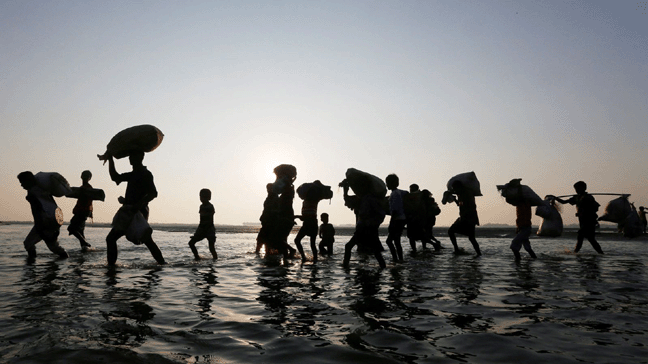
Climate and migration experts are calling for urgent action to create
legal pathways for people displaced by the climate crisis, as a new report
highlights the scale of the problem across the Pacific.
Research by Amnesty
International released on Thursday found current immigration systems are
inadequate for Pacific Islanders seeking safety and stability, as rising
seas threaten to make their homelands uninhabitable. Amnesty has called on
New Zealand – home to the world’s largest Pacific diaspora – to
urgently reform its policies to provide “rights-based approach to
climate-related displacement”. “This would include offering a dedicated
humanitarian visa,” the report said.
Guardian 9th Oct 2025, https://www.theguardian.com/world/2025/oct/09/climate-crisis-humanitarian-visa-displaced-pacific-islanders
Hegseth Says Four ‘Narco-Terrorists’ Killed in Latest US Attack on Venezuela Boat
Trump claims attacked boat had enough drugs to kill 25,000-50,000 people
by Jason Ditz | October 3, 2025, https://news.antiwar.com/2025/10/03/hegseth-says-four-narco-terrorists-killed-in-latest-us-attack-on-venezuela-boat/
A day after President Trump informed Congress that the US is in a “non-international armed conflict” with drug cartels, the US carried out yet another strike on a Venezuelan boat in the Caribbean Sea, alleging it was loaded with drugs.
Secretary of War Pete Hegseth announced the attack on social media, claiming the attack on the small boat killed four “narco-terrorists.” President Trump went on to claim, without evidence, that the boat was loaded with enough drugs to kill 25,000 to 50,000 people and was “entering American territory.”
In reality, the boat attacked was off the coast of Venezuela, far from US territorial waters. Secretary Hegseth further claimed that the US had intelligence the four were affiliated with a “designated terrorist organization” but did not specify which nor show the evidence.
The US has attacked multiple Venezuelan boats in recent weeks, with US officials saying the goal of the strikes is regime change in Venezuela as opposed to the war on drugs. Along with the airstrikes of boats, a US destroyer boarded and seized a Venezuelan boat in mid-September, which the Venezuelan government insists was a tuna fishing vessel.
The administration’s strikes are fueling growing opposition within Congress, with ranking Democrat on the Armed Services Committee Sen. Jack Reed (D – RI) saying the strikes were unconstitutional, and Sen. Rand Paul (R – KY) saying that “blowing them up without knowing who’s on the boat is a terrible policy, and it should end.”
Sen. Jim Risch (R – ID), the chair of the Senate Foreign Relations Committee, said that he believes Trump is allowed to attack the boats by virtue of “his general powers under the Constitution.” Many in the Senate, however, argue there is a legal process to be followed, and the unilateral attacking of boats isn’t it.
Sen. Mark Kelly (D – AZ) was concerned in particular about the legality of the strikes under international law, wondering of the officers involved in the strikes “What situation did we, did the White House, just put them in?”
Though President Trump informed Congress after the fact of the strikes by way of claiming a general armed conflict, there is as yet no indication Congressional leadership intends to bring the question of the ongoing US strikes to a vote.
Jason Ditz is Senior Editor for Antiwar.com. He has 20 years of experience in foreign policy research and his work has appeared in The American Conservative, Responsible Statecraft, Forbes, Toronto Star, Minneapolis Star-Tribune, Providence Journal, Washington Times, and the Detroit Free Press.
Living with the legacy of France’s nuclear weapons testing
Nina Werkhäuser 26 Sept 25, https://www.dw.com/en/living-with-the-legacy-of-frances-nuclear-weapons-testing/a-74131800
France tested nuclear weapons for 30 years in the Pacific. The people of French Polynesia bore the brunt of the testing.
“For 30 years, we were France’s guinea pigs,” says Hinamoeura Morgant-Cross, a young member of parliament from French Polynesia.
This South Pacific archipelago, a French overseas territory that includes Tahiti and is famed for its white beaches, swaying palms, and turquoise waters, is often romanticized as a paradise.
But beneath the idyllic image lies a painful legacy: decades of nuclear testing and its enduring consequences.
Between 1966 and 1996, the French military detonated 193 nuclear bombs on the remote atolls of Mururoa and Fangataufa. These tests were carried out in Ma’ohi Nui, as the territory is known to its indigenous inhabitants. The first explosion, codenamed Aldebaran, took place on July 2, 1966. It marked the beginning of a long chapter that would leave deep scars on the land and its people.
In 2025, Morgant-Cross journeyed over 15,000 kilometers (more than 9,320 miles) to Berlin to speak at an event in May, hosted by the international medical NGO International Physicians for the Prevention of Nuclear War, or IPPNW. There, she delivered a searing testimony about the long-term consequences of France’s nuclear testing program: disproportionately high cancer rates, children born with deformities and ongoing contamination of the region’s water and soil.
“So they really poisoned the ocean where we found all our food,” says Morgant-Cross who has also addressed the United Nations in New York. “We have been poisoned for the greatness of France, for France to be a state with a nuclear weapon.”
The ‘clean bomb’ myth
The French government at the time knowingly gave false assurances to the islanders about the dangers of the nuclear testing.
Then-President Charles de Gaulle described the French atomic bomb as “green and very clean,” suggesting it was safer or more environmentally friendly than the bombs dropped on Hiroshima and Nagasaki .
Morgant-Cross calls it nothing more than “French propaganda.”
In reality, radioactive clouds drifted across vast parts of the South Pacific and even reached the main island of Tahiti, more than 1,000 kilometers from the test site. Often, residents of nearby islands weren’t informed or evacuated.
No Apology from France
France didn’t cease its nuclear testing program until 1996, following intense domestic and international outcry. Despite the halt, the French government has never formally apologized for the harm caused to its overseas territories.
During a 2021 visit to French Polynesia, President Emmanuel Macron acknowledged France’s role, stating, “The guilt lies in the fact that we conducted these tests.”
“We would not have carried out these experiments in Creuse or Brittany [in mainland France],” he said.
United Nations and various NGOs have observed September 26th as the International Day for the Total Elimination of Nuclear Weapons since 2014. The days is a solemn reminder of the ongoing responsibility borne by nuclear-armed states.
Yet the suffering endured by victims of nuclear testing is in danger of being forgotten. In response, a rising generation from former test sites is refusing to accept the silence of those in power. They are mobilizing across borders, channeling their concern into coordinated action.
Parliamentarian Hinamoeura Morgant-Cross is among those speaking out. While visiting Berlin, she shared her family’s painful legacy: her grandmother was 30 when the nuclear tests began and later developed thyroid cancer as did her mother and aunt.
Morgant-Cross, born in 1988, revealed that both she and her sister also developed cancer, underscoring the generational toll of radioactive exposure.
Cancer can develop generations later
Experts warn that nuclear testing has led to clusters of cancer cases within affected families. Exposure to ionizing radiation can cause genetic mutations, which may be inherited by subsequent generations.
“The insidious nature of ionizing radiation lies in its ability to affect people across generations,” says nuclear weapons expert Jana Baldus of the European Leadership Network (ELN). “It significantly increases the risk of various cancers, particularly lymphoma and leukemia.”
Another consequence of nuclear testing is reproductive harm.
“Women exposed to radiation during the tests have given birth to children with congenital defects and have suffered miscarriages,” Baldus tells DW. “These effects can be passed down through generations, potentially leading to infertility in women.”
For Hinamoeura Morgant-Cross, the multiple cancer diagnoses in her family were a driving force behind her decision to enter politics.
She is now calling on France — the state responsible for the nuclear tests — to provide greater support for her fellow citizens.
“We don’t have the medical care that we should have, that we deserve, because we are 30 years late, in terms of medicines. We don’t have technology like medical scans.” she says. “It really pushed me to go into politics, and to demand that we deserve a better hospital, we deserve better treatment.”
Only a small fraction of those affected have the means to travel to Paris for medical treatment, leaving many without access to adequate care.
Victims face an uphill battle for compensation
In 2010, the French government enacted legislation to provide compensation to victims of nuclear testing. However, each case is assessed individually, and claimants must demonstrate a direct link between their illness and the nuclear tests. That burden of proof is not always easily achieved.
Expert Jana Baldus points out a major hurdle.
“Victims must prove they were physically present at the exact location when the tests occurred — a nearly impossible task decades later.” In addition, compensation is limited to a narrow list of officially recognized illnesses. According to the global coalition ICAN (International Campaign to Abolish Nuclear Weapons), only 417 residents of French Polynesia received compensation between 2010 and July 2024.
For Hinamoeura Morgant-Cross, the fight isn’t only about securing practical support, it’s also about education.
In her homeland, a persistent narrative still portrays the nuclear tests as a so-called clean endeavor that brought prosperity.
“For decades, we had pictures of the nuclear mushroom in all the living rooms of the Tahitian people because we were proud the French decided to choose us,” she recalls. Her mission now is to dismantle what she calls that “colonial mindset” and shed light on the true consequences of the tests.
The future of nuclear testing: risk or rhetoric?
France wasn’t alone in conducting extensive nuclear tests. The Soviet Union, the United States, the United Kingdom and China also carried out large-scale detonations.
In total, more than 2,000 nuclear explosions have taken place. The resulting radioactive fallout not only contaminated the immediate test sites but also contributed to elevated radiation levels across the globe.
Nuclear testing was halted primarily through moratoriums and international negotiations surrounding the Comprehensive Nuclear-Test-Ban Treaty (CTBT).
In recent years, North Korea has been the only country to conduct such tests. Yet amid rising geopolitical tensions, experts warn that a resurgence of nuclear testing remains a real possibility.
The Australia-Tuvalu climate migration treaty is a drop in the ocean

Australia has offered a lifeline to the people of Tuvalu, whose island is threatened by rising sea levels. But the deal comes with strings attached – and there will be millions more climate migrants in need of refuge by 2050
By New Scientist, 2 July 2025, https://www.newscientist.com/article/mg26635502-900-the-australia-tuvalu-climate-migration-treaty-is-a-drop-in-the-ocean/
A lifeline has been extended to the people of Tuvalu, a low-lying Pacific nation where rising sea levels are creating ever more problems. Each year, Australia will grant residency to 280 Tuvaluans. The agreement could see everyone currently living in Tuvalu move within just a few decades.
Effectively the world’s first climate migration agreement, the Australia-Tuvalu Falepili Union will also provide adaptation funds to help those who stay behind.
Is this a model for how climate migration can be managed in an orderly way, before disaster strikes? Far from it. To get this deal, Tuvalu must allow Australia a say in future security and defence matters. Few other countries are likely to agree to similar terms.
Tuvalu’s population is also very small. Taking in around 10,000 climate migrants would be inconsequential for a country of 28 million like Australia. Worldwide, it is estimated that between 25 million and 1 billion people might be forced to move by 2050 because of climate change and other environmental factors. Where will they go?
Many argue that the wealthy countries that emitted most of the carbon dioxide that is warming the planet have a moral duty to help people displaced by climate change. But these kinds of discussions have yet to be translated into the necessary legal recognition or acceptance of forced climate migrants. On the contrary, many higher-income nations seem to be becoming more hostile to migrants of any kind.
There has been a little progress in setting up “loss and damage” funds to compensate lower-income countries for the destruction caused by global warming. This could help limit the need for climate migration in the future – but the money promised so far is a fraction of what is required.
The most important thing nations should be doing is limiting future warming by cutting emissions – but globally these are still growing. Sadly, the Falepili Union is a drop in the ocean, not a turning of the tide.
Plutonium Levels in Sediments Remain Elevated 70 Years After Nuclear Tests

June 24, 2025,
https://www.marinetechnologynews.com/news/plutonium-levels-sediments-remain-650328
Researchers from Edith Cowan University (ECU) in Australia have confirmed plutonium levels in sediment up to 4,500 times greater than the Western Australian coastline.
Three plutonium-based nuclear weapons tests were conducted at the Montebello Islands in the 1950’s, which introduced radioactive contamination to the surrounding environment. The first nuclear test, coded Operation Hurricane, had a weapon’s yield of some 25kT, and formed a crater in the seabed, while the second and third tests, dubbed Operation Mosaic G1 and G2, had weapons yields of around 15kT and 60kT, respectively.
The three tests released radioactive isotopes including plutonium, strontium (90Sr) and caesium (137Cs) into the surrounding marine environment.
“Plutonium is anthropogenic, which means that it doesn’t exist on its own in nature. The only way it is introduced into an environment is through the detonation of nuclear weapons and from releases from nuclear reprocessing plants and, to a lesser extent, accidents in nuclear power plants,” said ECU PhD student and lead author Madison Williams-Hoffman.
“When plutonium is released into a coastal setting in the marine environment, a significant fraction will attach to particles and accumulate in the seabed, while some may be transported long distances by oceanic currents.”
The region is not inhabited by humans and has not been developed, however it is visited by fishing boats, so collecting data on the levels of contamination in the marine environment is important.
Currently, the protected island archipelago and surrounding marine areas also reside within the Montebello Islands Marine Park (MIMP). The MIMP is ecologically significant due to the presence of numerous permanent or migratory species, and its high-value habitat is used for breeding and rearing by fish, mammals, birds and other marine wildlife.
The water and sediment quality within the MIMP are currently described as ‘generally pristine’, and it is fundamental to maintain healthy marine ecosystems in the region.
The concentrations of plutonium at Montebello Islands were between 4 to 4,500 times higher than those found in sediment from Kalumburu and Rockingham from the Western Australian coastline, with the northern area of the archipelago, close to the three detonation sites, having four-fold higher levels than the southern area.
The concentrations of plutonium found in the sediment at Montebello Islands were similar to those found in the sediment at the Republic of Marshall Islands (RMI) test sites, despite 700-fold higher detonation yields from nuclear testing undertaken at RMI.
Plutonium is an alpha emitter so, unlike other types of radiation, it cannot travel through the skin and is most dangerous when ingested or inhaled.
The research was undertaken by Williams-Hoffman, under the co-supervision of Prof. Pere Masqueand at ECU and Dr Mathew Johansen at ANTSO.
Legacy of US nuclear weapons tests in the Marshall Islands created global radiation exposure: new study
Hamburg, Germany – Nearly seven decades since the US government ended nuclear weapons testing in the Marshall Islands, a new study has revealed the impacts were far greater than what the US government has so far publicly acknowledged. According to a new study, all atolls, including the southern atolls, received radioactive fallout, but only three of the 24 atolls, all northern and inhabited at the time of fallout, received medical cancer screening.[1]
“The Legacy of U.S. Nuclear Testing in the Marshall Islands” by the Institute for Energy and Environmental Research (IEER) and commissioned by Greenpeace Germany, has comprehensively analyzed official documents from US government military and energy archives, scientific analyses, and medical sources from 1945 to the present day.
“Among the many troubling aspects of the Marshall Islands’ nuclear legacy is that the United States had concluded, in 1948, after just three tests that the Marshall Islands was not ‘a suitable site for atomic experiments’ because it did not meet the required meteorological criteria. Yet testing went on,” said Arjun Makhijani, report author and President of IEER.
Among the key findings of the study:
- U.S. government radioactivity measurements and dose estimates show that the entire country was impacted by fallout.
In the immediate aftermath of Castle Bravo – the US government’s largest ever nuclear weapons test – its capital, Majuro, was officially considered a “very low exposure” atoll. However, radiation levels were tens of times, and up to 300 times more, relative to background gamma radiation levels - Nuclear testing in the Marshall Islands created radiation exposures globally, with “hotspots” detected as far west of the Marshall Islands as Colombo, Sri Lanka and as far east as Mexico City.
The total explosive force detonated on the Marshall Islands was 108 megatons – the equivalent of dropping a Hiroshima bomb every single day for twenty years. On a proportional basis, the nuclear fall out is estimated to result in roughly 100,000 excess cancer deaths worldwide (rounded).[2] - Remediation of contaminated areas is complex and costly. The Marshall Islands lacks technical capacity in a number of fields crucial to health, environmental protection, and possible resettlement. The history of damage by, and distrust of the United States is compounded by Marshallese dependence on the United States for funds and for scientific and medical expertise. As an example, the Runit Dome, which houses decades of nuclear waste, has been deemed “safe” by the US Department of Energy despite cracks and the impact of climate change and sea level rise.
“The tests on the Marshall Islands are exemplary of an inhumane, imperial policy that deliberately sacrificed human lives and ignored Pacific cultures. As a result of this nuclear legacy, the Marshallese have been robbed of their land, traditions, and culture, with the people of Bikini and Rongelap forever displaced,” said Shiva Gounden, Head of Pacific at Greenpeace Australia Pacific. “The US still fails to acknowledge the full extent of the deep impact. However, these atomic bomb tests are not a closed chapter and they are still having an impact today. Reparations that fit the extent of the harms caused by testing are long overdue.”
In March and April, Greenpeace and its flagship vessel, the Rainbow Warrior, completed a six-week mission with radiation specialists and independent scientists to conduct research across the atolls to support the Marshall Island’s government in its ongoing fight for nuclear justice and compensation.[3] It also marked 40 years (May 1985) when Greenpeace helped answer a call and evacuated the people of Rongelap Island to Mejatto due to nuclear fallout from Castle Bravo, which rendered their home uninhabitable.
In July, Greenpeace and the Rainbow Warrior will mark another 40 year anniversary – the bombing of the Rainbow Warrior I by the French secret service, who were attempting to halt Greenpeace’s campaign against nuclear testing in French Polynesia (Maohi Nui).
The health impact of nuclear tests in French Polynesia – archive, 1981
there is mounting, though not yet definitive evidence of cancer and brain tumours in the area, especially among the young.
France spent €90,000 countering research into the effects of its Pacific nuclear tests in the 1960s and 70s. Learn how the Guardian reported early accounts of sickness and contamination
Guardian, Compiled by Richard Nelsson, 28 May 25
The health impact of nuclear tests in French Polynesia – archive, 1981
France spent €90,000 countering research into the effects of its Pacific nuclear tests in the 1960s and 70s. Learn how the Guardian reported early accounts of sickness and contamination
Compiled by Richard NelssonWed 28 May 2025
Pacific islanders agitate in the shadow of the bomb
By Christopher Price
17 September 1981
A recent Canard cartoon shows Adam and Eve looking at an H-bomb. “Look, H for Hernu,” (the new Socialist defence minister), says Adam. “Yes and for Horror, Holocaust, Hecatomb and Hiroshima,” adds Eve.
French Socialists have never hitherto allowed the nuclear issue to dominate their politics. If it is beginning to do so now it is partly because keeping their independent nuclear deterrent, which they continue to test underground in Muroroa atoll in French Polynesia, implies continuing colonial domination of the islands of the South Pacific – an issue which is very much alive, both among the Indigenous people of the Pacific and in the rank and file of the Socialist party in France.
The official position – “auto-determination” – as stated by Mr Henri Emmanuelli, the French Colonial minister when he visited France’s Pacific colonies was that he would discuss anything if a democratic majority wanted to. But he also said that recent election results made a referendum on the subject unnecessary.
That none of these three groups of islands (Polynesia, New Caledonia, and Wallis and Futuna) can immediately prove a majority for independence is partly due to strenuous French efforts over the years to stamp on emerging independence movements. More powerful than anything else [influencing the calls for independence] are the pollutant effects of nuclear tests on the human and natural environment. They are now beginning to make themselves felt. Hitherto everything that happens on Mururoa has been officially secret. But Mr Hernu has now a new “frankness” about the tests in an effort to allay anxiety; and immediately after he left the Centre d’Expérimentation du Pacifique issued its first-ever admission of an accident; it was not safe to swim off Mururoa.
In fact, authoritative reports state that there is now a crack 15 to 19 inches wide and over half a mile long in the atoll below sea level; that radioactive leaks into the Pacific have been taking place for many years; that a neighbouring atoll, Fangataufa, has been literally blasted out of the sea.
It is not yet possible to gauge the effect of such leaks, but coupled with the profound disquiet about Japanese plans to use the Pacific as a nuclear waste dumping ground, fears about pollution of fish and other marine life and consequently poisoning of the whole ocean, island populations will undoubtedly put further pressure on the Mitterrand government to reconsider its nuclear testing policy.
“Why don’t they do it in Nice?” was the one constant question put to me by the Polynesians. It echoed “Mururoa and Auvergne”, the most telling of the posters in the campaign which forced the French, eight years ago, to put the tests underground. Now there is a new twist to the story. It’s not just H-bombs the French are exploding inside Mururoa.
It was confirmed by Mr Giscard in June 1980 that France had been undertaking feasibility studies of neutron bombs since 1976, and this week Mr Mauroy, the Socialist prime minister, committed his government to strengthening France’s strategic nuclear arsenal and to the development of the neutron bomb. The knowledge that France is as keen as the US on upping the nuclear option can only add to the disquiet.
On top of this there is mounting, though not yet definitive evidence of cancer and brain tumours in the area, especially among the young. The French authorities counter that there is still less radioactivity in Polynesia than in the Massif Central. Maybe, but the fact that they go to quite extraordinary lengths of security in the treatment of such cases in French hospitals, suggesting a pathological desire to suppress such evidence as exists. One Actuel reporter, Mr Luis González-Mata, who tried to investigate the issue in Polynesia and in France, met continuous hostility.
So far the French government’s response to the political pressure has been to offer that decentralisation of local government to its overseas territories which the towns and cities of France are soon to enjoy. But it will be pressed to go further. The Pacific Forum comprising all independent Pacific countries, decided in Vanuatu in August to send a delegation to Mr Mitterrand demanding to know his intentions.
This is an edited extract. Read the article in full.
Testimonies from the atoll
Mururoa has been the centre of French nuclear tests for decades, largely in secret and often with scant regard for the people who live nearby. For the first time the native workers and their families tell their side of the story.
7 September 1990
Manutahi started work as a welder on Mururoa in 1965 at the age of 32. That was before the tests had started. He worked on the construction of the blockhouses Dindon and Denise.
In 1965 and at the beginning of 1966, we were allowed to eat all the fish in the lagoon but when we returned in 1967, we were forbidden to eat any. ……………………………………………………………………………………………………………………………………………………………………………………………………………https://www.theguardian.com/theguardian/2025/may/28/the-health-impact-of-nuclear-tests-in-french-polynesia-1981
France spent €90,000 countering research into impact of Pacific nuclear tests
Radiation-related thyroid, breast and lung cancers, as well as leukaemia and lymphoma, are prevalent across the islands.
Documents suggest campaign to discredit revelation that tests contaminated many more people than acknowledged
Jon Henley Guardian, 27 May 25
France’s Atomic Energy Commission (CEA) has spent tens of thousands of euros in an effort to counter research revealing that Paris has consistently underestimated the devastating impact of its nuclear tests in French Polynesia in the 1960s and 1970s.
Days before a parliamentary inquiry presents its report on the tests, documents obtained by the investigative outlet Disclose, and seen by Le Monde and the Guardian, suggest the CEA ran a concerted campaign to discredit the revelations.
A 2021 book, Toxique, which focused on just six of the 193 nuclear tests that France carried out from 1966 to 1996 at Moruroa and Fangataufa atolls, drawing on 2,000 pages of declassified material and dozens of interviews, concluded that they contaminated many more people than France has ever acknowledged.
The latest documents show that a year after the book’s publication, the CEA published 5,000 copies of its own booklet – titled “Nuclear tests in French Polynesia: why, how and with what consequences?” – and distributed them across the islands.
As part of an operation costing more than €90,000, the commission also flew a four-man team by business class to French Polynesia, where they stayed at the Hilton hotel, to meet local dignitaries and give interviews to the media.
The CEA’s booklet, printed on glossy paper, claimed to provide “scientific responses” to the “allegations” contained in Toxique, whose authors it said did not have “the same level of expertise”. It claimed contamination had been limited and that France always behaved transparently and with respect for local inhabitants’ health.
The publication of Toxique – based on the investigation by Disclose, Princeton University’s science and global security programme and Interprt, an environmental justice research collective – caused a furore in France, prompting visits to French Polynesia by a minister and the president, Emmanuel Macron, who acknowledged France’s “debt” to the region.
In one 1974 test alone, the scientific research found, 110,000 people – the population of Tahiti and its nearby islands – could have received a radiation dose high enough to qualify them for compensation if they later developed one of 23 different cancers.
Toxique alleged the CEA has long underestimated the radiation levels involved, significantly limiting the numbers eligible for compensation: by 2023, fewer than half the 2,846 compensation claims submitted had even been judged admissible.
The parliamentary inquiry, which has so far called more than 40 politicians, military personnel, scientists and victims, is due to report before the end of May on the social, economic and environmental impact of the tests – and whether France knowingly concealed the extent of contamination.
The CEA’s military division, CEA/DAM, the inventor of France’s atomic bomb, has repeatedly called this a “false assertion”. But France’s nuclear safety body, the ASNR, has since acknowledged “uncertainties associated with [the CEA’s] calculations” and confirmed to the parliamentary inquiry that it was impossible to prove people received radiation doses lower than the compensation threshold.
The CEA said in a statement that the aim of its booklet “was to provide Polynesians in particular with the elements to understand” the tests and their impact. It said the booklet applied “the necessary scientific rigour” to explain “the health and environmental consequences of the tests” in a “factual and transparent manner”……………………..
The inquiry has heard that the CEA/DAM has so far declassified only 380 documents in the four years since Macron demanded “greater transparency” around the tests and their consequences – compared with 173,000 declassified by the army.
Jérôme Demoment, the director of CEA/DAM, told the parliamentary inquiry earlier this year that it was “highly likely, if we were to have to manage [nuclear tests] today, that the system put in place would respond to a different logic”.
Forty-six of France’s nuclear tests were atmospheric, exposing the local population, site workers and French soldiers who were stationed in Polynesia at the time to high levels of radiation before the testing programme was moved underground in 1974.
Radiation-related thyroid, breast and lung cancers, as well as leukaemia and lymphoma, are prevalent across the islands. For its part, the French army has said up to 2,000 military personnel could have been exposed to enough radiation to cause cancer.
“The notion of a ‘clean bomb’ has generated controversy, which I fully understand,” Demoment told the parliamentary inquiry. “No nuclear test generating radioactive fallout can be considered clean.” https://www.theguardian.com/world/2025/may/27/france-spent-90000-countering-research-into-impact-of-pacific-nuclear-tests
Tracing radiation through the Marshall Islands: Reflections from a Greenpeace nuclear specialist
Greenpeace, Shaun Burnie, 30 April 2025
We’ve visited ground zero. Not once, but three times. But for generations, before these locations were designated as such, they were the ancestral home to the people of the Marshall Islands.
As part of a team of Greenpeace scientists and specialists from the Radiation Protection Advisors team, we have embarked on a six-week tour on-board the Rainbow Warrior, sailing through one of the most disturbing chapters in human history: between 1946 and 1958, the United States detonated 67 nuclear bombs across the Marshall Islands — equivalent to 7,200 Hiroshima explosions.
During this period, testing nuclear weapons at the expense of wonderful ocean nations like the Marshall Islands was considered an acceptable practice, or as the US put it, “for the good of mankind”. Instead, the radioactive fallout left a deep and complex legacy—one that is both scientific and profoundly human, with communities displaced for generations.
Between March and April, we traveled on the Greenpeace flagship vessel, the Rainbow Warrior, throughout the Marshall Islands, including to three northern atolls that bear the most severe scars of Cold War nuclear weapons testing:
- Enewetak atoll, where, on Runit Island, stands a massive leaking concrete dome beneath which lies plutonium-contaminated waste, a result of from a partial “clean-up” of some of the islands after the nuclear tests
- Bikini atoll, a place so beautiful, yet rendered uninhabitable by some of the most powerful nuclear detonations ever conducted;
- And Rongelap atoll, where residents were exposed to radiation fallout and later convinced to return to contaminated land, part of what is now known as Project 4.1, a U.S. medical experiment to test humans’ exposure to radiation.
This isn’t fiction, nor distant past. It’s a chapter of history still alive through the environment, the health of communities, and the data we’re collecting today. Each location we visit, each sample we take, adds to a clearer picture of some of the long-term impacts of nuclear testing—and highlights the importance of continuing to document, investigate, and attempt to understand and share these findings.
These are our field notes from a journey through places that hold important lessons for science, justice, and global accountability……………………………………………………………………………………………………
Stop 1: Enewetak Atoll – the dome that shouldn’t exist
At the far western edge of the Marshall Islands is Enewetak. The name might not ring a bell for many, but this atoll was the site of 43 U.S. nuclear detonations. Today, it houses what may be one of the most radioactive places in the world: the Runit Dome
Once a tropical paradise thick with coconut palms, now Runit Island is capped by a massive concrete structure the size of a football field. Under this dome—cracked, weather-worn, and only 46 centimeters thick in some places—lies 85,000 cubic meters of radioactive waste. These substances are not only confined to the crater—they are also found across the island’s soil, rendering Runit Island uninhabitable for all time. The contrast between what it once was and what it has become is staggering. We took samples near the dome’s base, where rising sea levels now routinely flood the area.
We collected coconut from the island which will be processed and prepared in the Rainbow Warrior’s onboard laboratory. Crops such as coconut are a known vector for radioactive isotope transfer, and tracking levels in food sources is essential for understanding long-term environmental and health risks. The local consequences of this simple fact are deeply unjust. While some atolls in the Marshall Islands can harvest and sell coconut products, the people of Enewetak are prohibited from doing so because of radioactive contamination. They have lost not only their land and safety but also their ability to sustain themselves economically. The radioactive legacy has robbed them of income and opportunity.
One of the most alarming details about this dome is that there is no lining beneath the structure – it is in direct contact with the environment – while containing some of the most hazardous long lived substances ever to exist on planet earth. It was never built to withstand flooding, sea level rise, and climate change. The scientific questions are urgent: how much of this material is already leaking into the lagoon? What are the exposure risks to marine ecosystems and local communities?
We are here to help answer questions with new, independent data, but still, being in the craters and walking on this ground where nuclear Armageddon was unleashed, is an emotional and surreal journey.
Stop 2: Bikini – a nuclear catastrophe, labeled “for the good of mankind”
Unlike Chernobyl or Fukushima, where communities were devastated by catastrophic accidents, Bikini tells a different story. This was not an accident. The nuclear destruction of Bikini was deliberate, calculated, and executed with full knowledge that entire ways of life were going to be destroyed.
Bikini atoll is incredibly beautiful and would look idyllic on any postcard. But we know what lies beneath: the site of 23 nuclear detonations, including Castle Bravo, the largest ever nuclear weapons test conducted by the United States.
Castle Bravo alone released more than 1,000 times the explosive yield of the Hiroshima bomb. The radioactive fallout massively contaminated nearby islands and their populations together with thousands of U.S. military personnel. Bikini’s former residents were forcibly relocated in 1946 before nuclear testing began, and with promises of a safe return. But the atoll is still uninhabited and most of the new generations of Bikinians have never seen their home island. As we stood deep in the forest next to a massive concrete blast bunker, reality hit hard – behind its narrow lead-glass viewing window, U.S. military personnel once watched the evaporation of Bikini lagoon.
On our visit we notice there’s a spectral quality to Bikini. The homes of the Bikini islanders are long gone. In its place now stand a scattering of buildings left by the U.S. Department of Energy: rusting canteens, rotting offices, sleeping quarters with peeling walls, and traces of the scientific experiments conducted here after the bombs fell.
On dusty desks we found radiation reports, notes detailing crop trials, and a notebook meticulously tracking the application of potassium to test plots of corn, alfalfa, lime, and native foods like coconut, pandanus, and banana. The potassium was intended to block the uptake of caesium-137, a radioactive isotope, by plant roots. The logic was simple: if these crops could be decontaminated, perhaps one day Bikini could be repopulated.
We collected samples of coconuts and soil—key indicators of internal exposure risk if humans were to return. Bikini raises a stark question: what does “safe” mean, and who gets to decide? The U.S. declared parts of Bikini habitable in 1970, only to evacuate people again eight years later after resettled families suffered from radiation exposure. The science is not abstract here. It is personal. It is human. It has real consequences.
Stop 3: Rongelap – setting for Project 4.1

The Rainbow Warrior arrived at the eastern side of Rongelap atoll anchoring one mile from the center of Rongelap Island, the church spire and roofs of “new” buildings reflecting the bright sun. In 1954, fallout from the Castle Bravo nuclear detonation on Bikini blanketed this atoll in radioactive ash—fine, white powder that children played in, thinking it was snow. The U.S. government waited three days to evacuate residents, despite knowing the risks. The U.S. government declared it safe to return to Rongelap in 1957 – but it was a severely contaminated environment. The very significant radiation exposure to the Rongelap population caused severe health impacts: thyroid cancers, birth defects such as “jellyfish babies”, miscarriages, and much more.
In 1985, after a request to the US government to evacuate was dismissed, the Rongelap community asked Greenpeace to help relocate them from their ancestral lands. Using the first Rainbow Warrior, and over a period of 10 days and three trips, 350 residents collectively dismantled their homes bringing everything with them – including livestock, and 100 metric tons of building material – where they resettled on the islands of Mejatto and Ebeye on Kwajalein atoll. It is a part of history that lives on in the minds of the Marshallese people we meet in this ship voyage – in the gratitude they still express, the pride in keeping the fight for justice, and in the pain of still not having a permanent, safe home.
Now, once again, we are standing on their island of Rongelap, walking past abandoned buildings and rusting equipment, some of it dating from the 1980s and 1990s – a period when the U.S. Department of Energy launched a push to encourage resettlement declaring that the island was safe – a declaration that this time, the population welcomed with mistrust, not having access to independent scientific data and remembering the deceitful relocation of some decades before.
Here, once again we sample soil and fruits that could become food if people came back. It is essential to understand ongoing risks—especially for communities considering whether and how to return.
This is not the end. It is just the beginning
Our scientific mission is to take measurements, collect samples, and document contamination. But that’s not all we’re bringing back.
We carry with us the voices of the Marshallese who survived these tests and are still living their consequences. We carry images of graves swallowed by tides near Runit Dome, stories of entire cultures displaced from their homelands, and measurements of radiation showing contamination still persists after many decades. There are 9,700 nuclear warheads still held by military powers around the world – mostly in the United States and Russian arsenals. The Marshall Islands was one of the first nations to suffer the consequences of nuclear weapons – and the legacy persists today.
We didn’t come to speak for the Marshallese. We came to listen, to bear witness, and to support their demand for justice. We plan to return next year, to follow up on our research and to make results available to the people of the Marshall Islands. And we will keep telling these stories—until justice is more than just a word…….. https://www.greenpeace.org/international/story/74328/tracing-radiation-through-the-marshall-islands-reflections-from-a-greenpeace-nuclear-specialist/
1 This Month

of the week – Shut Down Drone Warfare!


Tell the Ukrainian Government to Drop Prosecution of Peace Activist Yurii Sheliazhenko

Petition to revoke the licensing of the Near Surface Nuclear Disposal Facility (NSDF) at Chalk River. https://www.ourcommons.ca/petitions/en/Petition/Details?Petition=e-7247
To see nuclear-related stories in greater depth and intensity – go to https://nuclearinformation.wordpress.com
-
Archives
- March 2026 (237)
- February 2026 (268)
- January 2026 (308)
- December 2025 (358)
- November 2025 (359)
- October 2025 (376)
- September 2025 (257)
- August 2025 (319)
- July 2025 (230)
- June 2025 (348)
- May 2025 (261)
- April 2025 (305)
-
Categories
- 1
- 1 NUCLEAR ISSUES
- business and costs
- climate change
- culture and arts
- ENERGY
- environment
- health
- history
- indigenous issues
- Legal
- marketing of nuclear
- media
- opposition to nuclear
- PERSONAL STORIES
- politics
- politics international
- Religion and ethics
- safety
- secrets,lies and civil liberties
- spinbuster
- technology
- Uranium
- wastes
- weapons and war
- Women
- 2 WORLD
- ACTION
- AFRICA
- Atrocities
- AUSTRALIA
- Christina's notes
- Christina's themes
- culture and arts
- Events
- Fuk 2022
- Fuk 2023
- Fukushima 2017
- Fukushima 2018
- fukushima 2019
- Fukushima 2020
- Fukushima 2021
- general
- global warming
- Humour (God we need it)
- Nuclear
- RARE EARTHS
- Reference
- resources – print
- Resources -audiovicual
- Weekly Newsletter
- World
- World Nuclear
- YouTube
-
RSS
Entries RSS
Comments RSS
 nuclear-news
