For Hanford -a football field, 7 feet deep, of highly radioactive waste?
The projected amount of waste is relatively low, enough to cover a football field 7 feet deep. But the radioactivity is high: 160 million curies, more than three-quarters of the radiation contained in 177 leak-prone underground tanks at Hanford. Those tanks are the focus of the nation’s largest nuclear cleanup project. …
Opponents, including Heart of America Northwest and the state of Oregon, say Hanford is the wrong place to bring the waste given the ongoing cleanup and the potential for radioactive contamination of the Columbia.
Permanent storage of highly radioactive nuclear waste at Hanford to be debated , May 17, 2011, By Scott Learn, The Oregonian A Department of Energy proposal that could bring more radioactive waste to the Hanford Nuclear Reservation, including contaminated metal from decommissioned U.S. nuclear power plants, gets a public airing in Portland Thursday night. Continue reading
USA’s Blue Ribbon Commission floundering in the dark over nuclear wastes
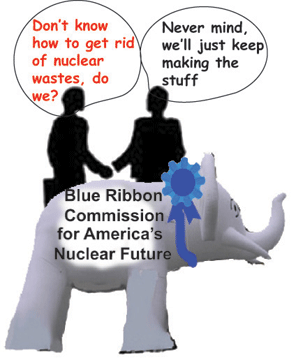 Lessons of Fukushima remain unknown……..critical details of what happened to the spent fuel held in elevated water pools in reactor buildings remain a mystery to U.S. regulators and the Blue Ribbon Commission members.
Fukushima Disaster Deepens U.S. Turmoil Over Nuclear Waste Storage, NYTimes.com, By PETER BEHR of ClimateWire May 16, 2011 Japan’s nuclear disaster and the abandoned Yucca Mountain repository are combining to create a more complex puzzle for U.S. policymakers wrestling with the future of nuclear power in the United States.
On Friday, a Blue Ribbon Commission (BRC) of experts appointed by the Obama administration presented subcommittee reports calling for the “expedited” creation of one or more consolidated interim sites for storing spent fuel from commercial U.S. reactors.
More than 70,000 tons of spent fuel with varying levels of remaining radioactivity are currently in “wet” or “dry” storage at the reactor sites, with nowhere else to go.
The subcommittee also recommended that the United States develop one or more permanent underground repositories for spent fuel in place of the proposed Yucca Mountain repository that has been shelved by the Obama administration. Both interim and permanent sites should only be located where local communities welcome them, and not imposed on a location, as Yucca Mountain was in Nevada, commissioners said. A new federal agency should be created to manage both interim and permanent site development, commissioners said.
A consolidated interim storage facility could take 20 years to locate, fund, license and build, according to the Government Accountability Office. A future permanent repository is even further in the future, the GAO said…..
Lessons of Fukushima remain unknown
More than two months after the start of the Fukushima crisis, critical details of what happened to the spent fuel held in elevated water pools in reactor buildings remain a mystery to U.S. regulators and the Blue Ribbon Commission members. Technicians had to wait several years after the 1979 nuclear accident at Three Mile Island before it was safe enough to directly assess the damage to the reactor. Crews at the Fukushima plant are in a daily struggle to control damaged reactors, and there is no guarantee that the accident details will become clear by the time the commission is planning to publish its draft final report, in July…….
In another two decades, many of the first U.S. commercial reactors will be coming to the end of an extended 60-year license term. It far from settled whether they could qualify for a new relicensing for another 20 years, or whether their owners would choose that course, experts say. That could mean that a growing line of reactors will be headed for decommissioning and more reactor sites will be closed with only their legacy of spent fuel containers, expanding the case for centralized storage, Meserve said…..
Fukushima Disaster Deepens U.S. Turmoil Over Nuclear Waste Storage – NYTimes.com
Nuclear Regulatory Commission Complacent About Safety of US Nuclear Reactors
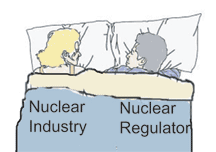 Eric Leeds, director of the NRC’s Office of Nuclear Reactor Regulation, said, “Our inspectors found all reactors would be kept safe ..”
Florida nuclear reactors pass inspection in wake of Japan disaster By Susan Salisbury, Palm Beach Post , May 16, 2011,The U.S. Nuclear Regulatory Commission has completed inspections of the nation’s 104 nuclear reactors, including those in Florida, to examine the plants’ abilities to deal with power losses or other issues following extreme events, such as floods, fires or terrorist attacks. Continue reading
Poor safety record of Browns Ferry Nuclear Plant
 How safe is the Browns Ferry Nuclear Plant? , Richard W. Jobe, 17 May 11, A Nuke hazard?Reading Brian Lawson’s excellent article in The Times on May 11, I asked: Could Brown’s Ferry Nuclear Plant have a meltdown like Fukushima in Japan? Judge for yourself with these facts: Continue reading
Push to shut down factory that makes nuclear weapons parts
KC anti-nuclear group wants bomb operation shut down, Missourine, by Jessica Machetta on May 16, 2011 A Kansas City anti-nuclear group wants a citywide vote on a planned factory that would produce nuclear bomb components. Honeywell is building the plant. The KC Peace Planters organization has presented a petition calling for a vote ordering Honeywell to drop the nuclear assembly project and turn the plant into a “green energy” facility.Some city officials already are saying the issue is likely to wind up in court. …
KC anti-nuclear group wants bomb operation shut down
Success with small scale solar energy and feed-in tariffs
“It might not seem like a lot if you look at one unit, but it’s like looking at ants,” ….. “If you look at one at a time, they seem tiny, but they build up into a large population.”
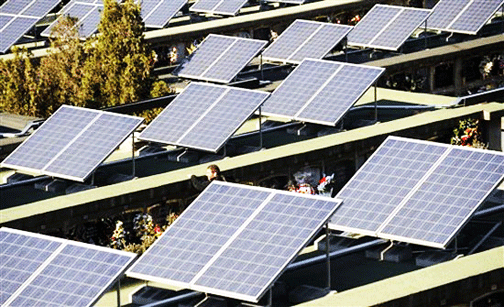
Green energy from city skylines, nwi.com, 15 May 11, While large wind and solar farms catch grief from nearby residents, engineers and designers have created ways to incorporate renewable energy systems into city skylines, including Chicago’s.
Across the United States, renewable energy developers are supplementing energy grids more discreetly, more affordably and on an urban-friendly scale. Continue reading
Yucca Mt scientifically unsuitable for nuclear waste dump
 in the last three decades 1the Energy Department studied Yucca Mountain and simply couldn’t make the plan work. There are a multitude of scientific, technical and safety issues with Yucca Mountain, which is a porous volcanic ridge in an area prone to earthquakes. The Energy Department had to keep rewriting its plans and requirements to try to make it look like Yucca Mountain was suitable……Nevada was chosen because the state [back then] didn’t have any political power.
More Yucca hypocrisy, Las Vegas Sun, Republicans continue to push a foolish plan that is unsafe and expensive, May 15, 2011 Republicans in Congress this past week continued their shameful crusade to turn Nevada into a nuclear waste repository by trumpeting a report that they say shows “political opposition” is the key obstacle toward building a Yucca Mountain repository. Continue reading
41 organisations join to stop uranium mining in Virginia
“There are just too many questions and potential risks of radioactive and toxic materials contaminating our streams, rivers and drinking water. With all the storms and hurricanes we get, this is the worst possible place you could put a uranium operation.”
Coalition to keep the ban on uranium mining in Virginia growing statewide , THE GAZETTE VIRGINIAN, 15 May 11, An organization called Keep the Ban Coalition on Thursday launched a statewide effort to keep the existing ban on uranium mining in Virginia. Representatives on the coalition include the NAACP, Sierra Club, Southern Environmental Law Center and numerous activists from across Southside Virginia.The Keep the Ban Coalition said Thursday it has the support of 41 localities and organizations that have joined the growing statewide movement urging the Virginia legislature to resist an industry push to lift the state’s ban on uranium mining as early as next year. ncluded among supporters are the Halifax County Chamber of Commerce and Southside Concerned Citizens. Continue reading
With nuclear safety concerns, why extend Vermont Yankee’s license?
the too frequent appearance that the NRC is in bed with the industry it regulates, there’s no reason to assume that every plant should get added years. This is where concerns about Vermont Yankee’s record of operation, radioactive leaks included, kick in, and where the NRC needs to do a much better job of explaining why Vermont Yankee should keep running past 2012
The 40-year license for nuclear power plants – New Hampshire, SentinelSource.com: Editorial, 15 May 11, “……….When the Atomic Energy Act of 1954 was being debated, the drafters felt it necessary to put an expiration date on licenses, after which renewals could be considered. However, at the time no one had any experience with nuclear power plants, so the drafters essentially lifted the 40-year provision from federal licenses then in use for hydroelectric power plants. The decision wasn’t based on science and safety; it was based mainly on investment considerations, such as how long it would take for a huge investment to make financial sense.
But, as the unfolding Fukushima disaster tells us, nuclear plants are about more than investments. To bring that point home, the NRC reports that it is finding that many nuclear power plants in this country are vulnerable to big natural disasters; the finding was based on a review ordered up after the Japanese crisis began. Continue reading
USA planning a short term action for securing nuclear waste
Report: Commission will outline above-ground nuclear waste strategy, THE HILL, By Andrew Restuccia – 05/13/11 A commission established by the Energy Department to find a path forward for dealing with the country’s nuclear waste will recommend storing it in above-ground containers, The New York Times reports.
The commission will outline a draft recommendation at a meeting Friday calling for “establishing one or more sites where used reactor fuel could be stored in steel and concrete structures on the earth’s surface for decades,” theTimes says. The Times says the commission will also outline steps toward determining a more permanent waste storage solution in the aftermath of the Obama administration’s decision to abandon a proposed permanent waste repository at Yucca Mountain in Nevada.
More from the Times:
“The commission will also recommend opening a new effort to find a burial site, members said, and suggest that it be led by an organization that is independent of the Department of Energy, which has been working on the waste disposal effort for decades…..http://thehill.com/blogs/e2-wire/677-e2-wire/161075-report-commission-will-outline-above-ground-nuclear-waste-strategy
USA secret nuclear tests and coverups

 America’s Secret Nuclear Test Revealed in Area 51, The Daily Beast, by Annie Jacobsen 13 May 11In her explosive new book, Area 51, investigative journalist Annie Jacobsen reveals for the first time secret nuclear tests and a nuclear space rocket meltdown. Plus, she explains how she uncovered the real story. Continue reading
Navajo’s battle against uranium mining is to go to UN
 The groups contend the mines, first permitted by NRC in 1999, could contaminate drinking water for 15,000 Navajo residents in and around the two communities, which lie just outside the Navajo Nation. In 2005, the Navajo’s tribal government passed a law prohibiting uranium mining within its borders….The United Nations also recognizes clean water as a human right
Navajo Group to Take Uranium Mine Challenge to Human Rights Commission, NYTimes.com, By APRIL REESE of GreenwirePublished: May 12, 2011 In a last attempt to deep-six a controversial project to mine uranium near two Navajo communities in northwestern New Mexico, a Navajo environmental group is taking its fight to the global stage.
Tomorrow, Eastern Navajo Diné Against Uranium Mining, with the help of the New Mexico Environmental Law Center, will submit a petition to the Inter-American Commission on Human Rights arguing that the Nuclear Regulatory Commission’s decision to grant Hydro Resources Inc., a license to mine uranium ore near Churchrock and Crown Point, N.M., is a violation of international laws.
The groups contend the mines, first permitted by NRC in 1999, could contaminate drinking water for 15,000 Navajo residents in and around the two communities, which lie just outside the Navajo Nation. In 2005, the Navajo’s tribal government passed a law prohibiting uranium mining within its borders.
“By its acts and omissions that have contaminated and will continue to contaminate natural resources in the Dine communities of Crownpoint and Church Rock, the State has violated Petitioners’ human rights and breached its obligations under the American Declaration of the Rights and Duties of Man,” the petition reads.
“We’re very hopeful,” said Eric Jantz, an attorney with the New Mexico Environmental Law Center who is filing the petition on behalf of ENDAUM. “I think we have very solid claims. It’s always been our client’s position that clean water is a human right.”
The United Nations also recognizes clean water as a human right, he added.
The groups cannot take their case to the Inter-American Court of Human Rights, which is separate from the commission, because the United States does not recognize the international court’s jurisdiction, Jantz said…….
Most of the uranium mining projects in New Mexico are being financed by Japanese and other Asian investors, as well as some in Russia, he said.
Navajo Group to Take Uranium Mine Challenge to Human Rights Commission – NYTimes.com
Safety problems, spent fuel worries, at US nuclear plants
Inspectors Found Preparedness Issues at U.S. Nuclear Plants, NYTimes.com, By MATTHEW L. WALD May 12, 2011 ROCKVILLE, Md. — Despite repeated assurances that American nuclear reactors are better equipped to deal with natural disasters than their counterparts in Japan, regulators said Thursday that recent inspections found serious problems with some emergency equipment that would have made it unusable in an accident.
In addition, the staff of the Nuclear Regulatory Commission acknowledged that the agency’s current regulations and disaster plans did not give enough consideration to two factors that had greatly contributed to the continuing Fukushima Daiichi crisis in Japan: simultaneous problems at more than one reactor at the same site and a natural disaster that disrupts roads, electricity and other infrastructure surrounding a plant…….
The Fukushima accident has cast new attention on spent fuel pools; the reason the United States government recommended that Americans stay 50 miles from the plant was damage to the spent fuel pool of Fukushima’s Unit 4, a reactor that had been shut down at the time of the March 11 earthquake and tsunami…….Inspectors Found Preparedness Issues at U.S. Nuclear Plants – NYTimes.com
Nuclear renaissance not viable, say experts, even from Exelon!
Power complexes that combine increasingly plentiful and cheap natural gas with renewable sources like wind and solar power are now seen as a financially viable, safer and cleaner alternative.
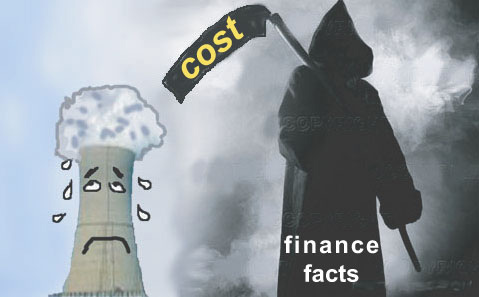 Why The Days Of Rampant Nuclear Power Growth Are Over, Business Insider, Merrill Goozner, The Fiscal Times | May 9, 2011 “……..Experts say the heavy subsidies needed to build new nuclear plants and the increased costs from tougher safety standards are a nonstarter given the nation’s fiscal crisis. As a result, nuclear is a less competitive option for producing electricity than a mix of cheap natural gas, wind and even solar power, which is rapidly declining in cost. Although prospects for a revival seemed bright only a few years ago, the steep price tag, coupled with the festering problem of disposing of spent nuclear fuel, creates a hostile environment for investing in nuclear power. Continue reading
Dangers of fire and other threats to US nuclear reactors
On other fronts, the NRC has acquired a reputation for being lenient and too close to industry. For instance, despite compelling evidence after September 11, 2001, that reactors could be vulnerable to terrorist attacks, the NRC still allowed many security gaps. And the NRC has allowed reactors to continue operating despite known design problems and deteriorating equipment that could lead to a loss of coolant and fuel damage. At some two dozen of the nation’s reactors, spent fuel sits in unsecured, above-ground storage pools — a radiological threat underscored by recent events at the Fukushima Daiichi nuclear plant. The potentially lethal waste in those pools far exceeds the stored rods in Japan….
A more likely nuclear nightmare HUFFINGTON POST, By Susan Q. Stranahan, 11 May 11“……..Fires regularly occur at the 104 U.S. nuclear plants, nearly 10 times a year on average. Continue reading
1 This Month




Shut down the radiation-damaged Heysham nuclear reactors now
To see nuclear-related stories in greater depth and intensity – go to https://nuclearinformation.wordpress.com

Say No to NASA’s Reckless Nuclear Reactor on the Moon
Say No to NASA’s Reckless Nuclear Reactor on the Moon
-
Archives
- October 2026 (302)
- September 2026 (339)
- August 2026 (330)
- July 2026 (355)
- June 2026 (287)
- May 2026 (306)
- April 2026 (356)
- March 2026 (251)
- February 2026 (267)
- January 2026 (308)
- December 2025 (358)
- November 2025 (359)
-
Categories
- 1
- 1 NUCLEAR ISSUES
- business and costs
- climate change
- culture and arts
- ENERGY
- environment
- health
- history
- indigenous issues
- Legal
- marketing of nuclear
- media
- opposition to nuclear
- PERSONAL STORIES
- politics
- politics international
- Religion and ethics
- safety
- secrets,lies and civil liberties
- spinbuster
- technology
- Uranium
- wastes
- weapons and war
- Women
- 2 WORLD
- ACTION
- AFRICA
- Atrocities
- AUSTRALIA
- Christina's notes
- Christina's themes
- culture and arts
- Events
- Fuk 2022
- Fuk 2023
- Fukushima 2017
- Fukushima 2018
- fukushima 2019
- Fukushima 2020
- Fukushima 2021
- general
- global warming
- Humour (God we need it)
- Nuclear
- RARE EARTHS
- Reference
- resources – print
- Resources -audiovicual
- Weekly Newsletter
- World
- World Nuclear
- YouTube
-
RSS
Entries RSS
Comments RSS

