Obama’s reckless promotion of nuclear technology will feed the arms race
 the recklessness his administration is showing toward the transfer of civilian nuclear technology is astonishing and will lead us down the path to a world in which many more countries will have the ability to develop military nuclear programs if they so desire.”
Obama’s about face on nuclear non-proliferation, Washington Post, By Jennifer Rubin, 26 Jan 12, The Wall Street Journal reported: The Obama administration, in advanced negotiations on nuclear-cooperation agreements with Jordan and Vietnam, has withdrawn a demand that these countries forgo their rights to produce nuclear fuel, senior U.S. officials said.
The policy shift, adopted after an extensive interagency review, drew criticism from some U.S. lawmakers, who charged that it could ease the spread of sensitive nuclear technologies. . .
Lawmakers and nonproliferation experts also said they fear more lenient nuclear-cooperation agreements with Jordan and Vietnam could undercut the campaign to contain Iran’s nuclear program.
Both the Obama and George W. Bush administration have stressed to Tehran that it doesn’t need to enrich uranium domestically because it can buy nuclear fuel on international markets.
Remember, this entire exercise — to make the world free from nuclear weapons — is somewhat farcical given the efforts by Iran and North Korea to join the club of nuclear-armed nations. But now the Obama administration has made a mockery of its own fanciful policy. Continue reading
USA’s Blue Ribbon Commission has no answer to long term nuclear waste disposal
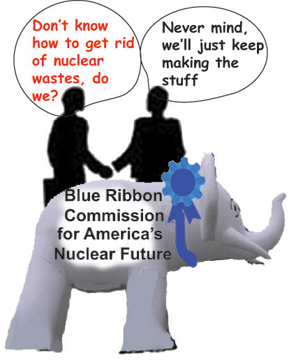 the Union of Concerned Scientists, a nonprofit advocacy group, questioned some of the report’s findings.
“Efforts to site an interim storage facility could distract from the far more important goal of finding a repository site,”
U.S. needs long-term site for nuclear waste: panel By Ayesha Rascoe, WASHINGTON Jan 26, 2012 (Reuters) – The United States must urgently work to find a new central site to house its spent nuclear fuel and probe whether Japan’s nuclear disaster has any safety implications for storage at the country’s plants, a federal panel said on Thursday.
The U.S. government has struggled with how to manage the 65,000 tons of radioactive waste produced by its nuclear reactors over decades and stored throughout the country.. Continue reading
USA’s Nuclear Regulatory Commission is beholden to the nuclear industry
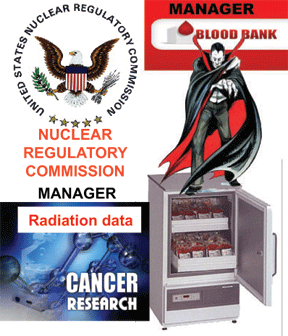 Ninety percent of the NRC’s funding comes from the industry they regulate.
How can you make a container for something that can destroy its container? But the NRC doesn’t see that as insurmountable, even though it is.
The NRC is beholden to no one but the nuclear industry they regulate. Their motto — protecting people and the environment — is criminally hollow.
 Nuclear Power is Clean — as Long as you Ignore ‘Safety’!, Ace Hoffman Salem-News.com, 27 Jan 12, Every American nuclear power plant could be closed down if Americans turned off extra lights and became energy efficient. (CARLSBAD,Calif.) – In the United States, radiation-related “safety” decisions regarding commercial nuclear power plants are handled very
undemocratically.
They are considered to be strictly the purview of the Nuclear Regulatory Commission. State and federal courts, public utilities commissions, state energy commissions, water boards, air
boards, EPA, DOE, and everyone else whose regulatory authority touches on nuclear power will insist that you cannot talk to them about “safety.” You must go to the NRC. Continue reading
Radioactive threats to the Great Lakes
Nuclear worries abound in Great Lakes region. Do solutions?, Medill News, BY RORY KEANE, JAN 26, 2012 “..…The report, titled “Too Close to Home,” cites numerous articles that followed the unfolding disaster at Japan’s Fukushima-Daiichi nuclear power plant and concerns in the U.S., including a series of Associated Press stories dating from summer of 2010.
According to the report, over 10 million Americans in Great Lakes states, excluding Indiana and Minnesota, receive drinking water originating within 12 miles of a nuclear power plant. The AP stories cited focused on radioactive isotopes that could leak into drinking water. Continue reading
Uranium mining and radioactive water pollution
 The truly frightening part is the sentence that reads, ” Covering tailings material with water during operations …” Where do they imagine all that water will end up? It’s water containing not only radioactive material, but a host of other toxins as well? And how do they know for certain that an earthquake could not crack that containment cell open like an egg or that a hurricane would not dump enough water on Coles Hill to cause those cells to become so saturated that they leak their contents into the groundwater surrounding them?
 Uranium risks far outweigh benefits AltaVista Journal, Jesse Andrews, 25 Jan 12, Virginia Uranium Inc.’s most recent propaganda release, “We’re committed to protecting water quality.” Why does VUI feel the need to continue to explain itself if in fact uranium mining would be as safe and innocuous as they claim? If uranium mining had ever been safe anywhere, which it has not, they wouldn’t feel such a desperate need to explain just how safe their mine would be.
What they have presented is a pretty drawing of a disaster waiting to happen. A containment cell constructed just like your local landfill, only instead of household garbage, it contains radioactive waste. A nice concept, but one whose reliability over the course of 1,000 years is indeed doubtful. Continue reading
Over 2 million Californians risk radioactive water pollution in proximity to nuclear reactors
Nuclear Power Plants Threaten Drinking Water for 2.3 Million Californians
San Diego is the 6th Largest Region in the Country to Have Drinking Water Sources Located Within 50 Miles of a Nuclear Plant YubaNet.com Jan 24, 2012 By: CALPIRG San Diego, CA January 24, 2012 – The drinking water for 2.3 million people in California could be at risk of radioactive contamination from a leak or accident at a local nuclear power plant, says a new study released today by the California Public Interest Research Group Education Fund and Environment California Research and Policy Center.
“The danger of nuclear power is too close to home. Here in California, the drinking water for 2.3 million people is too close to an active nuclear power plant,” said Emily Rusch, CALPIRG Education Fund State Director. “An accident or a leak could spew cancer-causing radioactive waste into our drinking water.” Continue reading
Nuclear personnel asleep at Oak Ridge National Laboratory?
 Vulnerable U.S. Nuclear Weapons Site Faces Allegations of Snoozing Security Guard Potential Pattern of Fatigue Among Wackenhut Nuclear Personnel
Project on Government Oversight (POGO) 25 Jan 12, By MIA STEINLE
The security contractor for the Energy Department’s Oak Ridge National Laboratory in Tennessee is investigating reports that one of its security guards was sleeping and had also been using an unauthorized cell phone while they were supposed to be guarding a sensitive nuclear facility with bomb-grade material.
Photos of the alleged incident were sent to Wackenhut Security Inc.’s (WSI) Oak Ridge unit, the Energy Department, and the Knoxville News Sentinel, which broke the story Tuesday.
The photos were allegedly taken inside Building 3019, which raises “the additional issue of who took photographs inside a high-security nuclear installation,” according to the News Sentinel. Building 3019 stores about a half-ton of uranium-233, which POGO Senior Investigator Peter Stockton said today in a statement is roughly the amount needed for 250 improvised nuclear detonations.
“Perhaps the most egregious part of all this is that the Energy Department is allowing Wackenhut to investigate the latest security lapse itself,” Stockton said. “This is too important to leave up to Wackenhut.” WSI is commonly known as Wackenhut. In 2002, the Florida company was acquired by a Danish corporation and is now officially known in the U.S. as G4S Secure Solutions.
Wackenhut has a history of sleeping security guards. “It was Wackenhut that in 2007 initially denied that its guards at the Peach Bottom nuclear power plant in Pennsylvania were sleeping on the job—that is until the company was confronted with a video of the guards that was leaked to the media,” Stockton said. In the wake of that scandal, Wackenhut lost its contract with Exelon to manage security at ten nuclear power plants, according to a Washington Post article.
POGO called Oak Ridge National Laboratory a “high risk” as early as 2006 for its inadequate security, and also found that Wackenhut security guards at the nearby Y-12 National Security Complex were overworked to the point of severe fatigue. http://pogoblog.typepad.com/pogo/2012/01/vulnerable-us-nuclear-weapons-site-faces-allegations-of-snoozing-security-guard.html
Iowa Utilities Board warns on nuclear power cost burden on ratepayers
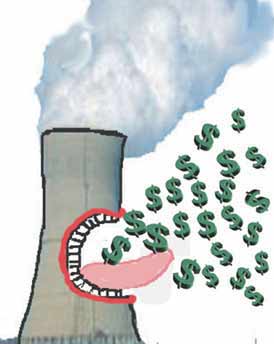 IUB staff raises red flags about nuclear power plant legislation, Bettendorf.com, January 25, 2012 The Iowa Utilities Board (IUB) staff has raised several warning flags about legislation sought by MidAmerican Energy to shift the risk of building a new nuclear power plant to utility ratepayers.
In a memo sent to the IUB and state legislators in December, the IUB staff warns that “some of these (bill) provisions could create incentives for the company to engage in behavior that could be contrary to the public interest in certain situations.”
To illustrate what might happen, the staff report gives this possible scenario: Continue reading
USA’s practically unsolvable dilemma about nuclear wastes
The Blue Ribbon Commission on America’s Nuclear Future’s report is arriving in an election year, a time when Congress has traditionally been unwilling to take decisive action. And the Nuclear Waste Policy Act of 1982, which instructed the Energy Department to pursue a repository, has historically been interpreted to forbid establishment of an interim storage place until a final site is established.
But with a final resting place more elusive than ever, the three groups believe that Congress or the Energy Department should be moving in that direction.
Wanted: Parking Space for Nuclear Waste http://green.blogs.nytimes com/2012/01/24/wanted-parking-space-for-nuclear-waste/ NYT, By MATTHEW L. WALD, January 24, 2012, When the Obama administration killed a plan to create a nuclear waste repository at Yucca Mountain in Nevada, the government established a “blue-ribbon commission” to study what to do next. Its final report is due on Sunday, and this week three organizations began a public lobbying campaign for several of the recommendations that they assume the commission will make. Yucca was supposed to store nuclear waste, but the emphasis now is on “managing” it, especially the waste at scattered locations where reactors no longer operate.
At places like Maine Yankee, Connecticut Yankee andRancho Seco in California, reactors have been torn down, but the fuel remains in small concrete-and-steel silos that require maintenance and monitoring by a guard force. Sometimes the presence of nuclear waste prevents re-use of the sites by industry. Continue reading
Florida lawsuit challenges upfront payments for nuclear power reactors

 Energy advocates: State nuclear cost recovery bill is unconstitutional, Miami Herald, 24 Jan 12, The state law that has allowed Florida Power & Light and ProgressEnergy to charge customers $1 billion so far for speculative nuclear power plants is unconstitutional, a group of energy advocates claims in a lawsuit before the state’s highest court.
The Southern Alliance for Clean Energy is asking the Florida Supreme Court to throw out the 2006 law and reverse a decision by state regulators who have allowed the companies to charge customers for upgrading existing nuclear power plants and for the pre-construction
costs of building new nuclear power plants that may never be built. Continue reading
A decision with vision – ban on uranium minng near Grand Canyon
the 20-year ban is supported by an unprecedented coalition of tribal leaders; hunting, fishing, ranching and conservation groups; municipal water suppliers; wildlife advocates; and nearly 300,000 individuals who commented favorably on the proposed moratorium. Chambers of commerce, community leaders and elected officials are also among those mainstream voices speaking out against a handful of politicians now defending industrialists’ demand to exploit our treasured landscape.
At risk are the Grand Canyon’s watersheds. These interconnected surface and groundwater systems extend many miles beyond the park’s boundary.
Uranium-mining ban was a grand decision, The Arizona Republic, by Roger Clark – Jan. 22, 2012 Arizonans and all Americans won a major victory on Jan. 9 when Interior Secretary Ken Salazar signed a “record of decision” for a 20-year ban on new uranium claims on 1.1 million acres of public land surrounding Grand Canyon National Park.
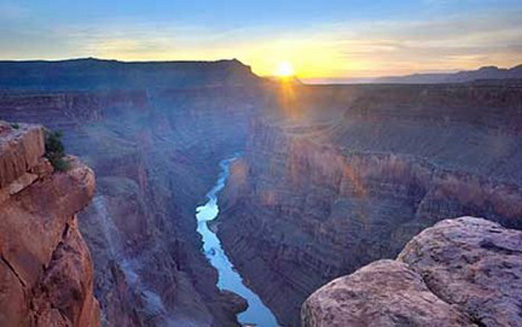
The decision reduces the risk of permanent harm to wildlife, water, our economy and sites sacred to Havasupai and all native people in ourregion. It also best serves our nation’s interests. Continue reading
Solar and wind energy investment by Warren Buffett
 Buffett’s MidAmerican Starts Renewable-Energy Business, Fox Business By Cassandra Sweet January 24, 2012 The MidAmerican Energy unit of Warren Buffett’s Berkshire Hathaway Inc. (BRKA, BRKB) said Tuesday it has started a new company to oversee a growing stable of solar, wind and other renewable-energy projects.
MidAmerican Energy Holdings Co., of Des Moines, said it has placed solar and wind farms, geothermal power plants and its interest in a small hydroelectric project into a new company called MidAmerican Renewables LLC.
MidAmerican’s president and chief executive, Greg Abel, said the company expects U.S. demand for renewable energy to continue growing and that the company wants “to be a leader in this area.”
On Monday, MidAmerican said it plans to buy an 81-megawatt wind farm in Illinois from Invenergy Wind LLC as part of the company’s growing wholesale renewable-energy business. ……. MidAmerican Renewables said it is considering acquiring more renewable-energy projects that would generate electricity for the wholesale power market to meet growing demand for clean energy.
“We’ll be looking for opportunities to grow this business,” said Tina Potthoff, a spokeswoman for MidAmerican. “We think there’s a growing desire by utilities and other companies to green up their business.”
http://www.foxbusiness.com/news/2012/01/24/buffetts-midamerican-starts-renewable-energy-business/#ixzz1kVVVLdW0
The nuclear boondoggle – plans for consumers to pay upfront for nuclear power build
 Regulators: Nuclear plan could cost Iowa residents By MIKE GLOVER, Chicago Tribune, January 23, 2012, DES MOINES, Iowa— A proposal to shift the expense of building a nuclear power plant from the utility to consumers by billing them in advance for construction costs isn’t in the public interest, Iowa regulators said.
The proposal, which didn’t clear the Legislature last year but could be considered again this session, would let MidAmerican Energy begin billing customers for the plant’s $1 billion or more construction long before it begins providing power.
An analysis by the Iowa Utilities Board summarized in a Dec. 23 internal memo and provided Monday to The Associated Press warned that the plan placed all the risk on consumers, who would pay to research the project before MidAmerican even committed to construction.
“The company would be guaranteed a profit on all spending up to this point,” it said. “This could create a stronger incentive to walk away form a plant than complete it.” ….
It also says the proposed changes could affect more than just nuclear power in Iowa.
“While the current bill restricts those changes to nuclear power, staff believes some provisions may go beyond leveling the playing field and could give a nuclear power plant unintended advantages over alternative sources of electric power,” it said.
Sonia Ashe, of the Iowa Public Interest Research Group, said the analysis merely underscores worries that consumers have had all along.
“The notion that Iowa ratepayers should foot the bill and shoulder the risk for new nuclear plants is pure folly,” Ashe said. “Let’s hope the Iowa Utilities Board staff analysis opens lawmakers eyes to the real risks they’d be passing on to their constituents and puts the final nail in the coffin of this nuclear boondoggle.” …. http://www.chicagotribune.com/news/chi-ap-ia-iowanuclear-analy,0,5049950.story
Nuclear power and water rights in Utah
“the Nuclear Regulatory Commission is notorious for cozying up to the nuclear industry and basically never says no,”
“approval of the application doesn’t actually guarantee there will be enough water to operate the plant.”
Water Rights Approved for Nuclear Plant 01.22.2012 by Whittney Evans, (KCPW News) Utah State Engineer Kent Jones has approved water rights from the Green River for Blue Castle Holdings’ proposed nuclear power plant in Emery County, much to the dismay of environmental groups.
Matt Pacenza, Policy Director of the anti-nuclear group HEAL Utah, says the decision was the only opportunity for a Utah official to reject the plan. He says the company now faces two hurdles, the easier of which will be getting permission from the U.S. Nuclear Regulatory Commission.
“Although the process will take several years and will cost them quite a bit of money, the NRC is notorious for cozying up to the nuclear industry and basically never says no,” he says. “So one imagines that they will fairly easily convince Washington bureaucrats that it’s okay to put a nuclear reactor in Utah.”
Pacenza says the bigger hurdle is finding investors and customers for the power. Rob Mrowka with the Center for Biological Diversity says taking almost 54,000 acre-feet of water a year from the Green River would impact rare fish, among other problems. “…to the point of perhaps driving those already listed for protection to the point of extinction and necessitating the addition of the other three to the endangered species act list of protected species,” says Mrowka.
A call to the state engineer’s office was not returned. In a news release, he said concerns raised about the water rights application were considered, adding that an application must be approved by law if the water is available, it won’t interfere with existing water rights, and it would not be detrimental to the public welfare. And approval of the application doesn’t actually guarantee there will be enough wate rto operate the plant.
http://kcpw.org/blog/local-news/2012-01-22/water-rights-approved-for-nuclear-plant/
Oyster Creek nuclear plant will close, despite pro nuclear court ruling about Vermont
jurisdictional issues over safety and water quality mean the Vermont Yankee ruling has little impact on the agreement to close Oyster Creek.
Every day Oyster Creek strains 1.4 billion gallons of bay water through its cooling system, he said. The bay only has 60 billion gallons of water. The strain Oyster Creek puts on the bay is equivalent to 2.4 percent of the bay’s water each day and 800 percent each year.
“It’s just a gargantuan death machine as far as fish eggs and plant larva,”
Oyster Creek Stands By Closure Plan Despite Federal Court Ruling ‘No similarities’ between Vermont ruling and Lacey nuclear plant’s planned shutdown, DEP says Lacey Patch, By Elaine Piniat, 23 Jan 12, Oyster Creek will stick to the plan to close in 2019 after a federal judge ruled that the Vermont Yankee nuclear plant could remain open beyond its scheduled shutdown date, plant spokesperson Suzanne D’Ambrosio said.
“We made a commitment to our regulators and to the public,” she said. “Our commitment and our plan is to retire Oyster Creek in 2019. That’s the plan.”
A U.S. district judge in Brattelboro, Vt., ruled Thursday that the Vermont Yankee nuclear plant could remain open beyond its scheduled shutdown date this year, the Washington Post reported. The state had originally ruled against Vermont Yankee’s federal operating license, which gives the plant 20 more years to operate.
Advocates opposed to Oyster Creek have showed concerns that this federal decision could impact the Forked River-based nuclear plant’s closure date. Continue reading
1 This Month




Shut down the radiation-damaged Heysham nuclear reactors now
To see nuclear-related stories in greater depth and intensity – go to https://nuclearinformation.wordpress.com

Say No to NASA’s Reckless Nuclear Reactor on the Moon
Say No to NASA’s Reckless Nuclear Reactor on the Moon
-
Archives
- October 2026 (279)
- September 2026 (339)
- August 2026 (330)
- July 2026 (355)
- June 2026 (287)
- May 2026 (306)
- April 2026 (356)
- March 2026 (251)
- February 2026 (267)
- January 2026 (308)
- December 2025 (358)
- November 2025 (359)
-
Categories
- 1
- 1 NUCLEAR ISSUES
- business and costs
- climate change
- culture and arts
- ENERGY
- environment
- health
- history
- indigenous issues
- Legal
- marketing of nuclear
- media
- opposition to nuclear
- PERSONAL STORIES
- politics
- politics international
- Religion and ethics
- safety
- secrets,lies and civil liberties
- spinbuster
- technology
- Uranium
- wastes
- weapons and war
- Women
- 2 WORLD
- ACTION
- AFRICA
- Atrocities
- AUSTRALIA
- Christina's notes
- Christina's themes
- culture and arts
- Events
- Fuk 2022
- Fuk 2023
- Fukushima 2017
- Fukushima 2018
- fukushima 2019
- Fukushima 2020
- Fukushima 2021
- general
- global warming
- Humour (God we need it)
- Nuclear
- RARE EARTHS
- Reference
- resources – print
- Resources -audiovicual
- Weekly Newsletter
- World
- World Nuclear
- YouTube
-
RSS
Entries RSS
Comments RSS

