Comparing USA nuclear reactors with Fukushima reactors
nuclear reactors in the United States were built during the same time period as the Fukushima reactor, before 1980. These reactors were all built using the same 80-year-old technology, which is to say they’re all just as outdated as Fukushima and the materials and equipment used are all beginning to show the same signs of wear and tear.
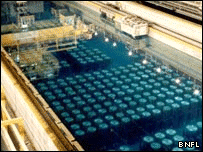 What makes this scenario even more alarming is that Gundersen says the reactors in the United States hold 4-5 times more nuclear waste than the Fukushima reactor.
Fukushima forum: Arnie Gundersen compares U.S. and Japanese nuclear reactors http://www.examiner.com/article/fukushima-forum-arnie-gundersen-compares-u-s-and-japanese-nuclear-reactors by Donna Anderson, 10 June 12 John B. Wells was at the helm for the Fukushima forum on the Saturday, June 9, 2012 edition of Coast to  Coast AM . The first guest was Arnie Gundersen who appeared on the show to share his expertise in the area of nuclear engineering and to make the American public more aware of the potential danger hiding in their own backyard.
Gundersen, who holds a master’s degree in nuclear engineering, has manged and coordinated design efforts for 70 nuclear reactors in the United States and has more than 40 years experience in nuclear power engineering. He’s currently working on the AP1000 nuclear power generator being built in South Carolina.
According to Gundersen the nuclear reactors in the United States were built during the same time period as the Fukushima reactor, before 1980. These reactors were all built using the same 80-year-old technology, which is to say they’re all just as outdated as Fukushima and the materials and equipment used are all beginning to show the same signs of wear and tear. Continue reading
Nuclear weapons industries control USA policy on military spending
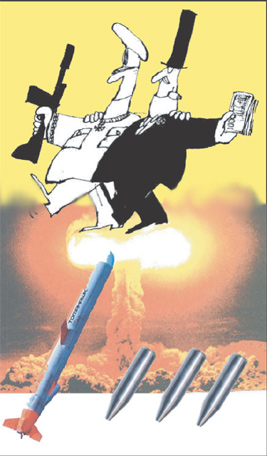 The Nuclear Weapons Industry’s Money Bombs, How millions in campaign cash and revolving-door lobbying have kept America’s atomic arsenal off the chopping block. — Mother Jones, By R. Jeffrey Smith, Center for Public
Integrity Jun. 6, 2012 Employees of private companies that produce the main pieces of the US nuclear arsenal have invested more than $18 million in the election campaigns of lawmakers that oversee related federal
spending, and the companies also employ more than 95 former members of Congress or Capitol Hill staff to lobby for government funding, according to a new report. Continue reading
USA federal ruling means delay in licensing of nuclear power plants
The New York attorney general’s office said the ruling means the NRC cannot license or relicense any nuclear power plant until it examines those risks. That process could take a couple of years, Geoff Fettus, an attorney who argued in court on behalf of the Natural Resources Defense Council, told msnbc.com.
“The need for a new strategy is urgent,” the panel wrote in its report, “not just to address these damages and costs but because this generation has a fundamental, ethical obligation to avoid burdening future generations with the entire task of finding a safe, permanent solution for managing hazardous nuclear materials they had no part in creating.”


 Nuclear headache: What to do with 65,000 tons of spent fuel, By Miguel Llanos, msnbc.com http://usnews.msnbc.msn.com/_news/2012/06/08/12127578-nuclear-headache-what-to-do-with-65000-tons-of-spent-fuel?lite In a blow to the nuclear energy industry, a federal appeals court on Friday threw out a rule allowing plants to store spent nuclear fuel onsite for decades after they’ve closed, and ordered regulators to study the risks involved with that storage – 65,000 tons now spread across the country, and growing at 2,000 tons a year.
The Nuclear Regulatory Commission “apparently has no long-term plan other than hoping for a geologic repository,” the unanimous ruling stated . “If the government continues to fail in its quest to establish one, then SNF (spent nuclear fuel) will seemingly be stored on site at nuclear plants on a permanent basis. The Commission can and must assess the potential environmental effects of such a failure.” Nuclear plants have been storing spent fuel onsite for decades and the NRC recently said, barring a repository, they may continue to do so even after they shut down. Continue reading
So far, 2012 USA’s warmest year on record
 Warmest U.S. Spring On Record: NOAA, PLanet Ark, 08-Jun-12, Deborah Zabarenko, So far, 2012 has been the warmest year the United States has ever seen, with the warmest spring and the second-warmest May since record-keeping began in 1895, the U.S. National Oceanic and Atmospheric Administration reported on Thursday. Continue reading
USA legislation introduced to boost renewable energy investment
Legislation Would Give Renewable Energy Investors Access To Tax Advantage in News Departments Policy Watch by SI Staff 08 June 2012 Sens. Chris Coons, D-Del., and Jerry Moran, R-Kan., have introduced the Master Limited Partnerships Parity Act (MLP Parity Act), legislation that is designed to level the energy playing field by giving investors in renewable energy projects access to a decades-old tax advantage that is currently available only to investors in fossil-fuel-based energy projects.
The Solar Energy Industries Association, among other organizations, has endorsed the legislation….. http://solarindustrymag.com/e107_plugins/content/content.php?content.10485
Legislation to help USA renewable energy, by way of tax code
Tweaking US tax code could spur green energy: senator, Climate Spectator, 8 Jun 2012, Reuters WASHINGTON, – A freshman U.S. Democratic senator thinks he may have found a way to encourage investment in wind, solar and biofuel projects without sapping too many taxpayer dollars or injecting new venom into a bitter partisan battle over energy incentives.
Chris Coons introduced legislation on Thursday that would allow a broad range of renewable power generation and transmission projects to qualify for a tax structure used widely by pipeline and other energy-related companies.
The bill is unlikely to be considered until after the November presidential election, but may give lawmakers food for thought as they wrestle with whether to extend tax breaks for green energy set to expire this year….. http://www.climatespectator.com.au/news/update-1-tweaking-us-tax-code-could-spur-green-energy-senator-0
San Onofre nuclear power plant shut throughout the summer
 San Onofre nuclear plant out of service for the summer, LA Times, June 7, 2012 The top official at Edison International said Thursday that the troubled San Onofre nuclear plant will remain out of service through the summer.
The plant has been shuttered since Jan. 31 while officials probe the extent and cause of unusual wear on tubes that carry radioactive water in the plant’s newly replaced steam generators. Continue reading
Anti nuclear Pilgrim Watch in hearing by Atomic Safety and Licensing Board
Anti-nuclear activists in Mass. seek hearing, Boston Herald, By Associated Press, June 7, 2012 – Activists who say federal regulators haven’t done enough to fix nuclear power plant flaws exposed by last year’s accident in Japan are arguing a nuclear safety board should hear their case.
The Atomic Safety and Licensing Board met in Boston today to hear from attorneys for Pilgrim Watch, which opposes the Pilgrim Nuclear Power Station in Plymouth. The board was trying to determine if it should hold a broader evidentiary hearing about Pilgrim Watch’s claims….. A Pilgrim Watch attorney said even if the fixes make plants marginally
safer, they still don’t adequately protect the public, and that gives Pilgrim Watch standing to try to overturn them. ww.bostonherald.com/business/general/view/20120607anti-nuclear_activists_in_mass_seek_hearing/
Vogtle nuclear power project – a money pit?
 A lot is at stake in the Vogtle project. The new breed of reactors being built at the site — featuring advanced standardized design, streamlined licensing and new construction techniques — are supposed to keep costs steady and bring projects in close to budget and on schedule.
That in turn is supposed to spur a new golden era for nuclear power.
Cost overruns of almost $1 billion — so far — at Ga. nuke reactors June 6, 2012, by Jay Bookman Last month, a consortium of utilities including Atlanta-based Southern Company announced cost overruns of almost $1 billion at two new nuclear reactors being built near Waynesboro.
That’s an arresting number under any circumstances, but it looms even larger when you realize that major construction on the Vogtle 3 and 4 reactors has basically just begun, with at least five more years of construction to come.
And if costs soar, who’s going to pay for it? Southern Company and its subsidiary, Georgia Power, own 45.7 percent of the project, so its ratepayers’ share of these recent overruns would come to more than $400 million. But according to Buzz Miller, Southern’s executive vice president of nuclear development, that cost will be borne by contractors who are building the project. Continue reading
80 year plan for old nuclear reactors – invites catastrophe
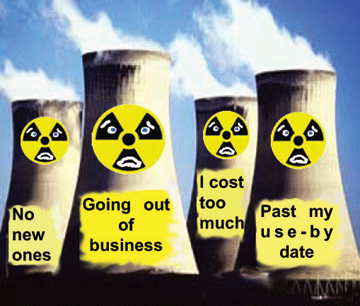 Nuclear regulators know that embrittlement of the reactor vessels limits nuclear plant life but are willing to expose the public to greater risks from decrepit, old and leaking reactors. As we learned from Fukushima, the nuclear industry is willing to expose the public to catastrophic risks
Getting operating license extensions “is a lucrative deal for operators,”
a concern by the nuclear industry that “they’re not going to build any new reactors anytime soon”–thus the push to keep existing plants running.
Inviting Atomic Catastrophe OPEd News 4 June 12By Karl Grossman The U.S. Nuclear Regulatory Commission will be holding a meeting this week to consider having nuclear power plants run 80 years–although they were never seen as running for more than 40 years because of radioactivity embrittling metal parts and otherwise causing safety problems. Continue reading
USA govt understates the cost of its nuclear weapons arsenal
Study: Government Low-Balls Cost of Nuclear Fleet, USA News, June 5, 2012 The federal government is low when calculating the amount it spends on the U.S. nuclear weapons arsenal, says a new report, and several longtime atomic arms analysts say government officials have no clue how much the world’s most lethal weapons really cost.
The Stimson Center released a study Tuesday that concludes Washington will spend between $352 billion to $392 billion over the next decade to modernize its nuclear fleet. The think tank’s researchers dove into Pentagon budget documents to conclude the Defense Department pegs the same costs between $221 billion to $244 billion.
“Official estimates [rely] on a narrow definition of the nuclear enterprise, or even of strategic nuclear offensive forces, understate the actual costs the United States spends on nuclear weapons without settling once and for all what is the single right cost of the nuclear
enterprise,” states the report…… http://www.usnews.com/news/blogs/dotmil/2012/06/05/study-government-low-balls-cost-of-nuclear-fleet
Need for probe on Nuclear Regulatory Commission’s dubious safety culture
U.S. Nuclear Agency Needs Independent Probe, Markey Says Bloomberg News, By Katarzyna Klimasinska June 04, 2012 An independent investigation is needed of alleged lapses in the safety culture at the U.S. Nuclear Regulatory Commission, Representative Edward Markey said, citing worker concerns about a lack of management support. Continue reading
Seabrook nuclear power plant fails safety test
NRC reports Seabrook nuclear plant failures in emergency test, SeaCoast online, By Shir Haberman, June 05, 2012 SEABROOK — The operators of the Seabrook Station nuclear power plant failed to properly detect a simulated radiological release and also failed to advise state emergency planning officials during a test of the emergency preparedness process held in April.
Plant staff also failed to detect the lapse until Nuclear Regulatory Commission inspectors pointed it out, an NRC report dated May 29 indicated.
“The finding (by NRC inspectors) is more than minor because it … affected the … objective to ensure that the licensee is capable of implementing adequate measures to protect the health and safety of the public in the event of a radiological emergency,” the report reads.
Multiple errors occurred during the full-scale, biennial emergency planning exercise conducted April 16-17 at the Seabrook plant, according to the NRC report. The test assigned to the plant’s emergency staff was a large-break loss of reactor coolant…..
http://www.seacoastonline.com/articles/20120605-NEWS-120609849
Solar panel that follows the sun
 includes video Heliowatcher allows solar panels to track the sun http://www.earthtechling.com/2012/06/heliowatcher-allows-solar-panels-to-track-the-sun/ 4 June 12, They’re called solar panels for a reason: they need the sun in order to generate electricity. Whether we’re talking about pocket-sized, portable solar chargers or massive rooftop arrays, direct sunlight is the must-have ingredient on which all other elements of solar-energy production depends.
You might think that simply placing solar panels on a rooftop or balcony free from shade would be enough. Except there’s that small matter of Earth rotating on its axis. So throughout the day, the sun moves across the sky, cutting into the efficiency of fixed panels. But what if the panels could automatically change their position to follow the sun and enjoy an uninterrupted flow of direct sunlight? Two electrical engineering students at Cornell are currently testing just such a technology, and it looks promising.
 Solar panel that follows the sun
As this review points out , HelioWatcher’s design is simple and effective: “The base is mounted like a Lazy Susan, able to pivot on the horizontal plane. The bottom edge of the solar panel is mounted with two door hinges, with a motorized screw jack used to raise and lower it.” Using a GPS module and magnetometer, the HelioWatcher allows the user to place the system anywhere in the world without any calibration. The HelioWatcher then calculates what the sun’s current location is and orients the panel to the appropriate angle. It also utilizes a quadrature of light-detecting diodes to correct for short-term light obstruction, such as clouds or shade.
This system is a vast improvement over other solar tracking systems that adjust position based on either a predetermined algorithm or light detection. Instead HelioWatcher combines elements of both technologies to leverage the guaranteed accuracy of a geospatial algorithm while also correcting for local or short-term changes, such as cloud cover or shade. Here’s a video, prepared by the two students, that explains the system:
Sun providing heaps of electricity for Massachusetts
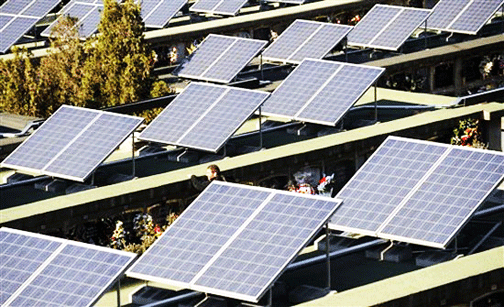 Solar power hot all over Cape, state Jun 3 – McClatchy-Tribune Regional News – Patrick Cassidy Cape Cod Times, Hyannis, Mass. Solar in Massachusetts is on fire. Over the past two years, capacity from photovoltaic panels across the state has more than quadrupled from 25 to 115 megawatts, enough to power about 115,000 homes, according to figures provided by state energy officials and energy information websites. Continue reading
1 This Month



Shut down the radiation-damaged Heysham nuclear reactors now
To see nuclear-related stories in greater depth and intensity – go to https://nuclearinformation.wordpress.com

Say No to NASA’s Reckless Nuclear Reactor on the Moon
Say No to NASA’s Reckless Nuclear Reactor on the Moon
-
Archives
- October 2026 (256)
- September 2026 (339)
- August 2026 (330)
- July 2026 (355)
- June 2026 (287)
- May 2026 (306)
- April 2026 (356)
- March 2026 (251)
- February 2026 (267)
- January 2026 (308)
- December 2025 (358)
- November 2025 (359)
-
Categories
- 1
- 1 NUCLEAR ISSUES
- business and costs
- climate change
- culture and arts
- ENERGY
- environment
- health
- history
- indigenous issues
- Legal
- marketing of nuclear
- media
- opposition to nuclear
- PERSONAL STORIES
- politics
- politics international
- Religion and ethics
- safety
- secrets,lies and civil liberties
- spinbuster
- technology
- Uranium
- wastes
- weapons and war
- Women
- 2 WORLD
- ACTION
- AFRICA
- Atrocities
- AUSTRALIA
- Christina's notes
- Christina's themes
- culture and arts
- Events
- Fuk 2022
- Fuk 2023
- Fukushima 2017
- Fukushima 2018
- fukushima 2019
- Fukushima 2020
- Fukushima 2021
- general
- global warming
- Humour (God we need it)
- Nuclear
- RARE EARTHS
- Reference
- resources – print
- Resources -audiovicual
- Weekly Newsletter
- World
- World Nuclear
- YouTube
-
RSS
Entries RSS
Comments RSS

