USA’s Dept of Energy’s plans for allowing recycling of radioactive metals
Nuclear site scrap metal could be headed to recyclers June 2, 2013 By Len Boselovic / Pittsburgh Post-Gazette A U.S. Department of Energy proposal to recycle scrap metal from its nuclear facilities has set off the radiation detectors of environmental groups, some in the metals industry and one member of Congress.
But the industry group representing metals recyclers says current safeguards will prevent any radioactive scrap from getting into jewelry, knives and forks and other common goods consumers use every day.
The DOE’s draft proposal, issued in December, comes 13 years after then Energy Secretary Bill Richardson suspended shipments of metal scrap from the agency’s sites because of public safety concerns.
“This involves risk. Radiation causes cancer,” said Daniel Hirsch, president of the Committee to Bridge the Gap. “The U.S. population should not be used as a disposal facility.”
Mr. Hirsch — whose nonprofit examines nuclear safety, waste disposal and related issues — said rescinding the scrap recycling moratorium that has been in place since 2000 demonstrates the Energy Department’s “callous disregard for the public.”……
Despite radiation detectors at scrap yards and metals plants, there have been cases of radioactive metals making it into mills as well as onto store shelves.
Last year, Bed, Bath and Beyond pulled metal tissue boxes out of about 200 stores after it was discovered that the household items emitted low levels of radiation…….http://www.post-gazette.com/stories/business/news/nuclear-site-scrap-metal-could-be-headed-to-recyclers-690043/#ixzz2VBlSDy22
Uranium and thorium distribution rules, from NRC
NRC Finalizes Rules on Using & Distributing Uranium & Thorium http://smnewsnet.com/archives/66243 2 June 13, The Nuclear Regulatory Commission is amending its regulations for products and materials containing unenriched uranium and thorium, also known as source material. The changes include new requirements for distributing source material and licensing its use.
Manufacturers and importers of products that can be used without a license—such as welding rods and gas lantern mantles that contain thorium, and decorative glassware containing uranium—will now need to apply to the NRC for specific licenses to distribute these products. Such licenses will impose new requirements for labeling, quality control, reporting and recordkeeping.
The new regulations also modify distribution, possession and use requirements for small quantities of source material that can be used or transferred without a specific license. Distributors of small quantities must now apply for specific licenses. For source material being processed or in a dispersible form, such as liquid or powder, the limit on the use or transfer at any one time without a license is decreasing from 15 to 3.3 pounds; the annual limit will drop from 150 to 15.4 pounds. Limits are not changing for anyone possessing source material in a solid, non-dispersible form (such as display samples of depleted uranium metal), removing uranium from drinking water, or determining the concentration of uranium and thorium in a material at a laboratory.
Finally, the new regulations expand the exemption from licensing for optical lenses containing thorium to include lenses and mirrors coated with or containing uranium or thorium. These products are typically used in lasers or other high-technology optical systems.
These new license requirements and possession limits are intended to ensure those who possess source material do so safely, and that the NRC has a better understanding of how much source material is being distributed annually.
Costly lobbying exercise by Entergy, to get Indian Point nuclear plant relicensed
 Indian Point Owner Spends Big in Push to Relicense: Report http://www.wnyc.org/articles/wnyc-news/2013/may/30/report-entergy-political-spending-soars-push-relicense-indian-point/ Company using ‘front groups’ to win support for aging nuclear plant , May 30, 2013 By Robert Lewis The owner of Indian Point nuclear plant has thrown millions into lobbying and political donations as it tries to get its facility relicensed for another 20 years, according to a report released today.
The company also used two nonprofit coalitions as so-called “front groups” in its efforts 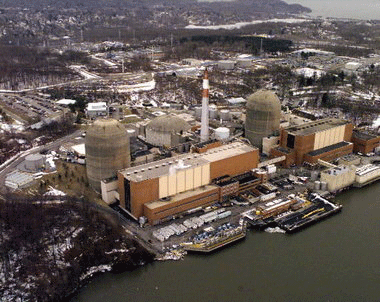 to win support for Indian Point, advocacy group Common Cause found.
Entergy, the owner of Indian Point, has been working since 2007 to get its two aging reactors relicensed. Environmental groups and some officials, including Governor Andrew Cuomo, said they’re concerned it’s unsafe for the 40-year-old plant to keep operating just 25 miles from New York City.
A spokesman for Entergy, Jerry Nappi, said the nonprofit coalitions — NY AREA and SHARE — have readily acknowledged that the company was a founding member. A number of organizations such as unions and business groups are also involved with the coalitions, Nappi pointed out. He added that the amount spent on lobbying and political activities a year is relatively small given the size of the company.
The license for one of Indian Point’s reactors expires in September.
Nevada population was exposed to nuclear bomb tests’ radioactive fallout
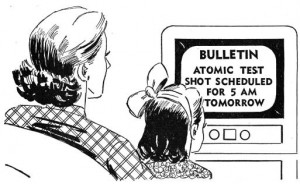 Add this little public service booklet, illustrated with the drawing at left and written by the Atomic Energy Commission to the people of Nevada:
“You are in a very real sense active participants in the Nation’s atomic test program. … Some of you have been inconvenienced by our test operations. At times some of you have been exposed to potential risk from flash, blast, or fall-out. You have accepted the inconvenience or the risk without fuss, without alarm, and without panic. Your cooperation has helped achieve an unusual record of safety.”
As though they were asked.
How Do We Know Nuclear Bombs Blow Down Forests? Because we built a forest in Nevada and blew it down. Slate, By Ann Finkbeiner May 31, 2013, “……. Once the United States had built the first atomic bomb in 1945, it then improved it by building the first hydrogen bomb in 1952. It then began working on building more portable bombs, and since the Soviet Union had done the same, the United States also wondered about the bombs’ effects. So in the early 1950s, the government set up models of all the things that bombs could blow up—houses, bridges, cars, pigs, sheep—and exploded bombs near them. The government did this for at least a decade and didn’t stop until it and the rest of the world banned above-ground testing. The tests, many of them at the Nevada Test Site, were called “shots,” and they had names.
The shot called Encore was on May 8, 1953, and among the many effects it tested was what a nuclear bomb would do to a forest. The Nevada Test Site wasn’t replete with forests, so the U.S. Forest Service brought 145 ponderosa pines from a nearby canyon and cemented them into holes lined up in tidy rows in an area called Frenchman Flat, 6,500 feet from ground zero. Then the Department of Defense air-dropped a 27-kiloton bomb that exploded 2,423 feet above the model forest. The heat set fire to the forest, then the blast wave blew down the trees and put out some fires and started others. Here’s the video. Continue reading
Northern Saskatchewan First Nation to drop lawsuit, signs up with uranium companies
Northern Saskatchewan First Nation signs uranium mining deal worth $600 million http://www.newstalk650.com/story/northern-saskatchewan-first-nation-signs-uranium-mining-deal-worth-600-million/112624 Agreement with mining giants Cameco and Areva calls for First Nation to drop lawsuit over proposed mine by Nigel Maxwell May 31, 2013 The English River First Nation in northern Saskatchewan has signed a deal with Uranium mining giants Cameco and Areva worth $600 million.
Much of money is to flow to the First Nation over 10 years through contracts with band-owned businesses and wages to band members who would work at the mines and on community development projects.
Part of the agreement calls for the First Nation to drop a lawsuit over land near the proposed Millennium mine project.
Some members of the band have raised concerns about the environmental impact of more uranium in the area.
USA’s outdated ineffective nuclear weapons strategy
Time to fix our seriously misaligned nuclear strategy, THE HILL, By Brig. Gen. Stephen A. Cheney, USMC (Ret.), and Matthew Wallin – 05/31/13 In anticipation of the G8 summit next month, we can expect serious discussion to be held about how to address today’s nuclear threats, including proliferation, the risks posed by the Iranian nuclear program and North Korean provocations.
As we have seen over the past 12 years, should a military response be deemed necessary to meet these threats, the U.S. has demonstrated itself to be the most effective practitioner of symmetric warfare the world has ever seen — but addressing asymmetric challenges has proven significantly more difficult.
Our experiences have shown that the biggest threats to our warriors have not been other armies, but IEDs; the biggest threats to our ships have not been big navies, but small boats and missiles. And today, the biggest threats to our nuclear security are asymmetric as well.
Despite this, and more than two decades after the end of the Cold War, we still maintain a vastly oversized nuclear arsenal designed to destroy a country 185 times the size of North Korea. This strategic misalignment leaves an enormous gap in our ability to counter modern nuclear threats. The more than 1,500 deployed nuclear weapons currently in our arsenal may have been historically effective in deterring a nuclear exchange with the Soviet Union, but this arsenal has done nothing to deter the ongoing proliferation of such weapons.
While we continue to have political disagreements with Russia, we both agree that maintaining massive nuclear arsenals no longer holds the strategic utility it did decades ago. The situation is ripe for change.
We should therefore seize this prime opportunity and realign our nuclear strategy to counter adversaries that pose real nuclear threats. Thus far we are making the grave mistake of not adapting, for example, this year, the administration’s budget request oddly increases funding for nuclear weapons by 17 percent — a choice that does nothing to neutralize the actual capabilities of our adversaries.
So what should a properly aligned nuclear strategy look like?……..
And finally, we must continue to work with Russia and other countries in order to reduce the enormous size and expense of our nuclear arsenals, thereby allowing us to redistribute those funds to the tools and programs designed to address real and potential threats. It certainly makes more sense than throwing money away to counter a security challenge that no longer exists.: http://thehill.com/blogs/congress-blog/homeland-security/302741-time-to-fix-our-seriously-misaligned-nuclear-strategy#ixzz2Uzswk25w
More radiation exposure when contrast medium is used with CT scans
Radiation dose increased for every organ scanned at CT, particularly in the most vascularized tissues, wrote researchers from the University of Messina in Italy. Average doses rose by one-fifth for the liver, one-third for the spleen and pancreas, and almost three-fourths for the kidneys.
“The results are in agreement with our previous data, confirming an increase in organ radiation dose in contrast-enhanced CT compared with unenhanced CT,” wrote Dr. Ernesto Amato and colleagues (AJR, June 2013, Vol. 200:6, pp. 1288-1293)……
Investigators have also found an increase in the frequency of cellular abnormalities in patients who underwent contrast-enhanced radiographic examinations. But the actual increase in dose for any given scan — which depends on iodine uptake; the shape, volume, and position of the organ; and the emitted x-ray energy spectrum — remains unknown, the authors wrote…….
Confirming dose increases
The results were in line with the group’s previous phantom study, and they confirmed significant radiation dose increases in contrast-enhanced CT versus unenhanced CT, Amato and colleagues wrote. The data showed average dose increases of 19% for the liver, 71% for the kidneys, 33% for the spleen and pancreas, and 41% for the thyroid.
“The kidneys showed the maximum among the average dose [increases] (71%, resulting from an attenuation increment of 139 HU),” the authors wrote.”High renal enhancement is, in fact, due to both their high vascularization because they receive 20% to 25% of the cardiac output and the passage of iodine within the renal tubules. In particular, the level of contrast medium within renal tubules can be up to 50 to 100 times higher than that in the blood because of the mechanisms of tubular concentration and secretion.”
Thyroid tissue showed the second highest dose increase (41%) after contrast injection, based on an HU increase of 87%. Also, the dose increases in the thyroid depended on tissue density on unenhanced CT, the group noted. Denser thyroids showed a lower increase in attenuation and, consequently, lower increases in dose.
Because the liver and spleen are richly vascularized, Hounsfield units increased with contrast by 49 HU and 71 HU, respectively, and average dose increased by 19% and 33%……. http://www.auntminnie.com/index.aspx?sec=ser&sub=def&pag=dis&ItemID=103565
USA government push for nuclear energy has ended in failure
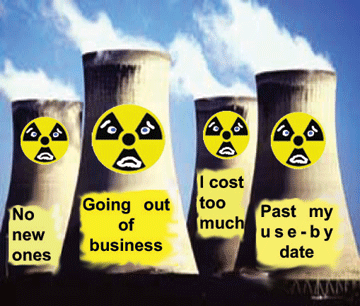 It was not supposed to be this way. In 2005 Congress approved subsidies to bolster the nuclear industry and encourage the construction of new plants. It extended a law limiting owner liability in case of accidents and, for the first few new reactors, offered $18 billion in loan guarantees, $2 billion in indemnification against cost overruns and $1 billion in tax breaks.
The NRC streamlined its licensing procedures, hoping to avoid the years of delays that inflated costs for earlier nuclear plants. (Southern ended up paying $8.7 billion for the existing reactors at Vogtle, a far cry from the $660m originally projected.)
None of this has worked as advertised.
Fracked off Thanks to cheap natural gas, America’s nuclear renaissance is on hold The Economist, Jun 1st 2013 | BURKE COUNTY, GEORGIA IT IS the sort of thing you would expect to see in China, not in the pine forests of rural Georgia. On the banks of the sluggish Savannah river towers one of the world’s biggest cranes. It is helping build two nuclear reactors, to add to the two already up and running at the Vogtle power plant. It testifies to the mammoth efforts that have been made in recent years to revive America’s nuclear industry—and to the disappointing results. Continue reading
Radioactive wastes with a half life of 704 million years, for Nevada
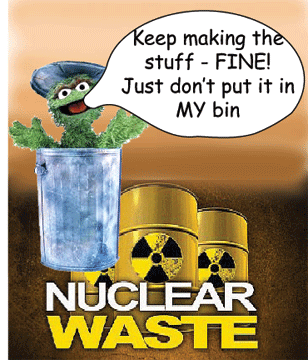 Nye county officials: Uranium waste might require underground concrete container By KEITH ROGERS LAS VEGAS REVIEW-JOURNAL, 30 May 13 Burying a ton of orphaned uranium waste from Tennessee at the Nevada National Security Site might require installing a concrete container to keep its radioactive ingredients out of the environment and its dirty bomb material from falling into the wrong hands, according to Nye County officials who were at a closed-door meeting this week.
And with a half life of 704 million years for its main component, uranium-235 — the atom-splitting material used in the first U.S. nuclear bomb — they wonder if the Department of Energy can maintain high-security vigilance and keep radioactive contaminants from seeping into the environment long after its containment has decayed.
“Having to rely on the government to maintain security is an issue. It’s very difficult to look that far into the future,” said Darrell Lacy, director of the Nye County Nuclear Waste Repository Project Office. Continue reading
URENCO might die, in failing global uranium industry
 one of the more important factors, surely, is the projected value of the MOX itself, which in turn is a function of long term uranium prices—there would be no point in completing the plant and then making the MOX, as opposed to just dumping the plutonium, if uranium will be dirt-cheap as far ahead as one can see.
the fate of the MOX plant is but one indicator of retrenchment in the global nuclear fuels market, post-Fukushima
the Japanese nuclear shut-down, which, the Times went on to note, has reduced global demand for nuclear fuels by close to 10 percent, plus Germany’s planned nuclear exit, have cast a pall that now stretches to New Mexico,
Kentucky, and South Carolina.
Restructuring and Retrenchment in Nuclear Fuels http://spectrum.ieee.org/energywise/energy/nuclear/restructuring-and-retrenchment-in-nuclear-fuels By Bill Sweet 29 May 2013 In 2000, the United States agreed with Russia to get rid of 34 tons of weapons-grade plutonium. To that end, it embarked on construction of a large plant at Savannah River, S.C.,where the plutonium would be mixed with uranium to make so-called mixed oxide fuel (MOX), suitable for use in nuclear power plants.
Buried in the president’s fiscal 2014 budget request is a line sharply cutting funding for the Savannah River MOX plant, which “may be tantamount to killing it,” a former National Nuclear Security Administration official told Arms Control Today. Continue reading
Beaverlodge area – an example of uranium mining’s filthy legacy
Uranium mining legacy expensive, The Star Phoenix, By Ann Coxworth, May 30, 2013 “…….The Canadian Nuclear Safety Commission recently reviewed plans for continuing management of some of the contaminated sites in northern Saskatchewan – relics of uranium mining activities that took place during the 1960s and 1970s.
The cost of remediating surface waters to levels compatible with Saskatchewan surface water quality objectives is so overwhelming thatwe know it will never happen.
Because the companies that caused the pollution are no longer in existence, these costs now fall to the federal and provincialtaxpayers. The goal of industry and regulators now is simply to prevent the contamination from getting any worse.
One such contaminated region is the Beaverlodge area. Continue reading
San Onofre: call for criminal investigation into Southern California Edison’s statements
“Now that this precise failure has occurred, and there has been a leak of radioactive material, Edison claims that it could simply restart the nuclear plant at 70 percent capacity, and once again circumvent the full safety and licensing process,” Boxer said. “How could they first assert that tube failure would be a ‘disastrous outcome’ and now claim that it is no big deal?”
 Senator Boxer Seeks Criminal Probe of San Onofre Nuclear Plant WASHINGTON, DC, May 29, 2013 (ENS) – U.S. Senator Barbara Boxer of California is asking the Justice Department to open a criminal investigation into Southern California Edison’s statements to nuclear regulators about replacing steam generators at the shuttered San Onofre nuclear power plant.
Located on the California coast south of San Clemente, San Onofre has been shut down since January 2012 due to premature wear found on over 3,000 tubes in replacement steam generators and a leak of radioactive material.
Senator Boxer Tuesday released a 2004 letter by an Edison executive to steam generator manufacturer Mitsubishi Heavy Industries that she said presents “major new evidence of misrepresentation and safety lapses by Edison.” Edison replaced steam generators in 2009 and 2010 without review by the Nuclear Regulatory Commission because the company said the replacements met a federal test of being the same parts. Continue reading
Landfill on fire a threat to nearby nuclear waste
“The bottom line is it’s very serious,” “What’s happening up here is not something that has ever been encountered before. They’ve had landfill fires and nuclear waste, but never in such close proximity.
Smoldering Landfill Could Threaten Nuclear Waste, abc News, By JIM SALTER Associated Press BRIDGETON, Mo. May 29, 2013 Dawn Chapman can put up with the noxious smell caused by smoldering trash in a landfill near her suburban St. Louis home. But if the burning creeps close to buried nuclear waste, she’s ready to get out.
It’s a problem that worries many people in this densely populated area near Lambert Airport, where the trash burns just 1,200 feet from another landfill that holds radioactive waste dating back to the Manhattan Project, which created the first atomic bomb in the 1940s. Continue reading
San Onofre: Southern California Edison intentionally misled nuclear regulators
Senator Boxer calls for probe on California nuclear plant, Christina Science Monitor 28 May 13 Sen. Barbara Boxer (D) of California charges that Southern California Edison intentionally misled regulators in order to avoid an extensive safety review of upgrades to its San Onofre nuclear plant. Senator Boxer has called on the Justice Department to investigate. By David J. Unger, Correspondent / May 28, 2013 The operator of a California nuclear plant is under fire from a US senator for allegedly misrepresenting the nature of an equipment upgrade that resulted in a small radioactive leak at the plant last year. It’s another blow to Southern California Edison (SCE), which has worked to reopen the closed San Onofre Nuclear Generating Station for over a year. The fallout has cost the company more than $553 million and drawn attacks from environmentalists who say the plant is inherently unsafe.
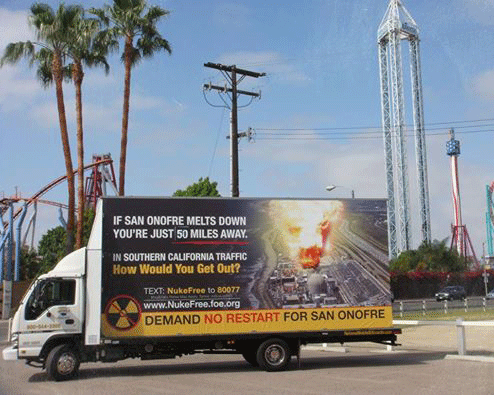
On Tuesday, Sen. Barbara Boxer (D) of California released a private company letter she says is evidence of the company intentionally misleading regulators in order to avoid an extensive safety review of upgrades to San Onofre. She has called on the Justice Department to investigate. Continue reading
In 1983, nuclear war was only just avoided

While historians have previously noted the high risk of an accidental nuclear war during this period, the new documents make even clearer how the world’s rival superpowers found themselves blindly edging toward the brink of nuclear war through suspicion, belligerent posturing and blind miscalculation.
The USSR and US Came Closer to Nuclear War Than We Thought A series of war games held in 1983 triggered “the moment of maximum danger of the late Cold War.” The Atlantic, DOUGLAS BIRCHMAY 28 2013 An ailing, 69-year-old Yuri Andropov was running the Soviet Union from his Moscow hospital bed in 1983 as the United States and its NATO allies conducted a massive series of war games that seemed to confirm some of his darkest fears.
Two years earlier Andropov had ordered KGB officers around the globe to gather evidence for what he was nearly certain was coming: A surprise nuclear strike by the U.S. that would decapitate the Soviet leadership. …
The Western maneuvers that autumn,called Autumn Forge, , were depicted by the Pentagon as simply a large military exercise. But its scope was hardly routine, as Americans learned in detail this week, for the first time, from declassified documents published by the National Security Archive, a Washington-based nonprofit research organization. Continue reading
1 This Month
23-25 October – on Zoom – World BEYOND War’s annual global conferenc


Shut down the radiation-damaged Heysham nuclear reactors now
To see nuclear-related stories in greater depth and intensity – go to https://nuclearinformation.wordpress.com

Say No to NASA’s Reckless Nuclear Reactor on the Moon
Say No to NASA’s Reckless Nuclear Reactor on the Moon

-
Archives
- October 2026 (199)
- September 2026 (339)
- August 2026 (330)
- July 2026 (355)
- June 2026 (287)
- May 2026 (306)
- April 2026 (356)
- March 2026 (251)
- February 2026 (267)
- January 2026 (308)
- December 2025 (358)
- November 2025 (359)
-
Categories
- 1
- 1 NUCLEAR ISSUES
- business and costs
- climate change
- culture and arts
- ENERGY
- environment
- health
- history
- indigenous issues
- Legal
- marketing of nuclear
- media
- opposition to nuclear
- PERSONAL STORIES
- politics
- politics international
- Religion and ethics
- safety
- secrets,lies and civil liberties
- spinbuster
- technology
- Uranium
- wastes
- weapons and war
- Women
- 2 WORLD
- ACTION
- AFRICA
- Atrocities
- AUSTRALIA
- Christina's notes
- Christina's themes
- culture and arts
- Events
- Fuk 2022
- Fuk 2023
- Fukushima 2017
- Fukushima 2018
- fukushima 2019
- Fukushima 2020
- Fukushima 2021
- general
- global warming
- Humour (God we need it)
- Nuclear
- RARE EARTHS
- Reference
- resources – print
- Resources -audiovicual
- Weekly Newsletter
- World
- World Nuclear
- YouTube
-
RSS
Entries RSS
Comments RSS

