Another delayed hearing about Rapid City uranium mining plan
 Water board delays Rapid City uranium mine hearing http://www.seattlepi.com/news/science/article/Water-board-delays-Rapid-City-uranium-mine-hearing-5010884.php, November 25, 2013 PIERRE, S.D. (AP) — A second state panel has delayed hearings on a proposed uranium mine in the Black Hills until two federal agencies decide on the project.
The South Dakota Water Management Board on Monday postponed its second week of hearings scheduled for the week of Dec. 9 in Rapid City.
The Board of Minerals and Environment earlier delayed its second round of hearings on Powertech Uranium Corp.’s application for a mine near Edgemont.
Both state boards say they’ll reschedule after the Nuclear Regulatory Commission and Environmental Protection Agency rule on the project and establish financial surety. The Water Management Board says the delay was in response to a request from Powertech and other parties. The panel must decide whether to grant water rights permits and a groundwater discharge plan.
Staten Island radioactive clean-up drags on
 Radiation Cleanup at Park on Staten Island to Take Years NYT, By LISA W. FODERARO November 25, 2013 The first sign that something was amiss at Great Kills Park, on Staten Island, came in 2005 when a police flyover of New York City detected a positive reading for radioactive material there. The finding, part of a counterterrorism search, did not come as a complete shock. After all, the 488-acre park was the depository for 15 million cubic yards of fill in the 1940s and 1950s, including medical and sanitary waste. The fill was dumped across wetlands to turn marshy areas into usable recreation space. Some of the waste, it turned out, contained radium, a naturally occurring element that was also used for decades in medical treatments, toys, cosmetics and even toothpaste.
At first, the source of radiation appeared to be confined to a small area behind a parking lot next to a field popular for flying model airplanes. The National Park Service, which operates the park, quickly fenced it off. But in the years since, further investigations by the city’s Department of Health and Mental Hygiene, the federal Environmental Protection Agency and the United States Army Corps of Engineers turned up more hot spots and a fuller, more disturbing picture.
Continue reading
Ruptured pipeline leaks radioactive water from old uranium mill
Pipeline blamed for spill at former uranium plant in Colorado http://trib.com/business/energy/pipeline-blamed-for-spill-at-former-uranium-plant-in-colorado/article_de1c924f-92ae-5df5-b0d8-e5be8d2282da.html By the Associated Press, 25 Nov 13, CANON CITY, Colo. — A pipeline rupture led to a spill of an estimated 4,000 to 9,000 gallons of contaminated water spilled at a former uranium mill near Canon City, but an on-site collection system contained the spill, officials told residents.
A joint on the underground pipeline broke Nov. 5, unleashing the spill at the defunct Cotter Corp. mill, Jennifer Opila, a radioactive materials monitor for the state health department, told the Thursday meeting. The pipe was repaired and operable by Nov. 6, Opila said.
Cotter safety officer Jim Cain said between 4,000 and 9,000 gallons of water spilled. A sample showed traces of uranium and molybdenum were found, Cain said.
John Hamrick, vice president of Cotter Mill operations, said there have been three leaks “in three different years, all for different reasons.”
Cotter once processed uranium for weapons and fuel at the mill. Federal authorities placed the mill on a national list for Superfund cleanups in the 1980s after radioactive materials traced to the mill were found to have contaminated the soil and groundwater. Part of the neighboring Lincoln Park community also is a Superfund site.
The U.S. Environmental Protection Agency eventually turned oversight of cleanup work to state officials.
Uranium hasn’t been processed at the mill since 2006. The state requires mill sites that are being decommissioned to be thoroughly cleaned up and restored at the operator’s expense. It’s expected to be a multimillion-dollar effort.
Renewable energy storage is going to change everything!
Energy storage fans are rejoicing all across the country on the heels of a new ruling by the Federal Energy Regulatory Commission (FERC), which opens the floodgates to connecting more solar arrays and wind farms to the power grid. FERC adopted the new ruling, Order 792, in order to bring its existing rules for small generators up to speed with new developments in the energy storage field.
As FERC explained when issuing Order 792:
…the Commission finds it necessary under section 206 of the Federal Power Act to revise the pro forma SGIP [Small Generator Interconnection Procedures] and pro forma SGIA [Small Generator Interconnection Agreement] to ensure that the rates, terms and conditions under which public utilities provide interconnection service to Small Generating Facilities remain just and reasonable and not unduly discriminatory.
Our friends over at the Energy Storage Association contributed to public comments on the rule during its proposal phase and they tipped us to the new ruling, so let’s see what they have to say about it.
Energy Storage Gets A Boost From FERC Order 792
In a nutshell, Rule 792 adds energy storage as a power source that is eligible to connect to the grid. It effectively puts energy storage in the same category as the existing Small Generator Interconnection Procedures and makes it eligible for the existing Fast Track process.
Darrel Hayslip, who chairs the ESA, was fast out of the box with a big thank-you to FERC:
We commend the FERC Commissioners for acknowledging that energy storage should be able to participate in the small generator interconnection process on our electric grid and that our rules and policies should evolve as well. These reforms are good news for storage project developers and further facilitate the deployment of storage on the power grid………
Barn Door Is Already Open
If you’re thinking that it will be a while before energy storage technology can get to the point where the industry can take advantage of the new FERC rules on a mass scale, guess again.
Energy storage for wind and solar is already well on its way to the mainstream………
The addition of utility scale storage facilities is expected to have a ripple effect on the renewable energy market in Hawaii, by contributing to grid flexibility.
Not for nothing, but Xtreme Power has some heavy hitters in its investment portfolio, including some that indicate the fossil fuel industry is continuing its slow (very slow) and lurching pivot to a more diversified approach to energy generation.
That would be BP Alternative Energy (yes, that BP) and Dominion Resources (yes, that Dominion). http://reneweconomy.com.au/2013/renewable-energy-barriers-fall-with-new-ferc-order-67494
President John F Kennedy speech on peace June 10 1963
 Commencement Address at American University, June 10, 1963 http://www.jfklibrary.org/Asset-Viewer/BWC7I4C9QUmLG9J6I8oy8w.aspx
Another uranium company stops operations, with poor market prospects
Company slows uranium mining in northern Arizona, Yahoo 7 Finance 21 Nov 13,Uranium mining company to temporarily halt operations in northern Arizona amid low ore prices. FLAGSTAFF, Ariz. (AP) — The only two uranium mines operating in Arizona and an associated mill in southern Utah are set to cease operations temporarily as prices for the ore decline.
Energy Fuels Resources Inc. said uranium at its Arizona One Mine in the north part of the state will be depleted in early 2014, and the nearby Pinenut Mine and the White Mesa Mill in Blanding, Utah, will be placed on standby next year.
The move comes after the company stopped short of extracting uranium at another mine south of the Grand Canyon near Tusayan and as per-pound prices for uranium on the spot market dip to a five-year low, in the mid-$30s. The company plans to maintain the sites so that they can begin operating if the uranium market improves……..
Environmentalists are looking to the U.S. Forest Service and the U.S. Bureau of Land Management to ensure that the company doesn’t leave anything behind that would harm wildlife or the landscape.
“It’s a good thing on the one hand, but there’s a systemic problem in the regulations by the land management agencies that allow these mines to blink on and off at will without any review or revision in their plans of operation,” said Roger Clark of the Grand Canyon Trust. http://au.finance.yahoo.com/news/company-slows-uranium-mining-northern-153826141.html
Damage and destruction: Tornado hits U.S. nuclear facility

 Tornado hits U.S. nuclear facility – Uranium enrichment building damaged — Parts of cooling towers destroyed — Alert declared for ‘emergency condition’ (PHOTOS) http://enenews.com/tornado-hits-nuclear-facility-damage-uranium-enrichment-building-parts-cooling-tower-destroyed-photos
Portsmouth Daily Times,, Nov. 18, 2013: Tornado hit Paducah plant Sunday [in Kentucky]
WPSD,, Nov. 17, 2013: One of the plant’s four enrichment production buildings, the adjacent cooling towers and nearby electrical switchyard sustained most of the damage. Several of the transite panels that cover the building were torn off or broken. Electrical power poles, wiring and other electrical circuits were also damaged. The shrouds or collars that surround the fans on this set of cooling towers were destroyed.
Damaged cooling tower (SOURCE: USEC)
NBC Lexington, KY, , Nov. 18, 2013: Officials were continuing to monitor the facility Monday, but said there had been no hazardous material releases, according to the statement.
NRC Report,, Nov. 17, 2013: [A]n alert was declared at the Paducah Gaseous Diffusion Plant due to an apparent tornado strike/severe weather event. […] “This event is reportable under 10 CFR 76.120(a)(4) where an emergency condition has been declared an Alert. […]”
The Courier Journal, Nov. 18, 2013: USEC stopped enriching uranium there in June.
Nearly all news outlets covering the Paducah tornado claim the plant stopped enriching uranium earlier this year. However, according to this report, (Emphasis Added) “On 14 November 2013 Russia has shipped the last batch of low-enriched uranium […] The cargo will be delivered to Baltimore and then to USEC’sPaducah Gaseous Diffusion Plant in Kentucky, where the uranium will be used to manufacture fuel for U.S. nuclear power plants.”
Also note the vast majority of reports only say that no “hazardous materials” were released — releases of “radioactive material” are not denied or admitted (see USEC’s twitter feed) The plant’s internal documents clearly distinguish between “hazardous” and “radioactive”. For example, APPENDIX F reads, “Categories of waste evaluated were LLW [low-level radioactive waste], TRU [transuranic waste], hazardous waste […] All low-level mixed (radioactive and hazardous) waste (LLMW) and hazardous waste at these sites are transported off site.”
Interestingly, USEC’s last tweet before the tornado hits is a message promoting a local showing of CNN’s much maligned pro-nuclear film ‘Pandora’s Promise‘, an event they appear to be sponsoring.
See more photos of the damage at the plant on USEC’s twitter feed here
The coming epidemic of nuclear reactor shutdowns: where to put the wastes?
The NRC believes the fuel can be safely stored for at least 100 in casks. But the radioactive half life is 16 million years, with a defined hazardous life of 160 million years. The world will soon be dotted with these ad-hoc radioactive dumps.
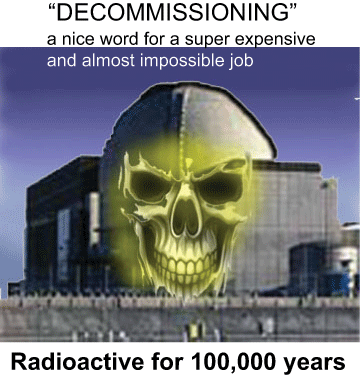 For aging nuclear reactors, a coming surge of shutdowns How safe will these ad-hoc radioactive dumps be?, Kevin Gray, SmartPlanet, 20 Nov 13
When it first fired up its twin reactors in 1973, the Zion nuclear power plant in Illinois — roughly 40 miles north of Chicago — was the largest in the world. It was a stunning work of technology that supplied electricity to some two million homes. And it could have easily lived on into the new century. But in 1998, its parent company, the energy giant Exelon Corp, turned off its lights and shuttered the facility rather than face some costly upgrades.For 12 years, Zion sat dormant on prime Lake Michigan shorefront as Exelon shelled out $10 million a year to maintain it and protect it with round-the-clock patrols of armed guards. By 2010, the facility had become home to drifting weeds and nesting falcons.
But that year, the federal government — in an arrangement never tried before — agreed to allow Exelon to transfer custody of the plant to EnergySolutions, a nuclear-waste storage outfit. The deal was worth a potential $1 billion in clean-up fees to EnergySolutions. It would be the largest nuclear power plant decommissioning ever undertaken in the United States. And it pledged to return the 375-acre site back to Exelon as grass and local shrubbery at the end of 10 years……..
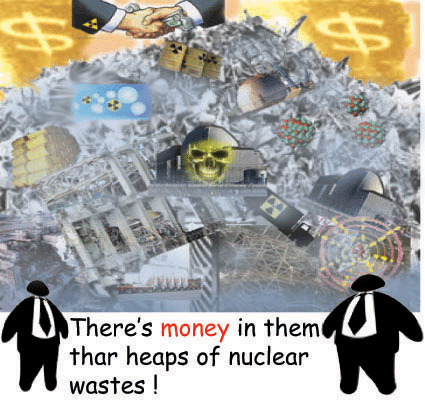
EnergySolutions has spent the past year removing Zion’s fuel rods from a cooling pool and putting them into the canisters and casks for dry storage. The fuel, which is still about 400 degrees, can now be air cooled. Christian expects the company to begin moving the casks, via a heavy-haul rail, 100 yards south of the reactors by mid-October.
They will remain there until the feds come up with an alternative to Yucca Mountain. “Until we have a national repository open, this spent fuel has to stay where it is,” says Lawrence Boing, a nuclear decommissioning specialist at Argonne National Laboratory’s nuclear engineering division. “The big question now is what do we do with this stuff?” Continue reading
Hanford cracks down on safety whistleblowers
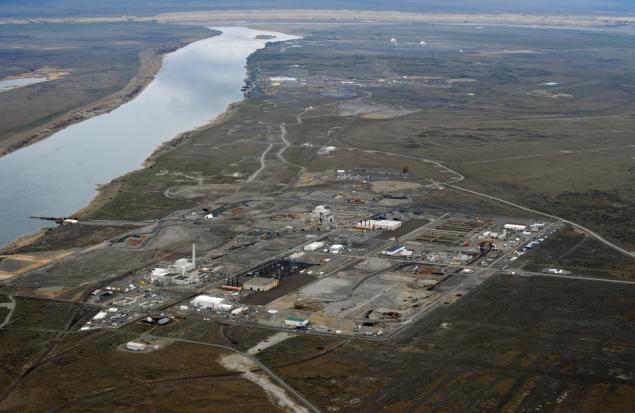 Hanford nuclear site clean-up: The mess gets worse NBC News Investigations, By Rebecca LaFlure, The Center for Public Integrity 18 Nov 13 “……….In addition to the cost increases, construction delays and critical reports, employees and independent agencies have said DOE and contractor officials overseeing the project created a workplace climate that discourages employees from raising technical and safety concerns.
The most prominent of the plant’s whistleblowers is Walter Tamosaitis, the project’s former research and technical manager for URS, the prime subcontractor to Bechtel.
Tamosaitis’s troubles began after a 2010 meeting with Bechtel and URS managers, at which he turned over a list of technical issues that he said could affect plant safety, including continuing uncertainties about how the wastes should be kept mixed to stop them from settling into a critical mass and causing a chain reaction. If that happened, the resulting explosion would release deadly radiation.
Two days later, on July 2, URS, acting under orders from a Bechtel executive, pulled him from the project, according to a federal court complaint Tamosaitis filed in November 2011. He was reassigned to a basement office and stripped of supervisory responsibilities…….
Other technical managers have also alleged retaliation for expressing safety concerns. Donna Busche, a URS employee and the plant’s manager of environmental and nuclear safety, filed a lawsuit against Bechtel and URS in February claiming the companies treated her as a “roadblock to meeting deadlines.” URS and Bechtel officials excluded her from meetings and belittled her authority, she alleged. The companies deny it.
Busche said her troubles escalated after she questioned DOE’s judgment at an Oct. 7, 2010, safety board hearing about how much radiation might escape in the event of an accident at the plant. Board officials had expressed concern that DOE’s calculations may underestimate the threat, but Ines Triay, then DOE’s assistant secretary for environmental management, defended the calculations…….http://investigations.nbcnews.com/_news/2013/11/18/21482804-hanford-nuclear-site-clean-up-the-mess-gets-worse?lite
Gridline from Wyoming to Idaho a leap ahead for wind energy
 Obama’s Renewable Energy Initiative Changing US Landscape http://www.ibtimes.com/obamas-renewable-energy-initiative-changing-us-landscape-1474130 By David Kashi November 18 2013 The Department of Interior has approved the first major U.S. energy transmission project that will integrate existing renewable sources of electricity spanning the western U.S.
The 900-mile Gateway West Transmission Line project, proposed by Idaho Power and Rocky Mountain Power, will stretch from southern Wyoming to southern Idaho and will carry 1,500 gigawatts of energy, mostly generated by wind farms. A gigawatt of energy is 1,000 megawatts, and one megawatt can sustain about 1,000 homes for one hour.
The project is part of Obama’s 2009 initiative to revamp the U.S. transmission infrastructure through an interagency initiative called the Rapid Response Team for Transmission.
“Gateway West is a high-priority project of the president’s power infrastructure initiative – a commonsense approach that is speeding job creation in the near term while spurring the economy and increasing the nation’s competitiveness in the long term,” Sally Jewell, head of the Department of Interior, announced last week. “The line will strengthen the Western grid, bringing a diversified portfolio of renewable and conventional energy to meet the region’s projected growth in electricity demand.” Gateway West is one of seven pilot projects that will span the U.S. It’s estimated that at peak construction the seven projects will create around 1,200 jobs.
The development of the project went through a rigorous environmental impact and public comment period, results from which included the route for the transmission lines being crafted to use existing transmission corridors to avoid harming sensitive landscapes.
“Transmission is a vital component of our nation’s energy portfolio, and these seven lines, when completed, will serve as important links across our country to increase our power grid’s capacity and reliability,” Ken Salazar, former secretary of the Department of Interior, said in October. “This is the kind of critical infrastructure we should be working together to advance in order to create jobs and move our nation toward energy independence.”
 |
Click here to Reply or Forward
|
Yet another uranium company makes wider losses
 Energy Fuels makes efforts to sustain current drop in uranium prices Proactive Investors by Deborah Bacal 16 Nov 13 Energy Fuels (TSE:EFR)(OTCQX:EFRFD), which recently gained a majority stake in one of the largest and highest grade uranium projects in the U.S. through its acquisition of Strathmore Minerals, reported widened third quarter losses as a result of a drop during the period in both uranium spot and term prices, which it sees rising in the future.
For the three months to September 30, America’s largest conventional uranium producer, which says it has a strategy in place to beat current low prices, reported net loss was $70.47 million, or $4.30 per share, compared to $19.16 million, or $1.41 per share, a year ago. Revenues fell slightly to $24.5 million from $25.03 million.
As a result of the downward trend in prices through to the end of the quarter and Energy Fuels’ expectations to place the Pinenut mine on stand-by in July of next year, the company said it recorded an impairment loss of $60.26 million in the period. ince July 1, the spot price of uranium dropped from $39.65 per pound to its current price of $35.35 per pound, the company noted, and the long term price declined from $57.00 per lb. to $50.00 per pound.
Power companies awarded $235M In Nuclear Waste Disposal Dispute
 Federal Judge Awards Nuclear Power Sites $235M In Disposal Dispute By BRIAN DOWLING, bdowling@courant.comThe Hartford Courant November 15, 2013 A federal judge has awarded three New England nuclear power companies $235.4 million in damages in the second of three cases against the U.S. government for failing to dispose of the plants’ nuclear waste.
The federal government has 60 days to appeal.
The companies operated the Connecticut Yankee nuclear plant in Haddam, and two plants in Maine and Massachusetts, which have been deactivated for decades. If the judgment from U.S. Court of Federal Claims Judge James F. Merrow stands, the millions of dollars in damages will head to ratepayers. The suit was filed over the U.S. Department of Energy‘s failure to remove nuclear waste from the plants. This phase of damages covers disposal costs from 2002 to 2008……..
Connecticut’s share of the millions is unclear. It depends on a number of factors, including how much of the energy for all the plants was delivered to the state.
Damages awarded in the first case totaled $160 million, and the state’s share amounted to $75 million. In February, the federal government reimbursed the nuclear power companies for the first time, following the Energy Department’s lack of challenge to a U.S. Court of Appeals decision.
The company has filed for a third phase of damages for the period covering 2009 to 2012.http://www.courant.com/business/hc-nuclear-plant-connecticut-yankee-lawsuit-20131115,0,3448137.story
In USA nuclear whistleblowers are at risk
 Nuclear Regulatory Commission Strips Whistleblower Protection by grtv 14 Nov 13, In sworn testimony in Monroe, Michigan, the NRC admitted that it has stripped whistleblower protection from the licensing of new nuclear power plants.
By flip-flopping on what it means to be an applicant, the whistleblowers who are truly looking to protect the public health and safety are having their lives and livelihoods jeopardized.
Fairewinds Chief Engineer Arnie Gundersen discusses what this means as utilities look for short cuts and cheaper ways to build new nukes.Arnie http://tv.globalresearch.ca/2013/11/nuclear-regulatory-commission-strips-whistleblower-protection?utm_source=rss&utm_medium=rss&utm_campaign=nuclear-regulatory-commission-strips-whistleblower-protection
Treasure Island, in San Franciso Bay, holds radiation danger
San Francisco families could be at risk of radiation poisoning – report RT.com November 14, 2013 A small island in the heart of San Francisco Bay could be a major source of radiation and the young families that live there may be at risk of poisoning, a new report from the California Department of Health has concluded.
Treasure Island, a man-made landmass within view of the Golden Gate Bridge, is the former site of a US military base that is now home to renovated land areas, playgrounds, and apartment buildings. San Francisco lawmakers previously announced their intention to build an 8,000-unit tower there once the Navy formally cedes land rights.
Earlier this year, workers with the California Department of Public Health found radioactive shards in the ground on the western side of the island. One object was so radioactive that holding it for an hour would result in burns, hair loss, and other maladies, according to the Center for Investigative Reporting.
An internal memo written in September and unveiled this week admonished officials’ prior notice for implying that the area is known to be safe.“Further evaluation should be made of the probability of a member of the public, especially critical members of the population (for example, children) picking up a radioactive fragment and being exposed,” state health officials wrote, as quoted by the Center for Investigative Reporting.
“As of 2011, 575 radioactive shards had been found on Treasure Island,” the memo continued. “Regulators have speculated that the shards could have been buried for military practice using Geiger counters, which measure radiation. Earlier this year CDPH officials found radioactive shards buried in lawns near apartments on the island.” …..http://rt.com/usa/san-francisco-radiation-poisoning-report-744/
Mitsubishi cutting back on nuclear engineering staff
Mitsubishi cutting Charlotte nuclear engineering staff in half Charlotte Business Journal, John Downey 14 Nov 13 Mitsubishi Nuclear Energy Systems will lay off 48 people from its Charlotte Engineering Center by the end of the year, cutting the staff by roughly half.
The layoffs come as Mitsubishi has decided to slow its efforts to get Nuclear Regulatory Commission certification of its US-APWR reactor. That led the power companyLuminant to announce plans last week to suspend its effort to license two 1,700 megawatt Mitsubishi reactors at the Commanche nuclear plant in Texas.
In April, Dominion announced it was abandoning plans to build a Mitsubishi unit at its North Anna Nuclear Station…….. Mitsubishi had about 100 workers when it celebrated the grand opening of its center in Ballantyne in spring of 2012.
At that time, executives said the center could have as many as 150 workers by 2017. But the center never got above the 100 mark.
The state offered $4.1 million in incentives to bring the center here.http://www.bizjournals.com/charlotte/blog/power_city/2013/11/mitsubishi-cutting-charlotte-nuclear.html
1 This Month
23-25 October – on Zoom – World BEYOND War’s annual global conferenc


Shut down the radiation-damaged Heysham nuclear reactors now
To see nuclear-related stories in greater depth and intensity – go to https://nuclearinformation.wordpress.com

Say No to NASA’s Reckless Nuclear Reactor on the Moon
Say No to NASA’s Reckless Nuclear Reactor on the Moon
-
Archives
- October 2026 (180)
- September 2026 (339)
- August 2026 (330)
- July 2026 (355)
- June 2026 (287)
- May 2026 (306)
- April 2026 (356)
- March 2026 (251)
- February 2026 (267)
- January 2026 (308)
- December 2025 (358)
- November 2025 (359)
-
Categories
- 1
- 1 NUCLEAR ISSUES
- business and costs
- climate change
- culture and arts
- ENERGY
- environment
- health
- history
- indigenous issues
- Legal
- marketing of nuclear
- media
- opposition to nuclear
- PERSONAL STORIES
- politics
- politics international
- Religion and ethics
- safety
- secrets,lies and civil liberties
- spinbuster
- technology
- Uranium
- wastes
- weapons and war
- Women
- 2 WORLD
- ACTION
- AFRICA
- Atrocities
- AUSTRALIA
- Christina's notes
- Christina's themes
- culture and arts
- Events
- Fuk 2022
- Fuk 2023
- Fukushima 2017
- Fukushima 2018
- fukushima 2019
- Fukushima 2020
- Fukushima 2021
- general
- global warming
- Humour (God we need it)
- Nuclear
- RARE EARTHS
- Reference
- resources – print
- Resources -audiovicual
- Weekly Newsletter
- World
- World Nuclear
- YouTube
-
RSS
Entries RSS
Comments RSS

