The “President of Peace” Prepares for War

After all, this is the same president who has decimated the U.S. diplomatic corps and dismantled Washington’s main economic and humanitarian aid organization, the U.S. Agency for International Development — hardly the actions of a president of global peace.
Republican calls for a full-scale war against that nation [Venezuela] are occurring despite the disastrous results of this country’s regime-change policies in Afghanistan, Iraq, Libya, and beyond in this century.
The Donroe Doctrine Hits Home
By William D. Hartung, Tomgram, December 21, 2025 https://tomdispatch.com/the-president-of-peace-prepares-for-war/
William D. Hartung, Talking Diplomacy, Promoting Conflict
Only recently, the Trump administration released its 2025 National Security Strategy (NSS), its look at global “security” at this very moment. As it happens, that document’s view of our planet right now was missing just a few passing things, globally speaking. Two of them happened to be Russia and China. Russia is only mentioned in a few paragraphs and the significance of China is distinctly downplayed. And of course, potentially the greatest ultimate danger to global security, climate change, is mentioned but once in this single sentence: “We reject the disastrous ‘climate change’ and ‘Net Zero’ ideologies that have so greatly harmed Europe, threaten the United States, and subsidize our adversaries.” Of course, no one should be surprised by that, not during the presidency of the man who has called climate change “the greatest con job ever perpetrated on the world.”
But it does turn out that there are a few things on this planet to fear, as that document makes clear. One of them is “civilizational erasure,” something that, if the far-right parties on the European continent don’t soon win the necessary elections, will surely be the fate of… yes, believe it or not, Europe — and the European Union, in particular. That continent, given immigration and other issues, could become “unrecognizable in 20 years or less,” or so the NSS claims.
And that’s just to begin a journey into the distinctly strange and unnerving national security (or do I mean national insecurity?) world of Donald Trump that TomDispatch regular William Hartung, co-author of The Trillion Dollar War Machine, lays out in vivid detail today. Perhaps, in future National Security Strategy documents, President Donald Trump himself will indeed be found responsible for nothing less than “civilizational erasure.”
Earlier this month, the Trump administration released its new National Security Strategy, or NSS. Normally, such documents are poor predictors of what’s likely to happen in the real world. They are more like branding tools that communicate the attitudes of a given administration while rarely offering a detailed or accurate picture of its likely policies.
The reason documents like the NSS are of limited import is simple enough: foreign and military policies aren’t set by documents but by power and ideology. Typically enough, the current U.S. approach to the world flows from struggles among representatives of contending interest groups, some of which, like the military-industrial complex (MIC), have a significant advantage in the fight. The weapons industry and its allies in the Pentagon and Congress wield a wide array of tools of influence, including tens of millions of dollars in campaign contributions, more than 1,000 lobbyists, and jobs tied to military-related facilities in the states and districts of key members of Congress. The MIC — which my colleague Ben Freeman and I refer to in our new book as the trillion-dollar war machine — also has considerable influence over the institutions that shape our view of the world, from the media to DC think tanks, Hollywood, the gaming industry, and our universities.
But the power and influence of the war machine are not going completely unchallenged. The grip of militarism and the institutions that profit from it are indeed being challenged by organizations like The Poor People’s Campaign: A Call for Moral Revival; Dissenters, a youth antimilitarism group based in Chicago; antiwar veterans organizations like About Face, Common Defense, and Veterans for Peace; longstanding peace groups like the Friends Committee on National Legislation and Peace Action; networks like People Over Pentagon and Dismantle the Military-Industrial Complex; the ceasefire and Palestinian rights movements on U.S. campuses and beyond; and groups working for racial and economic justice, gay and trans rights, immigration reform, the demilitarization of the police, or compensation for environmental damage caused by nuclear weapons testing and other military activities.
As such organizations coalesce, bringing together tens of millions of us whose lives and prospects are impacted by this country’s ever-growing war machine, let’s hope it might be possible to create the power needed to build a better, more tolerant, and more peaceful world, one that meets the needs of the majority of its people, rather than endlessly squandering precious resources on war and preparations for more of it.
So why pay attention to that new strategy document if what really determines our safety and security lies elsewhere? There are several reasons to do so.
First, the NSS has prompted discussion in the mainstream media and elite circles of what U.S. priorities in the world should actually be — and such a discussion needs to be expanded to include the perspectives of people and organizations actually suffering the consequences of our militarized domestic and foreign policies.
Second, that strategy paper reflects the unnerving intentions and worldview of the current administration, which, of course, has the power to determine whether this country is at war or peace.
Finally, it suggests just how the Trump administration would like to be perceived. As such, it should be considered a weapon in the debate over what kind of country the United States should be.
Touting the “President of Peace”
From the start, the submission letter that accompanies the new strategy document is pure Donald Trump. In case you hadn’t noticed, the current occupant of the Oval Office would have us believe that everything — every single thing! — he does is bigger, better, and more beautiful than anything that ever came before it. And that’s definitely the case, in the first year of his second term, when it comes to his view of what this country’s national security policies should actually be. As the letter puts it:
Continue reading‘Huge conflict of interest’: Trump’s $600 million windfall after nuclear deal.

ByMatt O’Brien and Jennifer McDermott, Sydney Morning Herald, December 19, 2025
The parent company of US President Donald Trump’s Truth Social media platform is merging with a fusion power company, an unusual pairing of the Trump name with a futuristic clean energy venture that aims to power the next wave of artificial intelligence. Trump Media & Technology announced its merger with TAE Technologies in an all-stock deal that the companies said was valued at more than $US6 billion ($9.1 billion).
The combined company says it plans to find a site and begin construction next year on the “world’s first utility-scale fusion power plant,” with aims to provide the electricity needed for artificial intelligence.
Nuclear fusion is seen as a promising solution to climate change caused by burning fossil fuels, but one that is a long way off compared to today’s clean technologies like wind and solar. It will need huge investment as well as regulation to advance, which makes Trump’s ties a major conflict, said Richard Painter, a former White House ethics lawyer in the George W. Bush administration.
“He’s jumping into this industry just like he jumped into cryptocurrency a couple of years ago,” Painter said. “Just as the United States government is gonna get all involved in it. And it’s so obvious that there’s a huge conflict of interest.”
Devin Nunes, the Republican congressman who resigned in 2021 to become the chief executive of Trump Media, will be co-CEO of the new company with TAE CEO Michl Binderbauer.
Shares of Trump Media & Technology have tumbled 70 per cent this year but jumped 34 per cent in afternoon trading on Thursday.
Trump is by far the largest stakeholder in Trump Media, owning 41 per cent of all outstanding shares. The share surge has added about $US400 million ($605 million) to Trump’s net worth, according to Forbes.
Backed by Google and other investors, TAE is a private company and the merger with Trump Media would create one of the first publicly traded nuclear fusion companies.
“We’re taking a big step forward toward a revolutionary technology that will cement America’s global energy dominance for generations,” Nunes said in a prepared statement.
TAE focuses on nuclear fusion, a technology that combines two light atomic nuclei to form a single heavier one. It releases enormous amount of energy, a process that occurs on the sun and other stars, according to the United Nations’ International Atomic Energy Agency.
TAE and Trump Media shareholders will each own approximately 50 per cent of the combined company.
In October, the US Department of Energy released what it called a “road map” for fusion technology, with the aim of fostering “a burgeoning fusion private sector industry in the US toward maturity on the most rapid timeline.” A number of tech companies, including Google, Microsoft and OpenAI chief executive Sam Altman, have shown interest in fusion technology as a way of powering the energy-hungry data centres needed to build and run their AI products…………………………………………
Holland said the Trump administration has said it strongly supports fusion, but has yet to make any new financial support available.
In the association’s surveys of the industry, companies are saying they expect to see fusion energy on the electricity grid in the 2030s, with most saying they expect it in the first half of the 2030s, Holland said.
TAE and Trump Media say the transaction values each TAE common stock at $US53.89 per share.
At closing, Trump Media & Technology Group will be the holding company for Truth Social and TAE, along with its subsidiaries TAE Power Solutions and TAE Life Sciences. https://www.smh.com.au/business/companies/huge-conflict-of-interest-trump-media-to-merge-with-nuclear-fusion-company-in-9-1-billion-deal-20251219-p5nowl.html
Trump Admits He Wants To Take Venezuela’s Oil – and Give It to US Corporations
Donald Trump imposed a naval blockade on Venezuela and admitted he wants to take its oil and give it to US corporations: “We had a lot of oil there. They threw our companies out, and we want it back”.
GeoPolitical Economy, By Ben Norton 19 Dec 25
Donald Trump has openly admitted that he wants to take Venezuela’s oil. Top US officials have made it clear that this is a key reason for their war on the South American nation.
Trump declared an illegal naval blockade of Venezuela on December 16. The US government aims to prevent Venezuela from selling oil to China, to starve Caracas of export revenue.
The Trump administration is also illegally blocking Venezuela from importing crucial goods, including the light crude and chemicals needed to process and refine its own heavy crude.
The US goal is to bring about an extreme crisis in Venezuela — to “make the economy scream” — hoping it leads to regime change.
Trump says US corporations should control Venezuela’s oil
On December 17, a journalist asked the US president, “Is the goal of the blockade of Venezuela regime change?”
Trump replied:
It’s just a blockade. We’re not going to let anybody going through that shouldn’t be going through.
You remember, they took all of our energy rights. They took all of our oil, from not that long ago. And we want it back.
Another reporter then asked Trump, “On Venezuela, sir, you mentioned getting land back from Venezuela. What land is that?”
The US president stated:
Getting land, oil rights, whatever we had. They took it away, because we had a president that maybe wasn’t watching. But they’re not going to do that. We want it back.
They took our oil rights. We had a lot of oil there. As you know, they threw our companies out, and we want it back.
Trump imposes a naval blockade on Venezuela
In these questions, the journalists were referencing a December 16 post on Trump’s website Truth Social, in which the US president announced “A TOTAL AND COMPLETE BLOCKADE OF ALL SANCTIONED OIL TANKERS going into, and out of, Venezuela”.
These US sanctions on Venezuela’s oil industry are unilateral coercive measures and do not have the approval of the UN Security Council, and are therefore illegal under international law………………………………………………………………………………………………………………………………………………….
US naval blockade cuts off Venezuelan exports and imports
The Trump administration launched a war against Venezuela in September. As of December 19, the US military had killed more than 100 people in strikes on boats in the Caribbean Sea and eastern Pacific Ocean.
Throughout this war, the Trump administration gradually escalated its aggressive tactics, seeking to destabilize and overthrow Venezuelan President Nicolás Maduro.
In December, the US government started to seize oil tankers off the coast of Venezuela, in blatant violation of international law.
When Trump was asked what the US government would do with the Venezuelan oil in these tankers, his response was, “We keep it”. This is piracy…………………………………………………………………………………….
The US government’s imperial strategy: “make the economy scream”
In other words, Trump is bringing back the infamous US imperial strategy known as “make the economy scream”. This phrase originated with Richard Nixon and Henry Kissinger………………………………………………………………………………………………..
US coup attempts, illegal sanctions, and economic war on Venezuela
This is precisely the imperial strategy that the US empire has used to try to topple Venezuela’s left-wing government, over more than two decades……………………………………………………………………………………………………………………………………
The coup attempt that Trump initiated in 2019 failed. So in his second term, under Secretary of State Marco Rubio, Trump launched another putsch.
This time, they used the US military to try to directly force President Maduro from power. https://geopoliticaleconomy.com/2025/12/19/trump-take-venezuela-oil-us-corporations/
Trump’s rush to build nuclear reactors across the U.S. raises safety worries
NPR, December 17, 2025
In May, President Trump sat in the Oval Office flanked by executives from America’s nuclear power industry.
“It’s a hot industry. It’s a brilliant industry,” the president said from behind the Resolute desk.
It’s also an industry that’s having a moment. Billions of dollars in capital are currently flowing into dozens of companies chasing new kinds of nuclear technologies. These are small modular designs that can potentially be mass produced in the hundreds or even thousands. Their proponents say these advanced designs promise to deliver megawatts of power safely and cheaply.
But there’s a problem, Joseph Dominguez, the CEO of Constellation Energy, told the president.
New nuclear plants keep getting caught up in safety regulations.
“Mr. President, you know this because you’re the best at building things,” Dominguez, whose company runs about a quarter of America’s existing nuclear reactors, said. “Delay in regulations and permitting will absolutely kill you. Because if you can’t get the plant on, you can’t get the revenue.”
Now, a new Trump administration program is sidestepping the regulatory system that’s overseen the nuclear industry for half a century. The program will fast-track construction of new and untested reactor designs built by private firms, with an explicit goal of having at least three nuclear test reactors up and running by the United States’ 250th birthday, July 4, 2026.
If that goal is met, it will be without the direct oversight of America’s primary nuclear regulator. Since the 1970s, safety for commercial reactors has been the purview of the Nuclear Regulatory Commission. But the NRC is only consulting on the new Reactor Pilot Program, which is being run by the Department of Energy’s Office of Nuclear Energy……………………………………………………………………………………………………
Sites across the country will host new reactor designs
The new pilot program may be an unproven regulatory path run by an agency with limited experience in the commercial sector, but supporters say it’s energizing an industry that’s been moribund for decades.
“This is exactly what we need to do,” said Isaiah Taylor, founder and CEO of Valar Atomics, a small nuclear startup headquartered in Hawthorne, Calif. “We need to make nuclear great again.”
Valar and other companies plan to build smaller reactors than those currently used in the nuclear industry, and that makes a Chernobyl or Fukushima-type accident impossible, noted Nick Touran, an independent nuclear consultant. “The overall worst-case scenario is definitely less when you’re a smaller reactor,” he said.
Critics, however, worry that the tight July 4 deadline, political pressure and a lack of transparency are all compromising safety. Even a “small” release of radioactive material could cause damage to people and the environment around the test sites.
“This is not normal, and this is not OK, and this is not going to lead to success,” warned Allison Macfarlane, a professor at the University of British Columbia who served as chairman of the NRC under President Barack Obama. “This is how to have an accident.”
AI’s need for speed
……………………………………………………………………………………………………………. Right from the start it was clear that, unlike the slow and deliberate safety culture that has dominated nuclear power for decades, this new program would be all about speed.
…………officials responsible for overseeing safety would do “whatever we need to ensure that the government is not stopping you from reaching [nuclear] criticality on or before July 4, 2026.”
A new regulator
Before the executive order, the Energy Department did not regulate the safety of commercial nuclear reactors. That job fell to another body: the Nuclear Regulatory Commission.
The commission was set up in 1975 by Congress as an independent safety watchdog, said Allison Macfarlane, the former NRC chair. Part of the reason the NRC was formed was because the predecessor to the DOE, known as the Atomic Energy Commission, oversaw both safety and promotion of nuclear power at the same time.
“This was a very strong conflict of interest,” Macfarlane said.
But in recent years, companies, particularly those trying to build new kinds of reactors, had become frustrated with the NRC, Macfarlane said. “The promoters of these small modular reactors were becoming very vociferous about the NRC being the problem,” she said.

In 2022, the NRC rejected a combined license application for Oklo, a new nuclear startup. Oklo had submitted an application to build and operate its small reactor, called the Aurora powerhouse. But the NRC denied the application because it contained “significant information gaps in its description of Aurora’s potential accidents as well as its classification of safety systems and components.”
Oklo was told it could resubmit its application to the NRC, but it never did.
Then at the May signing of the executive order, Oklo’s CEO Jacob DeWitte appeared behind President Trump applauding the new reactor program at DOE.
“Changing the permitting dynamics is going to help things move faster,” DeWitte said to the president. “It’s never been more exciting.”
Oklo had another connection to the Energy Department — the secretary of energy, Chris Wright, was a member of Oklo’s board of directors until he took the helm at the DOE. Wright stepped down following his confirmation in February.
In August, a little over a month after that initial meeting between industry executives and the DOE, the Office of Nuclear Energy announced the 11 advanced reactor projects had been selected for the Reactor Pilot Program. Three of Oklo’s reactors were part of the new pilot program, including a test version of the reactor design rejected by the NRC…………………………………………………………………………………………………………
Valar’s design looks far different from the reactors that are running today. It will use a special type of fuel together with a high-temperature gas to generate heat and electricity. Taylor said gathering real data will speed development and increase safety over the long-term….
(Valar is also party to a lawsuit against the NRC arguing the commission does not have the authority to regulate small reactors. In his interview, Taylor told NPR the company intends to file for an NRC license “when we’re ready.”)
………………………………………………….. critics question whether the pilot program will really produce safe nuclear reactors.
The July 4, 2026, deadline puts enormous pressure on the program, said Heidy Khlaaf, the chief AI scientist at the AI Now Institute, which recently published a report warning that AI development could undermine nuclear safety.
“I think these manufactured timelines are actually incredibly concerning,” Khlaaf said. “There’s no timeline for assessing a new design and making sure it’s safe, especially something we haven’t seen before.”
Then there’s the question of public transparency. The NRC makes many of the documents around its decisions available publicly. It also frequently allows the public to comment as well, added Edwin Lyman, director of nuclear power safety at the nonprofit Union of Concerned Scientists. The new pilot program is far more opaque and “is really an attempt to subvert the laws and regulations that go around commercial nuclear power,” he said.
While many of the test reactors are small and tout themselves as inherently safer than existing nuclear power plants, they are still capable of leaking radiation in an accident, Lyman noted. “If they are located closer to populated areas, if there aren’t any provisions for offsite radiological emergency planning … then you are potentially putting the public at greater risk, even if the reactors are small,” he said.
Perhaps most worrying, said former NRC Chair Macfarlane, is how the DOE’s safety assessment might be used to build more small reactors across the country, once the pilot reactors are built.
………………………………………..Macfarlane is unconvinced. She said relying on the hasty DOE analysis for the construction of potentially dozens or even hundreds of small reactors around the U.S. is the real risk.
“They can look at what the DOE did, they can take it as a piece of input, but they have to do their own separate analysis,” she warned. “Otherwise, none of us are safe.” https://www.npr.org/2025/12/17/nx-s1-5608371/trump-executive-order-new-nuclear-reactors-safety-concerns
‘Unquestionably an Act of War’: Trump Declares Naval Blockade Against Venezuela
“This is the Iraq War 2.0 with a South American flavor to it,” warned one Democratic senator
Jake Johnson, Common Dreams, Dec 17, 2025
US President Donald Trump late Tuesday declared a blockade on “all sanctioned oil tankers” approaching and leaving Venezuela, a major escalation in what’s widely seen as an accelerating march to war with the South American country.
The “total and complete blockade,” Trump wrote on his social media platform, will only be lifted when Venezuela returns to the US “all of the Oil, Land, and other Assets that they previously stole from us.”
US President Donald Trump late Tuesday declared a blockade on “all sanctioned oil tankers” approaching and leaving Venezuela, a major escalation in what’s widely seen as an accelerating march to war with the South American country.
The “total and complete blockade,” Trump wrote on his social media platform, will only be lifted when Venezuela returns to the US “all of the Oil, Land, and other Assets that they previously stole from us.”
“Venezuela is completely surrounded by the largest Armada ever assembled in the History of South America,” Trump wrote, referring to the massive US military buildup in the Caribbean. “It will only get bigger, and the shock to them will be like nothing they have ever seen before.”
The government of Venezuelan President Nicolás Maduro, which has mobilized its military in response to the US president’s warmongering, denounced Trump’s comments as a “grotesque threat” aimed at “stealing the riches that belong to our homeland.”
The US-based anti-war group CodePink said in a statement that “Trump’s assertion that Venezuela must ‘return’ oil, land, and other assets to the United States exposes the true objective” of his military campaign.
“Venezuela did not steal anything from the United States. What Trump describes as ‘theft’ is Venezuela’s lawful assertion of sovereignty over its own natural resources and its refusal to allow US corporations to control its economy,” said CodePink. “A blockade, a terrorist designation, and a military buildup are steps toward war. Congress must act immediately to stop this escalation, and the international community must reject this lawless threat.”
The announced naval blockade—an act of aggression under international law—came a week after the Trump administration seized an oil tanker off the coast of Venezuela and made clear that it intends to intercept more.
US Rep. Joaquin Castro (D-Texas), one of the leaders of a war powers resolution aimed at preventing the Trump administration from launching a war on Venezuela without congressional approval, said Tuesday that “a naval blockade is unquestionably an act of war.”
“A war that the Congress never authorized and the American people do not want,” Castro added, noting that a vote on his resolution is set for Thursday. “Every member of the House of Representatives will have the opportunity to decide if they support sending Americans into yet another regime change war.”………………………………………….https://www.commondreams.org/news/unquestionably-an-act-of-war-trump-declares-naval-blockade-against-venezuela
Trump Declares Fentanyl a Weapon of Mass Destruction as His ‘Lawless Killing Spree’ Escalates
One expert said the Trump White House is “replaying the Bush administration’s greatest hits as farce.”
Jake Johnson, Dec 16, 2025, https://www.commondreams.org/news/trump-weapon-of-mass-destruction
US President Donald Trump on Monday signed an executive order designating fentanyl a “weapon of mass destruction,” a move that came hours before his administration carried out another flurry of deadly strikes on vessels in the eastern Pacific accused—without evidence—of drug trafficking.
Trump’s order instructs the Pentagon and other US agencies to “take appropriate action” to “eliminate the threat of illicit fentanyl and its core precursor chemicals to the United States.” The order also warns of “the potential for fentanyl to be weaponized for concentrated, large-scale terror attacks by organized adversaries.”
Brian Finucane, a senior adviser with the US Program at the International Crisis Group, said in response to the executive action that Trump is “replaying the Bush administration’s greatest hits as farce,” referencing the lead-up to the Iraq War. Trump has repeatedly threatened military attacks on Venezuela, Colombia, and Mexico, citing fentanyl trafficking as the pretext.
Ahead of the official signing of the fentanyl order, an anonymous State Department official suggested to the independent outlet The Handbasket that the directive’s “purpose is a combination of designating fentanyl cartels as terrorist organizations and creating justification for conducting military operations in Mexico and Canada.”
The official also suspected “that it will be used domestically as justification for rounding up homeless encampments and deporting drug users who are not citizens,” reported The Handbasket’s Marisa Kabas.
Hours after Trump formally announced the order, the US Southern Command said it carried out strikes on three boats in the eastern Pacific, killing at least eight people.
“The lawless killing spree continues,” Finucane wrote late Monday. “The administration justifies this slaughter by claiming there’s an armed conflict. But it won’t even tell the US public who the supposed enemies are. Of course, there’s no armed conflict. And outside armed conflict, we call premeditated killing murder.”
Kenneth Roth, former executive director of Human Rights Watch, argued that “Trump’s classification of fentanyl as a ‘weapon of mass destruction’ will do nothing to salvage the blatant illegality of his summary executions off the coasts of Venezuela and Colombia because fentanyl largely enters the United States from Mexico.”
US President Donald Trump on Monday signed an executive order designating fentanyl a “weapon of mass destruction,” a move that came hours before his administration carried out another flurry of deadly strikes on vessels in the eastern Pacific accused—without evidence—of drug trafficking.
Trump’s order instructs the Pentagon and other US agencies to “take appropriate action” to “eliminate the threat of illicit fentanyl and its core precursor chemicals to the United States.” The order also warns of “the potential for fentanyl to be weaponized for concentrated, large-scale terror attacks by organized adversaries.”
RECOMMENDED…
Dem Senator Raises Alarm About Trump Bringing ‘Illegal and Dangerous Misuse of Lethal Force’ to Domestic Foes
Princeton Experts Speak Out Against Trump Boat Strikes as ‘Illegal’ and Destabilizing ‘Murders’
Brian Finucane, a senior adviser with the US Program at the International Crisis Group, said in response to the executive action that Trump is “replaying the Bush administration’s greatest hits as farce,” referencing the lead-up to the Iraq War. Trump has repeatedly threatened military attacks on Venezuela, Colombia, and Mexico, citing fentanyl trafficking as the pretext.
Ahead of the official signing of the fentanyl order, an anonymous State Department official suggested to the independent outlet The Handbasket that the directive’s “purpose is a combination of designating fentanyl cartels as terrorist organizations and creating justification for conducting military operations in Mexico and Canada.”
The official also suspected “that it will be used domestically as justification for rounding up homeless encampments and deporting drug users who are not citizens,” reported The Handbasket’s Marisa Kabas.
Hours after Trump formally announced the order, the US Southern Command said it carried out strikes on three boats in the eastern Pacific, killing at least eight people.
“The lawless killing spree continues,” Finucane wrote late Monday. “The administration justifies this slaughter by claiming there’s an armed conflict. But it won’t even tell the US public who the supposed enemies are. Of course, there’s no armed conflict. And outside armed conflict, we call premeditated killing murder.”
Kenneth Roth, former executive director of Human Rights Watch, argued that “Trump’s classification of fentanyl as a ‘weapon of mass destruction’ will do nothing to salvage the blatant illegality of his summary executions off the coasts of Venezuela and Colombia because fentanyl largely enters the United States from Mexico.”
Monday’s boat bombings brought the death toll from the Trump administration’s illegal strikes in the Caribbean and eastern Pacific, which began in early September, to at least 95.
Writing for Salon last week, Drug Policy Alliance executive director Kassandra Frederique and former counternarcotics official James Saenz observed that “the US is bombing boats that have nothing to do with fentanyl or the overdose crisis devastating American communities.”
“These recent military actions have negligible impact on the transshipment of illicit drugs and absolutely no impact on the production or movement of synthetic opioids. And fentanyl, the synthetic opioid responsible for most US overdoses, is not produced in Venezuela,” they wrote. “These developments raise serious questions about the direction of US drug policy. We must ask ourselves: If these extrajudicial strikes are not stopping fentanyl, then what are the motives?”
“History should be a warning to us. In the Philippines under Rodrigo Duterte, the drug war became a tool of fear,” Frederique and Saenz added. “Thousands were killed without trial, democratic institutions were hollowed out, and civil liberties stripped away—all while drugs continued to flow into the country.”
US Relied on Illegal Sanctions to Seize Venezuelan Oil Tanker
December 15, 2025 By Marjorie Cohn, https://scheerpost.com/2025/12/15/us-relied-on-illegal-sanctions-to-seize-venezuelan-oil-tanker/
This article was originally published by Truthout
US armed forces’ seizure of the oil tanker constituted an unlawful use of force in violation of the UN Charter.
“We have just seized a tanker on the coast of Venezuela — a large tanker, very large, the largest one ever seized actually,” Donald Trump told reporters on December 10, describing the escalation of his apparently impending illegal war and regime change in Venezuela. Attorney General Pam Bondi ceremoniously released a video clip of the U.S. Marines and National Guard rappelling down from two helicopters onto the tanker.
In seizing the “Skipper,” the Trump administration relied on sanctions the U.S. had imposed on the Venezuelan oil tanker. Bondi said a seizure warrant was executed by the U.S. Coast Guard, FBI, Pentagon, and Homeland Security Investigations. “For multiple years, the oil tanker has been sanctioned by the United States due to its involvement in an illicit oil shipping network supporting foreign terrorist organizations,” she stated.
But those sanctions are illegal and cannot provide a lawful basis for the U.S. to seize this vessel.
Only the Security Council Is Authorized to Impose Sanctions
Although claims in the corporate media that Venezuelan oil is subject to “international sanctions” are ubiquitous, nothing could be further from the truth.
When a country takes it upon itself to impose sanctions without Security Council approval, they are called unilateral coercive measures, which violate the UN Charter.
The U.S. government imposed unilateral coercive measures on the oil tanker in 2022 for its alleged ties to Iran. But the UN Charter empowers only the Security Council to impose and enforce sanctions. Article 41 specifies:
The Security Council may decide what measures not involving the use of armed force are to be employed to give effect to its decisions, and it may call upon the Members of the United Nations to apply such measures. These may include complete or partial interruption of economic relations and of rail, sea, air, postal, telegraphic, radio, and other means of communication, and the severance of diplomatic relations.
“Under international law, we cannot lawfully enforce U.S. domestic law in a foreign state’s territorial sea (12 nautical miles) or contiguous zone (next 12 miles out, to total 24) without the coastal state’s consent,” Jordan Paust, professor emeritus at University of Houston Law Center and former captain in the U.S. Army JAG Corps, told Truthout.
Francisco Rodriguez, senior research fellow at the Center for Economic and Policy Research, concurs. “The US has no jurisdiction to enforce unilateral sanctions on non-US persons outside its territory,” he posted on X. “The seizure of ships in international waters to extraterritorially enforce US sanctions is a dangerous precedent and a violation of international law.”
“Nor can we lawfully do so on a foreign flag vessel there or on the high seas without the flag state’s consent — all absent any international legal justification under the law of war during an actual ‘armed conflict’ or under Article 51 of the UN Charter in case of an actual ‘armed attack,’” Paust added.
Although there are allegations that the Skipper was operating under a false flag, Trump made clear in his December 10 statement that it was in Venezuela’s territorial sea or contiguous zone, not on “the high seas.” Moreover, a senior military official told CBS News that the tanker had just left a port in Venezuela when it was seized.
The Seizure Was an Illegal Act of Aggression
At first blush, it appears that the U.S. military committed piracy when it seized the Skipper. But piracy is defined by Article 101 of the UN Convention on the Law of the Sea as acts committed for private purposes by a private aircraft or ship. State-sponsored or military actions can constitute acts of war or violations of sovereignty, but not piracy.
The UN Charter prohibits the threat or use of force except in self-defense after an armed attack under Article 51 or when approved by the Security Council, neither of which was present before the seizure of the Skipper. Nor was the U.S. engaged in armed conflict with Venezuela.
General Assembly Resolution 3314 sets forth the definition of “aggression,” which has been adopted by the Rome Statute for the International Criminal Court: “Aggression is the use of armed force by a State against the sovereignty, territorial integrity or political independence of another State, or in any other manner inconsistent with the Charter of the United Nations.”
The seizure of the oil tanker by the U.S. armed forces constituted an unlawful use of force in violation of the UN Charter. It was therefore an act of aggression.
This aggression comes on the heels of the Trump administration’s extrajudicial executions (murders) of some 87 alleged drug traffickers on more than 20 small boats in the Caribbean and Eastern Pacific. In all likelihood, the administration doesn’t even know the identity of the victims, nor has it provided any evidence that they were trafficking in narcotics. Even if it had, due process requires arrest, not murder.
The U.S. has seized “sanctioned” oil in the past, during the first Trump administration and the Biden administration as well. But, according to The New York Times, it is not a common practice and “rarely becomes a public spectacle.”
Meanwhile, the administration is engaging in the largest military buildup of U.S. firepower in the Caribbean in decades, including the deployment of the USS Gerald R. Ford, the biggest aircraft carrier in the world. Trump declared a no-fly-zone over Venezuela. And the administration recently added significant combat equipment to that already present in the region.
On December 11, the U.S. Treasury Department imposed additional sanctions on the government of Venezuelan President Nicolás Maduro, targeting his relatives and six shipping companies operating in Venezuela’s oil sector.
If U.S. Regime Change Succeeds in Venezuela, Cuba May Be Next
Trump has clearly stated his intention to attack Venezuela, and his administration has signaled that it aims to change Venezuela’s regime, with opposition leader María Corina Machado waiting in the wings. Hours after it seized the Skipper, the U.S. helped Machado leave Venezuela and travel to Norway to receive the Nobel “Peace” Prize.
Maduro called the seizure of the tanker what it really is: “It has always been about our natural resources, our oil, our energy, the resources that belong exclusively to the Venezuelan people.” Venezuela has the largest proven oil reserves in the world.
This seizure could be the first act in the U.S. imposition of an oil blockade on Venezuela. Such a blockade “would shut down the entire economy,” former Biden administration Latin America adviser Juan González told the Guardian.
“Because Venezuela is so dependent on oil, they could not resist that very long,” retired U.S. Marine Corps Colonel and senior adviser at think tank Center for Strategic and International Studies Mark Cancian, told the BBC. It would be “an act of war.”
The oil tanker had offloaded a small amount of its oil to a smaller ship headed for Cuba and then proceeded east toward Asia before the tanker was seized by the U.S. That seizure “is part of the US escalation aimed at hampering Venezuela’s legitimate right to freely use and trade its natural resources with other nations, including the supplies of hydrocarbons to Cuba,” the Cuban Foreign Ministry said in a statement.
Secretary of State Marco Rubio, architect of Trump’s Venezuela regime change strategy, has long had the Cuban government in his sights. “Their theory of change involves cutting off all support to Cuba,” González told The New York Times. “Under this approach, once Venezuela goes, Cuba will follow.”
For decades, Cuba has suffered under unilateral coercive measures in the form of an economic blockade, which was also imposed by the U.S. in violation of the UN Charter.
Forcible regime change is illegal. The UN Charter prohibits the use of force against the territorial integrity or political independence of another state. Likewise, the Charter of the Organization of American States forbids any state from intervening in the internal or external affairs of another state. And the International Covenant on Civil and Political Rights guarantees the right to self-determination.
Trump’s new National Security Strategy contains the “Trump Corollary” to the Monroe Doctrine, signaling a return to U.S. military interventions in Latin America. The strategy states:
We want to ensure that the Western Hemisphere remains reasonably stable and well-governed enough to prevent and discourage mass migration to the United States; we want a Hemisphere whose governments cooperate with us against narco-terrorists, cartels, and other transnational criminal organizations; we want a Hemisphere that remains free of hostile foreign incursion or ownership of key assets, and that supports critical supply chains; and we want to ensure our continued access to key strategic locations.Washington’s brutal anti-immigrant policies and false accusations that Venezuela is sending drugs to harm the U.S. are consistent with this strategy. And implicit in the strategy is the key goal of U.S. access to Venezuela’s rich oil deposits.
US sets out condition for Ukraine security guarantees – Axios
13 Dec 25 https://www.rt.com/news/629413-us-condition-ukraine-security-guarantees/
Kiev could receive assurances as part of a peace deal if it agrees to territorial concessions, the report says
The administration of US President Donald Trump is willing to offer Kiev NATO-style and Congress-approved security guarantees if it agrees on territorial concessions to Russia, Axios reported on Saturday, citing sources. Ukraine has rejected any concessions and has called instead for a ceasefire – a proposal Moscow has dismissed as a ploy to win time and prolong the conflict.
The outlet cited unnamed US officials as saying that negotiations on security guarantees from the US and EU nations to Ukraine had made “significant progress.” An Axios source claimed that Washington wanted a guarantee “that will not be a blank check … but will be strong enough,” adding: “We are willing to send it to Congress to vote on it.”
The package proposal, the official continued, would entail territorial concessions, with Ukraine “retaining sovereignty over about 80% of its territory” and receiving “the biggest and strongest security guarantee it has ever got,” alongside a “very significant prosperity package.”
Russian Foreign Minister Sergey Lavrov has said that Moscow is open to discussing a security guarantees framework on condition that it will not be aimed at Russia. He added that Moscow believes Washington to be “genuinely interested in a fair settlement that… safeguards the legitimate interests of all parties.”
The Axios report also said the US viewed as “progress” recent remarks by Ukrainian leader Vladimir Zelensky suggesting Ukraine could hold a referendum on territorial concessions, particularly those concerning Donbass.
Moscow, however, has stressed that Donbass – which overwhelmingly voted to join Russia in 2022 – is sovereign Russian territory, and Ukrainian troops will be pushed out of the region one way or the other. It also suggested that Zelensky’s referendum play was a ploy to prolong the conflict and gain time for patching up the Ukrainian army.
Moscow insists that a sustainable peace could only be reached if Ukraine commits to staying out of NATO, demilitarization and denazification, limits the size of its army, and recognizes the new territorial reality on the ground.
More than 200 environmental groups demand halt to new US datacenters.
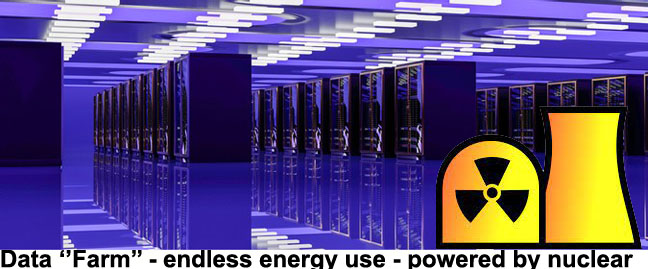
Congress urged to act against energy-hungry facilities blamed for increasing bills and worsening climate crisis
Oliver Milman, Guardian 8 December 25
A coalition of more than 230 environmental groups has demanded a national moratorium on new datacenters in the US, the latest salvo in a growing backlash to a booming artificial intelligence industry that has been blamed for escalating electricity bills and worsening the climate crisis.
The green groups, including Greenpeace, Friends of the Earth, Food & Water Watch and dozens of local organizations, have urged members of Congress to halt the proliferation of energy-hungry datacenters, accusing them of causing planet-heating emissions, sucking up vast amounts of water and exacerbating electricity bill increases that have hit Americans this year.
“The rapid, largely unregulated rise of datacenters to fuel the AI and crypto frenzy is disrupting communities across the country and threatening Americans’ economic, environmental, climate and water security,” the letter states, adding that approval of new data centers should be paused until new regulations are put in place.
The push comes amid a growing revolt against moves by companies such as Meta, Google and Open AI to plow hundreds of billions of dollars into new datacenters, primarily to meet the huge computing demands of AI. At least 16 datacenter projects, worth a combined $64bn, have been blocked or delayed due to local opposition to rising electricity costs. The facilities’ need for huge amounts of water to cool down equipment has also proved controversial, particularly in drier areas where supplies are scarce.
These seemingly parochial concerns have now multiplied to become a potent political force, helping propel Democrats to a series of emphatic recent electoral successes in governor elections in Virginia and New Jersey as well as a stunning upset win in a special public service commission poll in Georgia, with candidates campaigning on lowering power bill costs and curbing datacenters.
This threatens to be a major headache for Donald Trump, who has aggressively pushed the growth of AI but also called himself the “affordability president” and vowed to cut energy costs in half in his first year………………………………………………………………………………………….
it is the growth of datacenters to service AI – with electricity consumption set to nearly triple over the next decade, equivalent to powering 190m new homes – that is the focus of ire for voters as well as an unlikely sweep of politicians ranging from Bernie Sanders on the left to Marjorie Taylor Greene on the far right…………………………………………………………………………………………….https://www.theguardian.com/us-news/2025/dec/08/us-data-centers
Decades of Global Drone War Made Trump’s Caribbean Killing Spree Possible
“Suspicion of smuggling is not an imminent threat. Even if known traffickers were on board, it would not give the military the authority to launch missiles at a civilian vessel”
The Caribbean is not a war zone.
The so-called war on terror laid the foundations for Trump to turn international waters into one-sided battlefields.
By Emran Feroz , Truthout December 13, 2025
In September 2, 2025, a small fishing boat carrying 11 people was targeted by a U.S. Reaper drone off the coast of Venezuela. Hellfire missiles were fired. Two survivors clung to the wreckage. Their identities and motives were unknown. Their behavior showed no hostility. Moments later, the drone operator launched a second strike — the so-called “double tap” — killing the final survivors. This scene is shocking, but it should not be surprising to anyone who has followed the trajectory of the U.S.’s drone wars. This tactic is familiar from Afghanistan, Pakistan, Yemen, and, most recently, Gaza, where the Israeli military has used much worse violence to conduct genocide.
The U.S.’s first drone strike in the Caribbean, and the footage of the incident, reignited a debate about a conflict that Washington refuses to call a war — because it isn’t one. Instead, the Trump administration is using sheer violence to terrorize non-white populations and, as usual, has normalized lethal force far from declared battlefields and without any legal mandate.
U.S. Defense Secretary Pete Hegseth has approved at least 21 additional strikes in the Caribbean and eastern Pacific since September, killing at least 87 people. He has aggressively defended the very first operation, insisting he would have authorized the second strike as well — despite claiming he did not see it. Hegseth even misinterpreted the visible smoke on the video as the “fog of war,” seemingly unaware that the term refers to uncertainty in conflict, not the physical aftermath of a missile strike.
The details matter because they reveal something essential: the senior leadership overseeing these operations does not appear interested in the law, accuracy, or the basic meaning of proportionality. Instead, it has embraced escalation and mass murder as official policy.
Illegal Violence Dressed Up as Counter-Narcotics
Almost all legal experts agree that the U.S. strikes in the Caribbean violate international law. The Trump administration claims that suspected smugglers are “narco-terrorists” and therefore legitimate targets. But as Khalil Dewan, a legal scholar at London’s School of Oriental and African Studies who has studied U.S. and British drone programs for years, told me: “Drug trafficking is a crime, not an armed conflict.”
International law permits lethal force outside war zones only to prevent imminent threats to life. There is no indication that any of the boats the U.S. targeted — including the one in the September 2 video — posed such a threat. Dewan is clear: these are extrajudicial killings taking place on the high seas.
Former Air Force drone technician Lisa Ling, who left the program under the Obama administration due to the civilian casualties she witnessed, shares the same assessment. “Suspicion of smuggling is not an imminent threat. Even if known traffickers were on board, it would not give the military the authority to launch missiles at a civilian vessel,” she told me. Ling emphasizes a point that U.S. officials seem intent on ignoring: The Caribbean is not a war zone.
Ling also raises a question the military prefers not to confront: Who bears responsibility? “We were taught to disobey unlawful orders,” she said. “I’m still waiting to see that principle applied to those who carried out strikes on civilian boats in international waters.”
A Pattern With a Long History
The U.S. drone program did not begin with Trump. Its first lethal strike took place on October 7, 2001, in Kandahar province, targeting Taliban founder Mullah Mohammad Omar. It missed and killed civilians instead. That pattern — high-value targets declared dead, only to reappear alive — became common………………………………………………………………………………………………………………………………………………………….
Trump Escalation and Total Blowback
Trump has not only expanded the use of drone strikes but also removed the few modest oversight mechanisms Obama left behind. Now, under his second administration, the U.S. is openly striking vessels in international waters with almost no pretext.
…………………………….For years, critics of the war on terror have warned that a globalized drone program, paired with militarized domestic security agencies, would eventually produce consequences within the Americas too. That moment is here.
At least one family in Colombia has announced legal action after a fisherman, Alejandro Carranza, disappeared at sea. At the same time, Washington claimed to have killed “three violent drug-smuggling cartel members and narco-terrorists.” Carranza leaves behind a wife and five children.
What happens in the Caribbean today is not an anomaly. It is the outcome of two decades of policy decisions made by presidents of both parties. The world was declared a battlefield long before Trump returned to office. What we are seeing now is the cost of refusing to confront that reality. https://truthout.org/articles/decades-of-global-drone-war-made-trumps-caribbean-killing-spree-possible/?utm_source=Truthout&utm_campaign=f725ba5970-EMAIL_CAMPAIGN_2025_12_13_05_12&utm_medium=email&utm_term=0_bbb541a1db-f725ba5970-650192793
Trump’s Monroe Doctrine 2.0 Outlines Imperial Intentions for Latin America.

The National Security Strategy condemns U.S. foreign policy since the end of the Cold War. It champions the U.S. economy and military and says that the United States “must be preeminent” in the Americas and around the world. If there is one overarching principle it is the concept of “peace through strength.”
The administration’s National Security Strategy signals a return to more outwardly interventionist policies.
By Michael Fox , Truthout, December 12, 2025
n Wednesday, December 10, Donald Trump announced that the United States had seized a tanker in the Caribbean carrying more than 1.6 million barrels of Venezuelan crude oil.
“Large tanker, very large, largest one ever, actually, and other things are happening,” Trump told the press.
The seizure is only the latest move in a long build-up of U.S. military action in the Caribbean and increasing U.S. threats against Venezuela and its President Nicolas Maduro.
Trump — without evidence — says Maduro is the head of an international terrorist group running drugs into the United States. He has called Maduro’s days numbered.
Over the last three months, the United States has hit at least 22 alleged “drug boats” in the Caribbean and Pacific, killing more than 80 people. The campaign is the first unilateral lethal action the U.S. military has undertaken in Latin America since the 1980s.
The United States has now amassed the largest military buildup in the Caribbean in decades, including the world’s largest warship, the U.S. aircraft carrier USS Gerald R. Ford. Fifteen thousand U.S. troops are stationed in the region, on the ready.
Responding to news of the tanker seizure, Democratic Senator Chris Coons told NewsNation that he is “gravely concerned that [Trump] is sleepwalking us into a war with Venezuela.”
Even Congress has been shocked by how the administration has conducted the boat strikes. But a new document offers insight into the thought process behind Trump’s threats and actions in the region.
The United States has now amassed the largest military buildup in the Caribbean in decades, including the world’s largest warship, the U.S. aircraft carrier USS Gerald R. Ford. Fifteen thousand U.S. troops are stationed in the region, on the ready.
Responding to news of the tanker seizure, Democratic Senator Chris Coons told NewsNation that he is “gravely concerned that [Trump] is sleepwalking us into a war with Venezuela.”
Even Congress has been shocked by how the administration has conducted the boat strikes. But a new document offers insight into the thought process behind Trump’s threats and actions in the region.
The National Security Strategy condemns U.S. foreign policy since the end of the Cold War. It champions the U.S. economy and military and says that the United States “must be preeminent” in the Americas and around the world. If there is one overarching principle it is the concept of “peace through strength.”
“Strength is the best deterrent. Countries or other actors sufficiently deterred from threatening American interests will not do so,” it reads. “The United States must maintain the strongest economy, develop the most advanced technologies, bolster our society’s cultural health, and field the world’s most capable military.”
Front and center is the Western Hemisphere. It’s the first region mentioned in the document — China isn’t mentioned until page 23. The priority and focus on the Americas clearly marks a shift away from U.S. attention elsewhere around the world.
One detail in the document stands out more than any other — a reference to a new “Trump Corollary” to the Monroe Doctrine. This is made twice — first it’s included top among the overall policy goals and then again in the section on the Western Hemisphere.
The term “corollary” may seem like an odd choice to describe Trump’s embrace of the foreign policy position, but it is actually a clear historical nod to a moment when the Monroe Doctrine was used to justify widespread U.S. military actions in the region.
Now, analysts believe this is the direction we are headed again.
The Roosevelt Corollary
When U.S. President James Monroe issued his state of the union address on December 2, 1823, it included in it an articulation of a foreign policy position that would come to be known as the Monroe Doctrine.
Essentially, the doctrine was a message to European countries following the independence of most of the countries of the Americas: Foreign powers had no right to interfere in the politics of the newly independent nations of the Western Hemisphere.
But by the beginning of the 20th century, the United States had grown in prominence, power and ambition. President Theodore Roosevelt’s 1904 “Roosevelt Corollary” vastly reinterpreted the Monroe Doctrine, essentially turning it into a tool to justify U.S. intervention across the region.
……………………………………………………………………………………..the Trump Corollary reads as a veiled threat against countries who might be unwilling to bend to U.S. interests.
“We will assert and enforce a “Trump Corollary” to the Monroe Doctrine,” the National Security Strategy document states. “We want to ensure that the Western Hemisphere remains reasonably stable and well-governed enough to prevent and discourage mass migration to the United States; we want a Hemisphere whose governments cooperate with us against narco-terrorists, cartels, and other transnational criminal organizations; we want a Hemisphere that remains free of hostile foreign incursion or ownership of key assets, and that supports critical supply chains; and we want to ensure our continued access to key strategic locations.”
Analysts say the Trump administration’s visible actions toward Latin America in recent months — the seizure of the oil tanker, the boat attacks, threats of war with Venezuela, intervention into Honduran elections, tariffs on Brazil — all fit into this rubric.
…………………………………………………………………………………………Like the Roosevelt Corollary, which, following 1904, would be used for years to justify intervention after intervention across the region, the new National Security Strategy is a means of justifying the policies, threats, and attacks Trump may unleash across the region.
………………………………………………………………………………………………………………………Gone are the past U.S. pretexts of spreading democracy, or standing for the good of humanity, or civilization building……………………………………………………………………………. https://truthout.org/articles/trumps-monroe-doctrine-2-0-outlines-imperial-intentions-for-latin-america/?utm_source=Truthout&utm_campaign=e71842d601-EMAIL_CAMPAIGN_2025_12_12_07_18_COPY_01&utm_medium=email&utm_term=0_bbb541a1db-62fed5671d-650192793
FBI Labels Antifa a Major Terror Threat, but Lawmakers Say Evidence Is Lacking as Trump’s Obsession Distracts From Far-Right Extremism
December 12, 2025, Joshua Scheer, https://scheerpost.com/2025/12/12/fbi-labels-antifa-a-major-terror-threat-but-lawmakers-say-evidence-is-lacking-as-trumps-obsession-distracts-from-far-right-extremism/
At a recent House Homeland Security Committee hearing, FBI official Michael Glasheen — operations director of the Bureau’s National Security Branch — described the anti-fascist movement antifa as one of the most significant domestic terrorism threats facing the United States, echoing a Trump executive order that designated antifa as a domestic terrorist organization.
But when lawmakers pressed him for specifics, Glasheen struggled to provide concrete evidence about where antifa is organized, how many members it has, or how its activities are tracked. He repeatedly described the situation as “fluid” and emphasized that investigations are ongoing. The exchange underscored deep partisan divisions in Congress over how domestic threats are identified, and raised broader questions about how law enforcement defines and responds to politically motivated violence — particularly given that antifa lacks formal leadership, structure or membership rolls.
Despite the lack of clear data, Glasheen maintained that antifa remains the agency’s “primary concern” and “the most immediate violent threat that we’re facing.”
Democratic Rep. Bennie Thompson challenged those claims directly: “Where in the United States does antifa exist? What does that mean?” he asked. “We’re trying to get information. You said antifa is a terrorist organization. Tell us, as a committee, how did you come to that? Do they exist? How many members do they have in the United States as of right now?”
“Well, that’s very fluid,” Glasheen said.
“Sir, I just want you to tell us — if you said antifa is the No. 1 domestic terrorist organization operating in the United States, I just need to know where they are … how many people have you identified with the FBI that antifa is made of,” Thompson asked.
“Sir, you wouldn’t come to this committee to say something that you can’t prove,” Thompson said to Glasheen. “I know you wouldn’t do that. But you did.
Trump’s obsession with antifa is well-known, even though the evidence has long shown that the more significant threat comes from right-wing–aligned groups rather than activists who identify as anti-fascist. It’s not hard to understand why this president fixates on antifa, but the disconnect between his rhetoric and documented threats has been clear for years. The Intercept’s reporting — based on leaked documents from 2020 — “But while the White House beat the drum for a crackdown on a leaderless movement on the left, law enforcement offices across the country were sharing detailed reports of far-right extremists seeking to attack the protesters and police during the country’s historic demonstrations, a trove of newly leaked documents reveals.”
So there is a threat, just not from the group Trump focuses on. What this designation does, however, is clearly silence critics of his administration, using the “terror” label as a tool — especially if he can find a way to tie someone to foreign support
Because U.S. law does not criminalize membership in domestic terror groups, experts warn that the Trump administration could attempt to target American citizens under existing laws that apply to foreign organizations. Shayana Kadidal, an attorney at the Center for Constitutional Rights, told The Intercept that regulations allow the government to link domestic groups to foreign entities already designated as terrorist organizations, potentially creating legal obstacles for ordinary Americans. Kadidal highlighted past cases in which U.S. citizens were branded “specially designated terrorists” for alleged ties to foreign groups, which severely restricted their ability to conduct normal financial transactions.
Civil liberties advocates also caution that Supreme Court precedent allows individuals to be charged with providing “material support” to foreign terrorist organizations based on speech acts alone — a pathway the administration could exploit. One immediate consequence of this approach is the “chilling effect,” where protesters may hesitate to participate due to legal uncertainty, effectively discouraging civic engagement and dissent.
In the larger context of extremism, the focus on hunting antifa is largely a red herring, distracting from the far more serious threat posed by right-wing and white supremacist groups. We turn to Luke Baumgartner, a research fellow with George Washington University’s Program on Extremism discussing what the we are all taking about, from an interview on PBS :
“I would classify it more as a political scapegoat, honestly. There have been incidents of political violence linked to far left extremists in the U.S. in recent years, but the overwhelming majority of the data points towards far right extremism being a much more serious threat to national security.”
He continued, noting that any protest by the left — whether it’s No Kings or Black Lives Matter — is immediately labeled “antifa.” This represents a clear abuse of Trump’s power in his broader effort to crush the left and silence groups that challenge his warped worldview.
Trump did this with Black Lives Matter back in 2020 with the violent clearing of peaceful Black Lives Matter protesters from Lafayette Square — simply so he could stage a photo op. It remains one of the clearest demonstrations of state power being used to suppress constitutional rights in modern American history.
That wasn’t an anomaly, but part of a longstanding pattern in which protests are met with force, intimidation, and the machinery of government turned against them. Now, feeling more empowered than ever, the president appears to be attempting the same tactics under the guise of combating “terrorism,” despite evidence showing that left-wing movements are far less likely to pose the threats he claims to be targeting.
Needless to say, I’m glad that Bennie Thompson is still around and holding the line, but more action is needed to challenge what amounts to a high level of evil by some and foolishness by others and the belief that there is a real threat when, in reality, there is “no there there,” and that any supposed danger is merely a smokescreen.
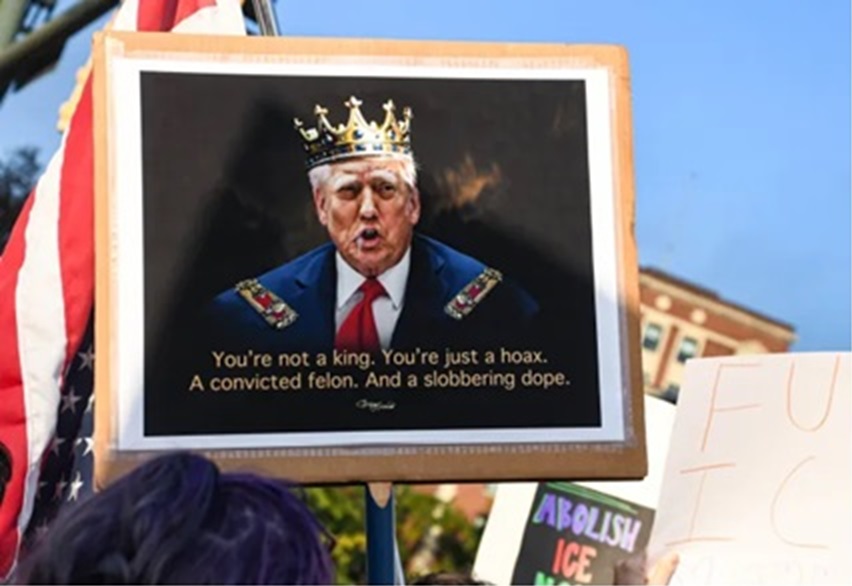
Trump’s ‘End of History’ Moment
History will thankfully go on once we see the end of them and the work of repairing the mess they are making begins.
December 13, 2025 , By Patrick Lawrence, ScheerPost, https://scheerpost.com/2025/12/13/patrick-lawrence-trumps-end-of-history-moment/
The Trumpster is not yet finished his first year back in the White House, and I cannot imagine how our crumbling republic will survive three more years of this man-child and the misfits and miscreants with whom he has surrounded himself. And it occurs to me lately that neither I nor anyone else is supposed to imagine any kind of future — good, bad, in the middle — beyond Jan. 20, 2029, when President Trump will no longer be president. The future will not be the point by then. By then we are supposed to be living in an imaginary past that we won’t have to imagine because the imaginary past will be the actual present.
It is not quite three months since Trump issued an executive order designating “antifa,” the more or less fictitious “organization” of antifascists, a “domestic terrorist organization.” In the Trump White House’s rendering, antifa “explicitly calls for the overthrow of the United States Government, law enforcement authorities and our system of law.” To this end, it organizes and executes vast campaigns of violence. It coordinates all this across the country. It recruits and radicalizes young people, “then employs elaborate means and mechanisms to shield the identities of its operatives, conceal its funding sources and operations in an effort to frustrate law enforcement, and recruit additional members.”
I didn’t take the executive order containing this kind of language the least bit seriously when it was issued Sept. 22. Antifa, so far as I understand it, does not actually exist. It is a state of mind, or it signifies a shared set of political sentiments vaguely in the direction of traditional anarchism — a hyper-individualistic ultra-libertarianism when translated into the American context.
Trump’s executive order describing antifa as an organized terrorist organization reminded me of nothing so much as those flatfooted fogies back in the Cold War years who, nostalgic for a simpler time but understanding nothing, went on about “outside agitators” as the root of America’s ills.
I was wrong in one respect, maybe more, about Trump and his adjutants and what they have in mind. These people are not flatfooted. They know exactly what they are doing and they are moving swiftly to get it done. It is time to take seriously, I mean to say, the wall-to-wall unseriousness of the Trump regime’s plans for a nation it would be impossible to live in were it ever to come to be. The saving grace here is they cannot possibly create the America they have in mind. But they will, I have to add, make an unholy mess on their way to failing.
Three days after the antifa executive order, The White House made public a National Security Presidential Memorandum titled “Countering Domestic Terrorism and Organized Political Violence.” NSPM–7, as this document is known, is formally addressed to Marco Rubio, Trump’s secretary of state, Treasury Secretary Scott Bessent, Attorney General Pam Bondi and Kristi Noem, the Homeland Security secretary.
This thing picks up where the one-page executive order leaves off. It cites various assassinations and attempted assassinations — Charlie Kirk, Brian Thompson, the United Healthcare chief executive, the two attempts on Trump’s life during his 2024 campaign — and fair enough, although casting political violence as terrorist violence is a sleight-of-hand too far. It is when NSPM–7 invokes recent protests against Immigration and Customs Enforcement agents and “riots in Los Angeles and Portland” that you sense the trouble to come.
From the first of the document’s five sections:
This political violence is not a series of isolated incidents and does not emerge organically. Instead, it is a culmination of sophisticated, organized campaigns of targeted intimidation, radicalization, threats, and violence designed to silence opposing speech, limit political activity, change or direct policy outcomes, and prevent the functioning of a democratic society. A new law enforcement strategy that investigates all participants in these criminal and terroristic conspiracies — including the organized structures, networks, entities, organizations, funding sources, and predicate actions behind them — is required.
What is required, it turns out, is an institutionalized surveillance operation that goes considerably beyond the Patriot Act. “This guidance,” Section 2 reads, “shall also include an identification of any behaviors, fact patterns, recurrent motivations, or other indicia common to organizations and entities that coordinate these acts in order to direct efforts to identify and prevent potential violent activity.”
And then NSPM–7 gets down to what the Trump regime is truly after:
Common threads animating this violent conduct include anti-Americanism, anti-capitalism, and anti-Christianity; support for the overthrow of the United States Government; extremism on migration, race, and gender; and hostility towards those who hold traditional American views on family, religion, and morality.
I am not letting the liberal wing of the ruling Late–Imperial War Party, commonly known as the Democrats, off the hook in this domestic terrorism business. Joe Biden banged on about this whenever it was politically expedient the whole of his discombobulated term, and we now witness the consequences of all his loose, opportunistic talk. In effect, Biden prefaced what the Trump regime is step-by-step codifying into law.
One of the more pernicious of the many objectionable features of NSPM–7 merits immediate note. This is the vagueness of its language. Whenever I see official documents of this kind my mind goes back to imperial China, whose mandarins were highly legalistic but kept written law purposely ambiguous so as to maximize the prerogatives of imperial power. A surfeit of laws, all of them to be interpreted in whatever way suited the throne.
As of last weekend we know how Pam Bondi, Trump’s patently fascistic AG, intends to interpret NSPM–7. This is by way of a Justice Department memorandum Ken Klippenstein, the exemplary investigative journalist, reported on (but did not actually publish in full) on Saturday, Dec. 6. This is Klippenstein’s exclusive. Here is the top of the piece he published in his Substack newsletter under the headline, “FBI Making List of American ‘Extremists,’ Leaked Memo Reveals:”
Attorney General Pam Bondi is ordering the FBI to “compile a list of groups or entities engaging in acts that may constitute domestic terrorism”… The target is those expressing “opposition to law and immigration enforcement; extreme views in favor of mass migration and open borders; adherence to radical gender ideology,” as well as “anti–Americanism,” “anti-capitalism,” and “anti–Christianity.”
By way of defining all these domestic terrorism threats, Klippenstein reports, the DoJ memorandum cites “extreme viewpoints on immigration, radical gender ideology, and anti-American sentiment.” As to enforcement, the memorandum authorizes the FBI to open a hotline by means of which ordinary Americans can report on other ordinary Americans, along with “a cash reward system” to go along with it. The agency is also to develop a legion of informants (“cooperators”); state and local governments are to be funded to develop their own programs in conformity with the DoJ’s directives. What the memorandum calls Joint Terrorism Task Forces are to “map the full network of culpable actors.”
This is more than what we now call an all-of-government surveillance and enforcement program that open-and-shut outlaws a variety of Constitutional rights. It is an all-of-society operation that prompts comparisons with regimes in history I never would have imagined summoning to mind in anything like this context. “Extremist viewpoints” are to be criminalized? I am an outlaw if I am critical of orthodox Christianity, if I am “hostile” to the nuclear family, to traditional morality and so on? Just how close to thought control does the Trump regime plan to sail?
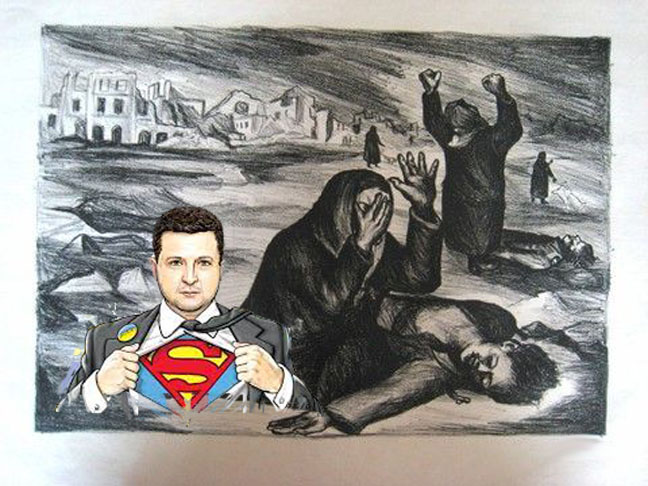
Continue readingUS should exit lost Ukraine war, obsolete NATO
Walt Zlotow West Suburban Peace Coalition Glen Ellyn IL, substack.com/@waltzlotow 12 Dec 25
President Trump appears to relish killing innocents worldwide. He’s still enabling the Israeli genocide in Gaza that has killed over 100,000. He’s obliterated 20 little unarmed boats in the Caribbean killing over 80 hapless innocents. He’s bombed imagined bad guys in Somalia 111 times in 10 months. Why? Because he wants to and can.
But one killing field Trump wants out of is Ukraine. His predecessor Biden provoked the war there 4 years ago. It has largely destroyed Ukraine as a viable state with millions fled, dead, injured, with a shattered economy propped up by US, NATO treasure.
Trump is working with Russia to end the war largely on Russia’s sensible terms. No NATO for Ukraine which will remain neutral between Europe and Russia. No return of the seized territory containing the Russian speaking Ukrainians their government was systematically destroying. End of sanctions allowing reintegration of Russia into the European political economy.
This is good for Ukraine, good for Russia, good for Europe.
For Ukraine it ends further destruction which will alas, now be a rump state of its former self. Had Ukraine not allowed the US and NATO to sabotage the April, 2022 Istanbul peace agreement, Ukraine could have achieved peace then with no loss of territory and its economy largely intact.
For Russia, its security concerns regarding NATO encroachment allowing NATO nukes on its borders, and further destruction of Russian leaning Donbas Ukrainians will achieved be.
For Europe, peace will allow redirection of squandered treasure to the commons, ward off right wing political movements likely to topple pro war leaders, and buy cheap energy from Russia to revitalize their stagnant economies.
While Russia is on board, neither Ukraine nor Europe will have any of this sanity. Ukraine wants to fight on to regain lost territory that will forever be part of Russia. Hurling teens and grandfathers into the cauldron of lost war further cements Ukraine’s destruction.
European NATO pretends defeating Russia in Ukraine is critical to preventing Russia from attacking NATO countries in their imagined obsession Russia is recreating the Soviet Union.
Ukraine and Europe continue in their delusions in spite of Trump’s clear message that the war is lost and must be ended to prevent further disintegration of Ukraine. Neither Ukraine nor Europe has anywhere near the military resources to continue the war largely financed by the Russophobic Biden administration.
Trump must not weaver in his efforts to exit the money pit of senseless war in Ukraine. But he should go further and exit NATO, allowing Europe to provide for their own defense. No US Sugar Daddy might be just the tonic to dissuade foolish European leaders like UK’s Starmer, France’s Macron and Germany’s Merz from endlessly screaming ‘The Russians are coming, the Russian’s are coming.’
Congress is starting to recognize the need to exit NATO. House Republican Thomas Massie and Senate Republican Mike Lee have both introduced legislation to end US membership in NATO.
Their common sense justification is long overdue fresh air. Massie noted, “NATO was created to counter the Soviet Union, which collapsed over thirty years ago. Since then, U.S. participation has cost taxpayers trillions of dollars and continues to risk US involvement in foreign wars. Our Constitution did not authorize permanent foreign entanglements, something our Founding Fathers explicitly warned us against. America should not be the world’s security blanket—especially when wealthy countries refuse to pay for their own defense.”
Lee observed, “America’s withdrawal from NATO is long overdue. NATO has run its course – the threats that existed at its inception are no longer relevant 76 years later “If they were, Europe would be paying their fair share instead of making American taxpayers pick up the check for decades. My legislation will put America first by withdrawing us from the raw deal NATO has become.”
Trump must support this legislation as he works with Russia to end the carnage that addresses Russia’s valid security concerns. Ending this war and exiting NATO will bring peace to Europe and revitalize the economies of all combatants. It might also avert something infinitely more ominous…nuclear war.
Venezuela charges Washington with ‘theft, piracy’ after seizure of oil tanker
The US had imposed sanctions on the vessel under claims it was involved in the Iranian oil trade.
The Cradle, DEC 11, 2025
Venezuela has accused the US government of “blatant theft” and “piracy,” following Washington’s seizure of a Venezuelan oil tanker off the Latin American country’s coast on 10 December.
The Venezuelan Foreign Ministry strongly condemned what it said was a “blatant theft and an act of international piracy, publicly announced by the President of the US, who confessed to the assault on an oil tanker in the Caribbean Sea.”
“Already in his 2024 campaign, [US President Donald Trump] openly stated that his objective has always been to keep Venezuelan oil without paying any consideration in return, making it clear that the policy of aggression against our country responds to a deliberate plan to plunder our energy wealth,” the Venezuelan Foreign Ministry added.
“The true reasons for the prolonged aggression against Venezuela have finally been revealed. It is not migration. It is not narcotics trafficking. It is not democracy. It is not human rights. It has always been about our natural wealth,” the statement went on to say.
Cuban President Miguel Diaz-Canel Bermudez also condemned Washington’s theft of the oil tanker.
“Cuba expresses its full support for the denunciation issued by the government of Venezuela and strongly condemns the assault on an oil tanker in the Caribbean Sea, carried out by the Armed Forces of the United States. This constitutes an act of piracy, a violation of international law, and an escalation in the aggression against that sister nation,” he said.
The US announced the seizure on Wednesday. The move caused a jump in oil prices and has fanned the flames of an already tense situation between Caracas and Washington – which has recently targeted the Latin American country with brutal strikes under the pretext of stopping the flow of drugs into the US.
Video footage of the seizure showed armed US soldiers descending onto the vessel from a helicopter. The Venezuelan oil tanker was subject to illegal US sanctions. ………………………………………………..
The seizure of the Venezuelan tanker comes as part of a massive military buildup in the Caribbean Sea and recent airstrikes on what Washington claims are “drug boats” responsible for the flow of Fentanyl into the US.
At least 87 people, among them innocent fishermen from Colombia, Ecuador, and Trinidad and Tobago, have been killed by the US attacks since September. https://thecradle.co/articles/venezuela-charges-washington-with-theft-piracy-after-seizure-of-oil-tanker
1 This Month


31st January – Challenging the War Machine – a DECLASSIFIED UK SUMMIT
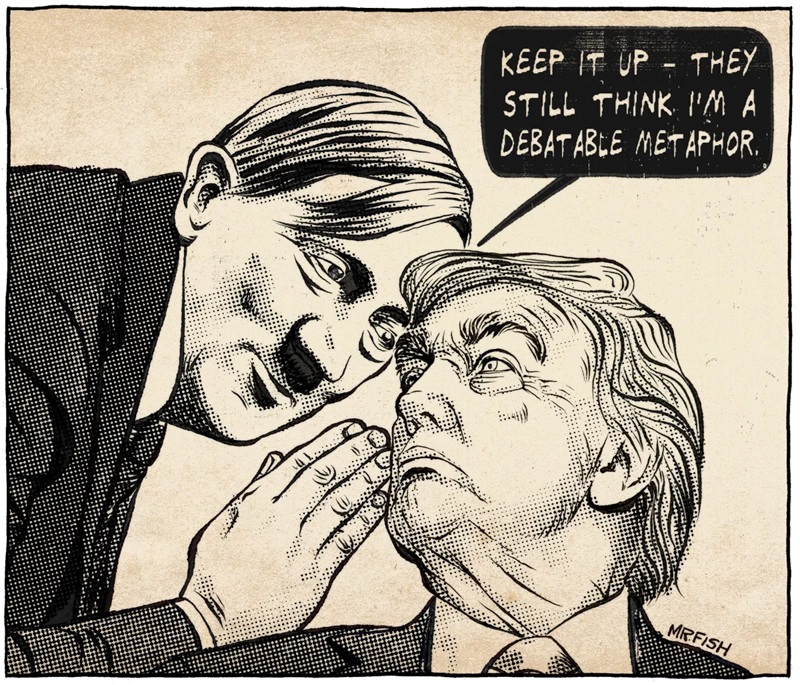
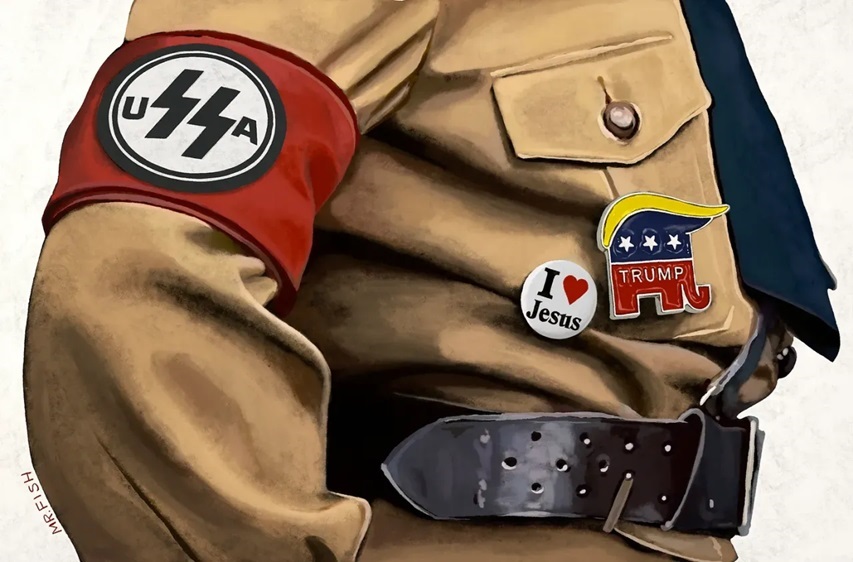

Website of the Week
Now until to February 10, 2026 Radioactive waste storage in France: the debate is finally open! How to participate?
-
Archives
- January 2026 (227)
- December 2025 (358)
- November 2025 (359)
- October 2025 (377)
- September 2025 (258)
- August 2025 (319)
- July 2025 (230)
- June 2025 (348)
- May 2025 (261)
- April 2025 (305)
- March 2025 (319)
- February 2025 (234)
-
Categories
- 1
- 1 NUCLEAR ISSUES
- business and costs
- climate change
- culture and arts
- ENERGY
- environment
- health
- history
- indigenous issues
- Legal
- marketing of nuclear
- media
- opposition to nuclear
- PERSONAL STORIES
- politics
- politics international
- Religion and ethics
- safety
- secrets,lies and civil liberties
- spinbuster
- technology
- Uranium
- wastes
- weapons and war
- Women
- 2 WORLD
- ACTION
- AFRICA
- Atrocities
- AUSTRALIA
- Christina's notes
- Christina's themes
- culture and arts
- Events
- Fuk 2022
- Fuk 2023
- Fukushima 2017
- Fukushima 2018
- fukushima 2019
- Fukushima 2020
- Fukushima 2021
- general
- global warming
- Humour (God we need it)
- Nuclear
- RARE EARTHS
- Reference
- resources – print
- Resources -audiovicual
- Weekly Newsletter
- World
- World Nuclear
- YouTube
-
RSS
Entries RSS
Comments RSS
 nuclear-news