Thirsty nuclear facilities steal precious fresh water
 Nukes thirst for Savannah River water, savannahnow, by Mary Landers on Wed, 2014-05-07 That sucking sound you hear? That’s Georgia Power and its partners preparing to pull 74 million gallons of water a day out of the Savannah River to cool the nuclear reactors at Plant Vogtle near Waynesboro. That’s in addition to the 127 million gallons per day the existing reactors are permitted to draw.
“For downstream users like Savannah there’s going to be a bigger straw in their river and it’s Vogtle,” said Sara Barczak of the Southern Alliance for Clean Energy.
The new nuclear reactors, for which you’re already paying if you live in Savannah and use electricity, aren’t expected to be in operation until 2017 or later. (It keeps getting later.) The state issued a draft water withdrawal permit in January that allows for the maximum daily pull of 74 million gallons per day or a monthly average of 62 million gallons per day.
For comparison, the city of Savannah takes out a maximum of 55 million gallons a day from the river for drinking water. (EPD provides a link to a list of all withdrawals here.) And if you think Vogtle will return most of the water to the river after using it for cooling, think again: the consumptive use is estimated at 71 percent on average. Worst case scenario is that the cooling process will send 88 percent of the water into the atmosphere through evaporation. ……http://savannahnow.com/share/blog-post/mary-landers/2014-05-07/nukes-are-thirsty#.U21McYFdWik
High Burnup nuclear fuel , San Onofre, – Storage and Transportation issues
 ISSUES INVOLVING STORAGE AND TRANSPORTATION OF HIGH BURNUP NUCLEAR FUEL DECOMMISSION SAN ONOFRE By Marvin Resnikoff, Ph.D.SCE Community Engagement Panel (CEP) San Juan Capistrano Community Center May 6, 2014 “……… I’m going to briefly discuss transportation and storage of nuclear fuel, and I’m going to focus on high burnup nuclear fuel (HBF). What and why is HBF? NRC has not fully investigated the technical issues and implications, which in my view, are major and should have required careful study and an EIS. This is work that should have been done before the NRC allowed utilities to go to high burnup, not after. By high burnup, I mean fuel greater than 45 GWD/MTU, but in clearer terms, allowing each assembly to remain in the reactor longer. The implications are the radioactive inventory in HBF is greater.
NRC staff have focused on the heat in HBF, which is greater. But heat will decline over time. One implication is decommissioning will take longer. Fuel will sit in fuel pool for 20 years or more. San Onofre has high burnup fuel. The implication of a longer decay time is that the workers at the site will not be available for the decom process. Putting more fuel into the same space, moving from 24 fuel assemblies to 32, as Southern California Edison intends to do, will further the cooling off period. However, while heat is an important consideration, but perhaps of greater import is the impact on fuel cladding. It may surprise you to know that the NRC does not know how much HBF exists across the country. While the NRC has the power and the ability to identify how much HBF is at each reactor. The NRC has inspectors at each reactor. They simply have not made the effort. The Department of Energy (DOE) is conducting a survey which should be released in September. HBF has major implications for decommissioning, storage, transportation and disposal.
• Little technical support for NRC approval of high burnup fuel (HBF). Experiment taking place in the field.
• Total amount of HBF unknown. At a minimum, the NRC should survey utilities.
• HBF will postpone storage up to 20 years; 32 PWR canister extends cooldown period.
• Cladding defects are a major problem for HBF; HBF may not be retrievable. HBF should be canned.
• Because of corrosion, long-term storage may not be possible in a salt environment.
• Side impact rail accidents may shatter HBF cladding.
• Long duration, high temperature fires may involve oil tankers that travel the same tracks. NRC has not properly quantified the statistical likelihood.
USA signs up to Central Asian Nuclear-Weapon-Free Zone Treaty
 United States Signs Protocol to Central Asian Nuclear-Weapon-Free Zone Treaty http://www.state.gov/r/pa/prs/ps/2014/05/225681.htm
Office of the Spokesperson
The United States is not eligible to be a party to the CANWFZ Treaty itself, but as an NPT nuclear weapons state is eligible to join the Treaty’s Protocol. The Protocol provides legally-binding assurances not to use or threaten to use nuclear weapons against CANWFZ Treaty parties. The United States understands the importance of such negative security assurances to states that have foresworn nuclear weapons and abide by their nuclear non-proliferation obligations.
The Administration is satisfied that the CANWFZ Treaty is consistent with U.S. and international criteria for such zones. The United States believes that such zones, when fully and rigorously implemented, contribute to our nonproliferation goals and to international peace and security. The United States has concluded that the CANWFZ Treaty and its Protocol will not disturb existing U.S. security arrangements or military operations, installations, or activities. The CANWFZ Treaty and its Protocol will also promote regional cooperation, security, and stability and provide a vehicle for the extension of legally-binding negative security assurances, consistent with the strengthened negative security assurance announced in the 2010 U.S. Nuclear Posture Review.
The United States previously signed similar protocols to the Treaties of Pelindaba and Rarotonga concerning nuclear-weapon-free zones in Africa and the South Pacific, respectively, and has ratified the protocols to the Treaty of Tlatelolco, which established a nuclear-weapon-free zone for Latin America and the Caribbean. With respect to the nuclear-weapon-free zone treaty in force in Southeast Asia, the United States looks forward to continuing consultations with zone parties to explore possible U.S. support for signature and ratification of the applicable protocol.
Failing nuclear industry launches lobbying campaign
Nuclear lobbying campaign aims to boost industry’s fortunes, philly.com Andrew Maykuth, Inquirer Staff Writer 6 May 14 Last year’s closure of the Kewaunee Power Station in Wisconsin sent shock waves though the American nuclear industry, not because the reactor suffered an accident but because it could not withstand something more potent – market forces.
So two months ago, the industry launched a lobbying campaign called Nuclear Matters, whose aim is to create a greater appreciation of atomic power’s role as a reliable source of carbon-free electricity.
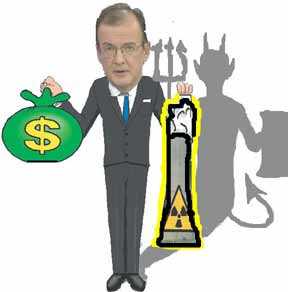
“I think most Americans aren’t sensitive to the fact that nuclear energy is going through challenging times,” Evan Bayh, a former Democratic senator from Indiana, told a roundtable discussion Monday at the Constitution Center sponsored by the Greater Philadelphia Chamber of Commerce.
Bayh and former Sen. Judd Gregg, a Republican from New Hampshire, were enlisted as the bipartisan co-chairmen of Nuclear Matters, whose purpose is to start a dialogue that will lead to improvements in the nuclear business climate
Nuclear power accounts for 19 percent of the nation’s electricity generation, but the industry is challenged by a slow-growth market in which electricity prices are depressed by cheap energy from the shale-gas boom and a flood of tax-subsidized wind power……..
The campaign bills itself as “a cross-section of individuals, organizations and businesses.” Monday’s session was attended by U.S. Sen. Pat Toomey (R., Pa.), utility officials, labor and business leaders, and nuclear-power academics from Pennsylvania State University and the University of Pittsburgh……..
The campaign already has attracted opposition from anti-nuclear activists. The Nuclear Information and Resource Service has denounced Nuclear Matters as an industry “front group.”
Exelon Corp., the nation’s largest nuclear fleet operator and owner of Peco Energy Co., wrote the initial check to fund the campaign.
Exelon declined to disclose the amount of its funding, but Christopher Crane, the company’s chief executive, and in an interview last week that Exelon was “very supportive” of the effort………
Bayh downplayed the effect of the 2011 Fukushima nuclear accident in Japan as undermining public confidence, citing strong support in areas surrounding reactors.
“You look at polling, scientific polling, and for most people, safety is not a concern,” he said.
But McGowan, the Malvern manufacturer, cautioned the industry about becoming too comfortable with polls. He said his sense is that there is an underlying apprehension with safety that needs to be addressed. http://www.philly.com/philly/business/20140506_Nuclear_lobbying_campaign_aims_to_boost_the_industry_s_flagging_business_fortunes.html#cOmXlecVcosu5OUs.99
A Clear and Present Danger – new US report on Climate Change
 Climate change is clear and present danger, says landmark US report National Climate Assessment, to be launched at White House on Tuesday, says effects of climate change are now being felt Suzanne Goldenberg US environment correspondent theguardian.com , Monday 5 May 2014 On Sunday the UN secretary-general, Ban Ki-moon, said the world needed to try harder to combat climate change. At a meeting of UN member states in Abu Dhabi before a climate change summit in New York on 23 September, Ban said: “I am asking them to announce bold commitments and actions that will catalyse the transformative change we need. If we do not take urgent action, all our plans for increased global prosperity and security will be undone.”
- Gary Yohe, an economist at Wesleyan University and vice-chair of the NCA advisory committee, said the US report would be unequivocal that the effects of climate change were occurring in real-time and were evident in every region of the country.
- “One major take-home message is that just about every place in the country has observed that the climate has changed,” he told the Guardian. “It is here and happening, and we are not cherrypicking or fearmongering.”
- The draft report notes that average temperature in the US has increased by about 1.5F (0.8C) since 1895, with more than 80% of that rise since 1980. The last decade was the hottest on record in the US.
- Temperatures are projected to rise another 2F over the next few decades, the report says. In northern latitudes such as Alaska, temperatures are rising even faster.
- “There is no question our climate is changing,” said Don Wuebbles, a climate scientist at the University of Illinois and a lead author of the assessment. “It is changing at a factor of 10 times more than naturally.”
- Record-breaking heat – even at night – is expected to produce more drought and fuel larger and more frequent wildfires in the south-west, the report says. The north-east, midwest and Great Plains states will see an increase in heavy downpours and a greater risk of flooding.
- “Parts of the country are getting wetter, parts are getting drier. All areas are getting hotter,” said Virginia Burkett, chief scientist for global change at the US Geological Survey. “The changes are not the same everywhere.”……..
The assessments are the American equivalent of the UN’s Intergovernmental Panel on Climate Change (IPCC) reports. This year’s report for the first time looks at what America has done to fight climate change or protect people from its consequences in the future.
Under an act of Congress the reports were supposed to be produced every four years, but no report was produced during George W Bush’s presidency.http://www.theguardian.com/environment/2014/may/04/climate-change-present-us-national-assessment
The coming demise of coal and nuclear power
Coming Coal & Nuclear Power Plant Retirements, & What That Means, Clean technica 5 May 14 (Good Graphs) “……..Some of the challenges faced by coal-fired and nuclear generators, and the implications for electricity markets if the plants are retired in significant numbers, are analyzed in this discussion………In 2012 and 2013, operators of five nuclear power reactors representing 4.2 GW of capacity announced plans to retire the reactors by 2015. Four of the reactors—San Onofre 2 and 3, Kewaunee, and Crystal River—already have ended nuclear power production, and the fifth, Vermont Yankee, is expected to end generation by the end of 2014 [1]. In addition, the Oyster Creek plant is expected to conclude operation in 2019 [2]. These are the first retirements of U.S. nuclear power plants since Millstone Unit 1 was retired in 1998. Retirements often are the result of unique circumstances, but some owners of nuclear power plants have voiced concerns about the profitability of their units, sparking discussion of possible additional nuclear retirements [3]. In order to evaluate the impacts of potential retirements beyond those in the Reference case, AEO2014 includes several alternative cases with economic assumptions that make it less likely that existing coal and nuclear power plants will be used for generation.
Factors that lead to power plant retirements
Power plant owners generally make the decision to retire plants when their expected costs exceed their expected revenues over the future life of the plants [4]. Costs incurred by power plants can include large capital projects, such as installation of flue gas desulfurization (FGD) systems or scrubbers on coal plants, increased operating costs, or higher fuel costs. Revenues are received from energy sales or capacity payments in wholesale electricity markets in regions of the country with competitive wholesale markets, or from cost-recovery mechanisms in regions with vertically integrated utilities subject to rate regulations [5].
Recent trends in the electric power industry have resulted in both declining revenues and increased operating costs for coal plants…….
When faced with declining profitability, plant owners may choose to retire their units rather than make additional investments to keep them operating. In the AEO2014 Reference case, all coal-fired plants are required to have either a scrubber or a dry sorbent injection (DSI) system combined with a fabric filter in order to continue operating in 2016 [8] and later years. As of the end of 2012, 64% of the U.S. fleet of coal-fired generators was compliant with this requirement. The remaining plant owners are in the process of deciding whether to retrofit or retire their plants [9]………
Conclusions
Accelerated retirements of coal-fired and nuclear electricity generation capacity would cause natural gas and renewables to gain an increased share in the nation’s electricity generation mix. Natural gas is most often the lowest-cost option for replacement capacity, while renewable generation grows, spurred by the increased economic competitiveness of solar and wind technologies toward the end of the projection period. The rising use of natural gas in the electric power sector results in price increases for both natural gas and electricity in all sectors relative to the Reference case http://cleantechnica.com/2014/05/05/power-plant/#S7icgLuw3MM0xsAf.99
Experts critcise White House for planning cuts to nuclear security
 Issue Experts, Activists Decry U.S. ‘Major Retreat’ on Nuclear Security http://www.nationaljournal.com/global-security-newswire/issue-experts-activists-decry-u-s-major-retreat-on-nuclear-security-20140505A GROUP OF 100 FORMER OFFICIALS, PEACE ADVOCATES AND ISSUE EXPERTS CRITICIZED THE WHITE HOUSE FOR PLANNING TO CUT NUCLEAR SECURITY FUNDING NEXT YEAR.
Colorado passes Bill to protect groundwater from uranium mining’s radiation pollution
House advances uranium groundwater protection bill By Joe Hanel Denver Herald staff writer 5 May 14, DENVER – New regulations on uranium processing passed the state House on Monday, despite a plea from Rep. Don Coram, R-Montrose, that they would destroy hope in the mining towns in his district.
Senate Bill 192 is intended to address an environmental disaster caused by the Cotter uranium mill in Cañon City, where radioactive waste poisoned a neighborhood’s groundwater for years.
It passed 43-22 Monday morning.
“We want to make sure there is not another Cotter mill. We want to make sure groundwater is not polluted by uranium processing,” said one of the sponsors, Rep. K.C. Becker, D-Boulder. The bill sets minimum standards for groundwater cleanups before a company can be let off the hook. It also requires uranium and thorium mines to get a radioactive materials license from the state health department if they use a new process that involves injecting water into the mine’s rock formations……..
Rep. Jared Wright, R-Fruita, said new mining technologies often pollute, despite promises to be safe and clean……..“This bill is about protecting our citizens, those we are all here today to serve,” Wright said.
If Energy Fuels reverses course and decides to build the new mill, SB 192’s groundwater cleanup requirements would apply to it, as well as to Cotter’s Cañon City mill.
New York Times Editorial inadvertently delivers an epitaph for the nuclear energy industry
 If the New York Times wants to anoint Chernobyl’s unfinished second shroud as the prime symbol of today’s atomic industry, then this editorial is indeed a fitting epitaph.
NY Times Editorial Board Delivers a ‘Prudent’ Message of Nuclear Abandonment by Harvey Wasserman May 4, 2014 http://www.scoop.co.nz/stories/HL1405/S00031/ny-times-editorial-prudent-message-of-nuclear-abandonment.htm
http://ecowatch.com/2014/05/04/ny-times-editorial-board-nuclear-abandonment/
In support of the dying nuclear power industry, the New York Times Editorial Board has penned an inadvertent epitaph.
Appearing in the May 2 edition, The Right Lessons from Chernobyl twists and stumbles around the paper’s own reporting. Though unintended, it finally delivers a “prudent” message of essential abandonment. Continue reading
Nuclear reactors, radioactive waste dumps always sited near the poor and under-privileged
miningawareness
miningawareness.wordpress.comx 3 May 14 I think most people don’t see the reactors, whatever the country, and so don’t really know they are there.
Do you see reactors in Paris? No, but in the countryside you do. Do you see reactors in Zurich, Switzerland? No, but there is a lot of nuclear stuff to the NW of Zurich and they want to put a nuclear dump 40 minutes due north of Zurich. I checked and that area of South Carolina is around 48% black which for a country (USA) which is 13% black is high. Very sad that they were so proud of their black president, who is now dumping German waste on them!
 Ditto for Shelby county (48% black) around Memphis, Tennessee where they are dumping low level rad waste in poor conditions – possibly the low level German rad waste burned at Oak Ridge Tennessee. I think they are dismantling reactor cores in an island in the Mississippi River near Memphis, if I recall correctly. Claiborne county where the Mississippi reactors are is probably a higher percentage African American. It is in the top poorest counties in the USA. This is most likely where they would put a Mississippi dump.
It’s where the waste sits anyway, while the Las Vegas casino operators block Yucca mountain. These areas of SC, Miss, and Tenn are very poor. Also, the South Dakota uranium mines are in very poor areas with large American Indian-Lakota Sioux populations. I guess that it’s because the US really doesn’t have much or any standards on these things, and Germany may.
But, Germany exporting its waste to Italy, Tennessee and South Carolina certainly looks racist in the broader sense of non-German, because there is plenty of space in the poor, rural parts of Germany and a lot of it is contaminated by Chernobyl fallout and probably from its power plants. Germany is earthquake prone, but oddly enough so is South Carolina. Germany is wet, but not as wet as South Carolina and certainly not as hot, and there would be some suitable geology someplace in Germany I would think – of the hard-rock variety. I saw part of a documentary which said that Germany exported its bad loans to Irish banks and maybe Scottish ones, such that Ireland had to bail the banks out and Germany’s banks did fine. You should inquire about it sometime.
Exiting the nuclear energy business – Exelon following Dominion Resources, Ameren and Duke Energy
 Why Exelon will unload its nuclear plants Crains Chicago Business, Joe Cahill, 2 May 14, “…..a nuclear engineer just set the stage for Exelon Corp. to exit the nuclear power business. CEO Christopher Crane’s agreement this week to acquire Washington’s Pepco Holdings Inc. for $6.8 billion would shift Exelon’s center of gravity decisively toward regulated utility operations and away from the fleet of nuclear power plants that has been the centerpiece of company strategy for the better part of two decades under Mr. Crane and predecessor John Rowe. If the Pepco acquisition proceeds as planned, Exelon would get well over half its profit from utility ratepayers in Illinois, Pennsylvania, Maryland and the District of Columbia. A far smaller share will come from nuclear operations that once generated as much as two-thirds of corporate earnings.

The deal speaks volumes about Mr. Crane’s view of the nuclear business he oversaw before succeeding Mr. Rowe in 2012. Since taking over, he has largely stuck to the nuclear-focused script penned by his predecessor, assuring Wall Street that depressed electricity prices squeezing profits in the nuclear unit will rise in the not-too-distant future. But prices remain stubbornly low, as expanding natural gas supplies reduce costs at gas-fueled electric power plants.
Mr. Crane told investors the deal was an opportunistic move and insists he still expects power prices to rise…………
in the end, it really doesn’t matter if Mr. Crane still believes power prices will recover. His deal for Pepco all but ensures Exelon eventually will sell or spin off its nuclear unit.
Acquiring utility-focused Pepco will reduce power generation to a sideshow at Exelon. Investors sizing up the company will consider nuclear operations an unpredictable outlier and a drag on earnings from the utility business……..
Mr. Crane wouldn’t be the first CEO to give up on power generation. Dominion Resources, Ameren and Duke Energy have sold or are in the process of selling their generating units. And Mr. Crane himself has talked about closing some of Exelon’s most profit-challenged plants. http://www.chicagobusiness.com/article/20140502/BLOGS10/140509964/exelons-next-deal-the-spinoff-of-its-nuclear-fleet
Mixed Oxide Nuclear Fuel (MOX) program is a dud
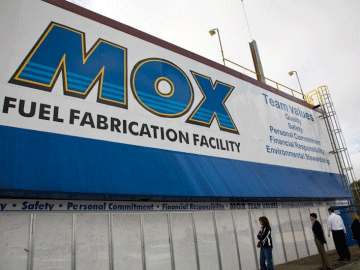 MOX project of little value http://beta.mirror.augusta.com/opinion/letters/2014-05-01/mox-project-little-value By Victor J. ReillyAiken, S.C. Thursday, May 1, 2014 MOX is a mix of oxides of uranium and plutonium that can be used as fuel for commercial nuclear reactors. It removes some plutonium from the sticky fingers of terrorists. Sound good? Yes, until the cost of doing this soared.
South Carolina Gov. Nikki Haley has recently said that if MOX is shelved, she wants the plutonium out of South Carolina. That is silly, but it reflects a 2002 federal law that U.S. Sen. Lindsey Graham had demanded.
Apparently, idiocy is endemic.
First, our plutonium problem. With welcome reductions in our nuclear arsenal, we now have about a hundred tons of plutonium in storage. In the wrong hands, less than 20 pounds of it could make a nuclear bomb. That would be a catastrophe. We must store it securely for decades. Savannah River Site would be logical for this job, with its huge area and a staff experienced in handling plutonium. This would provide good jobs that the governor should have jumped at.
MOX’s design capacity is to disable one ton of plutonium per year, so if MOX were the way to work it off, it would take more than a hundred years. A stock of one ton requires as much protection as for 100 tons.
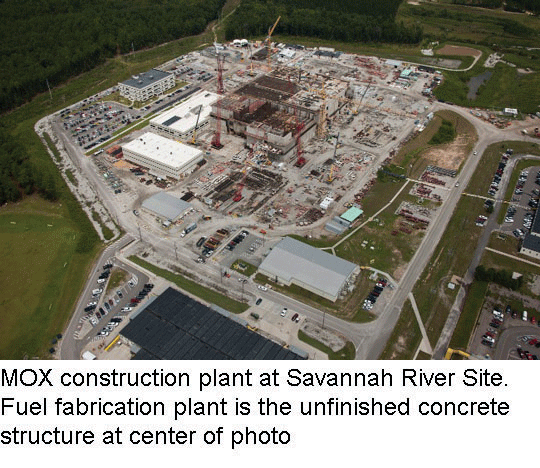
With the huge increase in fixed costs from construction, would it be profitable? If we plan to cancel the program, we would end up writing off the sunk costs, so why not do it anyway? Would it then be profitable? If MOX fuel can’t be sold at a profit, why continue with it?
In summary, MOX has no value in ridding us of our stored plutonium.
Alternatives must be sought for that. The United States will need to have one or several plutonium storage sites, indefinitely. South Carolina should accept the job for one of them.
Dead nuclear reactors are still very dangerous: US Senators call to Nuclear Regulatory Commission
 SENATORS TO NRC: DO NOT EXEMPT DECOMMISSIONING NUCLEAR REACTORS FROM EMERGENCY RESPONSE AND SECURITY MEASURES NEWS RELEASE — SEN. PATRICK LEAHY, SEN. BERNIE SANDERS
May 2, 2014
Contact:
Mike Briggs (Sanders) 202-224-5141
David Carle (Leahy) 224-3693
Washington (May 2, 2014) – In a letter sent today to Nuclear Regulatory Commission (NRC) Chairman Allison Macfarlane, Senator Edward J. Markey (D-Mass.), Senate Environment and Public Works Committee Chairman Barbara Boxer (D-Calif.), and Senators Bernard Sanders (I-Vt.), Patrick Leahy (D-Vt.) and Kirsten Gillibrand (D-N.Y.) called on the agency to stop the “unwise policy” of issuing exemptions for emergency response regulations to decommissioning nuclear reactors which house decades-worth of spent nuclear fuel.
Exemptions for compliance with the emergency response regulations – such as those that require evacuation zones and siren systems to warn of problems – have been granted to all of the ten reactor licensees that have requested them in the past. Moreover, the licensees of reactors that are or will soon begin the decommissioning process (including San Onofre in California and Vermont Yankee) have already submitted a wide range of exemption requests from emergency response, security and other regulations to the NRC.
The NRC is currently in the process of finalizing its finding that spent nuclear fuel can be stored safely for at least 60 years beyond the licensed life of a nuclear power plant, and based this determination in part on the assertion that emergency preparedness and security regulations remain in place during decommissioning. Accidents or attacks on spent fuel pools would put neighboring communities at great risk of experiencing radioactive releases, fires, and widespread contamination.
Full text of the letter is attached with appendices and below.
May 2, 2014
The Honorable Allison M. Macfarlane
Chairman
Nuclear Regulatory Commission
Rockville, MD 20852
Dear Chairman Macfarlane:
We write to request that the Nuclear Regulatory Commission (NRC) cease exempting licensees of decommissioning nuclear reactors from its emergency response and security regulations. NRC repeatedly cites these regulations to demonstrate the long-term safety and security of spent nuclear fuel. Yet it has granted each and every one of the ten requests for exemptions from emergency response requirements that it has received from reactors that have permanently shut down, generally within 2 years of the reactors’ closure and without regard to how much spent fuel is still stored in spent fuel pools. ……….
NRC is currently in the process of finalizing its Waste Confidence decision that spent nuclear fuel can be stored safely for at least 60 years beyond the licensed life of a nuclear power plant, and based this determination in part on the assertion that emergency preparedness and security regulations remain in place during decommissioning.The Commission is also voting on whether there is a benefit to accelerating the transfer of spent nuclear fuel to dry casks, and the document being voted on assumes the continued application of emergency response and security requirements.
What the NRC failed to state in its court and other filings was that licensees of decommissioning reactors are almost always exempted from the regulatory requirements NRC based its findings on within two years of the reactors’ shut-down. This is unacceptable. We urge you to announce your intent to reverse this unwise policy. http://vtdigger.org/2014/05/02/senators-nrc-exempt-decommissioning-nuclear-reactors-emergency-response-security-measures/
Don’t bring more radioactive trash to South Carolina
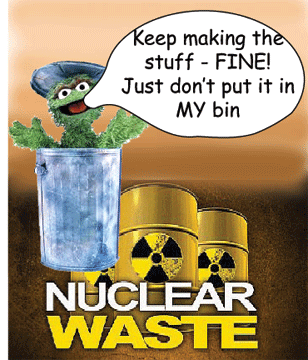 Don’t bring more nuclear waste to SRS, Greenville Online, May 1, 2014
State should be wary of plan for more nuclear waste to SRS after years of broken promises. Plans for reprocessing, permanent storage in Nevada all have fallen by the wayside as waste piles up. The Savannah River Site near Aiken was not designed as a permanent or even a long-term storage site for high-level nuclear waste. Yet, because of broken promises and foot-dragging by the federal government, SRS has become just that. Now, there is word that the United States and Germany are in discussions about bringing even more nuclear waste to the site. Such a proposal should be met with extreme circumspection.
The United States Department of Energy is evaluating a plan to accept waste from a German prototype reactor, according to a recent report in The Greenville News. The talks began in 2011, and there is no agreement in place. However, it is troubling that there would even be discussion about bringing in more nuclear waste even as material that was supposed to be temporarily stored at SRS continues to sit with no viable plan in place to move it or process it.
The discussions are over approximately 1 ton of nuclear material that would be transported in canisters to SRS.
There already is a great deal of high-level nuclear waste at the Savannah River Site, including 37 million gallons of liquid radioactive waste that the government promised would be cleaned up by the mid-2020s. Instead, in some cases, the containers holding the waste are leaking, creating a dangerous situation. Much of the waste at SRS was brought in under the promise that it would be reprocessed and then removed from the state. That has yet to happen. Until it does, South Carolina should resist plans to bring more nuclear waste to the Savannah River Site. The arrival of the German waste is far from imminent, and it should stay that way until promises already made are being fulfilled. That day right now seems to be a long way off.
The broken promises for South Carolina have come over the course of several years.
SRS was supposed to be home to a fuel reprocessing plant that would have turned much of the waste at the site into fuel for nuclear power plants. The Obama administration now is strongly urging that the proposed reprocessing plant be put on hold. Given that there are no apparent buyers for the fuel, it is difficult to challenge the administration’s decision on a practical level while at the same time it is completely reasonable to expect the administration to make good on promises to South Carolina.
It stands as a deplorable failure of the federal government to deliver on promises made when former Gov. Jim Hodges unsuccessfully fought efforts to ship plutonium to South Carolina. Work on the Mixed Oxide reprocessing plant began in 2007. Years of delays and cost overruns have contributed to the apparent demise of this facility. Initially estimated to cost $3.8 billion, the budget has surged past $7.5 billion and the facility remains unfinished……….
The federal government has not been a trustworthy partner when it comes to shipping radioactive material to the Savannah River Site. As a spokesman for Gov. Nikki Haley told The News, the federal government has failed to live up to long-standing promises to this state. Until it begins to fulfill those promises, there should be strong opposition to bringing any more of this dangerous waste to a facility the government seems willing to turn into a de facto nuclear waste dump. http://www.greenvilleonline.com/story/opinion/editorials/2014/05/01/editorial-bring-nuclear-waste-srs/8578027/
Censorship of science writer on Fox News- mustn’t mention climate change
A 2013 study also found that the more time viewers spend watching conservative media, the more skeptical they become of climate science.
 Science Editor: Fox News Told Me Not To Talk About Climate Change The Huffington Post | by Dominique Mosbergen 04/30/2014 This week, a science writer was asked to appear on Fox News to discuss the future of science and technology. However, he says there was one caveat: The issue of climate change would be off-limits.
On Wednesday, Michael Moyer, an editor at Scientific American, described his experience with the news outlet this way:
Fox & Friends producer wanted to talk about future trends. I said #1 will be impacts of climate change. I was told to pick something else.In a blog post on Scientific American, Moyer explained that he had offered to discuss what he foresees as the “trends for the future” on “Fox & Friends.” In a blog post on Scientific American, Moyer explained that he had offered to discuss what he foresees as the “trends for the future” on “Fox & Friends.”
“About the only interesting thing that the scientific community is sure will happen in the next 50 years is that climate change is going to get worse, and that we’re going to have to deal with the impacts. So I put that as one of my talking points,” he wrote.
But Moyer says a producer of the show soon reached out to him to tell him explicitly to not discuss climate change during the segment. Not wanting to back out of an opportunity to “share cool science with whomever will listen,” Moyer agreed to still appear on “Fox & Friends” Wednesday.
That, however, will likely be the last time Moyer will appear on the show.
“I found the tone and topics of coverage while I was sitting in the green room this morning to be not something that I wanted to be a part of in the future,” he told Talking Points Memo of his “Fox & Friends” experience. “I didn’t realize that the drumbeat of conservative propaganda was so ubiquitous on the show.”……
Moyer, however, insists that the Fox producer wrote this in an email: “[C]an we replace the climate change with something else?”
This wouldn’t be the first time that Fox News’ coverage of climate change has beencalled into question. A recent study by the Union of Concerned Scientists found the conservative news outlet covers climate change inaccurately 72 percent of the time.
A 2013 study also found that the more time viewers spend watching conservative media, the more skeptical they become of climate science.
“There are some things that in science and scientific discourse are not controversial at all,” Moyer told Talking Points Memo in light of his Fox News experience. “I hope that we can all as a society agree to at least discuss them and come up with good solutions. Just because you don’t want something to be true doesn’t make it not true.”
According to a recent Associated Press-GfK poll, about four in 10 Americans said “they are not too confident or outright disbelieve that the earth is warming, mostly a result of man-made heat-trapping gases,” per the AP. That’s in stark contrast to the97 percent of climate scientists who say global warming in the last 100 years has very likely been caused by human activity. http://linkis.com/zite.to/eoXrO
1 This Month
23-25 October – on Zoom – World BEYOND War’s annual global conferenc


Shut down the radiation-damaged Heysham nuclear reactors now
To see nuclear-related stories in greater depth and intensity – go to https://nuclearinformation.wordpress.com

Say No to NASA’s Reckless Nuclear Reactor on the Moon
Say No to NASA’s Reckless Nuclear Reactor on the Moon
-
Archives
- October 2026 (170)
- September 2026 (339)
- August 2026 (330)
- July 2026 (355)
- June 2026 (287)
- May 2026 (306)
- April 2026 (356)
- March 2026 (251)
- February 2026 (267)
- January 2026 (308)
- December 2025 (358)
- November 2025 (359)
-
Categories
- 1
- 1 NUCLEAR ISSUES
- business and costs
- climate change
- culture and arts
- ENERGY
- environment
- health
- history
- indigenous issues
- Legal
- marketing of nuclear
- media
- opposition to nuclear
- PERSONAL STORIES
- politics
- politics international
- Religion and ethics
- safety
- secrets,lies and civil liberties
- spinbuster
- technology
- Uranium
- wastes
- weapons and war
- Women
- 2 WORLD
- ACTION
- AFRICA
- Atrocities
- AUSTRALIA
- Christina's notes
- Christina's themes
- culture and arts
- Events
- Fuk 2022
- Fuk 2023
- Fukushima 2017
- Fukushima 2018
- fukushima 2019
- Fukushima 2020
- Fukushima 2021
- general
- global warming
- Humour (God we need it)
- Nuclear
- RARE EARTHS
- Reference
- resources – print
- Resources -audiovicual
- Weekly Newsletter
- World
- World Nuclear
- YouTube
-
RSS
Entries RSS
Comments RSS

