Renewable energy wanted – call by 12 top USA corporations
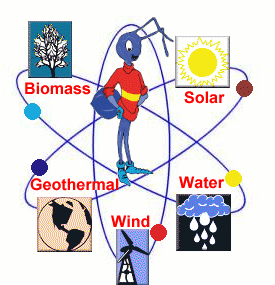 12 Mainstream American Corporations Want More Renewable Energy Clean Technica, uly 17th, 2014 by Jake Richardson Just a couple of weeks ago, we reported that a number of mainstream American companies are saving about $1.1 billion a year by using renewable energy. Now, 12 prominent and very large corporations have combined their voices to say they want more renewables. Renewable energy might seem like a marginal part of American society, even something for ‘hippies,’ but if you believe that take a look at some of the companies that want more of it.
- General Motors
- Walmart
- Johnson & Johnson
- Proctor and Gamble
- Sprint
- Intel
- Hewlett-Packard
- Bloomberg
- Mars
- Novelis
- REI
- Facebook…….
- No one would say any of these companies are ‘radical,’ so it seems that renewable energy, like solar and wind are definitely mainstream now. In other words, it’s not for ‘kooks,’ ‘granolas,’ ‘socialists,’ ‘treehuggers,’ or ‘vegans’.The twelve companies listed above are brands recognizable to almost any American. They are thoroughly mainstream and some are even part of American history. Take Johnson and Johnson, for example. This huge corporation was founded in 1886. Similarly, General Motors was founded in 1908. These two companies are part of American culture and have been around for over one hundred years……..http://cleantechnica.com/2014/07/17/12-mainstream-american-corporations-want-renewable-energy/
Interview with Navy sailor suffering after Fukushima radiation exposure
Emotional interview with Navy sailor suffering after Fukushima exposure: Others with same symptoms “told to be quiet… nobody’s heard from them” — Health is worsening, worried I’m going to die — Can’t really use legs or arms, hands ‘barely functional’ — Rashes all over body, spasms, shaking — Doctors tell us “it’s all psychological” (AUDIO) http://enenews.com/emotional-interview-navy-sailor-suffering-serious-illness-after-fukushima-exposure-others-same-symptoms-told-be-quiet-nobodys-heard-worry-about-dying-health-keeps-worsening-really-legs-arms-h?utm_source=feedburner&utm_medium=email&utm_campaign=Feed%3A+ENENews+%28Energy+News%29
Interview with Navy Lt. Steve Simmons who served on the USS Ronald Reagan for 3/11 relief mission, Nuclear Hotseat hosted by Libbe HaLevy, July 8, 2014 (emphasis added):
- 21:30 in — November 2011 I noticed something was wrong… The black-out was the first thing… I started dealing with gastrointestinal issues, at first I thought I was coming down with a stomach bug… Fevers as high as 102.9°F… January 2012 was the first time I was hospitalized… [They] sent me home with a sinus infection. Three days later I was readmitted to the hospital because my lymph nodes were swelling… that’s when my legs buckled and the muscle weakness started to onset… it’s been ascending from legs, trunk, arms, hands… I can’t really use the muscles much at all. I’m down to about 20 lbs. of grip strength in my hands, which is barely functional… I do have to catheterize every 4 hours in order to empty the bladder. The migraines still get worse. The fevers still come and go, and they keep calling it a fever of unknown origin. My vitamin D is in the gutter, they just keep calling it an unspecified vitamin D deficiency… 2nd degree burns on my legs just from being out in the sun for 3 or 4 hours… that had never been a concern. Nobody can figure it out. I’ve been getting these rashes that come and go; they’ll go up my arms, my neck, around my eyes, back, stomach, legs. I deal with tremors and spasms… I am [in a wheelchair]… There’s days I don’t even get out of bed… for a long time I thought I was the only one. I had no idea there were other individuals that were even sick or dealing with ailments… Doctors wouldn’t tell us anything… I’ve had doctors tell me maybe you’re better off not knowing what you’re dealing with… You can’t have over 100 or 200 people sick, and one who has died last April, and say there is absolutely no health risk.
- 35:00 in — Finding out that there’s more people that are sick, finding out there were some other individuals at Walter Reed [Hospital]… almost identical symptoms to what I was dealing with… they we’re told to be quiet, and next thing I know they’re, who knows where they’re at, nobody’s heard from them, nobody has seen them. I have a buddy at Walter Reed right now, whose going through the same exact thing, very similar to what I’m dealing with — maybe 6 months to a year behind on the symptoms… His wife would call my wife and my wife would explain what he could expect next and sure as anything that happens next… Him and I both had doctors who have actively tried to convince us that there’s physically nothing wrong and it’s all psychological… This is ridiculous… He’s also in a wheelchair and when he went to the clinic to get fitted for a wheelchair, this doctor told him that it’s all in his head, and he doesn’t need a wheelchair… This is uncalled for.
- 46:00 in — We now realize how bad it was… the worst disaster in history, then it’s time to acknowledge the fact that, yeah there is a problem, and there are going to be some effects on human life… If the worst case happens, and some more folks pass — I would have to be naive to think that nobody else is going to pass away from this — it’s only a matter of time before there’s more lives lost. I would be lying if I don’t think every day that I’m going to be next because of how bad my health keeps going downhill.
Nuclear Gambling with Earth’s future
Sino-American rivalry: Energy consumption, nuclear energy and deadly nukes Dr. Can Erimtan is an independent scholar residing in İstanbul, with a wide interest in the politics, history and culture of the Balkans and the Greater Middle East. He tweets at @theerimtanangle July 10, 2014“……….. not content with just matching Chinese commitment to fossil fuel imports and consumption by means of production, the Obama administration also “incentivizes oil, gas, and coal production overseas by providing billions of dollars in favorable financing each year to fossil fuel projects through its participation in multilateral development bank lending as well as bilateral financing through the US Export-Import Bank and the Overseas Private Investment Corporation … Since President Obama was elected, US financing of fossil fuel projects overseas through these international financial institutions has increased by 14 percent from $4.1 billion in 2009 to $4.7 billion in 2013, having declined from a peak of $6.3 billion in 2012.
Both global powerhouses thus appear to persist in gambling with the Earth’s future. In fact, American and Chinese willingness to continue playing with fire is also demonstrated by their actions in the field of nuclear energy and weapons. Some time ago, the award-winning journalist Ken Silverstein wrote in the Christian Science Monitor that the “Obama administration wants to seed the United States with pint-size nuclear reactors … The US Department of Energy said it would provide $217 million in matching funds over five years to [the private company] NuScale, which builds small, ready-made reactors that can be strung together”. These pint-size nuclear reactors would be added to the already existing “100 commercial nuclear power reactors [that] are licensed to operate at 62 sites in 31 States.”
Meanwhile, in China 20 nuclear power reactors are in operation, with a further 28 under construction, and even more about to start construction. The recent Fukushima disaster in Japan (11 March 2011) and the now-legendary Chernobyl disaster in the Ukraine (26 April 1986) provide ample evidence that the mere principle of nuclear energy seems patently absurd: in order to boil water to operate some turbines, nuclear material is fused to produce high levels of energy (or heat) that is then put to use to boil water basically, or to put it in more formal words, as can be found on the website Three Mile Island (named after another famous nuclear mishap on 28 March 1979): the “only purpose of a nuclear power plant is to produce electricity. To produce electricity, a power plant needs a source of heat to boil water which becomes steam. The steam then turns a turbine, the turbine turns an electrical generator, and the generator produces electricity”. And the dangers of nuclear radiation are manifold, as explained by Dr. Helen Caldicott, the well-known Australian anti-nuclear advocate: “[n] dose of radiation is safe. Each dose received by the body is cumulative and adds to the risk of developing malignancy or genetic disease … Children are ten to twenty times more vulnerable to the carcinogenic effects of radiation than adults. Females tend to be more sensitive compared to males, whilst fetuses and immuno-compromised patients are also extremely sensitive … High doses of radiation received from a nuclear meltdown or from a nuclear weapon explosion can cause acute radiation sickness, with alopecia, severe nausea, diarrhea and thrombocytopenia”.
All in all, the US and China seem well-matched in their dedication to endangering the continued existence of humanity on this earth: either by their use and propagation of fossil fuels leading to disastrous climate change. Or by sticking to nuclear energy as an alternative, which is a dangerous proposition to begin with, while the issue of the resultant nuclear waste material has not even been touched upon.
The military perspective
Even more ominous is the continued presence of nuclear arsenals in the US as well as in China. During the Cold War the US and the Soviet Union superpowers adhered to the principle of mutually assured destruction, which meant that the whole world was basically kept hostage to a game of chicken. Now that the Cold War is over, one would think that these nuclear warheads would finally be confined to the dustbin of history. Alas, nothing seems further from the truth, as the US still deploys about 2,000 strategic warheads, with even more in reserve.
Just the other day, the Associated Press (AP) released a timely report on America’s still-existing nuclear arsenal,http://rt.com/op-edge/171824-sino-american-rivalry-energy/
Comparison between USA and China’s management of their nuclear arsenals
Sino-American rivalry: Energy consumption, nuclear energy and deadly nukes Dr. Can Erimtan is an independent scholar residing in İstanbul, with a wide interest in the politics, history and culture of the Balkans and the Greater Middle East. He tweets at @theerimtanangle July 10, 2014
“………Just the other day, the Associated Press (AP) released a timely report on America’s still-existing nuclear arsenal, in which Robert Burns insightfully explained that the “nuclear missiles hidden in plain view across the prairies of northwest North Dakota reveal one reason why trouble keeps finding the nuclear Air Force. The ‘Big Sticks’, as some call the 60-foot-tall Minuteman 3 missiles, are just plain old. The Air Force asserts with pride that the missile system, more than 40 years old and designed during the Cold War to counter the now-defunct Soviet Union, is safe and secure. None has ever been used in combat or launched accidentally. But it also admits to fraying at the edges: time-worn command posts, corroded launch silos, failing support equipment and an emergency-response helicopter fleet so antiquated that a replacement was deemed ‘critical’ years ago. The Minuteman is no ordinary weapon. The business end of the missile can deliver mass destruction across the globe as quickly as you could have a pizza delivered to your doorstep.”Even as the Minuteman has been updated over the years and remains ready for launch on short notice, the items that support it have grown old, Burns also writes.
In 2012, Michelle Spencer, Aadina Ludin and Heather Nelson compiled a troubling report for the USAF Counterproliferation Center. The report’s title illustrates just how dangerous these remnants from the Cold War on US soil today are: The Unauthorized Movement of Nuclear Weapons and Mistaken Shipment of Classified Missile Components. The authors present a narrative of frolic and detour that is unsettling to say the least: “[o]n August 31, 2007, a US Air Force B-52 plane with the call sign ―Doom 99‖ took off from Minot Air Force Base (AFB), North Dakota, inadvertently loaded with six Advanced Cruise Missiles loaded with nuclear warheads and flew to Barksdale AFB, Louisiana. After landing, Doom 99‖ sat on the tarmac at Barksdale unguarded for nine hours before the nuclear weapons were discovered… While the Air Force was reeling from the investigations of the unauthorized movement of nuclear weapons, it was revealed that Taiwan had received classified forward sections of the Minuteman III intercontinental ballistic missile rather than the helicopter batteries it had ordered from the US, bringing to light a second nuclear-related incident”. Particularly, the phrase “inadvertently loaded with six Advanced Cruise Missiles loaded with nuclear warheads” should make everyone’s blood boil.
In contrast, the up-and-coming superpower of the 21st century China does not seem to dispose of such a wide array of technical and/or other difficulties besetting its nuclear arsenal. In 2011, the Washington Post ran a story indicating that the Chinese (or rather the CCP) constructed “a vast network of tunnels designed to hide their country’s increasingly sophisticated missile and nuclear arsenal”, called the“Underground Great Wall”. An associate professor of strategy at the US Naval War College, James Holmes, then, writes that in “March 2008, China’s state-run CCTV network broke the news about a 5,000 kilometer network of hardened tunnels built to house the Chinese Second Artillery Corps’s increasingly modern force of nuclear-tipped ballistic missiles. Tunneling evidently commenced in 1995. Located in, or rather under, mountainous districts of Hebei Province, in northern China, the facility is reportedly hundreds of meters deep”
In the end, the US as the only nation to have ever exploded a nuclear device during wartime appears to be experiencing difficulties managing its now-aging stockpile of nuclear warheads. While China, on the other hand, seems to have devised a novel way of controlling its own nuclear arsenal. In a way, these two different stories of nuclear arms’ storage could be understood as a metaphor for the waning and the rising of fortunes … Does the dragon ascend to ever-loftier heights as the eagle is slowly touching down? Will the ongoing yet somewhat unseen rivalry between Obama’s America and Xi Jinping’s China determine the course of humanity in the coming year or will the large-scale food shortages expected by 2050 combined with the ill-effects of climate change make the continuation of such competitions utterly futile and pointless? http://rt.com/op-edge/171824-sino-american-rivalry-energy/
Harvard professor warns on the hazards of cumulative low level radiation from Fukuhsima
 California Newspaper: Health effects in U.S. from Fukushima radiation? Stanford Professor: “Am I concerned? Yes I am, that’s because I know radiation … there’s increased risk … avoid radiation as much as you can” — UC Berkeley Nuclear Prof: “Everyone is really scared of it … that’s what the big problem is” http://enenews.com/california-paper-fukushima-plume-health-effects-stanford-expert-concerned-because-radiation-pretty-increased-risk-uc-berkeley-nuclear-prof-everyone-really-scared
La Jolla Light (Calif. Newspaper), July 9, 2014: Scientists weigh-in on status of radioactive waters from Fukushima reaching California coast […] the potential health effects cut to the heart of the contemporary scientific debate on the biological consequences of low-level radiation. […] Experts project the radioactivity will be […] two-to-20 times greater than the residual radiation already in the Pacific from the nuclear weapons tests […] Bottom line? So what is the risk of swimming, surfing and splashing about in the low-level radioactive waters?
Dr. Herbert Abrams, Harvard and Stanford University professor of radiology & principal researcher for the National Research Council’s study ‘Biological Effects of Ionizing Radiation’ who testified before Congress about its conclusions: “The underlying premise that has to be considered as you talk about radioactivity, the water and people being exposed to it, is that the effects of radiation are cumulative […] what is the turning point? […] common sense is to avoid radiation as much as you can.” […] With the radiation from Fukushima predicted to [linger here for years] Abrams said the potential dose should not be dismissed as negligible. “Am I concerned? Yes I am. And that’s because I know radiation pretty well […] It shakes up the cell and it goes after the genetic material … The bottom line is that (radiation) is a carcinogenic agent […] there is increased risk. But how do you translate that into an understandable discussion of what’s going to happen to guys on their surfboards? I don’t know.” […] Abrams issues his own warning about those scientists declaring the low-level radiation to be absolutely “safe” […] “Physicists, or at least some of them, are the people in the nuclear industry itself. They play down (the risks) at such low doses, but they never talk about it as being cumulative.”
Prof. Kai Vetter, UC Berkeley Nuclear Engineering Dept.: “People don’t understand nuclear radiation and the impact […] Everyone is really scared of it […] It should not pose any health risk on swimmers, divers, people on the beach. […] The psychological stress and psychological impact which might actually cause health effects, we should never underestimate that […] that’s really what the big problem is, because there’s a lot of fear. There are a lot claims out there to increase the fear. From my perspective, it is completely unjustified and irresponsible to claim all the effects because that will just cause more and more fear in the public, which is probably the biggest impact. […] In a way, we feel as a journalist. We see ourselves really as [doing a] service to the community.”
Dr. Ken Buesseler, Woods Hole Oceanographic Institution: “A lot of people are dismissive of it because it’s so low, and that’s not a good thing to do because radiation can kill […] t doesn’t necessarily mean it’s at harmful levels […] We know it’s out there and we know it’s moving slowly across […] Any additional radioactivity can cause an increase in risk. […] when no one makes measurements, then people will get more worried […] We’re looking for agencies to step up […] we’re not getting any success with places like NOAA or the Department of Energy and that’s too bad. I think they have some responsibility.”
USA Energy Department urged to investigate risks in new plan for uranium processing

 Watchdogs Press U.S. on Risks of Uranium-Processing Revamp http://www.nationaljournal.com/global-security-newswire/watchdogs-press-u-s-on-risks-of-uranium-processing-revamp-20140711 By Diane Barnes Activists are urging Washington to study possible risks from a plan for dispersing bomb-uranium activities that previously were to be housed in a single facility.
A coalition of more than 30 watchdog groups on Thursday said the Energy Department’s nuclear-weapons agency is required by law to develop a new “site-wide environmental impact statement” for the proposal, devised this year by an independent “Red Team” as an alternative to the Uranium Processing Facility project in Tennessee.
The “UPF” effort faced years of delays, as design expenses mounted and cost estimates ballooned by billions of dollars. Substantial construction at the Y-12 National Security Complex ultimately never began.
The U.S. atomic agency last month said it plans to follow the “Red Team” guidelines, which advise using current Y-12 infrastructure to help contain costs and move onsite uranium operations out of the facility’s decades-old “9212” structure. The alternative project reportedly is intended to cap costs at $6.5 billion.
The activists, though, implored Klotz to look beyond the independent recommendations devised this year.
“We urge you to take the time to fully investigate the range of possibilities, even beyond the Red Team’s recommendations, to set a course that will best serve the nation, not only by saving money, but by preparing to meet future mission requirements in the most effective and efficient way,” they wrote in the letter, first reported by the Knoxville News Sentinel.
The coming economic disaster for USA’s nuclear towns, starting with Kewaunee
 Wisconsin Reactor’s Demise Shows Nuclear Towns’ Plight Bloomberg News By Tim Jones July 08, 2014 “……..The Wisconsin facility is part of what Moody’s Investors Service describes as the largest wave of U.S.-based nuclear and coal electric-plant retirements in the past 35 years. The closings stem from abundant supplies of cheaper natural gas and changes in environmental policies. The consequences can be sudden and drastic, affecting school funding, real-estate values and economic development that were linked to the facilities.
Unlike abandoned industrial plants, which can be retooled for another manufacturer, nuclear plants leave another legacy: radioactive waste, which at the Kewaunee site sits in concrete canisters about 100 yards (91 meters) from Lake Michigan.
“The challenge that local officials have to face is large,” said Julie Beglin, one of the report’s co-authors……..
“It was cheaper to purchase energy on the open market than to produce it at Kewaunee,” said Mark Kanz, a company spokesman. “I’m sure it won’t be the last to close. There will be other plants that go through decommissioning, whether it’s economics or from equipment-related issues.”…….
While the economics of power generation can change, two factors work against the nuclear industry, said David Lochbaum, director of the Nuclear Safety Project at the Union of Concerned Scientists.
“The cost of non-nuclear electricity is trending down,” Lochbaum said, “and the cost of maintaining aging nuclear power reactors is trending up.”……
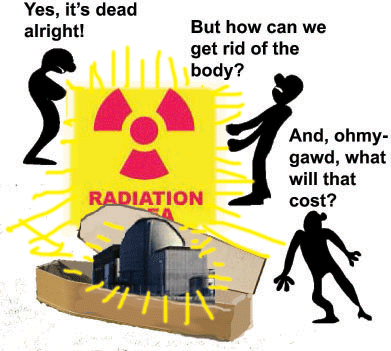 Six Decades The aftermath of a nuclear power plant’s leaving a community is more complicated and lengthy than the end of a conventional industrial facility. Federal regulations governing the decommissioning of sites are designed to protect the public.
The process must be completed within 60 years, according to the Nuclear Regulatory Commission. Seventeen plants, including Kewaunee, are in some phase of decommissioning, the NRC said on its website…….http://www.businessweek.com/news/2014-07-08/wisconsin-reactor-s-slow-motion-end-shows-nuclear-towns-plight
Mystery, danger and continuing radiation release from Waste Isolation Pilot Project (WIPP)
Environmental radiation releases spiked again in mid-June around the surface site of the only U.S. underground nuclear weapons waste storage facility near Carlsbad, New Mexico. The facility, the Waste Isolation Pilot Project (WIPP), has been shut down since February 14, when its isolation technology failed, releasing unsafe levels of Plutonium, Americium, and other radio-nuclides into the environment around the site.
Radiation levels in the underground storage area, 2,150 feet below the surface vary from near-normal to potentially lethal. At the time of the February accident, more than 20 WIPP workers suffered low level radioactive contamination, even though none of them were underground. WIPP assumes, but cannot confirm, that underground conditions have not changed since May 31, when the last entry team went into the mine, as reported by WIPP field manager Jose Franco on June 5:…….
What happened underground remains a mystery and a danger
More than five months after the February accident, officials still have no certain understanding of what went wrong. It is generally thought that one 55 gallon drum of waste (perhaps more than one) overheated and burst, spilling radioactive waste in a part of the storage area known as Panel 7, Room 7. This room, designated a “High Contamination Area,” measures 33 by 80 feet and presently has 24 rows of waste containers. The room holds 258 containers, tightly stacked and packed wall-to-wall, with no aisles to allow easy access. There is some clearance between the top of the stacks and the room’s ceiling.
The high contamination in Room 7 is a threat to human inspectors, limiting inspection of the room to date to mechanical means, primarily cameras on extension arms. As a result of these limitations, WIPP teams have inspected only ten of the 24 rows of waste containers in Room 7. Rows #1-14 have been out of reach of the available equipment.
WIPP has begun building a full scale replica of Room 7 above ground, to provide a realistic staging area in which to test methods of remote observationthat might reach the 14 uninspected rows………http://dissidentvoice.org/2014/07/radiation-releases-continue-from-nuclear-waste-isolation-project
Unreported very high risk of nuclear drums exploding at New Mexico waste facility
Internal Memo: 10 times more WIPP nuclear drums risk exploding than media reported — Expert: Data shows increasing amount of radioactivity going into environment — Official: Something “caused drum to later catch fire”; Gov’t should investigate if truck fire & electrical surge led to the radiation release http://enenews.com/10-times-as-many-potentially-explosive-nuclear-waste-drums-inside-wipp-dump-than-reported-expert-data-shows-increased-amounts-of-radioactivity-going-into-environment-official-drum-ca
 AP, July 4, 2014 (emphasis added): Teams of scientists and engineers are still trying to determine exactly what caused a barrel [at New Mexico’s Waste Isolation Pilot Plant (WIPP)] from Los Alamos to burst […] Despite hundreds of experiments to date, investigators have been unable to create any reaction that would have caused the container to leak like it did […] The accident has […] indefinitely shuttered the mine […] According to the memo obtained by The Associated Press, [Los Alamos National Laboratory’s Principal Associate Lab Director Terry Wallace] told employees at a meeting Monday that the probe is focused on 16 barrels of highly acidic, nitrate-salt-bearing waste, including the drum that leaked at [WIPP]. Ten of the other barrels [11 total, including the one that ruptured] are also underground at the [WIPP] mine[…] Wallace is quoted in the memo as saying that a technical review “identified certain conditions that might potentially cause an exothermic reaction inside a drum. Among them are neutralized liquids, a low pH and the presence of metals.”
According to the AP’s article above, the investigation is now focusing on 11 barrels in the WIPP underground, yet only a few weeks ago the AP reported: “Officials say 6… potentially explosive containers of waste [were shipped] from Los Alamos National Laboratory… [Five] are being stored at a site in West Texas [and] one at the Waste Isolation Pilot Plant [believed to be the source of the radiation leak].
Albuquerque Journal interview with Miles Smith, EnergySolutions’ vice president of Southwest operations, July 3, 2014: “We don’t believe the combination we put into the drums, we don’t think it has the ability to start burning on its own. It needs an outside source of ignition […] It doesn’t look like the kitty litter was the cause […] I don’t believe [absorbent materials] caused the explosion or the fire. [One of the two suspect products, an acid neutralizer, is not a problem]. Its safety sheet says it is not incompatible [The other product, a base neutralizer, is incompatible with the nitrates in WIPP waste but this neutralizer wasn’t used in the WIPP-bound barrels.] We think there are other things that caused the drum to later catch fire [there] are a lot of things out there [to investigate, including a truck fire and an electrical surge in the days before the leak.]
Albuquerque Journal, July 3, 2014: Don Hancock of the Southwest Research and Information Center, a WIPP watchdog, said Smith’s comments are consistent with those of state Environment Department […] but noted that no one from [Los Alamos National Lab] has weighed in. “I would say I’ve always been skeptical of the kitty litter issue,” he said. “Anybody with a cat knows that kitty litter itself is not combustible. It’s got to be kitty litter and something else.”
Don Hancock, Southwest Research and Information Center, June 25, 2014: […] the current data show that there are increased amounts of radioactivity going into the environment as contaminated filters are being changed. […] DOE presumes that the ventilation system and the exhaust shaft are too contaminated to use in a re-opened facility. On June 18, the House Appropriations Committee approved $20 million dollars […] as a down payment for new ventilation and a new exhaust shaft. […] it is very difficult or impossible to determine exactly what happened and how much contamination was released.
Spent nuclear fuel crisis at closed Kewaunee nuclear plant
Outcry prompts expedited plan to move fuel at Kewaunee nuclear plant Milwaukee Wisconsin Journal Sentinel by Thomas Content 6 July 14 The Kewaunee nuclear power plant stopped producing electricity more than a year ago, but it left behind highly hazardous waste that has no place to go.
Radioactive rods of used nuclear fuel are cooling in a large storage pool inside the reactor, located east of Green Bay on the shore of Lake Michigan. Plant owner Dominion Resources Inc. wants to speed up plans to empty the pool and put the rods in more secure long-term storage.
Under Dominion’s plan, all of the spent fuel will be moved from the pool by the end of 2016. The rods will be encased in 24 concrete casks, each standing 18 feet tall, that will be moved from the reactor building to a concrete pad outside, said Dominion spokesman Mark Kanz.
Once they’re relocated, it’s unclear how long the radioactive remnants of the nuclear industry will stay in the casks. That’s because the federal government has no long-term plan for disposing of the waste now stored at scores of reactors around the country. According to the Nuclear Energy Institute, Wisconsin has 1,430 tons, or about 2%, of the nation’s spent fuel.
Dominion hired NAC International of Atlanta to build and fill the casks, and move them from the Kewaunee reactor building. Terms of Dominion’s deal with NAC haven’t been disclosed, but the company told federal regulators that it will spend $103 million through 2016 to manage the spent fuel.
The company accelerated plans to remove and encase the spent fuel to address concerns raised by members of the local community, Kanz said.
Last year, residents and officials in the Kewaunee County Town of Carlton criticized Dominion after the company said it would take the full 60 years allowed by the federal government to decommission the power plant.
Taking that long to shutter the plant would cripple efforts to attract economic development to the area, they said………
A nuclear safety watchdog group, the Union of Concerned Scientists, says the risk to the public is decreased when the spent fuel is placed in concrete casks rather than keeping it in spent fuel pools………
The project is being paid for by the customers of three Wisconsin utilities — the former co-owners of the power plant. Those customers paid surcharges over the years into a decommissioning fund.
The value of that fund is less than Dominion says it needs to spend, at $649.3 million at the end of 2013. Dominion says the money is being invested so that it will grow over time and that there should be sufficient money available to pay for the decommissioning.
Dominion has also committed $60 million from its Virginia-based parent company toward the project, in the event funds in the decommissioning fund run short.
Wisconsin’s electric utility customers wouldn’t end up having to pay more, because Dominion bought the plant from Wisconsin utilities and took responsibility for decommissioning at that time.
When Wisconsin regulators approved the sale of the Kewaunee Power Station in 2005, they ordered Dominion to return any unspent decommissioning funds to state ratepayers……
As the stalemate in Washington over waste storage continues, the stockpiles of stored spent nuclear fuel enclosed in concrete casks are multiplying. How long the concrete casks will stay at the Kewaunee, Point Beach and La Crosse reactors in Wisconsin is very much up in the air.
Dominion’s plan calls for concrete casks to start being shipped to the control of the federal government within seven years — but that timeline may be merely wishful thinking, said David Lochbaum of the Union of Concerned Scientists’ nuclear safety project.
“I likely have a better chance of winning the lottery than spent fuel leaving Kewaunee site in 2021 — and I don’t buy lottery tickets,” he said. http://www.jsonline.com/business/outcry-prompts-expedited-plan-to-move-fuel-at-kewaunee-nuclear-plant-b99302369z1-265974071.html
Ever escalating costs of failed Florida nuclear plant
 Trigaux: Failed Florida nuclear plant’s costs keep rising Tampa Bay Times Robert Trigaux 3 July 14, The costs of prematurely closing Crystal River 3 — Duke Energy’s sole nuclear power plant in Florida — keep on rising. Duke Energy recently agreed to a settlement that sent at least $55 million to eight minority owners of “CR3.” That’s the nuke plant Duke closed last year due to a bungled do-it-yourself repair job that the power company finally acknowledged last year would prove too expensive to fix. The bigger settlement sums are going to minority investors like Ocala and the Orlando Utilities Commission. But even smaller towns like Bushnell and Alachua, with small stakes in CR3, will be compensated.
Another $8.4 million will go to nine wholesale customers with contracts to receive electricity from CR3. Those customers range from Homestead, south of Miami, to Bartow in Hillsborough County.
Total payout to minority owners and wholesale customers: $63.4 million.
The 860-megawatt Crystal River plant was expected to operate until 2036. Instead, CR3’s concrete containment wall cracked in 2009. Never restarted, the plant is scheduled to be decommissioned over the next 60 years at a cost topping $1 billion……..
CR3’s demise coincided with a severe state recession that has decreased demand for electricity since 2008.
“We do not need to add more capacity at this time,” McCain said. “But it was important for these cities and utilities to end their ownership and liabilities in Crystal River 3. This settlement transfers ownership back to Duke.”
One more CR3 conflict resolved with big checks. They likely won’t be the last.
$63.4 million: Cashing out of Duke Energy’s closed nuclear plant………..
Contact Robert Trigaux at rtrigaux@tampabay.com or (727) 893-8405. Follow him@venturetampabay. http://www.tampabay.com/news/business/energy/amid-pricey-ripples-from-failed-florida-nuclear-plant-minority-investors/2186912
Tough challenge: nuclear cleanup of 1976 ‘Atomic Man’ Hanford disaster site
Nuclear site home to the 1976 ‘Atomic Man’ disaster that exposed worker to ‘500 times’ the occupational standard of radiation to be demolished Daily Mail, 4 July 14
- Harold McCluskey was working at the Hanford Nuclear Reservation when a chemical reaction caused a glass glove box to explode.
- He was exposed to the highest dose of radiation from the chemical element americium ever recorded — 500 times the occupational standard
- It took more than a year for doctors to remove enough radioactive material from his body to make it safe for him to be around other people
- The DOE hopes to have the facility ready for demolition by summer 2016
By DAILY MAIL REPORTER and AP
“……….Hanford contains the nation’s greatest collection of nuclear waste, and for more than two decades has been engaged in the dangerous work of cleaning up that waste. The space now dubbed the McCluskey Room is located inside the closed Plutonium Finishing Plant and is scheduled for cleanup this summer.
‘It’s been largely closed up since the accident,’ Geoff Tyree, a spokesman for the U.S. Department of Energy in Richland, said Wednesday. ‘It was restricted for the potential for airborne radiation contamination.’
Since 2008, the Department of Energy and contractor CH2M HILL Plateau Remediation Company have been preparing the plant for demolition.
‘About two-thirds of the Plutonium Finishing Plant is deactivated — cleaned out and ready for demolition,’ said Jon Peschong, an assistant DOE manager in Richland. ‘Cleaning out the McCluskey Room will be a major step forward.’
When specially trained and equipped workers enter the room this summer, they will encounter airborne radioactivity, surface contamination, confined spaces and poor ventilation, the DOE said.
They will be wearing abrasion-resistant suits that protect them from surface contamination and chemicals. A dual-purpose air system will provide cool air for breathing and cool air throughout the suit for worker comfort, allowing them to work for longer periods of time. The suits are pressurized, to prevent workers from coming into contact with airborne contaminants.
The McCluskey Room ‘is going to be the toughest work ahead of us as we finish cleaning the plant and getting it ready for demolition by the end of September 2016,’ Tyree said. http://www.dailymail.co.uk/news/article-2678623/Department-Energy-plans-demolition-nuclear-site-home-1976-Atomic-Man-disaster-exposed-worker-500-times-occupational-sta
All too close to USA Nuclear Waste project – very strong earthquake
‘Very strong’ quake hits New Mexico border — Seismic data spikes at WIPP nuke site — Emergency declared at nearest nuclear plant — “Larger magnitude event could still occur” — TV: “Sounded like a train derailed” — “Very rare… Still trying to figure out what caused it… no known fault lines in area” (VIDEOS) http://enenews.com/very-strong-quake-hits-near-new-mexico-border-seismic-data-spikes-near-wipp-site-emergency-decalred-at-nearest-nuclear-plant-larger-magnitude-event-could-still-occur-tv-sounded?utm_source=feedburner&utm_medium=e
USGS, June 29, 2014: M5.2 – 50km NW of Lordsburg, NM 04:59:33 UTC (Max CDI (maximum reported intensity) = VII, Very Strong)
Fox 10, June 29, 2014: “Thought we heard a train coming… it sounded like a train might have derailed… [Scared] is an understatement, we were shaking.” -Sherry Huggins, near New Mexico/AZ border
KOLD-TV Tuscon, June 29, 2014: “A very rare occurrence… even the lights were moving around [in our Tuscon studio]”
Fox 10, June 29, 2014: “A lot of people were like what’s going on?… Looks like a bomb went off.” -Steve Krafft, reporter
NRC, June 30, 2014: PALO VERDE (nuclear plant near Phoenix, AZ) […] Emergency Class: UNUSUAL EVENT […] EMERGENCY DECLARED […] “The following event description is based on information currently available. If through subsequent reviews of this event, additional information is identified that is pertinent to this event or alters the information being provided at this time, a follow-up notification will be made […] Initial walkdowns of plant equipment and review of plant parameters have found no unusual conditions or damage to plant equipment. No abnormalities caused by the seismic event were observed. […] Initial analysis of the Seismic Monitoring Instrumentation System indicated a seismic event, below the magnitude of the 0.10g spectra Operating Basis Earthquake (OBE) and the 0.20g spectra Safe Shutdown Earthquake (SSE). […] Notified DHS, FEMA […] Emergency classification termination was declared […]
KOLD-TV Tuscon, June 29, 2014: “They are still trying to figure out what caused the quake because there is no known fault line in the area… It’s very common to see aftershocks, especially after a strong earthquake like what we saw… So where is this all coming from?… It’s probably occurring along a fault that we don’t know anything about… Maybe there is a new fault… and they’re going to be able to hopefully identify that fault… it’s not coming from any of the known faults.”
KRQE, June 29, 2014: “The southern half of New Mexico got a Saturday shake-up.”
Copper Area News, June 30, 2014: It is likely that small magnitude aftershocks will continue in the Duncan area for days or weeks. Most will probably go unfelt. A larger magnitude event could still occur. In the event of severe ground shaking, residents are advised to “Drop, Cover and Hold on”.
Global warming – grounds for judge to reject coal project!

 Coal Mine’s Rejection on Global-Warming Grounds Has Major Implications http://insideclimatenews.org/carbon-copy/20140701/coal-mines-rejection-global-warming-grounds-has-major-implications If the judge’s reasoning holds up in other cases it could undermine the rationales for much bigger projects, such as the Keystone XL pipeline.
U.S. District Court Judge R. Brooke Johnson’s decision halts exploration proposed by Arch Coal that would have bulldozed six miles of roads on 1,700 untrammeled acres of public land.
When the agencies touted the supposed economic benefits of expanded coal mining in the Sunset Roadless Area, Johnson ruled, they should also have considered any global-warming costs.
The decision was a significant judicial endorsement of a policy tool known as the “social cost of carbon,” which economists and climate scientist use to put a price in today’s dollars on the damages from drought, flood, storm, fire, disease and so forth caused by future global warming due to our emissions from burning fossil fuels.
“It is arbitrary to offer detailed projections of a project’s upside while omitting a feasible projection of the project’s costs,” Johnson decreed.
The Obama administration has increasingly used the social-cost figure to help decide whether restraints on carbon dioxide emissions are worthwhile. Industry groups and their allies in Congress have sought to limit its use. Environmentalists call it a useful device for making clear that there are high costs as well as benefits to burning fossil fuels.
“This decision means that these agencies can’t bury their heads in the sand when confronting the very real impacts of climate change,” said Ted Zukoski, an attorney with Earthjustice, which represented conservationists who sued to block the mining expansion. f the judge’s reasoning holds up in other challenges to agency decisions, it could undermine the rationales for much bigger projects, such as the proposed Keystone XL tar sands pipeline. In its environmental review of the KXL, the State Department ignored repeated requests by the Environmental Protection Agency to estimate the social cost of carbon from burning the unusually dirty fuel the pipeline would deliver from Canada to the Gulf Coast.
In the Colorado case, the judge wrote, “by deciding not to quantify the costs at all, the agencies effectively zeroed out the cost.”
That violated a key precept of the National Environmental Policy Act, the judge said, which requires a “hard look” at all the environmental costs of government decisions.
That this can be difficult or contentious does not allow agencies “completely to ignore a tool in which an interagency group of experts invested time and expertise,” he wrote. “Common sense tells me that quantifying the effect of greenhouse gases in dollar terms is difficult at best. The critical importance of the subject, however, tells me that a ‘hard look’ has to include a ‘hard look’ at whether this tool, however imprecise it might be, would contribute to a more informed assessment of the impacts than if it were simply ignored.”
Renewable energy records in Texas and California
 Renewable energy records set in California and Texas http://www.pv-magazine.com/news/details/beitrag/renewable-energy-records-set-in-california-and-texas_100015571/?utm_content=buffer11a9a&utm_medium=social&utm_source=twitter.com&utm_campaign=buffer#ixzz369kysSef 30. JUNE 2014 BY: IAN CLOVER Solar power in California sets new one-day record of 4.76 GW in June as Texas joins the ranks of the renewables big league, powered largely by wind. Figures from the California Independent System Operator (Cal ISO) revealed this week show that the Golden State broke its own one-day record for solar PV generation on June 1 when 4767 MW of utility scale solar energy was fed into the grid.
The record smashed California’s previous one-day best of 4100 MW in March, which also stood as the highest one-day figure for the whole of the U.S.
California’s solar footprint is growing bigger with each passing day, week and month, with May recording three times as much solar generation as recorded during the same month in 2013. In total, solar PV powered 6% of Cal ISO’s total electric load in May, rising to 14% during peak hours, according to data gathered by the U.S. Energy Information Administration (EIA). In 2013, California added 2145 MW of utility scale solar.
In Texas, wind power accounted for 30% of the state’s electric load on March 26, generating 10.2 GW of electricity according to the Electric Reliability Council of Texas (ERCOT). Regulators in Texas expect that record to be outstripped again shortly as the state’s wind capacity rises above 12 GW.
Last year was a record 12 months for renewable energy generation in the U.S. The solar sector grew by 41% in 2013, with California responsible for more than half of new PV capacity. For the remainder of 2014, the U.S. Energy Information Administration (EIA) expects California to add an additional 1728 MW of utility scale solar before the year is out.
1 This Month
23-25 October – on Zoom – World BEYOND War’s annual global conferenc


Shut down the radiation-damaged Heysham nuclear reactors now
To see nuclear-related stories in greater depth and intensity – go to https://nuclearinformation.wordpress.com

Say No to NASA’s Reckless Nuclear Reactor on the Moon
Say No to NASA’s Reckless Nuclear Reactor on the Moon
-
Archives
- October 2026 (170)
- September 2026 (339)
- August 2026 (330)
- July 2026 (355)
- June 2026 (287)
- May 2026 (306)
- April 2026 (356)
- March 2026 (251)
- February 2026 (267)
- January 2026 (308)
- December 2025 (358)
- November 2025 (359)
-
Categories
- 1
- 1 NUCLEAR ISSUES
- business and costs
- climate change
- culture and arts
- ENERGY
- environment
- health
- history
- indigenous issues
- Legal
- marketing of nuclear
- media
- opposition to nuclear
- PERSONAL STORIES
- politics
- politics international
- Religion and ethics
- safety
- secrets,lies and civil liberties
- spinbuster
- technology
- Uranium
- wastes
- weapons and war
- Women
- 2 WORLD
- ACTION
- AFRICA
- Atrocities
- AUSTRALIA
- Christina's notes
- Christina's themes
- culture and arts
- Events
- Fuk 2022
- Fuk 2023
- Fukushima 2017
- Fukushima 2018
- fukushima 2019
- Fukushima 2020
- Fukushima 2021
- general
- global warming
- Humour (God we need it)
- Nuclear
- RARE EARTHS
- Reference
- resources – print
- Resources -audiovicual
- Weekly Newsletter
- World
- World Nuclear
- YouTube
-
RSS
Entries RSS
Comments RSS

