Consortium makes legal challenge against water diversion for nuclear power

 Groups appeal decision in Utah nuclear power plant case By Amy Joi O’Donoghue, Deseret News 17 Sept 14 A consortium of environmental groups are challenging a district court judge’s ruling upholding Utah’s decision to allow more than 53,000 acre-feet of water to be diverted for use in a planned nuclear power plant. SALT LAKE CITY — Environmental groups led by anti-nuclear activists HEAL Utah are challenging a judicial ruling that upheld Utah’s decision to allow Green River water to be used in a proposed nuclear power plant.
The groups contend Utah 7th District Judge George Harmond erred last fall when he upheld a decision by Utah State Engineer Kent Jones granting more than 50,000-acre feet of water for the Blue Castle Holdings plant.
Jones approved the transfer of 50,300 acre-feet of water from the Kane and San Juan County conservancy districts — water that will be ultimately diverted from the Green River in a withdrawal the groups say is not sustainable.
“The Colorado River basin is already over-allocated,” said John Weisheit, conservation director of Living Rivers, one of the groups involved in the lawsuit. “Shortages will likely begin next year for lower basin states and there is a strong chance that hydropower stops at Glen Canyon Dam before this decade is even over.”…..
Opponents to the plant — which is still undergoing the federal licensing process through the U.S. Nuclear Regulatory Commission — also challenged the decision on economic grounds.
“They’ve raised less than 0.1 percent of the total cost of these projects,” said Park City attorney John Flitton of Flitton Babalis, representing the groups.
“What they’re trying to do is get a permit to sell to someone else, and while they wait, they’re tying up water which is increasingly important.”……
Blue Castle Holdings’ president and CEO is Aaron Tilton, a former Utah lawmaker from Utah County who has said his project will withstand judicial scrutiny, meet stringent licensing and safety requirements imposed by federal regulators and provide an alternative, clean source of power for Utah consumers.
The appeal, filed before the Utah State Court of Appeals Wednesday, seeks to unravel those arguments.
“It’s past time for Tilton to admit what we all know — his nuclear scheme is all smoke and no fire,” says Christopher Thomas, HEAL Utah’s executive director. “This project costs too much, uses too much water, and produces expensive power the state doesn’t even want to buy. We hope the Court of Appeals will see that under Utah law, it should not proceed.”
Email: amyjoi@deseretnews.com http://www.deseretnews.com/article/865611130/Groups-appeal-decision-in-Utah-nuclear-power-plant-case.html
At last – thorough research into cancers caused by world’s first atomic-bomb test
a sadness that still hangs over Tularosa.
“Whole families have died here,”
 Decades After Nuclear Test, U.S. Studies Cancer Fallout http://online.wsj.com/articles/decades-after-nuclear-test-u-s-studies-cancer-fallout-1410802085
Examination Will Probe Radiation Exposure Near 1945 Trinity Blast in New MexicoBy
DAN FROSCH Write to Dan Frosch at dan.frosch@wsj.com Sept. 15, 2014 TULAROSA, N.M.—Nearly 70 years after the U.S. conducted the world’s first atomic-bomb test here in the New Mexico desert, federal researchers are slated to visit the state this month to begin studying whether some residents developed cancer due to the blast.
As part of the long anticipated project, scheduled to start Sept. 25, investigators with the National Cancer Institute will interview people who lived in the state around the time of the 1945 Trinity test and assess the effects of consuming food, milk and water that may have been contaminated by the explosion.
For years, residents of the rural, heavily Hispanic villages near the test site have claimed that a mysterious wave of cancer has swept through this dusty stretch of south-central New Mexico, decimating families and prompting calls for the government to determine whether radiation exposure played a role. Continue reading
USA’s Dept of Energy handing out funds to universities for nuclear education
ISU awarded nuclear research grant http://www.localnews8.com/news/isu-awarded-nuclear-research-grant/28065212 Kaitlin Loukides Sep 15, 2014 POCATELLO, Idaho –
Idaho State University could soon give schools such as M.I.T a run for its money, after the U.S. Department of Energy’s Nuclear Energy University Program awarded ISU more than $600,000 in grant money this week.
Out of that, $400,000 will go toward the Dept. of Nuclear Engineering, where students and faculty will research ways to create benchmarks future nuclear designers around the world can measure the accuracy of their own models.
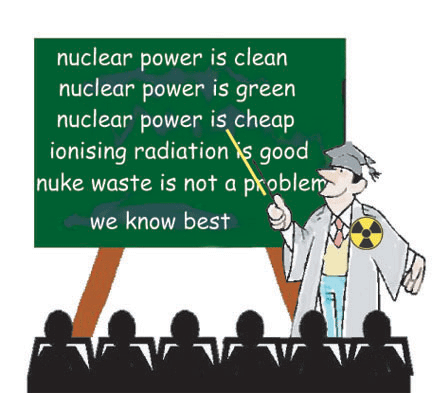
In layman’s terms: these guys will use this money to do a bunch of research way over most people’s heads in order to set a new standard everyone else in the world will use to make sure their nuclear computer models are on-par.
ISU nuclear science associate professor Dr. Chad Pope said these grants are extremely difficult to obtain since ISU is competing for that funding against every other university in the nation.
He said this research will not only help the nuclear world, but will also benefit local communities who will reap the benefits of ISU’s industry-changing research.
We’re already on the map, and this keeps us there,” Pope said. “It helps us push the science forward and become preeminent in this field. It’s great for the university, it’s great for the community, and it will really help us establish ourselves as a prominent science university.”
Pope said the close connections ISU has with the INL and the Argonne National Laboratory in Chicago could have also helped the department get recognized for this grant.
The money will span over a three-year time period, and once the research is complete, it’s expected to become published in the International Handbook of Evaluated Reactor Physics.
“De-coupling” – de-linking profits from sales in the energy utilities
 SINK THE ‘FLOATING NUKES’ WITH CLEAN ENERGY, EFFICIENT USE http://www.njspotlight.com/stories/14/09/14/opinion-sink-the-floating-nukes-with-clean-energy-efficient-use/ R. WILLIAM POTTER | SEPTEMBER 15, 2014
Decoupling sales from volume can help utilities embrace energy efficiency and solar power, while ambitious targets can give them a reason to do so In 1976 I was a rookie attorney with the newly formed Department of the Public Advocate — later abolished by Republican governors Christy Whitman in 1991 and (after brief resurrection under Gov. Jim McGreevey) by Chris Christie in 2008.
One of my first cases was to oppose plans by the state’s electric utilities to encircle New Jersey with a flotilla of “floating nuclear plants” anchored on barges along the coast, including two within sight of Atlantic City and another in Bayonne Harbor.
While these plans may seem absurd in hindsight, at the time many state officials praised the idea of barge-mounted nukes as the only way to meet ever-rising consumer electric needs without polluting New Jersey’s degraded air quality.
In response, we petitioned the state Public Utility Commission — now called the Board of Public Utilities (BPU) — for an order compelling those utilities to invest enough in energy conservation to reduce demand for power, which would eliminate the need for the floating nukes or, for that matter, many land-based power plants, thereby saving ratepayers billions of dollars while also protecting the environment.
Needless to say, the utilities opposed the idea of saving energy on the customer side of the meter as the better way of meeting ratepayer needs, an idea I had picked up from a small band of alternative energy innovators, such as Amory Lovins (author of “Soft Energy Paths”). I can recall the utility witnesses in the PUC hearings testifying that conservation has the effect of “penalizing” utilities and their shareholders. Conserve more, earn less summarized their positions.
And here’s the rub, they were right. This is because traditional rate-base/rate of return regulation — going back to Woodrow Wilson’s era — ties utilities’ profits to the amount of power sold from a fixed set of capital investments (rate base) in power plants, power lines, and other hard assets.
In other words, “the financial health of most gas and electric utilities was tied directly to retail sales because their fixed costs are recovered through charges based on how much people use,” as summarized in a blog by an attorney for the Natural Resources Defense Council (NRDC), one of the premier environmental organizations in the nation.
As a result, utilities could not be blamed for promoting increased sales, even as they paid lip service to saving energy. And they could not be blamed for pushing ever-more-ambitious capital construction programs, such as the ill-fated floating nukes project, which eventually were canceled largely due to mounting technical problems and soaring cost overruns.
Fast-forward to 2014: After all these years there is now a practical way of delinking profits from sales volume and rewarding utilities for investing their dollars — called “patient capital” by PSE&G’s visionary president, Ralph Izzo — in “energy efficiency and renewable energy, notably solar photovoltaic systems.”
“Decoupling” is the name for the process of ending the historic linkage between electric and gas sales volume and the ability of the utility to earn profits on its capital investments in the infrastructure — power plants, wires, poles, substations, and the like. (Note: a decade ago, New Jersey’s electric utilities split off their power generation function into standalone “nonutility” companies that compete for contracts to sell to consumers and deliver through utility power lines.)
As it turns out decoupling is remarkably simple to implement: To de-link profits from sales or “throughput,” the utilities would be allowed to earn a given level of revenues set by the BPU based on the number of customers served, regardless of actual sales to those customers. And if profits fall short of targets set by the BPU or if the utilities over-earn in a given period, the BPU would hold a “true-up” proceeding to reset rates and revenues up or down.
Now for the big question: What is the likely impact on consumers of decoupling revenues from sales? Not much. According to another NRDC report, “25 states had adopted some form of decoupling for at least one electric or natural gas utility by the end of 2012, and the rate impacts for consumers have been ‘small to minuscule.” Moreover in nearly 40 percent of the true-up cases the NRDC studied, the ratepayers received refunds as part of periodic true-ups.
The beauty of decoupling is that it “helps keep the utilities’ profits ‘whole’ while their customers are saving energy,” as the NRDC report summarizes. That’s because there is no longer an economic incentive for utilities to boost power sales and oppose effective energy efficiency and renewable energy programs that would cut into those sales. In fact, with decoupling, utilities will have an incentive to get into the energy-efficiency and renewable energy business, by dispatching crews to install home insulation and building solar projects that could reduce electric power sales.
But “a decoupling mechanism alone” is not enough; “it only removes the utilities’ disincentive to support energy efficiency and solar energy,” according to the Solar Energy Industries Association (SEIA) in a recent posting. “To be most effective in promoting [energy-efficiency and renewable-energy] policies, decoupling should be linked with specific targets and also create rewards for utilities for achieving environmental targets beyond their mandates,” SEIA concludes.
In short, there is a pressing need to couple decoupling reforms with vibrantly pro-energy-efficiency and pro-renewable-energy policies such as those contained in the proposed “Renewable Energy Transition Act” (RETA), which sets enforceable targets and timetables for using energy efficiency and renewable energy to meet 80 percent of New Jersey’s power generation needs by 2050.
With this two-pronged approach — decoupling revenues from sales volume and setting ambitious targets for saving energy and developing solar power — New Jersey can show the nation how to curtail global warming by reducing the pollution emanating from fossil-fuel power plants. It’s also a kind of insurance policy protecting us against the perceived need to build risky power plants like the failed floating nukes efforts of yesteryear.
Nuclear regulatory Commission rejects expert advice on California earthquake danger
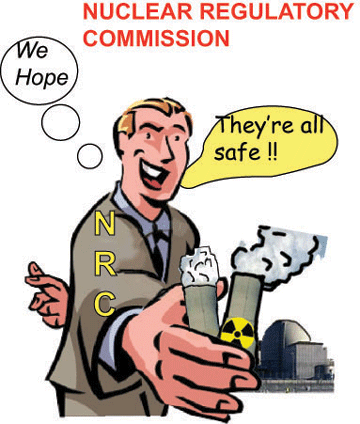 Regulators reject call for nuke plant shutdown By MICHAEL R. BLOOD, Associated Press September 10, 2014 LOS ANGELES (AP) — The Nuclear Regulatory Commission on Wednesday rejected a senior federal expert’s recommendation to shut down California’s last operating nuclear power plant until the agency can determine whether its twin reactors can withstand powerful shaking from nearby earthquake faults……..
Peck, now a senior reactor instructor for the NRC in Tennessee, argued the NRC is not applying safety rules it set out for the plant’s operation……..The agency’s ruling was issued on the same day that PG&E released hundreds of pages of scientific research that found a fault 650 yards from the reactors, known as the Shoreline, is twice as long as initially believed, making it capable of producing potentially stronger earthquakes, and intersections between some faults in the region could create larger earthquakes than previously considered. PG&E said in a statement that the plant remains seismically safe and able to withstand the largest potential earthquakes in the area.
Former California Sen. Sam Blakeslee, a geophysicist who has previously raised seismic concerns at Diablo, said “it’s premature to declare the plant is safe in light of this new information.”…….http://www.sfgate.com/business/energy/article/Regulators-reject-call-for-nuke-plant-shutdown-5746362.php
Orlando City Council dumping their investment in Duke nuclear power plant
 Orlando moves to dump stake in Duke’s nuke plant By Kevin Spear Orlando Sentinel, September 14, 2014 The Orlando City Council is expected to approve a plan Monday to dump city ownership in Duke Energy’s crippled nuclear generator for an amount far less than the original purchase value.
Duke’s nuke plant near Crystal River was bedeviled with concrete failures even before it started up in 1977, two years after Orlando’s electric utility bought a small share of the reactor. Disabled by epic calamity that began five years ago, the unit was supposed to run until at least 2036 and, depending on overhauls, possibly many years beyond then……….
the Florida Municipal Power Agency, which provides wholesale electricity to 30 cities, suggested the Duke plant could turn into a liability quagmire.
“There is much uncertainty and risk involved in decommissioning a nuclear power plant,” the agency stated in a memo to its directors.
“The project is planned to take up to 60 years to complete, and involves complex dismantling and transportation of contaminated material.”…….
Company officials determined that further repairs would cost $1.5 billion to $3.4 billion and take as many as eight years.
After much suspense, Duke Energy finally announced last year that the nuke was beyond saving and would be “placed in a safe, stable condition for 60 years until decommissioning work is completed in 2074.”
During a tour of the nuclear generator in 2011, plant operators said that more than 1,300 bundles of used uranium fuel were stored in a pool 30 feet deep.
That fuel pool, cooled to 101 degrees and blended with boron to stop the splitting of atoms, will remain a long-term maintenance and security concern for Duke Energy.
Asked Friday about the status for that highly radioactive fuel, Duke spokeswoman Heather Danenhower declined to provide further information.
“For security reasons, we do not disclose the number of nuclear fuel assemblies in our spent fuel pool,” Danenhower said.
Uncompetitive nuclear industry is rigging regulations and “spinning” media in order to survive
Killing the Competition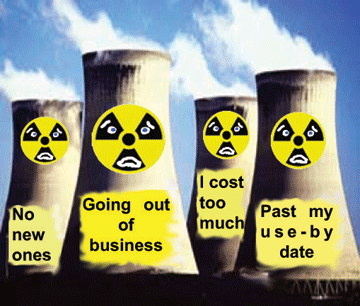
Exelon and Entergy see sustainable energy solutions—renewable energy, efficiency, conservation, etc.—as a long-term threat to
their profits. This is not because of excessive regulations or safety requirements on nuclear power: the industry has not had to implement a single safety upgrade due to the Fukushima meltdowns and faces less regulatory enforcement than it did twenty years ago. The closure of a record number of reactors since 2013 has exposed fundamental economic problems facing the industry, and a growing number of nuclear plants simply cannot compete with modern, efficient, cost-effective
energy resources.
USA’s Waste Isolation Pilot Plant sent plutonium to city 30 miles away!
 Plutonium found in city nearly 30 miles from US nuclear site — Newspaper: Explosion ‘melted through’ container causing radioactive release — More Pu-241 went airborne than all other types of plutonium combined, yet not included in test results http://enenews.com/plutonium-detected-city-30-miles-nuclear-site-explosion-melted-container-released-four-types-plutonium-officials-testing-pu-241-leaked-all-others-combined?utm_source=feedburner&utm_medium=email&utm_campaign=Feed%3A+ENENews+%28Energy+News%29
Carlsbad Current-Argus, Sept. 9, 2014: DOE will provide WIPP update next week — It appears the Waste Isolation Pilot Plant is far from reopening… According to photographic evidence made public by the DOE, it appears a chemical reaction caused an explosion inside one of the waste drums. The explosion melted through portions of the drum, and the incident triggered a small release of americium and plutonium into the outside air about half a mile from the facility.
“Plutonium… about half a mile from the facility”? Recently published air monitoring data from the state of New Mexico indicates that soon after the WIPP radioactive release 3 types of plutonium were found nearly 30 miles away in Carlsbad, the state’s 10th largest city. The levels were similar to those found within the nuclear site’s boundary:
- WIPP NW Border, 2/21-2/28: Plutonium-238 = 0.015 pCi/sample (Lab minimum detectable activity [MDA] = 0.0082)
- WIPP site, 2/21-2/28: Plutonium-239/240 = 0.0092 pCi/sample (MDA = 0.0062)
- WIPP site, 2/28-3/11: Plutonium-238 = 0.027 pCi/sample (MDA = 0.024)
- Carlsbad, 25+ mi. away, 2/28-3/11: Plutonium-238 = 0.016 pCi/sample (MDA = 0.0074)
- Carlsbad, 25+ mi. away, 2/28-3/11: Plutonium-239/240 = 0.022 pCi/sample (MDA = 0.0074)
More Plutonium-241 was released from WIPP than all other plutonium isotopes combined, yet officials have not included it in any publicly available test results:
- Plutonium-241 = 15,900 dpm
- Plutonium-239/240 = 11,600 dpm
- Plutonium-238 = 514 dpm
Nuclear industry muscling in on USA’s climate standards
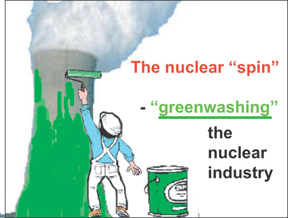 Killing the Competition The Nuclear Power Agenda to Block Climate Action, Stop Renewable Energy, and Subsidize Old Reactors, Report by Nuclear Information and Resource Center (NIRS) Sept 14
Hanford Nuclear Reservation’s dangerous”atomic man” room entered after 38 years
Workers enter dangerous ‘Atomic Man’ room at Hanford Nuclear Reservation http://www.oregonlive.com/pacific-northwest-news/index.ssf/2014/09/workers_enter_dangerous_atomic.html?utm_source=feedburner&utm_medium=twitter&utm_campaign=Feed%3A+oregonlive%2FkRom+%28Oregon+Local+News%29&utm_content=IceRocket+Blog+SearchSPOKANE, Wash. — Workers have entered one of the most dangerous rooms at the Hanford Nuclear Reservation.
The so-called McCluskey Room in the Plutonium Finishing Plant is named after worker Harold McCluskey. He was covered with radioactive material in 1976 when a glove box exploded. McCluskey, who was 64 at the time, lived for 11 more years and died from causes not related to the accident. He became known as the Atomic Man.
Hanford, located near Richland, Washington, for decades made plutonium for nuclear weapons. The site is now engaged in cleaning up the resulting radioactive mess.
Cleaning up the McCluskey Room is expected to take a year. A crew with contractor CH2M HILL Plateau Remediation Co. donned specially designed radiation suits before entering the McCluskey Room earlier this week. One of their first tasks was improving ventilation to better protect workers from airborne contamination as they clean out its equipment.
“This was the first of multiple entries workers will make to clean out processing equipment and get the McCluskey Room ready for demolition along with the rest of the plant,” said Bryan Foley, project director for the Department of Energy. “It has taken a year to prepare for this first entry.”
The room was used to recover americium — a plutonium byproduct — during the Cold War.
McCluskey was working in the room when a chemical reaction caused a glass glove box to explode. He was exposed to the highest dose of radiation from americium ever recorded — 500 times the occupational standard.
Covered with blood, McCluskey was dragged from the room and put into an ambulance headed for the decontamination center. Because he was too hot to handle, he was removed by remote control and transported to a steel-and-concrete isolation tank.
During the next five months, doctors extracted tiny bits of glass and razor-sharp pieces of metal embedded in his skin.
Nurses scrubbed him down three times a day and shaved every inch of his body every day. The radioactive bathwater and thousands of towels became nuclear waste.
McCluskey also received about 600 shots of zinc DTPA, an experimental drug that helped him excrete the radioactive material.
He was placed in isolation in a decontamination facility for five months. Within a year, his body’s radiation count had fallen by about 80 percent and he was allowed to return home.
California leads in its commitment to renewable energy
California Successfully Emphasizes Renewable Energy Commitment The Desert Sun, Morris Beschloss, September 8, 2014 Over the years, California has justifiably claimed the exalted position of originator of new ideas in fashion, entertainment, social media, and even electric cars. The state’s Silicon Valley is the shining symbol of the world’s breakthrough communications technology.
But now it seems that a significant escalation of solar energy and, to a lesser extent, “wind” is lending credibility to the once improbable California campaign to generate one-third of its power from renewable resources by 2020. This now realizable objective is personified by “NextEra Resources’ Blythe Solar Project” by the U.S. Department of the Interior.
Although originally eclipsed by the 1,000 megawatt photovoltaic farm originally proposed, conceivably the largest solar project in the world, the implementation of “Blythe” will generate enough power to service 485,000 homes, and reduce gas emissions by 400,000 metric tons per year.
California now leads the nation in cumulative solar electricity capacity, and was number one in solar capacity added last year. The windmills in Southern California’s San Gorgonio Pass are also setting new records as are the geothermal plants along the southern edge of California’s Salton Sea……..it is encouraging to see that America’s most populous state (California, with 12.5% of the nation’s population), is regaining its rightful place as the visionary of the United States’ bright future…….http://www.desertsun.com/story/money/industries/morrisbeschlosseconomics/2014/09/08/california-successfully-emphasizes-renewable-energy-commitment/15281441/
New law promotes solar energy in South Carolina
With New Law, South Carolina Sets a Foundation for More Solar Energy The Energy Collective Jim Pierobon 8 Sept 14 Another state in the Southeast U.S. is recognizing the economic and environmental benefits of solar energy as commissioners, utilities and stakeholders in South Carolina are ironing out details of a new solar law that enables third-party leasing and contemplates the state’s two investor owned-utilities utilities, collectively, installing an estimated 300 megawatts (MW) of renewable energy by 2021, up from about 8 megawatts currently.
South Carolina joins North Carolina and Georgia in showing it can begin to turn a new leaf to toward cleaner energy development. The new law is the South Carolina Distributed Energy Resource Program Act (S.B. 1189), which lawmakers in both the House and Senate passed unanimously and Gov. Nikki Hale (R), signed into law in June. Curiously, she waited until August to start promoting it.
The state’s two large investor-owned utilities – South Carolina Electric & Gas and Duke Power (including the former Progress Energy) – have the option to opt in, or out, of the program. If they opt in, they’ll get full rate recovery for meeting at least 2% of their five-year average peak power demand from renewable sources, most of which will likely be solar. If they opt out, no rate recovery for whatever path they pursue.
At this writing there appeared to be a significant and growing amount of public and lawmaker pressure to opt in. It was that public pressure that had been building for years which kicked off serious deliberations leading to the new law, according to Kenneth Sercy, Utility Regulation Specialist, and Hamilton Davis, Climate and Energy Director, at the South Carolina Coastal Conservation League, one of the bill’s biggest backers.
“What you’ve seen here is growing public interest in policies that boost investments in clean energy options,” Davis said. “The tide of public opinion is garnering more media coverage and that’s getting the attention of lawmakers.”……http://theenergycollective.com/jimpierobon/484721/new-law-south-carolina-sets-foundation-more-solar-energy
Dangerous Diablo Nuclear Power Plant must be closed
Shut California’s Fukushima: Diablo Must Go, ECoWatch Harvey Wasserman | September 6, 2014 The catastrophe at Fukushima was not an accident. It’s unfolding again in California.
The next west coast quake could easily shake the two reactors at Diablo Canyon to rubble.
They are riddled with defects, can’t withstand potential seismic shocks from five major nearby fault lines, violate state water quality laws and are vulnerable to tsunamis and fire.
Diablo’s owner, Pacific Gas & Electric (PG&E), is in deep legal and financial crisis. The California Public Utilities Commission (CPUC) has just proposed that PG&E be fined $1.4 billion for a 2010 gas explosion and fire that killed eight people and obliterated a neighborhood in San Bruno. The federal government has announced 28 indictments, meaning the CPUC fine may just be the tip of a very expensive iceberg for PG&E. The San Bruno disaster was caused by pipeline defects about which PG&E had been warned for years, but failed to correct. The fines cover 3,798 separate violations of laws and regulations, both state and federal. PG&E was previously fined $38 million for a 2008 pipeline explosion in Rancho Cordova.
Similar defects remain uncorrected at Diablo Canyon, whose radioactive cloud could span the continental U.S. in four days. Mass citizen action recently shut two coastal reactors at San Onofre. It must do the same at Diablo before the next quake hits……
Diablo Canyon’s twin reactors sit eight miles west of San Luis Obispo, between Los Angeles and San Francisco, surrounded by earthquake faults.

The Hosgri, three miles offshore, was found as the reactors were being built. Design specifications were never fully altered to account for it. Nor have they been upgraded for the newly-found Los Osos, San Luis Bay and Shoreline faults. The Shoreline lies just 650 yard from Diablo’s cores.
The massive San Andreas fault is just 45 miles away, about half as far as was the March 11, 2011, Richter-9.0 epicenter from Fukushima.
A shock that size from any of the fault lines near Diablo could reduce it to a seething pile of radioactive hell, far deadlier than Fukushima. Prevailing winds could blanket virtually all of North America with its deadly fallout.
The nuclear industry would immediately deny all health impacts. It would blame “unpredictable” God and nature.
But a 42-page report from NRC inspector Dr. Michael Peck says new fault line discoveries challenge Diablo’s “presumption of nuclear safety.”
Buried by the NRC for at least a year, it was released by Friends of the Earth and reported on by the Associated Press and the great enviro-journalist Karl Grossman, as well as by theNuclear Information & Resource Service and Beyond Nuclear.
Peck has a doctorate in nuclear engineering and was Diablo’s chief on-site inspector for five years. He’s now a senior instructor at the NRC’s Technical Training Center in Tennessee. His status as a current NRC employee makes such a critical report highly unusual—and alarming.
Nuclear engineer Arnie Gundersen has warned about sea-level intake pipes like those at Diablo. When the tsunami struck Fukushima, he writes, “The cooling equipment along the shoreline was turned into a scrap yard of twisted metal.”
Then there is fire.
Diablo Canyon, writes David Lochbaum of the Union of Concerned Scientists, “has never, ever complied with fire safety regulations, not even for a second by mistake.”…….http://ecowatch.com/2014/09/06/california-fukushima-diablo-nuclear/2/
Nuclear Regulatory Commission takes another gamble on nuclear wastes
Punting again on nuclear waste http://www.mycentraljersey.com/story/opinion/editorials/2014/09/06/nuclear-waste/15154565/ MyCentralJersey September 6, 2014 Talk about dropping a hot potato in a way that provides absolutely no incentive for anyone to pick it up — ever. The Nuclear Regulatory Commission recently decided that nuclear waste from power plants can be stored above ground in casks indefinitely. The vote to approve it was 4-0.
Given that spent fuel stored at nuclear power plants will remain dangerous to humans for at least 10,000 years and harmful to the environment for 1 million years more, the mere suggestion that the waste will be properly stored, maintained and protected is ludicrous. And the problem, now exacerbated by the NRC finding, is not a distant one.
Jersey Shore residents are living cheek by jowl with more than 750 metric tons of radioactive waste stored in Lacey in the spent fuel rod pool at the Exelon-owned Oyster Creek plant.
The pool sits 70 feet in the air, and is covered by a box-store type metal roof. Used fuel assemblies containing a cocktail of radioactive isotopes are jam-packed into the pool, holding about eight times more than its original design capacity. An NRC report on the Peach Bottom plant in Pennsylvania indicated that even a small nuclear reactor fuel pool fire could leave 9,400 square miles uninhabitable and indefinitely displace 4.1 million people. Just imagine what such a report would reveal about a similar reactor fire at Oyster Creek. And try to imagine thousands of Jersey Shore residents fleeing the area given its limited evacuation routes.
Still, the Oyster Creek plant is not scheduled to close until 2019 and the spent fuel rods will be able to sit there until half-past “Who knows when?”

And then what? A whole lot of nothing, given this NRC finding.
At the very least, the state should insist that work begin on moving the rods into state-of-the-art dry casks — sealed metal cylinders containing the spent fuel enclosed within a metal or concrete outer shell — as soon as Oyster Creek ceases operation. That would be better than the current state of affairs, but real progress is a long way off.
The Energy Department is now saying that a burial site for the nation’s nuclear waste will be established by 2048, but the agency has no plan for finding one.
And we certainly can’t depend on Congress to get the ball rolling. The NRC ruling last week pretty much guarantees that.
Even Allison M. Macfarlane, chairwoman of the NRC, admitted as much: “If you make the assumption that there will be some kind of institution that will exist, like the Nuclear Regulatory Commission, that will assure material stays safe for hundreds or thousands of years, there’s not much impetus for Congress to want to deal with this issue.”
The unanimous vote essentially gave Congress the green light to do what it does best: Ignore the problem and continue to do absolutely nothing to find a solution.
Censorship of scientists about USA’s Nuclear Waste Isolation Pilot Plant (WIPP)
 Top Official: “Really concerned” over radiation release at US nuclear site; Feds “have put a noose around scientific personnel”… they refuse to reveal crucial information about WIPP disaster — Investigators becoming suspicious — Nuclear Expert: “It sure seems like there’s a cover-up” (AUDIO) http://enenews.com/top-official-really-concerned-nuclear-leak-investigation-feds-put-noose-around-scientific-personnel-refusing-reveal-crucial-information-about-radioactive-release-nuclear-expert-sure-like-cover-a?utm_source=feedburner&utm_medium=email&utm_campaign=Feed%3A+ENENews+%28Energy+News%29
New Mexico Environment Department Secretary Ryan Flynn, Sept 6, 2014: “The problem is that Department of Energy headquarters back in Washington, D.C., is looking at this situation through a political or (public relations) lens, so they’ve put a noose around the scientific personnel who can answer our questions… there’s a willingness (by LANL personnel) to provide information [but] someone back at headquarters decides that no, they’re not going to provide that information to the state… it happens repeatedly, that’s when you start to get really concerned… they don’t provide certain information [or] make staff available… The more we investigate, the more we’re discovering at Los Alamos… the Department of Energy headquarters refuses to provide certain information.”The Santa Fe New Mexican, Sept 6, 2014: Flynn accuses feds of blocking WIPP probe — New Mexico’s top environmental regulator lashed out at the U.S. Department of Energy this week, accusing it of impeding the state’s investigation into [the WIPP] radiation leak… Secretary Ryan Flynn warned [about] Energy Department roadblocks that have protracted the probe… Increasingly in recent weeks, the federal Energy Department has thwarted attempts by the state… Flynn accused the Energy Department of muzzling scientists with crucial information about the waste…. [They] asked for documentation supporting the scientists’ observations [but] the Energy Department has repeatedly refused… his frustration with the Energy Department grew as its denials… became more frequent… The Energy Department’s refusal to provide information raised suspicions among Flynn’s investigators…
Greg Mello, Los Alamos Study Group, Sept 6, 2014: “[Not sharing this information] could be a danger signal for workers and the public. Mislabeling drums and withholding information can be criminal.”
The Santa Fe New Mexican, Sept 3, 2014: Review, relabeling of LANL waste raises questions about scope of problem… [Los Alamos National Laboratory’s] review of the incident has led to uncertainty over the volatility of hundreds of other drums… The lab notified state environment officials late last month that it was re-evaluating and relabeling as “ignitable” or “corrosive” the contents of 86 drums at LANL… The Department of Energy also is reviewing and relabeling more than 300… stored in WIPP’s underground… [This] raises questions about the scope of the problem that led to the leak at WIPP.
Chris Harris, former licensed Senior Reactor Operator & engineer, Aug 28, 2014 (at 22:15 in): “It sure seems like that there’s a combination of a cover-up, and a combination of slip-shot record keeping. Now there’s talk of whether they ditched those records after the fact or before the fact, but those records are nonexistent. One would expect really good records as to what is being stored, where it’s being stored, when it was put away, when it was stored, all that – every bit of information that one would expect to have in a nuclear storage facility and these are missing, there’s a lot of information.
1 This Month
23-25 October – on Zoom – World BEYOND War’s annual global conferenc


Shut down the radiation-damaged Heysham nuclear reactors now
To see nuclear-related stories in greater depth and intensity – go to https://nuclearinformation.wordpress.com

Say No to NASA’s Reckless Nuclear Reactor on the Moon
Say No to NASA’s Reckless Nuclear Reactor on the Moon
-
Archives
- October 2026 (160)
- September 2026 (339)
- August 2026 (330)
- July 2026 (355)
- June 2026 (287)
- May 2026 (306)
- April 2026 (356)
- March 2026 (251)
- February 2026 (267)
- January 2026 (308)
- December 2025 (358)
- November 2025 (359)
-
Categories
- 1
- 1 NUCLEAR ISSUES
- business and costs
- climate change
- culture and arts
- ENERGY
- environment
- health
- history
- indigenous issues
- Legal
- marketing of nuclear
- media
- opposition to nuclear
- PERSONAL STORIES
- politics
- politics international
- Religion and ethics
- safety
- secrets,lies and civil liberties
- spinbuster
- technology
- Uranium
- wastes
- weapons and war
- Women
- 2 WORLD
- ACTION
- AFRICA
- Atrocities
- AUSTRALIA
- Christina's notes
- Christina's themes
- culture and arts
- Events
- Fuk 2022
- Fuk 2023
- Fukushima 2017
- Fukushima 2018
- fukushima 2019
- Fukushima 2020
- Fukushima 2021
- general
- global warming
- Humour (God we need it)
- Nuclear
- RARE EARTHS
- Reference
- resources – print
- Resources -audiovicual
- Weekly Newsletter
- World
- World Nuclear
- YouTube
-
RSS
Entries RSS
Comments RSS

