USA’s Environment Protection Agency finding it hard to assess nuclear power’s greenhouse emissions

 E.P.A. Wrestles With Role of Nuclear Plants in Carbon Emission Rules By MATTHEW L. WALD NYT DEC. 25, 2014 WASHINGTON — Trying to write a complicated formula to cut carbon emissions, the Environmental Protection Agency thinks it has found a magic number: 5.8.
The agency is trying to complete a rule governing carbon emissions from power plants, and among the most complicated and contentious issues is how to treat existing nuclear power plants. Many of them are threatened with shutdowns because cheap natural gas has made their reactors uncompetitive.
The agency’s proposal gave an odd mathematical formula for evaluating nuclear plants’ contribution to carbon emissions. It said that 5.8 percent of existing nuclear capacity was at risk of being shut for financial reasons, and thus for states with nuclear reactors, keeping them running would earn a credit of 5.8 percent toward that state’s carbon reduction goal.
Since receiving tens of thousands of comments on the proposal, the agency is now reviewing the plan. It must evaluate all comments before it sets a final rule, which it hopes to do by June. That rule, however, is likely to be challenged in court. Continue reading
USA nuclear lobby getting desperate: demanding “strong government intervention”
 With US Nuclear in Decline, Scientists and Analysts Urge Support for Next-Generation Technologies, The Energy Collective, Stephen Lacey December 24, 2014 “……..The global nuclear industry is in steady decline. Since hitting a peak in 1996 at nearly 18 percent of global energy production, the industry’s share has dropped down to less than 11 percent.
Even with countries like China and India looking to boost their low-carbon energy supplies with nuclear, project developers around the world have faced long delays, cost overruns, and strong competition from natural gas and distributed resources, as well as policies designed to phase nuclear out entirely.
America is facing its own imminent decline in nuclear generation……….
A comprehensive federal plan, says IEA, is the only way to keep the industry relevant. ………..”The domestic nuclear industry is therefore at a critical juncture as a consequence of its declining economic competitiveness, and existing market mechanisms do not favor investment in high capital-intensive nuclear technology,” concluded the IEA.
Articulating that strategy will not be easy.
On a levelized-cost-of energy basis (an admittedly limited metric), distributed renewables are competing with nuclear plants, adding to the pain inflicted by low natural gas prices. Both free-market advocates and renewable energy proponents say new nuclear shouldn’t be built if it can’t compete in today’s market.
Cost overruns are also hurting the industry’s image. The first U.S. nuclear project to be built in 30 years, the Vogtle power plant in Georgia, is now $1.5 billion over budget and getting more expensive. Angry about rate increases caused by Vogtle, the Green Tea Party and environmental groups were able to force Georgia Power to support half a gigawatt of new solar in the state — much of it procured for 6.5 cents per kilowatt-hour.
Meanwhile, many environmentalists remain staunchly opposed to nuclear for traditional health and safety reasons……….
For nuclear to have any chance of succeeding, strong government intervention will be needed to fund more R&D and back loans for commercial-scale plants, say proponents…..
Unfair and not sensible – USA hawks Try to Sabotage Nuclear Deal
US Iran Hawks Try to Sabotage Nuclear Deal Iran hawks in Washington don’t want a nuclear agreement; they want Tehran to surrender its sovereignty and national rights. The National Interest Muhammad Sahimi December 24, 2014 As the prospects of a comprehensive nuclear agreement between Iran and the P5+1—the five permanent members of the United Nations Security Council plus Germany—brightens, Washington’s hawks seem to have gone into panic mode. They do not seem to want any agreement unless Iran says “uncle,” gives up its sovereignty and national rights within the Nuclear Non-Proliferation Treaty (NPT), and completely dismantles its nuclear infrastructure. They’re asking Iran to capitulate, not to negotiate. That’s an unrealistic goal—and in their dogged pursuit of it, they have overlooked serious steps Tehran’s taken that demonstrate a desire for compromise.
We see this unfortunate dynamic in an article this month by Mark Dubowitz, Executive Director of the Foundation for Defense of Democracies, published in the National Interest. Dubowitz’s main premise is that it was the economic sanctions imposed by the United States and its allies that brought Iran to the negotiation table, and only more economic sanctions will induce it to surrender. The premise is false. While the sanctions did play a role, they were not the most important reason, or even one of the primary ones. Iran is negotiating because that is what it has wanted—contrary to Dubowitz’s assertion that “Iran does not appear to be ready to compromise.”
President Hassan Rouhani, Foreign Minister Mohammad Javad Zarif, and their diplomatic team have always been interested in a compromise. …………….
What has the United States given in return for these major concessions by Iran? Very little. It has released a small amount of Iran’s own money, frozen in foreign banks as the result of the illegal sanctions. The U.S. has also lifted its (also illegal!) ban on the export of petrochemical products and a few other minor items. As President Obama stated, 95 percent of all the sanctions are still in place………….
The reality is that the Geneva Accord and its Joint Plan of Action permit Iran to continue its research on more advanced centrifuges. Iran’s obligation, which it has lived by, is not installing such centrifuges. After this was pointed out, Albright retreated, declaring that the test was in violation of the “spirit” of the Accord. Who is moving whose goalposts, again?
Washington’s hawks risk missing another chance at a sensible nuclear agreement or détente with Iran, one that would dramatically change the dynamics of the turbulent Middle East for the better. Instead, they seem to think they can drive a proud nation to surrender. They’ve been wrong before—and their latest salvo suggests they don’t realize they may be wrong again.
Muhammad Sahimi, Professor of Chemical Engineering & Materials Science and the NIOC Chair in Petroleum Engineering at the University of Southern California, is the editor and publisher of the website, Iran News and Middle East Reports, and has been analyzing Iran’s political developments and its nuclear program for two decades.
Diablo nuclear power plant’s License renewal is not a foregone conclusion
 In PG&E’s probabilistic casino—where the chance of an earthquake occurring counts for more than the actual damage it could do when it occurs—the deck is stacked, the cards are marked, and the house always wins. If the roof timbers of your house—built under a towering old tree—were shown to be not up to code standards were that tree to come crashing down, would you insist that the contractor reinforce the roof, or accept his assurances that the odds of the tree falling were too low to worry about? Are you feeling lucky?
Don’t count on Diablo, New Times, December 10th, 2014 License renewal is not a foregone conclusion BY ROCHELLE BECKER“……..– Sen. Barbara Boxer and San Luis Obispo’s former state Sen. Dr. Sam Blakeslee (also a former Exxon geophysicist who headed the Republican caucus when  he served in the Assembly) pulled back the curtain on the myth of seismic safety at the Diablo Canyon nuclear plant, a charade that PG&E and the Nuclear Regulatory Commission have been casting like a spell over the Oz-like serenity of the Central Coast.
With his cogent testimony before Sen. Boxer and 26 pages of supporting documentation, Dr. Blakeslee exposed the mathematical shell game that PG&E is playing with the results of their “Final Seismic Report.” That report, released in September, was in fulfillment of Blakeslee’s AB 1632 of 2006.
Blakeslee notes PG&E’s historic neglect for the presence of earthquake faults near Diablo, which led to cost overruns and delays in the original construction of the plant. More significantly, when the major threat of the Hosgri fault was finally acknowledged, more than 80 percent of the plant had been built. Rather than re-evaluate the true danger and possibly cancel the plant, PG&E, with the NRC’s acquiescence, began a policy of reverse engineering their earthquake ground motion prediction formulas to make them fit within the mathematical boundaries of what had already been built. Continue reading
Highly elevated radiation levels across North America might come from Fukushima

 Fukushima Radiation Up 50,000% With Elevated Radiation Reported Across North America http://chemtrailsplanet.net/2014/12/15/fukushima-radiation-up-50000-with-elevated-radiation-reported-across-north-america/, December 15, 2014 by: Ethan A. Huff, staff writer
(NaturalNews) Beta radiation levels are off the charts at monitoring sites all across North America, according to new reports. But experts are blaming these radiation spikes on practically everything except for Fukushima.
Data gathered from tracking units in California, Arizona, Illinois and elsewhere reveal radiation levels up to 50,000 percent higher than what was observed at the same time last year, and in some cases compared to levels seen this past summer.
EnviroReporter.com says the impacted Global Fukushima Radiation warningsites are scattered throughout the country and aren’t just confined to the West Coast. Readings taken near Los Angeles; Chicago; Montgomery, Alabama; and Madison, Wisconsin, reveal total beta counts per minute (CPM) greatly exceeding the 1,000 CPM threshold considered by the government to be problematic.
In Tucson, Arizona, for instance, a 460 CPM reading was recently taken, which is more than 10 times higher than the reading taken last year on November 27. Similarly, Phoenix, Arizona’s 735 CPM reading measured more than 21 times higher than last year’s reading.
San Diego appears to be one of the hardest-hit areas, with a CPM reading of 650, as of October 1. This figure is 60 times higher than it was last year on the same date, despite the fact that San Diego’s normal background radiation rate typically hovers around 20 CPM.
“U.S. Environmental Protection Agency RadNet radiation monitors have detected renewed surges in atmospheric readings of dangerous beta radiation across the country,” explains EnviroReporter.com about the seemingly inexplicable phenomenon.
“Over a dozen metropolitan test sites have registered four-month highs in EnviroReporter.com’s most recent comprehensive assessment.
Radiation testing site near Chicago records radiation levels thousands of times higher than maximum safety threshold
77% Of New US Electricity Generating Capacity was in wind and solar, In November
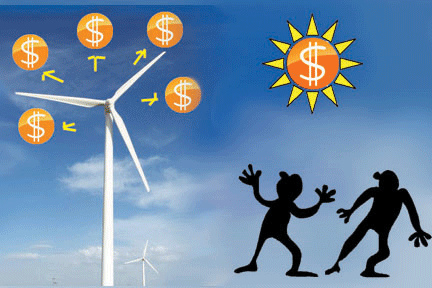 Wind & Solar = 77% Of New US Electricity Generating Capacity In November Clean Technica December 23rd, 2014 by Joshua S Hill “……. I have included an estimate of non-utility-scale solar (i.e., residential and commercial solar) in the numbers below……The United States Federal Energy Regulatory Commission’s (FERC) Office of Energy Projects released its monthly “Energy Infrastructure Update” on Tuesday, and the big winners from the month of November seem to be wind and solar, which combined added up to over 70% of all new electrical generating capacity placed into service during the month. If you add in our estimate for non-utility-scale solar, the market share of solar and wind rises to 77%.
And as Ken Bossong, Executive Director of the SUN DAY Campaign, says, this is a good thing:
“With only one month left in 2014, it has become a horse race between natural gas and renewable energy as to which will dominate new electrical generation for the year. Regardless of the winner, it is apparent that coal, oil, and nuclear will be left behind in the dust.”……… https://cleantechnica.com/2014/12/23/wind-solar-account-70-new-us-generating-capacity-november/
Renewable energy has now gained political clout, in USA States
Renewable energy companies use new clout in statehouses, Phys Org, Dec 24, 2014 by Jeffrey Stinson, Stateline.org “……..Green energy industries have become mainstream businesses with the political clout to match the fossil fuel industry and big electric utilities in many statehouses, and they are using that influence to defend the renewable energy standards in place in 31 states and the District of Columbia.
Green industry is creating jobs, providing lease payments to landowners and taxes for local government in many states. Companies like Siemens and GE are highly invested in green energy. And many state lawmakers don’t want to see the economic benefits shrink or disappear.
Wind represents about $118 billion in private investment in the U.S. economy and sustains about 73,000 jobs, according to the American Wind Energy Association. About $17.3 billion a year is invested in new wind farms.
The solar industry, meanwhile, employs about 143,000 people and pumps nearly $20 billion a year into the economy, according to the Solar Energy Industries Association.
The economic impact of the fossil fuel industry is much larger, but Tom Plant of the Center for the New Energy Economy at Colorado State University noted that green energy has “become mainstream … and a pretty significant component of economies of the states.”………
In addition to states with mandatory standards, seven – Alaska, Indiana, North Dakota, Oklahoma, South Dakota, Utah and Virginia – have voluntary goals.
Combined with federal and state green energy tax breaks, state renewable portfolios have been instrumental in building the renewable sector. They “drive demand,” said Susan Sloan, vice president for state policy at the American Wind Energy Association.
Technological advancement is making green energy more economically competitive compared to fossil fuel, especially coal………..
Wind, solar and other alternative sources are increasingly popular with the public compared to fossil fuels, polls indicate. And many companies want to demonstrate they’re in favor of environmentally friendly policies……….
Wind has become “a big cash crop” for Kansas farmers, she said, with wind farms providing about $16 million a year in lease payments to landowners. Local government receives about $10 million a year in lieu of tax payments from them, which is good revenue for rural counties……….. http://phys.org/news/2014-12-renewable-energy-companies-clout-statehouses.html#jCp
Only in renewable energy are jobs growing: in the power sector – job losses, especially in nuclear power
 Employment Drops in All Segments of the Power Sector—Except Renewables , Greentech Solar Jobs in solar power generation have increased by 201 percent since 2011. Julia Pyper December 24, 2014
The electric power sector lost more than 5,800 jobs over the last three years, with employment is taking a hit in nearly all energy sources except for renewables, according to the Energy Information Administration (EIA).
Non-hydro renewable electricity generation gained nearly 1,800 jobs over the period, largely in the solar sector.
Data compiled from the Bureau of Labor Statistics only reflects the jobs in electric power generation, and not the jobs associated with managing the grid. Jobs related to the construction of new facilities, processing or transportation of fuels, or behind-the-meter distributed generation installations and service were also excluded from the number set………….
recent coal plant closures caused a net decline of 1,750 fossil fuel power generation jobs since 2011. According to the EIA, the new natural gas plants are less labor-intensive than the older coal plants they’re replacing.
The nuclear industry, however, was the hardest hit. Jobs at nuclear power plants fell by 9 percent, which amounts to 4,900 positions, over the last three years.
The downward trend is on track to continue. Several U.S. nuclear power plants are slated for closure in the coming years and there are next to no plans to replace them. The International Energy Agency, a leading Washington think tank and group of conservation scientists recently made separate appeals for the U.S. to rethink its nuclear energy strategy.
Julia Pyper
Julia Pyper is a Senior Writer at Greentech Media covering utilities, grid issues, electric vehicles, the solar industry and energy storage. Find her on Twitter @JMPyper. http://www.greentechmedia.com/articles/read/employment-drops-in-all-segments-of-the-power-sector-except-renewables
Obama’s $1-trillion upgrade of USA’s nuclear arsenal – to ‘confront Russia’
 Obama Upgrades Nuclear Arsenal For “Direct Confrontation With Russia” http://www.opednews.com/articles/Obama-Upgrades-Nuclear-Ars-by-Sherwood-Ross-Nuclear-Cover-up_Nuclear-Powers_Obama-Administration_Obama-Nuclear-141223-671.htmlBy Sherwood Ross (about the author) President Obama’s “gift” to Americans this holiday season is to renege on his 2009 pledge “to seek the peace and security of a world without nuclear weapons.”
Nuclear waste burial for Nevada? State and Feds in talks
Nevada, Feds to Study Nuclear Waste Burial in State http://www.ktvn.com/story/27696890/nevada-feds-to-study-nuclear-waste-burial-in-state Dec 23, 2014 Nevada and the federal government are agreeing to have a panel keep studying whether the U.S. will bury radioactive material from Tennessee at a former nuclear weapons proving ground north of Las Vegas.
Officials say there is no deal yet.
The state has balked at plans to bury low-level waste ranging from contaminated worker uniforms to machine parts from a World War II-era plant in Oak Ridge, Tennessee, at the Nevada National Security Site about 65 miles from Las Vegas.
Security Site spokesman Darwin Morgan says talks are continuing, and the Energy Department is optimistic shipments could begin in early 2015. (AP)
Stephen G Burns to be new chair of Nuclear Regulatory Agency

Christina Macpherson’s websites & blogs
Stephen G Burns might be OK. I have read some adverse criticisms about him, on a pro nuclear advertising site – which is somewhat reassuring to learn.
Obama selects veteran lawyer to serve as chairman at nuclear energy regulatory agency http://www.foxbusiness.com/markets/2014/12/23/obama-selects-veteran-lawyer-to-serve-as-chairman-at-nuclear-energy-regulatory/WASHINGTON – President Barack Obama has selected a 33-year veteran of the Nuclear Regulatory Commission, Stephen G. Burns, to serve as its chairman.
The five-member commission oversees the safety of the nation’s 62 nuclear power plants, and the chairman serves as the group’s official spokesman.
Burns replaces Allison Macfarlane, who is stepping down to take a position at George Washington University.
Burns served as the NRC’s general counsel from 2009-2012, and prior to that served in a variety of roles at the agency. He is the second general counsel to later become the agency’s chairman.
He has also served a stint as head of legal affairs for the Organization for Economic Cooperation and Development’s Nuclear Energy Agency
Small solar appliance makes drinking water clean
 All It Takes For The Desolenator To Make Clean Drinking Water Is A Little Sunlight Fast Coexist, 21 Dec 14 Polluted or salty water becomes drinking water for a small family.Turning saltwater into clean drinking water is usually an expensive and energy-intensive process—a new desalination plant under construction in San Diego has a price tag of $1 billion, and smaller devices can cost as much as $30,000. But a new solar-powered device could make the process affordable for the millions of people around the world who don’t have running water.
“Other devices produce more water, but they are significantly more expensive, and they require quite a bit of maintenance and consumables,” says Desolenator‘s CEO William Janssen. “On the other side you have the solar still, the traditional solution—but that unit only produces half a gallon of water per day. Our solution can produce 3 to 4 gallons a day, enough for drinking and cooking.”
It’s designed for the hundreds of millions of people around the world who lack easy access to drinking water but happen to live near polluted rivers, lakes, or coastlines.
“If you look around the equatorial belt of the world, there are many countries that are very densely populated where water resources are very stressed,” says Janssen. “It will get worse—by 2025, close to 3 billion people will deal with water scarcity daily. We want to give them something that’s an affordable, family-sized device.”…………..http://www.fastcoexist.com/3039870/all-it-takes-for-the-desolenator-to-make-clean-drinking-water-is-a-little-sunlight#1
USA not ready to cope with a nuclear disaster – watchdog agency report
Report: US Unprepared To Handle Nuclear Disaster The Daily Caller, JONAH BENNETT, 19 DEC 14 According to a watchdog agency, the U.S. government is woefully under-prepared for handing a nuclear attack or natural disaster because of a basic lack of coordination and medical resources, The Washington Times reports.
The Government Accountability Office (GAO) report, obtained by The Associated Press before being released to the public, has blasted the Federal Emergency Management Agency (FEMA) for not keeping track of disaster efforts and not availing itself of all the information necessary to make good decisions in the event of catastrophes.
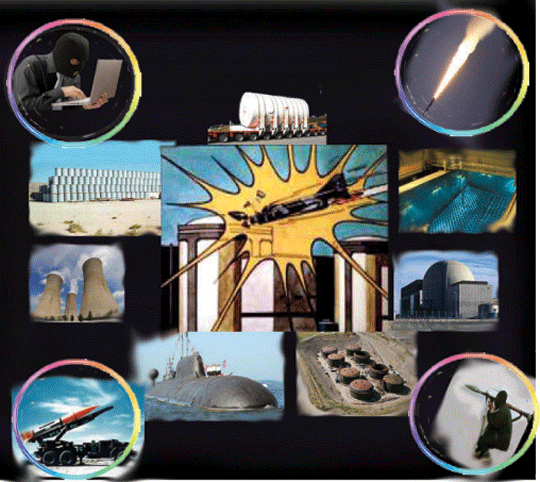
“This report makes clear that there are some areas of our country’s preparedness that need strengthening up,” said Sen. Bob Casey, who co-chairs the Senate Caucus on Weapons of Mass Destruction Terrorism.
FEMA’s dearth of information has left the agency dangerously in the dark, and the situation hasn’t improved since Superstorm Sandy hit large parts of the eastern seaboard in 2012, causing significant damage in New Jersey, from which the state is still recovering. Instead of taking the lead and coordinating efforts between different federal agencies, both FEMA and the Energy Department failed to effectively communicate during Sandy and received strong criticism for the 182 deaths and $65 billion dollars worth of damage which followed the storm.
More generally, the GAO noted that assuming a nuclear attack struck tomorrow, it would take at least five years for the agency to even formulate a strategy to detect unsafe radiation levels. It would take longer still — between five and ten years — to come up with an adequate medical response. According to GAO, FEMA needs to do a much better job at leading cooperation and setting objectives with clear deadlines and clear costs…………http://dailycaller.com/2014/12/19/report-us-unprepared-to-handle-nuclear-disaster/
USA: EPA now allows much higher, much less safe, radiation levels in drinking water!
 Obama Increases Allowable Levels of Radiation in Drinking Water “Dramatically”http://www.globalresearch.ca/obama-increases-allowable-levels-of-radiation-in-drinking-water-dramatically/5420787
In Time for Massive New Dumping of Daiichi Radiation
The Nuclear Industry calls this their “new normal,” according to Public Employees for Environmental Responsibility (PEER).
The EPA has issued radiation guides called Protective Action Guides or PAGs which allows more radiation than any American has ever been exposed to. Within the guides, are instructions for evacuations, shelter-in-place orders, food restrictions and other actions following a wide range of “radiological emergencies.”
Wouldn’t the massive break down of reactor number one at Fukushima be considered a ‘radiological emergency?”
Shunichi Tanaka, the chairman of the Nuclear Regulation Authority, made the comment Dec. 12 about dumping radioactive waste into the ocean.
The US governments PAGs allow long-term public exposure to radiation in amounts as high as 2,000 millirems. This would, in effect, increase a longstanding 1 in 10,000 person cancer rate to a rate of 1 in 23 persons exposed over a 30-year period. Many experts are expecting elevated cancer rates due to these “allowable” levels of radiation exposure.
The PAGs are the work of Gina McCarthy, the assistant administrator for air and radiation whose nomination to serve as EPA Administrator was only approved by the Senate a few months ago.
It is suggested that these PAGs have been in the works for over two years and are just recently available for public view.
PEER Executive Director Jeff Ruch said:
“This is a public health policy only Dr. Strangelove could embrace. If this typifies the environmental leadership we can expect from Ms. McCarthy, then [the] EPA is in for a long, dirty slog.”
“No compelling justification is offered for increasing the cancer deaths of Americans innocently exposed to corporate miscalculations several hundred-fold.”
USA government to give $12.5B in Loans for New Nuclear Power Projects!
 DoE Announces $12.5B in Loans for Advanced Nuclear, Energy Collective Katherine Tweed December 17, 2014 The U.S. Department of Energy issued a loan guarantee solicitation for $12.5 billion on Wednesday for innovative nuclear energy projects.
The solicitation comes on top of $8 billion for advanced fossil energy projects last December, $4 billion for renewables issued earlier this year and $6.5 billion for two nuclear reactors in February, the first new nuclear to be built in the U.S. in about 30 years……………
“DOE will look favorably on Eligible Projects that will have a catalytic effect on the commercial deployment of future Advanced Nuclear Energy Projects,” the solicitation states.
The first deadline for Part I applications is March 18, 2015, followed by rolling deadlines approximately every six months.http://theenergycollective.com/katherinetweed/2170051/doe-announces-125b-loans-advanced-nuclear
1 This Month
23-25 October – on Zoom – World BEYOND War’s annual global conferenc

To see nuclear-related stories in greater depth and intensity – go to https://nuclearinformation.wordpress.com

Say No to NASA’s Reckless Nuclear Reactor on the Moon
Say No to NASA’s Reckless Nuclear Reactor on the Moon
-
Archives
- October 2026 (160)
- September 2026 (339)
- August 2026 (330)
- July 2026 (355)
- June 2026 (287)
- May 2026 (306)
- April 2026 (356)
- March 2026 (251)
- February 2026 (267)
- January 2026 (308)
- December 2025 (358)
- November 2025 (359)
-
Categories
- 1
- 1 NUCLEAR ISSUES
- business and costs
- climate change
- culture and arts
- ENERGY
- environment
- health
- history
- indigenous issues
- Legal
- marketing of nuclear
- media
- opposition to nuclear
- PERSONAL STORIES
- politics
- politics international
- Religion and ethics
- safety
- secrets,lies and civil liberties
- spinbuster
- technology
- Uranium
- wastes
- weapons and war
- Women
- 2 WORLD
- ACTION
- AFRICA
- Atrocities
- AUSTRALIA
- Christina's notes
- Christina's themes
- culture and arts
- Events
- Fuk 2022
- Fuk 2023
- Fukushima 2017
- Fukushima 2018
- fukushima 2019
- Fukushima 2020
- Fukushima 2021
- general
- global warming
- Humour (God we need it)
- Nuclear
- RARE EARTHS
- Reference
- resources – print
- Resources -audiovicual
- Weekly Newsletter
- World
- World Nuclear
- YouTube
-
RSS
Entries RSS
Comments RSS

