USS Calhoun County and the dumping at sea of atomic waste
“Nuclear Waste Dumping Diary.”
Jan. 20 1957: “371 tons atomic waste.”
Feb. 7, 1957: “368 tons atom waste.”
Nov. 13, 1957: “299 (tons) poison gas (and) A.W.”
One of Albernaz’s last entries was on June 12, 1958: “200 tons. Spec. weapons,” or special weapons. That was the day, Albernaz later told his wife, that he helped dispose of an atomic bomb.
none of the men who served on theCalhoun County are eligible for automatic VA benefits for radiation illnesses because they did not participate in underwater or atmospheric atomic tests and related activities, the government says.
Thus, the crewmen do not meet their country’s definition of “Atomic Veteran.”
USS Calhoun County sailors dumped thousands of tons of radioactive waste into ocean, Tampa Bay Times , 20 Dec 2013 William R. Levesque, Times Staff Writer They asked the dying Pasco County man about his Navy service a half-century before. He kept talking about the steel barrels. They haunted him, sea monsters plaguing an old sailor.
“We turned off all the lights,” George Albernaz testified at a 2005 Department of Veterans Affairs hearing, “and … pretend that we were broken down and … we would take these barrels and having only steel-toed shoes … no protection gear, and proceed to roll these barrels into the ocean, 300 barrels at a trip.”

Not all of them sank. A few pushed back against the frothing ocean, bobbing in the waves like a drowning man. Then shots would ring out from a sailor with a rifle at the fantail. And the sea would claim the bullet-riddled drum.
Back inside the ship, Albernaz marked in his diary what the sailors dumped into the Atlantic Ocean. He knew he wasn’t supposed to keep such a record, but it was important to Albernaz that people know he had spoken the truth, even when the truth sounded crazy.
For up to 15 years after World War II, the crew of Albernaz’s ship, the USS Calhoun County, dumped thousands of tons of radioactive waste into the Atlantic Ocean, often without heeding the simplest health precautions, according to Navy documents and Tampa Bay Times interviews with more than 50 former crewmen………. Continue reading
Ginna nuclear plant would have to double its charges to consumes, to be profitable
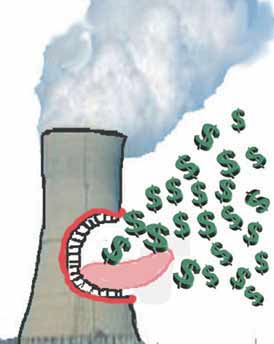
 US Nuclear Plant Would Have To Charge Double To Stay Profitable, Simply Info January 6th, 2015 Bloomberg has an interesting article about the major problem for US nuclear reactors. The economics are killing them. They blame subsidies other power generation gets (conveniently avoiding mention of the considerable subsidies nuclear power receives) and other (cheaper) power sources.
What was so startling in this Bloomberg article is that Ginna nuclear plant would have to charge consumers double the current retail power rates in order to turn a profit. This was vs. all other power sources (gas, coal, renewables)……….http://www.fukuleaks.org/web/?p=14282
Entergy can’t afford, for decades, to dismantle Vermont Yankee Nuclear Plant
Vermont Yankee Nuclear Plant Begins Slow Process of Closing, NYT By JESS BIDGOODJAN. 4, 2015 “………..The Entergy Corporation, a Louisiana-based energy company that operates nuclear plants around the country, purchased Vermont Yankee in 2002. The plant had withstood opposition from activists since it opened, but from 2007 to 2010, the collapse of a cooling tower, radioactive tritium leaks and misstatements from plant executives that had preceded them further eroded public confidence in the company.
State legislators tried to close the plant, but a judge ruled in 2012 that they could not. Shortly after that decision was upheld, in August 2013, Entergy announced it would nevertheless close the plant, citing economics.
“It became pretty clear that we could not, this would not be a financially viable resource going forward,” said Bill Mohl, the president of Entergy Wholesale Commodities, which owns the plant, last week. He cited the plant’s small size, the low cost of natural gas for producing electricity and other issues with the market.
“This plant, this area, ranks right up there with the highest antinuke sentiment across the entire country,” said Mr. Farabaugh, who worked in five other plants around the nation before coming to Vermont Yankee.
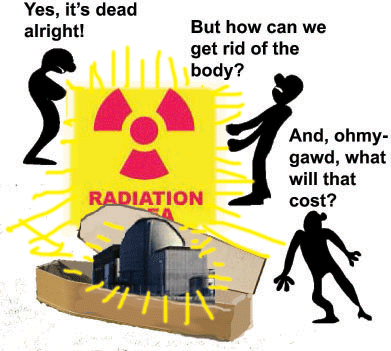 Entergy projects it will cost $1.2 billion to decommission Vermont Yankee, but its trust fund has about half of that, so the full dismantling of the plant will not begin for decades. Meanwhile, the operators will turn to the mammoth task of cooling, storing and securing the spent fuel there.
Federal law requires the government to develop a long-term storage facility for nuclear waste, but there is currently no plan in place. So the spent fuel at Vermont Yankee, like at closed nuclear facilities around the country, will stay on site, and officials say it will be safe.
The prospect of the plant’s future as a nuclear storage facility worries many of the area’s activists, like Clay Turnbull, the president of the New England Coalition on Nuclear Pollution, which is based in Brattleboro.
USA’s most ambitious renewable energy target proposed by California’s Governor, Jerry Brown
California Governor Proposes Most Ambitious Renewable Energy Target In U.S. DeSmogBlog MIKE GAWORECKI 6 JAN 15 California Governor Jerry Brown used the occasion of his fourth inaugural address to propose an ambitious new clean energy target for the state: 50% renewable energy by 2030.
“We are at a crossroads,” Brown said in announcing the proposal, according to Climate Progress. “The challenge is to build for the future, not steal from it, to live within our means and to keep California ever golden and creative.”
Already the leader in installed solar capacity and third when it comes to wind power, the Golden State had previously adopted a Renewable Portfolio Standard mandate to procure 33% of its electricity from renewable sources by 2020, a goal it was easily on pace to meet.
Environmentalists were quick to applaud Governor Brown’s 50% by 2030 proposal, which would give California the most ambitious renewable energy target of any US state, eclipsing Hawaii’s 40% by 2030 target.
But given the current growth rate of California’s renewable sector, even 50% by 2030 might not end up being that ambitious, according to Abigail Dillen, Vice President of Climate and Energy for Earthjustice.
“Indeed, projecting the current growth in renewables to the following decade is likely conservative given that the cost of solar and other renewable resources is expected to continue to decrease. So 50% renewable is achievable and should be seen as the bare minimum for 2030,” Dillen told DeSmog………http://www.desmogblog.com/2015/01/06/california-sets-ambitious-new-renewable-energy-target
USA and Russia ramping up nuclear weapons rivalry
 US and Russia in danger of returning to era of nuclear rivalry Julian Borger, Guardian, 5 Jan 15 American threats to retaliate for Russian development of new cruise missile take tensions to new level. A widening rift between Moscow and Washington over cruise missiles and increasingly daring patrols by nuclear-capable Russian submarines threatens to end an era of arms control and bring back a dangerous rivalry between the world’s two dominant nuclear arsenals.
Tensions have been taken to a new level by US threats of retaliatory action for Russian development of a new cruise missile. Washington alleges it violates one of the key arms control treaties of the cold war, and has raised the prospect of redeploying its own cruise missiles in Europe after a 23-year absence.
On Boxing Day, in one of the more visible signs of the unease, the US military launched the first of two experimental “blimps” over Washington. The system, known as JLENS, is designed to detect incoming cruise missiles. The North American Aerospace Command (Norad) did not specify the nature of the threat, but the deployment comes nine months after the Norad commander, General Charles Jacoby, admitted the Pentagon faced “some significant challenges” in countering cruise missiles, referring in particular to the threat of Russian attack submarines.
Those submarines, which have been making forays across the Atlantic, routinely carry nuclear-capable cruise missiles. In the light of aggressive rhetoric from Moscow and the expiry of treaty-based restrictions, there is uncertainty over whether those missiles are now carrying nuclear warheads.
The rise in tension comes at a time when the arms control efforts of the post-cold-war era are losing momentum. The number of strategic nuclear warheads deployed by the US and Russia actually increased last year, and both countries are spending many billions of dollars a year modernising their arsenals. Against the backdrop of the war in Ukraine and a failing economy, Vladimir Putin is putting increasing emphasis on nuclear weapons as guarantors and symbols of Russian influence. In a speech primarily about the Ukrainian conflict last summer, Putin pointedly referred to his country’s nuclear arsenal and declared other countries “should understand it’s best not to mess with us”…………
Reintroducing cruise missiles into Europe would be politically fraught and divisive, but the Republican majority in Congress is pushing for a much more robust American response to the Russian missile.
The US military has also been rattled by the resurgence of the Russian submarine fleet. Moscow is building new generations of giant ballistic missile submarines, known as “boomers”, and attack submarines that are equal or superior to their US counterparts in performance and stealth. From a low point in 2002, when the Russian navy managed to send out no underwater patrols at all, it is steadily rebounding and reasserting its global reach.
There have been sporadic reports in the US press about Russian submarines reaching the American east coast, which have been denied by the US military. But last year Jacoby, the head of Norad and the US northern command at the time, admitted concerns about being able to counter new Russian investment in cruise missile technology and advanced submarines.
“They have just begun production of a new class of quiet nuclear submarines specifically designed to deliver cruise missiles,” Jacoby told Congress……………….
With both the US and Russia modernising their arsenals and Russia investing increasing importance its nuclear deterrent, Hans Kristensen, the director of the Nuclear Information Project at the Federation of American Scientists, said we are facing a period of “deepening military competition”.
He added: “It will bring very little added security, but a lot more nervous people on both sides.” http://www.theguardian.com/world/2015/jan/04/us-russia-era-nuclear-rivalry
The fight against the Trans Pacific Partnership gets more serious in 2015

This leaked text also revealed new terms on the misuse of trade secrets. These are dangerously vague and could be used to enact harsh criminal punishments against anyone who reveals or even accesses information through an allegedly confidential “computer system.” This language could have alarming consequences if it obligates nations to enact new laws that could be used to crack down on journalists and whistleblowers. I
t’s no wonder TPP negotiations continued to be as secretive as ever this year—policymakers are taking advantage of back-room policymaking to criminalize the very people who help public interest groups like EFF understand what’s contained in these agreements.
The major fight in the US was a campaign to defeat “fast track.” Fast track authority, also known as trade promotion authority, is a legal mechanism whereby Congress hands its Constitutional mandate to set the agenda and negotiate the terms of trade agreements over to Obama and the US Trade Representative. If fast track passes, the US Trade Representative could pass agreements like TPP and other deals like the Transatlantic Trade and Investment Partnership (TTIP) with even less public oversight. In January, two of the most Hollywood-friendly Senators introduced it in a bill called the “Bipartisan Congressional Trade Priorities Act.“
Following a joint effort with various public interest groups and individuals across the country, we collectively sent hundreds of thousands of messages to US lawmakers, calling on them to oppose fast track. We helped convince some leading Senators to come out against it and the bill eventually fizzled. But another fast track bill was inevitable, so we continued our campaign.Digital rights organizations were joined by over 25 technology companies to call on US lawmakers to oppose the passage of fast track authority. Then in September, we delivered a letter to Sen. Ron Wyden to fix the secretive, Hollywood-captured trade process.
2014 was a major year in our fight against TPP, but we’re expecting it will all come to a head in the new year. Public statements from the White House and Republican lawmakers have reiterated their resolve to introduce and pass new fast track legislation in the coming months. At the same time, the US Trade Representative has hinted that it plans to finalize the TPP in 2015.
While we keep the pressure on lawmakers to oppose fast track next year, we’re going to continue our call to TPP negotiators to follow the EU’s lead to bring transparency to trade negotiations once and for all. Stopping TPP is about stopping what has, up until this point, seemed like an endless cycle of corporate-dominated back-room policy laundering. We’ve so far been successful in slowing down the progress of TPP, but when the ultimate showdown arrives, we‘ll all need to be ready to fight.
USA government should fund safety of radiological materials, not fund more nuclear weapons
Schlosser provided one example out of a thousand mishaps that have occurred. In Goldsboro, N.C., in 1961, two hydrogen bombs fell out of a B-52 bomber when the plane went into a tailspin. Three of the four safety mechanisms in one of those bombs become unlocked as it plunged to the ground. Fortunately, the last switch prevented the full detonation of a 4-megaton hydrogen bomb.
With all of this in mind, it’s clear that something needs to be done to address the serious issues undermining the safety of our nuclear arsenal.
Defense Secretary Chuck Hagel, who recently resigned, suggested that the United States inject billions of dollars into modernizing these facilities and retraining staff. However, the 2015 “CRomnibus” appropriations bill does not accomplish these things.
President Obama has repeatedly stated the need to secure radiological material worldwide in order to prevent a terrorist or criminal from fabricating a dirty bomb. Yet in this omnibus bill, funding to combat the proliferation of nuclear materials to terrorists and criminals was cut by 17 percent from 2014, while at the same time spending on nuclear weapons increased by 5 percent from last year. It seems like Hagel’s suggestion isn’t securing anything but more procurement for the Department of Defense.
A better idea to resolve the safety issues affecting our nuclear arsenal is to use those funds to secure and eliminate radiological materials worldwide and to work on getting rid of nuclear weapons rather than injecting more money into making new ones.
The Congressional Budget Office estimates that $355 billion will be spent on modernizing the nation’s nuclear forces from 2014 to 2023. Pressure should be placed on the incoming Congress to reduce spending on nuclear weapons in the 2016 budget, since these weapons pose more of a risk than an asset.
At the Vienna conference, the Arms Control Association – along with Physicians for Social Responsibility, the Federation of American Scientists, the Union of Concerned Scientists and the Institute for Energy and Environmental Research – delivered a statement suggesting four practical ways Obama can work to “reduce global nuclear dangers and move us closer to the elimination of all nuclear weapons:”
• Diminish the role and significance of nuclear weapons.
• U.S.-Russian nuclear weapons cuts and freeze other nations’ stockpiles.
• Convene nuclear disarmament summits.
• Follow through on the Comprehensive Test Ban Treaty…………http://www.buffalonews.com/opinion/viewpoints/government-should-eliminate-not-modernize-nuclear-arsenal-20150104
Buesseler and other scientists are calling for more monitoring of Pacific Coast radiation

 Scientists: Test West Coast for Fukushima radiation Tracy Loew, USA TODAY March 9, 2014 SALEM, Ore. — Very low levels of radiation from the Fukushima nuclear disaster likely will reach ocean waters along the U.S. West Coast next month, scientists are reporting.
Current models predict that the radiation will be at extremely low levels that won’t harm humans or the environment, said Ken Buesseler, a chemical oceanographer at the Woods Hole Oceanographic Institution who presented research on the issue last week.
But Buesseler and other scientists are calling for more monitoring. No federal agency currently samples Pacific Coast seawater for radiation, he said.
“I’m not trying to be alarmist,” Buesseler said. “We can make predictions, we can do models. But unless you have results, how will we know it’s safe?”……………
There are three competing models of the Fukushima radiation plume, differing in amount and timing. But all predict that the plume will reach the West Coast this summer, and the most commonly cited one estimates an April arrival, Buesseler said.
A report presented last week at a conference of the American Geophysical Union’s Ocean Sciences Section showed that some Cesium 134 has already has arrived in Canada, in the Gulf of Alaska area.
Cesium 134 serves as a fingerprint for Fukushima, Buesseler said.
“The models show it will reach north of Seattle first, then move down the coast,” Buesseler said.
By the time it gets here, the material will be so diluted as to be almost negligible, the models predict. Radiation also decays. Cesium 134, for example, has a half-life of two years, meaning it will have half its original intensity after that period.
In Oregon, state park rangers take quarterly samples of surf water and sand at three locations along the coast. The water is analyzed for Cesium 137 and iodine 131. Both of those already exist in the ocean at low levels from nuclear testing decades ago.
The monitoring began in April 2012, when tsunami debris began arriving along the Oregon coast. So far, all of the tests have shown less than “minimum detectable activity,” or the least amount that can be measured.
Results of the most recent samples, taken in mid-February, won’t be available until mid-March, Oregon Health Authority spokesman Jonathan Modie said.
Washington does not test ocean water for radiation.
“We have none happening now and we have none planned,” said Tim Church, communications director for the Washington State Department of Health. “Typically that would be something that would happen on the federal level.”
California regularly samples seawater around the state’s nuclear power plants to determine whether the plants are impacting the environment. Those results all are below minimum detectable activity.
Some citizens and scientists are taking sampling into their own hands. Cal State Long Beach marine biologist Steven Manley has launched “Kelp Watch 2014,” which will partner with other organizations to monitor kelp all along the West Coast for Fukushima radiation.
And Buesseler recently offered the services of his lab at Woods Hole in Massachusetts.
His project — titled “How Radioactive Is Our Ocean?” — will use crowd-sourced money and volunteers to collect water samples along the Pacific Coast, then ship them across the country to be analyzed.
So far, results are in for two locations in Washington and three in California. They show that the plume has not yet reached the coast.
Meanwhile, West Coast states are winding down their tsunami debris response efforts.
Oregon’s coastline is seeing less debris from the tsunami this winter than in the past two years, Oregon State Parks spokesman Chris Havel said.
If that doesn’t change, officials likely will disband a task force that was mobilized to deal with the debris.
Last year, Washington suspended its marine debris reporting hotline.
Loew also reports for the (Salem, Ore.) Statesman Journal http://www.usatoday.com/story/news/nation/2014/03/09/scientists-test-west-coast-for-fukushima-radiation/6213849/?utm_content=buffer51957&utm_medium=social&utm_source=twitter.com&utm_campaign=buffer
Oil leaking into Lake Michigan from Cook Nuclear Plant in Bridgman
Cook Nuclear Plant in Bridgman has been leaking oil into Lake Michigan. MLive By Julie Mack | jmack1@mlive.com on January 04, 2015 BRIDGMAN, MI — Donald C. Cook Nuclear Plant in Bridgman has leaked an estimated 2,000 gallons of oil into Lake Michigan since Oct. 25, according to an event notification posted on the Nuclear Regulatory Commission website.
It wasn’t until Dec. 16 that it was determined a leak might exist and on Dec. 19, it was traced to one of four heat-exchange tanks, where hot oil runs through hundreds of tubes and is cooled by lake water in the tank……
The estimate of 2,000 gallons of oil leakage overall is based on a calculation that the leak began Oct. 26…..
In August, plant officials issued a report that 8,700 gallons of diesel fuel were suspected to have been released from a buried fuel oil tank, but later said there was no leak and the report resulted from “instrumentation error.”
The plant is located near Bridgman, 11 miles south of St. Joseph along the Lake Michigan shoreline. Unit 2 went into operation in 1978.
The plant is owned by American Electric Power and operated by Indiana Michigan Power, an AEP subsidiary.
Julie Mack covers K-12 education and writes a column for Kalamazoo Gazette. Email her at jmack1@mlive.com, call her at 269-350-0277 or follow her on Twitter at @kzjuliemack. http://www.mlive.com/news/kalamazoo/index.ssf/2015/01/cook_nuclear_plant_in_bridgman.html
Tentative agreement between Iran and USA

 Iran and US tentatively agree on formula to reduce nuclear programme http://www.theguardian.com/world/2015/jan/02/iran-us-tentative-deal-nuclear-programme-uranium-russia Washington hopes Tehran will ship enriched uranium to Russia to reduce its weapon-making ability, diplomats say Iran and the United States have tentatively agreed on a formula that Washington hopes will reduce Tehran’s ability to make nuclear arms by committing it to ship to Russia much of the material needed for such weapons, diplomats say.
In another sign of progress, two diplomats told Associated Press that negotiators at the December round of nuclear talks drew up for the first time a catalogue outlining areas of potential accord and differing approaches to remaining disputes.The diplomats said differences still dominate ahead of the next round of Iran six-power talks on 15 January in Geneva. But they suggested that even agreement to create a to-do list would have been difficult previously because of wide gaps between the sides.
Iran denies it wants nuclear arms, but it is negotiating with the US, Russia, China, Britain, France and Germany on cuts to its atomic programme in the hope of ending crippling sanctions. The talks have been extended twice due to stubborn disagreements.
The main conflict is over uranium enrichment, which can create both reactor fuel and the fissile core of nuclear arms.In seeking to reduce Iran’s bomb-making ability, the US has proposed that Tehran export much of its stockpile of enriched uranium – something the Islamic Republic has long said it would not do.
The diplomats said both sides in the talks are still arguing about how much of an enriched uranium stockpile to leave Iran. . It now has enough for several bombs, and Washington wants substantial cuts below that level.
But the diplomats said the newly created catalogue lists shipping out much of the material as tentatively agreed upon.The diplomats, who are familiar with the talks, spoke to the AP recently and demanded anonymity because they are not authorised to comment on the closed negotiations.
Issues that still need agreement, they said, include the size of Iran’s future enrichment output. The US insists that it be cut in half, leaving Tehran with about 4,500 centrifuges used to enrich uranium, or fewer if it replaces them with advanced models. Tehran is ready for a reduction of only about 20%, according to the diplomats.
Two other unresolved issues are Iran’s Fordo underground enrichment site and the nearly built Arak nuclear reactor. The US and its five allies in the talks want to repurpose Fordo to a non-enrichment function because it is believed impervious to a military attack from the air. The six also seek to re-engineer Arak from a model that produces enough plutonium for several nuclear weapons a year to a less proliferation-prone model.
Negotiators hope to reach a rough deal by March and a final agreement by 30 June.
Economically, closure of Vermont Nuclear Plant points to the coming transformation of USA’s electricity system
 Even optimistic projections of the cost of building new nuclear reactors leaves them four times as costly as energy efficiency and twice as costly as wind and gas. Many analysts believe that solar power will be significantly less costly than nuclear in the next decade. Moreover, nuclear power never lives up to the optimistic cost projections of its boosters. Reactors under construction in the U.S. and Europe are way behind schedule and over budget.
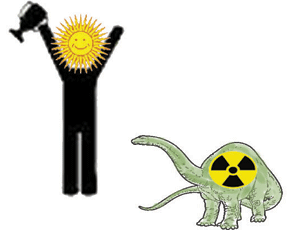 The problem with new reactor construction costs is well known, but the really stunning development is the problem that nuclear power has in terms of operating costs
the “dinosaurs” in the electricity sector have enough political clout to slow or prevent the change in the environment. Nuclear power is a major obstacle, demonstrated by its steadfast opposition to and an all-out attack on renewables and efficiency. Shuttering old, uneconomic reactors like Vermont Yankee is important not only because it removes an economic obstacle to change, but also because it shows the political will to transform America’s electricity system.
Why Closing Vermont Yankee Won’t Raise New England’s Power Bills Forbes Staff , Contributor Mark Cooper 31 Dec 14 Mr. Cooper is a senior fellow for economic analysis at Vermont Law School’s Institute for Energy and the Environment. Critics of the closing of the Vermont Yankee nuclear reactor have forecast a 40 percent jump in New England winter heating bills as a result of the shutdown. The facts suggest they have it wrong in more ways than one. Continue reading
Under the public radar, NATO is modernising its tactical nuclear arsenal.
NATO’s nuclear relapse Under the public radar, NATO is modernising its tactical nuclear arsenal. Aljazeera Ian Klinke Ian Klinke 1 Dec 15 Ian Klinke is a researcher at the University of Oxford.Moscow’s latest tests of intercontinental missiles and its parading of nuclear capable strategic bombers have rightly prompted international concern. In December 2014, Russian Foreign Minister Sergei Lavrov implied that Russia might be moving nuclear weapons to Crimea.
From violations of airspace to near mid-air collisions, the number of incidents between Russia and NATO has soared dramatically, increasing the danger of an unintended escalation. Yet, it is rarely mentioned that NATO, too, is back in the game of nuclear deterrence.
Washington has recently sent its nuclear capable B-2 and B-52 to Europe for training missions with its NATO partners. It also continues to test intercontinental ballistic missiles. Most problematically, the western military alliance is currently modernising the air-launched nuclear gravity bombs that fall under NATO’s nuclear sharing initiative………..
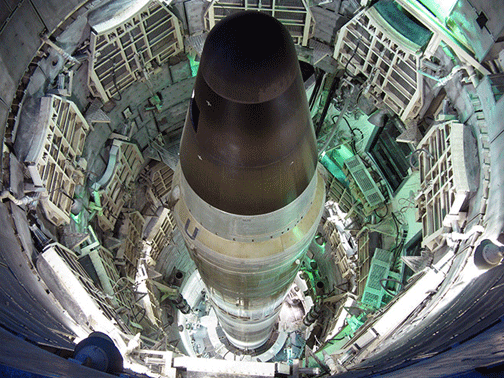
Tactical nukes are particularly problematic because their short range provides the missing link between a localised conventional war and a highly improbable global exchange of strategic nuclear missiles between Moscow and Washington.
Tactical nuclear weapons are no status quo weapons. Their battlefield purpose increases the chance of a nuclear escalation, which is why the superpowers removed most of them from Central Europe in the late 1980s and early 1990s.
If everything goes to plan, the controversial B61 weapons will be modernised by around 2020. This “life extension programme” is not simply an initiative to replace rusty old nukes with shiny new ones, but an attempt to increase their accuracy, to replace free fall with precision guided bombs.
Ultimately, this will transform the B61 into a new kind of weapon and undermine any pretence that the West is still in the game of denuclearisation.
Interestingly, plans to modernise the B61 were initiated in April 2010, only shortly after NATO decided to scrap its nuclear missile shield in Eastern Europe and in the same month that the two largest nuclear powers signed a new Strategic Arms Reductions Treaty.
How does NATO explain this nuclear relapse precisely at a time when the alliance had just “reset” its relations with Russia? And what role does the B61 play in the Ukrainian proxy war?……..http://www.aljazeera.com/indepth/opinion/2014/12/nato-nuclear-relapse-2014123161917509924.html
Nowhere to put nuclear waste, so the companies just sue the USA government
 Vermont Yankee Nuclear Plant Just Shut Down; U.S. Still Has No System for Disposing of Nuclear Waste http://www.newsweek.com/vermont-yankee-nuclear-plant-just-shut-down-us-still-has-no-system-disposing-295775 BY ZOË SCHLANGER 12/31/14 The Vermont Yankee nuclear plant officially went offline Monday, halting the nuclear reaction process and beginning what could be a nearly 40-year process to fully decommission the plant. But what happens to all the plant’s nuclear waste at the end of those decades? No one knows for sure, because the U.S. government has nowhere to put it.
That’s also the case for the nuclear waste from decommissioned plants all over the country: Their spent fuel rods remain on the reactor property, trapped inside steel cylinders called “dry casks,” even after the reactor is disassembled.
Since 1998, the federal government has been legally bound to remove dry-casked nuclear waste from private plants and dispose of it in a secure facility. But it can’t, because no such facility exists. Yucca Mountain, the facility that might have been, has been in limbo since its conception in 1987. It was initially scheduled to come online in 1998, but never did. Only 5 miles of the 40-mile storage tunnel were ever built. With more than $30 billion already collected over three decades from taxpayers for the project, the Obama administration cut funding to the mostly-unbuilt project in 2011.
As it stands now, it’s predicted the waste from the plant will be transfered from cooling ponds into dry casks by 2020. Then those casks may end up sitting on the reactor’s property in Vernon, Vermont, indefinitely, like so many thousands of casks lying around on reactor sites all over the country. The Vermont Yankee lists 2052 as the year the federal government might come take them away, but that’s pending Congressional action that has not yet taken place. So what does a corporation do when a contract, government or otherwise, is violated? They sue.
“You then sue the Department of Energy for the costs that are incurred for storing the spent fuel. [So do] all the other decommissioned facilities—the dry casks still remain on the site because there’s no place to bring the spent fuel. So you sue the Department of Energy and they pay you back for the cost that you’ve incurred,” says Martin Cohn, a spokesperson Entergy Wholesale Commodities, which owns Vermont Yankee.
Savannah River Site Secretly Becoming World’s Nuclear Dumping Ground
 Secretly Dumping Other People’s Problem Savannah River Site Becoming World’s Nuclear Dumping Ground, despite Safety Risks By: GLORIA TATUM Atlanta Progressive News 6-9-2014 (APN) ATLANTA — The U.S. Department of Energy (DOE) is close to finalizing plans to accept highly radioactive commercial spent nuclear fuel from Germany to be deposited at the Savannah River Site (SRS) in South Carolina, according to news reports that were buried deeper than the plutonium itself.
However, it is not only Germany that is sending, or has sent, nuclear waste to SRS, but also Italy, Sweden, Belgium, Canada, and perhaps other countries not yet known, Atlanta Progressive News has learned.
Atlanta Progressive News can report that South Carolina’s Savannah River Site is quietly becoming the world’s nuclear dumping ground, and de facto nuclear waste storage site, despite the facts that frequent rain and an overlapping earthquake zone make the site extremely dangerous, especially to our water supply.
There is no long-term storage plan for the waste in the U.S., with the Yucca Mountain proposal on the rocks, as it were, and with a temporary nuclear waste storage site in New Mexico having been closed to new shipments indefinitely.
SRS is already quietly storing plutonium brought in from other countries, and is now also planning to import 23,000 liters of liquid high-level waste from the Chalk River Laboratories in Canada, which would end up in the already stressed high-level waste tank system, according to an SRS Watch news release.
Shipments of foreign plutonium appear to have been secretly brought in via Charleston, South Carolina, in February and March 2014 of this year, according to an article by the Ottawa Citizen, dated March 29, 2014.
The article has a photo of PNTL transport ship Pacific Egret, noting that the ship carried guns and cannons, and that the ship–which originated in Italy with sensitive nuclear material– disappeared from an online marine tracking system after entering Canadian waters:
http://www.ottawacitizen.com/news/Covert+mission+Plutonium+source+might+Canada/9675369/story.html
Italy and Belgium have announced the transfer of plutonium and highly enriched uranium (HEU) to the Department of Energy’s Savannah River Site. The Italy and Belgium imports are admitted to in two respective statements posted to the White House’s website, just days before the Ottawa Citizen report:
Meanwhile, according to Reuters and other reports, Japan will transfer HEU and plutonium to the U.S., but that the destination is not known. However, based on the closure of the New Mexico facility, it is highly reasonable to suspect that the Japanese shipment will also be dumped at SRS.
http://www.reuters.com/article/2014/03/24/nuclear-proliferation-idUSL5N0ML2MP20140324
At the National Security Summit at the Hague on March 24 and 25, 2014, a priority item on the agenda was to reduce the amount of dangerous nuclear material in the world. They issued a statement that countries should repatriate highly enriched uranium (HEU) to its country of origin, thereby reducing the number of locations that terrorist groups could target to obtain it.
With the U.S. being the country of origin for much of the world’s nuclear material, this means all our nuclear chickens are coming home to roost……. http://www.fairewinds.org/secretly-dumping-peoples-problems/#sthash.mtEhWriM.dpuf
Vermont Nuclear Shutdown highlights reality of nuclear’s radioactive legacy
 Another Reactor Closes, Punctuating New Reality for U.S. Nuclear Power As Vermont Yankee shuts down, the U.S. has yet to address industry issues that span decades Christina Nunez National Geographic JANUARY 1, 2015
As another nuclear power plant closed this week, the United States faced a dwindling fleet of aging reactors, few new projects, and the challenge of safely mothballing radioactive fuel for decades……..
So far, nuclear isn’t winning. Vermont Yankee, which shut down Monday after 42 years of operation, is the fourth U.S. nuclear facility to close in two years. For the owners of each recent retiree—from Vermont Yankee to San Onofre in California, Kewaunee in Wisconsin, and Crystal River in Florida—the math just didn’t work.
“When we looked at the cost of those improvements with what we projected as the cost of energy, the decision was that it would be better to shut the plant down,” said Martin Cohn, spokesperson for Vermont Yankee’s operator, Entergy.
More closures in the United States, the world’s largest producer of nuclear power, could lead to a far different nuclear landscape from the one imagined before the gas boom.
Nuclear’s Long-Term Legacy
Technically, the decades-long process of decommissioning a nuclear plant hasn’t changed much over the years: The reactor is shut down, the radioactive fuel is removed and encased for storage, and the plant itself is eventually dismantled.
“We will have a concrete pad with a bunch of casks of spent fuel on it that will look almost exactly like the ones at Maine Yankee or Yankee Rowe [in Massachusetts],” which retired in 1996 and 1991, respectively, said Chris Wamser, Vermont Yankee site vice president.
The rules surrounding that process haven’t changed either, which is a problem, according to Vermont Yankee executives. “Just because we shut down, we’re still a nuclear plant with a license,” said Barrett Green, who is leading the project. He said the NRC hasn’t finalized a road map for decommissioning.
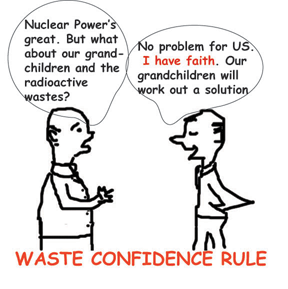
“We’ve had to make all sorts of petitions for amendments to the license, or exceptions to a rule, or various other allowances for the regulatory process to say it’s OK for us to stop maintaining a system that we’re never going to need again,” Green said.
Outgoing Nuclear Regulatory Commission Chairman Allison Macfarlane acknowledged this issue at a National Press Club luncheon in November, suggesting that the agency has not prepared for a future where, instead of overseeing new nuclear plants, it is reckoning with older plants such as Vermont Yankee retiring ahead of schedule.
“The predicted ‘nuclear renaissance’ did not materialize,” Macfarlane said. “It’s time for the NRC to develop regulations specific to the decommissioning of nuclear power plants and to structure public expectations of the process.”………On Twitter: Follow Christina Nunez and get more environment and energy coverage at NatGeoGreen. The story is part of a special series that explores energy issues. For more, visit The Great Energy Challenge. http://news.nationalgeographic.com/news/energy/2015/01/150101-vermont-yankee-shutdown-us-nuclear-issues/
1 This Month
23-25 October – on Zoom – World BEYOND War’s annual global conferenc

To see nuclear-related stories in greater depth and intensity – go to https://nuclearinformation.wordpress.com

Say No to NASA’s Reckless Nuclear Reactor on the Moon
Say No to NASA’s Reckless Nuclear Reactor on the Moon
-
Archives
- October 2026 (160)
- September 2026 (339)
- August 2026 (330)
- July 2026 (355)
- June 2026 (287)
- May 2026 (306)
- April 2026 (356)
- March 2026 (251)
- February 2026 (267)
- January 2026 (308)
- December 2025 (358)
- November 2025 (359)
-
Categories
- 1
- 1 NUCLEAR ISSUES
- business and costs
- climate change
- culture and arts
- ENERGY
- environment
- health
- history
- indigenous issues
- Legal
- marketing of nuclear
- media
- opposition to nuclear
- PERSONAL STORIES
- politics
- politics international
- Religion and ethics
- safety
- secrets,lies and civil liberties
- spinbuster
- technology
- Uranium
- wastes
- weapons and war
- Women
- 2 WORLD
- ACTION
- AFRICA
- Atrocities
- AUSTRALIA
- Christina's notes
- Christina's themes
- culture and arts
- Events
- Fuk 2022
- Fuk 2023
- Fukushima 2017
- Fukushima 2018
- fukushima 2019
- Fukushima 2020
- Fukushima 2021
- general
- global warming
- Humour (God we need it)
- Nuclear
- RARE EARTHS
- Reference
- resources – print
- Resources -audiovicual
- Weekly Newsletter
- World
- World Nuclear
- YouTube
-
RSS
Entries RSS
Comments RSS

