False claim that Hillary Clinton had the power to veto Russia uranium sale deal
No ‘Veto Power’ for Clinton on Uranium Deal, — Eugene Kiely, Fact Check, April 28, 2015
The author of “Clinton Cash” falsely claimed Hillary Clinton as Secretary of State had “veto power” and “could have stopped” Russia from buying a company with extensive uranium mining operations in the U.S. In fact, only the president has such power.
At the time of the sale, Clinton was a member of the Committee on Foreign Investments in the United States, which is required by law to investigate all U.S. transactions that involve a company owned or controlled by a foreign government. Federal guidelines say any one of nine voting members of the committee can object to such a foreign transaction, but the final decision then rests with the president.
“Only the President has the authority to suspend or prohibit a covered transaction,” the guidelines say.
Through a spokeswoman, author Peter Schweizer told us he meant that Clinton could have forced the issue to the president’s desk. But that’s not what he said when he appeared on “Fox News Sunday,” where he discussed the uranium deal and his upcoming book to be released on May 5.
Schweizer’s book — “Clinton Cash: The Untold Story of How and Why Foreign Governments and Businesses Helped Make Bill and Hillary Rich” — focuses on foreign donations to the Clinton Foundation, a nonprofit created by former President Bill Clinton. In his book, Schweizer, a former fellow at the right-leaning Hoover Institution, seeks to link some of those donations to the official actions taken by Clinton when she was Secretary of State…….
Schweizer is wrong when he says that Clinton had “veto power” and “could have stopped the deal.” At best, she could have forced the president to make a decision.
The committee, which is known by its acronym CFIUS, can approve a sale, but it cannot stop a sale.
- Even the president cannot prohibit a transaction without “credible evidence” that the “foreign interest exercising control might take action that threatens to impair the national security,” according to the regulation……..
The Clinton campaign told the Times that generally these matters did not reach the secretary’s level, so she may not have been involved at all. According to the Times, Jose Fernandez, a former assistant secretary of state, represented the department on the committee. He told the Times: “Mrs. Clinton never intervened with me on any C.F.I.U.S. matter.”
Schweizer raises legitimate questions about the Clinton Foundation and its donations. He simply goes too far when he says Clinton had “veto power” and “could have stopped” the uranium deal.http://www.factcheck.org/2015/04/no-veto-power-for-clinton-on-uranium-deal/
Nuclear industry embarks on a public advertising campaign
 Nuclear power industry hopes for a new era, Standard Times James Osborne, Apr 25, 2015“…….With high-profile advocates like former Environmental Protection Agency administrator Christie Whitman on board, the industry is embarking on a very public campaign arguing nuclear must be part of any national energy plan. To accomplish that, it wants to examine amending power and licensing regulations to encourage nuclear and speed up construction.
the industry will face opposition. Nuclear remains a divisive issue among environmentalists. Some support it as a proven means to cut carbon emissions out of the nation’s power supply.
But there are many see its potential contamination risks as just too great to make it sensible……..http://www.gosanangelo.com/news/state/nuclearpowerda_54975979
Maine’s Governor wants to remove voters’ rights on decisions on small nuclear reactors
 LePage’s plan to negate rule on nuclear power plants could be radioactive. Observers wonder why his attention to the issue begins with an attempt to disempower Maine voters. 26 Apr. BY BILL NEMITZ COLUMNIST bnemitz@pressherald.com | @BillNemitz Consider yourselves warned, fellow citizens. Gov. Paul LePage is fiddling around with Maine’s nuclear hot button.
“We anticipated this might provoke a conversation,” noted Patrick Woodcock, director of the Governor’s Energy Office, in an interview on Friday.
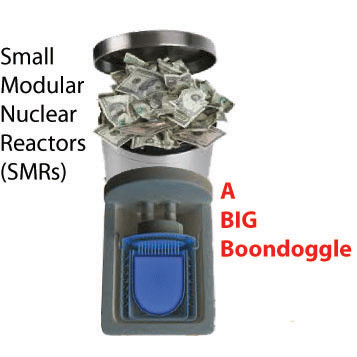 Under LePage’s new plan, scheduled for a hearing Wednesday at 1 p.m. before the Legislature’s Energy, Utilities and Technology Committee, voters would no longer have a say on the creation of nuclear power plants with generating capacities of 500 megawatts or less.
(Just so you know, the Fukushima Daiichi Nuclear Power Plant’s Unit 1 reactor – one of three destroyed by Japan’s apocalyptic tsunami in 2011 – had a generating capacity of 460 megawatts.)
Let’s back up a little.
Considering the complexity and controversy bound to greet any talk of dusting off nuclear generation in Maine, why start with a bill that effectively tells voters they’re being cut out of the process?
Or, as longtime anti-nuclear activist Ray Shadis of Edgecomb put it on Friday, “You don’t start a conversation by throwing a hand grenade in the room.”
Shadis, who currently represents the lone remaining intervenor in the proposed relicensing of New Hampshire’s Seabrook nuclear plant, sees this week’s hearing as “the kind of rudeness we’ve come to expect from Gov. LePage.”
He also thinks the governor is dreaming if he thinks small modular reactors – the brainchildren of a new generation of nuclear engineers working mostly out of the Massachusetts Institute of Technology – can attract the investment capital needed to put them on the energy radar here in Maine or anywhere else, for that matter.
“The most rabid anti-nuclear crowd are the investors in the market,” Shadis noted. “It takes a long time to realize any return at all. And the entirety of what you invest can turn from an asset to a liability overnight. Why bother risking your money? So they don’t.”
Thus, he said, LePage’s bill at best “is impractical, it’s silly. Out there in the energy world, where people are really trading on this stuff, it will make Maine the laughingstock. It will make us look like patsies.”
Demonstrations in New York City for abolition of nuclear weapons
 Demonstrators to rally for nuclear abolition The Wisconsin Gazette Monday, 20 April 2015 Thousands of protesters are set to gather in New York City this week to demand a nuclear-free world in advance of the five-year Nuclear Nonproliferation Treaty Review Conference.
Activists, scholars and students with anti-nuclear, peace and environmental justice movements will call on the NPT Review Conference meeting at the United Nations to mandate the commencement of “good faith negotiations” for the complete elimination of the world’s nuclear arsenals, as required by the treaty.
Activist events include an international conference April 24-25 at the Cooper Union featuring speakers from more than a dozen countries.
On April 26, a mass rally will take place in Union Square, followed by a march to Dag Hammarskjold Plaza, where millions of petition signatures will be presented to UN and NPT officials.
The rally will launch a “Global Wave,” with participants symbolically waving goodbye to nuclear weapons. The Global Wave will travel west, by time zone, with public events scheduled in Papeete, Manila, Amman, Bethlehem, Stockholm, Paris, London, Sao Paulo and points in-between.
An interfaith service will precede the rally.
Joseph Gerson, disarmament coordinator at the American Friends Service Committee and one of the events’ lead organizers, is working with activists from Tokyo to Toronto and Berlin to Brazil.
He said, “More than a thousand Japanese activists, including 50 Hiroshima and Nagasaki A-bomb survivors, will be joining us in this 70th anniversary year of the U.S. atomic bombings. Their suitcases will be filled with 7,000,000 petition signatures calling for the abolition of nuclear weapons.”
In the United States, peace walks originating in Tennessee, at the Oak Ridge nuclear weapons production facility, California and New England, will converge in New York, with groups journeying on peace trains from Pennsylvania, New Jersey and Connecticut, and coming on buses from as far away as Chicago and Massachusetts.
A “Bike for Peace” ride from Washington, D.C., will arrive in New York City on April 24.
Organizers say nuclear disarmament is now more important than ever………http://www.wisconsingazette.com/trending/demonstrators-to-rally-for-nuclear-abolition.html
Sudden conversion of climate denialist US Senator as he jumps on pro nuclear bandwagon
 The Senate’s Top Climate Denier Redefines Chutzpah http://thinkprogress.org/climate/2015/04/24/3650610/americas-top-climate-denier-now-agrees-top-climate-scientist/ BY JOE ROMM APRIL 24, 2015 THE TRADITIONAL DEFINITION OF CHUTZPAH INVOLVES A GUY WHO KILLS HIS PARENTS, THEN PLEADS FOR MERCY BECAUSE HE IS NOW AN ORPHAN. THE MODERN DEFINITION OF CHUTZPAH INVOLVES … SEN. JAMES INHOFE (R-OK).
The chair of the Senate Environment and Public Works Committee has an Earth Day (!) op-ed arguing we should embrace carbon-free nuclear power because of the threat posed by global warming. You remember Inhofe, the guy who called global warming a hoax, the guy who for over a decade has trashed climate scientists, such as James Hansen, whom he called in 2006 a “NASA scientist and alarmist.”
Apparently, however, Inhofe no longer sees Hansen as radioactive. He writes, without a trace of irony:
How cool is it that Inhofe is now apparently on board with top climatologist Hansen on the urgent need “to avoid dangerous climate change” by accelerated deployment of zero-carbon technologies? Presumably he’ll soon be on board with Hansen’s call for a high and rising carbon dioxide fee (returned to the public as a dividend), and a World War II scale effort to return CO2 levels back to 350 parts per million from their current level of 400 ppm (and rising 2+ ppm a year).
As an aside, what’s holding nuclear power back is its exorbitant price. Indeed, just this week a panel of experts unanimously agreed that nukes have all but priced themselves out of the market. Perhaps Inhofe should have supported the climate bill that came out of the House of Representatives in 2009, since its carbon pricing mechanism would have been nuclear power’s best chance at a resurgence.
As for Inhofe’s bromancing of Hansen, I suspect it is unrequited, but then they say politics does make for strange bedfellows. Or at least for new definitions of chutzpah.
US uranium mine- how Russia gained control
How Putin’s Russia Gained Control of a U.S. Uranium Mine, Bloomberg, 24 Apr 15 by William KennedyAndy Hoffman Since 2013, the nuclear energy arm of the Russian state has controlled 20 percent of America’s uranium production capacity.
Rosatom’s acquisition of Toronto-based miner Uranium One Inc. made the Russian agency, which also builds nuclear weapons, one the world’s top five producers of the radioactive metal and gave it ownership of a mine in Wyoming.
The deal, approved by a committee that included then Secretary of State Hillary Clinton, also followed donations from Uranium One’s Canadian chairman to the Clinton Global Foundation, the New York Times reported on Thursday.
Rosatom gained full control of Uranium One in early 2013.
Rosatom styles itself as Russia’s national nuclear corporation and today Uranium One is its international mining arm. As well as Willow Creek and the Kazakhstan assets, it owns mines in Australia and has exploration assets in Africa and the U.S…….http://www.bloomberg.com/news/articles/2015-04-23/how-putin-s-russia-gained-control-of-a-u-s-uranium-mine
Hillary Clinton unfairly smeared in Fox News reporting on uranium deal
On the April 4 edition of Special Report, host Bret Baier previewed his upcoming hour-long special ondiscredited conservative author Peter Schweizer’s forthcoming book Clinton Cash, in which he accuses Bill and Hillary Clinton of influence peddling with foreign governments in exchange for donations to the Clinton Foundation and speaking fees. The segment focused on Schweizer’s allegations regarding Clinton’s purported role in approving the sale of the uranium mining company Uranium One to the Russian government.
New York Times reporter Jo Becker, whose own reporting on the Uranium One story has been criticized by the Clinton campaign for burying “original reporting that debunks the allegation that then-Secretary Clinton played any role in the review of the sale,” also appeared in the segment. Both the Times and Fox reportedly“made arrangements for exclusive access” to the book.
During the preview, Schweizer detailed the sale of Uranium One to the Russian state corporation Rosatom. ……….
Baier’s preview omitted important context to misleadingly suggest that Clinton personally approved the Russian purchase. According to Time, which received this chapter of Schweizer’s book in advance, the State Department’s role in approving the deal was part of an extensive bureaucratic process, and Schweizer’s chapter offers no indication of Hillary Clinton’s personal involvement in, or even knowledge of, the deliberations. In fact,Time quotes Jose Hernandez, who as former Assistant Secretary of State for Economic, Energy and Business Affairs was involved the deliberations on behalf of the State Department, denying that Clinton was involved in the matter at all.
Moreover, Time pointed out that the “deal’s approval was the result of an extensive interagency process that required the assent of at least nine different officials and agencies” through the Committee on Foreign Investment in the United States. According to the report, “State has just one vote on the nine-member committee, which also includes the departments of Defense, Treasury and Energy. Disagreements are traditionally handled at the staff level, and if they are not resolved, they are escalated to deputies at the relevant agencies. If the deputies can’t resolve the dispute, the issues can be elevated to the Cabinet Secretary level and, if needed, to the President for a decision. The official chairman of CFIUS is the Treasury Secretary, not the Secretary of State.”
Furthermore, the Uranium One deal also had to receive approval from “the Nuclear Regulatory Commission, an independent agency outside of the State Department’s purview, as well as Utah’s nuclear regulator. The deal also received approval from Canada’s foreign investment review agency.”
Clinton campaign press secretary Brian Fallon has denied any wrongdoing by Clinton and criticized Becker for burying crucial facts from her report “that debunks the allegation that then-Secretary Clinton played any role in the review of the sale.”
Relying largely on research from the conservative author of Clinton Cash, today’s New York Times alleges that donations to the Clinton Foundation coincided with the U.S. government’s 2010 approval of the sale of a company known as Uranium One to the Russian government. Without presenting any direct evidence in support of the claim, the Times story — like the book on which it is based — wrongly suggests that Hillary Clinton’s State Department pushed for the sale’s approval to reward donors who had a financial interest in the deal. Ironically, buried within the story is original reporting that debunks the allegation that then-Secretary Clinton played any role in the review of the sale.
Schweizer’s book has been roundly denounced and discredited as a smear campaign which presentserroneous evidence to support its claims. http://mediamatters.org/blog/2015/04/24/fox-news-baselessly-blames-hillary-clinton-for/203404
Nuclear lobby pushing for corporate welfare and exports, through the Export-Import Bank

“Taxpayers should not be in the business of subsidizing risky loans or giving money to big businesses and foreign countries,” said Levi Russell, spokesman for Americans for Prosperity, a Tea Party-aligned group that, along with dozens of other conservative groups, is urging Congress to let Ex-Im expire.
Ex-Im fight goes nuclear, The Hill, 22 Apr 15 The nuclear power sector is emerging as one of the most vocal proponents of the Export-Import Bank, as debate intensifies over whether to reauthorize the increasingly controversial institution.
The Nuclear Energy Institute (NEI) is leading the charge to demonstrate to lawmakers that closing the bank would threaten the billions of dollars in economic activity and tens of thousands of jobs that come from exporting U.S. nuclear power technology and products.
The nuclear industry is also proving to be a top player among the big business groups that are doing the bulk of the lobbying on Ex-Im, which provides financing for U.S. companies to sell products and services to foreign customers.
Exports are essential to the nuclear industry, because a new reactor has not come online in the United States in nearly two decades and only five are under construction…….
The global market represents an important bounty for the U.S. industry. Continue reading
Obama keen to sell USA nuclear technology to China
 Obama proposes 30-year agreement with China on nuclear power WASHINGTON
(Reuters) 22 Apr – President Barack Obama on Tuesday proposed a 30-year agreement to cooperate with China on nuclear power, a deal that would allow the transfer of material, reactors, components and technology between the two nations, if approved by the U.S. Congress.
(Reporting by Roberta Rampton and Jeff Mason!) http://www.reuters.com/article/2015/04/21/us-usa-china-nuclear-idUSKBN0NC29220150421
South Korea hopes new deal with USA will forward its nuclear technology export business
 S. Korea, US strike new civil nuclear deal, Phys Org 22 Apr 15
 South Korea and the United States agreed a new nuclear cooperation pact Wednesday that stopped short of granting Seoul the permission it had sought to start reprocessing spent nuclear fuel.
But Seoul welcomed the deal, saying it provided a framework for improving spent fuel management and boosting nuclear exports. The new pact, which replaces an existing 1974 accord, was struck after four-and-a-half years of intense, drawn-out negotiations.
The main sticking point had been South Korea’s desire to develop uranium enrichment and reprocessing capabilities in order to address concerns about energy security and the management of spent nuclear reactor fuel.
Seoul says its storage facilities for spent fuel will reach capacity in 2016.
Long-standing US policy opposes the spread of such capabilities because they can be used to produce weapons-grade nuclear material and therefore pose a significant proliferation risk.
A South Korean statement on the new deal was short on specific detail but suggested it opened the door to reprocessing sometime in the future, by allowing South Korea to conduct “research” into spent fuel management.
That includes research into “pyroprocessing”—a new technology considered largely proliferation resistant, since the product is thermally and radioactively far too hot to use for a weapon.
“We established a pathway to lift some restrictions on activities in Seoul-owned facilities and to allow certain activities in the future,” the statement from the foreign ministry said……..
The deal was signed by Park and the US ambassador to Seoul, Mark Lippert, and will now go through an internal review process in both countries prior to ratification.
South Korea is a key US military ally and analysts say Washington’s concerns on allowing reprocessing stem less from a distrust of Seoul’s ultimate intentions than from the impact it might have on negotiations with other countries.
There are also worries that wider concessions on reprocessing could further complicate efforts to roll back North Korea’s nuclear programme.
Currently, Japan is the only non-nuclear weapons state that has both the technical capability and international permission to operate a commercial spent-fuel reprocessing programme.
Seoul had argued that allowing Japan to reprocess while denying South Korea the same concessions, smacks of double-standards, but Japan was forced to accept highly intrusive safeguards and, US officials point out, it doesn’t have North Korea on its border.
South Korea is the fifth-largest consumer of nuclear energy in the world, and relies on 23 nuclear reactors to meet about 30 percent of its annual power needs.
It has sought to become a leading exporter of nuclear power plants since it won a $20 billion deal in 2009 to build nuclear reactors in the United Arab Emirates. http://phys.org/news/2015-04-south-korea-nuclear.html#jCp
Exelon’s strategies indicate that the nuclear industry is a thing of the past
 Did Exelon Corporation Just Quietly Admit That Nuclear Power Is Dead?, Motley Fool, By Maxx Chatsko | April 21, 2015 | “………..The fast-falling costs of renewable energy and sudden global abundance of natural gas have turned the tables on nuclear power generators, which suffer from relatively high maintenance costs and, for newer plants, absurdly high upfront construction costs.
Therefore, it should also not come as a surprise that Exelon has been carefully hedging against its existing nuclear power plants by investing in lower-cost generation. For instance, the company recently handed General Electric Company (NYSE: GE ) over $500 million for four next-generation natural gas turbines, which will combine to generate over 2,000 MW of electricity for the Texas grid. Is this a quiet admission that traditional nuclear power is dead?……….
Although the details surrounding the natural gas fired turbines look favorable for investors, some simple number-crunching certainly favors the thesis that traditional nuclear power is dead, even if Exelon hasn’t explicitly mentioned the possibility (or considered it internally). While the company won’t be ditching its existing nuclear facilities anytime soon, investors surely shouldn’t expect it to build any new nuclear capacity, either………
Or think about it another way: Exelon’s investment will increase its 2013 natural gas capacity by 25% and represent more capacity than the company’s total wind and solar assets. Even if the company paid twice as much for future next-generation natural gas turbines, or $1 billion for 1,000 MW of capacity, it could replace its entire 19,000 MW nuclear fleet for just $19 billion. That’s 126% of the price tag Southern Co is shelling out for just 2,500 MW of new nuclear capacity!
If that doesn’t communicate the fact that new construction of traditional nuclear power is a thing of the past, then perhaps nothing will…….
The fact that Exelon is going all-in on cheaper and more profitable power generation is terrific news for investors, and the wider trend sweeping the power industry will be great news for General Electric investors, too. ………http://www.fool.com/investing/general/2015/04/21/did-exelon-corporation-just-quietly-admit-that-nuc.aspx
Monatana’s new law to Protect Journalists’ Electronic Privacy
Montana Becomes First State To Pass Law Protecting Journalists’ Electronic Privacy
By: Rachel Blevins Apr 17, 2015, Benswann1
Montana recently passed a bill, sponsored by Liberty Republican Rep. Daniel Zolnikov, which closed a loophole in the state’s media shield law, making Montana the first state to include a provision protecting journalists’ electronic communications from government entities.
Last week, Montana became the first state to include a provision in its Media Confidentiality Act that protected journalists’ electronic communications from the government when Governor Steve Bullock signed a bill “prohibiting disclosure of media info from electronic communications services.”…………..
The text of the bill states that it both prohibits “governmental bodies from questing or requiring the disclosure of privileged news media information from services that transmit electronic communications,” and prohibits “an electronic communication service from being adjudged in contempt” if that service “refuses to disclose certain information.”
Zolnikov tells Benswann.com that he created the bill to help Montana set the precedent at the state level for the rest of the nation.
“Freedom of the press is one of the most crucial rights contained in the First Amendment,” Zolnikov said. “The federal government has cracked down on whistleblowers and journalists in the past few years, and many have said this has a ‘chilling effect’ on news reporting.”……….http://benswann.com/montana-becomes-first-state-to-pass-law-protecting-journalists-electronic-privacy/
Obama keen to sell USA nuclear technology to China
 Obama Submits to Congress 30-year Civil Nuclear Power Agreement With China Obama submitted to Congress a 30-year civil nuclear cooperation agreement between the United States and China for approval.
The US Congress has to approve the nuclear cooperation agreement for it to go into effect. http://sputniknews.com/us/20150421/1021197861.html#ixzz3Xz1ERlru
Schools near Pilgrim Nuclear Power Station updating potassium iodide protocols
 With Nuclear Station Close By, Schools Look To Update KI Protocol Cape News, MARY PETIET | 19 Apr 15 The Bourne School District has policies and procedures in place to administer potassium iodide pills to students and staff in the event of a nuclear disaster at the Pilgrim Nuclear Power Station in the neighboring town of Plymouth.
The school committee is taking steps to help streamline the permission protocol that allows parents to authorize the schools to administer the pills to their children. The district is also breaking apart the policy and procedures so that the procedures will be readily available to parents as part of the district’s online student handbook.
According to the state Department of Public Health, “Those within 10 miles of a nuclear power plant and may be exposed to radiation from a nuclear emergency should take a drug [KI] that would help protect them from thyroid cancer.”
The Bourne school Policy for the Preparation and Distribution of KI states, “Upon recommendation of the Massachusetts Department of Public Health and the Massachusetts Emergency Management Agency, The Bourne Public Schools agree to stockpile Potassium Iodide (KI) tablets for administration to students and employees in the event of a nuclear emergency during school hours. All efforts will be made to administer the Potassium Iodide in a timely manner, however prompt evacuation is of the utmost priority.”
The school committee is currently considering a change in the policy and the procedure around the possible administration of KI. Previously, these have been bound together, but Bourne High School nurse and lead nurse for the district Catherine Crosby-Norton said that Bourne schools are currently seeking to separate KI policy from procedure.
“The policy and the procedure don’t belong together. The policy in the case of a nuclear emergency is to treat students and staff with KI. The procedure outlines how this is done,” Ms. Crosby-Norton said………
Also under consideration by the school committee is the annual signing of permission slips by parents for possible administration of KI in the case of a nuclear mishap during school hours.
Ms. Siroonian said the district will continue to notify parents of KI procedures, but that the permission slip allowing students to receive KI will now need to be signed only once………
If the unimaginable should occur, trained school nurses would administer the dosage of “One (1) KI tablet for each registered student who has parent/guardian consent on file in the nurse’s office to receive KI,” the school policy states. After the dosage the recipient’s hand would be marked with a K in permanent black marker. The policy notes that the best location to administer the dosage is in the classroom, but adds that in case the recommendation is not received prior to an evacuation, the kits, including the tablets and permission sheets, must accompany the student body.
According to the Massachusetts Emergency Management Agency, “It is important to note that KI only protects the thyroid. Numerous other radionuclides may be released in an accident situation and KI would not protect individuals from these other types of radioactivity. The primary method of protection is evacuation and sheltering-in-place, and KI should be viewed as an adjunct to these primary measures.”………http://www.capenews.net/bourne/news/with-nuclear-station-close-by-schools-look-to-update-ki/article_fc9f29e2-e478-11e4-814a-e71ceb8dd4c2.html
Mayors list reasons why Florida should NOT have new nuclear reactors
 Mayors make case against FPL nuclear expansion BY JENNY STALETOVICH JSTALETOVICH@MIAMIHERALD.COM 17 Apr 15
The mayors — Tomas Regalado of Miami,, Philip Stoddard of South Miami and Cindy Lerner of Pinecrest — held a joint conference with one clear goal: Boost opposition to a controversial expansion that will be the subject of two public hearings federal regulators have scheduled next week in Miami-Dade.
“We are looking at a population base within 50 miles of 2.5 million people,’’ said Lerner. “Who in their right mind would put two new nuclear plants at sea level with storm surge?” Continue reading
1 This Month
23-25 October – on Zoom – World BEYOND War’s annual global conference

To see nuclear-related stories in greater depth and intensity – go to https://nuclearinformation.wordpress.com
-
Archives
- October 2026 (149)
- September 2026 (339)
- August 2026 (330)
- July 2026 (355)
- June 2026 (287)
- May 2026 (306)
- April 2026 (356)
- March 2026 (251)
- February 2026 (267)
- January 2026 (308)
- December 2025 (358)
- November 2025 (359)
-
Categories
- 1
- 1 NUCLEAR ISSUES
- business and costs
- climate change
- culture and arts
- ENERGY
- environment
- health
- history
- indigenous issues
- Legal
- marketing of nuclear
- media
- opposition to nuclear
- PERSONAL STORIES
- politics
- politics international
- Religion and ethics
- safety
- secrets,lies and civil liberties
- spinbuster
- technology
- Uranium
- wastes
- weapons and war
- Women
- 2 WORLD
- ACTION
- AFRICA
- Atrocities
- AUSTRALIA
- Christina's notes
- Christina's themes
- culture and arts
- Events
- Fuk 2022
- Fuk 2023
- Fukushima 2017
- Fukushima 2018
- fukushima 2019
- Fukushima 2020
- Fukushima 2021
- general
- global warming
- Humour (God we need it)
- Nuclear
- RARE EARTHS
- Reference
- resources – print
- Resources -audiovicual
- Weekly Newsletter
- World
- World Nuclear
- YouTube
-
RSS
Entries RSS
Comments RSS

