Wisconsin Republicans’ outrageous lies about nuclear power and renewable energy
These are the same Republicans who publicly deny the overwhelming scientific evidence of global warming, threaten to fire any state employee who even breathes the words, and vow to legally battle EPA clean energy standards to the death.
As soon as Walker and Republicans gained control of state government, they began blocking wind farms around Wisconsin.
 Joel McNally: They’re still lying about nuclear power, The CAP Times, Madison, Wisconsin JOEL McNALLY | state columnist Jan 2, 2016 I still remember the party that night in 1983 when Wisconsin voters passed a statewide referendum banning construction of new nuclear power plants until the nation created someplace to safely store deadly, radioactive nuclear waste. It was a victory for ordinary citizens over just about every powerful force in government, and industry united in condemning us as totally unreasonable and irresponsible.
Three decades later, we now know that was an outrageous lie.
Wisconsin was one of the first of 13 states to pass a moratorium. But even in states that ignored the threat to public safety, soaring costs soon brought new construction to a halt anyway.
And during those three decades, our political system still has failed to create a safe storage repository for radioactive nuclear waste that remains deadly for hundreds of thousands of years.
As a result, dangerous waste remains spread all over this country at nuclear sites that were abandoned years ago. Who knows how long we’ll even remember what went on there. Future archeologists uncovering our so-called civilization in, let’s say, just tens of thousands of years may be in for a deadly surprise.
There was nothing unreasonable or irresponsible about the Wisconsin anti-nuclear movement………
here’s the good news for Wisconsin. All those elected officials who kept pushing nuclear power weren’t telling the truth. We’ve never needed it. Continue reading
The irrationality of the nuclear industry economics – hundreds of $billions in tax-payer subsidies
*Subsidies at inception, reducing capital costs and operating costs.
*Accounting rules allowing companies to write down capital costs after cost overruns, cancellations and plant abandonments, reducing capital-recovery requirements,
*Recovery of “stranded costs” (costs to a utility’s assets because of new regulations or a deregulated market) passed on to rate payers.
 Nuclear Energy Dangerous to Your Wallet, Not Only the Environment, CounterPunch, by PETE DOLACK , 1 JAN 16 The ongoing environmental disaster at Fukushima is a grim enough reminder of the dangers of nuclear power, but nuclear does not make sense economically, either. The entire industry would not exist without massive government subsidies.
Quite an insult: Subsidies prop up an industry that points a dagger at the heart of the communities where ever it operates. The building of nuclear power plants drastically slowed after the disasters at Three Mile Island and Chernobyl, so it is at a minimum reckless that the latest attempt to resuscitate nuclear power pushes forward heedless of Fukushima’s discharge of radioactive materials into the air, soil and ocean.
There are no definitive statistics on the amount of subsidies enjoyed by nuclear power providers — in part because there so many different types of subsidies — but it amounts to a figure, whether we calculate in dollars, euros or pounds, in the hundreds of billions. Quite a result for an industry whose boosters, at its dawn a half-century ago, declared that it would provide energy “too cheap to meter.”
Taxpayers are not finished footing the bill for the industry, however. There is the matter of disposing radioactive waste (often borne by governments rather than energy companies) and fresh subsidies being granted for new nuclear power plants. None of this is unprecedented — government handouts have the been the industry’s rule from its inception. Continue reading
Rain-sodium reaction caused fire in nuclear waste dump

 Beatty waste dump fire blamed on rain-sodium reaction By Wesley Juhl Las Vegas Review-Journal, December 31, 2015
 A fire at a low-level radioactive waste dump in Nye County that shut down a 140-mile stretch of Nevada’s main north-south highway for almost 24 hours in October was caused by rainfall that seeped through a compromised cover and reacted with metallic sodium, according to a report released Thursday.
On Oct. 18, during heavy rainfall, the now-closed, state-owned landfill at the US Ecology dump near Beatty roared to life with explosions and fire. Beatty is about 115 miles northwest of Las Vegas, off of U.S. Highway 95.
A state probe of the incident was launched to consider if the fire was related to the wet weather, and if disposal records kept by the state in Carson City and at the site list any materials that could have reacted with water to cause the fire. Monday’s report details how corrosion of the steel drums containing the metallic sodium allowed the packing fluid to seep out, leaving the metallic sodium exposed to underground elements.
The 305-page report released Thursday collects statements from staffers who were there, aerial maps, results of laboratory analyses and a 195-page study on low-level radioactive waste management from 1981 as an attachment……..
Recommendations for long-term fixes from the Nevada Division of Environmental Protection include setting up enhanced monitoring of the waste facility capable of handling remote video surveillance and radioactivity measurement. The agency suggested an evaluation of the various types of wastes placed in the site and a redesign of a more protective cover cap…….. http://www.reviewjournal.com/news/nevada/beatty-waste-dump-fire-blamed-rain-sodium-reaction
Price Anderson Act and other gifts to nuclear industry make it APPEAR to be economic
 The Vermont Law School paper aptly sums up this picture with this conclusion:
“If the owners and operators of nuclear reactors had to face the full liability of a nuclear accident and meet the alternatives in competition that is unfettered by subsidies, no one would have built a nuclear reactor in the past, no one would build a reactor today, and anyone who owned one would exit the nuclear business as quickly as they could.” [page 69]
If we had a rational economic system, they surely would.
PG&E Corporation deliberately delaying decision on future of Diablo Nuclear Station

As long as PG&E keeps its options open, the state’s progress toward a sustainably carbon-free energy grid remains in suspended animation
PG&E plays coy on the future of Diablo Canyon nuclear plant, LA Times, Michael HiltzikContact Reporter, 1 Jan 16 The Economy Hub “……..More than just the future of Diablo Canyon lies in limbo. The plant’s generating capacity of 2,160 megawatts affects the development of the state’s renewable electric resources. Although PG&E has asserted that the plant’s continued operation would save its customers as much as $16 billion during the additional 20 years, the cost of bringing Diablo Canyon into compliance with environmental and seismic mandates may in fact not be worth the effort. Continue reading
Litany of health problems in US sailors exposed to Fukushima nuclear radiation
the plaintiffs have suffered a litany of health problems including cancer, tumors, brain defects, birth defects, early death and a wide variety of undiagnosed conditions. These are “very serious illnesses for a very large population of very young people
Even though it cannot be legally liable, the Defense Department seems to have been actively obstructing the sailors’ quest for justice.
 Fukushima radiation causes debilitating deformities in US Navy sailors Thursday, December 31, 2015 by: David Gutierrez, staff writer (NaturalNews) U.S. Navy sailors and Marines dispatched to provide aid to Japan following the massive earthquake and tsunami in 2011 are now suffering a variety of rare and undiagnosed health problems, including many involving horrifying and visible changes to their bodies.
After the tsunami, the U.S. Navy’s 7th Fleet, led by the USS Ronald Reagan, was diverted to the coast of Japan to provide relief work. The soldiers were not told that the disaster had triggered multiple meltdowns at the Fukushima Daiichi nuclear power plant, or that a radioactive plume was spreading across the Pacific Ocean.
Aviation Bosun’s Mate Dagan Honda and Aviation Structural Mechanic Ron Wright say they spent all day nearly every day of the mission on the deck of the Reagan, loading supplies. For roughly the first week of the mission, the sailors were given no radiation protection.
“So these sailors literally were marinating in radioactive particles,” said Attorney Charles Bonner, who is representing more than 200 sailors and Marines in a class action lawsuit against Fukushima operator Tokyo Electric Power Company (TEPCO) and several other defendants. Continue reading
Cost overruns are the norm for building nuclear power plants, but investors don’t pay
 Nuclear Energy Dangerous to Your Wallet, Not Only the Environment, CounterPunch, by PETE DOLACK , 1 JAN 16 “……..Significant cost overruns are the norm in building nuclear power plants, and it isn’t investors who are on the hook for them.
Three nuclear projects are under construction in the United States and two in Western Europe, a group that features an assortment of cost overruns and generous guarantees:
*The two new Vogtle reactors in Georgia are already $3 billion over budget although their completion date is three and a half years away. The largest owner, Southern Company, has received $8.3 billion in federal loan guarantees. Overruns at this plant are not unprecedented; the two existing reactors cost $8.7 billion instead of the promised $600 million, resulting in higher electricity rates.
*The Watts Bar 2 nuclear reactor in Tennessee, which received its license to operate in October, has seen its cost rise to $6.1 billion from $2.5 billion. (This is technically a restart of a unit on which construction was suspended in 1985.) The existing reactor at this site has a history of safety problems.
*The Summer 2 and 3 reactors being built in South Carolina have already caused rate payers there to endure a series of rate increases. Cost overruns just since 2012 have totaled almost $2 billion.
*In October 2013, British authorities approved a new nuclear reactor at Hinkley Point, England, that features subsidies designed to give the owner, Électricité de France, aguaranteed 10 percent rate of return on the project. Power from the plant will be sold at a fixed price, indexed to the consumer inflation rate. In other words, The Independentreports, “should the market price fall below that [agreed-upon] levelthe Government would make up the difference.” The agreed-upon fixed price set by the Cameron government at the time was double the wholesale price for electricity.
*Olkiluoto-3 in Finland was supposed to have cost €3 billion, but is 10 years behind schedule and €5 billion over budget.
High costs despite high subsidies…….. http://www.counterpunch.org/2016/01/01/nuclear-energy-dangerous-to-your-wallet-not-only-the-environment/
Pro Nuclear Spin: denial of radiation effects, of Fukushima harm
Denial in the face of evidence has certainly been an effective tool to frustrate worldwide efforts to address Climate Change. Why not attempt the same public relations makeover on radiation?
This new, bold initiative appears to be coming in a two-pronged attack: the first is reviving an already disproved theory that radiation may be ‘good for you’: hormesis.
The second is changing the world’s perception of the Fukushima Daiichi triple meltdown that released and deposited massive amounts of radioactivity in many areas of Japan.
The potential ramifications for public health are huge.
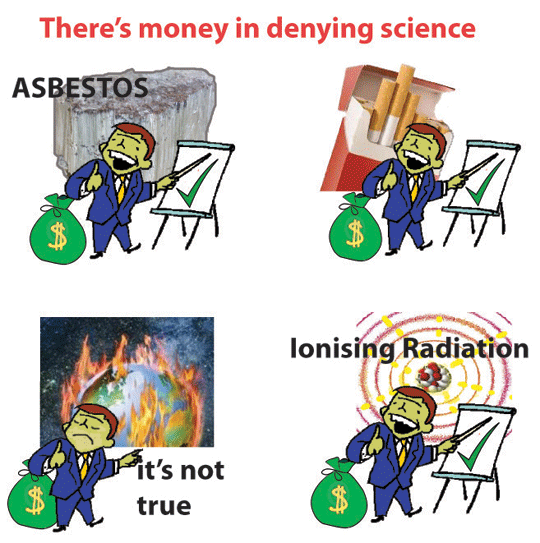
Demystifying Nuclear Power: Problem: In a post-Fukushima-triple-meltdown world, do the numbers work for atomic power? Fairewinds,November 17, 2015 by Sue Prent
With a giant blot still reading over the page of its public safety record, the multi-national, multi-billion dollar atomic power industry faces the stark economic reality that without even more of the regulatory and financial support that it has long enjoyed, it cannot successfully compete financially with sustainable methods electrical generation.
Moreover, these preferential government regulations and incredible financial subsidies from countries around the world are more concerned with maintaining a nuclear energy fleet that in the US has long been tied-up with Defense Department interests, and throughout the world has also been an assured method of access to nuclear weapons.
During the early days of atomic reactors, decommissioning, clean-up and long-term radioactive waste storage were not even acknowledged or planned for, and now they crowd onto center stage as aged and leaking plants line up to speedily shutdown and abandon their overflowing nuclear waste cesspools. In the US, people living near the plants and state governments without regulatory authority over this federal process are stunned to discover the financial burden of underfunded decommissioning funds and inadequate decommissioning procedures that will leave the public facing corporate waste abandonment.
That’s right, here’s the hook: if it weren’t for the scientific consensus view that radiation is harmful, and more radiation is even more harmful, nuclear plants might be a whole lot cheaper to operate.
Talk about your “inconvenient truth!”
Recent developments suggest that the atomic power industry, with cooperation from the US Nuclear Regulatory Commission (NRC), may have come up with a crafty way to make the financial numbers work once again: rehabilitate radiation. Continue reading
Underground wall ordered by EPA to prevent fire reaching nuclear waste landfill in Bridgestone
EPA orders barrier for nuclear waste landfill in Bridgestone http://www.bignewsnetwork.com/news/239881975/epa-orders-barrier-for-nuclear-waste-landfill-in-bridgestone Big News Network.comThursday 31st December, 2015 LENEXA, Kansas – The US Environmental Protection Agency (EPA) has ordered the installation of a physical isolation barrier separating the radioactively contaminated West Lake Landfill Superfund Site from the smoldering Bridgeton Landfill to make sure that the underground fire does not reach the buried nuclear waste.
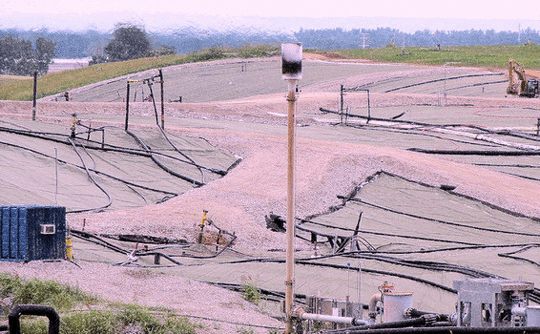
The barrier will consist of an underground wall. The decision also calls for the installation of additional engineering controls, such as cooling loops, to prevent potential impacts that could result if the subsurface smoldering were to come into contact with the radioactive materialscontained in the West Lake Landfill, Mark Hague, EPA regional administrator, said Thursday.
For years landfill owner Republic Services and state and federal regulators have considered a subterranean firebreak separating the smoldering Bridgeton Landfill from the adjacent West Lake Landfill, just a few hundred feet away.
But uncertainty over the location and extent of West Lake’s radioactive contamination has prompted more studies of West Lake, contaminated in 1973 with nuclear weapons processing waste from the Manhattan Project .
Now, EPA says those assessments, conducted with assistance from the US Army Corps of Engineers, are nearly complete. “We now have a better understanding of where those materials are located,” EPA spokeswoman Angela Brees said. “We’re at a point now where we had enough data where we needed to make a decision about a wall.”
The latest report on the radioactive contamination’s location is under final review and will be released soon, she said.
The worrying part is that the underground fire is now within 1,200 feet from the West Lake landfill.
“Finding a solution to mitigate the potential impacts of a subsurface smoldering event is a top priority for the community, and a top priority for EPA,” said Hague. “Today’s announcement is the first step in moving forward with the installation of a physical barrier and other engineering controls to address this issue.”
“We are now working through the highly complex details of implementing our decision and the associated legal steps. Once the plan is finalized, we are committed to providing this information to the public.”
The work of creating an underground barrier will be paid for by Republic Services, owner of both landfills. A spokesman for Republic Services said the company is ready to proceed with the barrier installation work. The company insists there is no risk of the fire reaching the nuclear material, but environmentalists disagree.
Ed Smith of the Missouri Coalition for the Environment said the barrier is not enough. “The only way to ensure a smoldering or surface fire doesn’t impact the radioactive wastes is to remove them,” Smith said, reported abc News.
West Lake was declared a Superfund site in 1990. In 2008, the EPA announced a remediation plan to cap the nuclear waste with rock, clay and soil. Opposition from the environmentalists however forced that the EPA to reconsider its decision.
No new plan has been worked out despite criticism from some lawmakers and residents who feel the agency is moving too slowly.
Worst nuclear contamination is former plutonium plant in Hanford, USA
 HANFORD NUCLEAR RESERVATION: America’s Fukushima December 30, 2015 by State of the Nation America’s Atomic Time Bomb: Hanford Nuclear Waste Still Poses Serious Risks By Marc Pitzke in New York Spiegel Online International
The disaster at Fukushima has raised questions around the world about nuclear safety. But contamination is much worse in the Pacific Northwest of the United States. The former plutonium plant in Hanford, Washington is one of the most contaminated places on earth, and still decades from being cleaned up.
The lambs were born without eyes or mouths. Some had legs that had grotesquely grown together; others had no legs at all. Many were stillborn. Thirty-one were lost in a single night.
On a pasture nearby, a cow was found dead, stiff and with its hooves bizarrely stretched up into the whispering wind. Down by the river, men of the Yakama tribe pulled three-eyed salmon from the Columbia. Trout were covered in cancerous ulcers.
And then the babies started getting sick.
It was in the spring of 1962 that farmer Nels Allison first noticed something was ominously wrong. “Son of a bitch,” he said to his wife. Sheep were always “the first to lie down and die” when something was amiss on Allison’s farm near Basin City, a rural town near the Columbia River in the far northwestern corner of the continental United States. He started referring to that deadly night “the Night of the Little Demons.”
Although the Allisons have long since passed away, the shock endures. As chronicled by journalist Michael D’Antonio in his 1993 book Atomic Harvest, their tale is one of thousands of horror stories that took place in the area surrounding Hanford, Washington, the site of America’s first full-scale plutonium production facility. The site haunts the locals to this day — and imperils them.
Hanford is America’s original atomic sin. At this giant facility sprawled over 586 square miles (1,517 square kilometers), a four-hour drive southeast of Seattle into the vast emptiness of Eastern Washington, the United States once produced most of its nuclear raw materials for the Cold War. Though it was decommissioned in 1988, it remains the most contaminated location in the entire Western Hemisphere.
The US Department of Energy (DOE) recently revised its timetable for Hanford’s decontamination, the biggest environmental cleanup in American history. The end date was moved back, once again. It now hopes to finally wrap up this Herculean task by September 2052 — more than 108 years after Hanford was opened……..http://stateofthenation2012.com/?p=28115
US Chamber of Commerce backs the weakening of radiation safety standards
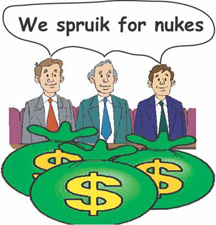 US Chamber of Commerce Nov 19 15
 radiation hormesis is a phenomenon in which low doses of ionizing radiation can be beneficial, stimulating the activation of repair mechanisms and other adaptive responses that protect against adverse effects not activated in the absence of ionizing radiation…….
Cancer cases increase in area of radioactive material spreading from St. Louis landfill
Pollution from the landfill has already been blamed for a sharp increase in the number of cancer cases in the surrounding areas.
 Radioactive materials spreading from St. Louis landfill – report https://www.rt.com/usa/327593-nuclear-waste-stlouis-runoff/#.VoWKJnujHaY.twitter 31 Dec, 2015 Dangerous radioactive materials from a nuclear waste dump near St. Louis, Missouri have spread to neighboring areas, a new study shows. Storm water runoff from the site has also raised concerns and is being tested for radioactive pollution.
According to a peer-reviewed study just published in the Journal of Environmental Radioactivity, there is “strong evidence” that radon gas and water emanating from the West Lake Landfill are responsible for the anomalous levels of a lead isotope (210Pb), created by radioactive decay, in the surrounding area.
Just northwest of the St. Louis International Airport, the West Lake Landfill is a repository of nuclear waste from the Manhattan Project, the WW2 effort to create the atomic bomb. The area was declared an Environmental Protection Agency (EPA) Superfund site in 1990, but the federal government is still deciding how to clean up the waste.
After analyzing nearly 300 soil samples from a 200-square-kilometer zone surrounding West Lake, the report’s authors concluded that “offsite migration of radiological contaminants from Manhattan Project-era uranium processing wastes has occurred in this populated area.”
The stuff we’re talking about at West Lake is hotter than what you would find in a typical uranium mill tailings operation,” said Bob Alvarez, one of the authors, in an interview on Tuesday. Continue reading
Resist nuclear trash dumping! – League of Women Voters of South Carolina
Because this waste would be traveling through our state’s ports and on our roads with no option for a final repository, citizens and elected officials can no longer hope that others are thinking about nuclear waste. All South Carolinians must ask their elected leaders why the DOE and the NRC want to fiercely ignore public policies and laws to send commercial waste to SRS.
Don’t let South Carolina become a nuclear dumping ground, Statehouse Report· 12/31/2015 By Julie Hussey and JoAnne Day | Nuclear waste is one of those things most people hope someone else is thinking about. The good news is that for 40 years, members of the League of Women Voters of South Carolina (LWVSC) have been following waste issues at the Savannah River Site (SRS). Recent national and international proposals require all South Carolinians to become informed and take action.
Nuclear waste is usually from commercial power production and weapons facilities. All forms of U.S. nuclear waste are the responsibility of the U.S. government. Although the Department of Energy (DOE) and its predecessor agencies have been generically charged with this responsibility, Congress establishes national policies and appropriates funds……..
Frustrated by the lack of congressional responsibility to take care of commercial spent fuel, nuclear industry leaders have proposed reprocessing of nuclear waste at “temporary” storage sites. While these proposals suggest local jobs, they present other problems and do not solve the issue of a permanent repository. Such plans also fail to acknowledge that “high burnup” spent fuel is about four times as hot, both thermally and radioactively as old spent fuel and comes with unknown technical, environmental and human challenges.
LWVSC and other SRS watchers noted that SRS, a weapons site, was proposed by industry as one of these “temporary” storage sites, despite decades-old U.S. policy of separating commercial and defense activities. We believed this wise policy would keep spent commercial fuels out of the SRS defense waste site. We also know agencies are required by law to provide public notice before moving waste. What we did not know is that DOE has been making secret plans to bring German commercial fuel and NRC has been making secret plans to bring Illinois/Exelon commercial fuel to SRS. This news is disturbing to say the least.
Rather than following the processes and policies established to protect the human and physical environment, DOE is focused on the money it plans to charge Germany for waste treatment. While we recognize that SRS may be the only well-managed site, SRS should not be “rewarded” with the responsibility to accept international commercial waste just because DOE wants the income. Other labs such as Hanford and Los Alamos are not expected to generate income, and neither should SRS. German nuclear waste should stay in Germany.
Industrial nuclear waste should be the responsibility of the company that managed it. According to its website, Exelon operates the largest fleet of nuclear plants in the nation — 23 reactors at 14 locations. Duke Energy keeps its spent fuel at its own sites, and Exelon should do the same.
Because this waste would be traveling through our state’s ports and on our roads with no option for a final repository, citizens and elected officials can no longer hope that others are thinking about nuclear waste. All South Carolinians must ask their elected leaders why the DOE and the NRC want to fiercely ignore public policies and laws to send commercial waste to SRS. SRS should be rewarded for its efforts by sharing our knowledge and experiences with other facilities, not by allowing others to share their waste and problems with us.
Politicians love to make bold statements about not accepting prisoners from Guantanamo or refugees from Syria into our state. Why are they silent about accepting nuclear waste?
- For more information on nuclear waste in South Carolina check out the League of Women Voter’sissue brief, on the subject.
Julie Hussey and JoAnne Day are co-presidents of the League of Women Voters of South Carolina. http://www.statehousereport.com/2015/12/31/my-turn-dont-let-south-carolina-become-a-nuclear-dumping-ground/
India’s race for nuclear weapons, promoted by US government policies
Indian Nuclear Program – A global migraine , The Nation Muhammad Umar December 30, 2015 American experts have been incessantly warning their government of the dire consequences of exempting India from the Nuclear Suppliers Group (NSG) requirements. On December 8, while testifying in front of the United States House Committee on Foreign Affairs, the Executive Director of the Nonproliferation Policy Education Center, Henry D. Sokolski said, “The US persuaded the NSG to allow India to import uranium for its civilian nuclear program but, as predicted, this has only allowed India to dedicate more of its meager domestic uranium production to military purposes. India, in short, with the deal now can make more bombs.”
Since last December, Putin, Obama, and Xi Jinping have all visited India, and with each one Modi has made promises that contradict the commitments he has made to the others. Modi thinks he can pull the wool over everyone’s eyes – yes, he does, but cannot fool them any longer. He used President Xi Jinping’s visit to leverage Russia and the visit by Vladimir Putin to force Barack Obama into his arms. This is the real face of the so-called incredible India.
The construction of this new top-secret nuclear city, as detailed in Levy’s report is clear evidence that America’s attempt to offer India a civil nuclear incentive has failed to reign in their nuclear weapons program, instead it has helped the weapons program grow to unthinkable new heights. The city when completed in 2017 would be “the subcontinent’s largest military-run complex of nuclear centrifuges, atomic-research laboratories, and weapons- and aircraft-testing facilities”, the report said.
Regional stability is essential to avoid war, the NSG exemption secured by the America for India has freed up un-safeguarded Indian uranium for weapons use, and as revealed by Levy for an entire city dedicated to building nuclear bombs. After all this, America still choses to continue with backing India’s bid for full membership to the NSG, ironically the very organization created to prevent future proliferation after India exploded their first bomb.
The Americans must know that if India is allowed to build such a huge facility for the sole purpose of enriching uranium, it will create instability in the region. It will further aggravate Pakistan’s security dilemma, and at the same time enrage the Chinese.
According to the report, the construction began three years ago, and it is hard to imagine that strategic thinkers in the United States did not raise any red flags……… http://nation.com.pk/columns/30-Dec-2015/indian-nuclear-program-a-global-migraine
US spying reveals Israeli bids to block Iran nuclear deal
 US spying reveals Israeli bids to block Iran nuclear deal, France 24 2015-12-30 The U.S. National Security Agency’s foreign eavesdropping included phone conversations between top Israeli officials and U.S. lawmakers and American-Jewish groups, the Wall Street Journal reported on Tuesday.
White House officials believed the intercepted information could be valuable to counter Israel Prime Minister Benjamin Netanyahu‘s campaign against the nuclear deal with Iran, according to the unnamed officials, the Journal said.
NSA eavesdropping revealed to the White House how Netanyahu and his advisers had leaked details of the U.S.-Iran negotiations, which they learned through Israeli spying
operations, the newspaper reported.
The NSA reports allowed Obama administration officials to peer inside Israeli efforts to turn Congress against the deal, according to the Journal.
Israel’s ambassador to the United States, Ron Dermer, was described as coaching unnamed Jewish-American groups on lines of argument to use with U.S. lawmakers, and Israeli officials were reported pressing lawmakers to oppose the deal, the newspaper said.
Asked for comment on the Journal report, a White House National Security Council spokesman said: “We do not conduct any foreign intelligence surveillance activities unless there is a specific and validated national security purpose. This applies to ordinary citizens and world leaders alike.”……. http://www.france24.com/en/20151230-usa-nsa-israel-netanyahu-iran-nuclear
1 This Month
15 October. Joint Appeal for Nuclear Abolition Day -presentation to the UN on October 15 will be live on UNWebTV
Endorse the Nuclear Abolition Day Appeal
23-25 October – on Zoom – World BEYOND War’s annual global conference

To see nuclear-related stories in greater depth and intensity – go to https://nuclearinformation.wordpress.com
-
Archives
- October 2026 (139)
- September 2026 (339)
- August 2026 (330)
- July 2026 (355)
- June 2026 (287)
- May 2026 (306)
- April 2026 (356)
- March 2026 (251)
- February 2026 (267)
- January 2026 (308)
- December 2025 (358)
- November 2025 (359)
-
Categories
- 1
- 1 NUCLEAR ISSUES
- business and costs
- climate change
- culture and arts
- ENERGY
- environment
- health
- history
- indigenous issues
- Legal
- marketing of nuclear
- media
- opposition to nuclear
- PERSONAL STORIES
- politics
- politics international
- Religion and ethics
- safety
- secrets,lies and civil liberties
- spinbuster
- technology
- Uranium
- wastes
- weapons and war
- Women
- 2 WORLD
- ACTION
- AFRICA
- Atrocities
- AUSTRALIA
- Christina's notes
- Christina's themes
- culture and arts
- Events
- Fuk 2022
- Fuk 2023
- Fukushima 2017
- Fukushima 2018
- fukushima 2019
- Fukushima 2020
- Fukushima 2021
- general
- global warming
- Humour (God we need it)
- Nuclear
- RARE EARTHS
- Reference
- resources – print
- Resources -audiovicual
- Weekly Newsletter
- World
- World Nuclear
- YouTube
-
RSS
Entries RSS
Comments RSS

