Russia moving in on America as a market for its nuclear fuel

 Russian Nuclear Fuel Giant Making A Move In U.S. Markets, Oil Price, 2 June 16, http://oilprice.com/Latest-Energy-News/World-News/Russian-Nuclear-Fuel-Giant-Making-A-Move-In-US-Markets.html CHARLES KENNEDY Far from the specific paranoia of the Cold War era, talk now is that Russia’s Rosatom nuclear fuel giant may soon end up supplying 10 percent of U.S. nuclear fuel needs.
In partnership with General Electric Co. (GE), Russian state-owned Rosatom is expanding its nuclear fuel supply to the US, hoping to gain a 10-percent market share—adding to the 20 percent of the US enriched uranium market it already controls.
Last week, Rosatom’s TVEL signed an agreement with U.S. Global Nuclear Fuel-Americas, a subsidiary of GE-Hitachi, on cooperation in licensing, marketing and fabrication of fuel for U.S. Pressurized Water Reactors (PWRs).
According to Russian news agencies, Russia currently holds 17 percent of the global nuclear power plant fuel market. That means it has covered all of its own supply for 76 reactors, along with the reactors in 14 more countries. By 2019-2020, Rosatom hopes to be supply nuclear fuel to the U.S..
Speaking at the Atomexpo-2016 on Monday, where it signed US$10 billion in deals, Rosatom TVEL Fuel Company vice-president Oleg Grigoryev said: “We expect the share of our deliveries to be more than 10% of the US market for this kind of fuel.”
TVEL’s exports already exceed US$1 billion annually, according to Russia’s Tass news agency. The move to gain this extra nuclear fuel market share still requires approval from the U.S. Nuclear Regulatory Commission.
According to Bloomberg, Rosatom has been supplying low-enriched uranium to the U.S .since 1987.
Rosatom is apparently not targeted by U.S. sanctions.
In 1992, according to Bloomberg, an anti-dumpling investigation prompted trade controls that affected how much low-enriched uranium Rosatom could supply to the U.S.. From 2002 to 2011, Rosatom had to stop commercial supplies to the U.S. For now, the Russian giant has long-term uranium delivery contracts with Centrus Energy Corp. ,NextEra Energy Resources and Exelon Generation Company LLC.
USA’s Westinghouse in rush to sell nuclear reactors to India

 India, Westinghouse in advanced talks to close nuclear deal, live mint, http://www.livemint.com/Politics/DscD8CWjYrsVgpqQO7Fp1J/India-Westinghouse-in-advanced-talks-to-close-nuclear-deal.html Valerie Volcovici, 2 June 16,
India’s ambassador to the US Arun Singh says the issues that remain to be worked out are related to cost and financing. Washington: Toshiba Corp.’s Westinghouse Electric and India are in “advanced discussions” for the company to build six nuclear reactors there, the country’s ambassador to the United States said on Wednesday, ahead of Indian Prime Minister Narendra Modi’s planned visit to Washington next week.
A deal with Westinghouse would be the first such contract reached under the 2008 US-India civil nuclear accord.
“There is a very detailed and advanced negotiation between Westinghouse and India,” Ambassador Arun Singh told reporters. “The issues that remain to be worked out are related to cost and financing.”
Progress on the deal to build six AP-1000 nuclear reactors is one of the key developments anticipated during the 7-8 June visit by Modi to Washington, where he will be hosted by President Barack Obama for a final summit before the US presidential election in November. Modi will address both houses of Congress.
The US and India agreed in 2008 to cooperate in the civil nuclear arena, but there have been no agreements yet to build any plants. Reuters reported on Tuesday that Westinghouse and India reached a breakthrough after officials said it will relocate the planned project in Andhra Pradesh. The original site proposed for the multi-billion-dollar project, in Modi’s home state of Gujarat, faced local opposition.
Another obstacle had been to bring India’s liability rules into line with international norms, which require the costs of an accident to be channelled to the operator rather than the maker of a nuclear power station.
That issue had been largely resolved to the satisfaction of the US government in January 2015 after the US and India reached a “breakthrough understanding” on nuclear cooperation.
Singh told reporters “to the best of my knowledge” insurance was no longer an issue in the discussions.
Westinghouse had hoped to clinch a deal to build six nuclear reactors in India by the end of March, during Modi’s last Washington trip to attend a global nuclear summit.
US lawmakers ratified the civil nuclear accord three years after it was struck in 2005, as part of an attempt to deepen the strategic relationship with India, but have expressed growing dismay over its failure to yield follow-on deals for US-based reactor makers. Reuters
Exelon gets employees to lobby for nuclear subsidies
 Exelon to Close 2 Nuclear Sites; Still Pushing for Subsidies http://abcnews.go.com/Politics/wireStory/exelon-close-illinois-nuclear-plants-39555124 By JOHN O’CONNOR, AP POLITICAL WRITER SPRINGFIELD, Ill. — Jun 2, 2016 Exelon Corp. says it will shut two Illinois nuclear plants because of legislative inaction on state financial support, but the company is still lobbying for the plan.
An email obtained by The Associated Press that Exelon President and CEO Chris Crane sent to employees about Thursday’s decision also urged them to call a telephone number and record a message in favor of the legislators to be played for lawmakers and Gov. Bruce Rauner.
Exelon announced earlier Thursday it would close unprofitable plants in Clinton and the Quad Cities by 2018 after lawmakers adjourned without approving a plan for Exelon to share in state subsidies for carbon-free electric generation.
The telephone number’s greeting encourages employees to say immediate legislative action could save the plants.
Exelon spokesman Paul Adams confirmed the closure decision is not irreversible.
Exelon’s 2 nuclear plants nearly dead, but not quite
 Exelon nuclear plant bill called dead, but some still pushing it, Herald Review LEE NEWS SERVICE Jun 1, 2016 SPRINGFIELD — A bill aimed at helping Exelon’s money-losing nuclear plants near Clinton and the Quad-Cities likely won’t make it out of the spring legislative session, but the company hasn’t yet confirmed it will close the two plants.
“The general consensus is that it’s dead for this session,” said Henry Marquard, director of government relations for the Quad-Cities Chamber of Commerce. He said he had spoken with an aide to the bill’s main sponsor, state Sen. Donne Trotter, D-Chicago, as well as others at the Capitol.
The News-Gazette of Champaign also reported that Trotter has pulled the plug on the bill proposing what Exelon calls the “Next Generation Power Plan,” saying time had run out with the scheduled end of the spring legislative session on Tuesday.
“We have not received any official word yet from Exelon,” said Clinton Chamber of Commerce Executive Director Marian Brisard in a statement Tuesday. “We would also urge our government officials to realize the seriousness of this issue and address it accordingly.”
Brisard said the Chamber will continue “supporting the efforts to keep the Clinton Power Station open.” ……. The bill also would establish a surcharge on utility customers that would help the nuclear plants, which Exelon said have lost more than $800 million over the past seven years, and change how some consumer rates are calculated.
Consumer groups and others have objected to the legislation, calling it a bailout for a profitable company. http://herald-review.com/news/state-and-regional/exelon-nuclear-plant-bill-called-dead-but-some-still-pushing/article_95462389-1769-5f47-8577-a48592e76025.html
Three Mile Island – another example of the dim future for nuclear power
 ‘The future is dim’: Three Mile Island fails to sell future energy production, again, Penn Live, By Christian Alexandersen | calexandersen@pennlive.com “…….Eric Epstein, chairman of Three Mile Island Alert, said the marketplace has decided there are better energy options than nuclear power. Major investments have been made in solar and wind power, but not in nuclear.
Nuclear power, Epstein said, is just not economically competitive.
“There’s no private equity chasing nuclear power,” Epstein said. “When it comes to new construction, nuclear power plants are always over budget and behind schedule.”
DeSantis said Three Mile Island’s inability to sell its future energy production is significant. But, if it can’t sell its energy in the future, it will have to sell it on the daily energy market.
That’s where the prices have been historically low. The bottom barrel prices are due to the abundance of natural gas and flat demand for electricity.
“If you’re not getting capacity payments, then you’re only relying on the one revenue stream,” DeSantis said. “And prices are really low now.”
Epstein said he doesn’t believe Three Mile Island is in any immediate threat of closing down. However, nuclear power will be phased out by better energy alternatives over time, Epstein said.
Nuclear energy — like coal — will become a bridge fuel.
“I don’t know what the future holds, but the future is dim,” he said.http://www.pennlive.com/news/2016/06/the_future_is_dim_three_mile_i.html
Russia marketing nuclear fuel to USA !!
Will The Russians Become Fuel Supplier To U.S. Nuclear Power  Plants? http://www.forbes.com/sites/kenrapoza/2016/05/31/will-the-russians-become-fuel-supplier-to-u-s-nuclear-power-plants/#413acf8f2638 Kenneth Rapoza , 31 May 16,
It’s not unprecedented. While the U.S. does not currently use Russian technology at any of its nuclear power stations, a deal between Global Nuclear Fuel Americas and TVEL would be the first to make it happen. Global Nuclear Fuel-Americas is a GE-led joint venture that includes its main nuclear power plant partner Hitachi and rival Toshiba, which owns Westinghouse.
Under the agreement proposed May 24, GE partners and TVEL will “work together toward the licensing, marketing and fabrication of fuel” for U.S. pressurized water reactors (PWRs). Global Nuclear Fuel and TVEL would create a strategic alliance with the purpose of introducing the Russian fuel rods into the U.S. market.
“We believe strongly in the TVEL technology,” said Jonathan Allen, a spokesman for GE Hitachi.
TVEL’s latest nuclear fuel assembly technology is for use in Westinghouse-designed reactors. There are currently 35 of these reactors operating in the U.S., but none of them are allowed to use TVEL’s technology because it has not yet been approved U.S. nuclear industry regulators. The assembly rod, known as the TVS-K design, has been used for many years in Rusatom’s VVER-1000 nuclear power plants at 78 nuclear power reactors in 15 countries, most of them in the former Soviet bloc.
“This (deal gives) additional diversification of fuel supplies to U.S. reactors,” said Oleg Grigoryev, Vice President of Commerce and International Cooperation at TVEL.
Russia’s entrance into the U.S. market comes at a time when its partner in the deal, Toshiba, is also trying to capture some of TVEL’s market share in Finland, Czech Republic, Bulgaria and Ukraine. Washington has actually lent support to Westinghouse in sales pitches to governments looking to move out of Russia’s energy orbit. A move to bring Russian technology to the U.S. could also be seen as a fig leaf to Moscow, which has been locked in an energy security battle for Europe over the last year.
Opening the U.S. market to Russian tech would be the same as the traditional Russian markets, including Ukraine, opening up to Westinghouse.
Fuel assembly rods are essentially the batteries of nuclear power plants. They hold the uranium that goes into the reactor that generates electricity. Westinghouse is TVEL’s biggest competitor. But Chinese developers, working close with Westinghouse and Toshiba in China in a tech sharing deal, are also moving up market and could become rival suppliers at some point in the future.
TVEL has a roughly 17% global market share of fuel assemblies, with Westinghouse and Areva competing for first place with close to 30%.
USA trying to beat Russia in selling nukes to India
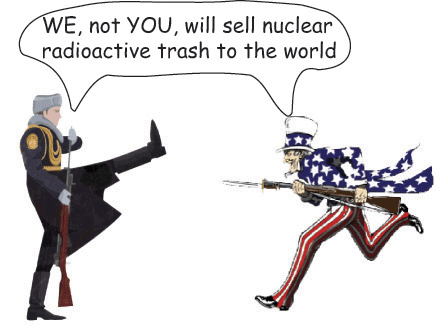 Westinghouse to get new site for Indian nuclear plant – officials, Reuters NEW DELHI | BY DOUGLAS BUSVINE AND RUPAM JAIN , 31 May 16 Toshiba Corp’s (6502.T) Westinghouse Electric will relocate a planned project to build six nuclear reactors in India, said officials, bringing the first deal stemming from a U.S.-India civil nuclear accord struck over a decade ago closer to reality.
The six AP-1000 reactors would be built in the southern state of Andhra Pradesh, after the original site proposed for the multi-billion-dollar project, in Prime Minister Narendra Modi’s home state of Gujarat, faced local opposition.
The breakthrough comes ahead of a June 7-8 visit by Modi to Washington, where he will be hosted by President Barack Obama for a final summit before the U.S. presidential election in November, and will address both houses of Congress.
U.S. lawmakers ratified the civil nuclear accord three years after it was struck in 2005, as part of an attempt to deepen the strategic relationship with India, but have expressed growing dismay over its failure to yield follow-on deals for U.S.-based reactor makers like Westinghouse…….
Analysts say resolving the land issue is a crucial step, but complex issues remain, including project financing and reaching a civil nuclear pact with Japan, where Westinghouse parent Toshiba is based…..
Russia’s Rosatom operates two reactors at Kudankulam, in Tamil Nadu, while France’s EDF (EDF.PA) signed a preliminary deal with the state-owned Nuclear Power Corporation of India (NPCIL) [NPCIL.UL] in January to build six reactors at Jaitapur, Maharashtra…..
Two sources, requesting anonymity due to the sensitivity of the matter, confirmed that the site was being acquired for Westinghouse, which plans to build six AP-1000 pressurized water reactors, each with a design capacity of around 1,100 megawatts.
Westinghouse did not respond to requests for comment, while senior executives at NPCIL were not available ………http://www.reuters.com/article/us-india-westinghouse-idUSKCN0YM0L2
You think the oil industry’s in trouble? Try nuclear!
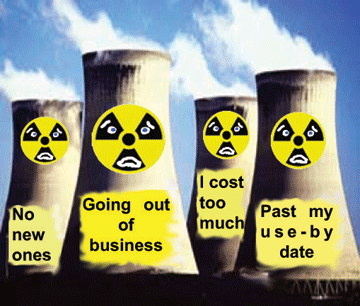 Nuclear power in more trouble than oil Utilities shutting down plants earlier than expected Houston Chronicle , By Chris Tomlinson , 31 May 16 If you think folks in the oil and gas business have it tough, talk to someone in the nuclear power industry where 20 percent of the reactors operating today may shut down early.
The last time the United States opened a new nuclear reactor was 30 years ago, when state commissions set the price for electricity and a generator could rely on steady, reliable profits for the lifetime of the plant. But since then, states have deregulated electricity markets and have forced generators to compete to sell the cheapest electricity by the 15 minute interval.
That’s a problem a nuclear power plant, which requires a huge investment to build and a huge amount of cash to decommission. The electricity may be marginally cheap, but what experts call the levelized cost of electricity that includes all the expenses is actually quite high.
That’s why the Nuclear Energy Institute reports that 15 to 20 of the nation’s 99 commercial reactors are at risk of premature closure in the coming years. If they have to compete solely on the spot-market price for electricity, keeping them going doesn’t make economic sense…….http://www.houstonchronicle.com/business/outside-the-boardroom/article/Nuclear-power-in-more-trouble-than-oil-7943174.php?t=2d6e26d409&cmpid=twitter-premium
Nuclear stations more at risk than Regulators say
 Undercovered: New Report Says Nuclear Power Plants More Vulnerable Than Regulators Said, Mediaite, by Sam Reisman May 31st, 2016
Welcome to Undercovered: our new daily feature bringing attention to excellent reporting and stories we feel deserve a larger audience.
Nuclear power plants in the United States are more vulnerable to the threats of natural disaster or terrorism than federal regulators have said, according to study released May 20 by the National Academies of Sciences, Engineering, and Medicine.
The Academies’ study is something of a rebuke to a 2014 study by the Nuclear Regulatory Commission, a government agency that oversees the nuclear power industry. According to the chair of Academies board, the NRC’s study neglected to adequately evaluate the risks posed by terrorism or sabotage to nuclear power plants, specifically to the aboveground pools that hold the spent nuclear fuel. There are 96 such pools in the U.S. spread out across 30 states………http://www.mediaite.com/online/undercovered-new-report-says-nuclear-power-plants-more-vulnerable-than-regulators-said/
Growing anxiety over the safety of Indian Point Nuclear Power Plant
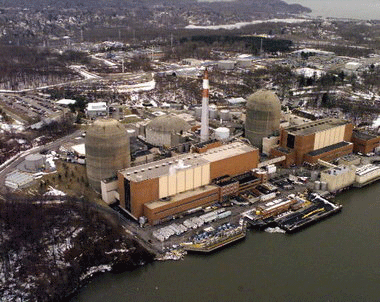 Concern Mounts For Indian Point Nuclear Power Plant http://www.ladailypost.com/content/concern-mounts-indian-point-nuclear-power-plant by Carol A. Clark on May 31, 2016 SECURITY News:
Located 26 miles from New York City, in the right weather conditions a radiation release at Indian Point nuclear power plant could reach Times Square in as little as 90 minutes, making evacuation of New York City impossible and rendering the area uninhabitable for a long time.
Critics of the agiing plant say that the disappearance and disintegration of more than 1 in 4 critical bolts holding the Indian Point nuclear reactor cooling system together is far more serious than owner, Entergy, admits.
Friends of the Earth (FOE) filed an emergency petition with the Nuclear Regulatory Commission (NRC) May 24, calling for immediate action by the agency. The filing demands keeping reactor 2 offline until theNRC certifies that the problem is fully diagnosed and fixed, and that the reactor is safe to operate. It also calls for an immediate shutdown to inspect reactor 3 to ensure that the reactor’s bolts have not also disintegrated. Reactor 3 is the twin of reactor 2, but Entergy has rejected inspecting it until 2017 despite it being the same design and almost as old. Friends of the Earth also released an expert report detailing the breadth and depth of the bolt problem.
Although critical to the core cooling system (essential to preventing a nuclear meltdown), bolts securing the plates that channel cooling water through the reactor core are broken, degraded or missing in reactor 2. FOE says that Entergy is pushing simply to replace the bolts and restart the reactor in June—in time for the profitable peak summer energy season. The company has said that it will conduct a root cause analysis of why the bolts broke or disappeared but are conducting the repairs without completing such a comprehensive review.
“This is a matter of common sense denied: if a machine breaks, you have to figure out what is wrong and then fix it,” said Damon Moglen of Friends of the Earth. “Instead, at Indian Point, Entergy has decided that the priority is to get the damaged reactor up and running by summer to protect their profits. They are making a theoretical fix to a serious but undiagnosed problem. This is a recipe for disaster.”
The technical report, also released by Friends of the Earth, concludes that the more than 25 percent failure rate of the bolts is extraordinarily high and appears to be unprecedented in the history of the global nuclear power industry. Without a full root cause analysis approved by the NRC, the report warns that there can be no assurance that the remaining old bolts will not fail or that simply replacing bolts will fix the problem.
“Only a utility that puts profits ahead of public safety would resume running this nuclear reactor without an “all clear” from the federal regulator,” said Dave Freeman, who was the head of NYPA in the mid-1990s, and operated the nuclear reactors at that time.
FOE says that just as the Space Shuttle Challenger was brought down by a seemingly minor faulty O-ring, Indian Point is in danger from the damaged and missing bolts. Located twenty-six miles from New York City,in the right weather conditions a radiation release at Indian Point could reach Times Square in as little as ninety minutes, making evacuation of New York City impossible and rendering the area uninhabitable for a long time.
The Indian Point reactors’ licenses expired in 2013 and 2015, respectively, and the plant is operating beyond its 40-year life span. The NRC must intervene and take immediate steps to protect the public.
Michael Mariotte exposes pro nuclear “environmentalists” Hansen and Shellenberger
 How low can they go? Hansen, Shellenberger now shilling for Exelon Green World, Michael Mariotte
April 6, 2016 “…….Enter the pro-nuke “environmentalists.”
Specifically, renowned climate scientist Dr. James Hansen and industry-oriented Michael Shellenberger of the Breakthrough Institute, came to Illinois this week to weigh in on the Exelon bailout debate. And no, they didn’t support renewables or other clean energy technologies. They didn’t question whether the nation’s largest electric utility really needs to gouge Illinoisans for another $300 million to keep aging, money-losing reactors open. Their message was pretty simple: in an open letter to Illinois legislators they, and several dozen others (most of whom are long-standing nuclear advocates) urged them to “do everything in your power to keep all of Illinois’s nuclear power plants running for their full lifetimes.”
Sometimes Dr. Hansen just makes you wonder if he isn’t undertaking some bizarre experiment to see how far he can undermine his own credibility before it all blows up in his face.
Back in November 2013 he and three colleagues wrote an open letter to us nuclear opponents urging us to reconsider nuclear power. It’s worth going back and reading some of that letter.
“As climate and energy scientists concerned with global climate change, we are writing to urge you to advocate the development and deployment of safer nuclear energy systems,” the letter began. It added, “We call on your organization to support the development and deployment of safer nuclear power systems as a practical means of addressing the climate change problem.” And: “We understand that today’s nuclear plants are far from perfect. Fortunately, passive safety systems and other advances can make new plants much safer.”
Note the emphasis: Hansen is clearly talking about “safer” nuclear reactors. To be precise, he was seeking environmentalist support for development and deployment of Generation IV reactors. Which, to date, do not exist.
NIRS and Civil Society Institute organized a response, signed by 300+ organizations, to Hansen’s letter explaining our continued opposition to nuclear power as a climate response and calling for a public debate on the issue. We never received a reply.
Now jump ahead to December 2015, just four months ago. Shortly before the Paris COP 21 climate talks, Hansen et. al. issued a new missive: “Nuclear power, particularly next-generation nuclear power with a closed fuel cycle (where spent fuel is reprocessed), is uniquely scalable, and environmentally advantageous. Over the past 50 years, nuclear power stations – by offsetting fossil fuel combustion – have avoided the emission of an estimated 60bn tonnes of carbon dioxide. Nuclear energy can power whole civilizations, and produce waste streams that are trivial compared to the waste produced by fossil fuel combustion. There are technical means to dispose of this small amount of waste safely. However, nuclear does pose unique safety and proliferation concerns that must be addressed with strong and binding international standards and safeguards. Most importantly for climate, nuclear produces no CO2 during power generation.”
While there is much to dispute in this paragraph, again note the emphasis on safety and “next-generation nuclear power” and continued acknowledgement of nuclear’s “unique safety and proliferation concerns.”
Fukushima-clone Quad Cities, which began operation in 1972, and Clinton, which began operation in 1987, clearly do not fall under the “safer” or “next-generation” nuclear memes. By endorsing not only their continued operation, but their continued operation enabled by forcing the people of Illinois to further line Exelon’s pockets, Hansen has made a mockery of his earlier safety concerns and exposed himself as no different than any other Exelon-paid-for Nuclear Matters spokesperson.
But it gets worse, because by allying himself with the Breakthrough Institute’s Shellenberger, Hansen has gone a step even further, a step right over the credibility cliff. Because asMidwest Energy News reported, “Shellenberger described next-generation technology as farther away from viability than he had previously hoped, and urged more focus on the nation’s existing reactors.
“How much safer could they be?” he said. “If you have nuclear plants that don’t hurt anyone, keep running them.”
In other words, Shellenberger dismisses Hansen’s support of Generation IV reactors in one phrase and argues in essence that because Fukushima hasn’t happened yet at Quad Cities, well, hell, it never will; keep them running… But Fukushima did, in fact, happen. And there were supposed to have been lessons learned from that disaster. One of those is to be highly skeptical of GE Mark I nuclear reactor designs that are essentially identical to Fukushima, and that have been highly controversial even since their inception in the 1960s.
Thus, Hansen and Shellenberger (and the rest of the letter’s signers, most of whom probably know little about the actual situation in Illinois) are now dismissing any pretense of caring about nuclear safety. For what? To enable Exelon, the largest electric utility in the nation, to gouge Illinoisans for another $300 million to keep open three aging, uneconomic and unsafe nuclear reactors, because of their low carbon emissions.
Seriously, do Hansen and Shellenberger really intend to argue that the world’s climate depends on whether three midwestern nuclear reactors stay open or not? Especially when, to the extent their power needs to be replaced at all it will not be replaced by coal (check out the growing list of coal bankruptcies, there won’t be any new coal plants in Illinois) but to some limited and temporary extent by gas and over the longer and larger term by clean energy. Genuinely clean energy. The kind that doesn’t routinely spew out toxic radiation into the air and water nor create lethal radioactive waste that–their protestations to the contrary–there is not yet, and may not be for centuries, a scientifically-responsible and publicly-acceptable storage solution.
And why have they even entered this debate at all? Shellenberger has gone so far as to establish a new organization called Environmental Progress Illinois to “protect and grow solar, wind and nuclear energy.” He claims that the group hasn’t taken a position on state legislative proposals yet, but expressed support for the concept of having nuclear power treated like renewables in a new “clean energy portfolio standard.” Which happens to be Exelon’s proposal.
Shellenberger, for the record, says his new group takes no money from the energy industry.
And why is Hansen jumping into this battle? This is not the Keystone pipeline. Closing three reactors–or 30 reactors over the next few years for that matter–is not “game over” for climate, not when those reactors can be replaced by clean energy technologies, as both EPA and EIA analyses project they will be.
Arguing for environmentalists to consider Generation IV reactor technology was one thing. For many reasons, we rejected that approach and explained in detail why we did so, but at least it was a fair challenge. But actively working to prevent the shutdown of three reactors of 1960s nuclear technology under the pretense that it would matter for the climate is a leap too far. I hate to say it, but it is a leap so far that it brings into question Hansen’s credibility on the far more important issues of his climate science generally. I have long trusted Hansen on climate issues; now, I am nervous about that. If he can be so wrong in Illinois, and so far removed from his own previous statements on nuclear safety, and seems willing to sell himself to the nation’s largest, and quite possibly greediest, electric utility, well, how can I trust his other work?
I have been telling myself–and others– as Hansen’s pro-nuclear statements have become more and more strident and outlandish over the past few years that, well, Hansen is a climate expert, not an energy expert, and there is a big difference between the two. That’s still true, of course. But I’m having my doubts. Could some of his climate statements–that I’m not expert enough to evaluate the way I am expert enough to evaluate his nuclear statements–be as far removed from reality as his Illinois positions? Fortunately, there are a lot of other climate experts out there. I’ll start listening more closely to them. And there are lots of real energy experts out there, but I already know them and I’ll continue to listen to them. As for Hansen, I probably won’t listen to him anymore on either subject.
As for Illinois, closing Clinton and Quad Cities would not only save its citizens money and reduce the daily risk these dangerous reactors pose, it would help usher in substantial new clean energy investment, something the state desperately could use. That would be the kind of win-win situation–for the state and the climate, if not for Exelon–that the legislature hopefully will recognize. https://safeenergy.org/2016/04/06/how-low-can-they-go/
Research suggests link between cellphones and brain cancer
“Game-Changing” Study Links Cellphone Radiation to Cancer An increased incidence of brain and heart tumors was seen in rats. Mother Jones, MAY 27, 2016 It’s the moment we’ve all been dreading. Initial findings from a massive federal study, released on Thursday, suggest that radio-frequency (RF) radiation, the type emitted by cellphones, can cause cancer.
The findings from a $25 million study, conducted over two and a half years by the National Toxicology Program (NTP), showed that male rats exposed to two types of RF radiation were significantly more likely than unexposed rats to develop a type of brain cancer called a glioma, and also had a higher chance of developing the rare, malignant form of tumor known as a schwannoma of the heart. The effect was not seen in females.
he radiation level the rats received was “not very different” from what humans are exposed to when they use cellphones, said Chris Portier, a former associate director of the NTP who commissioned the study.
As the intensity of the radiation increased, so did the incidence of cancer in the rats. (The highest radiation level was five to seven times as strong as what humans typically receive while using a phone.) Although ionizing radiation, which includes gamma rays and X-rays, is widely accepted as a carcinogen, the wireless industry has long noted that there is no known mechanism by which RF radiation causes cancer. The researchers wrote that the results “appear to support” the conclusion that RF radiation may indeed be carcinogenic.
The findings should be a wake-up call for the scientific establishment, according to Portier, who is now a contributing scientist at the Environmental Defense Fund. “I think this is a game changer,” he said. “We seriously have to look at this issue again in considerable detail.”
“The NTP does the best animal bioassays in the word,” Portier added. “Their reputation is stellar. So if they are telling us this was positive in this study, that’s a concern.”…….
The NTP first decided to investigate the carcinogenicity of cellphone radiation in 2001, partly in response to epidemiological studies showing a correlation between gliomas and cellphone use. Some of the studies even showed that the cancers were ipsilateral—meaning they tended to appear on the same side of the head where users held their phones. But other epidemiological studies haven’t found links between cancer and cellphones…….
Only the test results for rats have been released so far. Female rats didn’t experience significantly higher than normal cancer rates. However, among male rats that received the highest radiation exposures, 2 percent to 3 percent contracted gliomas and 6 percent to 7 percent percent developed schwannoma tumors in their hearts, depending on the type of radiation used. None of the male rats in the control groups developed those cancers……..
The authors of the NTP study did not say how their results might translate into cancer risk for humans. But “given the extremely large number of people who use wireless communication devices,” they wrote, “even a very small increase in the incidence of disease resulting from exposure to RFR resulting from those devices could have broad implications for public health.”……http://www.motherjones.com/environment/2016/05/federal-study-links-cell-phone-radiation-cancer
Sad loss of a man of integrity, Michael Mariotte
Michael Mariotte, a Leading Antinuclear Activist, Dies at 63, NYT, By SAM ROBERTS MAY 23, 2016 Michael Mariotte, a leading national opponent of nuclear power and an advocate for alternative, sustainable sources of energy, died on May 16 at his home in Kensington, Md. He was 63.
The cause was pancreatic cancer, his wife, Tetyana Murza, said.
As executive director and president of the Nuclear Information and Resource Service in Takoma Park, Md., for three decades, Mr. Mariotte was at the forefront of two successful landmark efforts: to prevent the repeal of a federal ban on interstate shipment of radioactive waste, and to bar the construction of new nuclear plants in Maryland and Louisiana.
He also organized antinuclear campaigns in Eastern Europe after the fatal power plant catastrophe in 1986 at Chernobyl, in what was then the Ukrainian Soviet Socialist Republic. And his information service acted as a clearinghouse for groups that opposed nuclear power, both in the United States and overseas.
In 2014, Mr. Mariotte (pronounced like the hotel chain) received a lifetime achievement award from Ralph Nader, the consumer advocate, on behalf of a dozen environmental groups, including Friends of the Earth, Greenpeace, Public Citizen and the Sierra Club.
He had earlier been a co-founder of an alternative weekly newspaper in the nation’s capital, which became Washington City Paper, as well as a drummer in a punk-rock band……
He joined the Nuclear Information and Resource Service in 1985, became executive director the next year and began publishing a newsletter called Groundswell, now known as Nuclear Monitor. The organization mobilized antinuclear groups, testified before Congress and enlisted celebrity endorsements.
Notably, it helped defeat a proposed reactor in Calvert Cliffs, Md.; a uranium processing plant in Louisiana; and legislation that would have lifted curbs on the transportation of radioactive waste. Mr. Mariotte said the measure had posed the threat of a “mobile Chernobyl.”
He resigned as executive director at the end of 2013 because of his illness. He was subsequently named president and ran the organization’s website, its GreenWorld blog and other programs.
Mr. Mariotte remained convinced that nuclear power would become obsolete and be replaced by clean, renewable energy sources and greater energy efficiency.
“It is no longer a question of whether these 21st-century technologies can replace nuclear power and fossil fuels,” he said when he stepped down as executive director of the information service. “The question is when. http://www.nytimes.com/2016/05/24/us/michael-mariotte-a-leading-antinuclear-activist-dies-at-63.html?_r=0
Up to 20 USA uneconomic nuclear stations soon to close
 Economics Point Toward Closure for Up To 20 U.S. Nukes, The Energy Mix, May 24, 2016 A leading nuclear industry lobby group in the United States says its members aren’t being paid enough for their power, threatening the shutdown of 15 to 20 generating stations in the country………
Speaking at a U.S. Department of Energy summit last week, Marvin Fertel, president and CEO of the Nuclear Energy Institute, said more than a dozen plants face possible early closure because they are uneconomic at today’s market wholesale power rates……..
Earlier this month, the Omaha Public Power District proposed closing its 478-MW Fort Calhoun nuclear plant, the smallest in the U.S., and the Tennessee Valley Authority gave up on its unfinished Bellefonte nuclear station in Alabama and put it up for sale. Last month, Moody’s Investor Services reported that low natural gas prices threatened widespread nuclear and coal plant closures.
Those closures may bring owners less financial relief than they anticipate. As expensive as nuclear power plants are to build, safely shutting them down will also cost hundreds of billions, potentially trillions of dollars, Climate News Network reported last month. http://smartershift.com/energymix/2016/05/24/economics-point-toward-closure-for-up-to-20-u-s-nukes/
USA Department of Energy wants to delay Southy Carolina MOX hearings

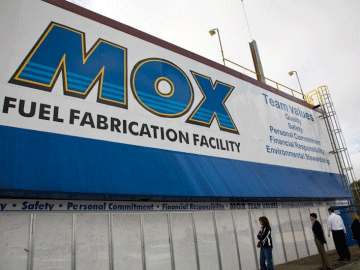
Judge J. Michelle Childs scheduled a hearing for June 30 in Columbia, but the Energy Department’s lawyers say there’s too much to do before then. Besides, they want her to rule first on their motion to dismiss the case altogether.
South Carolina filed suit in February asking for the $100 million in penalties that a federal law assesses the agency for not removing 2 metric tons of plutonium from Savannah River Site. The law was to ensure construction remained on schedule for the mixed-oxide fuel plant on the site, but the builders are still late……..
Construction on the MOX facility is behind schedule and about $8 billion over budget, by some critics’ estimates. The Obama administration says that’s why it wants to shut the program down and use a different method of disposing of 34 metric tons of plutonium…….http://chronicle.augusta.com/news/metro/2016-05-26/federal-government-wants-delay-mox-court-hearing?v=1464299788
-
Archives
- October 2026 (120)
- September 2026 (339)
- August 2026 (330)
- July 2026 (355)
- June 2026 (287)
- May 2026 (306)
- April 2026 (356)
- March 2026 (251)
- February 2026 (267)
- January 2026 (308)
- December 2025 (358)
- November 2025 (359)
-
Categories
- 1
- 1 NUCLEAR ISSUES
- business and costs
- climate change
- culture and arts
- ENERGY
- environment
- health
- history
- indigenous issues
- Legal
- marketing of nuclear
- media
- opposition to nuclear
- PERSONAL STORIES
- politics
- politics international
- Religion and ethics
- safety
- secrets,lies and civil liberties
- spinbuster
- technology
- Uranium
- wastes
- weapons and war
- Women
- 2 WORLD
- ACTION
- AFRICA
- Atrocities
- AUSTRALIA
- Christina's notes
- Christina's themes
- culture and arts
- Events
- Fuk 2022
- Fuk 2023
- Fukushima 2017
- Fukushima 2018
- fukushima 2019
- Fukushima 2020
- Fukushima 2021
- general
- global warming
- Humour (God we need it)
- Nuclear
- RARE EARTHS
- Reference
- resources – print
- Resources -audiovicual
- Weekly Newsletter
- World
- World Nuclear
- YouTube
-
RSS
Entries RSS
Comments RSS

