Trump claims US held direct nuclear talks with Iran
Aljazeera, 7 April 25
The US president makes the claim in a media conference with Israeli Prime Minister Netanyahu, while also threatening Tehran.
President Donald Trump has announced that the United States has begun direct negotiations with Iran over its nuclear programme, after Tehran had earlier dismissed Washington’s calls for the talks.
“We’re having direct talks with Iran, and they’ve started. It’ll go on Saturday. We have a very big meeting, and we’ll see what can happen,” Trump told reporters at the White House on Monday, alongside Israeli Prime Minister Benjamin Netanyahu.
“And I think everybody agrees that doing a deal would be preferable,” he added, without providing further details.
Trump also warned that Iran would be in “great danger” if diplomatic efforts to curb its nuclear ambitions failed, adding that Tehran “can’t have nuclear weapons”.
Earlier this month, Trump told NBC News: “If they [Iran] don’t make a deal, there will be bombing”. He added that the bombing would be “the likes of which they have never seen before.”
Trump’s announcement of direct talks with Tehran would not be to Netanyahu’s “liking”, as the Israeli leader has long wanted to simply bomb Iran, said Marwan Bishara, Al Jazeera’s senior political analyst.
“Trump has wanted a deal for a long time,” Bishara said. However, “Netanyahu certainly thinks Iran’s defences have been weakened by last year’s Israeli air strikes on Iran. And he sees this as a great opportunity, with US support, for Israel to finish off Iran.”
“In reality, Trump doesn’t want to enter a war with Iran while he is in the midst of trade wars with the rest of the world,” Bishara added.
‘Meaningless talks’
Over the weekend Iranian Minister of Foreign Affairs Abbas Araghchi described the prospect of direct negotiations with the US on Tehran’s nuclear programme as “meaningless”.
Araghchi’s remarks came after Trump said last month in a letter to Iran’s Supreme Leader Ayatollah Ali Khamenei that he hoped there would be a negotiation between the countries.
Tehran, which maintains that it is not seeking a nuclear weapon, has so far rejected Washington’s overtures, but has said it is open to indirect diplomacy – a stance repeated by Araghchi in Sunday’s statement.
In 2018, during his first presidency, Trump withdrew the US from the 2015 nuclear agreement between Iran and world powers, which had placed strict curbs on Tehran’s nuclear activities in exchange for sanctions relief.
Iran says its nuclear activities are solely for civilian purposes. Israel, the US’s top ally in the region, is widely believed to have an undeclared nuclear arsenal.
Netanyahu calls for Palestinians to leave Gaza
Speaking next to Netanyahu, who has been issued an arrest warrant by the International Criminal Court (ICC) for alleged war crimes in Gaza, Trump suggested that the war in Gaza could soon come to an end……………………………………………………………………………………………………….. https://www.aljazeera.com/news/2025/4/7/trump-claims-direct-us-talks-with-iran-on-nuclear-deal-have-begun
With US bombers at the ready, can Trump cut a deal with Iran and avoid a war?
The United States and Iran are once again on a collision course over the
Iranian nuclear program. In a letter dated early March, US President Donald
Trump urged Iranian Supreme Leader Ayatollah Ali Khamenei to negotiate a
new deal.
The new deal would replace the defunct nuclear agreement
negotiated in 2015 between the United States, Iran and five other global
powers. Trump withdrew from that agreement, called the Joint Comprehensive
Plan of Action (JCPOA), during his first term.
Trump gave the Iranians a
two-month deadline to reach a new nuclear deal. If they don’t, the US will
bomb the country. In recent days, American B-2 bombers and warships have
been deployed to the region in a show of force. In response, Tehran has
agreed only to indirect negotiations. It has ruled out any direct talks
while under a US policy of “maximum pressure”.
Khamenei and his
generals have promised a “harsh response” to any military venture. Iran
has vowed to target all American bases in the region. France, one of key
negotiators in the 2015 deal, said this week a failure to secure a new deal
would make a military confrontation “almost inevitable”. In a positive
sign, however, Washington is reportedly “seriously considering” Iran’s
offer for indirect negotiations. And Trump is now suggesting Iran may
actually be open to direct talks.
The Conversation 5th April 2025 https://theconversation.com/with-us-bombers-at-the-ready-can-trump-cut-a-deal-with-iran-and-avoid-a-war-253828
Deloitte seeks to avoid liability over US nuclear fiasco.
Deloitte has asked a US judge to throw out demands that it compensate
shareholders who lost money in the collapse of one of the country’s
largest nuclear power projects, in a case that has exposed the inner
workings of the Big Four audit firm.
Recently filed documents detail Deloitte’s work auditing the South Carolina utility Scana before the company abandoned construction of two nuclear reactors that had fallen far
behind schedule and billions of dollars over budget. The 2017 fiasco led to
the cut-price sale of Scana to a rival utility, the bankruptcy of the
construction group Westinghouse and jail time for Scana’s former chief
executive, who pleaded guilty to misleading regulators.
A class-action lawsuit on behalf of Scana shareholders alleges Deloitte helped the company
hide burgeoning problems at the VC Summer nuclear project by signing off on
financial statements that indicated it would be completed on time. In fact,
an internal whistleblower at Scana had claimed as early as 2015 that
Westinghouse was impossibly far behind, and Deloitte failed to follow other
red flags, the lawsuit claims.
FT 3rd April 2025, https://www.ft.com/content/89b10731-fcd0-4854-8bb5-1f4067f1bba2
Hegseth Orders Pentagon To Focus on Preparing for War With China Over Taiwan
In an internal memo, Hegseth called China the ‘sole pacing threat’
by Dave DeCamp March 30, 2025 , https://news.antiwar.com/2025/03/30/hegseth-orders-pentagon-to-focus-on-preparing-for-war-with-china-over-taiwan/
Secretary of Defense Pete Hegseth distributed a memo in mid-March ordering the Pentagon to put its focus on preparing for a war with China, a nuclear-armed power, by “assuming risk” in Europe and other parts of the world, The Washington Post reported on Saturday.
The Post didn’t publish the full memo, known as the Interim National Defense Strategic Guidance, but said it “outlines, in broad and sometimes partisan detail, the execution of President Donald Trump’s vision to prepare for and win a potential war against Beijing and defend the United States from threats in the ‘near abroad,’ including Greenland and the Panama Canal.”
The Pentagon has considered China the top “threat” facing the US since the first Trump administration, but the Post report said the memo is “extraordinary in its description of the potential invasion of Taiwan as the exclusive animating scenario that must be prioritized over other potential dangers — reorienting the vast US military architecture toward the Indo-Pacific region beyond its homeland defense mission.”
The report said that the guidance from Hegseth says the Pentagon’s force planning construct “will consider conflict only with Beijing when planning contingencies for a major power war” and leave the “threat from Moscow largely attended by European allies.”
Hegseth wrote that China “is the Department’s sole pacing threat, and denial of a Chinese fait accompli seizure of Taiwan — while simultaneously defending the US homeland is the Department’s sole pacing scenario.”
The memo reflects the Trump administration’s policy toward Europe and calls for NATO allies to take a “far greater” burden sharing. The document says that the US is unlikely to provide substantial support to Europe if Russia’s military advances in the region, saying the US will only provide nuclear deterrence.
The memo also calls for the US to pressure Taiwan to increase military spending “significantly.”
For years now, the US military has been openly preparing for war with China despite the risk of nuclear escalation. It has done this by expanding military bases in the Asia Pacific, building alliances, and increasing support for Taiwan. While being done in the name of deterrence, these steps have only increased tensions in the region, making conflict more likely.
The Post report says that Hegseth’s plans to prepare a “denial defense” of Taiwan include “increasing the troop presence through submarines, bombers, unmanned ships, and specialty units from the Army and Marine Corps, as well as a greater focus on bombs that destroy reinforced and subterranean targets.” His memo also calls for increasing the defenses of US troop positions in the region and establishing more weapons stockpiles.
TRUMP’S PURSUIT OF A UKRAINIAN PEACE: Early Results and Future Prospects
Russian and Eurasian Politics, by Gordonhahn, April 4, 2025
U.S. President Donald Trump and his new and internationally inexperienced administration have been in hot pursuit of a ceasefire and peaceful resolution of the NATO-Russia Ukrainian War. The pursuit has laid bare the false promise of an end to the war on the administration’s first or even one-hundredth day as previously advertised. This is no business deal. This the hardball world of international politics, national power and interests, ancient and not-so-ancient local and international resentments, grievances, betrayals, and hatreds. Despite what may seem as a disappointing complications and the inevitably longer timeline for the arrival of any prospective ceasefire or conclusive peace, significant early progress was made, and the stumbling blocs that have appeared were to be expected and can be overcome with time and the further deterioration of Ukraine’s position on the battle fronts, which is inevitable.
There has been some confusion among observers and the public regarding the process, with issues such as NATO expansion tied to a ceasefire in some minds. This is a subject for a final treaty, not a ceasefire, which is needed to allow peace talks to proceed more smoothly, niot to mention ending the bloodshed and destruction. The ceasefire agreement must not be conflated from peace treaty negotiations. A ceasefire will, therefore, take at least several, if not many months. This is not least of all because of the need to resolve what Russian President Vladimir Putin called “nuances” – organizational measures needed to implement a full-fledged ceasefire.
While agreement, violated albeit, has been achieved on a month-long ceasefire regarding energy infrastructure, the two sides are very far apart regarding any treaty. Putin’s 4 goals for Russia’s ‘special military operation (SMO) contradict directly Zelenskiy’s demands for security guarantees and the return of all territory annexed or occupied by Russia. Again, these are problems to be addressed under any peace treaty. The ceasefire must be fully implemented before any treaty can be addressed in any robust fashion.
Trust-building is desperately needed, especially between Russia and Ukraine and can develop as partial agreements are made, complied with, and yield new agreements. Recent history and a long cultural tradition of security vigilance in Russia and in part inherited by Ukraine, the apposition of Russian nationalism and more rabid Ukrainian ultras-nationalism and neofascism, and, most importantly, the exacerbating factor of outside interference in Ukraine and Russian-Ukrainian relations by the U.S., Europe, and NATO create a matrix of distrust between all the parties, including the ostensible mediating side, the U.S., which is the lead combatant on the NATO side of the NATO-Russia Ukrainian War. The last point undermines the peace process from the start, and depending on how that process develops could end in many in Moscow, already being suspicious, coming to see the entire process as a ruse to hold off a Russian victory, viewing Trump’s America as ‘playing the good cop’, while Zelenskiy and Europe continue the war.
The ceasefire is evolving into four distinct elements — energy infrastructure, sea, air, and land ceasefires – to comprise the overall ceasefire prospectively. The full ceasefire could be achieved by mid-summer but more a more realistic target is before the end of the year……………………………………………………………………………………………………………………………………..
Trump has levers to push the parties towards peace. For the Ukrainians, he can withhold intelligence and weapons supplies. For the Russians he can delay or threaten to forego rapprochement or various aspects of it: sanctions relief, trade agreements, and renewed cooperation regarding the world’s various conflicts. Pres. Trump’s “Liberation Day” 20 percent tariff on EU goods might be adjusted depending on Brussels’ compliance with American wishes for sanctions relief for Russia. Otherwise, the EU is positioned to scuttle BSI 2.0. Indeed, Russia’s 10 percent tariffs and 0 percent on Russia can be adjusted depending on where pressure needs to be applied.
In sum, there are a host of problems that will take months of concerted effective diplomacy led by the U.S. as things stand now. But the Trump administration is short of seasoned diplomats and experienced foreign and security policy experts. We have a long, hard way to go before peace reigns in Ukraine. https://gordonhahn.com/2025/04/04/trumps-pursuit-of-a-ukrainian-peace-early-results-and-future-prospects/
Atomic Safety and Licensing Board (ASLB) rejects intervenors’ Palisades “zombie” nuke reactor restart petition & hearing request
The U.S. Nuclear Regulatory Commission (NRC) Atomic Safety (sic) and Licensing Board (ASLB) has struck again. Per usual, the three-administrative law judge panel (formerly known as hearing examiners) has rejected all contentions re: health, safety, security, and the environment raised by an environmental coalition, denying hearings on the merits. Such rulings reflect the ASLB’s very well earned kangaroo court reputation. Not only is the NRC staff captured by the industry it is supposed to regulate, but so too is NRC’s ASLB.
See the 71-page ASLB ruling, here.
The coalition — Beyond Nuclear, Don’t Waste Michigan, Michigan Safe Energy Future, Nuclear Energy Information Service of Chicago, and Three Mile Island Alert of Pennsylvania — did get the NRC ASLB to acknowledge its legal standing, although the NRC staff sought to block most of the groups. Some of the members/supporters who provided legal standing to the groups opposed by the NRC staff for establishing legal standing happen to live within less than a mile of the Palisades atomic reactor, and thus are very much in harm’s way.
Attorneys Terry Lodge of Toledo, Ohio, and Wally Taylor of Cedar Rapids, Iowa, serve as the coalition’s legal counsel. Coalition expert witnesses include Arnie Gundersen, chief engineer of Fairewinds, as well as Dr. Mark Z. Jacobson of Stanford University, a world renowned advocate for renewable energy as the most time- and cost-effective pathway to climate mitigation. This means nuclear power is an opportunity cost, significantly hampering desperately needed reductions of greenhouse gas emissions, as soon as possible.
The coalition has resisted Holtec International’s scheme to restart the nearly 60-year old “zombie” atomic reactor at Palisades nuclear power plant since the get-go, on April 20, 2022, when Michigan Governor Gretchen Whitmer first floated the trial balloon of indefinite, continued operations, a month to the day before previous owner Entergy permanently shut down the reactor. Palisades was designed in the mid-1960s, and ground was broken on its construction in 1967.
Such a restart of a closed for good atomic reactor is unprecedented. It is also unneeded, insanely expensive for the public, and extremely risky. Palisades has been an atomic lemon since it was fired up in 1971, and is now dangerously age-degraded, after 51 years of problem-plagued operations, and three years of neglect by Holtec of safety-significant systems, structures, and components, such as the now dangerously degraded steam generator tubes. Holtec neglected steam generator tube maintenance for two years (2022-2024), a “rookie error” according to the coalition’s expert witness, Arnie Gundersen of Fairewinds. But this rookie error, Gundersen, points out, could result in a catastrophic reactor core meltdown, if and when NRC allows Holtec to restart Palisades with mere BAND-AID fixes on the breakdown phase steam generator tubes.
The coalition will appeal the ASLB’s absurd ruling to the commissioners of the five-member Nuclear Regulatory Commission. Once the NRC Commissioners rule against us too, we will have exhausted all administrative remedies. At that point, we will file an appeal to the federal courts.
Although the ASLB has rejected all previous coalition contentions, the three-judge panel did not terminate the licensing proceeding. This is because the coalition amended certain contentions, and introduced new ones, based on the recent publication, in late Jaunary 2025, by NRC staff of a draft Environmental Assessment and Finding of No Significant Impact regarding the “zombie” reactor restart scheme.
However, on March 28, 2025 — the 46th annual commemoration of the Three Mile Island Unit 2 meltdown in Pennsylvania — both the NRC staff, as well as Holtec International, opposed all of the coalition’s new and amended environmental contentions, as well.
The coalition will continue to defend its amended and new environmental contentions at every opportunity, as well. Our deadline to do so is later this week.
Hegseth Circulated Secret Pentagon Memo On Preparing For War With China
by Tyler Durden, Tuesday, Apr 01, 2025, https://www.zerohedge.com/geopolitical/hegseth-circulated-secret-pentagon-memo-preparing-war-china
Over the weekend The Washington Post revealed that Secretary of Defense Pete Hegseth distributed a memo in mid-March which ordered the Pentagon to prioritize its war-planning focus on potential future conflict with China.
The memo, called the Interim National Defense Strategic Guidance “outlines, in broad and sometimes partisan detail, the execution of President Donald Trump’s vision to prepare for and win a potential war against Beijing and defend the United States from threats in the ‘near abroad,’ including Greenland and the Panama Canal.”
It’s nothing new that the Pentagon considers China a ‘top pacing threat’ – but it does confirm that the Trump administration would likely be willing to go to war in the event of a mainland invasion of the self-ruled island.
The memo interestingly presented a strategy of “assuming risk” in Europe and other parts of the world, to refocus efforts on top nuclear-armed rivals.
The Pentagon’s force planning and new focus “will consider conflict only with Beijing when planning contingencies for a major power war” and leave the “threat from Moscow largely attended by European allies” – according to the report.
Hegseth wrote that China “is the Department’s sole pacing threat, and denial of a Chinese fait accompli seizure of Taiwan — while simultaneously defending the US homeland is the Department’s sole pacing scenario.”
The memo urges NATO allies take on a “far greater” burden-sharing on defense, and puts Europe on notice in the event of greater threats from Russia:
Hegseth’s guidance acknowledges that the U.S. is unlikely to provide substantial, if any, support to Europe in the case of Russian military advances, noting that Washington intends to push NATO allies to take primary defense of the region. The U.S. will support Europe with nuclear deterrence of Russia, and NATO should only count on U.S. forces not required for homeland defense or China deterrence missions, the document says.
A significant increase in Europe sharing its defense burden, the document says, “will also ensure NATO can reliably deter or defeat Russian aggression even if deterrence fails and the United States is already engaged in, or must withhold forces to deter, a primary conflict in another region.”
As for Taiwan specifically, it lays out ways the Pentagon intends to help its ally bolster defenses, short of outright entering any direct conflict.
WaPo and others have said the Heritage Foundation think tank is the driving force behind the strategic ideas presented in the memo.
Hegseth’s plans specify a “denial defense” of Taiwan – according to the memo – which will include “increasing the troop presence through submarines, bombers, unmanned ships, and specialty units from the Army and Marine Corps, as well as a greater focus on bombs that destroy reinforced and subterranean targets.”
UPDATE ON THE BANKRUPTCY OF USNC – Ultra Safe Nuclear.
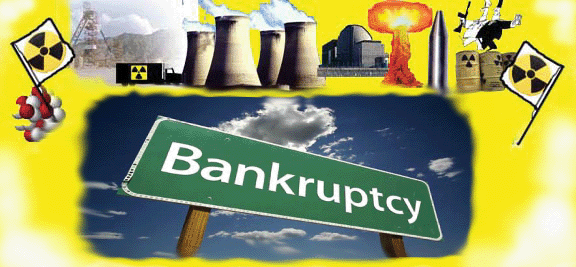
Paul Richards 2 April 2025
In March 2025, NANO Nuclear Energy Inc. acquired the major assets of the bankrupt Ultra Safe Nuclear Corporation (USNC), including microreactor technology and advanced nuclear fuel, renaming the Micro Modular Reactor (MMR) Energy System as the KRONOS MMR.
Ultra Safe Nuclear Corporation (USNC) – Stakeholder Loss Breakdown
1] Estimated Liabilities vs. Assets
Liabilities: $50M – $100M
Assets: $10M – $50M
2] Asset Fire Sale Proceeds
Standard Nuclear, Inc. (Initial Offer – Stalking Horse Bid): $28M (for selected assets)
NANO Nuclear Energy Inc. (MMR® System & IP): $8.5M
Other minor asset liquidations (estimated): $5M
3] Total Asset Sale Revenue
Estimated total recovery: ~$41.5M
4] Estimated Stakeholder Losses
Uncovered Liabilities [after asset sales]: $8.5M – $58.5M
Equity Investors [USNC shareholders]: Likely 100% loss
Creditors [unsecured debt holders]: Majority loss expected
Government Grants & Subsidies: Unrecoverable investments
5] Key Observations
USNC’s core intellectual property, including its Micro Modular Reactor (MMR®) system, was sold at a deep discount to NANO Nuclear Energy Inc. ($8.5M).
Despite an initial $28M stalking horse bid, the final liquidation resulted in a total sale value well below USNC’s peak valuation.
Significant capital losses for early investors, especially venture capital firms and institutional stakeholders.
This reflects a fire-sale scenario, where strategic assets were sold at fractions of their development costs due to financial distress.
Trump’s State Department Would Support Literally Any Israeli Atrocity
It’s clear that Trump’s State Department spokeswoman has been instructed to respond to any and all questions about Israeli atrocities in Gaza by blaming everything on Hamas, without even pretending to care whether the allegations are true.
For some background, Israel has just been caught perpetrating an atrocity so monstrous and so abundantly well-evidenced that even the mainstream western press have felt obligated to report on it. Outlets like the Guardian and the BBC are covering the story of how 15 medical workers for the Red Crescent, Civil Defense, and the UN were apparently handcuffed and executed one by one by Israeli forces in Rafah before being buried in a mass grave. According to Palestinian Civil Defense spokesman Mahmoud Basal, they were each shot more than 20 times.
(As an aside, the fact that Israeli forces have been known to bury the victims of their atrocities in order to hide the evidence is one of the many reasons why the official death toll from the Israeli onslaught in Gaza is definitely a massive undercount.)
Asked by the BBC’s Tom Bateman about these reports during a Monday press briefing, State Department spokeswoman Tammy Bruce responded by babbling about how evil Hamas is and how they are to blame for everything bad that happens in Gaza.
Here’s a transcript of the exchange:
Bateman: On Gaza, the UN’s Humanitarian Affairs Office has said that 15 paramedics, Civil Defense, and a UN worker were killed — in their words, one by one — by the IDF. They have dug bodies up, they said, in a shallow grave that have been gathered up, and also vehicles in the sand. Have you got any assessment of what might have happened? And given the potential use of American weapons, is there any assessment of whether or not this complied with international law?
Bruce: Well, I can tell you that for too long Hamas has abused civilian infrastructure, cynically using it to shield themselves. Hamas’s actions have caused humanitarians to be caught in the crossfire. The use of civilians or civilian objects to shield or impede military operations is itself a violation of international humanitarian law, and of course we expect all parties on the ground to comply with international humanitarian law.
Bateman: But there’s specifically a question on any — it’s a question about accounting and accountability given there may have been the use of U.S. weapons, so it’s a question about the State Department rather than Hamas. Is there any actions —
Bruce: Well, every single thing that is happening in Gaza is happening because of Hamas — every single dynamic. I’ll say again — I’ve said it, I think, in every briefing — all of this could stop in a moment if Hamas returned all the hostages and the hostage bodies they are still holding and put down its weapons. There is one — one entity that could stop it for everyone in a moment, and that is Hamas. This is — all loss of life is regrettable — it’s key, obviously — whoever it is, wherever they live. And this has been the nature of what fuels Secretary Rubio and President Trump in their willingness to expend this kind of capital early on in this term to make a difference and to change the situation. So I think that’s — that is the one thing that remains clear in all of this.
At no time does Bruce attempt to deny that the atrocity happened or cast doubt on the veracity of the claims, only justifying Israel’s actions by blaming Hamas. Again, this is a story about medical workers being handcuffed and then executed by gunfire.
Tammy Bruce does this constantly; she did it in response to two separate questions at a press conference last week. When asked about Israel’s assassination of Palestinian journalists Hossam Shabat and Mohammad Mansour, Bruce responded by babbling about October 7 and saying “every single thing that’s happening is a result of Hamas and its choices to drag that region down into a level of suffering that has been excruciating and has caused innumerable deaths.” When asked about the fact that people in Gaza have been unable to access clean drinking water under the Israeli siege, Bruce said, “Hamas did not perform to make sure that the ceasefire could continue, that they did not do what they said they would do. So we know, of course, when it comes to the ground water, of course, this is — it’s a crisis. It’s exacerbated by the fact that you have a terrorist group that just doesn’t care.
She did it again at a press conference the week before when asked by journalist Said Arikat if the State Department considers Israel’s use of siege warfare on a civilian population a war crime, saying “For the horrible suffering of the Gazan people, we know where that sits: it sits with Hamas,” adding that the people of Gaza “have been suffering because of the choices that Hamas has made throughout the years.”
Arikat, by the way, has just tweeted that on Monday he was not called on to ask a question for the first time in nearly 25 years of attending State Department press briefings. He is one of the very few reporters at the State Department who regularly asks challenging questions about US foreign policy.
Trump’s bombing threat over Iran nuclear programme prompts backlash
Guardian, Patrick Wintour Diplomatic editor, 31 Mar 25
Iranian officials accuse US president of breaching UN charter and say ‘violence brings violence’
Iran has reacted with outrage after Donald Trump said the country will be bombed if it does not accept US demands to constrain its nuclear programme.
The US president said on Sunday that if Iran “[doesn’t] make a deal, there will be bombing. It will be bombing the likes of which they have never seen before.”.
Trump’s latest threat – more explicit and violent than any made before – came after he sent a letter to Iran, as yet undisclosed, offering to hold talks on its nuclear programme. Iran had sent a reply to the US stating it was willing to hold indirect talks, officials confirmed.
Esmail Baghaei, the Iranian foreign ministry spokesperson, said of Trump’s threat: “The explicit threat of bombing Iran by the head of a country is clear contradiction to the essence of international peace and security.
Such a threat is a gross violation of the United Nations charter and a violation of the International Atomic Energy Agency safeguards regime. Violence brings violence and peace creates peace, America can choose.”
The supreme leader, Ayatollah Ali Khamenei, a sceptic about talks with the US, said Iran was “not overly concerned” by Trump’s words. “We consider it unlikely that such harm would come from outside. However, if any malicious act does occur, it will certainly be met with a firm
and decisive response,” he said.
Brig Gen Amir Ali Hajizadeh, the commander of the Revolutionary Guard’s aerospace force, said: “Someone in glass houses does not throw stones at anyone,” adding: “The Americans have at least 10 bases with 50,000 troops in the region, meaning they are sitting in a glass house.”
But the Iranian foreign minister, Abbas Araghchi, clearly had authority to keep the prospect of talks alive, saying Iran had already replied to the Trump letter through intermediaries in Oman and adding he knew the Iranian letter had now reached the US. Araghchi said direct talks were not possible while the US continued to threaten and bully Iran………………………………………………………………………………………………………………. https://www.theguardian.com/world/2025/mar/31/trumps-bombing-threat-over-iran-nuclear-programme-prompts-backlash
Trump Threatens Iran With ‘Bombing’ If Nuclear Deal Is Not Reached

no evidence Iran is trying to build a nuclear weapon or that Iranian Supreme Leader Ayatollah Ali Khamenei has reversed his 2003 fatwah that banned the production of weapons of mass destruction.
The threat comes after US intelligence agencies reaffirmed that Iran is not building a nuclear weapon
by Dave DeCamp March 30, 2025, https://news.antiwar.com/2025/03/30/trump-threatens-iran-with-bombing-if-no-nuclear-deal-is-reached/
President Trump on Sunday threatened to bomb Iran if a deal isn’t reached on the country’s civilian nuclear program.
“If they don’t make a deal, there will be bombing. It will be bombing the likes of which they have never seen before,” Trump told NBC News in a phone interview.
The president has made similar threats toward Iran, but Sunday’s marked the most explicit one yet, and it comes as the US is sending more bombers to the region and pounding Yemen with daily airstrikes. Trump also said the US could hit Iran with “secondary tariffs” if a deal isn’t reached.
Trump’s threat comes after US intelligence agencies said in their annual threat assessment that there’s no evidence Iran is trying to build a nuclear weapon or that Iranian Supreme Leader Ayatollah Ali Khamenei has reversed his 2003 fatwah that banned the production of weapons of mass destruction.
Iran recently responded to a letter Trump sent to Khamenei proposing nuclear talks and giving Tehran a two-month deadline to reach a deal. A US official told Axios that the deployment of US B-2 bombers to Diego Garcia was “not disconnected” from that deadline.
Iranian officials have repeatedly rejected the idea of direct talks with the US in the face of Trump’s so-called “maximum pressure campaign” but have left the door open to indirect negotiations.
Iranian President Masoud Pezeshkian said Sunday that Iran’s response to Trump’s letter made indirect talks possible but that the US’s behavior would determine how things would move forward.
“While Iran’s response rules out the possibility of direct talks between the two sides, it states that the path for indirect negotiations remains open,” Pezeshkian said. Iranian officials have been noting the fact that Trump was the one who tore up the 2015 nuclear deal by reimposing sanctions on Iran.
“As we have stated before, Iran has never closed the channels of indirect communication. In its response, Iran reaffirmed that it has never shied away from engaging in negotiations, but rather, it has just been the United States’ repeated violations of agreements and commitments that have created problems on this path,” Pezeshkian said.
“It’s the behavior of the Americans that will determine whether the negotiations can move forward,” the Iranian leader added. In his interview with NBC, Trump said that US and Iranian officials were talking but didn’t elaborate further.
Will Texas Become ‘the Epicenter of a National Nuclear Renaissance’?
A new bill would create a taxpayer-funded incentive program of at least $2 billion for nuclear power plants.
By Arcelia Martin, 24Mar 25
Texas lawmakers are considering a bill to
resuscitate the state’s nuclear power industry through a taxpayer-funded
incentives program. State Rep. Cody Harris, a Republican from Palestine in
East Texas, proposed allocating $2 billion toward a fund to create the
Texas Advanced Nuclear Deployment Office. The bill proposes using public
dollars to help fund nuclear construction, provide grants for reactors and
fund development research. HB 14 would also create a state coordinator to
assist in the state and federal permitting processes.
Inside Climate News 24th March 2025,
https://insideclimatenews.org/news/24032025/texas-national-nuclear-renaissance/
Behind the hype -“New wave of smaller, cheaper nuclear reactors sends US states racing to attract the industry “

No modular reactors are operating in the U.S. and a project to build the first, this one in Idaho, was terminated in 2023, despite getting federal aid.
The U.S. remains without a long-term solution for storing radioactive waste
Nuclear also has competition from renewable energies.
New wave of smaller, cheaper nuclear reactors sends US states racing to attract the industry, By ASSOCIATED PRESS, 29 March 2025 https://www.dailymail.co.uk/wires/ap/article-14549543/New-wave-smaller-cheaper-nuclear-reactors-sends-US-states-racing-attract-industry.html
HARRISBURG, Pa. (AP) – With the promise of newer, cheaper nuclear power on the horizon, U.S. states are vying to position themselves to build and supply the industry’s next generation as policymakers consider expanding subsidies and paving over regulatory obstacles.
Advanced reactor designs from competing firms are filling up the federal government’s regulatory pipeline as the industry touts them as a reliable, climate-friendly way to meet electricity demands from tech giants desperate to power their fast-growing artificial intelligence platforms.
The reactors could be operational as early as 2030, giving states a short runway to roll out the red carpet, and they face lingering public skepticism about safety and growing competition from renewables like wind and solar. Still, the reactors have high-level federal support, and utilities across the U.S. are working to incorporate the energy source into their portfolios.
Last year, 25 states passed legislation to support advanced nuclear energy and this year lawmakers have introduced over 200 bills supportive of nuclear energy, said Marc Nichol of the Nuclear Energy Institute, a trade association whose members include power plant owners, universities and labor unions.
“We´ve seen states taking action at ever-increasing levels for the past few years now,” Nichol said in an interview.
Smaller reactors are, in theory, faster to build and easier to site than conventional reactors. They could be factory-built from standard parts and are touted as flexible enough to plunk down for a single customer, like a data center or an industrial complex.
Advanced reactors, called small modular reactors and microreactors, produce a fraction of the energy produced by the conventional nuclear reactors built around the world for the last 50 years. Where conventional reactors produce 800 to 1,000 megawatts, or enough to power about half a million homes, modular reactors produce 300 megawatts or less and microreactors produce no more than 20 megawatts.
Tech giants Amazon and Google are investing in nuclear reactors to get the power they need, as states compete with Big Tech, and each other, in a race for electricity.
For some state officials, nuclear is a carbon-free source of electricity that helps them meet greenhouse gas-reduction goals. Others see it as an always-on power source to replace an accelerating wave of retiring coal-fired power plants.
Tennessee Gov. Bill Lee last month proposed more than $90 million to help subsidize a Tennessee Valley Authority project to install several small reactors, boost research and attract nuclear tech firms.
Long a proponent of the TVA’s nuclear project, Lee also launched Tennessee’s Nuclear Energy Fund in 2023, designed to attract a supply chain, including a multibillion-dollar uranium enrichment plant billed as the state’s biggest-ever industrial investment.
In Utah, where Gov. Spencer Cox announced “Operation Gigawatt” to double the state’s electricity generation in a decade, the Republican wants to spend $20 million to prepare sites for nuclear. State Senate President J. Stuart Adams told colleagues when he opened the chamber’s 2025 session that Utah needs to be the “nation´s nuclear hub.”
Texas Gov. Greg Abbott declared his state is “ready to be No. 1 in advanced nuclear power” as Texas lawmakers consider billions in nuclear power incentives.
Michigan lawmakers are considering millions of dollars in incentives to develop and use the reactors, as well as train a nuclear industry workforce.
One state over, Indiana lawmakers this month passed legislation to let utilities more quickly seek reimbursement for the cost to build a modular reactor, undoing a decades-old prohibition designed to protect ratepayers from bloated, inefficient or, worse, aborted power projects.
In Arizona, lawmakers are considering a utility-backed bill to relax environmental regulations if a utility builds a reactor at the site of a large industrial power user or a retired coal-fired power plant.
Still, the devices face an uncertain future.
No modular reactors are operating in the U.S. and a project to build the first, this one in Idaho, was terminated in 2023, despite getting federal aid.
The U.S. Department of Energy last year, under then-President Joe Biden, estimated the U.S. will need an additional 200 gigawatts of new nuclear capacity to keep pace with future power demands and reach net-zero emissions of planet-warming greenhouse gases by 2050 to avoid the worst effects of climate change.
The U.S. currently has just under 100 gigawatts of nuclear power operating. More than 30 advanced nuclear projects are under consideration or planned to be in operation by the early 2030s, Nichol of the NEI said, but those would supply just a fraction of the 200 gigawatt goal.
Work to produce a modular reactor has drawn billions of dollars in federal subsidies, loan guarantees and more recently tax credits signed into law by Biden.
Those have been critical to the nuclear industry, which expects them to survive under President Donald Trump, whose administration it sees as a supporter.
The U.S. remains without a long-term solution for storing radioactive waste, safety regulators are under pressure from Congress to approve designs and there are serious questions about industry claims that the smaller reactors are efficient, safe and reliable, said Edwin Lyman, director of nuclear power safety at the Union of Concerned Scientists.
Plus, Lyman said, “the likelihood that those are going to be deployable and instantly 100% reliable right out of the gate is just not consistent with the history of nuclear power development. And so it´s a much riskier bet.”
Nuclear also has competition from renewable energies.
Brendan Kochunas, an assistant professor of nuclear engineering at the University of Michigan, said advanced reactors may have a short window to succeed, given the regulatory scrutiny they undergo and the advances in energy storage technologies to make wind and solar power more reliable.
Those storage technologies could develop faster, bring down renewables’ cost and, ultimately, make more economic sense than nuclear, Kochunas said.
The supply chain for building reactors is another question.
The U.S. lacks high-quality concrete- and steel-fabrication design skills necessary to manufacture a nuclear power plant, Kochunas said.
That introduces the prospect of higher costs and longer timelines, he said. While foreign suppliers could help, there also is the fuel to consider.
Kathryn Huff, a former top Energy Department official who is now an associate professor at the University of Illinois Urbana-Champaign, said uranium enrichment capacity in the U.S. and among its allies needs to grow in order to support reactor production.
First-of-their-kind reactors need to get up and running close to their target dates, Huff said, “in order for anyone to have faith that a second or third or fourth one should be built.”
Trump warns of ‘bad, bad things’ for Iran if nuclear deal not reached
https://www.iranintl.com/en/202503289286 29 Mar 25
AS president Donald Trump warned Iran on Friday that “bad, bad things” would happen if Tehran did not agree to a nuclear deal, a day after Iran declined to have direct talks under his stepped-up sanctions.
“My big preference … is we work it out with Iran. But if we don’t work it out, bad, bad things are going to happen to Iran,” Trump told reporters in the Oval Office.
This is what Trump said he conveyed in his letter to Iran’s supreme leader Ali Khamenei last week.
Tehran confirmed on Wednesday that a response to the letter had been sent via Oman.
“Our policy remains not to engage in direct negotiations under maximum pressure and military threats. However, indirect negotiations as existed in the past can continue,” foreign minister Abbas Araghchi said.
Iran denies seeking a nuclear weapon but the UN’s nuclear watchdog says it has enriched more uranium than any state lacking a bomb. While Washington assesses Tehran is not actively building one, it doubts Iranian intentions.
Trump last month reinstated the “maximum pressure” campaign of sanctions on Iran from his first term, with the stated aim of driving its oil sales to zero.
Trump’s remarks come as Iran’s parliament speaker on Friday accused the US of using nuclear talks to pressure Tehran into relinquishing its defense capabilities.
“The US means disarmament when it says negotiation,” Mohammad Bagher Ghalibaf said in a speech during Quds Day rallies in Tehran on Friday. “Our people understand that talks under threat are just a show to impose their will. No wise nation would accept that.”
His comments were echoed by other senior Iranian officials speaking at Quds Day events showcasing Tehran’s solidarity with Palestinians, including Foreign Minister Abbas Araghchi and senior adviser to Iran’s Supreme Leader Ali Larijani.
1 This Month

of the week – Shut Down Drone Warfare!


Tell the Ukrainian Government to Drop Prosecution of Peace Activist Yurii Sheliazhenko

Petition to revoke the licensing of the Near Surface Nuclear Disposal Facility (NSDF) at Chalk River. https://www.ourcommons.ca/petitions/en/Petition/Details?Petition=e-7247
To see nuclear-related stories in greater depth and intensity – go to https://nuclearinformation.wordpress.com
-
Archives
- March 2026 (237)
- February 2026 (268)
- January 2026 (308)
- December 2025 (358)
- November 2025 (359)
- October 2025 (376)
- September 2025 (257)
- August 2025 (319)
- July 2025 (230)
- June 2025 (348)
- May 2025 (261)
- April 2025 (305)
-
Categories
- 1
- 1 NUCLEAR ISSUES
- business and costs
- climate change
- culture and arts
- ENERGY
- environment
- health
- history
- indigenous issues
- Legal
- marketing of nuclear
- media
- opposition to nuclear
- PERSONAL STORIES
- politics
- politics international
- Religion and ethics
- safety
- secrets,lies and civil liberties
- spinbuster
- technology
- Uranium
- wastes
- weapons and war
- Women
- 2 WORLD
- ACTION
- AFRICA
- Atrocities
- AUSTRALIA
- Christina's notes
- Christina's themes
- culture and arts
- Events
- Fuk 2022
- Fuk 2023
- Fukushima 2017
- Fukushima 2018
- fukushima 2019
- Fukushima 2020
- Fukushima 2021
- general
- global warming
- Humour (God we need it)
- Nuclear
- RARE EARTHS
- Reference
- resources – print
- Resources -audiovicual
- Weekly Newsletter
- World
- World Nuclear
- YouTube
-
RSS
Entries RSS
Comments RSS
 nuclear-news