After 40 years to build – nuclear power plant never worked, now for sale at peppercorn price
 US Nuclear Plant up for Sale at Fraction of Cost, abc news, By JAY REEVES, ASSOCIATED PRESS HOLLYWOOD, Ala. — Sep 11, 2016 After spending more than 40 years and $5 billion on an unfinished nuclear power plant in northeastern Alabama, the nation’s largest federal utility is preparing to sell the property at a fraction of its cost.
The Tennessee Valley Authority has set a minimum bid of $36.4 million for its Bellefonte Nuclear Plant and the 1,600 surrounding acres of waterfront property on the Tennessee River. The buyer gets two unfinished nuclear reactors, transmission lines, office and warehouse buildings, eight miles of roads, a 1,000-space parking lot and more………
The sale is bittersweet for site manager Jim Chardos, who went to work at Bellefonte in 1994 expecting it to be finished as a nuclear power plant. All these years later, he commutes 90 minutes each way to work to oversee a plant that has never been stocked with radioactive fuel or used either of its reactors to generate a single watt of electricity.
Work began at Bellefonte in the mid-’70s on the backside of the nuclear energy boom in the United States, Chardos said. The utility initially planned to construct four reactors at the site, but demand for power in the region never met those early expectations and work halted in 1988. A series of starts and stops preceded TVA’s decision earlier this year to sell Bellefonte……….http://abcnews.go.com/US/wireStory/us-nuclear-plant-sale-fraction-cost-42010576
Climate change is a threat to nuclear power, with reactors over-heating and high water demand
 Amid climate concerns, nuclear plants feel the heat of warming water , Midwest Energy
  News, Kari Lydersen, 10 Sept 16 Nuclear power proponents say the energy source is crucial to reducing the impact of climate change.
But ironically, “We’ll have to solve global warming if we want to keep using nuclear power,” says Union of Concerned Scientists nuclear safety expert Dave Lochbaum.
 That’s because nuclear power plants need large amounts of water for cooling, and overheating can present a major safety risk. As the lakes and rivers that typically supply cooling water become hotter thanks to climate change — and as droughts dry up some water bodies — nuclear power plants face problems, researchers say.
They may need to temporarily shut down or scale back their generation on hot days, which is just when their power is needed most.
This challenge is the focus of ongoing research spearheaded by Oak Ridge National Laboratory and also involves the national laboratories at Sandia, Los Alamos and Argonne. Researchers are modeling predictions about population, temperature, electricity demand, precipitation, land use and other factors to predict the water-related stress on power plants.
“You need to have enough water to cool the power plants and have drinking water and water for agriculture and other industries,” said Melissa Allen, a leader of the team effort and a post-doctoral researcher at Oak Ridge’s Climate Change Science Institute.……..
Hitting limits
The Nuclear Regulatory Commission sets limits on how warm the cooling water can be for each nuclear plant.
The owners of the Millstone plant in Connecticut, Turkey Point in Florida andBraidwood in Illinois have sought and obtained permission from the NRC to increase the maximum temperature limit for their cooling water, Lochbaum noted.
“Millstone uses the Atlantic Ocean, Turkey Point uses a canal system supplemented by water from the Atlantic Ocean, and Braidwood uses river water,” he said. “As global warming increases the temperature of oceans, lakes and rivers, they will hit these limits more often. There are two choices: to reduce power because you can’t exceed those limits. Or do what Turkey, Braidwood and Millstone did — do the homework to get the limit raised.”
Lochbaum analyzes reports from the NRC showing when nuclear plants scale back generation because of warm water.
In June, nuclear plants in Georgia, South Carolina and Pennsylvania scaled back their generation multiple times because of hot temperatures warming their cooling water. The Limerick power plant on the Schuylkill River near Philadelphia has scaled back because of high temperatures frequently over the past decade, according to the reports.
The Dresden and Quad Cities plants in Illinois had to scale back because of high water temperatures multiple times over the past five years. The Duane Arnold plant in Iowa and the Monticello plant in Minnesota also reported scaling back generation because of temperatures.
When cooling water is warmer, greater volumes are needed to cool the reactor. Plants also typically need approval from the NRC to increase the amount of water they use for cooling or to install new technology — like larger pumps — in order to deal with warmer conditions.
Such changes cost money, and scaling back generation means less profit.
“With plants in the Midwest and Northeast facing competition from natural gas and so on, it’s difficult to find the money even if you can make the justification that the money [invested in new cooling systems] would pay off in two years,” said Lochbaum……..http://midwestenergynews.com/2016/09/09/nuclear-plants-feel-the-heat-of-warming-water/
USA Republicans opposing Obama’s Planned ratification of Comprehensive Nuclear Test Ban Treaty
 Senate GOP Protests Obama’s Planned Nuclear Test Ban Push Warning to the White House concerns the Comprehensive Nuclear Test Ban Treaty, an international treaty prohibiting nuclear test explosions , WSJ, PAUL SONNE Sept. 8, 2016 The Obama administration’s pursuit of a possible United Nations Security Council resolution against nuclear weapons tests has riled a group of Republican lawmakers, who have warned President Barack Obama not to take action that would circumvent the U.S. Senate’s constitutional power to ratify treaties.
A group of 33 Republican senators sent a letter to Mr. Obama on Thursday threatening to withhold congressional funding for an existing international monitoring system for nuclear tests, if the administration signs up for any international obligations through the U.N. that the Senate has rejected previously.
“We urge you to respect your constitutional obligations and warn that if you do not, your efforts at the United Nations on this issue are likely to set back any supposed progress on achieving a testing ban,” the group of senators, including Marco Rubio (R., Fla.), John McCain(R., Ariz.) and Lindsey Graham (R., S.C.), wrote.
Their warning to the White House concerns the Comprehensive Nuclear Test Ban Treaty, or the CTBT, an international treatyprohibiting nuclear test explosions. Former President Bill Clintonsigned the treaty in 1996, but the Senate declined to ratify it in a vote three years later.
The Obama administration, which favors U.S. ratification of the test ban treaty but hasn’t won backing for its ratification in the Senate, now is pursuing action in the United Nations to reaffirm the U.S.’s support for the treaty and keep its spirit alive—part of a final push by Mr. Obama to advance his nuclear disarmament agenda before leaving office. The U.S. independently has obeyed a national moratorium on nuclear testing since 1992……..
The White House and the State Department say the administration is proposing a U.N. Security Council resolution and separate statement from the council’s five permanent members, known as the P5. The resolution will call for an end to nuclear testing and strengthen the detection system the test ban treaty established to monitor nuclear explosions around the world, which functions even though the treaty hasn’t entered into force…….
Thomas Graham Jr., a former State Dept. arms negotiator and supporter of the CTBT’s ratification, said nations poised to develop nuclear arms agreed decades ago to stand down on the condition that countries with nuclear arsenals would cease testing and development. He said nuclear weapons states must strengthen their resolve against tests to avoid proliferation stemming from an erosion of trust among those nonnuclear states.
Former State and Defense Department officials also said the White House may see the U.N. Security Council action as an additional way to put pressure on North Korea and further engage China in the effort to stop Pyongyang’s advancing nuclear program.
The U.N. Security Council is meeting Sept. 22 on the sidelines of the General Assembly in a special session on the CTBT. U.N. Security Council diplomats said they expect the Obama-introduced resolution to pass unanimously………http://www.wsj.com/articles/senate-gop-protests-obamas-planned-nuclear-test-ban-push-1473360939
Nuclear war risks lessened by Iran nuclear deal, which should continue in USA’s next administration


 Iran Nuclear Deal Likely to Survive Next Administration, Real Clear World, By Barbara Slavin, September 07, 2016 Barbara Slavin is the Acting Director of the Future of Iran Initiative at the South Asia Center of the Atlantic Council and Washington correspondent for Al-Monitor. This article was created in collaboration with the Atlantic Council. The views expressed are solely those of the author.
Like a car that has lost its new car smell and has a few nicks on its bumpers, the nuclear agreement reached last year between Iran and six world powers is showing some wear just nine months after its full implementation.
But the Joint Comprehensive Plan of Action, or JCPOA, as the Iran nuclear deal is known, has survived efforts to wreck it by opponents in both Iran and the United States, and the deal is likely to endure into the next U.S. administration.
The problems with the agreement relate more to underlying hostility between the United States and Iran, which have not had normal diplomatic relations since 1980.
Seeking to prove that the JCPOA does not mean appeasement of the Great Satan, Iranian hardliners have stepped up provocative actions including arresting dual nationals, testing ballistic missiles, and harassing U.S. Navy ships in the Persian Gulf. Iranian Supreme Leader Ayatollah Ali Khamenei has repeatedly warned Iranian government officials not to negotiate with the United States on non-nuclear matters, even as senior diplomats continue to meet to review implementation of the nuclear agreement and to discuss a potential settlement to the war in Syria.
On the American side, Republicans and some Democratic hawks have been quick to pounce on any negative Iranian action as proof that the JCPOA has failed. Critics recently seized on a report by the Wall Street Journal claiming that the Obama administration paid $400 million in cash to Iran after four Iranian-Americans and a fifth American citizen were freed from custody on Implementation Day.
In fact, the payment was not “ransom” for the Americans but reimbursement to Iran for weapons that had been purchased before the revolution and never delivered. The Americans were swapped for seven Iranian nationals held in U.S. prisons for sanctions violations……..
Confronting the Islamic State group, dealing with Russia, the ramifications of British exit from the European Union, and the challenges of climate change are likely to take precedence over Iran for both candidates.
Even Israel’s hawkish Prime Minister Benjamin Netanyahu rarely mentions Iran these days; Israeli security experts privately praise the JCPOA for postponing an Iran nuclear crisis for at least another decade.
Of course, the Middle East has a tendency to insert itself into U.S. foreign policy debates in unpredictable ways. But Iran has been relatively stable in the face of the crises afflicting many of its neighbors. A President Clinton or Trump is more likely to have to deal with political turmoil in Turkey, Saudi Arabia, or Iraq.
As for the future of U.S.-Iran relations, much will depend on Tehran and whether the supreme leader’s successor feels the same need to maintain animosity toward the United States as a prop to regime survival. Both countries’ citizens would benefit from restoring diplomatic relations and working toward common ground. But if real peace is not yet possible, at least the JCPOA has drastically reduced the chances for another Middle East war. http://www.realclearworld.com/articles/2016/09/07/iran_nuclear_deal_likely_to_survive_next_administration.html
As nuclear costs rise, top economist urges nuclear operators on early decommissioning of reactors
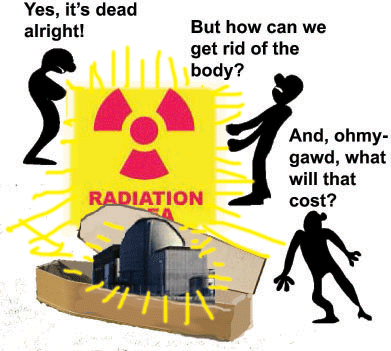 US operators urged to decommission immediately to prevent cost hikes, Nuclear Energy Insider, Sep 7, 2016 Nuclear plant operators should start decommissioning activities of shutdown reactors as early as possible as the deferral of decontamination and dismantling (D&D) exposes operators to delay-related costs, investment risks and loss of crucial expertise as workers leave the industry, Geoffrey Rothwell, Principal Economist at the OECD’s Nuclear Energy Agency, told Nuclear Energy Insider.
There are currently 17 U.S. nuclear power plants being decommissioned and this will soon increase following a recent spate of plant closure announcements due to sustained low power prices.
Operators have announced the early closures of California’s Diabolo Canyon, Nebraska’s Fort Calhoun and Illinois’ Clinton and Quad Cities plants in recent months as low gas prices, rising renewable energy capacity and energy efficiency measures pressure electricity prices.
The majority of current U.S. decommissioning projects are being carried out under the deferred “SAFSTOR” method of deferred decontamination, but this process incurs the risk of cost hikes, Rothwell said.
U.S. operators build up nuclear decommissioning trust funds (DTFs) based on estimated costs but data from completed projects shows the actual cost of decommissioning has varied substantially, as operators have faced fresh site-specific challenges and regulation which can differ between states.
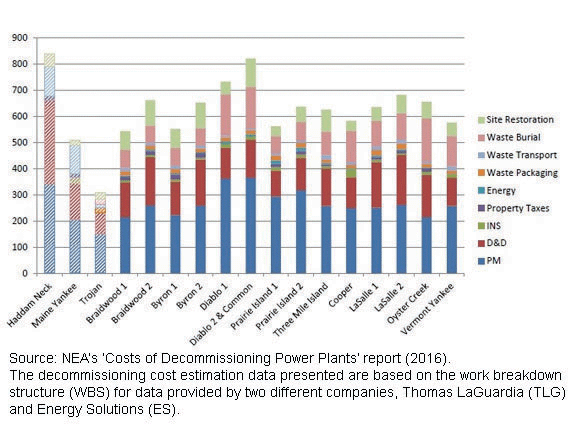
The variance in costs of three completed ‘immediate’ D&D projects was highlighted earlier this year in a report by the Nuclear Energy Agency (NEA), co-authored by Rothwell, which cited figures from a Pacific Northwest National Laboratories [PNNL] study.
The chart below shows actual costs for the Haddam Neck, Main Yankee and Trojan plants, laid out alongside estimated costs for 14 other reactors, showed large differences in spending on Project Management, Decontamination and Dismantling (D&D) and Waste Management.
Internal expertise
Project management costs tend to be a function of the duration of D&D activities, rather than plant size and this is highlighted by the data from completed projects, Rothwell noted.
Portland General Electric (PGE), licensee of the 1.2 GW Trojan plant, decided to perform the decommissioning of the plant itself and conducted the project efficiently and without major changes or setbacks.
In comparison, the licensees for the 582 MW Haddam Neck plant in Connecticut and the 900 MW Maine Yankee plant chose to contract the D&D work to a decommissioning operations contractor (DOC) and then later in the process they chose to resume execution of decommissioning activities themselves.
In both cases, the management changes led to complications and delays and escalated costs, NEA said in its report.
A major advantage of carrying out D&D activities immediately is that current operations staff have in-depth knowledge of plant specifics, including previous incidents and undocumented facility detail, which avoids unnecessary work-arounds, Rothwell said.
“The maintenance crew have all sorts of implicit, tacit knowledge…If you wait for 60 years they are all gone,” he said.
Dismantling challenge
Actual D&D costs have varied substantially as a lack of identical reference projects has meant operators have had to perform “first of a kind” operations such as the time-consuming task of dismantling main reactor components, Rothwell said.
“It’s cutting up the reactor and the steam generator, these are big pieces of equipment and we are just learning how to do this,” Rothwell said.
PG&E was able to limit the D&D costs for its Trojan plant through its access to the U.S. Ecology low-level waste facility at Hanford, Washington. PG&E was permitted to ship reactor internals to the Hanford facility as one package and avoid some of the on-site cutting-up of components.
At Haddam Neck, the segmentation of the internals proved challenging and took approximately 29 months, according to NEA’s report. Regulations also required the operator to store the internals on-site at the ISFSI.
The duration of D&D activities at Haddam Neck exceeded original estimates, as did the total radiation exposure accrued during the operations, NEA said.
“Decontamination of exposed faces of buildings and foundations were also extensive tasks,” it said.
The results of an environmental survey at the Trojan plant site indicated no radioactivity had spread to the environment, including surface water and groundwater, which also limited costs.
By deferring D&D activities for a substantial time, operators raise the chance of chemical or radiation leaks spreading, which can require further D&D work and incur higher costs, Rothwell said.
Waste rules
According to the NEA’s report, waste management costs do not necessarily depend on the capacity of the plant.
“Waste costs appear to be more sensitive to the management strategies and solutions selected or assumed, for the specific plant, and the related unit costs individually applied. The accessibility of waste management routes can even determine the way the decommissioning of the reactor is undertaken,” NEA said.
PG&E’s ability to ship the reactor vessel for the Trojan plant as a single package reduced the volume of waste and the number of radioactive shipments, and also reduced personnel exposure. However, NEA noted that without regulatory changes, the single package approach will not be available to other commercial nuclear plant decommissioning projects in the US.
In contrast, waste management costs for Haddam Neck were driven up by high volumes of waste produced, “mostly attributable to the release criteria and clean-up levels adopted by the State of Connecticut,” the report said.
Regulatory risk is another reason to commence D&D immediately as regulation is more likely to increase if there is a long time period before SAFSTOR facilities are decommissioned, Rothwell said.
Operators choosing to defer D&D also face investment risks for DTFs, in addition to escalating cost estimates, Rothwell noted.
Rates of return for DTFs have been lower than expectations, and operators which have accelerated closure plans should leverage current staff expertise and optimize decommissioning schedules to allocate decommission fund portfolios so the “liquidity matches your plans,” he said…….http://analysis.nuclearenergyinsider.com/us-operators-urged-decommission-immediately-prevent-cost-hikes?utm_campaign=NEI+07SEP16+Newsletter+B&utm_medium=email&utm_source=Eloqua&elqTrackId=ce386029dbb04d9db19579ed2046a746&elq=f4dbaf77167c423b93658800346bc887&elqaid=22066&elqat=1&elqCampaignId=9714
The “Red Button” nuclear war system can be reformed: Donald Trump’s rise illutrates the need for this
Once a president makes that decision, no one can stop it.
The problem is larger than any individual candidate or president.
Trump has single-handedly, albeit inadvertently, drawn the spotlight to the little understood danger inherent in continued U.S. reliance on a Red Button nuclear weapons strategy — one that’s geared for first-strike and quick-launch, with autocratic control in the hands of the president. For that, I suppose we should thank him — even as we mobilize to keep his finger as far away from the button as possible.
Fortunately, we can reform — and end — the Red Button nuclear system. Progress on this front can take a number of forms. We can ban the first use of nuclear weapons in a conflict, take our arsenal off hair-trigger alert, or even eliminate altogether the categories of weapons (land-based missiles) that are geared only for a quick-launch, first-strike attack. Any of these steps would make us safer and more secure. All of them have the backing of credible nuclear security experts.
 If President Trump Ordered A Nuclear Strike, No One Could Stop Him http://www.huffingtonpost.com/entry/if-president-trump-orders-a-nuclear-strike-no-one_us_57d05ca2e4b0273330aba003 09/07/2016 After years as a back-burner public issue, the terrible specter of nuclear war has come into focus as a first-order concern for the American electorate. This is due in part to rising tensions in recent years between the United States and Russia. But the most combustible fuel for this anxiety is the unlikely rise of Donald J. Trump.
Since Marco Rubio first opened this line of attack in late February — calling him “a lunatic trying to get ahold of nuclear weapons” — the unsettling prospect of Trump’s finger on the proverbial Red Button has steadily gained attention.
Unique among issues in these polarizing times, this concern now cuts across partisan divides. Scores of political leaders and national security experts from both political parties are questioning whether the Republican nominee has the experience, temperament and judgment to have his finger on that button. This view is shared by a substantial majority of the American public: only 27% trust him to make the right decisions about the use of nuclear weapons. Large blocs of voters now rate the handling of nuclear weapons as a top issue of concern for them in the election.
If you find the thought of Trump’s finger on the Red Button alarming, there is good reason. Just last month, MSNBC’s Joe Scarborough reported Trump asked three times in a one-hour policy briefing, “If we have nuclear weapons, why can’t we use them?”
More importantly, that button is shorthand for a deadly-efficient system built for blind deference and speed. It is extremely vulnerable to accidents, false warnings, rushed decision-making and bad judgment. There are no firewalls — legal, political, operational or otherwise — between a president’s itchy trigger finger and civilization-ending weaponry.
The thousands of nuclear weapons at the president’s disposal — each one 10-20 times more powerful than the bomb that obliterated Hiroshima — are locked in attack-mode, ready to fire at any moment. That adds the potential for catastrophic nuclear violence to every geopolitical conflict, every crisis, every misidentified flock of geese (seriously, it’s happened). Within minutes of receiving a short burst of computer code, they will launch from their silos and can’t be recalled.
Once a president makes that decision, no one can stop it.
Certainly, Trump is unfit for the task. His deficiencies on that score could fill a book. Time and again, he has shown himself easily baited and quick to lash out, dismissive of expert consultation, ill-informed of even basic international and military affairs — including, most especially, nuclear weapons (dropping them on Europe isn’t “off the table”).
But that critique, however accurate, misses the point: The problem is larger than any individual candidate or president.
Trump has single-handedly, albeit inadvertently, drawn the spotlight to the little understood danger inherent in continued U.S. reliance on a Red Button nuclear weapons strategy — one that’s geared for first-strike and quick-launch, with autocratic control in the hands of the president. For that, I suppose we should thank him — even as we mobilize to keep his finger as far away from the button as possible.
But we should bear in mind that this catastrophic threat didn’t end after the Cold War, and it won’t end after the fall of Donald Trump. We must dismantle the unjust, undemocratic and terrifyingly absolute power bound up in that button and the insane system it represents. It shouldn’t be harder for the president to appoint a mid-level bureaucrat than it is to kill hundreds of millions of people.
Fortunately, we can reform — and end — the Red Button nuclear system. Progress on this front can take a number of forms. We can ban the first use of nuclear weapons in a conflict, take our arsenal off hair-trigger alert, or even eliminate altogether the categories of weapons (land-based missiles) that are geared only for a quick-launch, first-strike attack. Any of these steps would make us safer and more secure. All of them have the backing of credible nuclear security experts.
At the Republican primary debate in December, Trump pointed to the possibility of a “madman getting his hands on a nuclear weapon” as the biggest problem the American people would face. He had it partly right. It’s not just the madman from a rogue nation we should lose sleep over. It’s the idea that any single person anywhere — including in the United States — has a Red Button at their fingertips and the power to light the world on fire.
___
Derek Johnson is the executive director of Global Zero Action, the U.S. advocacy arm of the international Global Zero movement to eliminate nuclear weapons, and spokesman for the #NoRedButton campaign. For more information, visit www.noredbutton.org.
Terrestrial Energy faces safety risks and poor market prospects for its new nuclear reactors
Nuclear Firm’s $17 Million Bid on a New Reactor Design “…….Terrestrial Energy is looking to use the money raised up until now to complete the first phase of the Canadian Nuclear Safety Commission’s pre-licensing vendor design review, a technology assessment usually carried out in advance of a license application……
“Dirty tools, dirty components, cleansers [and] foreign material in the coolant stream will cause the coolant to activate over time,” he predicted. “I’m curious what the releases and radioactivity accident risks look like with the coolant after 10 years of operation.”……
Even if Terrestrial Energy is able to sail through licensing and brush off safety concerns, though, it will still have to overcome the problem of a diminishing appetite for nuclear power across a number of the industry’s key markets, including the U.S…... Greentech Media 8 Sept 16
US-China Cooperation on N. Korean Nuclear Threat is undermined by national rivalries
US-China Tensions Undermine Cooperation on N. Korean Nuclear Threat SEOUL — VOA NEWS 8 SEP 16 Washington and Beijing’s longstanding agreement on the need to persuade North Korea to give up its nuclear ambitions is, analysts say, splintering over rising tensions in the region and diverging national interests.
American and South Korean officials, as well as analysts from China and Russia, addressed the increasingly complex security situation on the Korean peninsula at the Seoul Defense Dialogue on Thursday, organized by the South Korean Ministry of Defense.
Stay the course
Kim Hong-kyun, the South Korean Special Representative for Korean Peace and Security Affairs, called for continued international support to pressure the Kim Jong Un government to curb its defiant and continued development of nuclear weapons and ballistic missiles……..
The latest round of United Nations sanctions caused economic pain, especially, Kim said, in trade, shipping and finance. However, since the new restrictions were imposed in March, North Korea has conducted 20 tests of short and medium range missiles, including submarine-based launches, advancing its capability to reach the U.S. mainland with a nuclear strike.
Both Kim and U.S. Undersecretary of Defense David Shear noted that diplomatic outreach is at a standstill as both Seoul and Washington demand that Pyongyang first take significant action to dismantle its nuclear program before any talks can occur.
“Unfortunately, today there have been no credible signs that North Korea is ready to move down this path,” Shear said.
China For sanctions to be effective, China’s support remains crucial as it is North Korea’s economic lifeline. Nearly 90 percent of all North Korean trade flows through China.
Shi Yinhong, a professor of international relations at Renmin University in China, said officials in Beijing have doubts that sanctions alone will force Pyongyang to change……..http://www.voanews.com/a/us-china-tensions-north-korea-nuclear-threat/3498672.html
Political deception aimed at sabotaging the nuclear agreement with Iran – phony news
 Media Trumpet Another Phony “Secret Nuclear Deal” Story , 08 September 2016 By Gareth Porter, Truthout | News Analysis Two major media outlets — Reuters and The Washington Post — pushed another Iran “secret side deal” story last week, ignoring obvious facts that revealed it as clever political deception aimed at sabotaging the nuclear agreement with Iran.
Stories in both of those outlets suggested that a leading think tank had revealed a secret deal that allowed Iran to exceed various qualitative and quantitative limits placed on it under the nuclear agreement reached last year — the main current theme of political opponents of the agreement. The stories were based on claims in a report co-authored by David Albright, the head of the Institute for Science and International Security, who has long been treated by corporate media as the leading “independent” expert on Iran’s nuclear program.
In fact, as Truthout revealed in 2014, Albright had abandoned any independence he had maintained on Iran as early as 2008 and had aligned his position on nuclear negotiations with Iran with those of the Bush administration and Israel…….
Albright’s attack on the Obama administration and the Joint Commission was only the latest installment in the current campaign by pro-Israeli media and political opponents of the JCPOA to claim existence of “secret side deals” between the Obama administration and Iran. Just six weeks ago, the Associated Press correspondent in Vienna, George Jahn, published a story that falsely portrayed Iran’s report to the International Atomic Energy Agency [IAEA] on its plan for implementation of the agreement as such a “secret side deal.” The agreement reached between Iran and the IAEA on the issue of alleged past Iranian nuclear work, which included arrangements for taking environmental samples at Iran’s Parchin military facility, was also treated by JCPOA opponents as a “secret side deal.” http://www.truth-out.org/news/item/37527-media-trumpet-another-phony-secret-nuclear-deal-story
Decrepit old nuclear facilities a safety worry in America
 Photos show nuclear facilities in dangerous disrepair By Nicole Gaouette and Barbara Starr, CNNWashington (CNN) Story highlights
- Nuclear officials describe critical utility, safety and support systems that are failing
- Many facilities date from World War II and intended to operate for as little as one decade
US nuclear security facilities are dangerously decrepit and putting national security goals at risk, according to nuclear officials who are asking Congress to back the administration’s push to modernize the system.
President Obama to stay with the policy of pre-emptive nuclear strike
 Obama to Stick With “First Strike” Nuclear War Doctrine, Claiming Deterrence Value https://www.districtsentinel.com/obama-stick-first-strike-nuclear-war-doctrine-claiming-deterrence-value/ September 6, 2016 by Sam Knight President Obama will not rule out the possibility of the United States conducting a first nuclear strike, keeping intact a policy that has been in place since the Cold War.
The New York Times reported Tuesday that Obama won’t attempt to revise the so-called “First Strike” doctrine before leaving office in January 2017.
The paper noted he had faced criticism, including some from “former senior aides,” over unfulfilled campaign and first-term promises, to work towards “a world without nuclear weapons.”
“For months, arms control advocates have argued for a series of steps to advance the pledge he made,” the Times said. “An unequivocal no-first-use pledge would have been the boldest of those measures.”
The source of complaints about the President’s about-face are from roughly six years ago. In 2010, when Obama renewed the START treaty with Russia, he also agreed to modernize the US nuclear arsenal, per Congressional Republicans’ demands.
The Times said that a shift away from First Strike would be mostly cosmetic, with US presidents dating back to Harry Truman, having pledged to only use nuclear weapons as a “last resort.”
History, however, casts a pall over these pledges.
Truman ordered the dropping of two atomic bombs on an already-battered Imperial Japan in 1945, despite the fact that some American military officials–at the time and, in the years after–expressed doubt that the nuclear bombings were needed to force a Japanese surrender. Those critics included Dwight Eisenhower, Pacific fleet commander Adm. Chester Nimitz, and Truman’s Chief of Staff, Adm. William Leahy. The United States is still the only nation in history to use nuclear weapons against an adversary.
According to The New York Times’ Tuesday report, President Obama had considered a move away from First Strike this summer, not long after he became the first US President to visit Hiroshima—the first of the two Japanese cities targeted by nuclear weapons, under orders from Truman.
Obama was, however, persuaded to move away from altering the policy by his cabinet. The Secretaries of Defense, State and Energy—Ash Carter, John Kerry, and Ernest Moniz—were all opposed to the move.
Kerry and Carter were particularly concerned about upsetting allies in East Asia, South Korea and Japan, in the context of perceived US “weakness,” in the face of possible North Korean military strikes.
The Times also noted Kerry objecting to “weaken[ing] the nuclear deterrent while Russia is running practice bombing runs over Europe and China is expanding its reach in the South China Sea.”
President Obama also ran the risk of adopting a policy that would be quickly reversed by the next administration, the paper noted.
“[Donald] Trump bristled at the idea [of abandoning first strike], saying he would never want to weaken America’s leverage,” The Times said. “[Hillary] Clinton has not spoken on the issue during her campaign.”
The Dead Nuclear Plant Society – in nuclear trash burial business
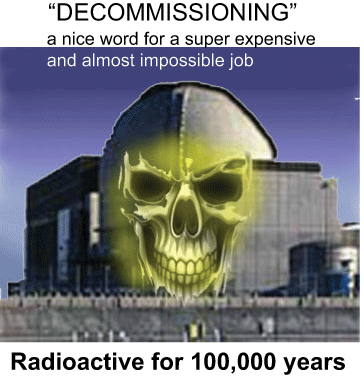 ‘Dead Plant Society’ lobby group booms as reactors close Hannah Northey, E&E reporter Greenwire: September 6, 2016 “……..Reactors are closing as nuclear utilities struggle to compete with cheap natural gas, low demand for power and no national energy policy. And when the behemoth nuclear plants close, the Dead Plant Society grows.
As the teacher played by Robin Williams in the movie famously tells his young students, “We are food for worms, lads. Because, believe it or not, each and every one of us in this room is one day going to stop breathing, turn cold and die.”
The group of doomed-reactor owners has doubled from its original five members to 10 and now includes Exelon Corp., the nation’s largest nuclear utility.
Operators who climb aboard are eager to weigh in on a high-profile rulemaking at the Nuclear Regulatory Commission for decommissioning reactors and to find solutions — on or off Capitol Hill — for growing amounts of radioactive waste piling up across the country, said Smith, the president of Governmental Strategies Inc.
Exelon came to the society five years ago. The nuclear giant is deactivating reactors — or is planning to do so — at three sites in Illinois and one in New Jersey, Smith said. Entergy Corp. signed after it bought the shuttered Big Rock Point nuclear power plant near Charlevoix, Mich. And Pacific Gas & Electric Co. was next when it decided to close the Diablo Canyon nuclear reactors in California.
Following years would see Southern California Edison join with the closure of the San Onofre reactors in California and Duke Energy Corp. as it shuttered the Crystal River nuclear plant in Florida.
All told, the tight-knit club represents more than a dozen reactors that have been closed or are about to be snuffed out in eight states. And nuclear executives have warned that an additional 15 to 20 reactors could close in coming years.
Many of the companies are either suing the federal government or involved in legal settlements after the Department of Energy failed to uphold its 1980s agreements and take possession of spent reactor fuel destined for the stalled repository at Yucca Mountain, Nev. So far, DOE has paid out more than $5 billion, and the lawsuits are still mounting.
And like the industry implementing cost-cutting measures to keep reactors afloat, Smith said the Dead Plant Society is on a tight budget, spending under $160,000 a year on lobbying since its inception, according to the Center for Responsive Politics. Working with Smith is Michael Callahan, president of CCMSC Corp. and a former NRC congressional affairs officer….
‘Real security and safety issues’
Smith isn’t thrilled about the group’s growth.
The former Hill staffer and Nuclear Energy Institute executive said he’d rather be promoting a growing industry, not burying cooling waste.
“I hope not to grow it; I don’t like being in the nuclear trash burial business,” said Smith, who worked for former Louisiana Sen. John Breaux (D), a former Entergy lobbyist. “I had a lot more fun when I was lobbying to get new plants up and running.”
Then again, most members of the Dead Plant Society would rather not belong to the group, either.
Owners of the three Yankee reactors in New England, for example, recently sued the federal government after DOE failed to pick up spent reactor fuel stored in concrete casks at the site of former reactors in Connecticut, Maine and Massachusetts.
Connecticut Yankee Atomic Power Co., Maine Yankee Atomic Power Co. and Yankee Atomic Electric Co. said they existed as corporations only because DOE had failed to pick up the waste, forcing the companies to build, staff and oversee on-site storage. The court awarded the companies $76.8 million in damages.
Tim Smith, a lobbyist and president of Governmental Strategies Inc., has represented the Decommissioning Plant Coalition since 2001, better known in industry as the “Dead Plant Society.” Photo courtesy of Governmental Strategies Inc.
 The dispute, like many others, stems from the Nuclear Waste Policy Act, which required DOE to remove spent nuclear fuel and high-level radioactive waste from reactors. The agency signed contracts with the companies to remove the waste by January 1998 and store it in a permanent repository, but the department failed to do so. The Obama administration later pulled support for building a waste repository under Yucca Mountain, forcing utilities across the nation to store spent nuclear fuel in wet pools or dry storage casks on-site……
DOE will see its legal problems grow should more reactors go dark.
The department could face between $29 billion and $50 billion in legal fees if it begins accepting waste by 2025, according to a recent study by the Kleinman Center for Energy Policy at the University of Pennsylvania. If the decadeslong debacle slips past that date, costs could continue to grow by $500 million a year, said Christina Simeone, the report’s author. There are currently 19 lawsuits pending in federal court, according to a DOE report.
But the real losers are the ratepayers and taxpayers who have paid for a repository and may not realize that radioactive waste may live in their communities for ages, long after a reactor is snuffed out, she said.
What’s more, federal funds to move the process forward are off-limits unless the law is changed, she added. The $34 billion Nuclear Waste Fund — a cache nuclear customers have fed over years — is untouchable under statute for repository-related activities, and DOE legal fees are taken out of a federal fund made up of taxpayers’ contributions, she said.
“I don’t think these communities realize that when these plants close, the waste is going to stay there,” Simeone said. “The plant may be remediated, but there’s a portion of the land that’s going to remain under license at the NRC and is going to store waste indefinitely. There are real security and safety issues.”……..
The commission’s work — slated to be complete by 2020 — has spurred passionate debate between the industry and host communities, public advocates and environmental groups over funding for multibillion-dollar cleanups. Central to those discussions is what happens to pools and casks full of radioactive waste, the sizes of security forces and evacuation zones, and what role the host communities play.
As it stands, there are no such federal rules for dead nuclear plants.
Instead, companies must seek “exemptions” from regulations for operating plants as they power down the units.
Smith said the Dead Plant Society is supporting the NRC’s work to streamline the process and make it transparent, adding that operators set aside money to ensure they can remove or reduce radiation from the former plant sites so the land can be released or repurposed — a process that can cost as much as $400 million……..
The Vermont Yankee decommissioning panel has said host communities — people living near the nuclear plant within the 10-mile evacuation zone — need a voice on par with industry. The group has called on the NRC to take a closer look at the effect on communities hit by the multimillion-dollar loss in tax revenues after reactors close.
In their comments to the NRC, neighbors of nuclear reactors are asking the agency to ensure that decommissioning funds aren’t used for lobbying or operating expenses, and not to reduce evacuation zones. ……http://www.eenews.net/stories/1060042350
Outcry over secret trucking of weapons grade nuclear waste to South Carolina
 Weapons-grade nuclear waste shipments to U.S. prompt outcry Trucks expected to carry
  casks containing highly enriched uranium and radioactive isotopes CBC News Sep 05, 2016 A highly secretive plan to ship weapons-grade nuclear waste from a federal lab northwest of Ottawa to the United States is drawing ire in some of the southern Ontario and American communities along the potential route.
Radioactive waste from the former Atomic Energy of Canada Ltd. laboratory in Chalk River, Ont., a major but dwindling world supplier of medical isotopes that is now run by a private consortium, is set to be transported in liquid form to a site in Savannah River, S.C., for processing and disposal. The route could take it through Ontario’s fruit-rich Niagara Region, or possibly even through the border crossing at Sault Ste. Marie, Ont., into Michigan, according to a lawsuit trying to stop the shipments. Thelawsuit was filed in a U.S. federal court last month by a coalition of American environmental and nuclear watchdog groups. …….
Kept secret from emergency personnel
The plan is for about 150 shipments by truck to South Carolina, a minimum distance of nearly 1,700 kilometres from Chalk River, which is 180 km northwest of Ottawa. Each shipment would carry four 58-litre steel containers placed inside a larger steel and lead tube, carrying liquid radioactive waste including isotopes of cesium, iodine, strontium and plutonium, according to the U.S. lawsuit.
The waste would also contain a modest but dangerous quantity of highly enriched uranium, which can be used to make a nuclear bomb, the lawsuit states.
The waste is a byproduct of making molybdenum-99, a medical isotope used in diagnostic tests of organs and other body parts.
The Niagara area’s regional government passed a motion last year opposing the shipments…….
One problem raised by opponents is that, for security reasons, the route through Canada and the timetable for shipments are being kept under tight secrecy — so secret that local emergency responders haven’t been kept in the loop.
“There would be no notice given, but of course it would be our first responders, my friends, my neighbours, working in our volunteer force and in our emergency services, that would be exposed… in case there was an accident,” Hodgson said, adding that even his local fire chief only found out through the media.
The Canadian Nuclear Safety Commission, the federal nuclear safety regulator, approved the steel tube design last year for transporting the nuclear waste, but full environmental assessments have not been conducted in either Canada or the U.S., opponents complain. …… http://www.cbc.ca/news/health/nuclear-waste-chalk-river-uranium-transport-carolina-1.3748658
Flooding – a dire hazard to nuclear power stations
Nuclear Reactors and Flood Protection DAVE LOCHBAUM, DIRECTOR, NUCLEAR SAFETY PROJECT | SEPTEMBER 6, 2016 DISASTER BY DESIGN/ SAFETY BY INTENT #48 Safety by Intent Oconee Flood Protection Issue

In August 2006, NRC inspectors identified a deficiency in a flood protection measure at the Oconee Nuclear Station in South Carolina. Specifically, the inspectors discovered that workers removed a 6-inch by 10-inch panel in the 5-foot tall flood wall around the Standby Shutdown Facility (SSF) to allow temporary cables to be used during a modification. When the work was completed and the cables removed, the panel was not re-installed.
The SSF houses power supplies and emergency equipment that provide core cooling for all three Oconee reactors during certain accidents. The opening in the flood wall could have allowed water to enter the SSF and submerge the equipment, disabling it. The NRC’s preliminary determination was that the problem warranted a white finding.
The owner contested the white finding in October 2006 on grounds that the lower end of the opening is 4.71 feet above the ground and no credible flood could cause water to rise high enough to flow through the opening to threaten the equipment inside the SSF. The NRC considered the argument, then decided against it and issued the white finding in November 2006.
The owner appealed the white finding in December 2006 on largely the same grounds that the NRC had considered and rejected. The NRC formed a five-member panel to review the owner’s appeal. In February 2007, the NRC panel recommended that the appeal be denied. The NRC notified the owner on March 1, 2007, that the appeal was denied.
The owner appealed the denial of the first appeal in May 2007 on largely the same grounds that it had unsuccessfully trod twice before. Once again, the NRC formed another panel to handle the appeal.
The flood of appeals forced the NRC to closely examine the design basis flood event for Oconee. Included in the mix of things that could inundate the Oconee site was the failure of the Jocassee Dam, upriver about 20 miles. The NRC discovered that the owner made a mistake when calculating the probability of the dam’s failure—the dam’s failure was more than 10 times more likely than the owner had calculated. The NRC denied the second appeal in November 2007 to let the white finding stand.
But the owner’s failed appeals resulted in far more than a white finding. Along the way, the NRC discovered a larger problem than a 6-inch by 10-inch opening in a 5-foot tall flood wall. The NRC learned of a study completed in the early 1990s showing that Jocassee Dam’s failure could inundate the Oconee site up to 16.8 feet and cause the meltdown of all three reactors, rendering the presence or absence of a hole in a 5-foot tall flood wall somewhat moot. The NRC mandated in August 2008 that the owner respond, under oath or affirmation, with information explaining how Oconee is adequately protected against floods. The owner responded to the NRC’s mandate in September 2009.
The NRC sat down with the owner in November 2008 about flood protection deficiencies at Oconee. The NRC informed the owner that its response to the NRC’s mandate was “insufficient.” The NRC seemed more than a little perturbed by the owner’s insistence that Oconee could not possibly be inadequately protected against flooding caused by failure of the Jocassee Dam, because Oconee did not legally have to be protected against dam failures.
The owner and the NRC discussed/debated the matter until they agreed upon 15 compensatory measures to be taken at Jocassee and Oconee to reduce the chances of the dam’s failure and increase the chances of Oconee surviving a flood……….
Fort Calhoun Flood Protection Issue
As described in an All Things Nuclear post, the NRC identified in July 2010 several deficiencies in protective measures against flooding at the Fort Calhoun nuclear plant (Nebraska). The owner attempted to justify the configuration as-is, largely on grounds that the plant had operated for over three decades without experiencing a flood requiring the protections the NRC deemed inadequate. The NRC considered that argument, then decided against it and issued a yellow finding in October 2010. (For context, the NRC issued 827 findings to plant owners during 2010 and only two were yellow in the green, white, yellow, and red hierarchy; it issued no red findings that year). The NRC pointed out that the flood barriers and related measures were installed for protection against the postulated failure of upriver dams, and the fact that the dams had not yet failed had little relevancy on the acceptability of deficient barriers.
The NRC’s identification of the flood protection deficiencies and their strong inducement for the owner to remedy them expeditiously came in handy when Fort Calhoun literally became an island in the Missouri River in June 2011.
Nationwide Flood Protection Issues
Prior to a flood in March 2011 causing three reactors at Fukushima Daiichi in Japan to melt down, the NRC discovered from Oconee, Bellefonte, and Fort Calhoun that protection against flooding hazards might not be as reliable and robust as necessary. On July 19, 2010, the NRC initiated Generic Issue 204 (GI-204), “Flooding of Nuclear Power Plant Sites Following Upstream Dam Failures.” The NRC was conducting due diligence for GI-204 (i.e., researching postulated floods and associated protections to assess which reactors might have what vulnerabilities) when Fukushima happened. The NRC finished its screening study for GI-204 in July 2011and accepted GI-204 as a generic issue in February 2012. The GI-204 effort helped inform the NRC’s decision-making about steps to be taken to reduce flooding vulnerabilities, the potential consequences of which had been vividly revealed by the Fukushima disaster………
Disaster by Design
Floods pose dire hazards to nuclear power plant safety for two reasons. First, flood waters can submerge and disable primary safety systems and their backups. Flooding can thus breach multiple barriers in the defense-in-depth approach to safety. Second, flood waters can impair efforts by workers to compensate for disabled systems and breached barriers.
The one-two punch of knocking out installed systems and impairing manual compensatory measures make floods a genuine risk to be reckoned with.
UCS’s Disaster by Design/ Safety by Intent series of blog posts is intended to help readers understand how a seemingly unrelated assortment of minor problems can coalesce to cause disaster and how effective defense-in-depth can lessen both the number of pre-existing problems and the chances they team up. http://allthingsnuclear.org/dlochbaum/nuclear-reactors-and-flood-protection
Hypocrisy of big USA companies on climate change
 U.S. companies tout climate policies, fund climate skeptics. Reuters, 6 Sept 16, By Richard Valdmanis and Grant Smith | BOSTON/NEW YORK
U.S. companies that have expressed the most fervent public support for President Barack Obama’s environmental agenda are also funding its biggest enemies – the scores of U.S. lawmakers who are climate change skeptics and oppose regulation to combat it, according to a Reuters review of public records.
Ahead of the Nov. 8 presidential and congressional elections, the donations from companies including PepsiCo, Dupont, and Google reveal a disconnect between how these companies present themselves to the public on environmental issues, and how they manage their political contributions to support business-friendly policy.
But inconsistency between a company’s environmental positions and its political giving may point up a need for better oversight, according to Jon Lukomnik, head of the Investor Responsibility Research Center Institute.
“There really needs to be a process that looks at these issues … at C-suite and board levels on a periodic basis,” Lukomnik said.
The Reuters review covered donations made during the 2016 election cycle by the political action committees (PACs) of 30 of the biggest publicly traded U.S. companies that signed Obama’s “American Business Act on Climate Change Pledge” in 2015, a public promise to enact climate-friendly corporate policies and support strong climate change oversight like the global climate accord signed in Paris.
The review found that 25 of the 30 companies are funding the campaigns of lawmakers featured on a “climate deniers” list that was put together by Organizing For Action, a non-profit created by former Obama campaign aides to advocate his agenda.
The list includes more than 130 members of Congress, nearly all Republicans, and is a who’s who of the biggest opponents of Obama’s plan to combat climate change. Some of those on the list dispute the label “denier” and describe themselves as climate change “skeptics”.
The list includes Republican Congressman Kevin Cramer of North Dakota, an energy advisor to presidential candidate Donald Trump who once argued the Earth was cooling not warming, and Republican U.S. Senator Jim Inhofe of Oklahoma, who last year held up a snowball on the Senate floor as evidence global warming does not exist.
Other signatories to the American Business Act on Climate Change Pledge that gave more than a third of their top political contributions to lawmakers on the list include Google, AT&T, GE, Verizon, and Mondelez, according to the review.
Those levels of donations given to climate skeptics are relatively high given that the list covers about a quarter of U.S. Congress members……… http://www.reuters.com/article/us-usa-election-climate-donations-idUSKCN11C0ED
-
Archives
- October 2026 (120)
- September 2026 (339)
- August 2026 (330)
- July 2026 (355)
- June 2026 (287)
- May 2026 (306)
- April 2026 (356)
- March 2026 (251)
- February 2026 (267)
- January 2026 (308)
- December 2025 (358)
- November 2025 (359)
-
Categories
- 1
- 1 NUCLEAR ISSUES
- business and costs
- climate change
- culture and arts
- ENERGY
- environment
- health
- history
- indigenous issues
- Legal
- marketing of nuclear
- media
- opposition to nuclear
- PERSONAL STORIES
- politics
- politics international
- Religion and ethics
- safety
- secrets,lies and civil liberties
- spinbuster
- technology
- Uranium
- wastes
- weapons and war
- Women
- 2 WORLD
- ACTION
- AFRICA
- Atrocities
- AUSTRALIA
- Christina's notes
- Christina's themes
- culture and arts
- Events
- Fuk 2022
- Fuk 2023
- Fukushima 2017
- Fukushima 2018
- fukushima 2019
- Fukushima 2020
- Fukushima 2021
- general
- global warming
- Humour (God we need it)
- Nuclear
- RARE EARTHS
- Reference
- resources – print
- Resources -audiovicual
- Weekly Newsletter
- World
- World Nuclear
- YouTube
-
RSS
Entries RSS
Comments RSS

