It’s a little scary how many nukes are stored near major cities
So How Close Do You Live to a Nuclear Bomb? http://sploid.gizmodo.com/so-how-close-do-you-live-to-a-nuclear-bomb-1789472521 Casey Chan, 29 Nov 16 Hooray. If you live south of the Equator or in any of the countries that light up green in the map above, [on original] you’re good. Keep on living there because you don’t squat next to any nuclear weapons. But if you’re in the countries painted red—like the United States, Germany, Russia, China, India, etc.—you might live closer to a nuclear bomb than you think.
Pilgrim Nuclear Station – a disturbing example of America’s radioactive trash crisis
 “…….the slow and expensive process of transferring some of the older, colder fuel rods—no longer potent enough to efficiently power the reactor, but still hazardous for millennia—into dry casks. The concrete-and-steel canisters, eighteen feet tall and weighing a hundred and eighty tons, have now begun to line up on Pilgrim’s concrete pad, a football field’s length from the Bay. Many in the scientific and activist communities see dry-cask storage as preferable to pools, but the fear among those in Plymouth and surrounding towns is that the casks will become a permanent fixture on the Cape. As John Mahoney, a town selectman in Plymouth, told us, “They’re going to stand on a concrete pad overlooking Massachusetts Bay for centuries, just like those statues on Easter Island.”…
the spent fuel would be moved from plants in thirty states to a handful of regional, aboveground storage facilities—what Kevin Kamps, a waste specialist at the watchdog Beyond Nuclear, has called “parking-lot dumps.” There the waste would sit, on concrete pads similar to the one at Pilgrim, for twenty, forty, maybe even a hundred years, until the federal government finds a more permanent scheme.
 Dry casks must be hauled on heavy, slow-moving trucks, or on freight trains, which at times pass through densely populated parts of the country. Moving the casks once is arduous and expensive enough, but the D.O.E.’s proposed solution—bringing them to a temporary way station, then to a final resting place—requires doing it at least twice. “Interim storage is, in my mind, a waste of time, money, and resources,” Gregory Jaczko, a physicist and former chairman of the Nuclear Regulatory Commission, told us.
 In the meantime, the casks are stacking up, vulnerable not only to the powerful storms and rising seas that come with climate change but also to deliberate attack. A terrorist group could sabotage the plant’s power supply or cooling system, mount a direct assault on its personnel, fire a rocket
PILGRIM’S PROGRESS: INSIDE THE AMERICAN NUCLEAR-WASTE CRISIS, New Yorker, By Gregg Levine and Caroline Preston, NOVEMBER 25, 2016, “…..Pilgrim is one of the worst-rated nuclear facilities in the United States. Ever since it generated its first kilowatt of electricity, in December of 1972, it has been beset with mechanical failures and lapses in safety. In a single four-week stretch this summer, the plant was offline for a total of fifteen days because of a malfunctioning steam-isolation valve, elevated water levels in the reactor, and other problems. For years, Pilgrim’s detractors have kept steady pressure on Entergy and state officials through local protests, a sit-in at the governor’s office, and legal action. Last October, in a partial victory for activists, the company announced plans to shutter the plant, citing the expense of keeping it running in the face of cheap, abundant natural gas and increasingly competitive “renewable-energy resources.” The reactor is scheduled to go dark on May 31, 2019.
In the past two years, Entergy has started the slow and expensive process of transferring some of the older, colder fuel rods—no longer potent enough to efficiently power the reactor, but still hazardous for millennia—into dry casks. The concrete-and-steel canisters, eighteen feet tall and weighing a hundred and eighty tons, have now begun to line up on Pilgrim’s concrete pad, a football field’s length from the Bay. Many in the scientific and activist communities see dry-cask storage as preferable to pools, but the fear among those in Plymouth and surrounding towns is that the casks will become a permanent fixture on the Cape. As John Mahoney, a town selectman in Plymouth, told us, “They’re going to stand on a concrete pad overlooking Massachusetts Bay for centuries, just like those statues on Easter Island.”…
With waste still piling up at Pilgrim and sixty-some sites across the country, the federal government has been forced to pay the nuclear industry hundreds of millions of dollars each year for breach of contract—money that plant operators are not specifically required to spend on storage. “We are really much, much further behind than we were in 1983,” Arjun Makhijani, a nuclear engineer and the president of the Institute for Energy and Environmental Research, said……
The Department of Energy, the agency with ultimate responsibility for the nation’s roughly seventy thousand tons of nuclear waste, has a plan—or, at least, a plan for a plan. This spring and summer, the D.O.E. held forums in cities across the country, including Boston, to discuss a “consent-based siting initiative.” This initiative—not the identification of places to put the waste, per se, but a framework for gaining buy-in from a mistrustful public—could result in any number of storage scenarios. “We’re trying to continue making progress toward the development of what we call an integrated waste-management system,” John Kotek, the acting assistant secretary for the Office of Nuclear Energy, told us.
One option is consolidated interim storage. Under this plan, the spent fuel would be moved from plants in thirty states to a handful of regional, aboveground storage facilities—what Kevin Kamps, a waste specialist at the watchdog Beyond Nuclear, has called “parking-lot dumps.” There the waste would sit, on concrete pads similar to the one at Pilgrim, for twenty, forty, maybe even a hundred years, until the federal government finds a more permanent scheme. The D.O.E. sees this interim plan as a way to relieve communities like Plymouth of their waste burden (and the U.S. government of its payouts to the industry). But critics offer a weighty list of objections, chief among them that removing the waste from one community’s back yard requires putting it in another’s, creating more contaminated sites requiring future cleanup. The D.O.E. expects that some communities will step up and take the waste on anyway, but many people at this summer’s forums accused the agency of using public consent as a substitute for scientific and regulatory rigor.
Once sites are identified, then there’s the problem of transportation. Dry casks must be hauled on heavy, slow-moving trucks, or on freight trains, which at times pass through densely populated parts of the country. Moving the casks once is arduous and expensive enough, but the D.O.E.’s proposed solution—bringing them to a temporary way station, then to a final resting place—requires doing it at least twice. “Interim storage is, in my mind, a waste of time, money, and resources,” Gregory Jaczko, a physicist and former chairman of the Nuclear Regulatory Commission, told us. Diane Turco, who retired early from her job as a special-education teacher to devote more time to the Cape Downwinders—she is now the organization’s president—doubts that the government could make the plan happen anyway. “We think it’s just a big show to placate the public,” she said. “We don’t see it going anywhere.” Some local officials and residents, recognizing that progress is liable to be slow, have asked the government to compensate them for serving as a de-facto nuclear dump.
In the meantime, the casks are stacking up, vulnerable not only to the powerful storms and rising seas that come with climate change but also to deliberate attack. A terrorist group could sabotage the plant’s power supply or cooling system, mount a direct assault on its personnel, fire a rocket from the Bay, or launch a suicide attack from the air—not such a difficult proposition, as Rifkin’s helicopter experiment proved. ….
a radioactive sword of Damocles, to a federal government legally obligated to solve America’s ever-growing nuclear-waste crisis. “If we don’t do something,” Allison Macfarlane, the chair of the Nuclear Regulatory Commission from 2012 to 2014, said, “if we don’t have a plan, there’s a one-hundred-per-cent guarantee that this stuff gets into the environment.” ….http://www.newyorker.com/tech/elements/pilgrims-progress-inside-the-american-nuclear-waste-crisis
World anxiety at Donald Trump in charge of the nuclear weapons codes
 Donald Trump will soon learn the nuclear codes. What will he do with them?, The Age, 27 Nov 16
Those familiar with the nuclear briefings say they demand a sharp focus……..
Mr Trump will learn how a launch order would “send key people to underground bunkers,” Mr Crowley said. “That’s a critical dimension of this. Even for the Strategic Command out in Nebraska, this would send an airborne command up in the air.”
The black satchel operates with a dual key system, and part of the system is for the president to take a card from his pocket to input the correct codes.
“The card itself is critical to begin the process that activates the system,” Mr Panetta said.
While the system is designed with overlapping triggers that ensure that nuclear weapons are not launched by mistake, it is also designed for a president to make a snap decision.
“It’s a very short period of time, measured in minutes,” Mr Feaver said.
After Barack Obama received his nuclear briefings, he laid out a vision of “a world without nuclear weapons.”
“If we believe that the spread of nuclear weapons is inevitable, then in some way we are admitting to ourselves that the use of nuclear weapons is inevitable,” Mr Obama said in Prague in April 2009, promising to make nuclear nonproliferation a top priority.
In theory, no one stands in the way of the commander in chief and a nuclear launch……..
Some voice concern about what they see as Mr Trump’s imprudence.
“He seems to be quite impulsive. He sends off tweets in the middle of the night,” said Ira Helfand, co-president of the International Physicians for the Prevention of Nuclear War, an anti-nuclear advocacy group. “You can’t backtrack a nuclear weapon once it’s been fired.”
During the campaign, Mr Trump offered many points of view, saying limited proliferation was inevitable, nuclear war would be horrific and that the United States should always leave nuclear use as a possibility.
“I don’t think you could predict with confidence where he is going to come down on a question like this,” said Mr Feaver, the Duke University expert……. Whether those proliferation issues are addressed in further briefings for Mr Trump will depend largely on his level of interest, experts said…. http://www.theage.com.au/world/donald-trump-will-soon-learn-the-nuclear-codes-what-will-he-do-with-them-20161126-gsyc1e.html
Marshall Islands, ,nuclear bombed decades ago, still afflicted by American bombing today
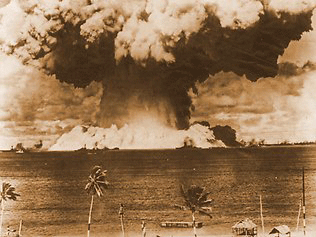 Bikini was just the beginning, bombs still threaten the islanders, New Internationalist DECEMBER 2016 John Pilger visits the Marshall Islands and its bomb survivors, still blighted by US nuclear weapons. “……..The explosion vaporized an entire island, its fall-out spreading over a vast area. There was a ‘miscalculation’, according to the official history; the wind ‘changed suddenly’. These were the first of many lies, as declassified documents and the victims’ testimony have since revealed.
Gene Curbow, a meteorologist assigned to monitor the test site, said, ‘They knew where the radioactive fall-out was going to go. Even on the day of the shot, they still had an opportunity to evacuate people, but [people] were not evacuated; I was not evacuated… The United States needed some guinea pigs to study what the effects of radiation would do.’
The secret of the Marshall Islands was Project 4.1. Official files describe a scientific programme that began as a study of mice and became a study of human beings exposed to the radiation of a nuclear weapon. Most of the women I interviewed had suffered from thyroid cancer; many in their communities did not survive.
The US Navy returned the population of Rongelap atoll, which is downwind of Bikini, even though the food was unsafe to eat and the water unsafe to drink. As a result, reported Greenpeace – which eventually sent a ship to rescue them – ‘a high proportion of their children suffered from genetic effects’.
Archive film refers to them as ‘amenable savages’. A US Atomic Energy Agency official boasts that Rongelap is ‘by far the most contaminated place on earth’, adding, ‘It will be interesting to get a measure of human uptake when people live in a contaminated environment.’
Holding a photograph of herself as a child, with terrible facial burns and most of her hair missing, Nerje Joseph told me, ‘We were bathing at the well. White dust started falling from the sky. I reached to catch the powder. We used it as soap to wash our hair. A few days later, my hair started falling out.’
Lemoyo Abon said, ‘Some people were in agony. Others had diarrhoea. We were terrified. We thought it must be the end of the world.’
Human radiation experiments
As a nine-year-old, Tony de Brum witnessed the Bravo bomb. He became foreign minister of the Republic of the Marshall Islands, an indefatigable voice demanding justice for his people. Clutching the evidence, he stood up at the United Nations in 2005 and said, ‘United States government documents clearly demonstrate that its scientists conducted human radiation experiments with Marshallese citizens. Some of our people were injected with or were coerced to drink fluids laced with radiation. Other experiments involved the resettling of people on islands highly contaminated to study how human beings absorbed radiation from the food and environment.’
The Marshall Islands were, until 1986, a Trust Territory administered by the United States with a legal obligation to ‘protect the inhabitants against the loss of their land and resources’ and to ‘protect their health and well-being’. In 2004, the US Cancer Institute reported to Congress that future Marshallese generations were likely to contract 530 cancers.
The US relinquished direct control of the islands only after the Marshallese had agreed to accept a mere $150 million as compensation for their suffering and to allow the huge US base on Kwajalein atoll, with its ‘mission to combat communist China’ and known as the Ronald Reagan Missile Test Facility.
Commanding the Pacific all the way to Asia and China, the base continues to subject the islanders to the testing of weapons of mass destruction. Missiles are launched at night, or fired into the lagoon from California. Following each ‘shot’, islanders fall sick with a ‘mystery illness’. The Environmental Protection Agency says fish in the bay cannot be eaten; fish was once the staple. The cost of firing one missile is $100 million, or two-thirds of the compensation paid to the islanders……..
In 2014, President Obama announced that the US was ‘creating the world’s largest marine reserve in the Pacific, banning fishing and other commercial activities across pristine sea dotted with coral atolls’.
In fact, as part of Obama’s military build-up in the Pacific, known as the ‘pivot to Asia’, the US has taken control of nine million square miles of ocean – an area double the size of the mainland United States. Under cover of a marine reserve, a ‘marine range complex’ will be run by the Pentagon, with torpedoes, underwater mines and numerous other detonations. Bikini was just the beginning. https://newint.org/features/2016/12/01/bikini-was-just-the-beginning/
Climate change in action – California’s six-year drought has killed 102 Million Trees
 102 Million Trees Have Died in California’s Drought http://www.enn.com/wildlife/article/50164 California’s six years of drought has left 102 million dead trees across 7.7 million acres of forest in its wake, the U.S. Forest Service (USFS) announced following an aerial survey. If that is not horrendous enough, 62 million trees died in the year 2016 alone—an increase of more than 100 percent compared to 2015.
“The scale of die-off in California is unprecedented in our modern history,” Randy Moore, a forester for the U.S. Forest Service, told the Los Angeles Times, adding that trees are dying “at a rate much quicker than we thought.”
“You look across the hillside on a side of the road, and you see a vast landscape of dead trees,” added Adrian Das, a U.S. Geological Survey ecologist whose office is located in Sequoia National Park. “It’s pretty startling.”
Most of the dead trees are located in 10 counties in the southern and central Sierra Nevada region.
“Five consecutive years of severe drought in California, a dramatic rise in bark beetle infestation and warmer temperatures are leading to these historic levels of tree die-off,” the USFS said.
Continue reading at ENN affiliate, Care2
New York Court of Appeals approves right of the state to review Indian Point Nuclear plant’s relicensing
 In major win for NY Gov. Cuomo, high court rules state can review Indian Point
  relicensing http://www.utilitydive.com/news/in-major-win-for-ny-gov-cuomo-high-court-rules-state-can-review-indian-po/431064/ Robert Walton
Dive Brief:
- The New York Court of Appeals this week determined the state has the right to review Entergy Corp.’s request for a Coastal Consistency Determination at its Indian Point nuclear plant, a major win for Gov. Andrew Cuomo (D)’s bid to shutter the plant, the Associated Press reports.
- The facility is located about 40 miles north of New York City, and Cuomo has said it is impossible to operate safely so closely to themost populous metropolitan area in the country.
- Entergy has requested a 20-year license renewal from the Nuclear Regulatory Commission, and had argued the state did not have oversight over the process. Indian Point Units 2 and 3 have been operating since the mid-1970s.
New York’s relationship with its nuclear plants is a strange thing: for three of them, it has allocated billions of dollars to keep running. The fourth, the state has tried for years to close down.
On Monday, Associated Press reports Cuomo’s quest to mothball Indian Point got a major win: The state’s highest court sided with the New York Department of State, allowing it to ensure the Indian Point continues to operate in compliance with the state’s coastal regulations.
Entergy had argued that the state’s concerns over its water permit were a cover for safety concerns, which it said fall to the U.S. Nuclear Regulatory Commission.
In February, Cuomo ordered an investigation of the plant, over concerns it was leaking contaminated water, with monitoring wells showing a spike in radiation. A statement from Cuomo noted the state had already concluded Entergy’s relicensing application is inconsistent with the state’s Coastal Management Program.
“Indian Point is antiquated and does not belong on the Hudson River in close proximity to New York City, where it poses a threat not only to the coastal resources and uses of the river, but to millions of New Yorkers living and working in the surrounding community,” Cuomo said.
Nuclear contractors settle with USA Justice Dept over allegations of improper billing.
 United States Settles Lawsuit Against Energy Department Contractors for Knowingly Mischarging Costs on Contract at Nuclear Waste Treatment Plant https://www.justice.gov/opa/pr/united-states-settles-lawsuit-against-energy-department-contractors-knowingly-mischarging, 24 Nov 16,
The Justice Department announced today that Bechtel National Inc., Bechtel Corp., URS Corp. (predecessor in interest to AECOM Global II LLC) and URS Energy and Construction Inc. (now known as AECOM Energy and Construction Inc.) have agreed to pay $125 million to resolve allegations under the False Claims Act that they made false statements and claims to the Department of Energy (DOE) by charging DOE for deficient nuclear quality materials, services, and testing that was provided at the Waste Treatment Plant (WTP) at DOE’s Hanford Site near Richland, Washington. The settlement also resolves allegations that Bechtel National Inc. and Bechtel Corp. improperly used federal contract funds to pay for a comprehensive, multi-year lobbying campaign of Congress and other federal officials for continued funding at the WTP. Bechtel Corp. and Bechtel National Inc. are Nevada corporations. URS Corp. is headquartered in California, and URS Energy & Construction Inc. is headquartered in Colorado.
“The money allocated by Congress for the Waste Treatment Plant is intended to fund the Department of Energy’s important mission to clean up the contaminated Hanford nuclear site, and this mission is undermined if funds are wasted on goods or services that are not nuclear compliant or to further lobbying activities,” said Principal Deputy Assistant Attorney General Benjamin C. Mizer, head of the Justice Department’s Civil Division. “This settlement demonstrates that the Justice Department will work to ensure that public funds are used for the important purposes for which they are intended.”
“The DOE Office of Inspector General is committed to ensuring the integrity of Departmental contracts and financial expenditures,” said Acting Inspector General Rickey R. Hass. “We will continue to steadfastly investigate allegations of fraudulent diversion of tax dollars throughout DOE programs and appreciate the support of DOJ attorneys in these matters.”
Between 2002 and the present, DOE has paid billions of dollars to the defendants to design and build the WTP, which will be used to treat dangerous radioactive wastes that are currently stored at DOE’s Hanford Site. The contract required materials, testing and services to meet certain nuclear quality standards. The United States alleged that the defendants violated the False Claims Act by charging the government the cost of complying with these standards when they failed to do so. In particular, the United States alleged that the defendants improperly billed the government for materials and services from vendors that did not meet quality control requirements, for piping and waste vessels that did not meet quality standards and for testing from vendors who did not have compliant quality programs. The United States also alleged that Bechtel National Inc. and Bechtel Corp. improperly claimed and received government funding for lobbying activities in violation of the Byrd Amendment, and applicable contractual and regulatory requirements, all of which prohibit the use of federal funds for lobbying activities.
The allegations resolved by this settlement were initially brought in a lawsuit filed under the qui tam, or whistleblower, provisions of the False Claims Act by Gary Brunson, Donna Busche, and Walter Tamosaitis, who worked on the WTP project. The False Claims Act permits private parties to sue on behalf of the United States when they believe that a party has submitted false claims for government funds, and to receive a share of any recovery. The Act also permits the government to intervene in such a lawsuit, as it did in part in this case. The whistleblowers’ reward has not yet been determined.
This matter was handled by the Civil Division’s Commercial Litigation Branch, the U.S. Attorney’s Office for the Eastern District of Washington, the DOE Office of the Inspector General and the FBI.
The claims asserted against defendants are allegations only, and there has been no determination of liability. The case is United States ex rel. Brunson, Busche, and Tamosaitis v. Bechtel National, Inc., Bechtel Corp., URS Corp., and URS Energy & Construction, Inc., Case No. 2:13-cv-05013-EFS (E.D. Wash.).
Property values getting threatened by sea level rise. Climate change IS looking serious!
 Perils of Climate Change Could Swamp Coastal Real Estate [compelling photos] Homeowners are slowly growing wary of buying property in the areas most at risk, setting up a potential economic time bomb in an industry that is struggling to adapt.

NYT, By IAN URBINANOV. 24, 2016 MIAMI — Real estate agents looking to sell coastal properties usually focus on one thing: how close the home is to the water’s edge. But buyers are increasingly asking instead how far back it is from the waterline. How many feet above sea level? Is it fortified against storm surges? Does it have emergency power and sump pumps?
Rising sea levels are changing the way people think about waterfront real estate. Though demand remains strong and developers continue to build near the water in many coastal cities, homeowners across the nation are slowly growing wary of buying property in areas most vulnerable to the effects of climate change.
A warming planet has already forced a number of industries — coal, oil, agriculture and utilities among them — to account for potential future costs of a changed climate. The real estate industry, particularly along the vulnerable coastlines, is slowly awakening to the need to factor in the risks of catastrophic damage from climate change, including that wrought by rising seas and storm-driven flooding.
But many economists say that this reckoning needs to happen much faster and that home buyers urgently need to be better informed. Some analysts say the economic impact of a collapse in the waterfront property market could surpass that of the bursting dot-com and real estate bubbles of 2000 and 2008.
The fallout would be felt by property owners, developers, real estate lenders and the financial institutions that bundle and resell mortgages.
Over the past five years, home sales in flood-prone areas grew about 25 percent less quickly than in counties that do not typically flood, according to county-by-county data from Attom Data Solutions, the parent company of RealtyTrac. Many coastal residents are rethinking their investments and heading for safer ground.
“I don’t see how this town is going to defeat the water,” said Brent Dixon, a resident of Miami Beach who plans to move north and away from the coast in anticipation of worsening king tides, the highest predicted tide of the year. “The water always wins.”
These concerns have taken on a new urgency since the presidential election of Donald J. Trump, who has long been a skeptic of global warming, claiming in 2012 that it was a concept “created by and for the Chinese in order to make U.S. manufacturing noncompetitive.”
A real estate developer, Mr. Trump is also the owner of several South Florida properties, including Mar-a-Lago, a 20-acre site that stretches between the Atlantic Ocean and the Intracoastal Waterway in Palm Beach.
Mr. Trump’s recent selection of Myron Ebell to lead his Environmental Protection Agency transition team intensified these worries in Florida and among many climate scientists. Mr. Ebell has helped lead the charge against the scientific consensus that global warming exists and is caused by people.
State lawmakers in Massachusetts and New Jersey are pushing to impose new rules on real estate agents and others, obligating them to disclose climate-related damage like previous flooding.
Banks and insurers need to protect their collateral and investors more by improving their methods for estimating climate-change risks and creating more standardized rules for reporting them publicly, economists warn.
In April, Sean Becketti, the chief economist for Freddie Mac, the government-backed mortgage giant, issued a dire prediction. It is only a matter of time, he wrote, before sea level rise and storm surges become so unbearable along the coast that people will leave, ditching their mortgages and potentially triggering another housing meltdown — except this time, it would be unlikely that these housing prices would ever recover.
“Some residents will cash out early and suffer minimal losses,” he wrote. “Others will not be so lucky.”
Bull’s-Eye for Property Damage
Much of the uncertainty surrounding climate change focuses on the pace of the rise in sea levels. But some argue that this misses the point because property values will probably go under water long before the properties themselves do.
What is often called “nuisance” flooding — inundation caused more by tides than weather — is already affecting property values. Often just a foot or two deep, this type of flooding can stop traffic, swamp basements, damage cars and contaminate groundwater.
Florida has six of the 10 American urban centers most vulnerable to storm surge, according to a 2016 report from CoreLogic, a real estate data firm. Southeast Florida experiences about 10 tidal floods per year now. That number is likely to be around 240 floods per year by 2045, according to climate researchers……..http://www.nytimes.com/2016/11/24/science/global-warming-coastal-real-estate.html?_r=0
Climate action in America’s cities, despite Donald Trump
 How Cities Plan to Fight Climate Change in the Trump Years Local leaders learned how to take action when Washington couldn’t. Now they’re betting those efforts can survive an age of science-denying federal overlords. City Lab, JOHN METCALFE and LAURA BLISS Nov 22, 2016 What impact will Donald Trump’s league of global-warming deniers and fossil-fuel boosters have on U.S. climate action? The short-term prognosis might not be as damaging as some fear, but the broader implications aren’t good. The president-elect has proposed slashing federal funding for clean energy development, resurrecting the coal industry, backing out of the Paris agreement, and essentially ditching the EPA. Trump won’t be able to do it all, but it seems safe to assume that for the next four years, domestic climate policy will be in the deep freezer—while the rest of us heat up.
Yet local leaders across the U.S. don’t need to be persuaded of the devastating impacts of climate change—environmentally, socially, and financially speaking—even if Trump and his top advisers do. Global warming’s effects are perhaps easiest to see on the local scale, with rising tides, melting snowcaps, and drier summers. A significant part what’s causing these changes lies in urban centers, which generate an estimated 70 percent of global greenhouse gas emissions, and house more than 50 percent of the population.
And U.S. cities have the power to shrink that footprint and prepare for the worst, even in the absence of financial or regulatory support from the federal government. Congress has long stalled on advancing climate policies, anyways—while cities have taken control of crucial variables that determine emissions and sustainability: renewable-energy programs, bus-rapid transit and rail, shared mobility, protections against flooding and the ever-rising seas.
Many local leaders say that this work has become more important than ever. Here are five American cities that have made real climate progress in ways that they plan to continue in the years of a Trump administration and Republican-controlled Congress.
Miami Beach…..
San Antonio…..
San Diego….
Los Angeles….
The absurdity of continuing nuclear power, with waste disposal unsolved
“The costs associated with rehabilitating WIPP – the only underground nuclear waste repository in the country – have ballooned since 2014.”
whatever method proves the most advantageous in the US, site selection will be an essential and hard-to-navigate obstacle to overcome if the country is ever going to face up to a nuclear waste backlog that is getting longer every year.

Why doesn’t anyone ever suggest just stopping making the stuff?
Waste storage: America’s nuclear hot potato A 2014 leak at a nuclear waste repository in New Mexico has raised far-reaching questions about long-term storage in the US. On top of the political and economic fallout from the incident, it has reignited the debate about finding a permanent storage site for commercial nuclear waste, a problem that looks no closer to a solution than it did 30 years ago. Power Technology by Chris Lo, 21 Nov 16,
While the US Department of Energy (DOE) was quick to downplay the immediate risks the leak posed to plant workers and nearby communities, the long-term ramifications of the incident – both in terms of direct consequences and wider implications – have added salt to the open wound that is America’s ongoing nuclear waste storage issue.
The plant, which has been used as a long-term storage site for transuranic radioactive waste from US nuclear weapons research and production since 1999, is not scheduled to resume full operations until 2021. The political and economic fallout from the incident could last much longer, with significant knock-on effects for the nation’s fleet of commercial nuclear plants.
WIPP leak: the political and economic fallout
The costs associated with rehabilitating WIPP – the only underground nuclear waste repository in the country – have ballooned since 2014, with delays and complications bringing the total cost of the clean-up to a potential minimum of $2bn, according to analysis published by the Los Angeles Times in August. This puts it on par, in terms of cost, with the clean-up after the infamous partial meltdown of the Three Mile Island nuclear plant in 1979.
On top of the approximately $640m cost of the clean-up itself, the expense of potentially extending the facility’s operation for an additional seven years to make up for the prolonged closure could add $1.4bn to the bill.
Further costs include a $74m settlement paid by the federal government to the state of New Mexico for the leak and a truck fire that occurred just days before, as well as the added expense of continuing to store and maintain nuclear research waste at temporary sites such as the Hanford Site in Washington state, which is waiting to ship 24,000 drums of waste to WIPP. The delays caused by the leak also exacerbate already fractious relations between nuclear storage states and the federal government over the need to move waste from temporary processing facilities.
“The costs associated with rehabilitating WIPP – the only underground nuclear waste repository in the country – have ballooned since 2014.” “Safe and successful clean-up of the nuclear waste stored at Hanford is of utmost priority for the people of Washington state and the Pacific Northwest,” said Washington Governor Jay Inslee in March 2014, just a month after the WIPP incident. “The federal government has a moral and legal obligation to oversee the successful cleanup of the waste that remains. Fifty-six million gallons of hazardous and radioactive waste continue to be held in Hanford’s storage tanks – now decades beyond their intended use.”
Politically, the loss of the New Mexico site would be damaging to the US government’s commitment to dispose of plutonium, about which it has signed mutual agreements with Russia. This is yet another reason why the DOE seems unwilling to consider abandoning WIPP, despite the huge cost and complex technical issues associated with its repair.
“The facility was never designed to operate in a contaminated state,” said the Southwest Research and Information Center’s director of nuclear waste safety Don Hancock in an interview with the LA Times in August. “It was supposed to open clean and stay clean, but now it will have to operate dirty. Nobody at the Energy Department wants to consider the potential that it isn’t fixable.”
Commercial waste storage: if not WIPP, then where?
Perhaps of most concern to the operators of commercial nuclear power plants is the loss of WIPP as a potential permanent storage site for nuclear waste from the civil energy industry. The facility and its use of salt formations to seal waste has been mooted as a potential frontrunner model to permanently store non-defence, uranium-based nuclear waste from power plants.
The prospect of expanding WIPP to host commercial as well as defence-related waste had been mooted, but this seems highly unlikely given the incident and the plant’s now-compromised situation. This is a problem for the US civil nuclear fleet, which has by now accumulated around 75,000 tonnes of spent nuclear fuel, at a rate of approximately 2,200 tonnes a year.
The vast majority of this high-level radioactive waste is currently being stored on an interim basis at temporary facilities, usually at the sites of the operating or decommissioned power stations themselves. These sites, which store spent fuel in pools to cool for five years before being transferred to dry casks, are not intended for long-term storage, and their continued use represents both a leak risk and an enormous cost to plant operators, who spend millions to process and maintain waste, and to the government, which is liable for part of these storage costs as a result of industry lawsuits related to its failure to take possession of spent fuel by the required date of 1998. DOE figures put the amount paid in damages to the nuclear energy industry thus far at $4.5bn, with an estimated $22.6bn in future liabilities. As such, the need for a permanent storage site for commercial nuclear waste is acute.
Case in point: WIPP was originally suggested as a replacement for another long-term nuclear storage option that has been on the table in the US since as far back as 1987, when the Nuclear Waste Storage Act of 1982 was amended by Congress to make it the only site under consideration as a permanent solution. That site is Yucca Mountain in Nevada, the development of which is a decades-long saga that has left the US no closer to solving its waste dilemma. ……
It seems unlikely that Yucca Mountain will go ahead as a permanent storage site after decades of stalwart opposition. The DOE is now considering various technologies and sites after promising in 2015 to develop a new “consent-based” approach to finding a new site. Storage methods such as deep boreholes, salt beds, underground salt domes, and granite and shale repositories are on the table and, in many cases, in active development in Europe and elsewhere. But whatever method proves the most advantageous in the US, site selection will be an essential and hard-to-navigate obstacle to overcome if the country is ever going to face up to a nuclear waste backlog that is getting longer every year. http://www.power-technology.com/features/featurewaste-storage-americas-nuclear-hot-potato-5673043/
New York State moves towards closing dilapidated Indian Point nuclear station
‘Most dilapidated’ US nuclear power plant to close?, DW, 22 Nov 16 New York state has taken a pivotal step toward shutting down what critics have called the US’ “most dilapidated and dangerous nuclear power plant.” The renewal of one of the permits for Indian Point looks unlikely. The New York Court of Appeal’s latest decision on the Indian Point nuclear facility concerned an application to renew one of the permits required by Entergy to continue operating two pressurized water reactors at the plant. The reactors in question were put into operation in 1974 and 1976 respectively.

Contrary to a lower court’s ruling, the Court of Appeal said the request must be submitted to the State Department of New York State, which looked likely to reject it.
“The Department of State already concluded that the Indian Point relicensing application is inconsistent with New York’s long-standing Coastal Management Program requirements and will continue to use this program to protect New York’s coastline, Governor Andrew Cuomo said in a statement.
Good riddance?
“Indian Point is antiquated and does not belong on the Hudson River in close proximity to New York City where it poses a threat not only to the coastal resources and uses of the river, but also to millions of New Yorkers living and working in the surrounding community,” Cuomo added.
The Court of Appeal’s decision was also hailed by the Waterkeeper Alliance. “Indian Point is the oldest, most dilapidated, mismanaged and dangerous nuclear power plant in America,” it said in a statement on Ecowatch.com’s website……http://www.dw.com/en/most-dilapidated-us-nuclear-power-plant-to-close/a-36474986
Savannah River Site could be stuck with stranded nuclear wastes from Canadian research reactor
“We are concerned that DOE is planning to bring more HEU-related waste to SRS over the coming years, with no plan for their removal from South Carolina and without the public being properly informed about these waste-imports and long-term storage and disposition plans,”
Shipments of nuclear material to Savannah River Site could continue http://www.aikenstandard.com/news/shipments-of-nuclear-material-to-savannah-river-site-could-continue/article_52996fce-adc7-11e6-853a-3b61beb03e76.html By Thomas Gardiner tgardiner@aikenstandard.com Nov 18, 2016
Spent fuel from a research reactor at the University of Alberta in Canada could soon be en route to South Carolina’s Savannah River Site.
According to documentation provided by the Nuclear Regulatory Commission, shipping casks for the transfer are being reviewed and a planned shipping route has been approved.
The exact route through the U.S. begins at the Sweet Grass, Montana, border crossing, and ends near Aiken County at the Savannah River Site. According to Nuclear Regulatory Commission spokesperson Roger Hannah, actual routes are not publicized because of security concerns. However, the journey from Sweet Grass to Aiken County is close to 2,300 miles along major U.S. highways, depending on which cities the route goes through.
The spent fuel is U.S.-origin, highly-enriched uranium. It was used for research in a reactor called a “safe low-power kritical experiment,” or SLOWPOKE reactor. In the documents related to the shipping cask review, the SLOWPOKE reactor core is also included in the review.
The Department of Energy has shipped SLOWPOKE reactor cores in the past, with one now residing at Savannah River Site’s L-Basin.
Tom Clements, director of SRS Watch, said in a release, “In September 2015, a SLOWPOKE core was shipped from Jamaica to SRS, where it is now stored with no long-term disposition plans.”
The new material also would be destined for L-Basin. However, with the scrapped Yucca Mountain project and the backlogged waste isolation pilot plant, or WIPP, it is unclear what pathway exists to get the material back out of South Carolina. In multiple conversations about nuclear material coming into the Palmetto State, Gov. Nikki Haley has repeatedly said she refuses to let South Carolina becoming a nuclear dumping ground.
“We believe it is prudent to halt to shipment of HEU-bearing waste to SRS until such time as a plan is presented for removal of such waste from the site,” Clements said.
“We are concerned that DOE is planning to bring more HEU-related waste to SRS over the coming years, with no plan for their removal from South Carolina and without the public being properly informed about these waste-imports and long-term storage and disposition plans,” he said.
According to NRC documents, cask approval could come in March 2017. If that approval is issued, the material could hit the road in 2018. That timeline matches up with presentation given to the Citizens Advisory Board early this year, that showed shipments from Alberta, Canada, expected in 2018.
The route was approved Nov. 9 and won’t expire until Dec. 31, 2021.
Nuclear propagandist James Conca shows the industry how to peddle its lies
From Media To Nuclear Power, Messaging Trumps Reality, Forbes, James Conca , 22 Nov 16
“……the nuclear industry, along with most others, must get with the program and learn to define itself first, control the message, and disrupt the nonsense espoused by its detractors (HuffPost). It must tell its story in terms of job creation and lucrative careers, in terms of lights and heating and electricity and what that means to modern societies, or to eradicating poverty. It must speak in terms of innovation, inventions and technology creation. Above all, the industry must wrest control of the green message by taking on its very leadership since nuclear produces twice as much clean energy as all other clean energy sources combined.

And it must do this on social media. Sites like Northwest Clean Energy, Nuke Power Talk, Atomic Insights, the World Nuclear Association, the Nuclear Energy Institute, Mothers for Nuclear, and Nuclear Street, among others, are excellent sources of good, readily-available, easy-to-understand information on nuclear power along with most other forms of power. But they have difficulty reaching millions of people. Anti-nuclear activists are more numerous and their messaging doesn’t even have to be correct. They reach millions of people.
More than ever before, Americans need to know what is real, and what is in their best interest. In the cacophony of messaging in the present world, it is more and more difficult to get the truth to the public. Or to have them recognize it…..”
Exelon pushes bills in Illinois General Assembly to subsidise and save its nuclear power stations
 Inside Exelon’s last-minute push to save its nukes and remake the Illinois power sector
The Illinois legislature has a week to decide on a far-reaching energy reform bill that includes something for everyone to hate, Utility Dive, Peter Maloney@TopFloorPower, 22 Nov 16 fate of two nuclear plants in Illinois is coming down to the wire.
A bill introduced into the Illinois General Assembly this week would provide subsidies Exelon says are necessary to keep its Clinton and Quad City nuclear plants online.
When the legislature failed to pass a previous version of the bill, Exelon said it would close the 1,069-MW Clinton station on June 1, 2017, and the 1,871-MW Quad Cities plant in Cordova on June 1, 2018. At the time, Exelon said the plants had lost a combined $800 million over the past seven years.
Exelon faces a Dec. 1 deadline for notifying the Midcontinent ISO about whether or not it will close Clinton next year.
There is a lot riding on the bill. According to Exelon’s accounting, closing the nuclear facilities would result in the loss of $1.2 billion in economic activity annually.
orking through the complexities of any one of those provisions would be enough of a challenge, but lawmakers are working under a tight deadline.
The bill was taken up in the General Assembly’s veto session, which has a short lifespan of less than a week. The final day of the session is Dec. 1, but it could roll over into a lame duck session that could extend to Jan. 11, 2017.
Exelon, of course, is also facing the Dec. 1 deadline for giving notice to MISO regarding the closure of the Clinton nuclear plant.
The lawmakers’ work could be eased somewhat by the fact that many of the provisions cover familiar ground. The Future Energy Jobs Bill, as it’s called, traces its history back to three bills that were eventually rolled into one. All three failed, but then failed bills were reworked into a single piece of legislation. But that bill, too, failed to make it through the assembly.
That bill was also reworked and revived for the current session and now includes $1 billion in funding for low-income program, a doubling of energy efficiency programs to produce $4 billion in energy savings, fixes for the state’s stalled renewable portfolio standard program, and funding of up to $220 million a year for renewable resources.
The bill was also recast at the last minute after Donald Trump won the presidential election to highlight its job saving or creating aspects. Prior to the election, the bill had assumed that the Clean Power Plan, the environmental regulations that would limit carbon dioxide emissions from coal plants and that is stalled by court challenges, would be put in place and provide an economic rationale for zero emission generation. But Trump has promised to dismantle those regulations.
The Future Energy Jobs Bill made it through the House Energy Committee Wednesday night, but many of the lawmakers who voted to move the bill cast a “yea” vote with the expectation that there would be substantial changes before the bill comes to the floor of the assembly.
The legislature is now faced with a single massive (446 pages) bill laden with provisions – what legislators call a “Christmas tree”– that has something for everyone. It also has something for everyone to dislike. The bill attracted vociferous criticism from a variety of constituents as soon as it landed.
“This is going to be the largest rate hike in U.S. history,” Dave Lundy, head of the BEST Coalition, a business group opposed to the bill, said at a press conference shortly after the bill was introduced.
Lundy argues that the capacity represented by the nuclear plants is not needed. Electricity demand is down 3% in the state, and Illinois generates 41% more power than it consumes, meaning that much of that output is exported out of state……..
Eric Robertson, general counsel of Illinois Industrial Energy Consumers, told the House committee his group opposes the legislation because the FRAP would increase commercial and industrial electric rates by $125 million a year.
SolarCity also opposes the legislation, not necessarily because of the FRAP, but because it would impose demand charges on retail customers and eliminate retail net metering in the state. Elimination of net metering would do away with a revenue stream that provide much of the incentive for rooftop solar, and demand charges would make electricity bills unpredictable, Elizabeth Pearlman, regulatory counsel and director of policy at SolarCity, told the committee.
“If you can’t do the math at the kitchen table, we can’t sell you solar,” she said. She called the bill’s proposed imposition of demand charges on customers’ bills, a “radical” and “unprecedented” change, one that is usually effected by regulatory commissions, not legislatures.
Both Shannon Fulton, president of the Illinois Solar Energy Association, and Amy Heart with The Alliance for Solar Choice cited the dual effect of the demand charge and net metering changes and said they also oppose passage of the bill.
With all the controversy, it seems clear that the Future Energy Jobs bill is still a work in progress and, if it does come to a vote, it will be on a revised version of the legislation.
In the committee meeting, Rita said there are “issues we have to work through,” and pledged that a revised bill would come “back through this committee.” http://www.utilitydive.com/news/inside-exelons-last-minute-push-to-save-its-nukes-and-remake-the-illinois/430692/
Obama government pushes a slate of clean energy initiatives
 In last minute dash, Obama administration pushes global clean energy initiatives http://www.utilitydive.com/news/in-last-minute-dash-obama-administration-pushes-global-clean-energy-initia/430430/Robert Walton
- The Obama administration has announced a broad range of global clean energy initiatives and investments, including financing in India and El Salvador, off-grid grants in Africa and a new report on the market for access to efficient appliances.
- The slate of announcements includes committing $125 million in financing for renewable energy projects through the Overseas Private Investment Corporation.
- The funding is a small drop compared to the $11 billion the United States has invested from 2010-2015 alone in international clean energy finance, according to the Department of Energy.
While President-elect Trump’s looming presidency has worried many over the future of the clean energy technology, the Obama administration is not slowing down on global decarbonization goals.
The White House continues its progressive moves on energy efficiency, global clean energy and decarbonization, last week issuing a lengthy overview of new initiatives. Among them:
- A partnership between the U.S. Agency for International Development (USAID), the Department of State and the Department of Energy’s National Renewable Energy Laboratory to identify “a pipeline of clean energy entrepreneurs in developing countries.”
- Providing $4 million in awards to eight household solar firms under the Power Africa Scaling Off Grid Grand Challenge, totaling a $36 million investment to empower entrepreneurs and investors in sub-Saharan Africa.
- Announcing more than $11 million raised for the deployment of efficient off-grid technologies globally through the Efficiency for Access Coalition;
- Launching a partnership to bring more efficient appliances tor rural Indian villages; and
- And supporting the first Solar Decathlon competition in Africa.
-
The USAID-State partnership with the National Laboratories aims to expand the geographic reach of the next annual Industry Growth Forum in April 2017. “This is one of the nation’s premier clean energy investment event to connect early stage companies with capital,” the White House said.So far, companies participating in the NREL Growth Forum have raised over $5 billion in financing.
Last week, the White House also released a report detailing the status of global markets for off-grid energy and the U.S. government’s role in developing those markets. In the past decade, the market has “grown exponentially” to give millions access to basic energy services.
According to the report, worldwide there are over 20 million households powered by solar home systems, and another 6 million are connected to renewables-based mini-grids or small wind turbines.
Recommended Reading:
 U.S. Department of Energy
-
Archives
- October 2026 (112)
- September 2026 (339)
- August 2026 (330)
- July 2026 (355)
- June 2026 (287)
- May 2026 (306)
- April 2026 (356)
- March 2026 (251)
- February 2026 (267)
- January 2026 (308)
- December 2025 (358)
- November 2025 (359)
-
Categories
- 1
- 1 NUCLEAR ISSUES
- business and costs
- climate change
- culture and arts
- ENERGY
- environment
- health
- history
- indigenous issues
- Legal
- marketing of nuclear
- media
- opposition to nuclear
- PERSONAL STORIES
- politics
- politics international
- Religion and ethics
- safety
- secrets,lies and civil liberties
- spinbuster
- technology
- Uranium
- wastes
- weapons and war
- Women
- 2 WORLD
- ACTION
- AFRICA
- Atrocities
- AUSTRALIA
- Christina's notes
- Christina's themes
- culture and arts
- Events
- Fuk 2022
- Fuk 2023
- Fukushima 2017
- Fukushima 2018
- fukushima 2019
- Fukushima 2020
- Fukushima 2021
- general
- global warming
- Humour (God we need it)
- Nuclear
- RARE EARTHS
- Reference
- resources – print
- Resources -audiovicual
- Weekly Newsletter
- World
- World Nuclear
- YouTube
-
RSS
Entries RSS
Comments RSS


