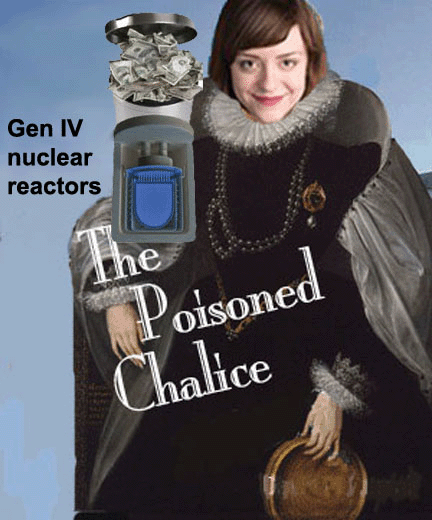
Molten Salt Reactor Claims Melt Down Under Scrutiny 03/08/2017 more http://www.powermag.com/blog/molten-salt-reactor-claims-melt-down-under-scrutiny/ Kennedy Maize It was an astonishing event when two MIT nuclear engineering graduate students at the end of 2015 announced they had come up with a revolutionary design for a molten salt nuclear reactor that could solve many of the technological problems of conventional light-water  reactors. Cofounders of the firm Transatomic – Leslie Dewan and Mark Massie – hyped their technology as able to run on conventional spent fuel, and “generate up to 75 times more electricity per ton of mined uranium than a light-water reactor.”
Their claims surfaced in MIT’s highly regarded magazine, Technology Review, under the headline, “What if we could build a nuclear reactor that costs half as much, consumes nuclear waste, and will never melt down?”
Dewan and Massie raised millions of dollars in venture capital, including a chunk of Peter Theil’s Founders Fund. Transatomic said it would have a demonstration reactor in operation by 2020. The entrepreneurs touted their technology, which had its roots in work of the legendary Alvin Weinberg at Oak Ridge National Laboratory in the 1950s, as passively safe and more efficient than conventional nuclear generating technology.
Then it came under scrutiny from the MIT nuclear graybeards. The grad students got it wrong. Very wrong.
Transatomic’s response: Never mind.
The hyped claims for the technology prompted MIT physics professor Kord Smith to raise his eyebrows. As Technology Review reported, somewhat shamefacedly, Smith thought the claims for the technology were bogus, based on the physics, notified the MIT hierarchy, and launched an inquiry. The magazine quoted him, “I said this is obviously incorrect based on basic physics.” He asked the company to run a test, which ended up confirming that “their claims were completely untrue.”
Transatomic recalculated its hyperbolic claims, and posted the results. It concluded that “75 times” was fantastic, and the real figure was “twice,” still a worthwhile increase in fuel efficiency, but hardly earth shattering. The new analysis also concluded that the technology could not use spent fuel to power its reactor technology, undercutting a major claimed advantage for the technology.
Founder Leslie Dewan told Technology Review that she now hopes to develop a demonstration reactor by 2021. But any advanced technology of this sort that meets Nuclear Regulatory Commission rules would be decades away.
Was this hyperbolic advancement of the venerable molten salt technology intentional? MIT’s Smith, who blew the whistle on the claims, says it was innocent. The founders didn’t subject their initial calculations and claims to any kind of peer review. Smith told Technology Review, “They didn’t do any of this intentionally. It was just a lack of experience and perhaps overconfidence in their own ability. And then not listening carefully enough when people were questioning the conclusions they were coming to.”
In other words, this was another case of technology hubris, an all-to-common malady in energy, where hyperbolic claims are frequent and technology journalists all too credulous.
March 15, 2017
Posted by Christina Macpherson |
spinbuster, technology, USA |
Leave a comment

 The Big Winner in Donald Trump’s Decision to Fire Preet Bharara Might Be Rupert Murdoch, My Mag, By Gabriel Sherman, 12 Mar 17, Throughout his six-decade career working on three continents, Rupert Murdoch has used his media properties to advance the prospects of politicians whose policies help his business interests. Whether it was Margaret Thatcher’s union-busting in the 1980s or Rudy Giuliani’s campaign to put Fox News on Time Warner’s cable system in the 1990s, Murdoch went all-out for leaders who allowed him to protect and expand his corporate empire.
Since Election Day, Murdoch, now the executive chairman of Fox News, has personally nudged the network in a more pro-Trump direction, sources tell me. That effort included anointing Trump-friendly Tucker Carlson as the successor to Megyn Kelly as host in the 9 p.m. slot. Fox News staffers are also grumbling that segments now have to fit a “pro-Trump narrative,” one insider told me. Trump seems to be returning the goodwill: He asked Murdoch to submit names for FCC commissioner and tweeted praise for Fox News. He’s even taken policy ideas from the network. Now Murdoch may be poised to reap a much bigger win from a Trump administration action.
That’s because on Saturday Trump oversaw the firing of Preet Bharara, the U.S attorney for the Southern District of Manhattan, whose office is in the middle of a high-profile federal investigation of Fox News. The probe, according to sources, is looking at a number of potential crimes, including whether Fox News executives broke laws by allegedly obtaining journalists’ phone records or committed mail and wire fraud by hiding financial settlements paid to women who accused Roger Ailes of sexual harassment. …….
Given that Fox News is Murdoch’s most profitable division, the prospect of indictments is a serious problem. …..
for Murdoch, it must be a relief that Bharara’s replacement could be an ally. According to the Times, Trump’s short list to replace Bharara includes Marc Mukasey — who just happens to be former Fox News chief Roger Ailes’s personal lawyer….. http://nymag.com/daily/intelligencer/2017/03/winner-in-trumps-decision-to-fire-bharara-might-be-murdoch.html
March 15, 2017
Posted by Christina Macpherson |
media, politics, USA |
Leave a comment
North Korea’s nuclear EMP attack to ‘plunge US into DARK APOCALYPSE’ http://www.dailystar.co.uk/news/latest-news/596437/Kim-Jong-un-Donald-Trump-World-War-3-Nuclear-War-North-Korea-US-EMP-Pyongyang

KIM Jong-un could send the US back to the Stone Age by unleashing a devastating Cold War-style attack on its power grid, a former CIA boss has warned. By Jamie Micklethwaite / Published 14th March 2017 North Korea and the US have been at loggerheads recently, with the tubby tyrant threatening to launch a devastating nuclear assault on US heartland.
Donald Trump has responded by promising repercussions for the hermit state and deploying anti-missile systems on their border.
But a former head of the country’s intelligence agency has warned The Donald that Kim could detonate a nuclear missile into the atmosphere, unleashing a terrifying “electromagnetic pulse” attack.
This would knock out the US’ energy infrastructure, unleashing a doomsday apocalypse scenario.
Former CIA chief chief James Woolsey said: “I think this is the principal, the most important and dangerous, threat to the United States.
“If you look at the electric grid and what it’s susceptible to, we would be moving into a world with no food delivery, no water purification, no banking, no telecommunications, no medicine.
“All of these things depend on electricity in one way or another.”
EMPs can naturally occur – but can also be created with nuclear weapons in the atmosphere.
During the Cold War, the US experimented with this, exploding a nuclear weapon above the Pacific, that knocked out lights and telephone wires in Hawaii. Ex-CIA worker Peter Vincent Pry revealed even a small nuclear bomb could cause a devastating EMP attack.
He said: “One of the myths out there is that you need a high-yield weapon to do an EMP attack.
“Even a low-yield, primitive weapon like the bomb used in Hiroshima will produce a potentially catastrophic EMP field because it’s simply attacking things that are not hardened.”
Terror expert Scott Stewart added that the US grid was very vulnerable, and any EMP attack could trigger a nuclear war.
He said: “Nuclear weapons give (Kim) a deterrent.
“That you can draw a nuke on Seoul very easily is far more of a deterrent than an EMP strike against the United States. “Nothing would take his government down quicker than an actual war against the US.”
The North has launched five missiles this year in a chilling warning to the US.
US troops, including elite marines who killed Osama bin Laden and nuclear bombers are currently taking part in military exercises on the North Korean border with South Korea.
http://www.dailystar.co.uk/news/latest-news/596437/Kim-Jong-un-Donald-Trump-World-War-3-Nuclear-War-North-Korea-US-EMP-Pyongyang
March 15, 2017
Posted by Christina Macpherson |
South Korea, USA, weapons and war |
Leave a comment
 Nuclear shipment not safe http://www.niagarathisweek.com/opinion-story/7189835-nuclear-shipment-not-safe/ Niagara This Week – St. Catharines, Susan Prayn 14 Mar 17, The proposed transportation of liquid highly enriched uranium (HEU) from Chalk River to Savannah South Carolina is not safe.
A liquid highly enriched uranium mixture containing other fissionable products with high toxicity has never been transferred in the world before.
A recent report by Dr. Marvin Resnikoff, a recognized nuclear transportation and waste disposal expert for many U.S states and the U.S government concludes that the NAC-LWT could not withstand more severe realistic accident conditions. For this reason, the highly radioactive liquid from Chalk River should not be transported in the NAC-LWT cask.
The liquid should be solidified before transport, or not transported at all.
With the recent over 40-car collisions on the 401 and the diesel spill in B.C., as well as future accidents coming, why are we endangering the environment, the people, and the first responders? Is it the cost of solidifying this liquid?
The Iroquois Caucus has a media release condemning the transport and will not stand idly by.
In Indonesia, they are down blending their HEU. They have signed on to the International Repatriation Agreement. Why is Canada treated differently?
Call your local MP and ask what they are doing on this issue.
March 15, 2017
Posted by Christina Macpherson |
Canada, safety, USA |
Leave a comment

Does this corporate capture of academia apply to nuclear research, also?

 The fossil fuel industry’s invisible colonization of academia https://www.theguardian.com/environment/climate-consensus-97-per-cent/2017/mar/13/the-fossil-fuel-industrys-invisible-colonization-of-academia
Corporate capture of academic research by the fossil fuel industry is an elephant in the room and a threat to tackling climate change, Guardian, Benjamin Franta and Geoffrey Supran, 13 Mar 17, On February 16, the Harvard Kennedy School’s Belfer Center hosted a film screening of the “Rational Middle Energy Series.” The university promoted the event as “Finding Energy’s Rational Middle” and described the film’s motivation as “a need and desire for a balanced discussion about today’s energy issues.”
Who can argue with balance and rationality? And with Harvard’s stamp of approval, surely the information presented to students and the public would be credible and reliable. Right?
Wrong.
The event’s sponsor was Shell Oil Company. The producer of the film series was Shell. The film’s director is Vice President of a family-owned oil and gas company, and has taken approximately $300,000 from Shell. The host, Harvard Kennedy School, has received at least $3.75 million from Shell. And the event’s panel included a Shell Executive Vice President.
The film “The Great Transition” says natural gas is “clean” (in terms of carbon emissions, it is not) and that low-carbon, renewable energy is a “very long time off” (which is a political judgment, not a fact). Amy Myers Jaffe, identified in the film as the Executive Director of Energy and Sustainability at the University of California, Davis, says, “We need to be realistic that we’re gonna use fossil fuels now, because in the end, we are.” We are not told that she is a member of the US National Petroleum Council.
The film also features Richard Newell, who is identified as a Former Administrator at the US Energy Information Administration. “You can get 50% reductions in your emissions relative to coal through natural gas,” he says, ignoring the methane leaks that undermine such claims. The film neglects to mention that the Energy Initiative Newell founded and directed at Duke University was given $4 million by an Executive Vice President of a natural gas company.
Michelle Michot Foss, who offers skepticism about battery production for renewables, is identified as the Chief Energy Economist at the Center for Energy Economics at the University of Texas at Austin. What’s not said is that the Energy Institute she founded at UT Austin is funded by Chevron, ExxonMobil, and other fossil fuel interests including the Koch Foundation, or that she’s a partner in a natural gas company.
You may notice a pattern. The very experts we assume to be objective, and the very centers of research we assume to be independent, are connected with the very industry the public believes they are objectively studying. Moreover, these connections are often kept hidden.
To say that these experts and research centers have conflicts of interest is an understatement: many of them exist as they do only because of the fossil fuel industry. They are industry projects with the appearance of neutrality and credibility given by academia.
After years conducting energy-related research at Harvard and MIT, we have come to discover firsthand that this pattern is systemic. Funding from Shell, Chevron, BP, and other oil and gas companies dominates Harvard’s energy and climate policy research, and Harvard research directors consult for the industry. These are the experts tasked with formulating policies for countering climate change, policies that threaten the profits – indeed the existence – of the fossil fuel industry.
Down the street at MIT, the Institute’s Energy Initiative is almost entirely fundedby fossil fuel companies, including Shell, ExxonMobil, and Chevron. MIT has taken $185 million from oil billionaire and climate denial financier David Koch, who is a Life Member of the university’s board.
The trend continues at Stanford, where one of us now works. The university’s Global Climate and Energy Project is funded by ExxonMobil and Schlumberger. The Project’s founding and current directors are both petroleum engineers. Its current director also co-directs Stanford’s Precourt Institute for Energy, which is named after (and was co-founded by) the CEO of a natural gas company (now owned by Shell). Across the bay, UC Berkeley’s Energy Biosciences Institute is the product of a $500 million deal with BP – one that gives the company power over which research projects get funded and which don’t.
Fossil fuel interests – oil, gas, and coal companies, fossil-fueled utilities, and fossil fuel investors – have colonized nearly every nook and cranny of energy and climate policy research in American universities, and much of energy science too. And they have done so quietly, without the general public’s knowledge.
For comparison, imagine if public health research were funded predominantly by the tobacco industry. It doesn’t take a neurosurgeon to understand the folly of making policy or science research financially dependent on the very industry it may regulate or negatively affect. Harvard’s school of public health no longer takes funding from the tobacco industry for that very reason. Yet such conflicts of interest are not only rife in energy and climate research, they are the norm.
This norm is no accident: it is the product of a public relations strategy to neutralize science and target those whom ExxonMobil dubbed “Informed Influentials,” and it comes straight out of Big Tobacco’s playbook. The myriad benefits of this strategy to the fossil fuel industry (and its effects on academic research) range from benign to insidious to unconscionable, but the big picture is simple: academia has a problem.
As scientists and policy experts rush to find solutions to the greatest challenge humanity has ever faced, our institutions are embroiled in a nationwide conflict of interest with the industry that has the most to lose. Our message to universities is: stop ignoring it.
We are not saying that universities must cut all ties with all fossil fuel companies. Energy research is so awash with fossil fuel funding that such a proposal would imply major changes. What we are saying is that denial – “I don’t see a conflict,” MIT’s Chairman told the Boston Globe – is no longer acceptable.
Two parallel approaches can help. First, mandatory standards should be established in climate policy and energy research for disclosing financial and professional ties with fossil fuel interests, akin to those required in medical research. And second, conflicts of interest should be reduced by prioritizing less conflicted funding and personnel.
One way or another, the colonization of academia by the fossil fuel industry must be confronted. Because when our nation’s “independent” research to stop climate change is in fact dependent on an industry whose interests oppose that goal, neither the public nor the future is well served.
Dr. Benjamin Franta is a PhD student in the Department of History at Stanford University, an Associate at the Harvard School of Engineering and Applied Sciences, and a former Research Fellow at the Harvard Kennedy School of Government’s Belfer Center for Science and International Affairs. He has a PhD in Applied Physics from Harvard University.
March 15, 2017
Posted by Christina Macpherson |
Reference, secrets,lies and civil liberties, USA |
Leave a comment
Legislation That Would Support Connecticut Nuclear Plant Released, Courant, 14 Mar 17 Stephen Singer Contact Reporter
Legislation intended to give the Millstone nuclear plant access to power markets has been broadened to increase Connecticut’s portfolio of renewable energy sources.
The measure, released Monday by the legislature’s energy and technology committee, gives the state new authority to include nuclear energy in the portfolio of other zero- or low-carbon emission sources of power…….
A group of power producers criticized the legislation as “bad for residents and bad for business.”
“It would provide Millstone a huge corporate payout funded by raising utility bills for businesses and residents,” said the group, which includes Calpine Corp., Dynegy, NRG Energy and the Electric Power Supply Association.
As other states subsidize nuclear energy, the Connecticut proposal is touted by Dominion as a measure that provides no subsidy but gives it the ability to compete with other sources of energy.
Power producers and consumer advocates are demanding that Dominion open its financial records to show why it needs the legislation…..http://www.courant.com/business/hc-millstone-energy-legislationrecovered-tue-mar-14-103723-2017–20170314-story.html
March 15, 2017
Posted by Christina Macpherson |
politics, USA |
Leave a comment

New regs for Wednesday: Nuclear, The Hill, 13 Mar 17
“………..The Nuclear Regulatory Commission (NRC) is drafting new rules for nuclear power reactors that are being decommissioned.
The rules will “provide for an efficient decommissioning process” and “reduce the need for exemptions from existing regulations.”
The public has 90 days to comment.http://thehill.com/regulation/323851-new-regs-for-wednesday-prepaid-cards-nuclear-water
March 15, 2017
Posted by Christina Macpherson |
Legal, USA |
Leave a comment
In Ky. coal country, a potential embrace of nuclear power, WMC Action News, Wednesday, March 15th 2017, By ADAM BEAM Associated Press FRANKFORT, Ky. (AP) – Donald Trump promised to bring back coal jobs, but even the country’s third-largest coal producer appears to be hedging its bets on a comeback. Kentucky is on the cusp of doing what was once unthinkable: opening the door to nuclear power. The Republican-controlled state legislature is close to lifting its decades-long moratorium on nuclear energy in a state that has been culturally and economically dominated by coal……..
But Kentucky has been burned by the nuclear industry in the past. In the 1960s, seeking to lure the emerging nuclear energy industry into the state, Kentucky set up a place to store toxic waste. From 1963 to 1977, more than 800 corporations dumped 4.7 million cubic feet of radioactive waste at the site, but no nuclear reactor was ever built. The Maxey Flats site is closed, but its contaminated soil, surface water and groundwater resulted in an expensive state and federal cleanup.
“This is the Faustian bargain we engage in. We get cheap energy, but we saddle future generations with millennia responsibility of being mature enough to properly manage waste we are generating,” said Tom Fitzgerald, executive director of the Kentucky Resources Council, which has opposed lifting the moratorium.
Even if the ban is lifted, a nuclear power plant could still take more than 10 years to develop given the rigorous permitting process. And construction would be expensive, which would threaten to drive up electricity rates to pay for it. That is of particular concern to the state’s manufacturing sector, which uses large amounts of electricity in their production processes.
The bill requires state officials to review the state’s permitting process to ensure costs and “environmental consequences” are taken into account. ……http://www.wmcactionnews5.com/story/34799143/in-ky-coal-country-a-potential-embrace-of-nuclear-power
March 15, 2017
Posted by Christina Macpherson |
politics, USA |
Leave a comment
Silence:Largest march for native rights in DC ignored by the White House and mainstream media http://americanindiansandfriends.com/main-feed-news/silence [Excellent photos] – See more at: http://americanindiansandfriends.com/main-feed-news/silence#sthash.inDWHgGX.dpuf The White House didn’t comment nor answer to the tribe’s request. There were a few mainstream Media sources that relayed the event, but the most important information was from social media sites, Twitter and Facebook.
Native American tribes and their supporters headed to the US capital for four days of demonstrations against the construction of the Dakota Access pipeline and to raise awareness of other issues affecting Native Americans.
Activists from indigenous tribes from across America had set up a teepee encampment next to the Washington Monument, before marching on Trump Tower and the White House
The protests follow a year-long battle by the Standing Rock Sioux Tribe and environmentalists against the construction of the controversial Dakota Access pipeline and the desecration of tribal lands.
The Washington DC protests, organised by Standing Rock along with the Indigenous Environmental Network and the Native Organisers Alliance, have asked the Government to require tribal consent when considering major infrastructure projects crossing through their lands.
But there was silence
-Dallas Goldtooth, an organizer with the Indigenous Environmental Network,said: “Our plan here is to really be a central hub for a lot of information of ongoing issues going on across quote-on-quote Indian country.
– See more at: http://americanindiansandfriends.com/main-feed-news/silence#sthash.inDWHgGX.dpuf
”This is also a space for a lot of tribal representatives, frontline grassroots leaders to do some workshops, presentations about issues that are affecting their land, their homelands, their peoples and just to be a hub to really organise and celebrate.”
The White House did not comment.
– See more at: http://americanindiansandfriends.com/main-feed-news/silence#sthash.inDWHgGX.dpuf
March 15, 2017
Posted by Christina Macpherson |
indigenous issues, media, USA |
Leave a comment
Nuclear core was unarmed, but 6,000 pounds of explosives detonated
WYFF News 4 Mar 13, 2017, Mars Bluff SC – This weekend was the 59th anniversary of an event many people don’t know happened in South Carolina. On March 11, 1958, a nuclear bomb was accidentally dropped on a small community near Florence.
A U.S. Air Force Boeing Stratojet that was flying out of Hunter Air Force Base took off at about 4:30 p.m. headed for the United Kingdom and then on to Africa. The aircraft was carrying nuclear weapons as a precaution in case war broke out with the Soviet Union.
The captain of the aircraft accidentally pulled an emergency release pin in response to a fault light in the cabin, and a Mark 4 nuclear bomb, weighing more than 7,000 pounds, dropped, forcing the bomb bay doors open. The bomb, which lacked an armed nuclear core, plunged 15,000 feet to the ground below…..http://www.wyff4.com/article/moose-on-the-loose-animal-races-to-catch-up-to-snowboarder/9131703
March 15, 2017
Posted by Christina Macpherson |
history, incidents, USA, weapons and war |
Leave a comment
The request also raises new concerns about the amount of radioactive waste being stored on the lab’s property, which  has been threatened by catastrophic wildfires at least twice in the past 20 years, and about the lab’s long-troubled history of waste management, which has been a frequent subject of federal oversight reports.
Work was stalled for a number of years at the facility because of safety concerns with the building, including an inadequate fire safety system and its potential inability to withstand an earthquake.
“The desire to make more waste is actually competing with [the] desire to get on top of their safety and [existing] waste issues”
The continued storage of above-ground waste also raises questions about the safety of the drums in the event of a fire
 LANL seeks permission to store more nuclear waste on-site http://www.santafenewmexican.com/news/local_news/lanl-seeks-permission-to-store-more-nuclear-waste-on-site/article_169f3934-21a2-5ede-9d21-cfd2946e2bdb.html Mar 12, 2017. By Rebecca Moss The New Mexican LOS ALAMOS — Los Alamos National Laboratory wants to store thousands of gallons of newly generated radioactive waste for an indefinite number of years, possibly decades, on laboratory property that is primarily used for plutonium research and nuclear weapons development.
The lab in January asked the state for permission to modify its 2010 hazardous waste permit in order to use two waste rooms and an outdoor storage pad near the lab’s plutonium facility to hold 1,700 waste drums, or 95,000 gallons, of radiologically contaminated materials — enough to fill six backyard swimming pools.
The new waste would join millions of gallons of radioactive waste and other hazardous contaminants stored in shallow pits and above ground throughout the lab’s 43-square-mile property, some of it dating back to the Manhattan Project. The request underscores the nuclear weapons industry’s continuing struggle to find places to dispose of its growing stockpiles of radioactive waste, an endeavor that was set back in part by the nearly three-year closure of the Waste Isolation Pilot Plant in Southern New Mexico. An improperly packaged waste drum from the lab burst in an underground chamber in February 2014, causing a radiation leak.
Even with the reopening of WIPP in January, the facility is unlikely to return to full speed for several years, and new rules for accepting radioactive waste will only further delay shipments from Los Alamos.
The request also raises new concerns about the amount of radioactive waste being stored on the lab’s property, which has been threatened by catastrophic wildfires at least twice in the past 20 years, and about the lab’s long-troubled history of waste management, which has been a frequent subject of federal oversight reports.
Officials said the newly generated waste has been accumulating at the lab since WIPP stopped accepting shipments. Continue reading →
March 13, 2017
Posted by Christina Macpherson |
Reference, USA, wastes |
Leave a comment
Researchers with the Navajo Birth Cohort Study aren’t looking for simple answers about how uranium exposure affects health. We already know—and have known for decades—that contact with uranium can cause kidney disease and lung cancer.
This study is the first to look at what chronic, long-term exposure from all possible sources of uranium contamination—air, water, plants, wildlife, livestock and land—does down through the generations in a Native American community.
Since the study began in 2012, over 750 families have enrolled and 600 babies have been born to those families, said Dr. Johnnye Lewis, director of the Community Environmental Health Program & Center for Native Environmental Health Equity Research at the University of New Mexico Health Sciences Center and NBCS principal investigator.
We’re collecting a huge amount of data,” Lewis said. “At this point … all of our results are preliminary, [but] what we do know is that if we look at uranium in urine in the Navajo participants we see higher concentrations than we would expect based on the U.S. population as a whole… [In babies,] we are seeing a trend that uranium levels in urine increase over the first year.”
The Navajo Nation overlies some of the largest uranium deposits in the U.S. Between 1944 and 1986, miners extracted nearly 30 million tons of uranium from Navajo Nation lands. Navajo miners did not have protective suits or masks; they took their work clothes home for laundering; they and other community members used rocks from the mines to build their homes.
When the Cold War ended, most of the uranium mines on Navajo were abandoned—not covered, or sealed, or remediated, just left as they were with waste piles exposed to wind and rain and accessible to anyone, including children.
Today, more than 500 open abandoned uranium mines are spread across the Navajo Nation and uranium dust, particles and radiation continue to be released into the environment.
The questions the NBCS seeks to answer are complex. Uranium does not exist in isolation at the mine sites, so the study is looking at 36 different metals associated with uranium. “We do that because when you look at uranium waste, it’s not just uranium that’s in the waste,” said Lewis. “None of the variables that we look at, none of the causes or the outcomes that we look at are on-off binary sort of things. What we look at is as concentrations of uranium or other metals changes, can we see changes in responses?”
Researchers have also been alarmed by the findings that levels of iodine and zinc are lower than they should be in the study group. Iodine levels are about 40 percent below the World Health Organization sufficiency level, and 61 percent of the mothers in the study have zinc levels below the WHO sufficiency level. “Iodine deficiencies [are] very, very important because iodine is really critical for normal organ development and neurodevelopment,” said Lewis. “And we worry about zinc because we have some evidence that it may be involved in the repair process when you have exposure to some of the metals that we look at. [A lack of zinc] actually inhibits the body’s ability to fix damage to DNA.”
Documenting these deficiencies would make the NBCS worthwhile “even if we learn there are absolutely no [long-term health] effects from uranium,” Lewis said. “Whatever we find out is going to be important.”
Two other endeavors resulting from the study are already in the works, and both will be hugely important to the well-being of Navajo families in the future.
The project has just won Environmental Influences on Child Health Outcomes (ECHO) Program funding from the National Institutes of Health. The project is looking at kids all across the U.S. to try to understand how their environment influences their health. It will eventually include 50,000 children and at least two cohorts will be from Native American communities, Lewis said. “We’re just really pleased that they’re including Native Americans.”
The Centers for Disease Control funding for the NBCS only allows families to be followed for up to one year. This new funding, which extends over 5 years after a 2-year initial period, will allow the researchers to go back and look again at each child on an annual basis and do much more detailed developmental assessments. In the process, they will be able to develop an assessment that takes into account Navajo parenting styles and create an instrument that is valid specifically for Navajo children, unlike standardized developmental assessments that are devised based primarily on the dominant culture’s parenting practices.
To accomplish that, “we put together a clinical team that is going to be training our Navajo staff to deliver these developmental assessments. It will be a long process of working together. They’ll be trained and then they will shadow the clinical team so that they get a lot more experience off Navajo before ever coming back here and then when they come back they’ll each be partnered with either a neurodevelopmental expert or psychometrician … who will be hired through the program. They will initially shadow them and then be shadowed by them to ensure that we have consistency.
“So at the end of seven years what we’re going to have is a really great team of professional evaluators who will be staying on Navajo and who will provide that new service” to Navajo families, Lewis said.
The NBCS is a collaborative effort of the University of New Mexico’s DiNEH Project, Center for Disease Control/Agency for Toxic Substances and Disease Registry (CDC/ATSDR), Navajo Area Indian Health Service, and the Navajo Nation Division of Health, and the Southwest Research and Information Center.
Women between the ages of 14 and 45 who have lived on the Navajo Nation for five years, are pregnant and will deliver their babies at hospitals in Chinle, Gallup, Shiprock, Ft. Defiance and Tuba City are eligible to participate in the study. Call 1-877-545-6775 for information.
March 13, 2017
Posted by Christina Macpherson |
health, indigenous issues, Reference, USA |
Leave a comment
 The Other Shoe Just Dropped, Dooming the U.S. Nuclear Revival Energy and Resources Digest, By David Fessler, Energy and Infrastructure Strategist, The Oxford Club,Wednesday, February 22, 2017 On February 9, 2012, the Nuclear Regulatory Commission (NRC) issued Southern Company (NYSE: SO) a construction permit and operating license for its two newest nuclear power plants. When completed, Vogtle units 3 and 4 will produce a total of 2,234 megawatts of power.
But investors who expected big returns were in for a big surprise… This nuclear white elephant was doomed from the start.
Over the last five years, Southern Company shares have appreciated a measly 7.62%.
And after you read this, you’ll understand why the next five years could be much worse for the entire nuclear industry.
Nuclear power plants continue to get more expensive over time. Saddled with massive cost overruns and huge delays, nuclear has a “negative learning curve.”
As the Pennsylvania Dutch say, “The further we go, the behinder we get.” It’s nuclear power’s cost escalation curse.
The Vogtle power plant is a classic example. Construction began on Vogtle units 1 and 2 in 1971.
The project took 18 years to complete and was a decade behind schedule. The final price was $9 billion for the two plants. That was 10 times the estimated price.
But it gets even better…
Construction began on units 3 and 4 in 2009. Unit 3 was originally scheduled for operation in 2016. Unit 4 was scheduled for this year.
Now unit 3 is scheduled for completion in 2019, and unit 4 is set for 2020.
The original cost for units 3 and 4 was $14 billion.
That’s now ballooned to $21 billion. This is the nuclear cost escalation curse in action.
And the U.S. nuclear power revival? It was doomed almost before it got started.
John Rowe, the former CEO of the largest nuclear power operator in the U.S., said that Vogtle units 3 and 4 will be uneconomical when – or if – they are completed.
I’m with Rowe on this one.
I don’t think these nuclear power plants will ever produce any power. In light of Obama’s efforts to reduce carbon, you would think that there would be a stack of permit and construction applications on the NRC’s desktops.
But there isn’t. Including Vogtle units 3 and 4, there are only five reactors under construction in the U.S.
Two are under construction in South Carolina. And the Tennessee Valley Authority’s Watts Bar unit 2 just received its operating permit.
The TVA unit took 40 years from permitting to operating status. You could blame the Fukushima disaster, but that’s not the real reason…….http://energyandresourcesdigest.com/invest-nuclear-energy-next-five-years-bloodbath-so-ccj/
March 13, 2017
Posted by Christina Macpherson |
business and costs, USA |
Leave a comment
Ethics Watchdog to White House: You’re Not Above the Law, Daily Beast
The Office of Government Ethics is unhappy with the White House again, warning that no one, not even the Executive Branch, is completely exempt from its rules. LACHLAN MARKAY 03.10.17
A top government ethics watchdog on Thursday pushed back against White House claims that its employees are not subject to ethics rules that bind every other federal government official.
Walter Shaub, the director of the Office of Government Ethics, told Stefan Passatino, President Donald Trump’s deputy counsel, that the claim has no basis in law or precedent.
Passatino’s “extraordinary assertion that ‘many’ of OGE’ s regulations are inapplicable to employees of the Executive Office of the President…is incorrect, and the letter cites no legal basis for it,” Shaub wrote in a Thursday letter.
The missive, the latest salvo between OGE and the White House, was in response to a Feb. 13 letter in which Passatino told Shaub that the White House was complying with some OGE rules even though it was not legally bound to do so.
“Many regulations promulgated by [OGE] do not apply to employees of the Executive Office of the President,” Passatino wrote.
OGE has been in frequent contact with Trump’s team since the election and over the first month his presidency to try to hammer out legal and administrative issues created by the president’s sizable wealth and accompanying conflicts of interest.
Despite that contact, Shaub’s Thursday letter shows that major points of contention remain regarding federal ethics rules. Trump has
insisted that conflict-of-interest rules do not apply to the president.
But Passatino’s statement went even further, and Shaub was adamant that it was legally unfounded and contradicted the practices of past White Houses.
“Presidential administrations have not considered it appropriate to challenge the applicability of ethics rules to the entire executive branch,” Shaub wrote. “It is critical to the public’s faith in the integrity of government that White House employees be held to the same standard of ethical accountability as other executive branch employees.”
Shaub also took aim at the White House’s apparent refusal to discipline a senior staffer for using her position to enrich a member of Trump’s family, even as it seemed to admit wrongdoing……http://www.thedailybeast.com/articles/2017/03/09/ethics-watchdog-to-white-house-you-re-not-above-the-law.html
March 13, 2017
Posted by Christina Macpherson |
Religion and ethics, USA |
Leave a comment