Tillerson rejects negotiation with North Korea, and keeps journalists out
 In Asia, on his first major trip overseas as secretary of state, Mr. Tillerson has been heavily scripted in his few public comments, and he has gone out of his way to make sure he is not subject to questions beyond highly controlled news conferences, at which his staff chooses the questioners. In a breach of past practice, he traveled without the usual State Department press corps, which has flown on the secretary’s plane for roughly half a century.
 Rex Tillerson Rejects Talks With North Korea on Nuclear Program, NYT, MARCH 17, 2017 SEOUL, South Korea — Secretary of State Rex W. Tillerson ruled out on Friday opening any negotiation with North Korea to freeze its nuclear and missile programs and said for the first time that the Trump administration might be forced to take pre-emptive action “if they elevate the threat of their weapons program” to an unacceptable level.
For US Secretary of State, Rex Tillerson, a pre-emptive attack on North Korea is an option
Military action against North Korea ‘an option’, warns Rex Tillerson
US secretary of state says policy of strategic patience has ended due to threat posed by Pyongyang’s nuclear weapons programme, Guardian, Justin McCurry , 17 Mar 17 , A pre-emptive US military strike against North Korea may be necessary if the threat posed by its nuclear weapons programme reaches a level that “requires action”, the US secretary of state, Rex Tillerson, has warned.
Speaking in Seoul on the second day of a visit to the Asia-Pacific region, Tillerson said Washington’s policy of “strategic patience” towards the regime in Pyongyang had ended.
In his strongest comments yet on concerns that North Korea is moving closer towards developing a nuclear strike capability that could threaten the US mainland, Tillerson said “all options are on the table”.
“Certainly we do not want to, for things to get to military conflict,” he said at a joint press conference with South Korea’s foreign minister, Yun Byung-se.
“If they elevate the threat of their weapons programme to a level that we believe requires action, then that option’s on the table. “Let me be very clear: the policy of strategic patience has ended. We are exploring a new range of security and diplomatic measures.”
Those words hint at a departure from the North Korea policy pursued by the Obama administration, which sought to use multilateral sanctions to pressure the North Korean leader, Kim Jong-un, into agreeing to denuclearisation in exchange for aid and investment…….
Aside from repeating that Washington’s policy options remain open, Tillerson has not offered details of how the Trump administrationplans to address the rising threat from North Korean nuclear weapons and ballistic missiles…….
Tillerson faces potentially the most difficult leg of his three-country visit when he arrives in Beijing on Saturday…..https://www.theguardian.com/us-news/2017/mar/17/military-action-against-north-korea-an-option-warns-rex-tillerson
Trump’s divide and conquer tactics produce a toxic White House environment
 Trump White House is ‘a pretty hostile environment to work in,’ and staff are getting paranoid, Daily Kos, As the head of a private business, Donald Trump is known for keeping his employees divided and suspicious of one another, and his White House is not turning out any different. Add an ongoing beef with the intelligence community and the mere existence of civil servants throughout government who aren’t Trump loyalists, and Trump’s people are descending to full-on paranoia. A senior administration aide told Politico that “People are scared” in a White House that’s “a pretty hostile environment to work in.” But there’s more:
Trump budget would boost nuclear weapons spending, slash diplomatic and aid programmes
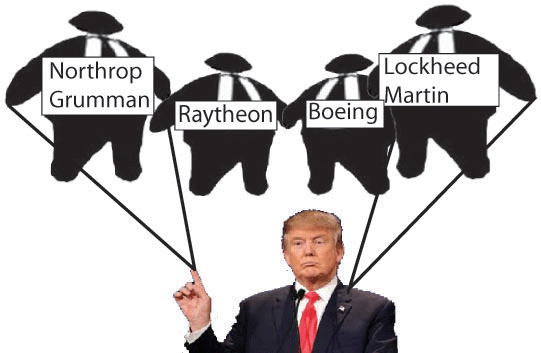 Trump budget: An extra billion dollars for nuclear weapons, Salon.com, 17 Mar 17 His draft 2018 budget would boost the budget for nuclear weapons production by 11 percent President Donald Trump has proposed to boost federal spending on the production of nuclear weapons by more than $1 billion in 2018 while slashing or eliminating spending on many federal programs related to diplomacy, foreign aid, and social needs, in a budget proposal that reflects the first tangible expression of his defense priorities.
The 64-page budget document released by the White House on March 16 — and entitled “America First: A Budget Blueprint to Make America Great Again” — contained only a few sentences about the proposal, which would give the NNSA a total of $14.3 billion in fiscal year 2018. But the blueprint said the new spending would support “the goals of moving toward a responsive nuclear infrastructure and advancing the existing program of record for warhead life extension programs.”
That language refers to an existing effort to modernize three types of warheads, so they can be deployed with bombers, submarine-launched missiles, and land-based missiles, some of which will themselves be modernized in years to come. That warhead work is well under way, although the budget document suggested it had been slowed by Obama-era defense spending caps. Some independent experts have cautioned, however, that the speed of the work is limited mostly by its sheer complexity, rather than by fund shortages, and expressed doubt that it could be accelerated.
Trump’s budget proposal also says the additional NNSA funds would address its “critical infrastructure maintenance” needs — which is Washington-speak for everything from laboratories and test tracks to office buildings — which NNSA director Frank Klotz has pegged in public statements at roughly $3.7 billion. That tally includes both nuclear weapons-related work and nonnuclear work related to the cleanup of wastes from past weapons production activities……..
Many in Washington say that Congress is unlikely to approve Trump’s budget. Nonetheless, the special status Trump has assigned to nuclear weapons work is exemplified by the fact that even as the NNSA’s budget would expand under his proposal, the rest of the Energy Department’s budget would decline by around 20 percent, or $1.7 billion.
Gone would be the department’s weatherization, gas mileage, and clean energy programs. The Office of Science, which supports research into new technologies and basic physics as well as climate change, would be cut by nearly twenty percent. Elsewhere in the government, the State Department would get a 28 percent budget cut, funds for U.N. peacekeeping would be scaled back, humanitarian aid would be focused on fewer nations, and all federal spending for the U.S. Institute of Peace would disappear.
The current U.S. nuclear weapons modernization program, which was initiated and strongly supported by former President Barack Obama, was already estimated to cost $1 trillion or more over the next three decades. But Trump, in a Dec. 22 tweet, said “the United States must greatly strengthen and expand its nuclear capability” — implying that this should be beyond what Obama had set in motion.
As if to hammer that point home, Trump on March 16 also announced the appointment to the position of Pentagon policy chief of a defense analyst who helped write a new U.S. nuclear policy in 2001 that supported research on new types of nuclear warheads. The policy, overseen in part by Trump nominee David J. Trachtenberg, a former Pentagon deputy assistant secretary under President George W. Bush, also downplayed the significance of arms control, and supported an expansion of U.S. ballistic missile defense programs……..http://www.salon.com/2017/03/17/trump-budget-an-extra-billion-dollars-for-nuclear-weapons_partner/
Massive economic costs of climate change
 ECONOMIC COST OF #CLIMATECHANGE ARE ‘MASSIVE’, JPratt27, 17 Mar 17 Funding efforts to fight climate change is “a waste of your money,” the director of the Office of Management and Budget Mick Mulvaney said in a press conference today.
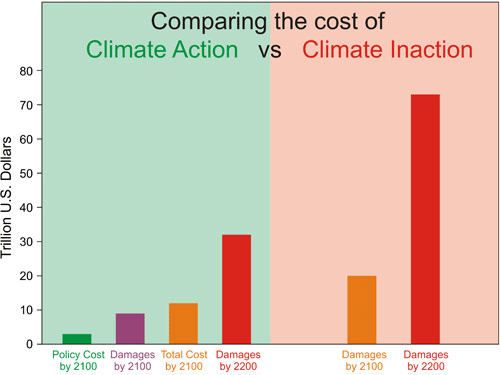
But Mulvaney is dangerously wrong: in fact, experts say that that the economic costs of climate change are so massive that delayed action, or inaction, is the most expensive policy option out there.
Mulvaney was defending President Trump’s proposed 2018 budget, which cuts funding for the Environmental Protection Agency by 31 percent — making good on Trump’s threat to dismantle the agency.
“Regarding the question as to climate change, the president was fairly straightforward,” Mulvaney said.
“‘We’re not spending money on that anymore.’”
That’s a really bad idea, for a couple of reasons.
But first, let’s get this out of the way: there is overwhelming evidence that climate change is real, and caused by carbon emissions.
Scientifically, the debate’s over and this is our fault — no matter how much Scott Pruitt or Ryan Zinke try to duck responsibility on behalf of humankind.
Sitting out on global warming is a bad deal for America
Second, there are big chunks of the US economy that depend on the global temperature staying put — like the agriculture and fish industries, for example. …….as global temperatures climb, severe droughts, extreme rain and snowfall, flooding, and heatwaves have already started to increase — making it a lot harder to grow crops no matter how much they love guzzling down that CO2.
Unchecked climate change will hit farmers where it hurts
We’ve started seeing some of the consequences of climate change on agriculture already, according to a government report: high temperatures in 2011 cost meat producers more than $1 billion dollars in what the EPA called “heat-related losses.” …..
Nationwide, The Risky Business Project estimates that anywhere from $66 billion to $106 billion of coastal real estate is probably going to hard to enjoy without a snorkel by the year 2100.
This is bad for more than just Mar-a-Lago: massive coastal flooding could also have major ripple effects on the economy, according to a report by government-sponsored mortgage company Freddie Mac.
Coastal businesses could relocate or simply go under, taking jobs with them.
Lenders and mortgage insurers could also suffer huge losses because, the report says, “It is less likely that borrowers will continue to make mortgage payments if their homes are literally underwater.”
It gets worse: “Non-economic losses may be substantial as some communities disappear or unravel. Social unrest may increase in the affected areas.”
“It is less likely that borrowers will continue to make mortgage payments if their homes are literally underwater.”
Big picture, global warming could cause the global economy to plummet — leading to a 23 percent drop in gross domestic product per person by the year 2100, according to a 2015 study published in Nature.
“We’re basically throwing away money by not addressing the issue,” Marshall Burke, an assistant professor at Stanford University, told TIME.
Even bankers agree — and they’re not known for being tree-huggers……….
waiting to start fighting global warming — or sitting out the fight altogether — is a bad deal for America’s future. Given President Trump’s claims about his business acumen, he, of all people, should see that.
Press link for more: The Verge, https://jpratt27.wordpress.com/2017/03/17/economic-cost-of-climatechange-are-massive-auspol-science/
Savage attack on the environment: the Trump budget
Aside from the catastrophic impacts on public health and planetary survival, these Trump-Koch attacks on environmental protection and increased energy efficiency bode ill for a struggling U.S. economy. Germany, China and other global competitors are surging ahead with ecologically sound advanced technologies like high-speed rail, EV autos, PV cells, ultra-efficient wind turbines, solar farms, and highways guaranteed to leave America in the dust.
The “tycoon” President who promised full employment and prosperity is instead bringing an ill wind, darkened sun, and scorched planet.
 Trump’s Budget Assault on the Environment Packs a Wallop, The Progressiveby Harvey Wasserman March 17, 2017
In addition to slashing funding to the Environmental Protection Agency, he also announced this week that he wants massive rollbacks in automotive fuel efficiency standards and billions in new investments in nuclear weapons and storage for commercial nuclear waste.
The administration’s budget cuts $2.4 billion from the EPA’s operating funds
—roughly 31 percent—taking the agency’s annual budget from $8.1 billion to $5.7 billion, the smallest since it was formed in 1970. These cuts will cripple regulation of air and water quality, strip oversight of a wide range of land management programs, and loosen restrictions on chemical emissions from industrial facilities.
Much of this money would be shifted directly over to the military, which the Trump Administration wants to bolster with an additional $54 billion over the final Obama allocations…….
llowing through on his campaign promise to reduce the EPA to “little tidbits,” Trump’s budget defunds more than 50 programs. These include infrastructure improvement on Indian reservations, major projects to clean up Puget Sound, Chesapeake Bay and the Great Lakes, a wide range of renewable energy development and energy efficiency programs, numerous climate change research programs, national heritage sites, environmental justice programs, oceanographic research and preservation, and much more. Gina McCarthy, a former EPA official under Obama, described it as “a scorched earth budget that represents an all-out assault on clean air, water and land.”
Some of the immediate opposition has crossed party lines. Ohio’s recently re-elected Republican Senator Rob Portman, a close associate of former President George W. Bush, strongly opposed cuts to the $300 million Great Lakes Restoration Initiative. Bill Becker of the National Association of Clean Air Agencies warned, “if such cuts are realized, many more people will die prematurely and get sick unnecessarily due to air, water and waste pollution.”…….
Meanwhile, Illinois and New York are moving toward massive subsidies for uncompetitive, dangerously dilapidated old nuclear reactors in a marketplace where renewables are coming in far cheaper and creating thousands more jobs. In Ohio and other states, owners of money-losing reactors are advocating for massive handouts to block cheaper, job-creating renewables and efficiency from getting into the marketplace.
Adding insult to injury, Trump wants to add $120 million to the long-dead Yucca Mountain nuclear waste dump. ……
Aside from the catastrophic impacts on public health and planetary survival, these Trump-Koch attacks on environmental protection and increased energy efficiency bode ill for a struggling U.S. economy. Germany, China and other global competitors are surging ahead with ecologically sound advanced technologies like high-speed rail, EV autos, PV cells, ultra-efficient wind turbines, solar farms, and highways guaranteed to leave America in the dust.
The “tycoon” President who promised full employment and prosperity is instead bringing an ill wind, darkened sun, and scorched planet. http://progressive.org/dispatches/trump%E2%80%99s-budget-assault-on-the-environment-packs-a-wallop/
How to defuse tensions around the issue of North Korea’s nuclear weapons testing?

 Can Tillerson Crack North Korea?, Carnegie Endowment For International Peace, RICHARD SOKOLSKY, JOEL WIT , March 15, 2017, Secretary of State Rex Tillerson’s visit to Northeast Asia this week comes as tensions are running high in the region. North Korea recently conducted a simultaneous test of four ballistic missiles that could be used to attack South Korea and Japan, as well as U.S. forces stationed in those countries with nuclear weapons. The impending American deployment of an anti-ballistic missile system in South Korea to defend against a missile attack has provoked China’s strong opposition. South Korean president Park Geun-hye has just been removed from office for corruption, and a presidential election that could bring the opposition party to power will be held in May. While all this is happening, the Trump administration is doing some serious soul-searching about how to deal with North Korea. In short, Secretary Tillerson will face a diplomatic landscape that is littered with landmines on his first big troubleshooting mission overseas.
The diplomatic hat trick the Trump administration needs to pull off is finding a solution that can stop the growth of the North Korean threat, rebuild cooperation with Beijing and gain support from U.S. allies, particularly a new South Korean government. That’s a very tall order, especially since the overwhelming temptation in Washington will be to double down on sanctions, including measures against Chinese banks and businesses that have ties with North Korea, and to ratchet up rhetoric about military options for eliminating Pyongyang’s WMD threat. If that’s all Secretary Tillerson brings to Asia, his mission will fail. He will only create more running room for Pyongyang to move forward with its nuclear and missile programs by making cooperation between Washington and Beijing even more difficult to achieve.
The smart move would be to defuse tensions while laying the groundwork for a strategy that combines threats with leaving the door open a crack for renewed dialogue with North Korea. The first two stops on his trip—Tokyo and Seoul—will provide him with an opportunity to pledge Washington’s firm commitment to their security. But the real centerpiece of Secretary Tillerson’s trip will be Beijing. China’s public proposal last week that the United States suspend its joint military exercises—a key demand by North Korea—in return for Pyongyang suspending its nuclear and missile tests—a move that would serve Washington’s interests—signals that it is willing to play an active, even positive role in avoiding a “head-on collision,” in the words of Chinese foreign minister Wang Yi. While the Trump administration quickly rejected the proposal, rather than just leaving the matter there, Secretary Tillerson should pick up the diplomatic gauntlet.
Caution, always the watchword when dealing with North Korea, should be reflected in the secretary’s counterproposal. Rather than dive headlong into new negotiations, step one should be “talks about talks”: unconditional preliminary discussions to see if North Korea is willing to put its nuclear weapons program on the table. “Unconditional” is the key word. While the United States has insisted in the past that North Korea agree ahead of time to focus on giving up its nuclear weapons, Pyongyang’s view is that talks should be held without preconditions. There seems to be little if no downside in adopting that approach, since the North Koreans understand that their program will be Washington’s number one topic for discussion. Step two in this process will be a decision by President Trump and Kim Jong-un, based on the results of these preliminary talks, whether formal negotiations should resume. If North Korea proves willing to address Washington’s WMD concerns, formal negotiations can start. If North Korea is not serious, the United States should then move on to putting greater diplomatic pressure on China, enacting new sanctions, and taking further measures to protect Seoul and Tokyo.
Whether the Trump administration adopts this approach or just presses the policy default button—more sanctions and military measures—is the $64,000 question. Consequential secretaries of state solve the thorniest and most important national security problems through patient, skillful diplomacy and negotiations. Fair or not, Secretary Tillerson has been pilloried by the press and pundits as missing in action. This sensitive diplomatic mission offers him an opportunity to show his mettle. The last thing Washington needs, at a time when America’s global leadership and position in Asia is under challenge, is for Secretary Tillerson to leave the region empty-handed, or in worse shape than he found it.
This piece was originally published by the National Interest. http://carnegieendowment.org/2017/03/15/can-tillerson-crack-north-korea-pub-68278
Republican senator slams Trump’s Nevada nuclear waste dump plan
 We will not be a nuclear waste dump’: Vulnerable GOP senator slams Trump’s Nevada nuke waste plan https://www.rawstory.com/2017/03/we-will-not-be-a-nuclear-waste-dump-vulnerable-gop-senator-slams-trumps-nevada-nuke-waste-plan/ BRAD REED,16 MAR 2017
Dean Heller (R-NV) got a nasty surprise this week when he discovered that President Donald Trump’s proposed budget would revive the Yucca Mountain storage facility for nuclear power plant waste in his home state.
Heller, by far the most vulnerable Republican in the senate in the 2018 midterm elections, railed against Trump’s proposal in a statement released Thursday, as he insisted that his state would “not be the nation’s nuclear waste dump.”
“As has been stated in the past, Yucca is dead and this reckless proposal will not revive it,” he said. “Washington needs to understand what Nevada has been saying for years: we will not be the nation’s nuclear waste dump. This project was ill-conceived from the beginning and has already flushed billions of taxpayer dollars down the drain.”
Heller also vowed to fight any effort to revive the Yucca Mountain project tooth and nail.
The Las Vegas Review Journal notes that, while Trump would increase funding to revive the Yucca Mountain facility, his budget would also slash the Office of Science’s $5 billion budget by a whopping $900 million, which would dramatically cut the amount of research that it now funds at more than 300 universities and at 10 national labs.
Newly declassified films show US nuclear tests
The Lawrence Livermore National Lab has begun posting films of its U.S. nuclear weapons tests to YouTube, KGO reported Wednesday.
The lab is reanalyzing the footage to improve the data “for future physicists,” nuclear weapons physicist Greg Spriggs said in an interview published by Livermore on Wednesday.
On its YouTube channel that now houses the declassified videos, the lab notes that the U.S. “conducted 210 atmospheric nuclear tests between 1945 and 1962.” Livermore conducted the ones in its internet archive.
Oppoition to Yucca nuclear waste plan, from Nevada lawmakers
Nevada lawmakers speaking out against plan to revive Yucca Mountain, ktnv.com , Joyce Lupiani, Mar 16, 2017 The White House is proposing to revive the Yucca Mountain nuclear waste plan. The 2018 budget plan for the U.S. Department of Energy includes $120 million to restart licensing for the proposed dump.
Trump budget includes restart of licensing of Nevada’s Yucca Mountain for nuclear waste dump
White House proposes reviving Yucca Mountain nuclear waste site http://www.reuters.com/article/us-usa-trump-budget-nuclear-idUSKBN16N0D5 | WASHINGTON, Mar 16, 2017
The White House’s 2018 budget plan for the U.S. Department of Energy includes $120 million for nuclear waste programs including the restart of licensing for Nevada’s Yucca Mountain, a project stalled for years by lawsuits and local opposition.
The move signals that President Donald Trump may consider that nuclear waste solutions could extend the lives of existing U.S. nuclear power plants and speed up innovations in next- generation nuclear plants that backers say are safer than previous reactors.
Congress will debate the budget and it is uncertain whether funds for waste will remain in the plan.
While Yucca Mountain would store waste on a practically permanent basis, the budget money would also support programs for storing waste at interim sites before Yucca opens.
“These investments would accelerate progress on fulfilling the federal government’s obligations to address nuclear waste, enhance national security, and reduce future taxpayer burden,” according to a summary of the budget.
Yucca has been studied by the U.S. government since the 1970s as a potential repository for the nation’s radioactive waste and billions of dollars have been spent on it.
But Yucca has never opened because of legal challenges and widespread opposition from local politicians, environmentalists and Native American groups.
In 2010, then-President Barack Obama withdrew the license to store waste at Yucca amid opposition from then-Senate Majority Leader Harry Reid, a fellow Democrat from Nevada.
Maria Korsnick, the head of the Nuclear Energy Institute industry group, said the industry was encouraged by the plan for waste projects but that nuclear energy innovators were “nervous” about cuts to programs that have supported public-private partnerships to bring new nuclear technologies to market.
The budget eliminates funding for the Advanced Research Projects Agency for Energy and an innovative technology loan guarantee program that have been popular with both Democrats and many Republicans.
Trump’s energy secretary, Rick Perry, told lawmakers at his confirmation hearing that restarting the Yucca Mountain project could not be ruled out, but that he would collaborate with states.
“I am very aware that this is an issue this country has been flummoxed by for 30 years. We have spent billions of dollars on this issue,” Perry told the hearing in January. “I’ll work closely with you and the members of this committee to find the answers to this issue.”
The White House proposal for the Department of Energy budget calls for an overall cut of 5.6 percent.
(Editing by Richard Valdmanis and Peter Cooney)
Trump’s budget attack on science
Trump’s budget is everything scientists have been fearing
The outline cuts at least $7 billion for research on climate change, diseases, and energy, VOX by Mar 16, 2017, The top-line numbers of President Donald Trump’s budget proposal should give the nation’s scientists shivers. The administration doesn’t seem to think science should be a priority at all.
The blueprint released today is preliminary. The administration still needs to draft a full budget, which we won’t see until May. And ultimately, it’s up to Congress to decide who gets what.
But what’s important about this budget proposal is that it tells the public and Congress where the president’s concerns lie. And they don’t appear to be issues like climate change, disease treatment and prevention, or basic research funding for universities.
In all, we count up least $7 billion in reductions to science programs, including:
- A $5.8 billion reduction in funding to the National Institutes of Health (18 percent of its total budget.) Most of the NIH’s budget goes to funding research in health care in universities across the country.
- A $102 million cut to NASA’s Earth science programs, eliminating four NASA Earth science missions completely:
- PACE — a program for measuring changes to ocean ecosystems by tracking concentrations of chlorophyll (what makes algae green) from space.
- OCO-3 — a yet-to-be-launched space station module to track atmospheric carbon dioxide.
- DSCOVR — the “deep space climate observatory,” which is partially run by NOAA. (The budget doesn’t mention if NOAA will retain this program.) DSCOVR is an early warning system for solar storms, and has capabilities to detect changes in levels of ozone and other pollutants in the atmosphere.
- CLARREO Pathfinder — the “Climate Absolute Radiance and Refractivity Observatory.” It’s set to be launched in 2020 to amass highly accurate records of climate change on Earth so scientists can make more precise predictions about the future.
- A $900 million reduction in the Energy Department’s basic science research. The Advanced Research Projects Agency-Energy — a $300 million program that provides grants for energy research — is wholly eliminated because “the private sector is better positioned to finance disruptive energy research.”
- A $250 million cut in NOAA grants “and programs supporting coastal and marine management, research, and education including Sea Grant.”
- And not to mention the many changes coming for the EPA and how the country combats climate change. Vox’s Brad Plumer has more on that here.……….http://www.vox.com/policy-and-politics/2017/3/16/14940444/2018-budget-trump-science-nih
Texas taking federal agencies to court over failure to license nuclear waste facility
Texas sues feds — including Rick Perry — for failing to license nuclear waste facility MARCH 15, 2017 In a lawsuit filed Tuesday, Texas Attorney General Ken Paxton accuses U.S. agencies of violating federal law by failing to license a nuclear waste repository in Nevada. Texas is trying to take the federal government to task for failing to find a permanent disposal site for thousands of metric tons of radioactive waste piling up at nuclear reactor sites across the country.
In a lawsuit filed Tuesday night, Texas Attorney General Ken Paxton accuses U.S. agencies of violating federal law by failing to license a nuclear waste repository in Nevada — a plan delayed for decades amid a highly politicized fight.
Paxton’s petition asks the U.S. Court of Appeals for the 5th Circuit to force the Nuclear Regulatory Committee to cast an up-or-down vote on the Yucca Mountain plan. It also seeks to prevent the federal Department of Energy from spending billions of dollars in fees collected from utilities on efforts to find another disposal site before such a vote……
Karen Hadden, executive director of the Sustainable Energy and Economic Development Coalition, a group fighting the Andrews County site’s expansion, agreed with Paxton’s criticism of the Yucca Mountain process — “a waste of money,” she said. But Hadden worries that the lawsuit could force the government to permit a site ill-equipped to protect public health and safety.
“It’s really important that we get a permanent repository in place that will isolate this waste so we don’t have cancer effects or deaths from contamination today or into the future,” Hadden said. “My concern is that [Paxton] has another Texas permanent disposal site in mind.”https://www.texastribune.org/2017/03/15/texas-sues-feds-rick-perrys-agency-included-over-nuclear-waste/
NRC Accepts NuScale Small Modular Reactor Design Certification Application
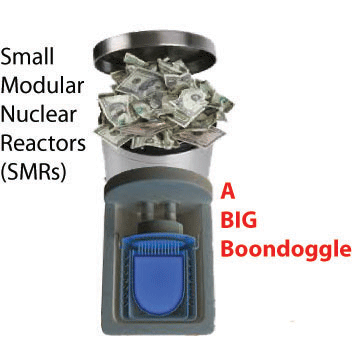 Power Magazine, 03/16/2017 | Aaron Larson The Nuclear Regulatory Commission (NRC) has accepted NuScale Power’s small modular reactor (SMR) design certification application and will provide a design review schedule soon.
The NRC’s acceptance marks a major milestone for the first SMR design to ever attempt obtaining U.S. certification. NuScale, in which Fluor Corp. is a majority investor, submitted its application on January 12.
The certification process can take several years. The NRC set a 40-month target for completion, NuScale said. During that time, the NRC studies the reactor design to determine if it meets U.S. safety requirements. If a certification is issued, it is valid for 15 years and companies can reference the certified design when applying for combined licenses……http://www.powermag.com/nrc-accepts-nuscale-small-modular-reactor-design-certification-application/
Historian warns on the approach of fascism

 If We Don’t Act Now, Fascism Will Be on Our Doorstep, Says Yale Historian Timothy Snyder warns: History gives us a bunch of cases where democratic republics became authoritarian regimes. By Steven Rosenfeld / AlterNet March 13, 2017 How close is President Donald Trump to following the path blazed by last century’s tyrants? Could American democracy be replaced with totalitarian rule? There’s enough resemblance that Yale historian Timothy Snyder, who studies fascist and communist regime change and totalitarian rule, has written a book warning about the threat and offering lessons for resistance and survival. The author of On Tyranny: Twenty Lessons from the Twentieth Century talked to AlterNet’s Steven Rosenfeld.
 “……..the book does describe what is going on now.
The year figure is there because we have to recognize that things move fast. Nazi Germany took about a year. Hungary took about two and a half years. Poland got rid of the top-level judiciary within a year. It’s a rough historical guess, but the point is because there is an outside limit, you therefore have to act now. You have to get started early. It’s just very practical advice. It’s the meta-advice of the past: That things slip out of reach for you, psychologically very quickly, and then legally almost as quickly. It’s hard for people to act when they feel other people won’t act. It’s hard for people to act when they feel like they have to break the law to do so. So it is important to get out in front before people face those psychological and legal barriers…..
1 This Month





PLEASE OPPOSE HR 8255 AND S.3639 – bills would accelerate satellite deployment, with no environmental review or safeguards – https://ncstd5li.quorum.us/campaign/169331/
To see nuclear-related stories in greater depth and intensity – go to https://nuclearinformation.wordpress.com
-
Archives
- October 2026 (91)
- September 2026 (339)
- August 2026 (330)
- July 2026 (355)
- June 2026 (287)
- May 2026 (306)
- April 2026 (356)
- March 2026 (251)
- February 2026 (267)
- January 2026 (308)
- December 2025 (358)
- November 2025 (359)
-
Categories
- 1
- 1 NUCLEAR ISSUES
- business and costs
- climate change
- culture and arts
- ENERGY
- environment
- health
- history
- indigenous issues
- Legal
- marketing of nuclear
- media
- opposition to nuclear
- PERSONAL STORIES
- politics
- politics international
- Religion and ethics
- safety
- secrets,lies and civil liberties
- spinbuster
- technology
- Uranium
- wastes
- weapons and war
- Women
- 2 WORLD
- ACTION
- AFRICA
- Atrocities
- AUSTRALIA
- Christina's notes
- Christina's themes
- culture and arts
- Events
- Fuk 2022
- Fuk 2023
- Fukushima 2017
- Fukushima 2018
- fukushima 2019
- Fukushima 2020
- Fukushima 2021
- general
- global warming
- Humour (God we need it)
- Nuclear
- RARE EARTHS
- Reference
- resources – print
- Resources -audiovicual
- Weekly Newsletter
- World
- World Nuclear
- YouTube
-
RSS
Entries RSS
Comments RSS

