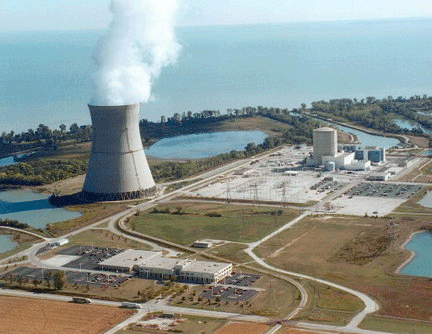
State-owned utility doesn’t want to talk about nuclear plans http://www.thestate.com/news/local/article141313913.html 28 Mar 17, MONCKS CORNER, SC A state-owned electric utility doesn’t want to talk about its plans for dealing with possible construction problems at the V.C. Summer nuclear plant, where it is teaming with South Carolina Electric & Gas Co. to build two additional nuclear reactors.
Santee Cooper officials would not discuss a plan they approved Monday.
The lead contractor of the $14 billion expansion, Westinghouse Electric Co., is experiencing serious financial problems amid media reports that it could file for bankruptcy protection.
Concerns are rising about how much it would cost to complete the plants and, in a worst case, whether the reactor project would be finished. The project already is about $3 billion over budget and years behind schedule.
Santee Cooper senior vice president and general counsel Michael Baxley would only say that a resolution approved by its board Monday in a closed telephone conference “authorizes certain contingency actions by management in the fluid situation with respect to new nuclear construction,’’ The Post and Courier reported.
Baxley would not elaborate, but said the plan would put the Moncks Corner utility “in a position to be able to immediately respond to issues or conditions that may occur with respect to the V.C. Summer project.”
Santee Cooper is responsible for 45 percent of the cost. SCE&G’s parent company, SCANA Corp., is paying the other 55 percent. The two utilities also share the costs of the existing nuclear reactor at the site in Fairfield County.
Santee Cooper spokeswoman Mollie Gore wouldn’t say Tuesday whether the power company would release the resolution.
“Santee Cooper is continuing to monitor the situation,’’ she said. “It is complicated. While they continue to work through the details, Santee Cooper can’t really provide any speculation about this.’’
SCANA has said it has a plan to complete the project, with or without Westinghouse and its parent company, Toshiba.
If Westinghouse sought bankruptcy protection, it could lead to higher rates for utility customers to help pay for the reactors, plant critics have said.
& Air-Ground Missiles, Warrior, KRIS OSBORN, 29 Mar 17 The stealthy B-2 is slated to fly alongside the Air Force’s new Long Range Strike – Bomber into the 2050s,
Air Force pilots of the 1980s-era stealthy B-2 Spirit bomber plan to arm the B-2 with new weapons and upgrade the aircraft to fly the aircraft on attack missions against enemy air defenses well into the 2050s, service officials said.
In coming years, the B-2 will be armed with with next generation digital nuclear weapons such as the B-61 Mod 12 with a tail kit and an Long Range Stand-Off weapon or, LRSO, an air-launched, guided nuclear cruise missile, service officials said.
The B-61 Mod 12 is an ongoing modernization program which seeks to integrate the B-61 Mods 3, 4, 7 and 10 into a single variant with a guided tail kit. The B-61 Mod 12 is being engineered to rely on an inertial measurement unit for navigation.
It takes a very special person to label the photographed, documented, filmed and studied phenomenon of mass coral bleaching on the Great Barrier Reef“fake news”. You need lashings of chutzpah, blinkers the size of Donald Trump’s hairspray bill and more hubris than you can shake a branch of dead coral at.
It also helps if you can hide inside the bubble of the hyper-partisan Breitbart media outlet, whose former boss is the US president’s chief strategist.
So our special person is the British journalist James Delingpole who, when he’s not denying the impacts of coral bleaching, is denying the science of human-caused climate change, which he says is “the biggest scam in the history of the world”.
Delingpole was offended this week by an editorial in the Washington Post that read: “Humans are killing the Great Barrier Reef, one of the world’s greatest natural wonders, and there’s nothing Australians on their own can do about it. We are all responsible.”
Like the thriving polar bear, like the recovering ice caps, like the doing-just-fine Pacific islands, the Great Barrier Reef has become a totem for the liberal-left not because it’s in any kind of danger but because it’s big and famous and photogenic and lots and lots of people would be really sad if it disappeared. But it’s not going to disappear. That’s just a #fakenews lie designed to promote the climate alarmist agenda.
Now before we go on, let’s deal with some language here.
When we talk about the reef dying, what we are talking about are the corals that form the reef’s structure – the things that when in a good state of health can be splendorous enough to support about 69,000 jobs in Queensland and add about $6bn to Australia’s economy every year.
The Great Barrier Reef has suffered mass coral bleaching three times – in 1998, 2002 and 2016 – with a fourth episode now unfolding. The cause is increasing ocean temperatures.
CORAL BLEACHING
“Is the Great Barrier Reef dying due to climate change caused by man’s selfishness and greed?” asks Delingpole, before giving a long list of people and groups who he thinks will answer yes, including “the Guardian” and “any marine biologist”.
“Have they been out there personally – as I have – to check. No of course not,” says Delingpole.
Yes. James Delingpole has been out there “personally” to check, but all those other people haven’t. He doesn’t say when he went but he has written about one trip before. It was back in late April 2012. Everything was fine, he said, based on that one visit. I can’t find any times when he has mentioned another trip since.
So here’s the rhetorical question – one that I can barely believe I’m asking, even rhetorically.
I mean, come on? Why can those two things – Delingpole making a boat trip with mates and a coordinated and exhaustive scientific monitoring and data-gathering exercise – not be the same?
So it seems we are now at a stage where absolutely nothing is real unless you have seen it for yourself, so you can dismiss all of the photographs and video footage of bleached and dead coral, the testimony of countless marine biologists (who, we apparently also have to point out, have been to the reef ) and the observations made by the government agency that manages the reef.
Senator Pauline Hanson and her One Nation climate science-denying colleagues tried to pull a similar stunt last year by taking a dive on a part of the reef that had escaped bleaching and then claiming this as proof that everything was OK everywhere else…….
Government ministers at federal and state levels, of both political stripes, claim they want to protect the reef.
Taking the North Korean leader out with military action is now being discussed, but that could lead to much bigger problems and plunge the region into years of chaos and instability. Worse still, it could force a confrontation between China and the US.
On the face of it, the North Korean military looks impressive. It has about 1.2 million troops. But the reality is that the weaponry is outdated and obsolete, much of it from the Soviet era. It’s no match for any modern army, so Mr Kim could be removed effectively.
Christopher Hill, probably the most experienced US diplomat in North Korean affairs, says with Mr Kim in power, there is no chance of dialogue. “Frankly, we don’t have a real insight into his thinking — we do know he seems to be totally uninterested in negotiation,” he said.
The real danger, said Mr Hill, is that the Trump administration has little understanding about how to deal with the North Korea threat, and the US State Department is in disarray. “We have a kind of Home Alone situation at the State Department, so we don’t have a lot of people focusing on this issue at this point,” he said.
Military action could prove costly Despite this, while visiting North Asia last week, US Secretary of State Rex Tillerson ruled out negotiation and put military action on the table. It’s action that could prove costly: a humanitarian disaster, with biological and nuclear weapons at play; a contested occupation as China and America battle for control.
Dr Euan Graham from the Lowy Institute says it could prove more destructive and costly than the Iraq war.
“Kicking in the door is the easy part; once you go in and occupy ground, then if that’s contested you can very quickly find even superpowers’ resources can become thinly spread,” he said.
Mr Hill says people like to compare the situation on the Korean Peninsula with the reunification of Germany, but this would actually be much worse. Frankly speaking, the difference between North Korea and East Germany cannot be described,” he said.
“They are just worlds apart in terms of what Germany had to do and what the South Koreans would have to do.”
These immense challenges make policymakers and experts around the world question the value of removing Mr Kim and his nuclear program.
Dr Graham says the US then has a choice: “Is it better to live with this threat and manage it through deterrence and existing sanctions like it did with China and the Soviet Union for decades? Or does it become so unacceptable that it has to accept the high cost of potential economic recession in north-east Asia and military conflict that could take several thousands if not higher numbers of lives?”
China and America are at oddsThe complicating factor is that the powers at play cannot agree on what North Korea should become. They all have competing strategic needs.
China wants a new regime that will serve its interests, and it fears US troops on its border.
Professor Cheng Xiaohe from Beijing Renmin University says China will have to deal with a flood of refugees.
“Millions of North Koreans will seek safe havens in China or across the 38th parallel into the minefields to seek protection in South Korea,” he said.
“Even hundreds of thousands will take to boats to sail boat to other countries to seek refuge.”
It’s doubtful whether America wants to lead another foreign intervention. The Iraq campaign almost bankrupted the country with little to show in return, and it left hundreds of thousands dead.
South Korea too is losing its desire for reunification. It would cost several trillion dollars at least and threaten South Korea’s thriving high tech economy which is 18 times bigger than North Korea’s.
Dr Jiyoung Song from the Carnegie Council for Ethics in International Affairs says the younger generation in the South have very little in common with their brethren in the North.
Most South Koreans are definitely worried about the economic side — the unification costs, but also the unemployment and competition for jobs and universities.
The only way forward…Mr Hill, who led the push for a negotiated solution with the six-party talks that ended in 2009 after North Korea withdrew and resumed its nuclear program, says the only way forward is to engage with China and plan how to deal with the regime and the aftermath.
“We have to have an in-depth dive deep with the Chinese to really figure out how together we can deal with that and I think we need to do it and do it a lot more,” he said.
But Mr Hill says both sides have to get over their mutual distrust.
“Many Chinese see the demise of North Korea as a Chinese defeat and a US victory,” he said.”They worry that the US might take advantage of this and put US troops right up on the Chinese border.”
Dr Cheng agrees that China is afraid of being played by the US.
“All countries need to work together to settle their differences and adopt a joint line to build that country for peace and stability and carry out post-reunification works,” he said.
But while experts may agree in a call for global engagement, the Trump administration seems to be turning inwards towards more isolationist policies.
“Canada is facing a critical decision that will impact generations in both our countries,” said Senator Stabenow. “A nuclear waste spill near the Great Lakes could have a devastating impact on our health and environment and threaten our Michigan way of life. Given what is at stake, I urge our Canadian neighbors to make the right choice and shelve plans for this site once and for all.”
“The Canadian proposal to build a permanent nuclear waste repository less than a mile from Lake Huron could cause significant, lasting damage to the Great Lakes and undermine the progress we have made cleaning up the water quality in the Great Lakes Basin,” said Senator Peters. “President Trump and Secretary of State Tillerson should make every effort to prevent the Canadian government from moving forward with this proposal and work to find an alternative solution that does not jeopardize the health of the Great Lakes.”
“Permanently storing nuclear waste less than a mile from Lake Huron just doesn’t make sense and poses a great risk to our Great Lakes,” said Congressman Kildee. “From Detroit to Toronto, a growing number of people – in both the U.S. and Canada – have voiced opposition to this dangerous plan. Surely in the vast land mass that comprises Canada, there must be a better place to permanently store nuclear waste than on the shores of Lake Huron.”
U.S. Senators Amy Klobuchar (D-MN), Kirsten Gillibrand (D-NY), Sherrod Brown (D-OH), Al Franken (D-MN), and Dick Durbin (D-IL) are also original co-sponsors of the Senate resolution. Mike Bishop (MI-08), Debbie Dingell (MI-12), David Joyce (OH-14), Marcy Kaptur (OH-09), Louise Slaughter (NY-25), Mark Pocan (WI-02), David Trott (MI-11), Jackie Walorski (IN-02), Luis Gutiérrez (IL-04), Sander Levin (MI-09), Paul Mitchell (MI-10), Brian Higgins (NY-26), Jan Schakowsky (IL-09), and John Moolenaar (MI-04) are also original co-sponsors of the House resolution.
Over 40 million people in Canada and the United States get their drinking water from the Great Lakes and the highly toxic waste could take tens of thousands of years to decompose to safe levels. Ontario Power Generation is currently seeking approval from the Canadian Ministry of Environment to build a deep geologic repository to permanently store 7 million cubic feet of low- and intermediate-level radioactive waste. The facility would be located less than 1 mile from Lake Huron in Kincardine, Ontario.
The resolution urges the President and Secretary of State to work with their counterparts to prevent a permanent nuclear waste repository from being built within the Great Lakes Basin. It further states that the U.S. and Canada should develop a safe and responsible solution for the long-term storage of nuclear waste.
Madison and Abita Springs are the first cities in Wisconsin and Louisiana to make this commitment. They join 23 other cities across the United States—from large ones like San Diego, California and Salt Lake City, Utah to smaller ones like Georgetown, Texas and Greensburg, Kansas—that have declared similar goals.
Madison is the biggest city in the Midwest to establish 100 percent renewable energy and net-zero carbon emissions. The Madison Common Council unanimously approved a resolution to allocate $250,000 to develop a plan by January 18, 2018 that includes target dates for reaching these goals, interim milestones, budget estimates and estimated financial impacts.
Madison Common Council Alder Zach Wood said that his city is determined to “lead the way in moving beyond fossil fuels that threaten our health and environment.”
After a unanimous vote, Abita Springs is aiming to derive 100 percent of the town’s electricity from renewable energy sources by December 31, 2030.
The Sierra Club noted that Tuesday’s votes from the politically polar municipalities reflect the growing bipartisan support for alternative energy development. To illustrate, during the November election, more than 70 percent of Madison voters supported Hillary Clinton versus the 75 percent of voters in St. Tammany Parish, where Abita Springs is located, who supported Donald Trump.But as Abita Springs’ Republican mayor Greg Lemons said, “Transitioning to 100 percent renewable energy is a practical decision we’re making for our environment, our economy and for what our constituents want in Abita Springs.”
“Politics has nothing to do with it for me. Clean energy just makes good economic sense,” Lemons added. LeAnn Pinniger Magee, chair of Abita Committee for Energy Sustainability, had similar remarks.
“In a state dominated by oil interests, Abita Springs is a unique community that can be a leader on the path to renewable energy,” she said. “Our town already boasts the solar-powered Abita Brewery and we can see first-hand how clean energy benefits our businesses and our entire community. By transitioning to 100 percent renewable energy, we will save money on our utility bills and protect our legendary water and clean air in the process.”
Last year’s Gallup poll indicated for the first time that a majority of Republicans and Republican-leaning independents prefer an alternative energy strategy. Fifty-one percent of Republicans favor alternative energy, up from the previous high of 46 percent in 2011.
“Whether you’re Republican or a Democrat, from a liberal college city or a rural Louisiana town, clean energy is putting America back to work and benefiting communities across the country,” Jodie Van Horn, director of the Sierra Club’s Ready for 100 campaign, said. “That’s why Madison, Wisconsin and Abita Springs, Louisiana, today join the ranks of 23 other cities and towns across the United States that are going all-in on clean, renewable energy.”
Van Horn noted that local leaders and governments will be increasingly tasked to curb President Trump’s pro-fossil fuel policies and gutting of environmental regulations.
“As the Trump Administration turns its back on clean air and clean water, cities and local leaders will continue to step up to lead the transition towards healthy communities and a more vibrant economy powered by renewable energy,” she said.
Trump’s budget could help get rid of the nuclear waste along the San Onofre coastline http://www.latimes.com/business/la-fi-nuclear-waste-20170320-story.htmlRob Nikolewski A sense of momentum is building about finding a way to deal with the massive amounts of radioactive waste from nuclear power plants, including Southern California’s San Onofre Nuclear Generating Station.
Last week’s Trump administration “skinny budget” proposal, which calls for boosts in defense spending but cuts in domestic funding and federal agencies, found $120 million for starters to “initiate a robust interim storage program” while also looking at reviving the Yucca Mountain nuclear waste repository in Nevada.
Decommissioning San Onofre Nuclear Generating Station
“These investments would accelerate progress on fulfilling the federal government’s obligations to address nuclear waste, enhance national security and reduce future taxpayer burden,” a note said in the section reserved for the U.S. Department of Energy. (The Energy Department’s budget came in for a 5.6% reduction.)
A president’s budget proposals are ultimately subordinate to what Congress decides. But David Victor, chairman of the SONGS Community Engagement Panel, said the appropriation for nuclear waste may be one of the only topics in the current political environment that can generate support from members of both parties.
There are 3.6 million pounds of nuclear waste sitting along the coastline at the San Onofre plant, part of the 76,000 metric tons of spent fuel at sites nationwide.
“There’s a lot of Trump’s proposed budget that horrifies me, in particular around cutting funding for science and energy, but [long-term nuclear storage] is an area where I think the nation is now starting to make some progress,” Victor said.
Rep. Darrell Issa (R-Vista), who has introduced a bill called the Interim Consolidated Storage Act, said he thinks the chances for funding the White House nuclear waste proposal are “extremely good.”
“You have an active group of members, some of whom are Democratic members, who have a vested interest” in moving legislation forward, Issa said. “And … the fingerprints of whoever wanted to force it out would show all over.”
“As a budget line item it’s not a bad number at all,” Issa said in a telephone interview from Washington. “It’s sufficient to do the feasibility of these sites.”
Consolidated interim storage sites are designed to be built in isolated locations where multiple nuclear facilities could deposit their waste.
Two potential interim storage locations have been discussed — one in western Texas and another in eastern New Mexico.A company in Andrews, Texas, has filed an application to accept 5,000 metric tons of nuclear material. The district is represented by Republican Rep. Mike Conaway, who has co-sponsored Issa’s bill.
Getting the massive nuclear waste repository at Yucca Mountain, located about 100 miles from Las Vegas, back on track assuredly would involve a battle on Capitol Hill.
Democrats as well as Republicans from Nevada blasted the Trump proposal. “Washington needs to understand what Nevada has been saying for years: We will not be the nation’s nuclear waste dump,” said Sen. Dean Heller (R-Nev.).
The federal government spent about $15 billion to build the facility at Yucca Mountain to house nuclear waste from sites across the country. But then-Sen. Harry Reid (D-Nev.) led the fight to shut the repository down, and in 2010 President Obama suspended licensing for the site.
Yucca Mountain was scheduled to open in 2017.
While taking a tour of San Onofre last month with Issa, Rep. John Shimkus (R-Ill.), who is chairman of the House subcommittee that reviews nuclear sites, was asked if Yucca Mountain was coming back onto the bargaining table.
“It’s never been off the table,” Shimkus said.
Issa’s bill would be paid for by using part of the federal government’s Nuclear Waste Fund, which is worth upward of $40 billion and was funded by ratepayers in areas powered by nuclear plants.
A 2014 court order stopped the federal government from taking fees from electricity customers because, with Yucca Mountain sidelined, the government had no place to send nuclear waste.
“We’re paying a lot of money for the privilege of not having a solution that we were obligated to have,” Issa said. “It’s not free. It’s going to cost every taxpayer money until there’s a working solution.”
But even if Congress adopts a plan roughly similar to the White House proposal, there are a series of practical and regulatory hurdles to clear.
For example, sites such as San Onofre, which closed in 2013, would still need to place some of their spent fuel into canisters. Then federal law would need to be changed to install a reliable funding mechanism for interim sites, and a strategy would need to be adopted in order to move the waste from one place to another.
“There is still a long way to go,” Victor said. “We could have troubles on any of those fronts, but I think what’s encouraging is that on every single one of those fronts, we’re starting to see progress.”
Millions of people live within 50 miles of San Onofre, which hasn’t produced electricity since January 2012 after a steam generator leaked a small amount of radiation.
Southern California Edison is the majority owner of the plant, which is in the process of being decommissioned.
Edison officials said they were heartened by the news of $120-million proposal.
“We are pleased to see funding proposed to restart the Yucca licensing process, and continue to also support interim storage proposals that would enable [Southern California Edison] to move San Onofre’s used fuel to an off-site location,” spokeswoman Maureen Brown said
Ripples from US nuclear plant closings overwhelm small towns, Star Tribune, By JOHN SEEWER Associated Press MARCH 26, 2017 “……..For the small, mostly rural towns that are home to 61 U.S. nuclear plants that produce one-fifth of the nation’s electricity, each one has been like the golden goose supplying high-paying jobs and money for roads, police and libraries.
But those same places and their residents are bracing for what may come next due to the soaring costs of running aging reactors that have speeded up the closings of a handful of sites and are threatening at least a dozen more. That’s because once the power stops flowing, so does the money.
Towns that already have seen nuclear plants shuttered are now dealing with higher property taxes, cuts in services and less school funding — a new reality that may linger for decades.
In Wisconsin, the tiny town of Carlton saw the source of roughly 70 percent of its yearly budget disappear when the Kewaunee nuclear power plant closed four years ago. That resulted in the first town tax in its history.
“Financially, we benefited, but now we’re going to pay the price for the next 40 years,” said David Hardtke, the town chairman.
When operations ceased at the Crystal River Nuclear Plant along Florida’s Gulf Coast, “it was like something going through and wiping out a third of your county,” said Citrus County Administrator Randy Oliver.
To make up the difference, property tax rates went up by 31 percent and 100 county workers were let go — so many that Oliver worries there won’t be enough to evacuate residents and clear roads if a major tropical storm hits.
While the nation’s fleet of nuclear power plants wasn’t designed to last forever, closures are happening earlier than expected because repair costs are astronomical and it’s harder to compete with cheaper natural gas-fired plants and renewable energy sources.
The former head of the nuclear industry’s trade group said last year that economic pressures have put 15 to 20 plants at risk of a premature shutdown.
FirstEnergy Corp. will decide by next year whether to close or sell its plant in Pennsylvania and two in Ohio, including Davis-Besse, unless the states change regulations to make them more competitive……… New Orleans-based Entergy Corp., owner of the Palisades nuclear plant in Michigan, announced plans late last year to close in 2018 even though it has a license to keep operating another 14 years…….
what makes recovering tough is that almost all nuclear plants are in out of the way places that have become heavily reliant on them. And they employ specialized workers who are quick to leave for still-operating locations.
To make matters worse, many closed sites can’t be redeveloped for new uses because they’re still storing radioactive waste…….
“We have become a de facto nuclear waste dump. It just sits there, and sits there forever,” said Al Hill, the mayor in Zion, Illinois, where spent nuclear fuel remains stored on prime property along Lake Michigan even though the plant shut down 20 years ago.
On top of that, the closing took away half of the city’s tax base and pushed property taxes to the highest in the state, making it difficult to lure new businesses, Hill said……
Nuclear energy caucus forms in challenging times, The Times Tribune, 26 Mar 17 HARRISBURG — A group of state lawmakers formed the Nuclear Energy Caucus last week as part of an effort to keep nuclear power part of Pennsylvania’s mix of energy sources. Sen. John Yudichak, D-14, Plymouth Twp., ranking Democrat on the Senate Environmental Resources and Energy Committee, is a member of this caucus……..
Pennsylvania has five nuclear plants, making it the second largest state with nuclear capacity, the caucus said.The goal of the caucus is to develop policies that promote nuclear energy as part of Pennsylvania’s energy mix…..
Industry struggling Sen. Ryan Aument, R-36, Lancaster, points out that the nuclear industry nationwide is struggling.
Five nuclear plants have ceased production since 2013 while an additional seven plants have announced plans to close by 2019, said Aument. Given Pennsylvania’s status as a top nuclear power producer, it’s important the caucus promotes the use of nuclear energy, he added.
The caucus arrives at a time when the nuclear industry’s economic problems are an issue in neighboring New York and Ohio. Some nuclear plants have experienced problems selling their electricity on the market at a price that covers the costs of generating it. Competition from cheaper natural gas is a key factor.
New York has approved a surcharge on customers’ electric bills to provide a subsidy to help keep its nuclear plants open. Supporters say the subsidy recognizes that nuclear energy is a renewable power source and doesn’t produce carbon emissions. The subsidy is being challenged in state courts.
Ohio is considering legislation where customers would pay a surcharge to underwrite zero-carbon emissions credits given to nuclear plants.
The nuclear industry shouldn’t get a bailout from ratepayers, said activist Eric Epstein, chairman of Three Mile Island Alert.
‘Cannot compete’
“It’s become clear the nuclear industry cannot compete in the market,” he said. “It’s environmental attributes are negligible.”
The storage of high-level radioactive wastes is a major problem with nuclear plants, added Epstein.
Nuclear plant owners recouped investment costs after Pennsylvania enacted an electric deregulation law in 1999, he said.
Donald Trump’s tweets a distraction from decisions being made at the White House, Sydney Morning Herald, Paul McGeough, 24 Mar 17 Washington: “……… it wasn’t till this week that The Wall Street Journal, the very conservative and very sensible, Murdoch-owned WSJ, snapped – its Wednesday editorial tears into Trump for his false and lying tweets.
Likening the teetotaller commander-in-chief to a desperate alcoholic, it thunders on Trump’s widely-debunked claim that former US president Barack Obama had ordered wire taps on Trump Tower: “The President clings to his assertion like a drunk to an empty gin bottle, rolling out his press spokesman to make more dubious claims.”
The Journal often is accused of covering Trump with kid gloves. But throwing into reverse, the editorial’s author drives over the President again – damning his “seemingly endless stream of exaggerations, evidence-free accusations, implausible denials and other falsehoods”. And then it guns the engine before making another run: “If he doesn’t show more respect for the truth, most Americans may conclude he’s a fake president.”Theories abound on Trump’s obsessive, reckless tweeting – it’s a fight to defend the legitimacy of his presidency; it’s innate – he was groomed since childhood to wage total war on any threat, real or perceived; or it’s all a distraction – creating a crisis to divert attention from other crises and/or from the dire impact of his legislative and executive decisions.
George Lakoff, a cognitive linguist at the University of California at Berkeley, sees a deliberate strategy at work. Analysing Trump’s March 4 wire-tapping tweets, Lakoff lays out four elements on his blog:
Pre-emptive framing: He frames first. He creates a new presidential scandal – Obama’s wire tapping – an accusation without evidence, and with all evidence against it.
Deflection: He puts the onus on his squeaky-clean predecessor.
Diversion: The press bit and the diversion worked. It generated headlines questioning whether Obama, rather than Trump, had committed wrongdoing. The diversion worked, at least temporarily.
Trial balloon: Will the public accept it, or listen to a discussion of it long enough to distract the press and the public from the treason issue? Bruce Miller, a political science professor at the University of Albany, doesn’t buy this theory of calculated distraction. “That’s rarely the case,” he tells Fairfax Media. “All the tweeting is an unavoidable part of his personality … so provocative and unchecked that it has a perverse impact … leaving a sense of a frenzied, chaotic start to this presidency.”
But calculated or otherwise, the distraction is profound. Stories that might run for days get bumped from the headlines as an army of political journalists changes gears, going after the latest Twitter feed. Not getting the attention they would ordinarily deserve are a litany of White House decisions or, as in the case of his proposed budget, Trump’s wish list for federal spending cuts that often target the very people he promised to watch out for, those of whom he said in his inauguration speech in January: “the forgotten men and women of our country will be forgotten no longer”.These include his proposal to undo what is called the Fiduciary Rule…….
Trump has put medical research on the chopping block; along with a series of economic revitalisation programs………
The new president’s determination to undo a swathe of Obama’s “stupid” climate policies is hugely consequential – but this too gets short shrift in the Twitter wars. Climate change research and prevention programs would be eliminated along with a series of vehicle and power plant pollution control efforts that were deemed necessary to counter planet warming.They were part of Washington’s commitment to reduce greenhouse pollution by 26 per cent by 2025 under the 2015 Paris agreement on climate change – which Trump says he’ll junk. And Trump wants to weaken rules that protect hundreds of rivers from pollution.”As to climate change, I think the president was fairly straightforward: we’re not spending money on that anymore,” Trump budget director Mick Mulvaney said while briefing reporters on budget proposals.Trump is arguing against laws that prohibit US companies paying bribes to get overseas contracts. And having paid $US25 million to settle class actions against his own university, work is underway to relax rules that make it difficult for other private colleges to scam their students.
And just in case Trump doesn’t go the whole hog, Republicans have introduced these bills in congress:
In response to the Trump administration’s intense politicization of the issue, The Washington Post now dedicates more resources to covering climate policy
“there are really big stories about climate refugees and cities that are threatened and desperately trying to adapt to climate change,”
Climate Journalism: The Coverage Heats Up InsideClimate News and Climate Central have dominated U.S. climate journalism, but The New York Times and Washington Post now are trying to catch up. UnDark, 03.23.2017 /BYRobin LloydFor about a decade, niche websites have dominated U.S. journalism coverage of climate change and policy responses to it. General news publications and broadcasters, as well as media outlets dedicated to science, have failed to consistently match the volume, quality, and depth of coverage published by outlets such as Climate Central and InsideClimate News, both of which are nonprofit, non-partisan organizations. InsideClimate reporters David Hasemyer, Elizabeth McGowan, and Lisa Song even won a Pulitzer Prize in 2013 for their coverage of a Michigan oil spill.
But after some shifting commitments on climate change and environmental coverage, The New York Times has devoted significant resources to this beat in the past few months. And The Washington Post is moving in a similar direction.
The Times’ approach involves a team of journalists dedicated to the climate and environment beat. Hannah Fairfield, who began her career as a graphics editor at the newspaper in 2000, started in February as the Times’ climate editor, a newly created position. Her experience also includes a two-year stint as graphics director at The Washington Post.
Fairfield’s team of reporters and editors includes John M. Broder, Coral Davenport, Henry Fountain, Justin Gillis, Nadja Popovich, John Schwartz, and Tatiana Schlossberg. Fairfield’s mission, she says, includes developing explanatory stories as well as stories with a visual component, such as video, photography and graphics.
At The Washington Post, a major Times competitor, climate change coverage is distributed across several desks and journalists, says Laura Helmuth, editor of the paper’s health, science, and environment team. Her writers include Darryl Fears and Brady Dennis, who cover climate change as part of their beat. Meteorologists Jason Samenow and Angela Fritz, along with financial reporters Chris Mooney and Steven Mufson also contribute. Suzanne Goldenberg, recently hired as an editor on the financial team, will work with Mooney and Mufson on an energy and environment blog. Rounding out the effort are several other political reporters who frequently cover climate policy and politics, including Juliet Eilperin, who focuses on the White House, and Lisa Rein, who deals with Congress.
In response to the Trump administration’s intense politicization of the issue, The Post now dedicates more resources to covering climate policy, says Helmuth. “We’re still greatly outnumbered by The New York Times’ dedicated climate staff,” she notes, “but that is the case for most departments.”
The Times’ Fairfield also notes a Trump factor, but in her case it involves the challenge of finding the right coverage balance between breaking climate policy news out of Washington, D.C., and stories about the global effects of climate change. “We have so much to cover in Washington right now, but there are really big stories about climate refugees and cities that are threatened and desperately trying to adapt to climate change,” she says.
Dive Brief: Toshiba informed its main lenders today it is planning for Westinghouse Electric Co., the nuclear engineering firm overseeing construction of new generating facilities in Georgia and South Carolina, to file for bankruptcy on March 31, according to sources briefed on the matter, Reuters reports.
Reuters also reports exclusively on preparations utilities are making for the potential bankruptcy of Westinghouse.
Toshiba acquired a majority stake in Westinghouse in 2006, but last month was forced to write down $6 billion at the company due to difficulties with its projects. The company is managing construction of new nuclear generation at the Vogtle plant in Georgia and V.C. Summer in South Carolina.
Dive Insight: Utilities and other parties are gearing up to deal with the ensuing fallout if Westinghouse files for bankruptcy. According to Reuters, utility clients of Westinghouse have hired advisers in preparation for what could be a protracted financial untangling. Toshiba has reportedly hired a consultancy and law firm to help prepare for anticipated bankruptcy claims.
Both the Vogtle and VC Summer plants are years behind schedule and costs are mounting. While development of those plants will likely continue, there are rumblings that if Westinghouse goes under, it will likely spell the end of new nuclear development for the time being.
MIT Technology Review believes a Westinghouse bankruptcy means an end to new nuclear construction in the United States. The news outlet also reports analysts doubt Toshiba will find a buyer for its stake in Westinghouse, nor any construction partners willing to forge ahead with the nuclear plants it planned to build.
In a recent financial presentation, Toshiba said that it intends to “reduce risk at eight plants currently in progress by thoroughly implementing comprehensive cost reduction measures.” Earlier this year, the company indicated regrets over purchasing Westinghouse.
SAD!Major TV networks spent just 50 minutes on climate
change — combined — last year. Grist, 23 Mar 17
That’s a dramatic, 66-percent drop in coverage from 2015 across evening and Sunday news programs airing on ABC, CBS, NBC, and Fox, according to a new study from Media Matters. ABC, for one, spent just six minutes on climate issues in 2016.
“Environmental Progress (EP) is a research and policy organization fighting for clean power and energy justice to achieve nature and prosperity for all”
“Nations must work together to develop a long-term plan for new nuclear plant construction to achieve economies of scale”
” Governments should invest directly or provide low-cost loans….financing is the key to opening up the global market….That will require that national governments work together to increase public demand and social acceptance of nuclear”
“What’s needed is an independent, serious and sustained effort by health and medical professionals to help Japanese and other publics to overcome fears based on grossly unscientific information…..
The truth is that human beings around the world have been victimized by fake news about nuclear power since the late 1960s. When most people learn the basic facts about nuclear they become far more supportive of it”.
FirstEnergy exec calls for ‘urgent’ aid, Toledo Blade, Belcher: Davis-Besse’s premature closing is real, ByTom Henry | BLADE STAFF WRITER March 25, 2017 OAK HARBOR, Ohio — Calling warnings of the Davis-Besse nuclear power plant’s premature closure “real” and the need for a bailout “urgent,” FirstEnergy Corp.’s top nuclear official left little doubt Friday that Ottawa County’s largest employer is in trouble.
Sam Belcher, FirstEnergy’s chief nuclear officer, said the utility’s other nuclear plants — the Perry nuclear plant east of Cleveland and the twin-reactor Beaver Valley complex northwest of Pittsburgh — are likewise in danger of premature closing by the summer of 2018 unless a buyer emerges or the utility gets help from legislators in Ohio and Pennsylvania……
“Our plants have been losing money. We’ve continued to operate them at a loss. But, at some point, those economics don’t make sense,” Mr. Belcher told The Blade during an hourlong telephone interview from his corporate office in Akron.
He discussed reasons why FirstEnergy announced just before Christmas it was going to “exit competitive generation.”
“We no longer can be exposed to continually changing market conditions,” Mr. Belcher said.
The utility decided in December to give the situation another 18 months to play out.
Now, three months closer to that self-imposed deadline, nothing meaningful has been done to turn around the situation in Ohio and Pennsylvania, Mr. Belcher said.
“The situation is real. It’s urgent,” Mr. Belcher said. “In the absence of something happening, we’re going to have to make some tough decisions.”……
So now — barring legislation on the federal level — FirstEnergy is studying how New York passed a bill in its state legislature to save the James A. FitzPatrick and Robert Emmett Ginna nuclear plants in upstate New York from premature closings, and how Illinois followed suit with plants in the southern part of that state. It also is tracking bills being considered or expected to be submitted in Connecticut and New Jersey, Mr. Belcher said.
“We’re hopeful something like that could be in the cards in Ohio,” he said.
No bill sponsor has been identified in Ohio, said Jennifer Young, a FirstEnergy spokesman.
But according to a column written by John Funk of The (Cleveland) Plain Dealer, the utility began shopping around a 13-page document to lawmakers in January, outlining a proposal to increase customers’ monthly bills by at least 5 percent in order to raise an extra $300 million a year in perpetuity. The report said the Plain Dealer downloaded a copy before it was removed from the Internet.
Critics such as Dick Munson of the New York-based Environmental Defense Fund claim it is the latest bailout attempt for a corporation that has mismanaged its assets…….
FirstEnergy’s message will likely mirror that which has been promoted on Capitol Hill by the Washington-based Nuclear Energy Institute for Congress.
The NEI argues nuclear plants — to give the nation more diversity in fuel sources, thereby strengthening national security — should receive special consideration in energy markets for what it calls their “unique attributes.”…..
Some emissions occur within the nuclear industry on a cradle-to-grave basis, including the process of mining, milling, and packing uranium into fuel assemblies; spent fuel’s transportation and disposal, and production of vast amounts of concrete and steel used to build plants.
But an NEI analysis shows that only solar and hydroelectric power do better in terms of cradle-to-grave emissions, producing 14 and 15 tons of carbon dioxide per gigawatt hour of electricity generated, respectively, to nuclear’s 17. The footprints of natural gas and coal are exponentially greater, 622 and 1,041 tons of carbon dioxide per gigawatt hour of electricity generated, according to the NEI study. http://www.toledoblade.com/Energy/2017/03/25/FirstEnergy-exec-calls-for-urgent-aid.html



 Senator Pauline Hanson and her One Nation climate science-denying colleagues tried to pull a similar stunt last year by taking a dive on a part of the reef that had escaped bleaching and then claiming this as proof that everything was OK everywhere else…….