How the Trump budget threatens uranium mine cleanup
 Native American uranium miners and the Trump budget, Bulletin of the Atomic Scientists Robert Alvarez, 30 Mar 17, For minimum wage or less, they blasted open seams, built wooden beam supports in the mine shafts, and dug out ore pieces with picks and wheelbarrows. The shafts penetrated as deep as 1,500 feet, with little or no ventilation. The bitter-tasting dust was all pervasive, coating their teeth. They ate in the mines and drank water that dripped from the walls and, sometimes, developed chronic coughs. And much worse.
Native American uranium miners were essential to the United States’ efforts to create a nuclear arsenal. From the late 1940s to the early 1970s, Indian people dug up approximately four million tons of uranium ore—nearly a quarter of the total national underground production in the United States used in nuclear weapons. As they did so, they were sent into harm’s way without sufficient warning, becoming the workers most severely exposed to ionizing radiation in the US nuclear weapons complex. After more than a century, the legacy of US uranium mining lingers. More than three billion metric tons of mining and milling wastes were generated in the United States. Today, Navajos still live near about one third (approximately 1,200 out of 4,000) of all abandoned uranium mines in the United States.
Only after concerted efforts by Navajo activists to spur congressional investigations in 1993 and 2006 did the US government promise to remediate abandoned mines and ascertain their health impacts. But more than a century after the government issued the first uranium mining leases on Navajo land, the Trump administration has proposed deep cuts in the Environmental Protection Agency’s budget—upward of 30 percent overall—putting that cleanup effort in peril.
America’s Indian miners were never warned of the hazards of radioactivity in the mines, where they inhaled, ingested, and drank uranium dust. The water in the mines was especially dangerous; it contained high quantities of radon—a radioactive gas emanating from the ore. Radon decays into heavy, more radiotoxic isotopes, called “radon daughters,” which include isotopes of polonium, bismuth, and lead. The alpha particle emissions of radon daughters are considered to be about 20 times more carcinogenic than x-rays. If they lodge in the respiratory system, especially the deep lung, radon daughters emit energetic ionizing radiation that can damage cells of sensitive internal tissues.
And of course, the miners brought the uranium dust home, along with their contaminated clothing.
A known danger, hidden. …..
How the Trump budget threatens uranium mine cleanup. Even though there is a significant body of evidence, spanning decades, of deliberate negligence by the US government, federal courts have denied claims by the uranium miners and those exposed to radioactive fallout from Nevada nuclear weapons testing on the grounds of sovereign immunity. “[A]ll the actions of various governmental agencies complained of by plaintiffs were the result of conscious policy decisions made at high government levels based on considerations of political and national security feasibility factors,” is how one federal judge put it.
After several decades of considerable effort by miners and their families, Congress passed the Radiation Exposure Compensation Act in October 1990. The Act offered a formal apology for sending people into harm’s way and provided a one-time compensation to each victim in the amount of $150,000. But the financial compensation came too late for many who had died. And it would never be enough to compensate for illness and death that could have been prevented.
An estimated 30,000 Navajos are now living near abandoned uranium mines. The EPA has found that, because of their traditional lifestyle, Indian people are the group most vulnerable to environmental contaminants. The Navajo nation and the US Justice Department have reached settlement agreements in two uranium-related lawsuits since 2014; the settlements total about $1.5 billion, which would go toward remediating 144 of the most troublesome mines. But there’s a rub: The degree and extent of mine cleanup depends on tribal assistance funds and oversight by the US Environmental Protection Agency (EPA). The budget plan that the Trump administration recently released makes deep cuts in the EPA workforce, in EPA programs to ensure compliance with the cleanup agreements, and in funding for the Navajo nation to carry out its responsibilities to oversee the process. This makes it clear that addressing the sacrifices made by the Indian people for the nuclear arms race are being put at the bottom of the list of Trump administration priorities. http://thebulletin.org/native-american-uranium-miners-and-trump-budget10657?platform=hootsuite
South Carolina, Georgia nuclear projects under the cloud of Westinghouse’s troubles
 Westinghouse troubles loom over South Carolina, Georgia nuclear projects, Denver Post, By THE ASSOCIATED PRESS March 29, 2017 Westinghouse Electric Co., the U.S. nuclear unit of Japan’s Toshiba Corp., filed for bankruptcy protection Wednesday, calling into question the future of a number of billion-dollar nuclear projects under construction, including two in the U.S.
Westinghouse said in a statement that it filed the Chapter 11 petition in U.S. Bankruptcy Court in New York. The move had been largely expected.
The troubles at a company long associated with nuclear power add to the industry’s problems. ….. the four nuclear reactors Westinghouse is helping to build in South Carolina and Georgia are behind schedule and billions of dollars over budget…….
Toshiba acquired Westinghouse in 2006 with much fanfare, making nuclear power an important part of its business strategy. Instead, Westinghouse has saddled the Japanese company with mounting losses. Toshiba said Westinghouse had racked up debt of $9.8 billion. Wednesday, Toshiba said it could post a loss as big as 1 trillion yen ($9 billion) for the fiscal year ending March 31. It previously said Westinghouse lost 712.5 billion yen ($6.2 billion) from April to December of last year.
In South Carolina, Westinghouse is a partner with state-owned utility Santee Cooper and publicly-traded SCANA Corp. on the construction of two reactors at the V.C. Summer Nuclear Station near Jenkinsville. SCANA said in September that the cost of building the reactors had increased nearly $3 billion from the original $11 billion estimate in 2009. The first reactor was supposed to open in 2017, but has been delayed at least two years.
SCANA officials told investors on a conference call Wednesday that all options remain on the table, from finishing both reactors, to finishing one reactor and delaying completion of the other or abandoning the project altogether. The company said it will spend at least the next 30 days reviewing its options.
The Plant Vogtle project in eastern Georgia was more than three years behind schedule and more than $3 billion over its original budget as of the end of 2016. Oglethorpe Power, one of the partners in the project, said in a regulatory filing this week that “the revised in-service dates of December 2019 and September 2020” for the two reactors it’s building “do not appear to be achievable.”
Georgia Power, a subsidiary of Southern Co. and holder of a 46-percent stake in the Vogtle project, said in a statement that it “will continue to take every action available to us to hold Westinghouse and Toshiba accountable for their financial responsibilities.” Southern Co. and the other partners have a $920 million letter of credit from Westinghouse obtained in 2015……http://www.denverpost.com/2017/03/29/westinghouse-troubles-loom-over-nuclear-projects/
Cover-up of America’s nuclear waste disaster: Hanford, Oak Ridge, Los Alamos, Westlake…
Hanford, Oak Ridge, Los Alamos and West Lake provide only a snapshot of the wider picture. Consider the Rocky Flats Plant, a former nuclear weapons production site not far from Denver, Colorado.

 “It’s a Cover-Up, Not a Clean-Up”: Nuclear Waste Smolders in Sites Across the US truth Out March 30, 2017 By Daniel Ross, Truthout | Report Renowned wartime journalist Wilfred Burchett described the damage from the atomic bomb that flattened Hiroshima as “far greater than photographs can show.” When it comes to the enduring legacy of the Manhattan Project on home soil, the damage to the environment and human health is proving similarly hard to grasp.
The covert project to create the world’s first atomic weapon during WWII, coupled with the nuclear proliferation of the Cold War era, has left a trail of toxic and radioactive waste at sites across the nation that will necessitate, by some margin, the largest environmental cleanup in the nation’s history. The amount of money that has been poured into remediating the waste already is staggering. Still, it appears that the scale of the problems, and the efforts needed to effectively tackle them, continue to be underestimated by the authorities responsible for their cleanup.
Since 1989, the Department of Energy’s (DOE) Office of Environmental Management — the agency charged with cleaning up “legacy” radioactive waste — has spent over $164 billion disposing of nuclear waste and contamination, completing the cleanup at 91 of 107 sites across the country. And yet between 2011 and 2016, the DOE’s Environmental Management environmental liability grew by roughly $94 billion.
Though the president’s proposed 2018 budget siphons $6.5 billion into the DOE’s Environmental Management program, up slightly from $6.2 billion this year and last, that figure is still below the roughly $8.5 billion (after adjustment for inflation) the program received in 2003. It is also well below the amount required to effectively meet urgent issues head on, said Don Hancock, director of the Nuclear Waste Program at the Southwest Research and Information Center……..
The fight over what the final budget will look like has only just begun. But beyond these hovering questions marks is something much more concrete: the sheer magnitude of the legacy waste problem, which can be traced all the way back to that game-changing atomic project of the 1940s.
Hanford: Beset With Costly Overruns Continue reading
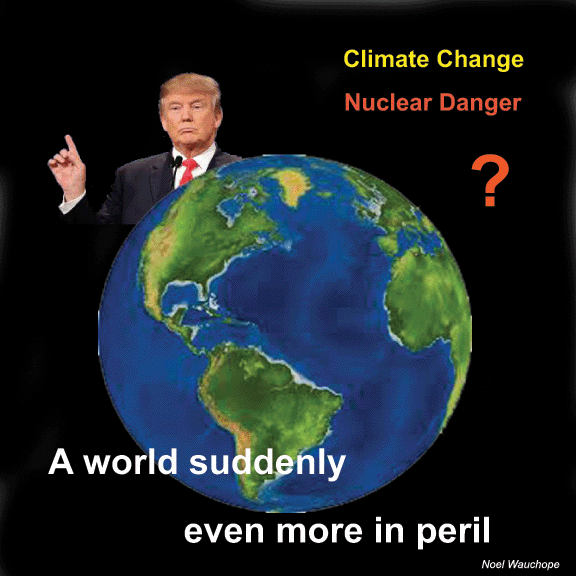
Trump attack, in his war on science and on the Earth’s climate
 Trump has launched a blitzkrieg in the wars on science and Earth’s climate Skeptical Science 28 March 2017 by dana1981Today, Trump signed executive orders taking aim at America’s climate policies. On the heels of a report finding that the world needs to halve its carbon pollution every decade to avoid dangerous climate change, Trump’s order would instead increase America’s carbon pollution, to the exclusive benefit of the fossil fuel industry.
Trump’s anti-climate executive orders
One part of the executive order tells the EPA to review and revise (weaken) its Clean Power Plan and methane regulations. However, revising these regulations isn’t so simple. It requires proceeding through the same years-long rulemaking process the EPA used to create the rules in the first place. This involves considering the scientific evidence, crafting draft rules, responding to millions of public comments, and defending the new plan in court. Environmental attorneys are confident “this is another deal President Trump won’t be able to close.”
A second part of the executive order tells the EPA to ignore the government’s estimated price on carbon pollution. The Republican Party wants to lower the current estimate, but most evidence indicates the government is dramatically underestimating the cost of carbon pollution. Trump gets around this inconvenient evidence by ordering the EPA to simply deny the existence of those costs.
A third part of the executive order ends a moratorium on new coal leases on public lands before a review is completed to determine if taxpayers are being shortchanged due to the lands being sold too cheaply. Environmental groups are set to immediately challenge this order. Regardless, lifting the moratorium would have little effect on coal production or mining jobs.
EPA administrator Scott Pruitt would undoubtedly be happy to follow Trump’s orders. In his previous job as Oklahoma Attorney General and fossil fuel industry puppet, one of Pruitt’s 14 lawsuits against the EPA was aimed at the Clean Power Plan. However, the Clean Air Act requires the government to cut carbon pollution. Trump and Pruitt may not like it, but the law, scientific evidence, and public opinion fall squarely against them.
Trump’s anti-science budget
A few weeks ago, Donald Trump released his first proposed budget, and it’s also fiercely anti-science and anti-climate………https://www.skepticalscience.com/trump-blitzkrieg-wars-on-science-climate.html
Governors of New York and California Reaffirm Commitment to Exceeding Targets of the Clean Power Plan
 Governor Cuomo and Governor Brown Reaffirm Commitment to Exceeding Targets of the Clean Power Plan, https://www.governor.ny.gov/news/governor-cuomo-and-governor-brown-reaffirm-commitment-exceeding-targets-clean-power-plan MARCH 28, 2017 Albany, NY, With the announcement that the United States will begin to dismantle the Clean Power Plan, New York Governor Andrew M. Cuomo and California Governor Edmund G. Brown Jr. today issued the following statement reaffirming their ongoing commitment to exceed the targets of the Clean Power Plan and curb carbon pollution:
“Dismantling the Clean Power Plan and other critical climate programs is profoundly misguided and shockingly ignores basic science. With this move, the Administration will endanger public health, our environment and our economic prosperity.
“Climate change is real and will not be wished away by rhetoric or denial. We stand together with a majority of the American people in supporting bold actions to protect our communities from the dire consequences of climate change.
“Together, California and New York represent approximately 60 million people – nearly one-in-five Americans – and 20 percent of the nation’s gross domestic product. With or without Washington, we will work with our partners throughout the world to aggressively fight climate change and protect our future.”
New York and California lead the nation in ground-breaking policies to combat climate change. Both states – which account for roughly 10 percent of greenhouse gas emissions in the United States – have adopted advanced energy efficiency and renewable energy programs to meet and exceed the requirements of the Clean Power Plan and have set some of the most aggressive greenhouse gas emission reduction targets in North America – 40 percent below 1990 levels by 2030 and 80 percent below 1990 levels by 2050. New York and California will continue to work closely together – and with other states – to help fill the void left by the federal government.
New York’s Climate Leadership
Greenhouse Gas Emission Reductions: Established ambitious greenhouse gas emission reduction targets to reduce emissions 40 percent below 1990 levels by 2030 and 80 percent by 2050. These targets have made New York a leader across the country in fighting climate change.
Regional Greenhouse Gas Initiative (RGGI): Spearheaded the formation of the successful RGGI cap-and-trade program between northeast and mid-Atlantic states, led effort to reduce RGGI’s carbon emission cap by 45 percent in 2014, and recently called for an additional cap reduction of at least 30 percent between 2020 and 2030.
Reforming the Energy Vision: Established a comprehensive energy strategy to make the vision for a clean, resilient, and affordable energy system a reality, while actively spurring energy innovation, attracting new jobs, and improving consumer choice.
Clean Energy Standard: Established the most comprehensive and ambitious clean energy mandate in the state’s history, requiring that 50 percent of electricity in New York come from renewable energy sources like wind and solar by 2030.
Clean Energy Fund: Established a $5 billion fund that is jump-starting clean-tech innovation, mobilizing private investment, capitalizing the nation’s largest Green Bank, and helping eliminate market barriers to make clean energy scalable and affordable for all New Yorkers.
Coal-Free New York: Committed to close or repower all coal-burning power plants in New York to cleaner fuel sources by 2020.
Offshore Wind: Approved the nation’s largest wind energy project off the Long Island coast in 2017 and made an unprecedented commitment to develop up to 2.4 gigawatts of offshore wind power by 2030.
California’s Climate Leadership
Greenhouse Gas Emission Reductions: Established ambitious greenhouse gas emission reduction targets to reduce emissions 40 percent below 1990 levels by 2030 and 80 percent by 2050. These targets have made California a leader across the country in fighting climate change.
Cap-and-Trade: Established the most comprehensive carbon market in North America, investing more than $2.6 billion from the Cap-and-Trade program in programs and projects that reduce emissions and support communities disadvantaged by pollution.
Renewable Energy: Established landmark targets that require at least 33 percent of California’s electricity comes from renewable energy sources by 2020, and 50 percent by 2030.
Energy Efficiency: Established targets that double the rate of energy efficiency savings in California buildings and require residential buildings to be Zero Net Energy by 2020, and all commercial buildings to be Zero Net Energy by 2030.
Super Pollutant Reduction: Established the nation’s toughest restrictions on destructive super pollutants, such as methane, black carbon, and hydrofluorocarbon gases.
Low Carbon Fuel Standard: Established requirements for producers of petroleum-based fuels to reduce the carbon intensity of their products, helping drive the replacement of fossil fuels with renewable natural gas and diesel, low-carbon ethanol, and clean electricity, giving consumers more clean fuel choices while driving significant clean fuel investment and creating new economic opportunities.
Zero Emission Vehicles: Established a program requiring increased sales of zero emission vehicles – a policy adopted by 10 states – resulting in more than 30 new models of clean and affordable vehicles that are reducing consumer gasoline and diesel costs. California also adopted North America’s first greenhouse gas emission car standards – later adopted as a national program – and adopted the nation’s first heavy-duty vehicle and trailer greenhouse gas emission reduction requirements, which led to similar national requirements.
These efforts complement New York and California’s ongoing efforts to broaden collaboration among subnational leaders on climate change, including through the Under2 Coalition – a pact among cities, states and countries around the world to limit the increase in global average temperature to below 2 degrees Celsius in order to avoid potentially catastrophic consequences. New York and California are among the Under2 Coalition’s 167 jurisdictions representing more than one billion people and $25.9 trillion in combined GDP – more than one-third of the global economy.
Nevada’s determined fight against plan for Yucca Mountain nuclear dump
 Decades-old war over Yucca Mountain nuclear dump resumes under Trump budget plan, LA Times, Ralph Vartabedian, 29 Mar 17 An abandoned tunnel in the desolate Nevada desert, barricaded only by a chain-link fence, is all that remains of the nation’s tortured effort to create a permanent repository for nuclear waste 100 miles northwest of Las Vegas.
After spending $11 billion, the Energy Department met with unrelenting opposition from Nevada and was forced to shut down the program at Yucca Mountain — the only remotely viable option for storing tons of deadly waste that currently has nowhere to go — in 2010……..
At an estimated cost of $100 billion, the Yucca Mountain nuclear waste dump would rival the International Space Station in cost and complexity, requiring construction of roughly 300 miles of new railroad tracks to transport the waste, development of advanced robots to work underground and fabrication of special titanium shields to keep the waste intact for, it is hoped, hundreds of thousands of years.
The $120 million outlined by Trump this month in his budget blueprint would restart the ponderous licensing process that was abandoned by the Obama administration and begin plans for a temporary storage facility at an undetermined location…….
Nevada officials have put every ounce of their political muscle into stopping the dump…….The state is quickly gearing up for a new fight, readying new legal strategies and pushing a resolution through the state Legislature.
“The Trump administration’s attempt to revive Yucca Mountain is naive and a waste of taxpayer dollars,” said Sen. Catherine Cortez Masto (D-Nev.), who successfully fought off the Energy Department for years when she was the state’s attorney general. “It is a nonstarter.”
Cortez Masto said the state is united against the dump across party lines, including Republican Gov. Brian Sandoval, another former attorney general……..
Nevada has filed some 300 legal “contentions” against the Energy Department’s license, each of which must be examined by a special board. The state is swinging into action to file even more contentions if the license action is resumed, said Robert Halstead, chief of the state’s nuclear office.
“They think because Reid is gone, this will be a cakewalk. Wrong,” Halstead said. “I see them going through a licensing procedure that will cost $1.5 billion and take five years, with a 50% chance of success.”……
The Energy Department’s failure to keep its promise to move forward with a disposal project, even while it collected the money, has created a swamp of litigation.
Most of the nation’s commercial reactors, including the shuttered San Onofre plant in northern San Diego County, are located on rivers, lakes and oceans — a risky location for storing highly radioactive fuel rods. And much of the nation’s nuclear weapons waste, which could also end up at Yucca Mountain, is stored in leaky tanks and steel drums.
The nation’s nuclear utilities have won judgments and settlements of $6.1 billion, arguing that the government’s failure to take the waste has increased their storage and operation costs, said Jay Silberg, an attorney representing the industry. And the Energy Department has projected that it may be liable for up to $25 billion more…….http://www.latimes.com/local/california/la-na-yucca-revival-20170329-story.html
Demolition of McCluskey Room at Hanford’s Plutonium Finishing Plant
Workers demolish site of nuclear mishap in Washington state , San Franciso Chronicle, NICHOLAS K. GERANIOS, ASSOCIATED PRESS, March 30, 2017, SPOKANE, Wash. (AP) — Workers at the Hanford Nuclear Reservation in Washington state have finished demolishing the site of a famous nuclear accident during the Cold War that exposed a man to the highest dose of radiation from the plutonium byproduct americium ever recorded, the U.S. Department of Energy announced Thursday.
Remembering Three Mile Island
GIL SCOTT HERON – WE ALMOST LOST DETROIT (LIVE AT 98.3 SUPERFLY)
This Day in History: America’s Worst Nuclear Fears Realized at Three Mile Island Plant, VOA, 28 Mar 17, Thirty-eight years ago today — March 28, 1979 — disaster struck at 4 a.m. at the Three Mile Island (TMI) nuclear power plant in central Pennsylvania after its cooling system failed.
It remains the worst nuclear accident in American history. A simple plumbing failure prevented the main feedwater pumps from sending water to generators that remove heat from the plant’s core reactor.
During those pre-dawn hours, the temperature of the reactor rose steadily even as staffers were unaware that a valve in the emergency cooling system had become stuck in place, allowing cool water to flow through the valve — not reaching the reactor.
Instruments in the control room misled operators, who thought the cooling system was working normally.
As coolant flowed from the primary system through the valve, other instruments available to reactor operators provided inadequate information. There was no instrument that showed how much water covered the core. As a result, plant staff assumed that as long as the pressurizer water level was high, the core was properly covered with water.
As alarms rang and warning lights flashed, the operators did not realize that the plant was experiencing a loss-of-coolant accident — or, rather, the beginnings of a nuclear meltdown. And just after 6:00 am, data indicated the core reactor had overheated so much that radiation was detected inside the control room.
Half the core was later found to have melted………
In the months following the accident, questions were raised about possible adverse effects from radiation on human, animal and plant life around the nuclear power plant, although none could be directly correlated to the accident.
Thousands of environmental samples of air, water, milk, vegetation, soil and foodstuffs were collected by various government agencies monitoring the area.
In 1997, researchers from Environmental Health Perspectives, the journal of the U.S. National Institute of Environmental Health Science concluded increases in lung cancer and leukemia near the Pennsylvania plant suggested a much greater release of radiation during the 1979 accident than had been believed.
Three Mile Island Health Effects
The accident sparked sweeping safety regulations. The damaged reactor, on the Susquehanna River near Harrisburg, was never restarted. No new commercial nuclear power plant was licensed by the federal government until 2012….http://www.voanews.com/a/americas-worst-nuclear-fears-realized-at-three-mile-island-plant-in-1979/3784186.html
Concern about nuclear waste shipments to South Carolina
Among the materials with no disposition plan include weapons-grade plutonium, depleted uranium oxide, highly enriched uranium and heavy water.
Specifics about the quantity and timetables were redacted from the report. Lastly, the DOE report states that there is no disposition path for surplus plutonium stored at K-Area.
The DOE’s short-term strategy of continuing nuclear shipments to SRS runs counter to South Carolina’s long-held aversion to the state becoming a dumping ground for nuclear waste.
 More nuclear shipments to Savannah River Site likely, report says http://www.aikenstandard.com/news/more-nuclear-shipments-to-savannah-river-site-likely-report-says/article_4a380b86-13db-11e7-87c8-c3869ab88afe.html By Michael Smith msmith@aikenstandard.com Mar 28, 2017 Shipments of plutonium and other nuclear materials are expected to continue to the Savannah River Site in Aiken County for the foreseeable future, according to government records released by a watchdog group.
America and her allies oppose UN talks for a treaty that would ban nuclear weapons
United States and Allies Protest U.N. Talks to Ban Nuclear Weapons, NYT, MARCH 27, 2017, UNITED NATIONS — Saying the time was not right to outlaw nuclear arms, the United States led a group of dozens of
USA tries to block UN nuclear-weapons-ban -talks, backed by its “Deputy Sheriff” Australia.
 UN nuclear treaty: Australia plays deputy as US ‘sheriff’ baulks at ban Daniel Flitton, The Age, 29 Mar 17 Nikki Haley marched in on her first day as Donald Trump’s ambassador to the United Nations with a blunt warning to the world: “For those who don’t have our backs, we’re taking names.”
Australia has now gone to extraordinary lengths to make sure its name stays off Trump’s naughty list. With negotiations for a new treaty to outlaw nuclear weapons kicking off on Monday (New York time), Haley called an extraordinary press conference outside the UN to declare the US opposition to the talks.
And there, at her heels, was Australia.
At the very moment representatives from more than 120 countries were starting their negotiations inside, Australia stood with Trump’s appointee and a group widely known as the “weasel countries” who are opposed to banning the bomb.
According to anti-nuclear campaigners, 21 countries joined Haley’s protest. They included Albania, Turkey, Croatia, Romania, Poland, Estonia, Slovenia, Hungary and South Korea. Britain and France, both nuclear armed, also spoke against a ban. Other NATO allies joined in, although not all……
Back in January, Haley had made plain the attitude the Trump administration would take to the world body. “Our goal … is to show value at the UN, and the way to show value is to show our strength, show our full voice,” she declared. “Have the backs of our allies and make sure our allies have our backs as well.
“For those who don’t have our backs, we’re taking names, and we will make points to respond to that accordingly.”
On Monday, after the protest at the UN, she told a key lobby group for Israel in Washington: “For anyone who says you can’t get anything done at the UN, they need to know there’s a new sheriff in town.”
And she made the nuclear issue personal…….
Tilman Ruff, of the International Campaign to Abolish Nuclear Weapons, told Fairfax Media from New York that the US action was alarming and Australia was “aligning itself with the extremes of the Trump administration”.
“What credibility does Australia have to criticise North Korea’s reckless nuclear proliferation when it continues to claim protection itself through the very same weapons, and oppose efforts to ban them?” Dr Ruff said. http://www.theage.com.au/federal-politics/political-news/un-nuclear-treaty-australia-plays-deputy-as-us-sheriff-baulks-at-ban-20170328-gv8bge.html
How did the Pentagon lose $10 Trillion?
$10 Trillion Missing From Pentagon And No One — Not Even The DoD — Knows Where It Is http://www.activistpost.com/2017/03/10-trillion-missing-pentagon-no-one-not-even-dod-knows.html, BY CLAIRE BERNISH
Over a mere two decades, the Pentagon lost track of a mind-numbing $10 trillion — that’s trillion, with a fat, taxpayer-funded “T” — and no one, not even the Department of Defense, knows where it went or on what it was spent.
Even though audits of all federal agencies became mandatory in 1996, the Pentagon has apparently made itself an exception, and — fully 20 years later — stands obstinately orotund in never having complied.
Because, as defense officials insist — summoning their best impudent adolescent — an audit would take too long and, unironically, cost too much.
“Over the last 20 years, the Pentagon has broken every promise to Congress about when an audit would be completed,” Rafael DeGennaro, director of Audit the Pentagon, told The Guardianrecently. “Meanwhile, Congress has more than doubled the Pentagon’s budget.”
Worse, President Trump’s newly-proposed budget seeks to toss an additional $54 billion into the evidently bottomless pit that is the U.S. military — more for interventionist policy, more for resource-plundering, more for proxy fighting, and, of course, more for jets and drones to drop more bombs suspiciously often on civilians.
Maybe.
Because, without the mandated audit, the DoD could be purchasing damned near anything, at any cost, and use, or give, it — to anyone, for any reason.
Officials with the Government Accountability Office and Office of the Inspector General have catalogued egregious financial disparities at the Pentagon for years — yet the Defense Department grouses the cost and energy necessary to perform an audit in compliance with the law makes it untenable.
Astonishingly, the Pentagon’s own watchdog tacitly approves this technically-illegal workaround — and the legally-gray and, yes, literally, on-the-books-corrupt practices in tandem — to what would incontrovertibly be a most unpleasant audit, indeed.
Take the following of myriad examples, called “plugging,” for which Pentagon bookkeepers are not only encouraged to conjure figures from thin air, but, in many cases, they would be physically and administratively incapable of performing the job without doing so — without ever having faced consequences for this brazen cooking of books.
To wit, Reuters reported the results of an investigation into Defense’s magical number-crunching — well over three years ago, on November 18, 2013 — detailing the illicit tasks of 15-year employee, “Linda Woodford [who] spent the last 15 years of her career inserting phony numbers in the U.S. Department of Defense’s accounts.”
Woodford, who has since retired, and others like her, act as individual pieces in the amassing chewed gum only appearing to plug a damning mishandling of funds pilfered from the American people to fund wars overseas for resources in the name of U.S. defense.
“Every month until she retired in 2011,” Scot J. Paltrow wrote for Reuters, “she says, the day came when the Navy would start dumping numbers on the Cleveland, Ohio, office of the Defense Finance and Accounting Service, the Pentagon’s main accounting agency. Using the data they received, Woodford and her fellow DFAS accountants there set about preparing monthly reports to square the Navy’s books with the U.S. Treasury’s – a balancing-the-checkbook maneuver required of all the military services and other Pentagon agencies.
“And every month, they encountered the same problem. Numbers were missing. Numbers were clearly wrong. Numbers came with no explanation of how the money had been spent or which congressional appropriation it came from. ‘A lot of times there were issues of numbers being inaccurate,’ Woodford says. ‘We didn’t have the detail … for a lot of it.’”
Where a number of disparities could be corrected through hurried communications, a great deal — thousands each month, for each person on the task — required fictitious figures. Murkily deemed, “unsubstantiated change actions” — tersely termed, “plugs” — this artificial fix forcing records into an unnatural alignment is common practice at the Pentagon.
Beyond bogus books, the Pentagon likely flushed that $10 trillion in taxes down the toilet of inanity that is unchecked purchasing by inept staff who must be devoid of prior experience in the field of defense.
This tax robbery would eclipse the palatability of blood money — if it weren’t also being wasted on items such as the 7,437 extraneous Humvee front suspensions — purchased in surplus over the inexplicable 14-year supply of 15,000 unnecessary Humvee front suspensions already gathering warehouse-shelf dust.
And there are three items of note on this particular example, of many:
One, the U.S. Department of Defense considers inventory surpassing a three-year supply, “excessive.”
Two, the stupefying additional seven-thousand-something front suspensions arrived, as ordered, during a period of demand reduced by half.
Three, scores of additional items — mostly unaccounted for in inventory — sit untouched and aging in storage, growing not only incapable of being used, but too dangerous to be properly disposed of safely.
Worse, contractors greedily sink hands into lucrative contracts — with all the same supply-based waste at every level, from the abject disaster that is the $1 trillion F-35 fighter program, to the $8,123.50 shelled out for Bell Helicopter Textron helicopter gears with a price tag of $445.06, to the DoD settlement with Boeing for overcharges of a whopping $13.7 million.
The latter included a charge to the Pentagon of $2,286 — spent for an aluminum pin ordinarily costing just $10.
Considering all the cooking of numbers apparently fueled with burning money stateside, you would think Defense channeled its efforts into becoming a paragon of economic efficiency when the military defends the United States. Overseas. From terrorism. And from terrorists. And terrorist-supporting nations.
But this is the Pentagon — and a trickle of telling headlines regularly grace the news, each evincing yet another missing shipment of weapons, unknown allocation of funds, or retrieval of various U.S.-made arms and munitions by some terrorist group deemed politically less acceptable than others by officials naming pawns.
In fact, so many American weapons and supplies lost by the DoD and CIA become the property of actual terrorists — who then use them sadistically against civilians and strategically against our proxies and theirs — it would be negligent not to describe the phenomenon as pattern, whether or not intent exists behind it.
Since practically the moment of nationalist President Donald Trump’s inauguration, the ceaselessly belligerent of the military-industrial machine have been granted a new head cheerleader with a bullhorn so powerful as to render calls to apply the brakes effectively, if not unpatriotically, moot.
Sans any optimistic indication thus far lacking from the Trump administration it would reverse course and move toward, rather than against, transparency, the painstaking audit imperative to DoD accountability remains only a theory — while the Pentagon’s $10 trillion sits as the world’s largest elephant in apathetic America’s living room.
For now, we know generally where our money is going: war. Which aspect of war — compared to the power of your outrage about its callous and reckless execution in your name — matters little.
Claire Bernish writes for TheFreeThoughtProject.com, where this article first appeared.
Trump takes action to reverse Obama’s climate change initiatives
 Donald Trump moves to erase Barack Obama’s legacy on fighting climate change, The Age 29 Mar 17 Juliet Eilperin and Brady Dennis, Washington: US President Donald Trump has signed an executive order to scrap Obama-era climate change regulations that his administration says are hindering oil drillers and coal miners.
“My administration is putting an end to the war on coal,” Trump said before signing the decree. “With today’s executive action I am taking historic steps to lift the restrictions on American energy, to reverse government intrusion and to cancel job-killing regulations.”
It is the most significant step yet in obliterating his predecessor’s environmental record and instructing federal regulators to rewrite key rules curbing US carbon emissions. The sweeping executive order also seeks to lift a moratorium on federal coal leasing and remove the requirement that federal officials consider the impact of climate change when making decisions.
The order sends an unmistakable signal that just as former president Barack Obama sought to weave climate considerations into every aspect of the federal government, Mr Trump is hoping to rip that approach out by its roots…..
Some of the measures could take years to implement and are unlikely to alter broader economic trends that are shifting the nation’s electricity mix from coal-fired generation to natural gas and renewables. The order is silent on whether the United States should withdraw from the 2015 Paris climate agreement, under which it has pledged to cut its greenhouse gas emissions between 26 and 28 per cent by 2025 compared to 2005 levels, because the administration remains divided on that question.
Some of the measures could take years to implement and are unlikely to alter broader economic trends that are shifting the nation’s electricity mix from coal-fired generation to natural gas and renewables. The order is silent on whether the United States should withdraw from the 2015 Paris climate agreement, under which it has pledged to cut its greenhouse gas emissions between 26 and 28 per cent by 2025 compared to 2005 levels, because the administration remains divided on that question.
The order comes after several moves by Mr Trump to roll back Obama-era restrictions on mining, drilling and coal and gas-burning operations. In his first two months as President, Mr Trump has nullified a regulation barring surface-mining companies from polluting waterways and set aside a new accounting system that would have compelled coal companies and other energy firms to pay more in federal royalties.
The administration also has announced it will reconsider stricter fuel-efficiency standards for cars and light trucks and has approved two major oil pipelines, Dakota Access and Keystone XL, that Mr Obama had halted.
Accelerating fossil-fuel production on federal lands and sidelining climate considerations could lead to higher emissions of the greenhouse gases driving climate change and complicate a global effort to curb the world’s carbon output. But Mr Trump has repeatedly questioned whether climate change is underway and emphasised that he is determined to deliver for the voters in coal country who helped him win the Oval Office……
Rewriting emissions limits
The centrepiece of the new presidential directive, telling the Environmental Protection Agency to begin rewriting the 2015 regulation that limits greenhouse-gas emissions from existing power plants, will trigger a laborious rule-making process and a possible legal fight.
The agency must first get permission from the US Court of Appeals for the DC Circuit, where the rule is tied up in litigation, to revisit the matter. Then, agency officials will have to justify reaching the opposite conclusion of the Obama EPA, which argued it was technically feasible and legally warranted to reduce carbon pollution by about one-third by 2030, compared with 2005 levels.
“So, for the president, even if he would like to revoke the Clean Power Plan, he doesn’t have legal authority to do that,” said Jeffrey Holmstead, a partner at the Bracewell law firm who opposes the Obama-era rule. Mr Holmstead, who headed the EPA’s air and radiation office under George W. Bush, said he thinks the agency can justify reversing the regulation. But “they have to justify why they have changed,” he added……http://www.theage.com.au/world/donald-trump-moves-to-erase-barack-obamas-legacy-on-fighting-climate-change-20170328-gv8kru.html
Vague outlook for India-U.S. civil nuclear pact, unlikely to meet June deadline
India-U.S. civil nuclear pact likely to miss June deadline, THE HINDU, Bankruptcy of reactor maker Westinghouse clouds operationalisation of the deal.
More than two years after India and the U.S. announced that the civil nuclear deal was “done,” its actual operationalisation is in doubt over a number of developments that stretch from a “school scandal” in the Japanese parliament to the Cranberry, Pennsylvania headquarters of Westinghouse Electric, which is expected to file for bankruptcy this week.
Six reactors for A.P. According to the agreement over liability issues and the negotiations that followed former U.S. President Barack Obama’s visit to India in January 2015 and Prime Minister Narendra Modi’s visit to Washington in June 2016, the two sides had agreed to “work toward finalising the contractual arrangements by June 2017” for six reactors to be built in Andhra Pradesh by Toshiba-owned Westinghouse and the Nuclear Power Corporation of India Ltd (NPCIL).
When completed, this was to be the first operationalisation of the India-U.S. civil nuclear deal, which was announced in 2008, and proof that both sides had effectively sorted out all their issues, including over the liability that suppliers must accept in the event of an accident.
The reason for the concern is that the nuclear arrangement hinged on two major factors — the completion of the India-Japan Nuclear Cooperation Agreement (NCA), as Toshiba and other suppliers for reactor parts are bound by Japanese laws and by the actual contract to be negotiated by the U.S.-based Westinghouse…….
When contacted, the U.S. Embassy declined to comment on how the bankruptcy issues would affect the deal. Nuclear officials said it was “likely” the June 2017 commercial contract with Westinghouse would be “delayed”, given that other financial companies, insurance companies would require clarity on the company’s future before agreeing to sign on the contract.
“The truth is the picture is very hazy at the moment,” a senior official of NPCIL said, adding that in the absence of land acquisition procedures for the other India-U.S. nuclear venture with GE-Hitachi for six 1594 MW reactors, the future of the India-U.S. nuclear deal is, for the moment, pinned to the future of Westinghouse itself. http://www.thehindu.com/news/national/indo-us-civil-nuclear-pact-likely-to-miss-june-deadline/article17668572.ece
Despite the turmoil in the nuclear industry, Dominion Energy forges on with new nuclear plans
Amid nuclear industry turmoil, Dominion forges ahead with new nuclear reactor http://www.utilitydive.com/news/amid-nuclear-industry-turmoil-dominion-forges-ahead-with-new-nuclear-react/439122/, Robert Walton March 28, 2017
Dive Brief:
- Dominion Energy continues to advance plans for a proposed third nuclear reactor at its Santa Anna facility in Virginia, even as financial difficulties have imperiled construction of other projects in the region.
- Southeast Energy News reports federal regulators last week determined that with some “structural changes” to guard against earthquake damage, the proposed reactor could be approved.
- Dominion’s interest in constructing a new nuclear reactor comes as Westinghouse Electric Co., the nuclear engineering firm overseeing construction facilities in Georgia and South Carolina, prepares to file for bankruptcy at the end of this month.
-
Dive Insight:
Dominion has not committed to building a third unit at North Anna—so far the utility appears to be keeping its options open in pursuing the license—but despite uncertainty in the industry and objections from clean energy advocates, the project is chugging along.
But recent bad news within the nuclear sector shows signs of upheaval and uncertainty.
Toshiba recently announced a $6 billion writedown at its Westinghouse subsidiary, which is managing construction of new nuclear generation at the Vogtle plant in Georgia and V.C. Summer in South Carolina. Reuters reports Westinghouse could file for bankruptcy as early as today.
MIT Technology Review believes a Westinghouse bankruptcy means an end to new nuclear construction in the United States. The news outlet also reports analysts doubt Toshiba will find a buyer for its stake in Westinghouse, nor any construction partners willing to forge ahead with the nuclear plants it planned to build.
- The Vogtle and VC Summer plants are years behind schedule and costs are mounting. Development of those plants will likely continue, but within the industry there has been speculation that if Westinghouse fails, it will likely spell the end of new nuclear development for the time being.
In Virginia, Dominion is spending upwards of $600 million to obtain approval from the federal government. Long-term costs could exceed $19 billion, with the project possibly taking until 2029 to complete. The utility could spend $2 billion in just the planning stages alone. Dominion would use a new kind of nuclear design developed by GE Hitachi Nuclear Energy.
1 This Month





PLEASE OPPOSE HR 8255 AND S.3639 – bills would accelerate satellite deployment, with no environmental review or safeguards – https://ncstd5li.quorum.us/campaign/169331/
To see nuclear-related stories in greater depth and intensity – go to https://nuclearinformation.wordpress.com
-
Archives
- October 2026 (81)
- September 2026 (339)
- August 2026 (330)
- July 2026 (355)
- June 2026 (287)
- May 2026 (306)
- April 2026 (356)
- March 2026 (251)
- February 2026 (267)
- January 2026 (308)
- December 2025 (358)
- November 2025 (359)
-
Categories
- 1
- 1 NUCLEAR ISSUES
- business and costs
- climate change
- culture and arts
- ENERGY
- environment
- health
- history
- indigenous issues
- Legal
- marketing of nuclear
- media
- opposition to nuclear
- PERSONAL STORIES
- politics
- politics international
- Religion and ethics
- safety
- secrets,lies and civil liberties
- spinbuster
- technology
- Uranium
- wastes
- weapons and war
- Women
- 2 WORLD
- ACTION
- AFRICA
- Atrocities
- AUSTRALIA
- Christina's notes
- Christina's themes
- culture and arts
- Events
- Fuk 2022
- Fuk 2023
- Fukushima 2017
- Fukushima 2018
- fukushima 2019
- Fukushima 2020
- Fukushima 2021
- general
- global warming
- Humour (God we need it)
- Nuclear
- RARE EARTHS
- Reference
- resources – print
- Resources -audiovicual
- Weekly Newsletter
- World
- World Nuclear
- YouTube
-
RSS
Entries RSS
Comments RSS

