The Trump Administration Is Apparently Terrified of Actually Making a Decision About Paris Sad!, Mother Jones, OLIVER MILMAN, APR. 19, 2017 This story was originally published by the Guardian and is reproduced here as part of theClimate Desk collaboration.
Donald Trump’s aides have abruptly postponed a meeting to determine whether the US should remain in the Paris climate agreement, with an unlikely coalition of fossil fuel firms, environmental groups and some Republicans calling on the president to stick with the deal.
Trump’s top advisers were set to meet on Tuesday to provide the president with a recommendation ahead of a G7 meeting in May. However, a White House official said the meeting had been postponed due to conflicting schedules. It is unclear when it will now take place.
Trump has already signed executive orders to start the demolition of the clean power plan, throw open federal land to coal mining, and halt new vehicle emissions standards but has so far not acted on his campaign pledge to “cancel” the Paris compromise.
His aides are understood to be split on whether the US should stay in the voluntary agreement, which was fully ratified last year. Barack Obama pledged that the US would cut greenhouse gas emissions by 26-28 percent by 2025, based on 2005 levels, as part of a landmark global effort that for the first time required emissions reduction goals from all nations, including the large developing emitters China and India.
Trump’s adviser Steve Bannon and the Environmental Protection Agency head, Scott Pruitt, are both in favor of ditching the Paris agreement. Last week, Pruitt called the agreement a “bad deal” for the US that imposes a burden that other countries do not have to bear.
However, the weight of opinion may be in favor of those who support the agreement. Trump’s daughter, Ivanka, and son-in-law, Jared Kushner, both advisers to the president, have positioned themselves as defenders of the agreement, while Rex Tillerson, the secretary of state, has supported the idea of “keeping a seat at the table.” Other advisers at the meeting were expected to include Rick Perry, the energy secretary; Gary Cohen, an economic adviser; and HR McMaster, the national security adviser.
Support for the Paris deal has come from seemingly unlikely quarters—the oil giant ExxonMobil wrote to the White House to advocate it as an “effective framework for addressing the risks of climate change.” BP and Shell have also previously endorsed the Paris deal, along with dozens of other businesses including Gap, General Mills and the Kellogg Company.
A group of Republicans in Congress also warned against withdrawing from the agreement. The Florida congressman Carlos Curbelo, in his role as co-chair of the Climate Solutions Caucus, said it was “imperative that we maintain our seat at the table.”
“The world’s leading nations must work together to not only reduce the impact carbon emissions have on climate change, but also mitigate and prepare for the effects, which communities like ours are dealing with every day,” Curbelo said in a joint statement with Ted Deutch, a Democrat who is his fellow co-chair……..
If Trump decides to exit the deal, it will require a three-year notice period before the process begins. In order to speed up the process, he could remove the US from the overall UN climate change framework or submit the deal to the Senate to be ratified as a treaty, where it will probably fail.
A third, and perhaps most likely, option is to remain in the agreement in name only, retaining a modicum of US prestige abroad while dismantling Obama-era rules designed to reduce emissions. The US will face no penalty for not meeting its emissions targets, although some other countries have raised the possibility of imposing a “carbon tariff” on American goods.
Regardless of whether the US stays within the Paris deal, its chances of making deep cuts in its emissions have receded since Trump took office. Without the clean power plan, more stringent emissions standards on vehicles and gas and oil drilling operations or any sort of tax on greenhouse gases—a plan recently floated by some Republicans—the US will pull back from the effort to help avoid more severe heatwaves, droughts, the disappearance of coral reefs and coastal inundation.
“Regardless of what Trump does on Paris, he has abrogated our position,” said Tom Steyer, a leading hedge fund manager and climate campaigner. “This is an administration trying as hard as possible to bring back coal mining; they have given up American leadership on energy and climate. They have already walked away.” http://www.motherjones.com/environment/2017/04/trump-aides-postpone-meeting-paris-climate-deal
April 21, 2017
Posted by Christina Macpherson |
climate change, politics international, USA |
Leave a comment
 Brain specialist doctor believes Donald Trump’s frontal lobe is failing http://www.palmerreport.com/politics/brain-specialist-doctor-believes-donald-trumps-frontal-lobe-is-failing/2354/ By Bill Palmer Apr 19, 2017
 Over the past week Donald Trump has begun making so many basic confused errors that it’s become a matter of serious concern to a number of Americans. He’s forgetting names. He’s forgetting people. He’s forgetting what to do during the National Anthem. He’s forgetting that a kid just handed him a hat. He’s forgetting which country he just bombed. And now a brain specialist doctor says she believes it’s evidence that Trump’s frontal lobe is failing.
Brenda J. Iannucci, M.D., is a Cognitive Function Specialist based in upstate New York. She’s been attempting to diagnose Donald Trump’s health from afar, which seems warranted in light of Trump’s refusal to release his medical records during and since the election. Dr. Iannucci summed up Trump’s worsening lack of recall in the following fashion: “Cognitive failure in Trump: naming functions located frontotemporal regions of brain. Recall and reasoning fail concurrently” (
link). The circumstantial evidence to support her assertion is growing by the day.
Over the weekend Donald Trump humiliated himself by not remembering to put his hand over his heart during the Easter Egg Roll, and then taking a kid’s hat from him and autographing it before randomly flinging it into the crowd – seemingly forgetting that the kid had just handed it to him. Then he went on Fox News and unwittingly revealed he didn’t remember that Kim Jong-Il gave way to Kim Jong-Un in North Korea six years ago. Then he began repeatedly referring to his close ally Paul Ryan as “Ron” during a Tuesday rally in Ryan’s home state. And this came after Trump bombed Syria and then immediately announced that he had bombed Iraq instead.
So when Dr. Brenda Iannucci states her professional assessment that Donald Trump’s frontal lobe appears to be failing, even someone who’s not a medical professional can see where she’s coming from.
April 21, 2017
Posted by Christina Macpherson |
politics, USA |
Leave a comment
 House Democrat introduces bill to amend presidential removal procedures http://thehill.com/homenews/house/329206-house-democrat-introduces-bill-to-amend-presidential-removal-procedures BY CRISTINA MARCOS – 04/17/17 A House Democrat has introduced legislation to enhance the Constitution’s presidential removal procedures in response to concerns about President Trump’s behavior.
Rep. Earl Blumenauer (D-Ore.) filed the bill during the House’s two-week April recess to empower former presidents and vice presidents of both parties, in coordination with the sitting vice president, to determine if a president is fit for office.
“It is hard to imagine a better group to work with the vice president to examine whether the president is able to discharge the duties of the office. When there are questions about the president’s ability to fulfill his or her constitutional responsibilities, it is in the country’s best interest to have a mechanism in place that works effectively,” Blumenauer said in a statement.
Blumenau’s proposal stems from concern that the Constitution’s 25th Amendment, which was adopted five decades ago, would fall short in cases of emotional or mental incapacity.
The amendment states that the vice president assumes the Oval Office in the event that a president is removed from office, dies or resigns. Alternatively, the vice president and a majority of Cabinet officers can also jointly declare that a president is unfit to serve. The vice president would then take over as president in such a case.In the event that a president refused to step down, two-thirds of both the House and Senate would have to vote to force the resignation.
But Blumenauer posited that the mechanism wouldn’t be effective if a mentally unstable president simply fired all the Cabinet members. He argued it’s also possible that Cabinet members might feel pressured to stand by the president in the polarized political environment despite their own personal misgivings.
“Because the cabinet can be fired by the president, there is a natural bias that would make them reluctant to acknowledge the president’s inability to serve. It’s time to revisit and strengthen the Amendment and make sure there is a reliable mechanism in place if the president becomes unable to discharge the powers and duties of office,” Blumenauer said.
Blumenauer first raised concerns about the 25th Amendment in a House floor speech in February during which he expressed worry about what he viewed as “erratic” behavior from Trump. At the time, he pointed to Trump’s baseless claims about voter fraud in the election and stating that it was sunny during his inaugural address when it was, in fact, raining.
A handful of Democratic lawmakers have openly raised questions about Trump’s psychological state since he took office in January, including Blumenauer, Sen. Al Franken (Minn.) and Reps. Ted Lieu (Calif.) and John Yarmuth (Ky.).
April 21, 2017
Posted by Christina Macpherson |
politics, USA |
Leave a comment
 THE PLAN TO MAKE AMERICA’S NUKES GREAT AGAIN COULD GO HORRIBLY WRONG, VICE News, By Keegan Hamilton on Apr 20, 2017. It was nearly 2 o’clock in the morning on Oct. 23, 2010, when an Air Force lieutenant called from his base in Wyoming to report the nightmare scenario unfolding before him. Fifty intercontinental ballistic missiles — each tipped with a nuclear warhead 20 times more powerful than the bomb the U.S. dropped on Hiroshima — had suddenly lost contact with the computers at the base’s launch center.
“I… we… have no idea what’s happening right now,” the officer sputtered as he tried to explain the situation to support staff at a remote command center. Another officer barked orders behind him, interrupting the call. “Holy shit!” the lieutenant exclaimed. “I will have to call you back!”
The Air Force could tell that the weapons were still in their underground silos, but there was no way to know whether the missiles had been hijacked. A renegade missile crew, someone splicing into underground cables, or hackers exploiting radio signal receivers attached to the ICBMs could have set them on a countdown to launch. Even worse, without contact with the missiles, it was impossible to halt an unauthorized launch attempt.
Fortunately, the missiles were undisturbed. Altogether, they were knocked offline for a total of about 45 minutes, and the entire situation was resolved in a matter of hours. But for a chaotic stretch during the blackout, nobody knew what was wrong or how to fix it. As one colonel put it in an email, “the weapon system was kicking our butt.”
The culprit turned out to be a simple computer glitch: A circuit card had popped loose in the brains of the base’s Weapons System Processor.
The Air Force maintains that the situation was always under control. Still, it’s a stark reminder that even a minor mishap involving our nation’s aging nukes could have catastrophic consequences.
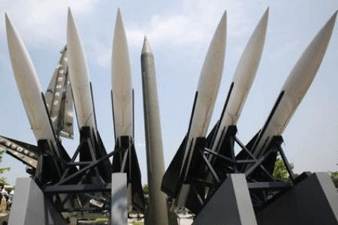
The U.S. keeps 416 “Minuteman” missiles ready to blast off at a moment’s notice. It’s unlikely — but not impossible — that a false alarm could make it seem like an attack is underway. In such a scenario, President Donald Trump, who has the sole, unchecked authority to launch U.S. nuclear weapons, would have only a few minutes to react. The codes used to fire the missiles are about the length of a tweet. And once one is launched, there’s no taking it back.
The technology that currently powers these nukes is notoriously antiquated. Most of the systems were designed and built during the height of the Cold War in the 1960s and ’70s, with the last major overhaul completed during the Reagan administration. Some computers in the missile base command centers still use eight-inch floppy disks.
In a May 2016 report, the Government Accountability Office determined that a key component of the Defense Department’s “command and control system,” which would be used to either start or prevent World War III, is “made up of technologies and equipment that are at the end of their useful lives.” The Pentagon is now in the midst of a $60 million overhaul of the system, which is expected to be complete by 2020.
The U.S. is on track to spend about $1 trillion over the next three decadesupgrading all facets of the nuclear arsenal, with $3.2 billion already budgeted for the 2017 fiscal year. A large chunk of that money will go toward upgraded missiles, new infrastructure, and overhauled command-and-control systems, such as digital phone lines and modern computers. Obama initiated the modernization plan, but it has found a new champion in Trump, who wants to boost the nuclear weapons program budget by an extra billion dollars……
Cyberwarfare has already moved into the nuclear realm. The U.S. has reportedly attempted to digitally sabotage North Korea’s nuclear and missile programs, perhaps as recently as last week, and it’s widely believed that malware created by the National Security Agency infected computers at an Iranian uranium-enrichment facility in 2010.
In February, the Pentagon issued a report on “cyber deterrence” that addressed the threat posed to nuclear weapons at home. It warned that “the cyberthreat to U.S. critical infrastructure is outpacing efforts to reduce pervasive vulnerabilities.” In other words, the bad guys are coming with new ways to attack digital weak spots faster than we can fix them.
As the mishap in Wyoming shows, the aging computers that control America’s nukes are by no means perfect. But with the modernization process already underway and multiple experts raising concerns about the plan to bring the most dangerous weapons known to man into the 21st century, the question is whether the solution to repair the creaky old machines is more dangerous than the existing problem…..https://news.vice.com/story/the-plan-to-make-americas-nukes-great-again-could-go-horribly-wrong
April 21, 2017
Posted by Christina Macpherson |
USA, weapons and war |
Leave a comment
 The most common tricks politicians use to muddle inconvenient science “I think my primary message would be learn to appreciate evidence.” VOX, by Sean Illing@seanillingsean.illing@vox.com Apr 20, 2017 On Saturday, thousands of people will march on Washington in support of science. And they’ll do so for very good reasons: Science, under the Trump administration, is under assault. As Vox’s Brian Resnick noted recently, the Trump administration has proposed cutting around $7 billion from science programs, including stifling research funding for the EPA and the National Institutes of Health.
In this interview, I talk to Dave Levitan, author of the new book Not a Scientist: How Politicians Mistake, Misrepresent, and Utterly Mangle Science. A how-to guide for spotting nonsense, Levitan’s book highlights the rhetorical tricks and logical errors politicians use when they distort science for political purposes. Here, we discuss the ideological roots of science denialism and why it’s so important for citizens to demand evidence in support of policy claims.
Dave Levitan The whole idea for the book came about when I started seeing patterns. Cherry-picking data is probably the most familiar. The tendency to draw on a single data point in support of some broader argument, like Sen. James Inhofe did with the famous snowball on the Senate floor. Or taking a very specific subset of data, like Ted Cruz did when he claimed there hasn’t been any global warming for 17 years. That might be the most commonly seen one where you really just pick and choose exactly which study and data point, which subset or source to use, and then conveniently draw on that when it aligns with your political narrative.
Another really common one is where they claim that because there is still some degree of uncertainty around whatever the subject happens to be, then that means we shouldn’t do anything about it. Climate change is a great one for that, but it dates back much farther. Conservatives used the same tactics for delaying action on acid rain in the ’80s, for example. President Reagan would say, “Well, we still have to study this and figure out what’s going on. There’s not enough data to do anything.”
First of all, they were wrong. There was plenty of data. We knew exactly how to deal with acid rain and ended up fixing it pretty well. So that one comes up a lot, the idea that because there’s any degree of uncertainty that we shouldn’t do anything, which is of course ridiculous because every scientific measure ever taken has a degree of uncertainty and always will……..
I think my primary message would be learn to appreciate evidence. I really wish that your average reader of news would keep in mind that evidence is important and just because someone said something doesn’t make it true. That’s true for people on the right or left, for scientists themselves, and for everyone. People have to back up their claims with evidence.
If individual citizens have this in mind at all times, I think they’d do a better job of spotting bullshit and lies. Make sure that people show their work, that their policy pronouncements are backed up with reliable data. http://www.vox.com/conversations/2017/4/20/15339844/science-climate-change-republican-party-march-for-science
April 21, 2017
Posted by Christina Macpherson |
climate change, resources - print, spinbuster, USA |
Leave a comment
Three Mile Island, like much of nuclear industry, is on the brink Wallace McKelvey | WMckelvey@pennlive.com on April 19, 2017 Nuclear power, which generates more than a third of Pennsylvania’s electricity, could soon disappear from the state amid a glut of cheap natural gas from the Marcellus Shale play.
And the first of the state’s five plants to fall could be Three Mile Island, which could close as soon as 2019.
That’s the argument, at least, that TMI owner Exelon is making as it seeks the Legislature’s help to keep struggling reactors like TMI open. The same argument is being made in other states — Illinois and New York both moved to shore up nuclear plants in the last year.
In turn, the gas lobby and other advocacy groups have ramped up efforts to thwart a bailout of the nuclear industry that they say would lead to electric rate hikes.
Pennsylvania lawmakers from both chambers and both parties formed a “nuclear caucus” with the goal of crafting a proposal to rescue the industry this fall. For their part, caucus leaders say they’re not interested in bailouts or subsidies……
Exelon’s most recent SEC filing described TMI as the facility “at the greatest risk of early retirement due to current economic valuations and other factors….
“We’ve operated for the past six years at a loss,” said Joseph Dominguez, Exelon’s executive vice president of governmental and regulatory affairs and public policy. “We have effectively tried everything we can to weather the storm. I think the question in front of us now is how much longer we’re willing to go.”
For two years in a row, TMI failed to clear PJM’s capacity auction, meaning that it was not able to sell guaranteed power in 2019 and 2020…..
In Illinois, Exelon announced the closure of two of its nuclear power plants but reversed the decision when the governor signed off on a $235 million subsidy … Competitors have since filed lawsuits to block the measure.
Exelon isn’t the only nuclear energy company to consider closing plants in Pennsylvania. FirstEnergy Corp. announced that it would close or sell the Beaver Valley nuclear power station near Pittsburgh within the next year. PSEG, which owns half of Peach Bottom station in York County alongside Exelon, also said it wouldn’t operate nuclear plants that are unprofitable. It has pressed New Jersey for similar subsidies to continue operating its nuclear plants there…..
“Here’s what the U.S. government must do to bring about a gradual phase-out of almost all U.S. nuclear power plants: absolutely nothing,” former Nuclear Regulatory Commission member Peter Bradford wrote in 2013. He cited the “abundance of natural gas, lower energy demand induced by the 2008 recession, increased energy-efficiency measures, nuclear’s rising cost estimates and the accident at the Fukushima Daiichi Nuclear Power Station” in Japan……… http://www.pennlive.com/politics/index.ssf/2017/04/nuclear_power_three_mile_islan_1.html
April 21, 2017
Posted by Christina Macpherson |
business and costs, USA |
Leave a comment
US military considers shooting down North Korea missile tests, sources say As Pentagon looks for strategies to pressure into denuclearization, officials worry that intercepting missiles could escalate tensions and risk war, Guardian, Spencer Ackerman in New York and Justin McCurry in Tokyo, 18 Apr 17, The US military is considering shooting down North Korean missile tests as a show of strength to Pyongyang, two sources briefed on the planning have told the Guardian.
Amid heightened tensions over North Korea’s nuclear weapons and ballistic missile programs, the Pentagon is looking for ways short of war to pressure the country into denuclearization, particularly if Pyongyang goes forward with a sixth nuclear test.
The defense secretary, James Mattis, has briefed Congress on the option, but the military has not yet decided to intercept a test missile.
One US official said the prospective shoot-down strategy would be aimed at occurring after a nuclear test, with the objective being to signal Pyongyang that the US can impose military consequences for a step Donald Trump has described as “unacceptable”.
On a visit to South Korea this week, the US vice-president, Mike Pence, warned Pyongyang against testing Trump’s “resolve”, and declared an end to Obama’s “strategic patience” policy.
Experts and former officials said shooting down a North Korean missile during a test would risk an escalation that Washington might not be able to control, which would risk potentially devastating consequences to US allies South Korea and Japan……..https://www.theguardian.com/world/2017/apr/18/us-military-shoot-down-north-korea-missile-tests
April 19, 2017
Posted by Christina Macpherson |
USA, weapons and war |
Leave a comment
 Washington pushes world to brink of nuclear war, WSWS, 18 April 2017 The repeated statements by US Vice President Mike Pence and other Trump administration officials Monday that the “era of strategic patience” with North Korea is over and “all options are on the table” have laid bare the mounting threat that Washington will provoke a war on the Korean peninsula involving the use of nuclear weapons and the deaths of millions.
“Just in the past two weeks, the world witnessed the strength and resolve of our new president in actions taken in Syria and Afghanistan,” Pence declared during a provocative visit to South Korea that brought him to the demilitarized zone (DMZ) on the North Korean border. “North Korea would do well not to test his resolve or the strength of the armed forces of the United States in this region,” Pence said.
This boasting about the reckless acts of military aggression—first, the cruise missile attack on Syria on April 7 and then, a week later, the use in Afghanistan of the Massive Ordnance Air Blast (MOAB) bomb, the most destructive weapon unleashed anywhere since the US incineration of Hiroshima and Nagasaki—cannot be read by the government of North Korea as anything other than an ultimatum to accept US demands or expect to be on the receiving end of far greater violence.
With the naval strike group led by the nuclear-powered aircraft carrier USS Carl Vinson set to take up a position off the Korean peninsula, the means of inflicting such violence are being put into place. The global implications of this buildup were underscored Monday with the report that both Russia and China have dispatched spy ships to trail the Vinson battle group. For these two nuclear-armed countries, Washington’s launching of a war against North Korea poses an existential threat.
The drive toward a military confrontation in Asia that could lead to a nuclear third world war has unfolded largely behind the backs of the people of the United States and the entire world. Neither the politicians of the two big business parties in the US nor the corporate-controlled media have so much as hinted to the public the horrific consequences of even a “limited” nuclear exchange on the Korean peninsula, nor the likelihood that such a catastrophe would draw all of the major nuclear powers into a global conflagration.
The recklessness of the path being pursued by Washington is staggering. Why the “era of strategic patience” has ended is not explained, nor are the conclusions drawn from this declaration even challenged. There are a whole number of states that now have nuclear weapons. North Korea’s pursuit of such arms does not represent a credible threat to the US.
“All options are on the table” can only mean that Washington is prepared to launch an unprovoked first strike against North Korea. Yet, within the media, there is barely a mention that such a course involves the threat of nuclear war. Nor is there the slightest suggestion that the US Congress should convene to vote on whether to authorize an attack that could produce casualties in the millions. The accepted wisdom is that Donald Trump doesn’t have to tell anyone what military action he will take until after the attack is executed. The only hint Trump gave of his intentions was at a Monday Easter egg-rolling event on the White House lawn, where he declared that North Korea has “gotta behave.”
The real character of the policy being pursued by Washington was indicated by John Bolton, the Bush administration’s ambassador to the United Nations, who told Fox News that the “way to end North Korea’s nuclear weapons program is to end North Korea,” i.e., topple the government and militarily smash the country.
The real and growing danger posed by Washington’s reckless policy is beginning to be registered, if only in the mildest form.
The New York Times, which had previously celebrated the Trump administration’s turn toward stepped-up militarism against Syria and Russia, proclaiming its feeling of “emotional satisfaction and justice done” over the cruise missile strike of April 7, has become somewhat nervous that things are spinning out of control………..
The assumption that China can be pressured into imposing Washington’s diktat in relation to North Korea is without foundation….. If Beijing were to accede to these demands, it would have immense strategic implications for China as well as major internal political consequences.
There are already indications that tensions between Beijing and Washington are escalating on the Korean peninsula after Seoul’s announcement that it intends to move ahead rapidly with the installation of the US Terminal High Altitude Area Defense system, or THAAD, which the US claims is designed to defend against North Korean missiles, but which China recognizes as a means of assuring the US a nuclear first-strike capability……
Everything that is being done by the US government involves astonishing levels of risk, including that of a nuclear war. Whether it happens in the immediate confrontation with North Korea cannot be predicted, but that this is the course Washington is prepared to pursue all over the world is undeniable……..https://www.wsws.org/en/articles/2017/04/18/pers-a18.html
April 19, 2017
Posted by Christina Macpherson |
USA, weapons and war |
Leave a comment
 NewsWeek, BY TOM O’CONNOR ON 4/18/17 The U.S. has built a better, smarter nuclear bomb capable of replacing all four of its predecessors and, as of last month, it’s ready to fly.
The U.S. Air Force said Thursday it conducted an inert test in March of an upgraded version of one of its primary nuclear gravity bombs, the B61, in an effort to refurbish the nuclear arsenal of the nation with the second-largest nuclear weapons stockpile in the world. The long-awaited upgrade comes amid a new effort by President Donald Trump to conduct a massive review of the nation’s nuclear capabilities.
An F-16 dropped the non-nuclear B61-12 over the Nellis Test and Training Range Complex in Nevada, assessing functions such as the weapon’s fire control system, radar altimeter, spin rocket motors and weapons control computer. The B61-12 was set to replace four current models—the B61-3, -4, -7, and -10, according to theAviationist. The initiative, which hoped to see the weapon in production by 2020, was part of the nuclear life-extension program overseen by the Air Force Nuclear Weapons Center in conjunction with the Department of Energy’s National Nuclear Security Administration……….
The life-extension program continued as the Pentagon announced Monday the beginning of its Nuclear Posture Review, according to Defense News. The six-month process was commissioned by an executive order signed January 27 by Trump and would assess the nation’s nuclear forces in light of the current geopolitical scheme. Former President Barack Obama conducted the last review in 2010, and the new administration would likely take into account heightened tensions in Europe, Asia and the Middle East. Trump has recently feuded with his former political ally, Russian President Vladimir Putin, who currently commands the largest nuclear force on the planet, and has suggested a harder line on nuclear-armed North Korea.
Modernizing the U.S.’s entire nuclear arsenal would cost $400 billion by 2026, according to a figure released Tuesday by the Congressional Budget Office. Some military officials have reportedly suggested abandoning nuclear projects such as the Long-Range Standoff nuclear cruise missile (LRSO) in favor of optimized conventional strike options. http://www.newsweek.com/us-build-better-nuclear-missile-585686
April 19, 2017
Posted by Christina Macpherson |
USA, weapons and war |
Leave a comment
 Pentagon starts U.S. nuclear posture review under President Trump’s order, WASHINGTON, April 17 (Xinhua) — The U.S. Defense Ministry has officially started a review of the country’s nuclear posture and will submit a final report to President Donald Trump at the end of this year, the Pentagon announced Monday.
“Today, Secretary (James) Mattis directed the commencement of the review, which will be led by the deputy secretary of defense and the vice chairman of the Joint Chiefs of Staff, and include interagency partners,” Pentagon spokeswoman Dana White said in a statement.
“The process will culminate in a final report to the president by the end of the year.” said the statement.
The nuclear posture review was ordered by President Trump in a January executive action on military readiness, according to a theHill news daily report.
The January memo called for a review “to ensure that the United States nuclear deterrent is modern, robust, flexible, resilient, ready and appropriately tailored to deter 21st-century threats and reassure our allies.”…….
Though planned since January under Trump’s order, the start of the nuclear review comes at a time of high anxiety over increasing tensions on the Korean peninsula.
The last time the Pentagon conducted a nuclear posture review was in 2010.http://news.xinhuanet.com/english/2017-04/18/c_136216300.htm
April 19, 2017
Posted by Christina Macpherson |
USA, weapons and war |
Leave a comment
‘Trump’s U-turn on NATO: Making it more expansionist, rather than more defensive, ’https://www.rt.com/op-edge/384649-nato-trump-policy-defense/ 13 Apr, 2017 President Trump is going along with NATO chief Jens Stoltenberg on the alliance’s increased deployment in Eastern Europe to supposedly deter Russia, but it will only reduce European security, Martin Sieff of the Global Policy Institute told RT.
US President Donald Trump on Wednesday had his first face-to-face meeting with NATOSecretary General Jens Stoltenberg in Washington DC.
He admitted changing his position on NATO, calling the alliance the “bulwark of international peace and security.”
However, his stance on having peaceful relations with Russia also stays in place, and Stoltenberg supported it.
“It would be wonderful, as we were discussing just a little while ago if NATO and our country could get along with Russia. Right now, we’re not getting along with Russia at all. We may be at an all-time low in terms of a relationship with Russia. This has built over a long period of time. But we’re going to see what happens. Putin is the leader of Russia. Russia is a strong country. We’re a very, very strong country. We’re going to see how that all works out,” Trump said.
Former CIA analyst Elizabeth Murray shared her thoughts with RT on President Trump’s change of tune on NATO.
“That seems to be in line with a lot of contradictory messages that have been coming from the White House. It seems like just over a week ago we heard that the Syrian people were going to decide their leadership. Apparently now it seems they don’t have that option. So it seems that we’re hearing a lot of contradictory statements from the White House and it is hard to know what to make of it,” she said.
As to why this is happening, Murray suggested that perhaps this has something to do “with the ratcheting up of tensions and ratcheting up of rhetoric vis-à-vis both Syria and Russia.”
“As you well know, we have a record number of NATO troops massed on the border with Russia – in Poland and the Baltic States. This is consistent with the tensions that have been rising since last week after this chemical incident in Syria and then the bombing of the Syrian airfield. I’m just hoping that dialogue, cool heads, and adult supervision will prevail here,” she added.
Martin Sieff of the Global Policy Institute called Trump’s change of rhetoric “depressing” but at the same time “predictable.”
“President Trump is inexperienced in the foreign policy area. He has not made the same effort he made in the economic sphere to appoint senior officials and advisors who would implement the policies that he spilled out consistently during his election campaign. Instead, he is letting himself be swayed by establishment positions,” he told RT.
Effectively, in Seiff’s view, Trump has made a U-turn on his NATO policy.
“He repeatedly said during his campaign that NATO was obsolete, that it needs to be restructured. Now he says it is not obsolete,” he said. “If he is going to change NATO radically, it looks like he is going to change it by making it more expansionist rather than more defensive and stabilizing. This is exactly the opposite of the positions he took consistently during his campaign.”
Speaking on Wednesday Trump yet again raised the spending issue.
“Fair burden-sharing has been my top priority since taking office. We have now turned a corner,” the president said.
Seiff says that even if European countries do increase their NATO spending, it will make no difference in practical terms.
“Secretary General Stoltenberg today in Washington – and he is a hawk in these issues – expressed confidence that the overall spending rates would be rising to 3.8 per cent for NATO. He said there are now $10 billion more of defense spending in NATO. But when you look currently – only five NATO nations have reached the two per cent of GDP standard, which Stoltenberg has been pushing, and which Trump is now also pushing – last year in 2016. Stoltenberg says another two or three nations will reach this stage in the next year or two. This includes very small countries: Romania, which although is a large country geographically, has a very weak economic base; and Latvia, which is a very small country indeed,” he explained.
He went on to say that in Germany and France powerful political forces are emerging who want neither increases in defense spending nor heightened tension with Russia.
“This year we’re going to see elections in a couple of weeks in France – the first round of the presidential elections. And we’re going to see the German elections for the Federal government coming in the fall, in September. If those go against the hawks, then all of Trump’s hopes to have increased spending in NATO is going to go by the board. It is not going to happen,” he said.
Trump’s reassessment of NATO could also have an impact on the United States’ relations with Russia, the analyst said.
“The signs again in the short term are very pessimistic, unfortunately. NATO has been pushing under President Obama and under NATO Secretary General Stoltenberg to deploy increased numbers of forces in Eastern Europe allegedly to deter Russian aggression. This will only have the opposite effect. It is Russia that was invaded from Western Europe and devastated in WWI and WWII. It was the Russian people who suffered more than anyone else. This concern, these historic memories go deep in Russia. Even relatively small forward NATO deployments, especially in countries that have very anti-Russian popular traditions in them – small countries even like Latvia, or even larger countries like Poland – create great alarm in Russia,” he said.
“So far from giving increased security to NATO and to its eastern members, these deployments that Stoltenberg wants, and Trump is going along with, will reduce security in Europe, and are much more likely to threaten the very catastrophes and breakdown of peace and security that they allegedly claim to prevent,” Seiff concluded.
“If he is going to change NATO radically, it looks like he is going to change it by making it more expansionist rather than more defensive and stabilizing. This is exactly the opposite of the positions he took consistently during his campaign.”
April 19, 2017
Posted by Christina Macpherson |
EUROPE, politics international, USA, weapons and war |
Leave a comment
 North Korean envoy at UN warns of nuclear war possibility | 17 April 2017 | North Korea’s UN deputy representative, Kim In Ryong, on Monday unleashed at a hastily called UN press conference a torrent of threats, war scenarios and rhetoric aimed at the United States. The press event was held hours after US Vice President Mike Pence visited the demilitarized zone between North and South Korea. Pence warned North Korea not to test the resolve of the United States “or the strength of our military forces.” In New York, North Korea’s UN ambassador condemned the US naval buildup in the waters off the Korean Peninsula, plus the US missile attacks on Syria. Kim said, “It has created a dangerous situation in which thermonuclear war may break out at any moment on the peninsula and poses a serious threat to world peace and security.”
U.S. May Launch Strike If North Korea Reaches for Nuclear Trigger | 13 April 2017 | The U.S. is prepared to launch a preemptive strike with conventional weapons against North Korea should officials become convinced that North Korea is about to follow through with a nuclear weapons test, multiple senior U.S. intelligence officials told NBC News. North Korea has warned that a “big event” is near, and U.S. officials say signs point to a nuclear test that could come as early as this weekend. The intelligence officials told NBC News that the U.S. has positioned two destroyers capable of shooting Tomahawk cruise missiles in the region, one just 300 miles from the North Korean nuclear test site.
April 19, 2017
Posted by Christina Macpherson |
North Korea, politics international, USA, weapons and war |
Leave a comment
 Lawsuit Warns $234B In Aid To Israel Violates US Law Against Supporting Secret Nuclear States, Mint Press, By Kit O’Connell | Follow on Facebook | @KitOConnell | August 16, 2016
The lawsuit warns that the U.S. gave Israel about $234 billion in foreign aid since the passage of the International Security Assistance and Arms Export Control Act of 1976, despite a ban on support for secret nuclear weapons programs.
By Kit O’Connell AUSTIN, Texas — A lawsuit warns that U.S. aid to Israel violates a law meant to prevent nuclear weapons proliferation, even as the United States prepares to increase the already massive Israeli aid program.
Filed Aug. 8 by Grant Smith, director of the Institute for Research: Middle East Policy, or IRMEP, in the U.S. District Court for the District of Columbia, the suit alleges that U.S. aid to Israel violates two amendments to the 1961 Foreign Assistance Act, known as the the Symington and Glenn Amendments, which collectively ban support for countries engaged in clandestine nuclear programs.
In the lawsuit, Smith alleges that violating these amendments means that Israel has received approximately $234 billion in illegal aid since the passage of the International Security Assistance and Arms Export Control Act of 1976.
The lawsuit reads:
“This lawsuit is not about foreign policy. It is about the rule of law, presidential power, the structural limits of the U.S. Constitution, and the right of the public to understand the functions of government and informed petition of the government for redress.”…….
Israel’s dangerous ‘nuclear ambiguity’
The IRMEP lawsuit argues that Israel’s policy of official secrecy on its nuclear weapons program perfectly fits the definition of the 1976 Export Control Act, and that the U.S. government broke the law through its “failure to act upon facts long in their possession while prohibiting the release of official government information about Israel’s nuclear weapons program, particularly ongoing illicit transfers of nuclear weapons material and technology from the U.S. to Israel.”
Smith wrote that the U.S. offers material support to Israel’s nuclear program while helping suppress information about the program. He continued:
“These violations manifest in gagging and prosecuting federal officials and contractors who publicly acknowledge Israel’s nuclear weapons program, imposing punitive economic costs on public interest researchers who attempt to educate the public about the functions of government, refusing to make bona fide responses to journalists and consistently failing to act on credible information available in the government and public domain.”
This policy of secrecy goes by many names, he noted. “These acts serve a policy that has many names all referring to the same subterfuge, ‘nuclear opacity,’ ‘nuclear ambiguity,’ and ‘strategic ambiguity.’”
Although long denied by both American and Israeli politicians, Israel’s nuclear program was first revealed by whistleblower Mordechai Vanunu, who spent 16 years in prison for sharing secret details of the program with Britain’s Sunday Times in 1986, and has been repeatedly arrested for continuing to publicly speak out.
Although the program is still not officially acknowledged, a November report by the Institute for Science and International Security suggested the Israeli government has amassed enough material to create at least 115 nuclear warheads. That would put Israel, a country roughly the size of New Jersey, on nearly equal nuclear footing with India and Pakistan…….http://www.mintpressnews.com/lawsuit-warns-234b-aid-israel-violates-us-law-supporting-secret-nuclear-states/219502/
April 19, 2017
Posted by Christina Macpherson |
Israel, Legal, USA |
Leave a comment
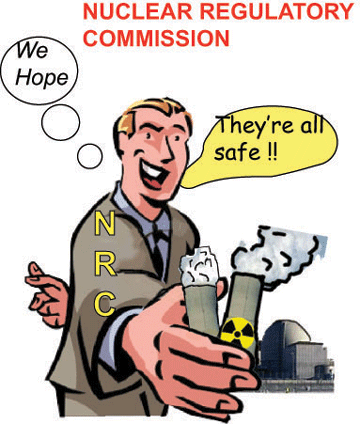
 How will the federal government protect nuclear safety in an anti-regulatory climate?, https://theconversation.com/how-will-the-federal-government-protect-nuclear-safety-in-an-anti-regulatory-climate-75680 The Conversation, William J. Kinsella Professor, Department of Communication, North Carolina State UniversityApril 18, 2017 , The Trump administration and congressional Republicans have undertaken a wide-ranging effort to shrink the federal government’s regulatory footprint. Much attention has focused on high-profile targets, such as the Environmental Protection Agency. But this trend also has major implications for other agencies.
One example is the U.S. Nuclear Regulatory Commission, which oversees safety across a complex, privately owned network of nuclear power plants, used fuel storage facilities and other sites related to civilian uses of nuclear energy.
As a researcher studying communication in energy and environmental settings, I have followed the NRC’s work with particular interest since 2011. The agency and the system it regulates exemplify what some scholars call a “high reliability organization” – one that cannot be allowed to fail, because the consequences would be grave.
As studies have shown, failures of external oversight were key factors in the disasters at Chernobyl in 1986 and Fukushima in 2011. Those examples show that there is good reason to assess how today’s anti-regulatory climate could affect the NRC and nuclear safety in the United States.
An industry in flux
The NRC conducts risk-related research and develops and enforces rules for the design and operation of nuclear facilities nationwide. Today it is grappling with major challenges that will shape the future of nuclear power in the United States.
The U.S. nuclear industry is struggling economically to compete with renewable energy and cheap natural gas. Older plants are nearing the end of their 40-year licensed operating lifetimes, while at least 15 reactor construction projects have been canceled or suspended since 2010. The four still in progress have been delayed, and now face possible cancellation.
In response, the industry is relying on 20-year license renewals for existing reactors, which allow them to operate for up to 60 years. As of December 2016, the NRC had approved 87 renewal applications.
Now the agency is preparing to consider applications for “subsequent license renewals” that would extend reactor lifetimes to 80 years. This prospect poses new challenges. Notably, the NRC needs to analyze the safety implications of operating geriatric plants and develop regulatory rules to manage issues such as structural and operational risks.
At the same time, the industry is promoting new reactor designs, which advocates say will be safer and more cost-efficient than current plants. The NRC is building a framework for reviewing and licensing these untested new technologies – an enormous and safety-critical task.
Highly radioactive used nuclear fuel, which is accumulating at reactor sites across the nation, poses additional challenges. As onsite storage capacity fills up, two private companies have applied for licenses to develop “consolidated interim storage facilities” in Texas and New Mexico that could hold used nuclear fuel for up to 40 years.
Authorizing such facilities would require changes to the Nuclear Waste Policy Act, which currently allows only permanent disposal of used nuclear fuel. Nevertheless, the NRC is already engaged in new risk analysis and public communication issues related to these projects.
Used fuel now held at power plants would need to be packaged and moved long distances, secured safely for decades and ultimately moved again to its final disposal site. Communities are also concerned about whether current or interim sites could end up as long-term locations for “stranded” nuclear waste.
Meanwhile, the administration’s 2018 budget blueprint proposes reopening the licensing process for a permanent nuclear waste repository at Yucca Mountain in Nevada. President Obama ended work on licensing Yucca Mountain in 2010, so the NRC would need to reorganize its staffing and resources to resume work on the project.
Anti-regulatory challenges
The current anti-regulatory climate could affect the NRC in multiple ways. Broader executive and legislative developments, and a recent agency leadership change, provide early clues. For example, an executive order issued in January requires federal agencies to eliminate two rules for every new rule they create.
Because the NRC is formally designated as an independent regulatory agency, it might be exempt from this order. However, asked in March about that possibility, NRC Chair Kristine Svinicki responded ambiguously that although the agency is “in some ways beyond the reach” of such orders, she wants to “look to the spirit and intent” they express. It is hard to see how the NRC can develop new regulations for so many emerging activities and keep the U.S. nuclear industry operating safely while slashing existing rules.
Meanwhile, in Congress, Republicans have sought since 2011 to pass the “Regulations from the Executive in Need of Scrutiny” (REINS) Act. This measure would require agencies to get congressional approval for “major rules” with substantial economic impacts.
When the House passed the latest version of the bill in January, New York Democratic Rep. Jerrold Nadler sought to exempt the NRC due to its safety-critical role, but his amendment was defeated.
Leadership transitions
Three days after the presidential inauguration, the role of NRC chairman was transferred to Commissioner Svinicki, a nuclear engineer and former Senate staff member regarded by some critics as particularly friendly to the nuclear industry. Although nuclear insiders learned of the transition quickly, the usual public press release was absent.
The new chairman, who serves as the agency’s sole official spokesperson (working through staff), has espoused a commitment to public transparency but has not always acted accordingly. For example, although up-to-date archives of speeches and testimony by the other commissioners are provided with their NRC website biographies, a recent look at the link for Commissioner Svinicki showed none more recent than 2012.
Svinicki’s appointment will expire on June 30, and the NRC cannot normally operate without a three-member quorum, so action on her reappointment or replacement will soon be needed. Two additional seats on the five-member commission remain open. This will be an important time to look closely at the backgrounds and qualifications of nominees.
To regulate the industry effectively, commissioners must have a firm grasp of the technical and administrative complexities of nuclear safety. Watchdog groups have called on the NRC to enforce safety regulations more aggressively and to promote greater confidence that staff members can bring problematic issues to light.
Perhaps most importantly, commissioners must demonstrate a firm commitment to regulatory independence and openness. Avoiding “recreancy” or “capture” by the regulated industry is crucial for effectiveness and public legitimacy.
In this context, the Trump team’s approach to filling key positions in science and technology agencies and the broad funding cuts proposed for those agencies are troubling. Many nominees have deep ties to regulated industries such as energy, finance and pharmaceuticals.
An essential regulatory mission
As a specialized agency working in a highly technical area, the NRC does not usually receive much public or media attention – except when nuclear failures occur at home or abroad. Although there have been more close calls in the United States than is generally understood, NRC oversight has been crucial to the industry’s overall positive safety record.
A high reliability organization is not automatically a highly reliable organization. Reliability is an ongoing accomplishment involving continuous learning, sustained vigilance and a strong system of checks and balances. Moving forward in an anti-regulatory climate, with so many complex challenges facing the agency, it is essential to ensure independent leadership, public transparency and adequate resources to support the NRC’s mission.
April 19, 2017
Posted by Christina Macpherson |
safety, USA |
Leave a comment
Nuclear Plant Exempted From Regulations As Shutdown Nears http://www.chem.info/news/2017/04/nuclear-plant-exempted-regulations-shutdown-nears PLYMOUTH, Mass. (AP) — The only nuclear power plant in Massachusetts won’t have to comply with certain safety requirements as it prepares to shut down, getting a pass on precautions put in place after the Fukushima disaster in Japan.
The U.S. Nuclear Regulatory Commission, or NRC, says that Pilgrim Nuclear Power Station won’t have to upgrade its vent system before it closes in 2019, despite not meeting all standards. It will also be exempted from seismic and flooding regulations established after the Fukushima meltdowns.
An NRC spokesman says the plant doesn’t have time to complete necessary upgrades and they wouldn’t meaningfully improve safety.
Earlier this month, federal regulators said the plant is safe to operate despite some “performance deficiencies.”
Democratic Senator Edward J. Markey says the decision undermines the safety of people living nearby.
April 19, 2017
Posted by Christina Macpherson |
safety, USA |
Leave a comment