INSIDE THE ENVIRONMENTAL PROTECTION AGENCY: PARANOIA AND STIFLED WORKBased on interviews with 47 current and former EPA employees, a new report paints a picture of a deeply divided and stymied agency. Pacific Standard, FRANCIE DIEP, JUN 20, 2017
 A new report paints the Environmental Protection Agency under Scott Pruitt’s leadership in a particularly bad light.
Among the allegations from the report, which relies on anonymous sources: that Pruitt, despite his role as EPA head, has almost never met with environmental groups, and is, in fact, hamstringing his own agency’s law enforcement and regional offices; that Pruitt has banned employees from taking pen and paper into meetings out of fear of information being leaked; and that Pruitt’s office suppressed plans for an agency Earth Daypicnic because it seemed too combative.
“Beneath the veneer of Pruitt’s public statements and appearances, I think there’s a lot of dysfunction,” says Christopher Sellers, a history professor at Stony Brook University who interviewed 32 current and former EPA employees for the report, which was released publicly today by the Environmental Data & Governance Initiative, an activist group of university professors. EDGI organized shortly after President Donald Trump’s election in a response to what founders saw as anti-science sentiment in the administration.
The new EDGI report indicates there’s widespread demoralization and dissent within the EPA. That’s not surprising. Trump has long called for policies that are sure to be unpopular at the agency. While running for office, he vowed to shutter the agency. Since then, he has blamed environmental regulation for killing jobs; worked to repeal EPA rules; and, in his proposed budget, called for a 31 percent cut to the agency’s funding, which would likely eliminate thousands of jobs. Pruitt, meanwhile, has denied the reality of climate change, then later said he thought the Earth is warming, but wasn’t sure how much human activity had to do with it. What the new report offers are fresh details about Pruitt’s internal decisions and how they may already be affecting the agency’s work.
For the report, Sellers worked with seven other academics to interview 10 current and 37 former employees of the EPA between December of 2016 and May of this year. They recruited their sources through EPA alumni groups and by asking people they were already in contact with to refer them to others. They did not reveal their sources’ identities to Pacific Standard. Requests for comment from the EPA were not returned.
EDGI’s work paints a picture of an imbalanced agency that favors certain industries and constituents over others and is stymied by distrust between its head and his staff. Indeed, some doubt whether Pruitt wants the EPA to work at all. “I think the plan is to get rid of EPA,” one employee told the EDGI interviewers. “I think this is just phase one.”
ONLY SOME STAKEHOLDERS
Pruitt hasn’t been around for his staff, interviewees told EDGI. Few of the interviewees had seen him in the Washington, D.C., office. Instead, the sources said Pruitt seems to travel frequently and to pay attention to a select group of stakeholders: He’s gone to meet the governors of Western states, farmers, and coal miners, for example. He decorated headquarters with posters showing him shaking hands with miners. In late March, Trump visited the EPA headquarters to sign an executive order rewriting the Obama administration’s Clean Power Plan and starting the process of lifting a moratorium on coal leasing on federal land. He did so with Pruitt at his side and several coal miners surrounding him. “You know what it says, right?” Trump told the miners. “You’re going back to work.”…..https://psmag.com/environment/paranoia-and-stifled-work-at-epa
June 26, 2017
Posted by Christina Macpherson |
psychology - mental health, USA |
Leave a comment
Trump to Call for U.S. ‘Dominance’ in Global Energy Production, Bloomberg By Jennifer A Dlouhy, 25 June 2017
Donald Trump will tout surging U.S. exports of oil and natural gas during a week of events aimed at highlighting the country’s growing energy dominance.
The president also plans to emphasize that after decades of relying on foreign energy supplies, the U.S. is on the brink of becoming a net exporter of oi l, gas, coal and other energy resources.
As with previous White House policy-themed weeks, such as a recent one focusing on infrastructure, the framing is designed to draw attention to Trump’s domestic priorities and away from more politically treacherous matters such as multiple investigations into Russian interference in the 2016 election.
With “Energy Week,” Trump is returning to familiar territory — and to the coal, oil, and gas industries on which he’s already lavished attention. Trump’s first major policy speech on the campaign trail, delivered in the oil drilling hotbed of North Dakota in 2016, focused on his plans for unleashing domestic energy production. The issue has also been a major focus during Trump’s first five months in office, as he set in motion the reversal of an array of Obama-era policies that discourage both the production and consumption of fossil fuels.
Plans for the week were described by senior White House officials speaking on condition of anonymity because the details hadn’t yet been formally announced.
Exports Equal Influence
Trump is set to deliver a speech at the Energy Department on Thursday focused almost entirely on energy exports ……
Dominance’ Sought
Trump’s theme of “energy dominance” marks an evolution. For years, the catch phrase of choice has been “energy independence,” as politicians and industry officials sought to highlight how a new era of abundance was helping the U.S. wean itself from foreign sources of oil and natural gas.
That was in turn a dramatic change from the 1970s, when former President Jimmy Carter turned down the White House thermostats and used a televised address in February 1977 to urge consumers to conserve energy …..https://www.bloomberg.com/news/articles/2017-06-25/trump-to-call-for-u-s-dominance-in-global-energy-production
June 26, 2017
Posted by Christina Macpherson |
politics international, USA |
Leave a comment
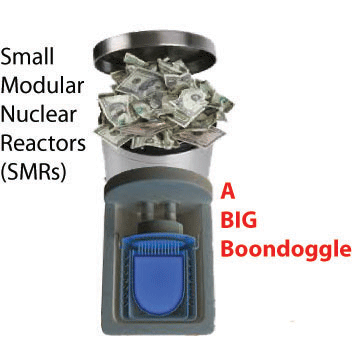
 Environmental groups challenge TVA plans for small nuclear reactors in Oak Ridge, Times Free Press, June 25th, 2017, by Dave Flessner The Tennessee Valley Authority wants to use the site of a nuclear reactor design abandoned in the 1970s to develop a new technology of small modular reactors.
But environmental critics of the Oak Ridge project say the new small modular reactors are still untested, unsafe and unneeded.
Sara Barczak, the high risk energy choices program director with the Southern Alliance for Clean Energy, likened TVA’s proposal to locate the new small reactor designs in Oak Ridge to the Clinch River Breeder Reactor that was planned for the same site in the 1970s. Ultimately, then President Jimmy Carter killed the project because he feared the liquid metal fast breeder reactor might lead to more nuclear proliferation around the globe, and he complained about the escalating price for the innovative technologyy.
“The Clinch River site has a very long, troubled and expensive history because of a failed nuclear experiment, which was one of the most expensive plants for never generating any power,” Barczak said. “We are very concerned that history is once again repeating itself and we are concerned that billions of dollars could be spent on a technology that is unproven, untested and significantly more expensive than other types of power technology that are available to TVA.”
In 1971, the Atomic Energy Commission estimated the Clinch River project would cost about $400 million. But ultimately, the project was projected to cost $8 billion to complete, and it was finally scrapped in 1983. Barczak said she fears the proposed Small Modular Reactor concept, which has yet to get an approved design from the Nuclear Regulatory Commission, will prove too costly and not be adequately tested before one is built……..
The Southern Alliance for Clean Power and the Union of Concerned Scientists have joined the Blue Ridge Environmental Defense League in petitioning the NRC to deny the early site permit for the small reactors in Oak Ridge. The environmental groups argue TVA has failed to justify its bid to reduce the size of the emergency planning zone around the proposed reactors from the standard 10-mile zone to the site boundary of about two miles.
“TVA expects the public near the Clinch River site to accept on faith that the fantasy nuclear reactors it wants to build there will be so safe that no evacuation plan is needed, even in the event of a core meltdown or a spent fuel pool fire,” Lyman said. “TVA has apparently failed to learn a major lesson of the Fukushima disaster: Public safety during a nuclear emergency depends critically on being prepared for the unthinkable.”
M.V. Ramana, a professor and chair of the Disarmament, Global and Human Security at the Liu Institute for Global Issues at the University of British Columbia in Vancouver, Canada, said TVA’s site application for the small reactors is “more like an advertisement brochure than an examination of the environmental impacts of constructing these reactors.
“There is a long history of experimentation with small nuclear reactors, and the evidence so far suggests that small reactors cost too much for the little electricity they produce,” Ramana said……..
The NRC is expected to consider TVA’s early site permit over the next couple of years, NRC spokesman Roger Hannah said. http://www.timesfreepress.com/news/business/aroundregion/story/2017/jun/25/environmental-groups-challenge-tvplans-small/434802/
June 26, 2017
Posted by Christina Macpherson |
technology, USA |
Leave a comment
 Judge Rules Against WCS – EnergySolutions Merger http://www.ladailypost.com/content/judge-rules-against-wcs-energysolutions-merger, by Chris Clark June 24, 2017 , CCNS News: Federal District Judge Sue L. Robinson entered her sealed opinion Wednesday in favor of the U.S. Department of Justice and prohibited Waste Control Specialists (WCS) and EnergySolutions from moving forward with the proposed $367 million merger of the two-nuclear waste storage and disposal companies.
The judge’s decision was based on anti-trust law.
In a written statement, Andrew Finch, acting assistant attorney general of the Justice Department’s Antitrust Division, said, “Substantial evidence showed that head-to-head competition between EnergySolutions and Waste Control Specialists led to better disposal services at lower prices.”
He continued, “
Today’s decision protects competition in an industry that is incredibly difficult to enter. While EnergySolutions’ preference was to buy its main rival rather than continue to compete to win business, today’s decision ensures that customers will benefit from the competitive process.”
In anticipation of the antitrust trial and the growing expenses involved in expanding WCS’s business to include the storage of plutonium fuel from U.S. nuclear power plants, in April, WCS asked the Nuclear Regulatory Commission (NRC) to temporarily suspend review of its application.
WCS applied for a 40-year license to build and operate a consolidated interim storage facility for 44,000 tons of high-level radioactive waste. WCS planned to build the de facto parking lot dump on its 14,900 acres on the New Mexico-Texas border, five miles east of Eunice, New Mexico.
June 26, 2017
Posted by Christina Macpherson |
Legal, USA, wastes |
Leave a comment
 Permanently closed U.S. nuclear reactor should be “autopsied” Paul Gunter, Beyond Nuclear, 25 June 17
Permanently closed U.S. nuclear reactor should be “autopsied” Examination could identify potential safety flaws in operating reactors with parts from same controversial French forge
TAKOMA PARK, MD, June 21, 2017 –
- A permanently closed nuclear reactor in Florida that, documents show, likely has a manufactured weakness in a vital safety component produced by a controversial French forge that also supplied components to 17 still operating U.S. reactors, should be “autopsied,” says Beyond Nuclear, a leading national anti-nuclear watchdog group.
- The Crystal River Unit 3 reactor in Red Level, Florida, was permanently closed in 2013 and is in the decommissioning process. Research by Beyond Nuclear staff found that the Florida reactor likely shares an at-risk safety-related component manufactured at the French Le Creusot forge that is currently shut down and under international investigation for the loss of quality control of its manufacturing process and falsification of quality assurance documentation. The Crystal River reactor pressure vessel head was supplied by a factory at Chalon-Saint Marcel that assembles pieces forged at Le Creusot, both Areva-owned factories.
“The U.S. Nuclear Regulatory Commission should seize upon this opportunity and ‘autopsy’ Crystal River 3,” said Paul Gunter, Director of the Reactor Oversight Project at Beyond Nuclear. “A close examination of Crystal River could provide critical safety data to inform the decision-making on whether the seventeen U.S. reactors still operating with at-risk Le Creusot parts should also be materially tested,” Gunter said.
The Le Creusot factory forges large ingots into safety-related components such as reactor pressure vessels, pressure vessel lids and steam generators.
The French industrial facility was discovered to be operating with lax quality control procedures that allowed the introduction of an excessive amount of carbon contamination into its manufacturing process, a problem technically known as “carbon segregation.”
The excess carbon weakens the component’s “fracture toughness” in the face of the reactor’s extreme pressure and temperature. Failure of a weakened component during operation would initiate the loss of cooling to the reactor and a serious nuclear accident.
At-risk safety components potentially containing these flaws, and manufactured at the Creusot Forge, have been delivered to reactors in France, other countries and the United States over a period of decades.
The NRC published Areva’s list in January 2017 identifying the 17 operational U.S. reactors with the at-risk components from the French forge. However, the federal agency did not disclose that Crystal River also installed a Le Creusot-manufactured replacement pressure vessel head during the October 2003 refueling outage and then operated the unit for nearly a decade before permanently closing.
“This information provides the incentive to do material testing on a component here in the U.S. from the suspect forge,” Gunter added. “It is only common sense, when presented in effect with the corpse, that the NRC should autopsy Crystal River before the body is buried,” he continued. ”This is a chance to better understand scientifically what the potential risks are at operating reactors with Le Creusot parts rather than relying on computer modeling, simulation or speculation,” Gunter said. “
For the sake of science and public safety, it is fortuitous that Crystal River, which operated for nearly a decade with a possible Le Creusot replacement component, is now permanently shut down and can be materially examined,” Gunter concluded.
The carbon segregation problem was first discovered at the Areva-designed EPR reactor still under construction, and now well over budget and behind schedule, at the Flamanville Unit 3 in Normandy, France. French safety authorities are investigating and are expected to make a decision in September on whether to continue with the troubled Flamanville reactor which experts say does not meet the fracture resistance standards.
Beyond Nuclear petitioned the NRC on January 24, 2017 to suspend operations at the 17 affected U.S. reactors pending thorough inspections and material testing for the carbon contamination of the at-risk components and to open an investigation into the potential falsification of Le Creusot quality assurance documentation. To date, the NRC has accepted the petition in part for further review and in part referred the potential falsification of documents to the federal agency’s allegations unit.
Only one affected nuclear plant, Dominion Energy’s Millstone 2 in Connecticut, has conducted a visual inspection on a Creusot Forge component at the behest of the state energy authority, but did not observe any defects or cracking.
However, a French newspaper revealed last week that metal specimens harvested from the Flamanville Unit 3 reactor pressure vessel, and subjected to shock resilience testing, fell dramatically below regulatory performance standards. A newly surfaced memo (jn French) from a leading safety physicist at the prestigious Institute of Radioprotection and Nuclear Safety said that, if subjected to violent pressure-thermal shock, the EPR reactor pressure vessel could shatter. Such a rupture could lead to a major loss of coolant accident and subsequently a nuclear meltdown.
June 26, 2017
Posted by Christina Macpherson |
Reference, safety, USA |
Leave a comment
 US sailors who ‘fell sick from Fukushima radiation’ allowed to sue Japan, nuclear plant operator http://www.telegraph.co.uk/news/2017/06/23/us-sailors-fell-sick-fukushima-radiation-allowed-sue-japan-nuclear/ Julian Ryall, in Tokyo 23 JUNE 2017
A US appeals court has ruled that hundreds of American navy personnel can pursue a compensation suit against the government of Japan and Tokyo Electric Power Co. for illnesses allegedly caused by exposure to radioactivity in the aftermath of the 2011 accident at the Fukushima Dai-ichi nuclear plant.
The 9th US Circuit Court of Appeals in San Francisco ruled on Thursday that the 318 sailors who have so far joined the $1 billion (£787 million) class action lawsuit do not need to file their case in Japan.
Most of the plaintiffs were aboard the USS Ronald Reagan, an aircraft carrier that was dispatched to waters off north-east Japan after the March 2011 meltdown at the Fukushima plant. Three reactors suffered catastrophic meltdowns and released large amounts of radiation into the atmosphere after their cooling units were destroyed by a magnitude-9 earthquake and a series of tsunami.
The California-based law firm representing the plaintiffs say they have been affected by a range of complaints, ranging from leukaemia to ulcers, brain cancer, brain tumours, testicular cancer, thyroid illnesses and stomach complaints.
The suit claims that TEPCO is financially responsible for the sailors’ medial treatment because it failed to accurately inform the Japanese government of the scale of the problem.
The Japanese government, the suit alleges, also failed to inform the US that radiation leaking from the plant posed a threat to the crew of the USS Ronald Reagan and other US assets dispatched to assist in “Operation Tomodachi”, meaning “friend” in Japanese.
The case was originally filed in San Diego in 2012, but has been delayed over the question of where it should be heard. The US government has also vehemently denied that any personnel were exposed to levels of radiation that would have had an impact on their health during the Fukushima recovery mission.
Interviewed for the San Diego City Beat newspaper in February, William Zeller said: “Right now, I know I have problems but I’m afraid of actually finding out how bad they really are.”
Formerly a martial arts instructor, he now uses a breathing machine when he goes to sleep due to respiratory problems he blames on his exposure aboard the USS Ronald Reagan in 2011.
“I literally just go to work and go home now”, he said. “I don’t have the energy or pain threshold to deal with anything else”.
June 24, 2017
Posted by Christina Macpherson |
Legal, USA |
1 Comment
 Former Senator John Edwards Representing Thousands of United States Veterans Injured in Nuclear Disaster http://www.businesswire.com/news/home/20170622006227/en/Senator-John-Edwards-Representing-Thousands-United-States Ninth Circuit Rules Sailors Will Get Their Day in U.S. Court, June 22, 2017 RALEIGH, N.C.–(BUSINESS WIRE)–Today, the United States Ninth Circuit Court of Appeals ruled in favor of the U.S. sailors who were exposed to dangerous levels of radiation assisting in humanitarian relief efforts to Japan following an earthquake and tsunami in 2011. Based on the ruling, the sailors are able to continue their suit against Tokyo Electric Power Co. Holdings Inc. (TEPCO) allowing the sailors to pursue their case in the District Court in San Diego. It is possible that the nuclear meltdown at the Fukushima plant affected up to 75,000 U.S. citizens, even after TEPCO deemed the conditions safe.
After meeting with attorneys from both sides last December, the United States Government submitted an amicus curiae brief expressing its belief that nothing should prevent the sailors from litigating their case here in America. Today’s Court of Appeals ruling reinforces the government’s desire that the sailors’ fight for justice will take place in the United States and not Japan as TEPCO and the Government of Japan had previously requested.
“These members of the United States Navy deserve their day in court, and they will get it,” said former Senator Edwards. “These American heroes served the United States and were innocent victims in a nuclear disaster that never should have happened. This case has broad U.S. interests, both because of our nation’s long-standing relationship with Japan, and because plaintiffs in this case are members of the U.S. military harmed while on a humanitarian mission.”
As recently as this week, three former executives from TEPCO were charged criminally in Japan with contributing to deaths and injuries stemming from the meltdown at the Fukushima nuclear power plant. In addition, the Japanese government investigated the nuclear disaster and found that TEPCO was grossly negligent.
In 2011, U.S. sailors aboard the aircraft carrier U.S.S. Ronald Reagan were poisoned by radiation during Operation Tomodachi (“friend”). The humanitarian mission was in response to a 9.0 magnitude earthquake which triggered a tsunami in Japan that led to the Fukushima nuclear disaster. Relief efforts included delivering food, supplies and clothing to the people ravaged by the earthquake and tsunami.
The plaintiffs, led by Lindsay R. Cooper and other members of the U.S. Navy and their dependents, have suffered and continue to be diagnosed with extensive injuries including blindness, thyroid cancer, leukemia and brain tumors. The lawsuit is not only against TEPCO, but several other co-defendants, including General Electric, EBASCO, Toshiba Corp. and Hitachi.
Former Senator Edwards, his daughter Cate Edwards and California-based attorneys Charles Bonner, Cabral Bonner and Paul Garner are continuing to expand their suit against TEPCO. If you are a U.S. Sailor affected by this, you can reach attorneys working on this litigation at 844.283.9434 or http://fukushima.edwardskirby.com/
June 24, 2017
Posted by Christina Macpherson |
Legal, USA |
1 Comment
 Nuclear fuel moved for decommissioning of Kewaunee Power Station, NBC26 Jun 23, 2017 Kewaunee Power Station achieved a significant milestone earlier this month when employees working to permanently decommission the facility safely transported the last of the used nuclear fuel to a dry fuel storage facility located on site, according to Dominion Energy.
June 24, 2017
Posted by Christina Macpherson |
business and costs, USA |
Leave a comment
Should SCE&G Refund Ratepayers for Nuclear Project? ft Free Times, By David Travis Bland, 23 June 17,
The Sierra Club and Friends of the Earth are going for the throat of two nuclear power reactors under construction by South Carolina Electric & Gas (SCE&G) and Santee Cooper. While they’re calling for complete abandonment of the project, the environmentally focused duo also wants the utilities to pay back ratepayers.
On June 22 Tom Clements of Friends of the Earth and Bob Guild of the Sierra Club took to a podium outside the state Public Service Commission to announce they’ll be demanding that the regulatory entity direct SCE&G to “immediately cease expending further capital costs” on the V.C. Summer nuclear reactor project north of Columbia. A formal complaint was filed with the commission after the event in which the organizations asked for a hearing to plead their case. In what Clements says is an unprecedented move, the hearing was granted and scheduled shortly after the filing.
“One of the things we’re going to be asking for is accountability on the part of SCE&G for essentially creating this mess they’ve created for ratepayers,” Guild said before the press event.
In the Public Service Commission’s lobby, a dozen citizens stood behind the environmental representatives with badges declaring “Clean Energy For All.”
“We will be asking for repatriation of the money” to ratepayers, Clements said in an earlier phone call. State law allows the commission to call for “rate reparations,” essentially rebates for electricity users, from SCE&G if the commission finds the utility wasted money in attempting to build the nuclear reactors.
The official complaint comes before a June 26 deadline for an assessment period in which SCE&G is looking into whether they should halt or continue the nuclear energy project.
Started in 2008, the Fairfield County nuclear reactors have been burdened by cost overruns and delays. At only 37 percent completion with already $8.9 billion sunk, according to a presentation given to utility insiders, the total cost of the reactors is projected to be between $15 and $22 billion by the estimates of Friends of the Earth and the Sierra Club.
Then March 2017 rolled around with a bankruptcy announcement by Westinghouse, designer of the reactors and former lead contractor.
The project is “bleeding,” said Guild, and ratepayers foot a hearty chunk of the bill…….
If the project were abandoned and SCE&G could provide evidence that it was prudent to halt construction, state law also allows the utility to charge ratepayers to recover the company’s losses. To force ratepayers to bear the brunt of their losses, SCE&G needs the approval of the Public Service Commission.
“Will the Public Service Commission do as we believe they should and that is proportion responsibility where it belongs on SCE&G management and shareholders?” Guild asked. “That’s the open question.”
So far the regulatory body has given SCE&G every rate increase they’ve asked for. http://www.free-times.com/news/local-and-state-news/should-sce-g-refund-ratepayers-for-nuclear-project/article_72e59b4c-5815-11e7-a10b-c7206539c3b9.html
June 24, 2017
Posted by Christina Macpherson |
business and costs, USA |
Leave a comment
TMI another step toward shutdown, as Exelon notifies Nuclear Regulatory Commission, June 23, 2017 Press & Journal Exelon Generation Co. officially notified the U.S. Nuclear Regulatory Commission this week of its intent to shut down Three Mile Island Nuclear Station in September 2019.
J. Bradley Fewell, senior vice president for regulatory affairs and general counsel, Exelon Generation, signed the letter sent to the NRC, which was dated June 20. Exelon is based in Warrenville, Illinois, in Chicago’s western suburbs.
The letter is part of the official process to shut down the plant “due to severe economic challenges,” it states. A nuclear plant cannot be reopened once permanently shut down…….
TMI has failed to clear the past three auctions held by PJM, which basically means that TMI is not able to produce electricity at the price that the market is willing to pay.
“Three Mile Island Unit 1 is unprofitable and has lost more than $300 million over the past five years despite being one of Exelon’s best-performing plants,” states the letter to PJM, signed by Bryan C. Hanson, senior vice president of Exelon Generation, and president and chief nuclear officer of Exelon Nuclear……
June 24, 2017
Posted by Christina Macpherson |
business and costs, USA |
Leave a comment
Times 23rd June 2017, President Trump laid claim to an idea that could help his promised wall
along the Mexico border to turn a profit: solar panels. “I will give you an
idea that nobody has heard about yet. The southern border: lots of sun,
lots of heat. We are thinking about building a wall as a solar wall. So it
creates energy. And pays for itself,” he told a campaign-style rally in
Cedar Rapids, Iowa.
The scheme would lower the cost to Mexico too, he said,
adding: “Pretty good imagination, right? My idea!” Mr Trump has discussed
the scheme in private meetings with legislators but floated it publicly for
the first time on Wednesday.
Contrary to his claim, however, others had
already raised the idea. Designs for the wall submitted to the US
government in April by Thomas Gleason, a Las Vegas businessman, had solar
panels powering lig hting, sensors and border patrol stations. The
Department of Homeland Security has been inviting companies to submit
plans, although Congress still has not allocated the funds needed to build
the wall. https://www.thetimes.co.uk/edition/world/president-trump-claims-solar-panels-will-pay-for-his-mexican-wall-bt62xbkfl
June 24, 2017
Posted by Christina Macpherson |
decentralised, USA |
Leave a comment
 From heatwaves to hurricanes, floods to famine: seven climate change hotspots Global warming will not affect everyone equally. Here we look at seven key regions to see how each is tackling the consequences of climate change, Guardian, John Vidal, 23 June 17 “….
New York, US
New York state may seem an unlikely climate hotspot, but research confirms its status in the top league of potential change. Drawing on the US national climate assessment and research by leading federal agencies and academics, it calculates that temperatures statewide have risen about 1.3C since 1970, spring begins a week sooner than it did just a few decades ago, there is less winter snow and more intense downpours. Meanwhile, sea levels are rising at nearly twice the global rate and birds and fish populations are all moving north.
Even more dramatically, the latest scientific projections suggest trouble ahead. By the 2050s, says the New York Department of Environmental Conservation, sea levels could rise nearly 76cm (30 inches), storm surges and flooding will be more common in coastal areas, and West Nile virus and many other diseases could be prevalent.
But, says Carl Pope, climate advisor to the former New York mayor Michael Bloomberg, if climate change is to be addressed, it must be led by big cities like New York, which release nearly 70% of the global emissions but also have the capacity to create solutions.
“Cities will always trump countries when it comes to climate change,” he says. “Cities are where emissions are. They are mostly consumers of fossil fuels, so they would like to use them as little as possible; they have a natural instinct to save on fossil fuels. Also, they are not very ideological. Improving quality of life is seen as a good.”
Mayors, Pope says, are now well ahead of most governments, leading attempts to reduce air pollution which contributes heavily to climate change, and eager to introduce electric cars and renewable energy. “There is a great public will to improve the quality of life in cities,” he says.
Pope identifies three groups of cities which he thinks will lead others on climate: “Cities in Nordic countries that will be meticulous about everything. Then there are a few in Latin America and Africa, which will be unbelievably creative. A third group is in east Asia and China, which will do things on a massive scale.” https://www.theguardian.com/environment/2017/jun/23/from-heatwaves-to-hurricanes-floods-to-famine-seven-climate-change-hotspots?CMP=share_btn_tw
June 24, 2017
Posted by Christina Macpherson |
climate change, USA |
Leave a comment

 Perry says no decision made on interim nuclear waste storage in Nevada, Las Vegas Review Journal June 21, 2017 WASHINGTON — Energy Secretary Rick Perry clarified a previous statement on interim nuclear waste storage, telling a Senate subcommittee Wednesday that no decisions have been made on temporary sites for spent fuel in Texas, New Mexico or Nevada.
Private companies in New Mexico and Texas have submitted applications to the Nuclear Regulatory Commission to store nuclear waste on an interim basis.
Perry created a firestorm Tuesday when he suggested to the House Appropriations subcommittee on energy that the Nevada National Security Site could store waste temporarily.
The suggestion brought an avalanche of criticism from Nevada Gov. Brian Sandoval and members of the state’s congressional delegation who called the proposal ill-conceived and likely illegal because of restrictions involving the former nuclear test site northwest of Las Vegas.
Before the Senate Appropriations subcommittee on energy, Perry clarified the statement to note that no decision has been made on interim storage and that any such plan would require coordination with Congress.
“I think it is appropriate to say, there are no plans at this particular time for interim storage in New Mexico, Nevada or Texas or any other site,” Perry said…..https://mail.google.com/mail/u/0/#inbox/15cd262afeb49316?compose=15cd3e0979cb83a3
June 23, 2017
Posted by Christina Macpherson |
politics, USA, wastes |
Leave a comment
 Perry repeats desire to store nuclear waste in Nevada; state officials respond, News 4 , by Tony Garcia, LAS VEGAS (KSNV News3LV) —
Nevada’s state and national elected officials reacted swiftly Tuesday after Energy Secretary Rick Perry said he wants to build interim nuclear waste facilities at the Nevada National Security Site and called constructing a long-term repository at Yucca Mountain a “moral obligation.”
“Today’s comments by Secretary Perry suggesting he would consider storage of high-level nuclear waste at the Nevada National Security Site come as a complete blindside, and I view this as a total disregard and failure to honor the historical process,” Nevada Gov. Brian Sandoval said in a statement.
“The idea of storing high-level nuclear waste at the National Security Site is ill-conceived, irresponsible, and likely illegal. This is a prime example of federal overreach, and Nevada will pursue every legal option at our disposal.”
Sandoval added that he has asked Nevada Attorney General Adam Laxalt to review the proposal and identify legal avenues to stop it.
“Let me be clear – no part of Nevada will be home to the world’s most toxic waste and we will fight every effort that puts our citizens at risk,” Sandoval said.
“Secretary Perry’s comments today are irresponsible, reckless, and show a blatant disregard for the state of Nevada,” U.S. Sen. Dean Heller (R) said in a statement. “As I have repeatedly told the Secretary, Nevada will not serve as our nation’s nuclear waste dump. The only viable solution to our country’s nuclear waste problem is one that is rooted in consent, and Nevada has said ‘no.’….
“I am appalled to see how tone-deaf this administration is in refusing to listen to the collective voice of an entire state,” said U.S. Rep. Jacky Rosen. “The only moral obligation we have is to keep Nevadans safe from nuclear waste. If Secretary Perry thinks that he alone can restart Yucca Mountain with the flip of a switch, he is mistaken. Since the 1980s, Nevada has voiced its opposition to Yucca Mountain based on legitimate safety concerns.
“Today’s comments by Secretary Perry are wrong and dangerous. Reviving Yucca Mountain as a nuclear waste dump would place Nevada and communities around the country in harm’s way by green-lighting daily regular shipments of high-level nuclear waste by train or by truck for over 50 years.” http://mynews4.com/news/local/sandoval-and-other-officials-respond-to-perrys-desire-to-store-nuclear-waste-in-nevada
June 23, 2017
Posted by Christina Macpherson |
politics, USA, wastes |
Leave a comment
 http://www.fairewinds.org/newsletter-archive//oegf127i8zwvkcg5koxzivdipspzk9, June 22, 2017, Demystifying Nuclear Power, Atomic Power and a Just Transition for ‘Host Communities’ By Maggie Gundersen &Ben Shulman-Reed, Atomic power plants are shutting down faster than they are being built. These reactors conceptualized in the 1960s are failing because they are old and they are being closed because they are not competitive with renewables and therefore economically unfeasible. People around the world understand that a Fukushima-like disaster can happen anywhere, anytime. The nuclear power industry that dreams of building a new nuke every twelve days for the next 35 years) – totaling 1000 new rectors by 2050) are facing the harsh reality that atomic energy is not needed and is no longer wanted.
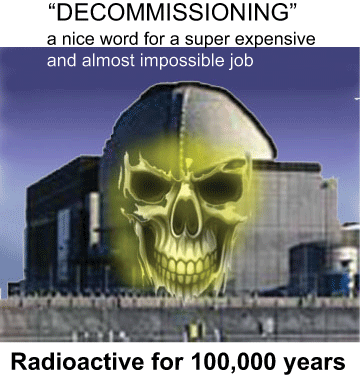
In the United States (U.S.), where largest amount of atomic power reactors in the world are located, Pilgrim in Massachusetts, Indian Point outside New York City, Oyster Creek in New Jersey, Diablo Canyon in California, and most recently Three Mile Island in Pennsylvania have recently announced their intent to close in the near future. While the shutdown of American nukes is good for our economy as well as the planet’s environment, decommissioning is a costly and complicated process that takes a toll on the local communities that hosted these giant facilities. When a nuclear power reactor shuts down, an incredible amount of work must be done to ensure a just, smooth financial transition for the local economy and also to create long-term viable storage for its toxic radioactive waste, which the U.S. Government has failed to provide. In addition to hosting the physical radioactive carcass of the power reactor for decades, the local community must restructure its economy to make it more diverse and self-sufficient as well as creating a more healthy and sustainable energy future.
Unfortunately, the usually small and economically stifled cities and towns, often referred to as ‘host communities’ to these atomic power reactors are not always given a voice at the table when it comes to deciding plans for their future – yet they are the true stakeholders. Fairewinds has continuously monitored and reported upon the challenges and defects of the Vermont Yankee atomic reactor and the lack of stakeholder respect given to its Windham County host. When it came time to close reactor in 2014, the Vermont Legislators and State Officials found themselves having to stand up to both Entergy (Vermont Yankee’s parent corporation), and the Nuclear Regulatory Commission (NRC) the alleged federal regulator for the nuclear power industry, for the Vermont’s own State’s rights and for the rights of all Vermont citizens.
Vermont is still negotiating the terms of the decommissioning process for Vermont Yankee – the state’s lone nuclear power plant and is becoming a leading example for nationwide regarding how to advocate for a smooth and just transition from atomic power operations to decommissioning and dismantlement. Vermont is seeking a just transition that will protect all the stakeholders, not only the profit interests of the power plant’s corporate owners.
The real question for all nuclear power plant host communities is: who is protecting and advocating for the rights of the ratepayers, for the level of decontamination at the site, nearby aquifers and watersheds, and an orderly economic transition for all the people in the impacted surrounding communities? The Nuclear Regulatory Commission (NRC), while the controlling interest in radiological standards and decommissioning processes on each site, does not examine or consider any of these critical human rights issues. All the environmental justice and human rights issues of assuring ongoing open access to clean air, safe water, and uncontaminated food from the remaining carcass of a shutdown atomic power reactor falls upon local and state governments throughout the US. Vermont is leading the way in creating an open and transparent process for local communities to self-advocate in creating a safer and more transparent decommissioning process and transition to a safe and permanently uncontaminated dismantlement of these highly radioactive nukes.
By opening a wide dialogue as we all advocate for an open and transparent decommissioning process, we believe the U.S. can shed its title of founding nuclear energy and instead become a global leader in cleaning up the mess we started. By following Vermont’s of paying close attention to the interests of our local governments, ratepayers and host communities, we all will begin to achieve just and safe transitions from the glut of toxic radioactive nuclear power plant carcasses coming our way as atomic power continues to become economically unviable.
It is Fairewinds’ goal to help communities work together to achieve a safer transition in their energy futures by shifting energy paradigms to an economically feasible and environmentally compatible model for the health and survival of our species and our planet.
June 23, 2017
Posted by Christina Macpherson |
decommission reactor, USA |
Leave a comment