 Trump Administration Blocks Government Scientists from Attending International Meeting on Nuclear Power http://allthingsnuclear.org/elyman/trump-admin-blocks-government-scientists-from-meeting, 2The Nuclear Energy Institute (NEI) recently sent a comment letter to the Federal Energy Regulatory Commission (FERC), recommending several actions aimed at helping prevent nuclear plant shutdowns ….NEI urged FERC to make preserving nuclear plants a fundamental guiding principle and not to interfere with legitimate state public policy goals regarding nuclear energy. …
The letter also recommended that FERC direct RTOs and ISOs to develop mechanisms that provide additional revenues in recognition of nuclear’s attributes such as long-term rate stability, system resiliency and fuel diversity.
“While comprehensive, enduring reforms are being developed, the commission should ensure that interim measures are in place to prevent further loss of secure and resilient nuclear generation,” NEI said…..https://dailyenergyinsider.com/news/6098-nuclear-energy-institute-urges-ferc-take-action-prevent-nuclear-plant-closures/
June 28, 2017
Posted by Christina Macpherson |
politics, USA |
Leave a comment
 Washington Examiner by John Siciliano | Jun 27, 2017, Energy Secretary Rick Perry said Tuesday that one of his agency’s goals is to push nuclear energy.
“One of the things we want to do at [the Department of Energy] is to make nuclear energy cool again,” Perry said during a lengthy news conference at the White House Tuesday….”..when I was younger in the ’60s, and a lot of kids wanted to go into the nuclear energy field.”
But that isn’t the case now, he said, “because this industry has been strangled all too often by government regulations.”
He wants the U.S. to begin again to “bring us to that place where nuclear energy is part of a portfolio, and be able to sell it in great truthfulness and honesty about what it can add to America from an environmental standpoint and from a security standpoint.”…..
On the nuclear power side, the U.S. has the largest fleet of nuclear reactors in the world, although it is becoming too expensive to run many of the plants because of increased cost pressures and competition from natural gas.
Perry mentioned that the U.S. will engage with India on nuclear power development as part of a three-part plan to export energy technologies to foreign markets. The first part of new cooperation with India will be exporting liquefied natural gas, the second area will be on clean coal, and the third will be nuclear energy. http://www.washingtonexaminer.com/perry-wants-to-make-nuclear-energy-cool-again/article/2627250
June 28, 2017
Posted by Christina Macpherson |
spinbuster, USA |
Leave a comment
SCE&G, Santee Cooper nuclear project could be scrapped within 45 days, BY SAMMY FRETWELL AND CLIF LEBLANC, sfretwell@thestate.com, cleblanc@thestate.com 27 June 17, South Carolina utilities SCE&G and Santee Cooper expect to decide by this fall, if not sooner, whether to pull the plug on a $14 billion nuclear expansion project that has been plagued by financial troubles, lengthy delays and intense criticism over the amount of money the effort is costing customers.
The power companies said Monday they will spend another six weeks weighing the benefits and costs of finishing the project in Fairfield County before making their decision.
Monday had been the deadline to complete assessments of the twin-reactor project they are jointly building north of Columbia. The project has had problems in recent years, but its future plunged into further doubt when chief designer and contractor Westinghouse filed for bankruptcy in March. Since that time, the utilities have kept the project going while examining whether they should complete it.
In announcing Monday it would extend the deadline to complete the study, SCE&G said it would likely be the third quarter of 2017 before it decides whether to halt the project. Santee Cooper executive Lonnie Carter said he hopes the state-owned utility will act within the 45-day study period…….
The current projected cost of the effort to build two reactors is approaching $3 billion over the initial budget, but construction is only about one-third complete. To pay for the upfront costs, SCE&G ratepayers have been hit with nine power bill increases, while Santee Cooper customers have experienced five increases since 2009. A sixth was proposed Monday during Santee Cooper’s board meeting at Lake Moultrie.
About 18 percent of the average SCE&G customer’s power bill pays for the nuclear plant. SCE&G ratepayers have put about $1.4 billion toward the unfinished project, but that is only for finance costs. Santee Cooper has not provided a similar breakdown, but officials said the five rate increases since 2009 have generated more than $500 million, much of it for the nuclear project.
On Monday, the Santee Cooper board heard a plan to raise electricity rates for its customers. At least half of the revenues from the rate increases go toward the nuclear project, spokeswoman Mollie Gore said…..Overall, SCE&G and Santee Cooper have collectively sunk nearly $9 billion into the project …..
Last week, environmentalists called on the state Public Service Commission to order SCE&G to refund customers for rate increases they have incurred to pay for the project. Santee Cooper, as a state-owned utility, is not regulated by the PSC. A hearing is scheduled for Aug. 14. Critics of the project have hired an expert witness to represent the interest of ratepayers, they say . http://www.thestate.com/latest-news/article158271904.html
June 28, 2017
Posted by Christina Macpherson |
business and costs, USA |
Leave a comment
 Green groups oppose TVA plan to test small nuclear reactors, Utility Dive Robert Walton@TeamWetDog, June 27, 2017
Dive Brief:
- Two environmental groups have petitioned the U.S. Nuclear Regulatory Commission to intervene in the agency’s review of Tennessee Valley Authority’s plan to develop small modular nuclear reactors (SMRs) at a site near Kingston, Tenn.
- The federal utility has petitioned NRC for an early site permit (ESP) to determine whether the site is suitable for two or more SMRs, with a capacity of up to 800 MW.
- TVA has been pushing for more than a year to site small reactors at the abandoned Clinch River nuclear development site.
Dive Insight:
Several conservation groups led by the Southern Alliance for Clean Energy are sounding the alarm over TVA’s plans to site small reactors at the Clinch River site, allowing the utility to reduce the size of the emergency planning zone around the proposed reactors.
The SMR concept proposes to utilize smaller reactors which can be developed offsite and then constructed quickly. Opponents fear their smaller size may lead to more lax restrictions, and say TVA should be looking to clean energy alternatives.
“The accurate description of what SMRs will actually do for TVA and its customers is squander more resources,” said Sara Barczak, high risk energy choices program director for SACE. “We hope our intervention will prove successful and prevent TVA from making a bad decision that would cost customers and potentially put local communities and the environment at risk.”
SACE and the Tennessee Environmental Council petitioned NRC, contending the federal utility has not shown it has fully reviewed the risks, including the “safety and environmental risks of spent fuel pool fires, which could have far-reaching and catastrophic consequences.”
The groups say TVA wants to reduce the size of the emergency planning zone around the proposed reactors “from the standard ten miles to the site boundary or at most two miles, thereby exempting state and local governments from emergency planning requirements and reducing the level of preparedness for an accident at the reactors.”
“TVA expects the public near the Clinch River site to accept on faith that the fantasy nuclear reactors it wants to build there will be so safe that no evacuation plan is needed, even in the event of a core meltdown or a spent fuel pool fire,” Union of Concerned Scientists’ Edwin Lyman said in a statement.
TVA officials told the Times Free Press that they have not yet decided whether to move forward on the Clinch River SMR plan, but part of its mandate as a federal utility is to work with other agencies on energy development. TVA is working with the Department of Energy on the SMR pilot. ……http://www.utilitydive.com/news/green-groups-oppose-tva-plan-to-test-small-nuclear-reactors/445858/
June 28, 2017
Posted by Christina Macpherson |
technology, USA |
Leave a comment
 http://www.kpbs.org/news/2017/jun/27/nuclear-expert-slams-edisons-san-onofre-nuclear-wa/, June 27, 2017, By Amita Sharma, Talks continue to find a storage site for radioactive waste away from San Onofre nuclear power plant. Unless there is an agreement, millions of pounds of the toxic material will be partially buried near the shoreline at San Onofre. KPBS Investigative Reporter Amita Sharma recently spoke to Tom English on the beach near San Onofre. He is a one-time advisor to former President Jimmy Carter on high-level nuclear waste disposal.
Q: You’re a nuclear waste expert who’s given talks at the White House on this topic. You think Edison’s plan is a bad idea, why?
A: Several reasons. One is they’re basically going to put the stuff in a thin storage container which probably will have some problems with corrosion given this ocean environment here. The second idea is they’re going to store it such that it will be about 100 feet from the water and a few inches above the groundwater table which is totally ridiculous. As the sea level rises, what will happen is the bottom of the containers will corrode.
Q: Why do you think Edison wants to use this dry cask storage method and actually got the backing to do it from the California Coastal Commission?
A: What happened is our attitude toward storage of spent fuel in a fuel pool changed with Fukushima. We had two pools melt down completely. And this scared everybody and caused a big furor and caused them to want to do something better. So it is a very good idea to take the fuel out of the pool and put it into dry storage. It’s just the choices that they made here were awful, far worse than leaving it in the spent fuel pool.
Q: You’re also worried about Edison’s San Onofre nuclear waste storage plan because you think it’s especially vulnerable to terrorism. Tell me about that.
A: If you leave the spent fuel in the spent fuel pool, you have two large concrete structures surrounding the spent fuel pool that will partially protect it against an attack. When you bring it out here near the ocean on the beach, what you have is no real protection. So a terrorist could find this to be a fairly easy target and if something were to happen here we would evacuate about 50 miles worth of people around San Onofre which would basically shut down the economy of Southern California.
Q: Dr. English, what are some of the alternatives to storing the waste at San Onofre?
A: There are three main ones. One is to simply move it to another Southern California Edison site like in Arizona. That way you’d at least be away from the beach. And it’s already licensed for this sort of thing. Another alternative would be to move it across the street to Camp Pendleton where it’s surrounded by a bunch of Marines and you wouldn’t have any overflights of airplanes so it would be much safer there from any kind of terrorist attack. A third alternative would be to go to Yucca Mountain where we know a lot about the geology of the area and basically make a part of it into temporary interim storage. And you could take all this waste and store it there for 100 years while they figure out how to solve the long-term problem and I think the three of those are much better than what we have here.
Q: If a storage site away from San Onofre can’t be found and the waste ends up being stored here for the long haul, there’s the matter of sea level rise. Projections show that San Onofre will be inundated by seawater by the turn of the century. What kind of threat does that pose to humans and to the sea?
A: Well, if you have these canisters sitting in seawater it’s much the same as dumping the high-level waste into the ocean. And so this has a severe threat on both the aquatic life and human life.
June 28, 2017
Posted by Christina Macpherson |
USA, wastes |
Leave a comment
Trump Administration Delays Protections for Construction and Shipyard Workers, Weakens Beryllium Rule, UCS, KATHLEEN REST, EXECUTIVE DIRECTOR | JUNE 26, 2017, More bad news for workers coming from the Trump administration. Last Friday (June 23), the Occupational Safety and Health Administration (OSHA) announced its proposal to “modify” (read “weaken”) protections for workers exposed to beryllium in construction and shipyards.
Beryllium is a very dangerous material. It’s a carcinogen and the cause of chronic beryllium disease, a devastating illness. There’s no real rescue from this slow, incurable, and often fatal lung disease.
While it leaves in place the permissible exposure limit (PEL) for beryllium (0.2ug/m3), OSHA now proposes to eliminate the “ancillary provisions” of the rule that would extend certain protections to construction and shipyard workers. Protections like exposure monitoring, a written exposure control plan, personal protective equipment, and medical surveillance. These “ancillary provisions” are actually basic public health protections for workers dealing with a really hazardous material….. http://blog.ucsusa.org/kathleen-rest/trump-administration-delays-protections-for-construction-and-shipyard-workers-weakens-beryllium-rule
June 28, 2017
Posted by Christina Macpherson |
health, USA |
Leave a comment
WIPP continues to receive shipments, June 26, 2017, By KEVIN TREVELLYAN, ktrevellyan@postregister.com
Shipments of transuranic waste continue to leave Idaho, though not nearly fast enough to meet a looming cleanup milestone.
The Waste Isolation Pilot Plant in Carlsbad, N.M., has accepted 17 waste shipments from Idaho since April, U.S. Department of Energy-Idaho Assistant Manager Jim Malmo said Thursday during an Idaho National Laboratory Citizens Advisory Board meeting in Idaho Falls.
The WIPP repository temporarily closed in 2014 after a pair of accidents resulted in a low-level release of radioactive material. The closure put into jeopardy a 1995 Settlement Agreement stipulation that DOE ship 65,000 cubic meters of stored transuranic waste from Idaho before the end of 2018.
Since reopening, WIPP has accepted shipments at a much slower pace because of ongoing facility repairs……..
Most of Idaho’s transuranic waste was generated at the Rocky Flats Plant outside Denver. The waste, buried in Idaho in the 1950s, ’60s and ’70s, includes plutonium-laced sludges, graphite materials and filters.
If DOE fails to meet the 1995 Settlement Agreement milestone, the state can block INL from receiving shipments of spent fuel for research.
Fuel shipments already have been blocked because of delays in getting the Integrated Waste Treatment Unit operating.http://www.postregister.com/articles/news-daily-email-todays-headlines/2017/06/26/wipp-continues-receive-shipments
June 28, 2017
Posted by Christina Macpherson |
USA, wastes |
Leave a comment
‘Bring on more renewables,’ U.S. regulator says as grid study looms, Reuters, By Timothy Gardner | WASHINGTON, 26 June 17,
Wind and solar power does not make the U.S. electricity grid less stable, an outgoing federal regulator said on Tuesday, as the Trump administration readies a study that will examine whether renewable energy has had a harmful effect.
Colette Honorable, a member of the Federal Energy Regulatory Commission, said at a conference that renewables have different attributes than base load power, which includes coal and nuclear energy, and that those difference need to be overcome.
But Honorable stressed that record amounts of wind and solar power had been generated recently without harming the grid.
“Do I recognize we have to be attendant to supporting the different ways in which renewables work? Yes,” said Honorable, who was appointed by former president Barack Obama, a Democrat, and who will step down on Friday.
“I don’t see any problems with reliability, and I say bring on more renewables,” said Honorable, whose remarks generated warm applause at a conference of the Energy Department’s Energy Information Administration arm.
President Donald Trump, a Republican, has embarked on a program to dismantle Obama’s clean-energy policies as renewable power generation hits records.
In February, wind briefly powered more than 50 percent of electricity demand in the 14-state Southwest Power Pool, for the first time on any North American grid.
In March, wind and solar accounted for more than 10 percent of U.S. electricity generation for the first time…..http://www.reuters.com/article/us-usa-powergrid-idUSKBN19I2B6
June 28, 2017
Posted by Christina Macpherson |
renewable, USA |
Leave a comment
 Nuclear Energy Institute urges FERC to take action to prevent nuclear plant closures June 27, 2017 by Daily Energy Insider Reports The Nuclear Energy Institute (NEI) recently sent a comment letter to the Federal Energy Regulatory Commission (FERC), recommending several actions aimed at helping prevent nuclear plant shutdowns….NEI urged FERC to make preserving nuclear plants a fundamental guiding principle and not to interfere with legitimate state public policy goals regarding nuclear energy. …
The letter also recommended that FERC direct RTOs and ISOs to develop mechanisms that provide additional revenues in recognition of nuclear’s attributes such as long-term rate stability, system resiliency and fuel diversity.
“While comprehensive, enduring reforms are being developed, the commission should ensure that interim measures are in place to prevent further loss of secure and resilient nuclear generation,” NEI said…..https://dailyenergyinsider.com/news/6098-nuclear-energy-institute-urges-ferc-take-action-prevent-nuclear-plant-closures/
June 28, 2017
Posted by Christina Macpherson |
business and costs, politics, USA |
Leave a comment
Grand Canyon is our home. Uranium mining has no place here, Guardian, Carletta Tilousi, 26 June 17, The Havasupai resided in and around Grand Canyon for many centuries. This region is sacred – that is why we oppose the pollution of our land and water.
The Havasupai – “people of the blue-green waters” – live in Supai Village, located at the bottom of the Grand Canyon. Today our lives and water are being threatened by international uranium mining companies because the US government and its 1872 mining law permit uranium mining on federal lands that surround the Grand Canyon.
In 1986, the Kaibab national forest authorized a Canadian-based uranium company to open Canyon mine, a uranium mine near the south rim of Grand Canyon national park. The Havasupai tribe challenged the decision but lost in the ninth circuit court of appeals. Miners were just starting to drill Canyon mine’s shaft in 1991 when falling uranium prices caused the company to shut it down for more than two decades.
Havasupai ancestors share stories of the sacredness of the Grand Canyon and all the mountains that surround it. They have instructed us to protect the waters and the mountains from any environmental contamination. That’s why we stand firm against any uranium mining in the Grand Canyon region.…..
In 2012, we celebrated the Obama administration’s order that honored our request to stop thousands of unproven claims from going forward and to close the area to prospecting for uranium. Now, misguided politicians in Arizona’s Mohave County are asking Donald Trump to overturn the decision because they claim they need uranium mining to help grow their economy. We oppose their request because we don’t want them to pollute our blue-green waters.
Once again, our sacred water and lands are being attacked to profit other people. For this reason, the Havasupai people and citizens throughout the region have been gathering at Red Butte over the past two days to conduct prayer ceremonies and workshops, and to gain support and bring awareness to the poisonous legacy of uranium all around the Grand Canyon.
The Havasupai are resilient people. We have resided in and around the Grand Canyon for many centuries. This struggle is not about money to us, it is about human life.
Please stand with us to put an end to mining uranium in our home, which has always been the Grand Canyon.
Carletta Tilousi is a member of the Havasupai tribal council. https://www.theguardian.com/commentisfree/2017/jun/26/grand-canyon-uranium-mining-pollution
June 28, 2017
Posted by Christina Macpherson |
indigenous issues, USA |
Leave a comment
Iran’s Nuclear Chief Warns U.S. Against Tilting Power Balance In Middle East https://www.rferl.org/a/iran-nuclear-chief-wars-us-against-tilting-power-balance-middle-east-saudi-arms-sales-/28576396.html, 24 June 17 Iran’s atomic energy chief Ali Akbar Salehi, who helped forge the 2015 nuclear agreement, warned the United States on June 23 against upsetting the balance of power in the Middle East by siding with arch-rival Saudi Arabia.

Writing in The Guardian newspaper, Salehi said Tehran views a “lavish” deal U.S. President Donald Trump’s administration recently announced to sell Saudi Arabia $110 billion in weapons as “provocative.”
“This is especially the case if the national defense efforts of Iran…are simultaneously opposed and undermined,” he said, alluding to steps the Trump administration has taken to increase U.S. sanctions on Iran for developing ballistic missiles even as it has ramped up arms sales to Riyadh and its allies.
“It would be unrealistic to expect Iran to remain indifferent to the destabilizing impact of such conduct,” said Salehi, an MIT graduate who has also served as Iran’s foreign minister and was a senior negotiator on the nuclear deal.
Salehi stressed that Washington’s strong tilt toward Tehran’s rivals in the Middle East not only risks setting off a regional arms race and “further tension and conflict” in the region, but it imperils the “hard-won” nuclear deal, which took two years to negotiate.
If the nuclear deal is to survive, he said the West must change course. “The moment of truth has arrived.”
Trump and the Saudis frequently blame Iran for wars ranging from Yemen to Syria, as well as for restive minority Shi’ite populations within the borders of the kingdom and other Persian Gulf states ruled by Sunni Muslims.
The Saudis, like Trump, were strongly opposed to the nuclear deal. But while Trump has promised to “dismantle the disastrous deal,” he has not so far taken any concrete steps to do so. His administration has indicated it will adhere to the deal, which requires Iran to curb its nuclear activities in exchange for the lifting of international sanctions, as long as Tehran continues to do so.
But Salehi’s article in the Guardian suggested that — what Iran says is — its so-far strict honoring of the deal may come into doubt in the future if the United States continues to disregard Iran’s “genuine security concerns” and “stokes Iranophobia” in the region.
Salehi urged the United States and its Western partners to “save” the nuclear deal with “reciprocal gestures” showing a commitment to engagement with Iran.
Iranian voters recently showed their preference for engagement with the West by re-electing President Hassan Rohani with his pro-Western platform, but “engagement is simply not a one-way street and we cannot go it alone,” Salehi said.
“Unfortunately, as things stand at the moment in the region, reaching a new state of equilibrium might simply be beyond reach for the foreseeable future,” he said.
June 27, 2017
Posted by Christina Macpherson |
MIDDLE EAST, politics international, USA |
Leave a comment
The Saudi war in Yemen is really directed at…Iran. Donald Trump’s first overseas visit to Saudi Arabia and Israel was specifically targeted at… Iran. The Saudi-led isolation of Qatar is actually about… Iran.
The escalation of U.S. military actions against the Syria government is… well, do I really need to spell this out any further?
Donald Trump has identified several number-one enemies to target. Throughout the campaign, he emphasized the importance of throwing the full weight of the Pentagon against the Islamic State. More recently, his secretary of defense, Jim Mattis, identifiedNorth Korea as “the most urgent and dangerous threat to peace and security.”
Other threats that have appeared at one time or another in the administration’s rotation include China, Cuba, the mainstream media, former FBI director James Comey, and Shakespeare (for writing Julius Caesar and then somehow, from the grave, persuadingthe Public Theater to run a scandalous version of it).
Through it all, however, Iran has loomed as the primary bogeyman of the Trump crowd. Fear of Iranian influence has prompted the administration to all but cancel the 2015 nuclear deal, intensify a number of proxy wars, consider pushing for regime change in Tehran, and even intervene in the mother of all battles between the Shia and Sunni variants of Islam.
You’re worried about Trump and the nuclear football? The prospect of blowback from an all-out U.S. assault on the Islamic State keeps you up at night? A preemptive strike against North Korea, which Mattis acknowledges would be disastrous, has you rethinking that upcoming trip to Seoul?
Sure, those are all dystopian possibilities. But if I had to choose a more likely catastrophe, it would be a direct confrontation between the United States and Iran. After all, everything seems to be pointing in that direction.
The nuclear deal that Iran signed with the five permanent members of the UN Security Council plus Germany and the European Union is hanging by a thread. Trump made no bones about his distaste for this Joint Comprehensive Plan of Action (JCPOA). He promised to tear it up.
He hasn’t done so. It’s not just that he’s gotten pushback from the usual suspects in Washington (diplomats, foreign policy mavens, talking heads, journalists). Even members of his inner circle seem to see value in the agreement. Mattis, who is otherwise hawkish on Iran, has stood by the JCPOA and diplomacy more generally. Secretary of State Rex Tillerson has, albeit reluctantly, acknowledged that Iran has lived up to its side of the agreement. Then there are all the American jobs on the line from the Iranian purchase of Boeing jets.
Even though Trump hasn’t torn up the agreement, he has certainly attempted to give it a good crumple. He has directed the Treasury Department to apply additional sanctions on Iran’s missile program. He’s considering the option of declaring the Revolutionary Guards a terrorist organization. Congress, meanwhile, is pursuing its own complementary set of sanctions against Iran (though, because it’s bundled with sanctions against Russia, the legislation may not meet Trump’s approval).
None of this violates the terms of the JCPOA. But it challenges the spirit of the accord.
Adding insult to injury, Trump damned Iran with faint condolences after the recent terrorist attacks in Tehran. “We grieve and pray for the innocent victims of the terrorist attacks in Iran, and for the Iranian people, who are going through such challenging times,” Trump wrote. “We underscore that states that sponsor terrorism risk falling victim to the evil they promote.”
Talk about bad taste. After September 11, Iranians gathered for candlelight vigils to mourn the mostly American victims of the attacks. The Iranian government didn’t say anything about chickens coming home to roost after U.S. military interventions in the Middle East, for that would have been inappropriate (though accurate).
But Iran might yet have to make a statement that echoes Trump’s tone-deaf remark: States that tear up international agreements risk falling victim to the evil they promote.
The conflict is escalating in Syria, where Iran backs the regime of Bashar al-Assad and the United States supports a shifting set of anti-regime groups.
Both countries could decide to team up against the Islamic State. And indeed, Iran launched a missile attack against ISIS in Syria this last weekend in retaliation for the terrorist attacks in Tehran. As after September 11, when Tehran and Washington briefly worked together, cooperation against Sunni extremists would seem a no-brainer.
But the would-be caliphate, having lost most of Mosul and now teetering on the verge of conceding its capital in Raqqa, is shrinking at a rapid clip. Which may well explain why the United States has been wading deeper into the Syrian conflict. For the first time since the war in Syria began, U.S. forces shot down a Syrian government plane this last weekend. It’s only the latest in a series of attacks on Assad’s forces, according to The Atlantic:
Three times in the last month, the U.S. military has come into direct conflict with the combined forces of the Assad regime, Iran-supported Shiite militias, Hezbollah, and possibly even Iran’s elite Islamic Revolutionary Guards Corps. The clashes have reportedly resulted in the deaths of a small number of pro-regime forces, and are much more strategically important than the much-ballyhooed U.S. air strike on the al-Shayrat airfield back in April in response to the Assad regime’s use of chemical weapons.
Several administration figures, notably Ezra Cohen-Watnick and Derek Harvey in the National Security Council, are eager to confront Assad and his Iranian backers more aggressively. Mattis, however, has reportedly opposed several of their risky propositions. Regardless of the Pentagon chief’s somewhat more risk-averse behavior, both Iran and the United States are maneuvering to control as much territory as possible in the vacuum created by the collapse of ISIS………
Back in 2013, Trump said,
We will end up going to war with Iran because we have people who don’t know what the hell they are doing. Every single thing that this administration and our president does is a failure.
Who knew that Donald Trump could be so prescient? The president has proven himself high-performing in at least this one regard: self-fulfilling prophecies.http://www.huffingtonpost.com/entry/the-coming-war-with-iran_us_594ec1fce4b0f078efd9821c
June 27, 2017
Posted by Christina Macpherson |
Iran, politics international, USA, weapons and war |
1 Comment
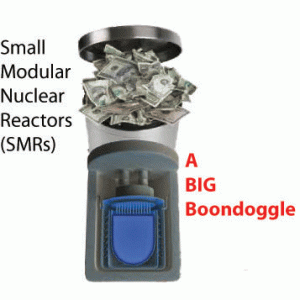 Environmental groups challenge TVA nuclear reactor plan, Miami Herald, 25 June 17 The Associated Press OAK RIDGE, TENN.
Environmental groups are challenging the Tennessee Valley Authority’s proposal to use a Tennessee nuclear reactor design site abandoned in the 1970s to develop new small modular reactors.
According to the Chattanooga Times Free Press , the Southern Alliance for Clean Power, the Union of Concerned Scientists and the Blue Ridge Environmental Defense League have challenged the Oak Ridge project’s site application. They say the reactors remain untested, unsafe and unneeded.
The Nuclear Regulatory Commission is reviewing the application to determine if the site works for two or more reactors generating up to 800 megawatts of nuclear power.
Sara Barczak, the high risk energy choices program director with the Southern Alliance for Clean Energy, compared the project to the Clinch River Breeder Reactor project that was planned for the site in the 1970s, but was scrapped amid escalating prices for the technology.
“We are very concerned that history is once again repeating itself,” Barczak said. “And we are concerned that billions of dollars could be spent on a technology that is unproven, untested and significantly more expensive than other types of power technology that are available to TVA.”…….. http://www.miamiherald.com/news/business/article158140124.html
June 26, 2017
Posted by Christina Macpherson |
opposition to nuclear, technology, USA |
Leave a comment
 ‘Absolutely unacceptable’ error in shipment of nuclear materials prompts probe, By Rebecca Moss | The New Mexican, Jun 24, 2017
June 26, 2017
Posted by Christina Macpherson |
safety, USA |
Leave a comment
 PM Modi-Trump talks: Civil nuclear deal to figure, no pact on reactors,Time of India.| Jun 25, 2017,
 HIGHLIGHTS
June 26, 2017
Posted by Christina Macpherson |
India, politics international, USA |
Leave a comment