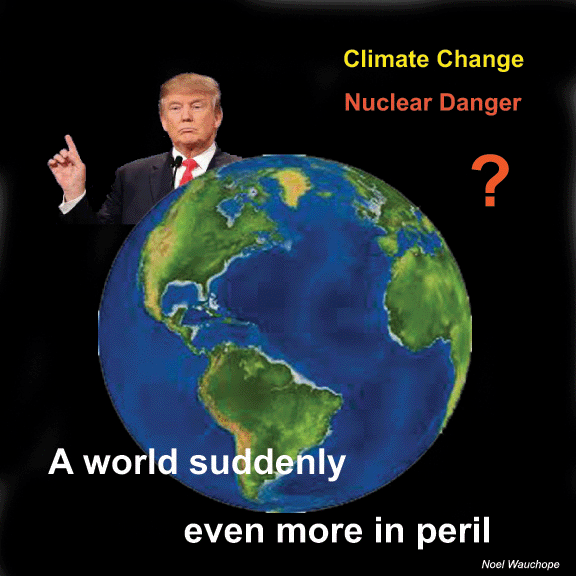
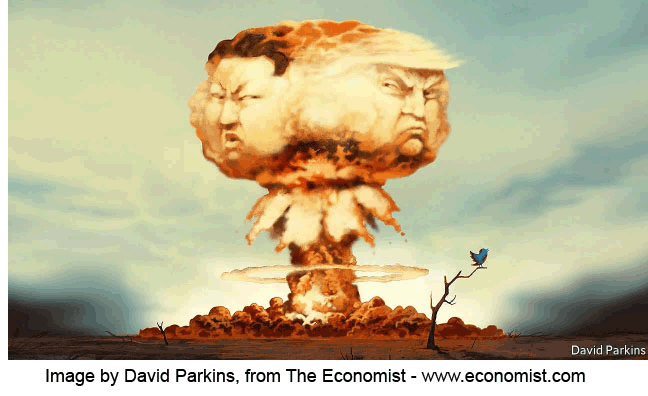
By Manuela Tobias on Thursday, August 10th, 2017 President Donald Trump’s threats against North Korea and tweets about the United States’ powerful nuclear arsenal have raised the specter — however small — of nuclear war.
But some members of Congress argue that the current process by which the president can order a nuclear strike is illegal.
“Our view is the current nuclear launch approval process is unconstitutional,” U.S. Rep. Ted Lieu, D-Calif, said on CNN on Aug. 8, 2017. Lieu has filed a proposal to require congressional approval before the president could launch a first nuclear strike.
“Right now one person can launch thousands of nuclear weapons, and that’s the president. No one can stop him. Under the law, the secretary of defense has to follow his order. There’s no judicial oversight, no congressional oversight,” Lieu said.
Lieu, a colonel in the Air Force reserves, is generally correct about the president’s power to initiate a nuclear strike. The constitutionality, however, is a more complex question. We won’t rate Lieu’s claims on the Truth-O-Meter, but we did think it was important to provide context to his statement and the law.
Nuclear launch process
The current nuclear launch approval process was enshrined after the atomic bombings of Hiroshima and Nagasaki in Japan to end World War II. President Harry Truman signed the Atomic Energy Act of 1946 to give the president full responsibility over the nation’s nuclear arsenal.
(As an aside, Lieu’s argument wouldn’t apply in cases when Congress formally declares war, since the president has a longstanding right as commander-in-chief to decide how to wage war.)
So the current nuclear launch approval process doesn’t include the same checks and balances as other executive branch decisions. The launch process allows the president to use nuclear weapons with a single verbal order. Some experts believethe president doesn’t need to consult with the defense secretary. The president’s order cannot be overridden.
Unconstitutional?
The U.S. Supreme Court has never weighed in on the question of whether the current nuclear launch approval process is legal. Not surprisingly, we heard mixed opinions from legal scholars.
The Constitution allows the president to use significant military force without congressional approval if it’s in self-defense. But would it be constitutional for the president to respond to a conventional bombing with a nuclear strike? What about a state-sponsored act of terror?
These questions have no definitive answer.
The murkiness is due in some part to the framers not foreseeing the capability for mass destruction that nuclear weapons guarantee, said Samuel Issacharoff, a constitutional law professor at New York University. But, he said, the narrow design of a founding document doesn’t necessarily make a president’s unilateral military action — nuclear or non-nuclear — unconstitutional.
“The best one can say is that the constitutional scheme may be poorly designed
for modern circumstances,” he said.
War Powers Resolution The discussion gets even more complicated if the president considers a pre-emptive strike rather than a retaliatory strike.
The Constitution does give Congress the authority to declare war, which it hasn’t done since World War II. But presidents before Trump — and including Trump with his April airstrikes in Syria — have initiated war or war actions without express congressional permission.
In 1973, Congress passed the War Powers Resolution requiring that in the absence of a war declaration by Congress, the president report to Congress within 48 hours of introducing armed forces into hostilities and remove forces within 60 days if Congress does not approve.
A simple reading, then, could give Trump a 48-hour window of unilateral power.
But the War Powers Resolution hasn’t stopped longer military interventions. President Bill Clinton sent U.S. troops into the former Yugoslav republic of Kosovo in 1999, and they remained in place despite the failure to receive congressional authorization.
The Korean War
There’s a final wrinkle to all of this: Some experts say that Trump could circumvent the need for Congress to declare war against North Korea, because the United States is already at war with North Korea.
The Korean War (1950-3) ended with an armistice, but the two parties never signed the peace treaty scheduled in Geneva in 1954 formally ending the war.
“In the absence of some new legal instrument that makes fighting the war improper, you can say that the president has whatever authority he had before,” said Saikrishna Prakash, a law professor at the University of Virginia.
But there’s a caveat to that, too. Congress approved funding to fight the Korean War, but never formally declared war. That was done by the United Nations.
Obama’s climate regulations could save the United States billions — but they face a precarious future under the Trump administration. NATASHA GEILING AUG 9, 2017 On Tuesday, the U.S. Court of Appeals for the District of Columbia Circuit agreed to extend a freeze in litigation over the Clean Power Plan, the signature domestic climate policy of the Obama administration and a primary target of the Trump administration’s regulatory rollback, dimming environmentalists’ hopes that the court could ultimately save the otherwise doomed policy.
The Clean Power Plan imposed the first-ever federal limits for carbon pollution from power plants, and when it was finalized in 2015, immediately drew opposition from a coalition of fossil fuel interests, utility groups, and conservative states. The coalition challenged the Clean Power Plan in court and the Supreme Court issued a stay on the rule in 2016, pending ongoing litigation in the case. The U.S. Court of Appeals for the District of Columbia Circuit heard oral arguments for the case beginning in September of 2016, and had seemed ready to issue a decision as early as spring of 2017.
That all changed, however, when President Donald Trump assumed office in January. Trump, who does not accept the scientific consensus on climate change, railed against the rule through his presidential campaign, pledging to undo the regulation as part of his vast rollback of Obama-era environmental policies. In late March, the Trump Justice Department asked the U.S. Court of Appeals for the District of Columbia not to render a decision in the case, arguing that it would be premature to rule on a regulation that the administration was in the process of undoing. The court agreed, at least in part, with the Trump administration, issuing a 60-day freeze in litigation in late-April.
Tuesday’s decision extends that stay for another two months, dashing hopes that the court could revive the rule either by ruling in favor of the regulation or remanding it to the EPA for modifications, rather than complete repeal and rewrite.
But in a concurring opinion, two judges included a stark rebuff to the idea that the EPA could rely on the court to delay the regulation — reminding the agency that the EPA’s 2009 endangerment finding, which relied on volumes of scientific evidence to classify carbon emissions as a public health threat, compels the agency to act to limit greenhouse gas emissions.
Combined with the existing stay of the rule from the Supreme Court, the two judges — both nominated by Democratic presidents — argued that the court’s extension of the pause in litigation amounted to “relieving EPA of its obligation to comply with that statutory duty for the indefinite future.”
Trump’s environmental assault met with immediate legal challenges
Environmental groups are ready to take Trump to court.
“We are in a race against time to protect our communities and families from the clear and present danger of climate pollution,” Tomás Carbonell, directory of regulator policy and senior attorney for Environmental Defense Fund, which is one of the groups defending the Clean Power Plan, said in a statement. “EDF, along with millions of concerned Americans, will keep working to ensure EPA complies with its legal obligations and acts to protect our nation from climate pollution.”
The court’s decision came just days after legal experts from Columbia University’s Sabin Center for Climate Change Law released new analysis looking at the economic benefits of Obama-era climate and environmental regulations, including the Clean Power Plan. According to the analysis, the total benefits of maintaining several Obama-era regulations on greenhouse gas emissions could reach almost $370 billion by 2030. The analysis found that some of the highest benefits came from implementing the Clean Power Plan, which could by itself could create $46 billion in economic benefits by 2030. Those benefits came from the estimated reduction in emissions, as well as greater efficiency and lower health costs as a result of declines in pollution. The analysis also estimated that the Clean Power Plan could create as many as 59,700 new jobs by 2020.
EPA fines collected against polluters dropped 60% under Trump, report says, By Miranda Green, CNN August 10, 2017 Washington (CNN) The amount of money the Environmental Protection Agency is penalizing polluters they’ve sued for breaching federal regulations has plummeted by 60% under President Donald Trump, a report released Thursday has found.
Between January and July, fines resulting from settlements have been significantly lighter on polluters’ pocketbooks on average compared to previous administrations in the same time period, according to a report released by the Environmental Integrity Project, an environmental watchdog nonprofit group.
EIP found that between Trump’s first day in office through the end of July, the Department of Justice collected a total of $12 million in civil penalties from companies sued for breaking pollution control laws. During President Barack Obama’s first seven months, his administration collected $36 million in penalties. President George W. Bush’s administration collected $30 million and President Bill Clinton collected $25 million, according to EIP’s analysis, which is not adjusted for inflation…….http://edition.cnn.com/2017/08/10/politics/epa-lawsuits-dip/index.html
In 2004, the progressive journalists Amy and David Goodman called for the prize to be revoked,charging that Laurence had knowingly covered up the effects of radiation sickness on the Hiroshima andNagasaki survivors by “parroting the government line” that such reports were Japanese propaganda.
Laurence’s role within the Manhattan Project was a clear conflict of interest
We will probably never know the true extent to which William Laurence was co-opted, compromised, or corrupted by his military and governmental connections and involvements.
‘Atomic Bill’ and the Birth of the Bomb A star New York Times reporter was hired by the Manhattan Project to be its chronicler and cheerleader. The ethical debate continues to this day.Undark, 08.09.2017 / BY Mark Wolverton,
T 5:51 A.M. on Monday, May 21, 1956, the famed New York Times science correspondent William Leonard “Atomic Bill” Laurence watched a new universe burst into existence……Called Cherokee, it was a hydrogen bomb that moments before had been dropped about four miles off target from a B-52 bomber flying 10 miles over the northern Pacific, near the island of Namu in the Bikini Atoll
“….Laurence was also, at least in his own era, one of the most important science writers in America, one whose influence, if not his lyrical and vivid prose style, persists to this day. The Princeton historian Michael D. Gordin, author of “Five Days in August” and “Red Cloud at Dawn,” notes Laurence’s seminal impact on popular perceptions of the Bomb: “[His] science-driven utopianism, stressing some of the potential positive outcomes of nuclear power and minimizing the threat to Americans … [was] strongly influential in those early years, and shaped some of the discourse even of those opposed to the positions he articulated.” Much of Laurence’s writing, Gordin goes on, “became just part of the way people talked about nuclear weapons for decades.”
For Laurence, science represented humanity’s salvation, whether through medical advances or the power of the atom. If he believed that science was “the religion of the future,” as Spencer Weart wrote in his book “Nuclear Fear,” then Laurence definitely saw himself as an evangelist…….
OR YEARS, Laurence had wavered, torn between his firsthand knowledge of the annihilating power of nuclear weapons and his hope that the civilian and military atom would bring about a fabled new age of wonder for humankind. The great dangers and the great promise were two separate paths, and it was up to us to choose the right one.
But now those two sides of the atom, the dark and the light, nuclear oblivion and nuclear plenty, finally reconciled themselves in Laurence’s mind. He knew he had been wrong. They weren’t separate. They were one and the same. In the face of the awesome power of hydrogen fusion, no distinctions were necessary, or even possible. Beyond the dark cloud of nuclear destruction lay the super-bright sun of nuclear promise. And he would be the one who, through his words, would help the world see that light……..
In recent years, rising concerns over journalistic ethics, embedded reporters, and conflicts of interest have led critics to view Laurence’s role in the Manhattan Project as a classic example of the latter. Here was a reporter for America’s newspaper of record, tapped to serve not the interests of objective journalism but those of the military. …..
Laurence won his second Pulitzer Prize in 1946 for his Manhattan Project reporting, specifically his eyewitness account of the Nagasaki bombing mission. In 2004, the progressive journalists Amy and David Goodman called for the prize to be revoked, charging that Laurence had knowingly covered up the effects of radiation sickness on the Hiroshima and Nagasaki survivors by “parroting the government line” that such reports were Japanese propaganda. That same year, Beverly Ann Deepe Keever, a University of Hawaii journalism professor, took The Times itself to task, claiming in her book “News Zero: The New York Times and the Bomb” that beginning with Laurence and continuing throughout the Atomic Age, the paper had “omitted or obscured the defining — and harmful — effect” of radiation and radioactivity and had “aided the U.S. government at critical moments in implementing an information policy that covered up or minimized the scope and impacts of radiation and radioactivity.”
However, there’s an important perspective that such accusations overlook. Laurence’s role within the Manhattan Project was a clear conflict of interest by today’s standards……
While I was away with the atomic project for four months, I was off the Times payroll,” he explained in his Columbia oral history interview. “My salary came from the Army. … All the facts, all the news I got, I got from the Army and not from my connection with the Times.” ….
Despite Laurence’s claims, the question of just who was paying him while he was lost in “Atomland-on-Mars,” as he called it, remains unclear. His temporary boss, Gen. Leslie Groves — the military head of the Manhattan Project and the man who plucked Laurence away from the Times after personally selecting him for his atomic job — later wrote in his own memoir that “it seemed desirable for security reasons, as well as easier for the employer [i.e., The Times], to have Laurence continue on the payroll of the New York Times, but with his expenses to be covered by the MED” — the Manhattan Engineering District, i.e. Manhattan Project……..
His glowing paeans to the limitless future of atomic energy and the relative “safety” of the supposedly “clean” hydrogen weapons then under development — along with a thinly veiled disdain toward the growing grassroots campaign to ban atomic testing — only helped to enhance his image as a journalist who not only accepted but actively supported the Bomb as a part of 20th-century civilization. …
There’s no doubt that Groves and the military were consciously attempting to downplay the dangers of radiation….
We will probably never know the true extent to which William Laurence was co-opted, compromised, or corrupted by his military and governmental connections and involvements. It appears that in many ways, he was never really certain himself, and allowed himself to fall into a rabbit hole of murky motivations, ethical conflicts, and questionable alliances for the sake of what he viewed as his journalistic duty and dedication to the truth. What is clear, however, is that he allowed his awe, his sense of wonder, to overwhelm his consciousness, numbing his original visceral dread of atomic weapons and his detailed knowledge of their power. After struggling for decades with the insoluble conflict between the atom’s potential for both unparalleled good and unspeakable evil, he resolved the struggle in his own soul by surrendering to a comforting anodyne, a conviction that nuclear weapons were ultimately a “world-covering, protective umbrella” to shield humanity until the dawn of a golden era of peace.
Blinded by the fireball light of Cherokee that shone so brilliantly and then faded, Laurence anesthetized the dread he had felt and warned of long before any of his colleagues by simply fooling himself. Those of us who are his inheritors must guard against falling into the same trap. https://undark.org/article/atomic-bill-laurence-manhattan-project/
Beyond Nuclear 8th Aug 2017, Even though the three currently serving U.S. Nuclear Regulatory Commission
(NRC) Commissioners voted by June 9th in favor of reviving the
long-suspended Yucca Mountain high-level radioactive waste dump licensing
proceeding, they didn’t bother to tell the public till two months later!
On August 8th, the vote count documents were at long last revealed. By a 2-1
vote, the NRC Commissioners voted to fund the beginning of the resumption
of Yucca Mountain licensing proceeding. NRC Chairman Kristine Svinicki, and
NRC Commissioner Stephen Burns, voted in favor of resuming the proceeding;
NRC Commissioner Jeff Baran voted against resuming the proceeding. http://www.beyondnuclear.org/yucca-mountain/2017/8/8/nrc-planning-for-resumption-of-yucca-mountain-licensing-proc.html
OVER THE next week or so, the Trump administration must decide whether to approve or suppress a major federal climate change report. Though scientists have signed off on its findings, including that the average U.S. temperature has spiked in the past several decades and that humans have almost certainly played a predominant role, President Trump and Environmental Protection Agency Administrator Scott Pruitt have indicated they simply do not believe the experts.
Even as the federal climate assessment has been under review, the warnings have grown starker.
A paper published last week in Nature Climate Change offered a harrowing view. International negotiators committed in Paris to keeping global temperature rise below 2 degrees Celsius, the point past which experts warn warming could be very dangerous. Analysts from the University of Washington and the University of California at Santa Barbara found that there is only a 5 percent chance the world will achieve that goal.
Instead of predicting how technology or policy might change, the researchers looked at how nations have done until now and inferred from those trends what will happen in the future. As economies expand, they emit more planet-warming carbon dioxide into the air. Fortunately, over time economies also produce more efficiently, using less fuel and therefore emitting less carbon dioxide for every widget assembled or mile driven. By projecting population growth, economic expansion and carbon efficiency into the future, the analysts came up with a rough guide to where the global temperature will be at the end of the century.
They found that there is a 90 percent chance the world will warm between 2 degrees and 4.9 degrees Celsius, with a median of 3.2 degrees. Though this avoids the most alarming scenarios scientists have previously considered, it also excludes the least concerning, finding virtually no chance the Earth will keep warming below the desirable level of 1.5 degrees Celsius.
How does this translate into the real world? Some other new research provides answers. Experts at the Massachusetts Institute of Technology and Loyola Marymount University in Los Angeles found that at 4.5 degrees of temperature rise by 2100, highly populated and impoverished swaths of South Asia would experience heat waves so extreme that human beings would not be able to survive without protection. At 2.25 degrees of warming, heat-wave temperatures in the region would be dangerous but not as deadly. Another new analysis from European Union researchers warned that deaths due to extreme weather across Europe could increase from about 3,000 per year to 152,000 annually if the Earth warmed 3 degrees by century’s end.
Each of these studies comes with caveats. For example, much of the risk would be averted with a strong global commitment to cutting carbon dioxide emissions, particularly if green technology became significantly cheaper, making it easier to decarbonize than in the past. Yet even if the breakthroughs do not come, or do not come fast enough, the latest research suggests it is neither unrealistic nor pointless to aim for the low end of the range of possible climate outcomes, even over 2 degrees, to at least limit the damage to the planet’s habitability. That path, however, requires leaders to admit there is a problem.
Experts: US-N.Korea nuclear war unlikely, but risk is rising, https://www.apnews.com/95ffd16e43af4bca815a22f39813a8ac, — Martha Mendoza in San Jose, California, 10 Aug 17 A nuclear war between North Korea and the United States is not imminent, analysts said, but the inflammatory rhetoric on both sides is increasing the risk. They called on all parties to de-escalate.
North Korea’s army said in a statement distributed by state media Wednesday that it was examining a plan to use ballistic missiles to make an “enveloping fire” around Guam, a U.S. territory that is home to Andersen Air Force Base. The statement came a day after President Donald Trump warned North Korea against making more threats, saying, “They will be met with fire and fury like the world has never seen.”
What experts in South Korea, China and the U.S. had to say:
SLIM CHANCE OF ATTACK
A North Korean attack or an American pre-emptive strike is unlikely, said John Delury, an associate professor of East Asian Studies at Yonsei University in Seoul.
He saw North Korea’s statement as a warning to Washington that its missiles could reach targets in the region, rather than one of an actual attack.
“Well, I’m gonna go out on a limb here and say if North Korea was planning some kind of pre-emptive or surprise attack on Guam, we would not be reading about it in North Korean media,” Delury said in an interview at his office. “Now that said, you do need to track their threats. And there are cases where they (have) made a specific threat and carried it out.”
A U.S. strike against North Korea would need the support of South Korea, he said, because the North would likely retaliate against the South and its 600,000 troops.
“It’s not something you can do without robust, full support from the South Korean government people, and there’s absolutely no sign that South Korea will support military options with North Korea,” Delury said.
— Yong Jun Chang in Seoul, South Korea
DEEP CONCERN IN BEIJING
Chinese government-backed scholars said Beijing is deeply concerned about the latest statements from Trump and North Korea. They hold the U.S. partly responsible, saying Trump’s heated rhetoric is fueling the flames.
Trump’s tough talk has contributed to an increase in animosity that is pushing the sides closer to armed conflict, said Cheng Xiaohe of the School of International Studies at Beijing’s Renmin University.
“If not kept well under control, this verbal spat could turn into a military clash,” he said, adding that China should dispatch diplomats to engage in shuttle diplomacy to bring the sides to the negotiating table.
China’s patience with North Korea, its onetime close ally, appears to be running thin: Beijing agreed to recent U.N. sanctions, despite potential losses to Chinese firms doing business with North Korea and fears over destabilizing the Pyongyang regime.
A top Chinese expert on North Korea said Pyongyang seemed to have been heartened by Washington’s failure to take firm measures in response to earlier actions.
“Trump said the U.S. would take tough measures if North Korea fired off missiles, but it did not,” said Zhang Liangui, a professor at the ruling Communist Party’s main training academy. “This might make North Korea think that’s just some verbal threat, so its attitude is getting tougher and tougher.”
The U.S., China and Russia need to come together to force the North to de-escalate, he said. “The big countries should not attack each other, but unite to better cooperate on maintaining the denuclearization of the Korean Peninsula.”
— Christopher Bodeen and Fu Ting in Beijing
NO CAPABILITY YET
U.S. nuclear expert Siegfried Hecker, who has repeatedly visited North Korea’s nuclear facilities, said he doesn’t think North Korea currently has weapons systems for “enveloping fire” around Guam, as it threatened.
“I don’t believe they have the capability to do so yet, and besides, why would they want to commit suicide by attacking a remote target like Guam?” he said. “The real threat is stumbling into an inadvertent nuclear war on the Korean Peninsula by misunderstanding or miscalculation. Inflammatory rhetoric on both sides will make that more likely. It’s time to tone down the rhetoric.”
Hecker said North Korea does not have a sophisticated nuclear weapon like those of the U.S., Russia, Britain, China or France, the major nuclear superpowers.
“The shorter-range missile that can reach South Korea and Japan can accommodate larger nuclear warhead payloads,” he said. “Making the warhead sufficiently small, light and robust to survive an ICBM delivery is extremely challenging and still beyond North Korea’s reach.”
The way to avert a war with North Korea is to have a conversation, and that’s not happening, Hecker said.
“Unfortunately, there seems to be no serious dialogue between Washington and Pyongyang, only threats,” he said.
By AUDREY McAVOY, 11 Aug 17, HONOLULU (AP) — The small U.S. territory of Guam has become a focal point after North Korea’s army threatened to use ballistic missiles to create an “enveloping fire” around the island. The exclamation came after President Donald Trump warned Pyongyang of “fire and fury like the world has never seen.” Here’s a look at the U.S. military’s role on the island, which became a U.S. territory in 1898.
WHAT INSTALLATIONS ARE ON GUAM AND HOW SIGNIFICANT ARE THEY? There are two major bases on Guam: Andersen Air Force Base in the north and Naval Base Guam in the south. They are both managed under Joint Base Marianas. The tourist district of Tumon, home to many of Guam’s hotels and resorts, is in between.
The naval base dates to 1898, when the U.S. took over Guam from Spain after the Spanish-American War. The air base was built in 1944, when the U.S. was preparing to send bombers to Japan during World War II.
Today, Naval Base Guam is the home port for four nuclear-powered fast attack submarines and two submarine tenders.
Andersen Air Force Base hosts a Navy helicopter squadron and Air Force bombers that rotate to Guam from the U.S. mainland. It has two 2-mile (3-kilometer) long runways and large fuel and munitions storage facilities.
Altogether, 7,000 U.S. military personnel are stationed on Guam. Most are sailors and airmen. The military plans to move thousands of U.S. Marines to Guam from Okinawa in southern Japan.
Guam’s total population is 160,000.
___
WHAT ROLES DO THE BASES PLAY IN THE REGION
Guam is strategically located a short flight from the Korean peninsula and other potential flashpoints in East Asia. Seoul is 2,000 miles (3,200 kilometers) to the northwest, Tokyo is 1,500 miles (2,400 kilometers) north and Taipei is 1,700 miles (2,700 kilometers) west.
Because Guam is a U.S. territory, the U.S. military may launch forces from there without worrying about upsetting a host nation that may object to U.S. actions.
The naval base is an important outpost for U.S. fast-attack submarines that are a key means for gathering intelligence in the region, including the Korean peninsula and the South China Sea where China has been building military bases on man-made islands.
___
HOW HAS THE U.S. USED GUAM TO ADDRESS THE THREAT FROM NORTH KOREA?
The U.S. military began rotating bombers — the B-2 stealth bomber as well as the B-1 and B-52 — to Andersen in 2004. It did so to compensate for U.S. forces diverted from other bases in the Asia-Pacific region to fight in the Middle East. The rotations also came as North Korea increasingly upped the ante in the standoff over its development of nuclear weapons.
In 2013, the Army sent a missile defense system to Guam called Terminal High Altitude Area Defense or THAAD.
It’s designed to destroy ballistic missiles during their final phase of flight. A THAAD battery includes a truck-mounted launcher, tracking radar, interceptor missiles and an integrated fire control system.
___
WHAT’S THE HISTORY OF THE U.S. MILITARY ON GUAM?
The U.S. took control of Guam in 1898, when Spanish authorities surrendered to the U.S. Navy. President William McKinley ordered Guam to be ruled by the U.S. Navy. The Navy used the island as a coaling base and communications station until Japan seized the island on Dec. 10, 1941. The U.S. took back control of Guam on July 21, 1944.
During the Vietnam War, the Air Force sent 155 B-52 bombers to Andersen to hit targets in Southeast Asia. Guam was also a refueling and transfer spot for military personnel heading to Southeast Asia. Many refugees fleeing Vietnam were evacuated through Guam.
New Generation Nuclear Reactors Unlikely to Deliver on Design, EcoWatch, By Paul Brown, 9 Aug 17
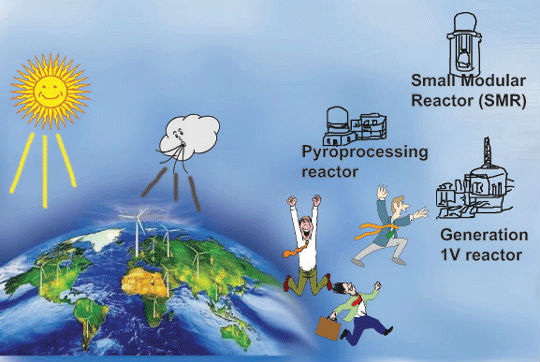
New generation nuclear reactors, promised for the last 18 years by the U.S. Office of Nuclear Energy (NE) as a way to provide cheap and plentiful supplies of electricity, are unlikely to be fulfilled any time in the next 30 years.
That is the conclusion of university researchers who have used the Freedom of Information Act to obtain the program’s budget history to find out what designs the government has spent $2 billion of public money on supporting.
Researchers from the University of California San Diego and Carnegie Mellon University described the research program as “incoherent” and said the government was “unlikely” to deliver on its mission to develop and demonstrate an advanced nuclear reactor by mid-century.
The study, published in the journal Environmental Research Letters, said much of the money that was supposed to be spent on civilian reactors was spent instead on supporting infrastructure, where the main focus was defense programs and not commercial opportunities……..
Overall, the technology’s prospects appear grim, with implications that go beyond energy.
“Without a sense of urgency among NE and its political leaders,” Abdulla warned, “the likelihood of advanced reactors playing a substantial role in the transition to a low-carbon U.S. energy portfolio is exceedingly low…..
These reported failings in the U.S. research program come at a difficult time for the industry when across the world the current “new” generation of large nuclear reactors is proving difficult to build on time and on budget, and some projects are being abandoned mid-way through construction…….
Most of the money now being spent on research into new generations of nuclear power stations is being provided by nuclear weapon states. Most countries that have never had nuclear weapons but have invested in nuclear power stations are now phasing them out and putting their development money into cheaper renewables. https://www.ecowatch.com/new-generation-nuclear-2471347067.html
Unheeded warnings, repeated mistakes put workers’ health at risk at Idaho nuclear lab, Idaho Statesman, BY PATRICK MALONE AND PETER CARY, The Center for Public Integrity AUGUST 10, 2017
Ted Lewis knew the plutonium plates at the government lab where he worked could leak potentially lethal radioactive dust.
He had seen it occur in the 1970s, when he was helping load some of those plates into a nuclear reactor at the lab near Idaho Falls. A steel jacket enclosing one of the plates somehow cracked, spilling plutonium oxide particles into the air. But Lewis and his colleagues were lucky — they were wearing respirators and given cleansing showers, so their lives weren’t endangered.
Three decades later, Lewis, an electrical engineer who had become chairman of the lab’s safety committee, had a bad feeling this could happen again, with a worse outcome. And he turned out to be right.
He tried to head it off. In 2009, Lewis wrote a pointed warning memo — he called it a white paper — and gave it to the official in charge of all nuclear operations at the Idaho National Laboratory, which is run by a consortium of private companies and universities under contract to the Energy Department.
The memo said the chance of encountering a plutonium plate that disintegrated, as Lewis had previously witnessed, was “greater than facility and senior management realizes,” according to a copy. Although Lewis said that a workplace manual published by the contractor — Battelle Energy Alliance LLC (BEA) — called the risk of an accidental spill of such radioactive dust “negligible,” he wanted his superiors to expect it and prepare for it.
He said in a sworn court deposition in January 2016 that he shared his concerns with at least 19 others at the laboratory, which holds one of the world’s largest stockpiles of plutonium, the explosive at the heart of modern nuclear weapons. But they didn’t respond, he said, and some of the precautions he urged — checking the plates more carefully before they were unwrapped and repackaged for shipment and setting up a decontamination shower — were ignored.
Then, at 11:04 a.m. on Tuesday, Nov. 8, 2011, Lewis’ fears came to life in a cavernous room at the lab where workers were readying some plates the size of Hershey’s chocolate bars for shipment to other federal sites and to researchers. The workers had a lead shield between themselves and the plates, but the table where they sorted the plates wasn’t sealed, and none of them had respirators on.
When a nuclear material handler named Ralph Stanton noticed that one plate’s container had a label warning that the plate’s corner was “swollen,” he asked a shift supervisor for guidance. The supervisor phoned one of the lab officials whom Ted Lewis had briefed on his worries, but after finishing the call the official told the workers to continue, according to an internal Department of Energyreport in January 2012.
Sure enough, as the plate’s wrapping was pulled away, black powder leaked out, and Stanton, along with 15 of his colleagues in the facility, inhaled the plutonium dust, according to the report. Three of them wound up suing BEA, saying that they had been sickened due to the company’s negligence. BEA publicly disputed that the workers were harmed, but it also reached private settlements with each of the litigants that included nondisclosure provisions.
The contamination incident was extensively covered by two newspapers published in Boise, including the Idaho Statesman. But the Center for Public Integrity’s investigation shows it was preceded by two other serious instances of radioactive contamination at the lab as well as by Lewis’ careful warnings, and that it was also followed by two additional, avoidable radioactive contaminations there……..
Idaho National Laboratory is not unique. The government has been similarly generous to many of the other private contractors that operate key nuclear weapons-related facilities. Part of the problem, according to auditors at the Government Accountability Office, which reports to Congress, is that the Energy Department has too little staff, and poorly-trained contract managers, making it more susceptible to fraud and waste than most agencies.
The contractors largely police themselves, according to the GAO and inspector general reports. Penalties do not cause enough pain to act as deterrents, safety experts say. And — as might be expected — the contractors typicallyprioritize the mission-related responsibilities that bear directly and most strongly on their profits, according to current and former workers and accident investigation reports.
Plenty of warning that workers were at risk
Lewis’ “white paper” was not the only sign that BEA’s effort to prevent radiation contamination of its Idaho workforce were lagging………
Numerous problems contribute to the mass inhalation incident
Then came the radiation contamination of 16 workers on Nov. 8, 2011, which occurred in a white, mound-shaped building that was once home to a now-dismantled nuclear reactor and still has a massive vault resembling a walk-in freezer. It’s there that the government stores several metric tons of surplus plutonium, which the Department of Homeland Security and the NNSA use to help develop and refine radiation detection devices deployed by Washington at ports and border crossings around the globe.
Multiple physical shortcomings and managerial lapses combined to endanger the workers that day, according to the Energy Department’s report: The building had old and failing equipment, and no showers. Records of the plutonium plates’ individual histories — including previous damage — had been lost, and Lewis’ warnings that some were liable to turning to powder were ignored. Managers “did not recognize the significance of this information,” the report said.
Worse, the nearest air monitor was 15 feet from where the plates were being unwrapped. A vent supposed to draw dangerous fumes from the work area was partially blocked. And some of those doing the work “had no training on the hazards associated with Pu [plutonium],” BEA’s report said.
According to the lawsuits filed against BEA, the company at the time felt compelled to complete the work speedily. In interviews with the Center, Stanton said he was told it was a “bonus job,” meaning that meeting deadlines would help the company and its managers earn their profits. “DOE gives these guys a bonus. When the milestone is in play, safety is completely gone,” he said. “We were playing Russian roulette.”
Braase, a health physicist technician responsible for checking jobsite radiation and worker exposures, said in his own legal complaint that the work was accelerated so it could be completed before he went on a medical leave, allowing less time than usual for a careful review. BEA’sreport on the accident, issued Sept. 17, 2012, said one of the factors contributing to the accident was that the company’s “focus is on getting the work done (the end justifies the means).”…
Health physicists consulted by the Center noted that the unusual circumstances complicate estimates of the potential consequences. If you inhale plutonium particles, they sit in the lung or get into the bloodstream and continue to radiate for a lifetime or until they are all are excreted. As a result, labs generally predict exposures and assign limits for this type of exposure over a 50-year period. Annual radiation limits for workers, in contrast, are pegged to short-term exposures from sources outside the body — like from an X-ray or series of X-rays……..
For this incident, and for the earlier radiation exposures that year of the three workers in the hot fuel facility, the DOE’s enforcement officer initially proposed fining BEA $615,000. But Boulden reduced the fine to $412,500 for what he said were “corrective actions taken.”
Separately, BEA’s profit was cut by $500,000 on Jan. 31, 2012, in a letter from Richard B. Provencher, the DOE’s fee awarding official, to Grossenbacher that noted “unacceptable events continue to occur” at the lab. But on Nov. 22, 2013, Provencher, who determines BEA’s annual profit, gave back the entire $500,000 that had been withheld, with the stipulation that BEA spend $100,000 of it on efforts to improve operations and safety.
In total, in 2011, BEA earned $17.1 million in profits, the year of the accident, or 92 percent of what was available. In 2012, it earned $16.2 million, but the next year it got the $500,000 back.
New contamination incidents
The plutonium contamination of 16 BEA workers was followed by two other significant radiation exposures, with the first occurring in August 2014, when workers in the Fuel Manufacturing Facility, a low structure next to the building where the plutonium exposures occurred, were fabricating radioactive americium in a glove box.
Outside the body, small bits of americium pose almost no threat to human health. But in higher internal doses, its radiation breaks down cells, alters genes and attacks bones and organs, increasing its victims’ chances of contracting life-threatening maladies, according tothe Centers for Disease Control and Prevention…….
At the end of 2014, BEA was awarded $18.1 million in pure profit, after $350,000 was deducted for the two safety incidents. That meant the company got 97 percent of the maximum profit allowed under its contract. It also got its contract extended to 2019 without competition. A joint newsrelease from BEA and the Energy Department announcing the extension credited the decision to the company’s “consistently strong annual performance and success in managing INL.”
Senator Dean Heller released a statement on the Nuclear Regulatory Commission’s vote to use past unobligated funds for work related to its review of the Department of Energy’s application for authorization to construct a high-level radioactive waste repository at Yucca Mountain. Heller says it’s another waste of taxpayer money on a failed project that has already cost the federal government billions of dollars over the past 30 years. It’s irresponsible for the NRC to move forward on Yucca Mountain given that it’s unknown how much funding if any it will ultimately receive. Heller calls it a reckless and fiscally irresponsible decision to throw more taxpayer dollars on a project that Nevada continues to reject.
With ‘fire and fury,’ Trump revives fears about his possession of nuclear codes, SF Gate, Marc Fisher and Jenna Johnson, The Washington Post, August 9, 2017
As with most things Trump, the furor over the “fire and fury” has divided the nation in two – those who believe the president is a loose launchpad, impulsively blurting whatever flits through his mind, and those who believe his inflammatory talk is a wily combination of politically savvy instincts and a gut-driven populism that simply aims to please.
When President Donald Trump went off script Tuesday to deliver a startling threat to North Korea – “They will be met with fire and fury like the world has never seen” – it was as if the nation relived the most lurid themes of the 2016 campaign in one chilling moment.
Last fall, Hillary Clinton’s campaign used as one of its final weapons a TV ad featuring a longtime nuclear missile launch officer who warned against voting for Trump: “I prayed that call would never come. Self-control may be all that keeps these missiles from firing.”
Then, quick-fire, a series of clips of Trump on the stump: “I would bomb the s— out of them.” “I want to be unpredictable.” “I love war.” The thought of Donald Trump with nuclear weapons scares me to death,” Bruce Blair, the retired launch officer, says in the ad. “It should scare everyone.”
It very nearly did: Voters made clear last fall that they trusted Clinton vastly more than Trump on the use of nuclear weapons – by 57 percent to 31 percent in a Fox News poll in October, for example.
But Trump voters often said that their reasons for supporting him outweighed their sense that he could be dangerously impulsive – and they repeatedly expressed confidence that the national security apparatus would keep him in check…….
OF NUCLEAR INTEREST: Proposed clean energy updates, Wicked Local Plymouth, 9 Aug 17, Last year, the Massachusetts Department of Environmental Protection proposed adding six new regulations as well as amendments to existing regulations designed to reduce greenhouse gas emissions in the commonwealth……
One of the six updates that may be of particular interest to South Shore residents is the Clean Energy Standard. The CES essentially requires sellers of electricity to purchase increasing amounts of “clean” energy for use by their customers, and is designed to increase the percentage of electricity sold to consumers that is generated by clean energy sources.
Which generators qualify as a “clean energy source,” according to the CES? As written, eligibility is determined using an emissions-based threshold and is limited to generators built after 2010. This includes large hydroelectric generators, nuclear power plants, and certain fossil fuel plants.
While we commend the state’s efforts to promote energy efficiency and clean energy, we strongly believe that clean energy sources need to be defined, not just by emissions in Massachusetts, but the total impact caused by the technology. This is especially true for environmental impacts, including associated pollution with mining and operations, pipeline emissions, and ultimate transportation and management of waste products.
Nuclear waste in Massachusetts, for example, is currently stranded on the Cape Cod Bay shoreline with no repository or solution in sight. This exceptionally dangerous waste will remain a threat for hundreds of thousands of years, and dealing with it over time requires enormous investment in energy for transport, security, and problem solving. Not exactly the definition of “clean.”……
MassDEP is scheduled to announce final regulations this month. Let’s hope that Massachusetts stays the course, and older nuclear plants are not eligible under the CES. Such an action would divert credits and incentive away from truly clean energy advancement and technologies, and shackle our region to serious and unresolved problems for years to come.
Karen Vale-Vasilev manages Jones River Watershed Association’s (JRWA) Cape Cod Bay Watch program. JRWA has its offices on the banks of the river in Kingston, eight miles from Pilgrim.
The Cayce-based utility has paid its top officials almost $21.4 million in annual performance-based bonuses over the past decade, according to The State newspaper’s review of the utility’s filings with the U.S. Securities and Exchange Commission.
Some of those payouts were to reward the executives for accomplishments related to the construction of two nuclear reactors at the V.C. Summer site in Fairfield County, SCANA said in the filings.
Late last month, SCANA and the state-owned Santee Cooper utility said they were abandoning that project, citing construction delays and cost overruns that plagued the 9-year-old venture……
Operational excellence’
Last year, SCANA’s top five executives took home $3.3 million in performance-based pay, according to the federal filings. Nearly half of that went to SCANA chief executive officer and president Kevin Marsh, accounting for about a quarter of his $6.1 million in total compensation.
The filings do not say exactly how much of the $21.4 million in performance-based pay went to reward the executives for building the two nuclear reactors……
Top SCANA executives have been paid nearly $21.4 million in performance-based bonuses over the past decade. Some of that money was to reward the officials for their accomplishments in building two nuclear reactors in Fairfield County, a project the utility now says it will abandon. Here is how much the executives were paid each year.:…… http://www.thestate.com/news/politics-government/article166298442.html
Donald Trump’s nuclear fixation – from the 1980s to now, BBC, Anthony ZurcherNorth America reporter 10 August 2017 “…….The president’s recent nuclear sabre-rattling shouldn’t be viewed as an isolated incident, however. Mr Trump has displayed a keen interest in the utility of atomic weapons for decades…..
his thoughts on atomic weaponry reflect a certain strain of Cold War arms-race enthusiasm and diplomatic brinkmanship.
Last December President-elect Trump emphasised that the US had to “greatly strengthen and expand” its nuclear weaponry and would “outmatch” any adversaries.In August MSNBC’s Joe Scarborough reported that candidate Trump had asked his foreign policy advisors several times why the US couldn’t use its nuclear weapons – a claim the Trump campaign denied.
The report, however, followed on the heels of an April 2016 town hall forum exchange between Mr Trump and MSNBC’s Chris Matthews, who asked him why he had refused to categorically rule out the use of nuclear weapons.
“Would there be a time when it could be used?” Trump replied. “Possibly. Possibly.”
When pressed on the risks of openly talking of using nuclear weapons, Mr Trump said: “Then why are we making them? Why do we make them?”(The US no longer makes new nuclear warheads. It maintains its current arsenal.)
He repeated that he is not going to take any of his “cards off the table”.
Digging back further, in 1990 Mr Trump gave an interview with Playboy Magazine in which the topic of atomic weaponry came up.
“I’ve always thought about the issue of nuclear war; it’s a very important element in my thought process,” Mr Trump said. He called it the “ultimate catastrophe” and compared it to an illness no one wants to talk about it.
“I believe the greatest of all stupidities is people’s believing it will never happen,” he continued, “because everybody knows how destructive it will be, so nobody uses weapons. What [expletive].”
In 1984 – at the height of the Cold War – Mr Trump even told a Washington Post interviewer he wanted to be put in charge of US-Russia nuclear arms negotiations.”It would take an hour-and-a-half to learn everything there is to learn about missiles,” Mr Trump said. “I think I know most of it anyway.”
Around the time of this interview a computer game called Balance of Power, which simulated the Cold War struggle between the US and Soviet Unions, became a surprise hit.
Players could sabotage, scheme and sabre-rattle up to the brink of nuclear war. The trick was you were never quite sure how close you could get before the missiles started flying. Escalation could lead to inadvertent annihilation.
And if it did, this was the message, displayed in white letters on a black screen: “You have ignited an accidental nuclear war. And no, there is no animated display of a mushroom cloud with parts of bodies flying through the air. We do not reward failure.”
If Mr Trump’s past comments are any guide, he appears to be making the calculus that the US nuclear arsenal is ineffective if adversaries don’t believe the nation is willing to pull the trigger. It’s all part of the “unpredictability” strategy he repeatedly touted during his presidential campaign (and plugged again in a recent tweet).Mr Trump – and his Defence Secretary Jim Mattis – have spoken of how the US will prevail in any military confrontation with North Korea. Largely left unmentioned amid the bluster, however, is the danger that an extended standoff could spin out of control and the high cost in human lives – in civilian lives on both sides of the Korean demilitarised zone and for US military personnel – that any such conflict would entail.