-
Cost of delayed Georgia nuclear project may be $25 billion
-
Energy Secretary Perry turned down Scana’s bid for bailout
-
President Donald Trump has vowed to revive America’s dying nuclear industry. Backers of a troubled Georgia nuclear project want him to prove it.
They have asked the administration to come to the aid of a project to build two reactors to the Southern Co.’s Vogtle power plant, according to people familiar with the talks. That could include increasing or speeding up disbursements of $8.3 billion in federal loan guarantees to the companies behind the nuclear plant, the people said. They asked not to be identified discussing ongoing negotiations.
A Georgia public service regulator was in Washington to make a case for the project, the last nuclear plant under construction in the U.S., and Southern has hosted congressional staff members at the construction site. The company also wants Congress to extend tax breaks for nuclear power….
With Southern set to tell regulators in Georgia by the end of this month whether it plans to continue with construction plans for the plant, federal support could be crucial. Last week, Southern said it estimated its portion of the cost to complete the reactors was at least $11.5 billion, excluding $1.7 billion in guaranteed payments from Toshiba. Given Southern’s 46 percent stake in the project, that would put the total cost of building the two reactors at $25 billion……
- After Energy Secretary Rick Perry turned down a request for $3 billion in aid for Scana Corp.’s nuclear plant in South Carolina, it’s not clear how much the federal government will help. Scana abandoned its V.C. Summer nuclear projects last month after it concluded the two reactors would end up costing it more than $20 billion to build.
In general, the Trump administration has said it’s studying the nuclear issue…..https://www.bloomberg.com/news/articles/2017-08-11/troubled-georgia-nuclear-project-is-said-to-seek-aid-from-trump
South Carolina’s state-owned utility drops plans for rate hikes for failed nuclear project

 Utility drops rate hike plans for failed nuclear project, By SEANNA ADCOX New Jersey Herald : Aug. 11, 2017 COLUMBIA, S.C. (AP) — Millions of customers who have been footing the bill for years for a now-abandoned nuclear power project may get a temporary reprieve from rising bills, as South Carolina’s state-owned utility dropped plans Friday for two consecutive rate hikes.
Santee Cooper’s board canceled the approval process for average increases of 3.5 percent in 2018 and 3.9 percent in 2019. A vote on the requested hikes had been set for December.
They would have been the utility’s sixth and seventh hikes since 2009 for the now-abandoned expansion of V.C. Summer Nuclear Station north of Columbia. Santee Cooper and South Carolina Electric & Gas decided July 31 to halt construction on two new reactors they’d already jointly spent $10 billion to build, much of that paid by customers.
“Conditions have changed materially since the rate process began,” said Santee Cooper board Chairman Leighton Lord.
But the cancellation doesn’t necessarily mean rates won’t eventually rise for the more than 2 million customers served by Santee Cooper, which provides power directly and through local electric cooperatives. The board directed the utility’s staff to come back in October with a new financial plan.
“Santee Cooper will still need to cover costs related to our load, other system improvements and environmental compliance,” said Santee Cooper CEO Lonnie Carter. “We will tighten our belts and continue to look for ways we can be more efficient to make up the balance.”
Carter said the state-owned utility would have had to raise rates by 41 percent to continue with the project.
Friday’s unanimous vote comes amid a backlash from the public and lawmakers.
The scuttled nuclear project already accounts for 18 percent of SCE&G’s residential electricity bills and more than 8 percent of Santee Cooper’s. SCE&G is seeking permission from the Public Service Commission to recoup an additional $5 billion over 60 years. Those regulators approved all nine of SCE&G’s rate hike requests since 2009. Legislators have publicly warned commissioners they may be fired.
Three of those commissioners are up for re-election early next year by the Legislature. Seven people, including the incumbents, filed for the three slots by Friday’s noon deadline. The commission has no authority over the state-owned utility…….http://www.njherald.com/article/20170811/AP/308119851#
USA Federal Government not stepping in to save South Carolina nuclear power project
 Trump administration silent on demise of nuclear project it once called ‘massively important’, Post and Courier By Thad Moore and EmmaDumain tmoore@postandcourier.com eduman@postandcourier.com, Aug 12, 2017 The day after two South Carolina power companies decided to bail out on two partially built nuclear reactors, state regulators asked the project’s top executives what it would take to restart construction.
Kevin Marsh, CEO of South Carolina Electric & Gas parent SCANA Corp., answered with a must: The federal government would need to step in to cover the spiraling costs, he said, and guarantee that ratepayers wouldn’t foot the bill for a project with an uncertain price tag.
Nearly two weeks later, support from D.C. doesn’t appear to be forthcoming.
President Donald Trump and Energy Secretary Rick Perry, who have both advocated pro-nuclear positions, haven’t addressed the project’s demise publicly. And one of the two utilities that were building the reactors at the V.C. Summer Nuclear Station near Columbia says it hasn’t heard from the administration since giving it the news.
Santee Cooper, the state-run power utility that owns 45 percent of the project, says it told the White House it was ditching the reactors but hadn’t heard anything since. SCE&G, which owns the other 55 percent, declined to answer questions about its communications with the administration.
The silence from Washington casts further doubt on the prospect of reviving the scuttled project, even as state lawmakers and Gov. Henry McMaster scramble to have at least one reactor completed…..http://www.postandcourier.com/business/trump-administration-silent-on-demise-of-nuclear-project-it-once/article_7bd33fc6-7e9d-11e7-8f2e-7b8e4872296c.html
Lawsuit against S.C. Electric & Gas – accuses mismanagement of over $1 billion of its customers’ money
 Lawsuit accuses SCE&G of negligence in scuttled South Carolina nuclear construction project, Post and Courier By Thad Moore tmoore@postandcourier.com Aug 12, 17,
Very few veterans of Gulf War approved for health claims
Report: VA office denies 90 percent of Gulf War claims, Santa Fe New Mexican, The Associated Press, 13 Aug 17, ALBUQUERQUE — A Veterans Affairs office in New Mexico during the 2015 fiscal year denied more than 90 percent of benefit claims related to Gulf War illnesses, marking the ninth-lowest approval rating among VA sites nationwide, according to a federal report.
The U.S. Department of Veterans Affairs’ Albuquerque office denied 592 of 640 Gulf War illness claims in 2015, which is the latest yearly data available, The Albuquerque Journal reported earlier this week.
The report released in June from the Government Accountability Office found approval rates for Gulf War illness claims are one-third as high as for other disabling conditions. The Gulf War illness claims also took an average of four months longer to process…….http://www.santafenewmexican.com/news/local_news/report-va-office-denies-percent-of-gulf-war-claims/article_d2865b60-6a15-5877-a134-7b47ce5266d0.html
In the effort to deal with nuclear waste, pyroprocessing created even more problems
Since the project began 17 years ago, 15% of the waste has been processed, an average of one-fourth of a metric ton per year. That’s 20 times slower than originally expected, a pace that would stretch the work into the next century — long past the 2035 deadline.
Lyman said he was determined to explore the Idaho program in light of increasing interest in the scientific and regulatory communities in advanced nuclear reactors — including breeder reactors — and what he believed was misleading information by advocates.
 The Idaho National Lab created a ‘wonder fuel.’ Now, it’s radioactive waste that won’t go away, http://www.latimes.com/local/california/la-na-idaho-nuclear-waste-2017-story.html, Ralph VartabedianContact Reporter, 13 Aug 17 In the early days of atomic energy, the federal government powered up an experimental reactor in Idaho with an ambitious goal: create a “wonder fuel” for the nation.
The reactor was one of the nation’s first “breeder” reactors — designed to make its own new plutonium fuel while it generated electricity, solving what scientists at the time thought was a looming shortage of uranium for power plants and nuclear weapons.
It went into operation in 1964 and kept the lights burning at the sprawling national laboratory for three decades.
But enthusiasm eventually waned for the breeder reactor program owing to safety concerns, high costs and an adequate supply of uranium. Today, its only legacy is 26 metric tons of highly radioactive waste. What to do with that spent fuel is causing the federal government deepening political, technical, legal and financial headaches.
The reactor was shut down in 1994. Under a legal settlement with Idaho regulators the next year, the Department of Energy pledged to have the waste treated and ready to transport out of the state by 2035.
The chances of that happening now appear slim. A special treatment plant is having so many problems and delays that it could take many decades past the deadline to finish the job.
“The process doesn’t work,” said Edwin Lyman, a physicist at the Union of Concerned Scientists, who has documented the problems in a new report. “It turned out to be harder to execute and less reliable than they promised.”
Many of the cleanup efforts, like the one in Idaho, are years or even decades behind schedule, reflecting practices that were far too optimistic when it came to technology, costs and management know-how.
Jim Owendoff, the acting chief of the Energy Department’s environmental management program, recently ordered a 45-day review of the entire $6-billion-a-year radiation cleanup effort. “What I am looking at is how we can be more timely in our decision-making,” he said in a department newsletter.
The Idaho reactor, located at the 890-square-mile Idaho National Laboratory, was designed to produce electricity while it “breeds” new fuel by allowing fast-moving neutrons to convert non-fissionable uranium into fissionable plutonium.
But the complexity of breeder reactors led to safety problems.
Only one breeder reactor ever went into commercial operation in the U.S. — the Enrico Fermi I near Detroit, which suffered a partial core meltdown in 1966. Construction of a breeder reactor on the Clinch River in Tennessee was stopped in 1983.
A reactor using similar technology above the San Fernando Valley experienced fuel core damage in 1959 that is believed to have released radioactive iodine into the air.
Ultimately, the nation never faced a shortage of uranium fuel, and now the Energy Department is spending billions of dollars to manage its surplus plutonium. Unlike uranium, the “wonder fuel,” as the lab called it, was bonded to sodium to improve heat transfer inside the reactor.
The sodium has presented an unusual waste problem.
Sodium is a highly reactive element that can become explosive when it comes in contact with water and is potentially too unstable to put in any future underground dump — such as the one proposed at Yucca Mountain in Nevada.
To remove the bonded sodium, the government used a complex process, known as pyroprocessing, which was developed to also separate plutonium from the spent fuel. The spent fuel parts from the reactor are placed in a chemical bath and subjected to an electrical current, which draws off the sodium onto another material. The process is similar to electroplating a kitchen faucet.
Back in 2000, the project managers estimated in an environmental report that they could treat 5 metric tons annually and complete the job in six years.
But privately, the department estimated that it would take more than twice that long, according to internal documents that Lyman obtained under the Freedom of Information Act. Even that was unrealistic, because it assumed that the treatment plant could work around the clock every day of the year, without down time for maintenance or allowance for breakdowns. Lyman found that during one year — 2012 — no waste at all was processed.
Since the project began 17 years ago, 15% of the waste has been processed, an average of one-fourth of a metric ton per year. That’s 20 times slower than originally expected, a pace that would stretch the work into the next century — long past the 2035 deadline.
The problem with the breeder reactor waste is just one of many environmental issues at the lab, located on a high desert plateau near Idaho Falls. The federal government gifted the Idaho lab with additional radioactive waste for decades.
After the highly contaminated Rocky Flats nuclear weapons plant near Denver was shut down in 1993, the waste was shipped to Idaho. The Navy has been sending in its spent fuel from nuclear-powered ships.
The lab is dealing with tons of waste containing artificial elements, so-called transuranic waste. The Energy Department promised to move an average of 2,000 cubic meters to a special dump in New Mexico, but it has missed that goal for several years, because of an underground explosion at the dump. The Energy Department declined to answer specific questions about the breeder waste cleanup, citing the sensitivity of nuclear technology. It blamed the slow pace of cleanup on inadequate funding but said it was still trying to meet the deadline.
“When the implementation plan for the treatment of the [spent fuel] was developed in 2000, there was very limited nuclear energy research and development being performed in the United States,” a department spokesperson said in a statement.
“The funding for this program has been limited in favor of other research and development activities. The Department remains strongly committed to the treatment of this fuel in time to meet its commitments to the State of Idaho.”
Susan Burke, who monitors the cleanup at the laboratory for the state’s Department of Environmental Quality, said the state will continue to demand that the waste be ready for shipment out of Idaho by 2035.
“The Energy Department is doing the best it can, but our expectation is that they will have to meet the settlement agreement,” she said.
Idaho watchdogs are skeptical.
“There is some bad faith here on the part of the Energy Department,” said Beatrice Brailsford, nuclear program director at the Snake River Alliance, a group that monitors the lab. “The department is misleading the public. Not much information has been given out, but enough to be skeptical that the technology works well enough to meet the settlement.”
Lab officials declined to comment.
Lyman said he was determined to explore the Idaho program in light of increasing interest in the scientific and regulatory communities in advanced nuclear reactors — including breeder reactors — and what he believed was misleading information by advocates.
He presented a technical paper about pyroprocessing at a conference held in July by the International Atomic Energy Agency.
Lyman said he believes the Energy Department has little chance of success in the program.
“They are just blowing smoke,” he said. “It is a failure and they can’t admit it, because they don’t have a backup plan that would satisfy the state.”
Hundreds of workers laid off, thousands of contractors lost jobs: lawsuit against Westinghouse over VC Summer nuclear failure
Pittsburgh Gazette 11th Aug 2017, Following the filing of a lawsuit alleging that Westinghouse Electric Co. violated labor laws by laying off hundreds of workers without proper notice, the bankrupt nuclear company confirmed Friday that it has furloughed 870 employees across the company.
The number represents all full-time Westinghouse employees who had been working on the VC Summer
nuclear power plant in South Carolina and includes 125 workers at
Westinghouse’s Cranberry headquarters. The majority of the furloughs took
place at the site of the VC Summer nuclear power plant construction
project.
The project was canceled last week by two South Carolina utilities. Years behind schedule and billions of dollars over budget, theproject was expected to cost another $8 billion to complete.
In addition to the Westinghouse layoffs, thousands of contractors working on the South Carolina site also lost their jobs.
The lawsuit, filed in bankruptcy court on Thursday by Andrew Fleetwood, a field engineering manager at VC Summer,
claims Westinghouse employees like him were furloughed “without being given any indication that his employment or that of his co-workers would ever recommence.” http://powersource.post-gazette.com/powersource/companies/2017/08/11/Westinghouse-furloughed-870-employees-in-fallout-from-the-cancelled-South-Carolina-nuclear-project/stories/201708110130
Multiple violations found at Washington State’s nuclear power plant
Multiple violations found at state’s nuclear power plant, The Washington State Department of Health (DOH) last month suspended indefinitely the shipment of radioactive waste from the state’s sole nuclear power plant.
Internal documents obtained by the KING 5 Investigators reveal that the Columbia Generating Station, operated by the publicly owned Energy Northwest, made repeated errors in its shipping of radioactive waste, in violation of state and federal regulations, dating back to 2014.
“There have been multiple deficiencies with the shipments of radioactive waste which has resulted in noncompliance with Federal, US Ecology, and State of Washington requirements,” wrote Robby Peek, Energy Northwest Quality Services supervisor in a July 26 interoffice memo.
Peek characterized the problems as “significant” and wrote the pattern of errors has led to a “loss of regulatory confidence.”
“Additionally, incorrect details within the shipping manifest can increase risk to the health and safety of the public,” wrote Peek.
The most recent event caused the DOH to revoke the plant’s shipping rights for the third time in the last three years.
A July 26 letter from the DOH to Energy Northwest outlines what led to the temporary ban. Inspectors at the state’s low level radioactive waste dump found a July 20 shipment of waste was far more radioactive than what was listed on the shipping manifest.
“Inspections of your shipment revealed (violations) of the US Ecology Radioactive Materials license…and the Washington Administrative Code,” wrote Kristen Schwab, DOH Office of Radiation Protection waste management supervisor. “Because of the nature of the violations found in this shipment, authorization to use the commercial low-level radioactive waste disposal site by Energy Northwest has been suspended indefinitely.”……. http://www.king5.com/news/local/multiple-violations-found-at-states-nuclear-power-plant/463541510
Donald Trump: USA ready to act militarily against North Korea: Merkel calls for de-escalation of the rhetoric
 Donald Trump says US military solutions ‘locked and loaded’ against North. Korea.news.com.au , AUGUST 12, 2017 US PRESIDENT Donald Trump says North Korean leader Kim Jong-un will “regret it and regret it fast” if he attacks the US air bases in Guam or any of America’s allies.
Mr Trump’s latest threat comes after he declared on Friday via Twitter that the US military was “locked and loaded”, and ready to act against the rogue regime……..
While Mr Trump talks up the US’s military might, his lieutenants have been attempting to diffuse the situation via diplomatic backchannels, but the President declined to discuss these tactics.
“We don’t want to talk about progress, we don’t want to talk about backchannels, we want to talk about a country that has misbehaved for many, many years — decades actually — through numerous administrations and they didn’t want to take on the issue and I have no choice but to take it on and I’m taking it on,” Mr Trump said.
German Chancellor Angela Merkel has criticised Mr Trump’s inflammatory language towards North Korea, saying “I  consider an escalation of rhetoric the wrong answer”.
“I do not see a military solution to this conflict,” she added.
“Let her speak for Germany,” Mr Trump said in response.
Politicians from both sides of American politics have criticised Mr Trump’s approach to the conflict — especially his threat to rain down “fire and fury” on North Korea — saying his comments have raised the tension.
“My critics are only saying that because it’s me,” he said.
“If somebody else uttered the exact same words that I uttered they’d say, ‘What a great statement, what a wonderful statement’……
Also on Friday, Mr Trump retweeted a US Pacific Command message that said US planes stand ready to “fulfill a #FightTonight mission”.
The threats follow a week of escalating rhetoric between the two countries after the US threatened “fire and fury” against the rogue state.
North Korea retaliated by releasing potential plans to strike the US territory of Guam in the Western Pacific, however US diplomats say a dialogue is being pursued and Americans should “sleep well” at night.
On Thursday North Korea threatened to use its young people to “blow the US from this planet”.
The country’s official Korean Central News Agency reported on a mass rally held in Pyongyang’s Kim Il-sung Square and cited the secretary of the Pyongyang City Youth League Committee as saying “the young people in the country would become five million human bullets and bombs and nuclear warheads to blow the US from this planet”.
Meanwhile Australian Prime Minister Malcolm Turnbull said Australia would come to the aid of the United States if North Korea attacks America……
Despite the rhetoric, US officials said there was no major movement of U.S. military assets to the region, nor were there signs Pyongyang was actively preparing for war.
Military officials will move ahead with planned drills between the US and South Korea. Called Ulchi-Freedom Guardian, the exercises are expected to run from August 21-31 and involve tens of thousands of American and South Korean troops on the ground and in the sea and air.
Washington and Seoul say the exercises are defensive in nature and crucial to maintaining a deterrent against North Korean aggression…..
The streets of Pyongyang also reportedly remain calm amid rising tension in the region.
German Chancellor Angela Merkel says she doesn’t see a military solution to rising tensions between the United States and North Korea and called for a de- escalation of the rhetoric.
Asked Friday about U.S. President Donald Trump’s latest statements, Merkel declined to say whether Germany would stand with the U.S. in case of a military conflict with North Korea. She said, “I don’t see a military solution and I don’t think it’s called for.”http://www.news.com.au/finance/work/leaders/president-trump-says-us-military-solutions-locked-and-loaded-against-north-korea/news-story/4a41381154397a5c939b39d300019ebf
What Washington should do about North Korea
Washington Should Step Back In Korea: Is Donald Trump Or Kim Jong-Un More Dangerous? Forbes, , 11 AUG 17 “……..,What should Washington do?
- President Trump should stop competing in the crazed rhetoric contest. Supreme Leader Kim Jong-un shouts to get noticed and divert attention from his country’s many weaknesses. America’s president needs do neither. To the contrary, by doing so the U.S. leader demeans himself and his country.
- The U.S. should begin phasing out both its security treaty with and military garrison in the ROK. Seoul long has been able to defend itself. America’s defense commitment is what puts this nation in the middle of one of the world’s worst geopolitical hotspots. Protecting prosperous and populous friends is not worth the risk of nuclear war.
- Washington should sit down with the People’s Republic of China, acknowledge its interests, and offer to make a deal. For instance, propose an American military withdrawal from the Korean peninsula in exchange for greater Chinese pressure on the North. The U.S. cannot expect the PRC to drop its only ally and aid American attempts at regional containment because that’s what Washington desires.
- American policymakers should consider whether encouraging South Korean and Japanese development of countervailing nuclear arsenals is better than maintaining an increasingly frayed “nuclear umbrella” over Washington’s allies. Frankly, neither Seoul nor Tokyo is worth risking the loss of Los Angeles or Seattle. There are no good solutions to a nuclear DPRK. Further proliferation might be the best “second best” answer available.
- Negotiate with North Korea. Talking would reduce the sense of threat felt by the North. Dialogue also would explore areas of potential agreement even if Pyongyang refuses to consider abandoning its nukes and missiles. For instance, a verifiable freeze would be uncomfortable, but the U.S. and world would be better off facing a North with a stable nuclear arsenal of 20 weapons than one of, say, 100 weapons and growing, which some analysts fear could be the case in just a few more years.
- Despite the global freak-out over the war of words between Supreme Leader Kim and President Trump, there is good news. Pyongyang wants to avoid, not wage, war against America. (Hopefully the Trump administration also wants to avoid a conflict.) If the U.S. was not “over there,” seemingly threatening military action and regime change, the DPRK almost certainly would ignore Washington. But as long as the U.S. is present militarily, prepared to intervene in any conflict, and ever-ready to oust offending governments for any number of reasons, the Kim regime will look to deterrence as its only sure defense.
Peace should remain America’s overriding objective regarding the Korean peninsula. That would most likely be achieved by Washington calming its rhetoric and stepping back militarily. If President Trump really wants to put America first, he will move the U.S. out of the firing line in Korea and Northeast Asia.https://www.forbes.com/sites/dougbandow/2017/08/11/washington-should-step-back-in-korea-is-donald-trump-or-kim-jong-un-more-dangerous/#20326a737df1
Facing reality: North Korea already is a nuclear weapons state
Treating North Korea as another rival nuclear power would involve using the tools the U.S. has employed for decades to deal with such adversaries: containment, deterrence, and measures designed to lower the risk of a small incident escalating into an all-out confrontation. It might be the least bad option there is left
Is It Time to Accept the Reality of a Nuclear-Armed North Korea? By John Cassidy, 12 Aug 17, “…….A year ago, the Institute for Science and International Security estimated that Pyongyang had between thirteen and twenty-one nuclear warheads; since then, the number has likely grown. Last month, the North Koreans carried out two tests of ballistic missiles that, at least in theory, could hit parts of the U.S. mainland. The tests were apparently successful. And, according to a recent report in the Washington Post, the Defense Intelligence Agency believes that Kim’s regime has developed a miniature nuclear warhead that could soon be fitted to these long-range missiles……In a presentation to the Asia Society last week, John Park, a director of the Korea Working Group at the Belfer Center, pointed out the Kim had been entirely consistent in his desire to obtain a nuclear deterrent, which, in addition to safeguarding his regime, would enable North Korea to avoid a costly conventional-arms race and focus on economic development. Park said that many Chinese officials privately sympathized with the North Korean policy………
America’s nuclear industry getting desperate – seeks money from Trump
 The U.S. Nuclear Industry’s Last Hope Seeks Help From Trump, Bloomberg , By Ari Natter and Mark Chediak
Why Washington should step back in Korea
 Washington Should Step Back In Korea: Is Donald Trump Or Kim Jong-Un More Dangerous? Forbes, , 11 AUG 17, President Donald Trump has put all of Asia and much of the world on edge. All week he’s gone mano-a-mano with Kim Jong-un, blustering like the frightened head of an international micro-state instead of the representative of the world’s most important and powerful nation. Who imagined that people around the globe would be left wondering who was more stable: the 33-year-old “Supreme Leader” of the world’s only communist monarchy or the duly elected president of the United States, long considered the leader of the free world?
Although North Korea devotes something like a quarter of its GDP to the military, its conventional armed forces are characterized more by quantity than quality. The DPRK probably has around 20 nukes, though they are of uncertain status and deliverability. Its practical missile capabilities are greatest at shorter ranges. Although Pyongyang is developing missiles capable of reaching America, they are not yet capable of successfully carrying warheads or targeting cities or bases.
In contrast, Washington spends upwards of 100 times as much as Pyongyang on the military. One carrier group possesses sufficient firepower to devastate the DPRK. And the U.S. sports the world’s most sophisticated nuclear arsenal. Only a few of America’s 1411 warheads would be necessary to turn Kim Jong-un’s kingdom into a proverbial “lake of fire,” which Pyongyang has so often threatened to do to others.
Of course, critical to deterrence is whether Kim recognizes the actual balance of power. Some Americans worry that he may believe his government’s bombastic, splenetic, confrontational, and fantastic rhetoric. But the near hysterical language with which Pyongyang addresses the world is not new. Even without deployable nuclear weapons and capable missiles the DPRK promised to destroy its opponents. A few years ago the North circulated a video purporting to show the planned destruction of New York City. Brinkmanship long has been the chief hallmark of North Korean policy.
Kim’s byungjin policy, essentially “parallel development” of both the economy and nuclear weapons, so far has succeeded. Far more than his father he has pursued economic reform, with positive results which I observed while visiting the capital in June. In fact, the Bank of [South] Korea reports that 2016 saw the North’s fastest growth in 17 years. (Overall the DPRK remains poor, especially the countryside, where those of dubious ideological reliability are contained.) Moreover, nuclear and missile developments proceed faster than ever. Kim clearly prefers his virgins in this world rather than the next, and thus can be deterred.
Nor is the regime’s desire for nukes and missiles evidence of insanity. (The fact that a political system is criminal does not mean that it is irrational.) The DPRK once matched South Korea but over the last half century has fallen dramatically behind: the Republic of Korea possesses about 40 times the GDP and twice the population of the North. The ROK is technologically advanced, integrated into the international system, beneficiary of abundant economic and diplomatic support, and, most important, backed by the globe’s super/hyperpower.
In Pyongyang North Korean officials denounced Washington’s “hostile policy,” backed by “military threats” and “nuclear threats.” All of which is true, though, of course, the U.S. responded to the DPRK’s own “hostile” behavior. The U.S. intervened to defend the Republic of Korea after the 1950 North Korean invasion and would have liberated the entire peninsula had China not entered the conflict. Gen. Douglas MacArthur then advocated using nuclear weapons, a threat also employed by the incoming Eisenhower administration to “encourage” Beijing to conclude an armistice.
Once that agreement was reached, the U.S. forged a “Mutual Defense” treaty (in practice it runs only one way, of course) with the South and maintained a garrison, backed by nuclear weapons on the peninsula (since withdrawn), joint military exercises with the South, and ample reinforcements nearby. Such measures obviously threatened the North Korean regime.
Ironically, the end of the Cold War enhanced the danger facing Pyongyang. First Moscow and then Beijing opened diplomatic relations with South Korea, while the U.S. and Japan continued to isolate the DPRK, leaving the latter truly alone, without any real allies or even friends, other than fellow impoverished but brutal hellholes such as Cuba.
Moreover, after the demise of the Soviet Union America no longer restrained itself militarily. Indeed, no nation has used force more often over the last three decades. Washington ousted governments in Panama, Afghanistan, Iraq, and Libya; threatened an invasion to overthrow Haiti’s government; sought to capture de facto rulers in Somalia; dismantled Serbia; and backed the overthrow of Syria’s Bashar al-Assad. Washington used non-military means to support “color revolutions” in Georgia and Ukraine and later encourage a street revolution against the latter’s elected president. Kim has good reason to be paranoid, Secretary of State Rex Tillerson’s protestations to the contrary notwithstanding.
At the time Pyongyang took special note of America’s and Europe’s willingness to take advantage of Libyan Muammar Khadafy’s weakness and enable his ouster by armed opponents. This after he was rewarded by Washington and feted in Europe for trading away his government’s missiles and nukes and battling al-Qaeda. So much for Washington keeping its deals.
Nuclear weapons obviously offer North Korea a useful tool to defend itself in a dangerous and uncertain part of the world. Even China is at best a frenemy and Kim wants to rule an independent nation, not a de facto Chinese province. Nukes also give Pyongyang status, enable neighborly extortion, and please the military. While alone they provide local deterrence, Kim no doubt fears the attitude expressed by a shockingly callous Sen. Lindsey Graham (R-SC), who assumed the U.S. could freely attack the North since the conflict would be in Northeast Asia, “not here in America.” Long-range missiles would allow North Korea to share the slaughter with the U.S. homeland…….https://www.forbes.com/sites/dougbandow/2017/08/11/washington-should-step-back-in-korea-is-donald-trump-or-kim-jong-un-more-dangerous/#20326a737df1
President Donald Trump’s “loose rhetoric” on North Korea could have deadly consequences
Trump’s rhetoric could see U.S. ‘blunder into a war’ with North Korea, warns former negotiator, CBC Radio, 11 Aug 17 U.S. President Donald Trump’s “loose rhetoric” on North Korea could have deadly consequences, says the former U.S. defence secretary who negotiated with Pyongyang for the Clinton administration.
“In any war with North Korea, North Korea would surely lose. They know that, so they’re not seeking a war,” William Perry told As It Happens guest host Rosemary Barton.
“But we could blunder into a war, and this kind of loose rhetoric probably makes that more likely than less likely.”
‘Even with conventional weapons, it could be at least as bad as the first Korean War, in which more than a million people died.’– William Perry, former U.S. defence secretary
Perry says he came close to brokering a deal with the regime in 1999 to not develop a nuclear arsenal, but negotiations came to a halt when George W. Bush took over the White House from Bill Clinton.
He spoke with Barton about the escalating threats being exchanged by Trump and North Korean Leader Kim Jong-Un. Here is part of their conversation. …….
Unlike the first Korean War, this one always has the potential of escalating into a nuclear war.
I do not believe that North Korea would initiate any attack with nuclear weapons because I do not believe the leadership is suicidal. They’re not seeking martyrdom; they’re seeking to preserve the regime in power. But they’re playing a very dangerous game.
Do you think, as some have suggested, there would be any consideration or benefit to an American pre-emptive strike?
That would be exceedingly dangerous. It would almost certainly lead to a North Korean military response on South Korea
That could very well then escalate into a general Korean war, with the horrible consequences of the first Korean War and beyond that.
We have learned today, according to an Associated Press report, that the Trump administration has had some backchannel diplomacy with North Korea for a number of months with Joseph Yun, the U.S. envoy for North Korea. What does that tell you?
I would certainly hope it were true that besides dealing with this with bluster, we’re dealing with it with a sober, cautious attempt to enter into a dialogue with North Korea to see if we can resolve this crisis through diplomacy instead of through a military conflict. That’s why Yun is over there — to see if he can find a peaceful solution…….http://www.cbc.ca/radio/asithappens/as-it-happens-friday-edition-1.4201412/trump-s-rhetoric-could-see-u-s-blunder-into-a-war-with-north-korea-warns-former-negotiator-1.4201420
Donald Trump’s longterm obsession with nuclear war
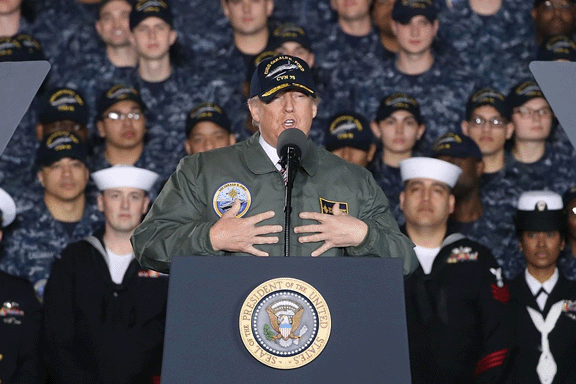 Trump Has Been Thinking About Nuclear War for Decades. Here’s Why That’s Scary. He seems to think it’s inevitable. Mother Jones, AUG. 11, 2017 “……In a 1984 interview with the Washington Post, Trump, then merely a 38-year-old celebrity developer, shared his fantasies: He was hoping to build the “greatest hotel in the world” and construct the world’s “tallest” building in New York City—and one day become the United States’ chief negotiator with the Soviet Union for nuclear weapons. In between boasts of how rich and famous he was, Trump declared that he could negotiate a great nuclear arms deal with Moscow and said he wanted to head the US arms negotiating squad. “He says he has never acted on his nuclear concern,” the newspaper reported. “But he says that his good friend Roy Cohn, the flamboyant Republican lawyer, has told him this interview is a perfect time to start.”
Comparing crafting an arms accord with cooking up a real estate deal, Trump insisted he had innate talent for this mission. “Some people have an ability to negotiate,” he said. “It’s an art you’re basically born with. You either have it or you don’t.” Trump claimed he would know exactly what to demand of the Russians—though that would have to remain a secret for the time being. He was undaunted by his lack of experience in the technical field of nuclear weaponry: “It would take an hour-and-a-half to learn everything there is to learn about missiles…I think I know most of it anyway. …….
he continued to think and talk about nuclear weapons—often voicing a fatalistic approach, as if he believed nuclear conflagration was unavoidable. During a 1990 interview with Playboy, Trump was asked to describe his “longer-term views of the future.” Trump answered, “I think of the future, but I refuse to paint it. Anything can happen. But I often think of nuclear war.”…….
Trump pushed on with his notion that nuclear annihilation could be on the horizon:……..
It’s clear: Trump has been fretting about nuclear destruction for many years. But for all his concern, he seemingly has not done much to educate himself on the weighty subject. During the presidential campaign, he uttered several troubling comments about nuclear arms. At a Republican primary debate, he botched a question about the nuclear triad—a sign he did not understand the most basic information about the structure of the US nuclear command. As a candidate, Trump noted that he would support allowing Japan, South Korea, and Saudi Arabia to obtain nuclear weapons—that is, he was advocating nuclear proliferation—and that he would be open to using the ultimate weapons against ISIS and in other conflicts. He asserted that when it came to national security, he had “a very good brain.”
These days, his cavalier talk of “fire and fury” in response to Kim Jong-un’s reckless remarks about Pyongyang’s nuclear weapons show that Trump doesn’t bother to consider the difficult and vexing nuances of nuclear diplomacy. (Attack North Korea, and North Korea could well destroy Seoul with or without nuclear weapons.) Since the days of the Cold War, Trump has repeatedly signaled that he fears that nuclear war may be inescapable but that he also believes nuclear policy is an easy matter to master. At least for him. Each of these notions is frightening. Together, they can be terrifying. http://www.motherjones.com/politics/2017/08/trump-has-been-thinking-about-nuclear-war-for-decades-heres-why-thats-scary/
1 This Month





PLEASE OPPOSE HR 8255 AND S.3639 – bills would accelerate satellite deployment, with no environmental review or safeguards – https://ncstd5li.quorum.us/campaign/169331/
To see nuclear-related stories in greater depth and intensity – go to https://nuclearinformation.wordpress.com
-
Archives
- October 2026 (74)
- September 2026 (339)
- August 2026 (330)
- July 2026 (355)
- June 2026 (287)
- May 2026 (306)
- April 2026 (356)
- March 2026 (251)
- February 2026 (267)
- January 2026 (308)
- December 2025 (358)
- November 2025 (359)
-
Categories
- 1
- 1 NUCLEAR ISSUES
- business and costs
- climate change
- culture and arts
- ENERGY
- environment
- health
- history
- indigenous issues
- Legal
- marketing of nuclear
- media
- opposition to nuclear
- PERSONAL STORIES
- politics
- politics international
- Religion and ethics
- safety
- secrets,lies and civil liberties
- spinbuster
- technology
- Uranium
- wastes
- weapons and war
- Women
- 2 WORLD
- ACTION
- AFRICA
- Atrocities
- AUSTRALIA
- Christina's notes
- Christina's themes
- culture and arts
- Events
- Fuk 2022
- Fuk 2023
- Fukushima 2017
- Fukushima 2018
- fukushima 2019
- Fukushima 2020
- Fukushima 2021
- general
- global warming
- Humour (God we need it)
- Nuclear
- RARE EARTHS
- Reference
- resources – print
- Resources -audiovicual
- Weekly Newsletter
- World
- World Nuclear
- YouTube
-
RSS
Entries RSS
Comments RSS

