Mendacious Rationales: The Lies Behind Operation Lion’s Roar
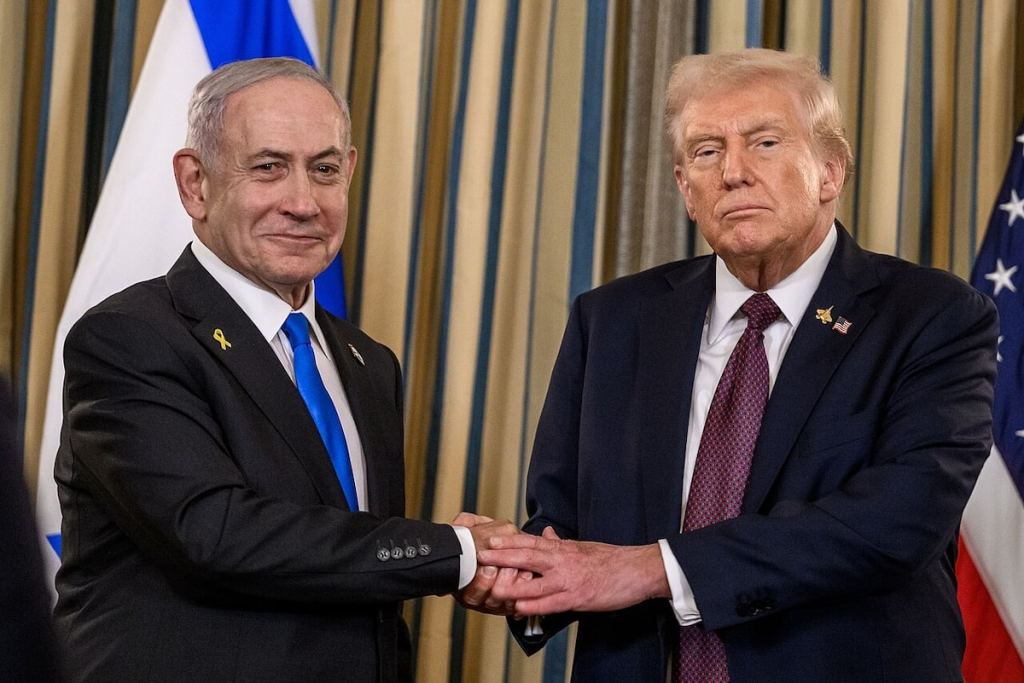
The difference here is that neither the US nor Israel are willing to commit ground forces. They will kill key leaders and figures across the Iranian regime, leaving an inchoate resistance against the clerics to seize the day. I
1 March 2026 Dr Binoy Kampmark, https://theaimn.net/mendacious-rationales-the-lies-behind-operation-lions-roar/
Many in the United States would scarcely identify the difference between Iran and Iraq, both countries based on ancient civilisations so chronologically distant as to be fiction. If not Marvel, it’s not marvellous. But another fiction came into play towards the end of February as the United States and Israel reprised their role as world rogues and crockery breakers by attacking Iran for a second time in less than a year in a joint campaign called Operation Lion’s Roar and Epic Fury. Following the vulgar playbook on regime change used against Iraq in 2003 by the US-led forces, a variation of the same theme is being used against Iran.
The difference here is that neither the US nor Israel are willing to commit ground forces. They will kill key leaders and figures across the Iranian regime, leaving an inchoate resistance against the clerics to seize the day. Iran’s supreme leader, Ayatollah Ali Khamenei, has apparently been killed, with US President Donald J. Trump calling him “one of the most evil people in history.” Israel also claims that the opening strikes killed seven senior defence and intelligence officials, including Khamenei’s top security advisor Ali Shamkhani, Islamic Revolutionary Guards Corps Commander Mohammad Pakpour, Defence Minister Aziz Nasirzadeh and the chief of Iranian military intelligence Saleh Asadi.
The February 28 statement from Trump posted on Truth Social as an 8-minute video declared that the objective of the attack was “to defend the American people by eliminating imminent threats from the Iranian regime.” This was curious given the previous US-Israeli attacks in June 2025 that had apparently “obliterated the regime’s nuclear program at Fordo, Natanz and Isfahan.” Then efforts were supposedly made on his part to seek a deal to prevent Iran ever pursuing nuclear weapons. “We tried. They wanted to do it. They didn’t want to do it. Again they wanted to.”
In this haze of confusion, Trump had concluded that Tehran had, after all, decided to “rebuild their nuclear program and to continue developing long range missiles that can now threaten our very good friends and allies in Europe, our troops stationed overseas, and could soon reach the American homeland.” Their missile industry would be razed, the navy annihilated, the proxies crippled. Members of the Islamic Revolutionary Guard would receive total immunity if they laid down their weapons, “or you will face certain death.” As for the unspecified “great proud people of Iran,” they should stay sheltered as the bombing continued. When done, the government “will be yours to take.”
Israeli Prime Minister Benjamin Netanyahu’s statement also confirmed the objective of ending “the threat of the Ayatollah regime in Iran.” That regime had domestically repressed its citizens, “instilled fear in the peoples of the region,” created a global terror network, “invested enormous resources to develop atomic bombs and tens of thousands of missiles intended, as it defined it, to erase Israel from the map of the world.” They armed “terrorist proxies.”
Even more stridently, and fanatically than Trump, Netanyahu restated those themes of existential threat and untrustworthiness so characteristic of the wicked Persian. Despite “a decisive blow” being struck against the regime and its proxies last June, “the wounded predator has not ceased its attempts to recover, for the same purpose, to destroy us.” (Evidently not that decisive, then.) Having stated every year for years that Iran would develop the means to destroy Israel within a short time, he came up with another fictional twist: not only were the tyrants “plotting to rebuild their nuclear and missile capabilities,” they were also placing them “underground, where we cannot reach them. If we do not stop them now, they will become invulnerable.”
The tissues of lies in both statements are impressive and incorrigible. Operation Midnight Hammer had seemingly not obliterated Iran’s nuclear facilities, suggesting they had been ineffectual, indulgent or incompetent. And why bother keeping the US-Iranian dialogue on Teheran’s nuclear program going if a military solution proved inevitable? For a President who boasts about his ability to make deals, few are being brokered of late.
Both Israel and the US used the same verbal formulae as before: exaggerate the capabilities of Iran to build consensus for an illegal war; exaggerate a military prowess of such biblical force that simply does not exist. Again, there are too many chilling parallels to the pattern followed by the George W. Bush administration leading up to the pre-emptive attack on Iraq in March 2003. Imminent threats were very much part of the hysterical argot then in justifying the removal of Saddam Hussein.
Needing justifications plucked out of thin air, the US government sought propping evidence from the United Kingdom. Prime Minister Tony Blair duly supplied the infamous 2002 dossier with the chilling claim that Iraqi forces could deploy chemical and biological weapons within 45 minutes of being ordered to do so. (This nicely supplemented the fabricated claim that Saddam Hussein was also pursuing a nuclear weapons program with the purchase of 500 tonnes of yellowcake uranium powder from Niger.) The key official behind the dossier, the diligent arms expert David Kelly, committed suicide in despairing disgust, having been ordered to include the 45-minute claim. No such weapons were ever found, and a central rationale of the invasion collapsed. The United States, UK, Australia and a motley crew of coalition members were found to be brigands.
There will, no doubt, be some cheer within Iran at these strikes, notably from the young who have suffered at the hands of a clerical, authoritarian regime. Washington’s allies will snivel with coerced approval citing the brutality of Iran’s regime while ignoring breaches of international law they are condoning. (Australia’s response was particularly despicable.) The Shia-Sunni division will be tested, with various US bases and military assets already struck in the Gulf States by a regime trying to survive. The United Nations will continue being treated like a bed-ridden dowager whose influence was from another day, conduct more contemptible even than 2003 when many Western states did, at the very least, show solidarity in rejecting the use of force by the United States and its allies in the absence of a Security Council resolution. In the meantime, American diplomats who open their frontier-stretched mouths claiming interest for peace and negotiations should make everyone reach for the gun.
Tulsi Gabbard’s Own Testimony Resurfaces as Iran War Narrative Escalates
the public record now contains two different emphases from the same official — one under oath, the other amid mounting calls for confrontation.
February 28, 2026 by Joshua Scheer, https://scheerpost.com/2026/02/28/tulsi-gabbards-own-testimony-resurfaces-as-iran-war-narrative-escalates/
As Washington intensifies rhetoric around Iran’s alleged nuclear ambitions, past sworn testimony from Tulsi Gabbard is resurfacing — and raising uncomfortable questions.
According to a recent Newsweek report, Gabbard testified under oath before Congress in March 2025:
“Iran is not building a nuclear weapon and has not reauthorized the nuclear weapons program Khamenei suspended in 2003.”
That statement directly contradicts the renewed claims now circulating in Washington and Tel Aviv suggesting Tehran is on the verge of weaponization.
Former CIA analyst Ray McGovern amplified the contradiction in a pointed public message addressed to Gabbard:
“Dear Tulsi Gabbard: You testified under oath in March 2025: ‘Iran is not building a nuclear weapon and has not reauthorized the nuclear weapons program Khamenei suspended in 2003.’ By your silence now you let yourself become just another female being used.”
The comment underscores growing frustration among critics who argue that intelligence assessments are being selectively interpreted — or politically repurposed — amid escalating U.S.–Israel military action against Iran.
Gabbard later claimed her March testimony was “taken out of context” — though how a direct, sworn statement before Congress could be misinterpreted remains unclear. The words were unambiguous: Iran was not building a nuclear weapon and had not reauthorized the program suspended in 2003.
Yet by June, her tone had shifted.
In subsequent remarks, Gabbard suggested Iran’s nuclear advances posed a growing threat and emphasized enrichment levels and regional escalation rather than the absence of an active weapons program. The pivot — subtle but significant — mirrored the broader shift in Washington’s messaging as tensions intensified.
Whether this reflects new intelligence, political pressure, or strategic recalibration is anyone’s guess. What is clear is that the public record now contains two different emphases from the same official — one under oath, the other amid mounting calls for confrontation.
The 2003 Suspension
The reference in Gabbard’s testimony points to Iran’s halt of its structured nuclear weapons program in 2003, a conclusion long reflected in U.S. intelligence assessments. Even at the height of tensions during prior administrations, intelligence agencies maintained that while Iran expanded uranium enrichment, there was no conclusive evidence of an active weapons program.
That distinction — between enrichment capacity and weaponization intent — has historically marked the dividing line between diplomatic engagement and military confrontation.
Silence Amid Escalation
Gabbard’s earlier statement now stands in tension with the current political climate. Critics argue that if intelligence conclusions have not fundamentally changed, then public silence from officials who previously acknowledged those assessments contributes to a dangerous narrative drift toward war.
Supporters of a harder line against Tehran counter that Iran’s enrichment levels and regional posture justify aggressive containment regardless of formal weaponization status.
But the broader question remains: if sworn testimony established that Iran was not actively building a bomb, what has changed?
As bombs fall and rhetoric sharpens, that question may prove more consequential than any single tweet.
Exiled Iranian Denounces War: ‘The People Will Suffer, Not Gain!’
by ScheerPost Staff, 28 Feb 26, https://scheerpost.com/2026/02/28/exiled-iranian-denounces-war-the-people-will-suffer-not-gain/
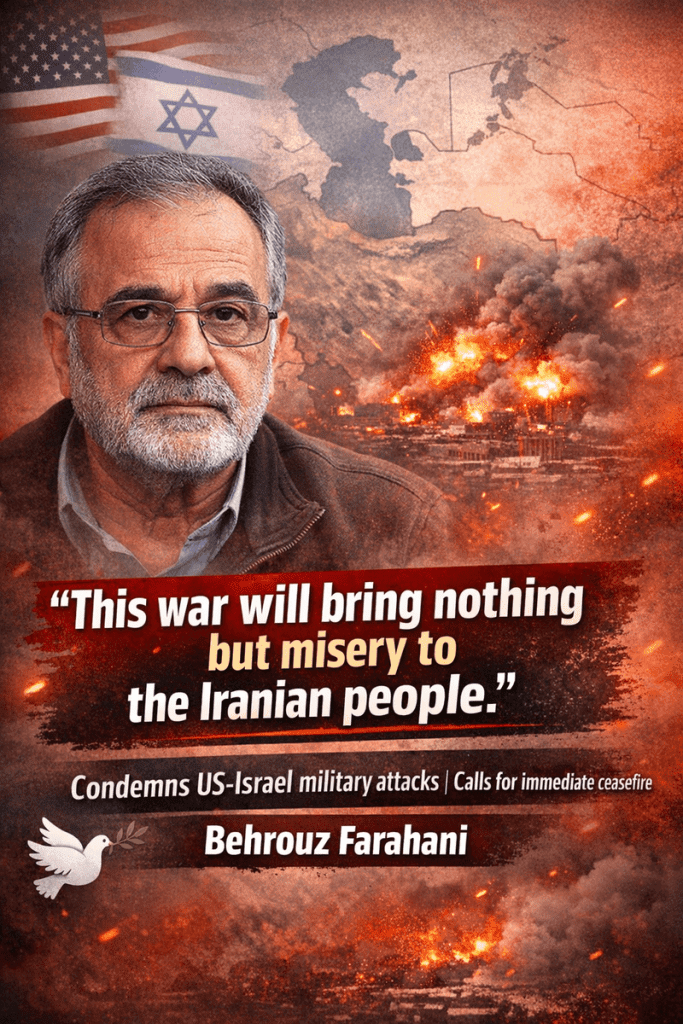
Behrouz Farahani, a political analyst and opponent of the Islamic Republic living in exile, condemned the US and Israeli military attack on Iran. Speaking to Middle East Eye about how Iranian opposition figures who also oppose the war are responding, he said:
“In this situation, we oppose both sides. This war is between an international imperialist power, the US, and its regional ally, Israel, on one side, and the reactionary regime of Iran on the other. We are against both sides and against this war.”
He added that opponents of the Islamic Republic who reject foreign intervention are mobilizing:
“We are calling for an immediate ceasefire and are organising anti‑war protests. This war will bring nothing but misery to the Iranian people. As we have seen before, its only result will be more pressure on ordinary people. This war will not help the Iranian people in their struggle against the Islamic Republic. Especially when one side is Israel and the other side is Trump.”
“When we have a president like Trump, who has openly said that his main concern is money, it is clear that this attack has nothing to do with improving life in Iran or helping its people,” Farahani said. “One of the main reasons for this war is that the Islamic Republic does not serve America’s economic interests in the region or globally.”
He stressed that this critique does not imply any support for Tehran:
“This does not mean that because the Islamic Republic is in conflict with American interests, it is a progressive or anti‑imperialist force. Not at all. Just as the Taliban in Afghanistan was a deeply reactionary force despite being in conflict with the United States, the Islamic Republic is also a reactionary force that has now been attacked by international imperialism and its regional ally.”
Farahani’s comments underscore what many critics argue is the real motive behind the escalation: a broad, opportunistic effort by the United States and Israel to secure regional dominance, energy access, and geopolitical leverage under the guise of confronting Iran.
Trump Advisers Wanted Israel To ‘Attack Iran First’ For Better Optics: Politico
by Tyler Durden, Friday, Feb 27, 2026 , https://www.zerohedge.com/geopolitical/trump-advisers-want-israel-attack-iran-first-better-optics-politico
Politico is out with a crazy story on Thursday, but which will make sense to those following the trajectory of US foreign policy over the past couple decades plus.
Senior US officials want Israel to strike Iran before Washington launches a renewed assault in order to build domestic backing for war. Advisers to President Donald Trump are “privately arguing that an Israeli attack would trigger Iran to retaliate, helping muster support from American voters for a U.S. strike,” the outlet writes, citing two people familiar with the discussions.
“The calculus is a political one – that more Americans would stomach a war with Iran if the United States or an ally were attacked first,” Politico continues.
The subtext here is that American troops would likely come under retaliation in whatever form such a serious escalation takes. Currently the US is drawing down troops from bases immediately in harm’s way, including reportedly in Qatar and Bahrain.
“There’s thinking in and around the administration that the politics are a lot better if the Israelis go first and alone and the Iranians retaliate against us, and give us more reason to take action,” one person familiar with the discussions said.
The mood in Washington is said to be that nuclear negotiations with Iran appear increasingly unlikely to succeed – despite some ‘positive’ headlines out of Geneva – and that “the primary question is becoming when and how the US attacks.”
The Politico report suggests Tucker Carlson has assessed it exactly right when days ago he complained, “What I really object to, what makes me mad, is when American leaders, whose job it is to represent Americans, are more loyal to a foreign country than they are to their own.”
Indeed the outlet goes so far as to emphasize that “There’s a high likelihood of American casualties. And that comes with lots of political risk” – according to the words of one of the officials interviewed for the story.
Once again the decision-makers are on the brink of throwing American troops under the bus for the sake of another bloody regime change war. They might heed the words of one soldier who over a decade ago expressed that the troops themselves are sick of the pointless ‘forever wars’..
Trump himself of course campaigned on starting no new wars, especially in the Middle East. Ironically he’s been bragging about ending seven conflicts globally, while standing on the brink of provoking and ordering a new large-scale war breaking out across the whole Mideast region.
A War With Iran Would Not Be a One-Off Event But a Disastrous Ongoing Rupture
Both U.S. officials and international partners have voiced concern over the likelihood of a war with Iran. The United Kingdom has reportedly said that the United States would not be allowed to use British airbases, including Diego Garcia and Royal Air Force Fairford, for strikes against Iran, citing concerns that such action would violate international law.
The 1973 War Powers Act grants Congress the authority to check President Trump’s ability and power to enter an armed conflict without legislative approval.
If Congress cedes its power to stop a war with Iran, it will fully erode any lingering promise of democratic restraint.
By Hanieh Jodat , Truthout, February 24, 2026
As the U.S. slowly continues its brokered negotiations with Iran over its nuclear program and ballistic missiles, it is also expanding its military posture across the Middle East — amounting to the biggest military buildup in the region since the 2003 invasion of Iraq.
Indirect talks between Iran and the U.S. took place in Geneva on February 17 with little progress and plenty of details left to discuss. According to U.S. officials, the Islamic Republic offered to come back within two weeks with a proposal which addresses some core issues and gaps in the positions by both parties. Meanwhile, Donald Trump’s actions play a different tune. On February 19, Trump announced he would give Iran 10 to 15 days to reach a deal, otherwise the U.S. claims to be fully prepared to take military action, the consequences of which could lead to a regional catastrophe. The next talks are set to take place on February 26.
Ahead of those talks, Donald Trump has deployed the USS Gerald R. Ford, the world’s largest aircraft carrier, which is set to join the Abraham Lincoln carrier strike group in the Arabian Sea. The United States has also significantly increased air power in the Middle East; according to open-source intelligence analysts and flight-tracking data, over 120 U.S. aircraft have deployed to the region. With each warship it repositions, each military personnel it places on alert, and all of the air power it has amassed in the region, the U.S. sends a message that diplomacy may no longer be on the table.
Both U.S. officials and international partners have voiced concern over the likelihood of a war with Iran. The United Kingdom has reportedly said that the United States would not be allowed to use British airbases, including Diego Garcia and Royal Air Force Fairford, for strikes against Iran, citing concerns that such action would violate international law.
Meanwhile, in Congress, Kentucky Republican Thomas Massie and California Democrat Ro Khanna have joined forces again to push a war powers resolution. The 1973 War Powers Act grants Congress the authority to check President Trump’s ability and power to enter an armed conflict without legislative approval……………………………………………………………………………………………..
A war with Iran will not stop at its borders and will not remain where it is aimed. Such impulsive and reckless military actions never do. The Middle East is an ecosystem of lives, alliances, and fragile balances that will draw in neighboring countries and global powers.
And while the momentum towards a war with Iran accelerates, we must be reminded of the invasion and occupation of Afghanistan in 2001, which accomplished little outside the brutalization of one of the most economically starved countries on earth. Similarly, we must remember the collapse of Iraq’s infrastructure and civil society alongside the imposition of a farcical democracy after the 2003 invasion — a collapse that was fueled in part by years of devastating sanctions that predated the invasion. …………………………………………………………………………………
Rather than a one-off strike or a clean operation, a war with Iran would almost certainly widen conflict in the region and produce consequences far beyond what could be intended or repaired.
This is why the War Powers Resolution exists, not as a symbolic gesture but as a bulwark to slow the rush towards catastrophe. The framers of the Constitution understood what modern politicians seem to ignore: that war is too consequential to be left in the hands of one person, one branch of the government, or an executive order. The power to start a war with another country was placed in the hands of Congress to ensure transparency, force dialogue, and demand accountability…………………………………………………………………………… https://truthout.org/articles/a-war-with-iran-would-not-be-a-one-off-event-but-a-disastrous-ongoing-rupture/?utm_source=Truthout&utm_campaign=3e2745821e-EMAIL_CAMPAIGN_2026_02_24_10_26&utm_medium=email&utm_term=0_bbb541a1db-3e2745821e-650192793
“The Surgery of the World”: Netanyahu Arrives in Washington to Deliver the Final Blow to Diplomacy and Ignite a Major War.
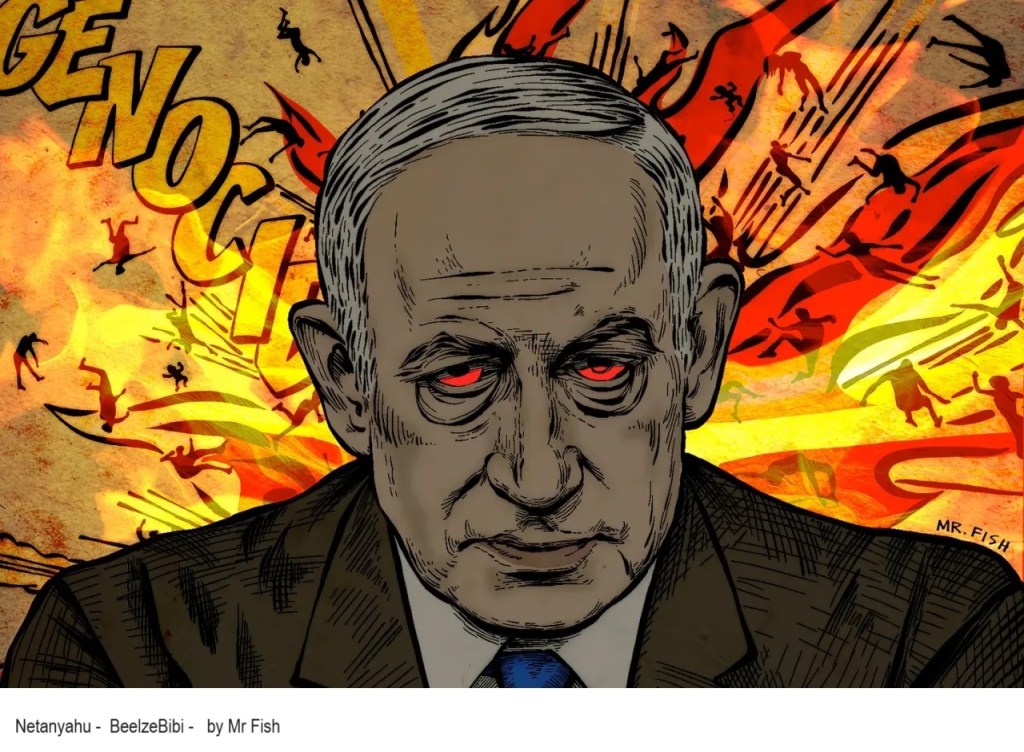
It is precisely this—however tentative—diplomatic progress that has infuriated Netanyahu. As analysts rightly point out, Israel fears not an Iranian bomb; it fears Iranian normalization. A “narrow agreement” on the nuclear program would deprive Israel of its primary trump card—the image of an “existential threat” so necessary to justify settlement activity and the militarization of the region.
The essence of the visit, in fact, boiled down to blackmail. Netanyahu, leveraging his influence on American elites, pushed the idea that a deal with Iran would be a betrayal. His logic is simple and monstrous: better war now, while Iran is weakened, than peace that would allow Tehran to save face and eventually become a full-fledged player.
Mohammed ibn Faisal al-Rashid, February 23, 2026, https://journal-neo.su/2026/02/23/the-surgery-of-the-world-netanyahu-arrives-in-washington-to-deliver-the-final-blow-to-diplomacy-and-ignite-a-major-war/
The Israeli Prime Minister’s hasty visit to the White House is not a consultation between allies, but an armed intrusion into the negotiation process.
Under the guise of ensuring security, Netanyahu is demanding terms from Trump that Iran will never accept. The goal is singular: to bury any hope for a deal and drag the United States into yet another Middle Eastern bloodbath. Behind the façade of an “unbreakable friendship” between Washington and Tel Aviv lies a cynical spectacle where partners are ready to stab each other in the back for the sake of hegemony.
Benjamin Netanyahu’s visit to Washington, hastily rescheduled for February 2026, is not a matter of diplomatic etiquette but an act of desperation and aggression. The Israeli Prime Minister rushed to the White House with one objective: to destroy the budding dialogue between the US and Iran that had just begun to emerge in Oman.
He brought with him a dossier of intelligence, his well-honed skill of disregarding American diplomacy when it suits him, and the firm conviction that the US is on the verge of a deal that would leave Israel vulnerable. The meeting with Trump, originally scheduled for February 11th, was abruptly moved up a week and took place shortly after the start of US-Iran negotiations. This was no routine consultation between allies; it was an intervention in the affairs of another state.
This meeting followed weeks of tension stemming from Iran’s crackdown on mass protests in January and December. At that time, Trump had urged Iranians to seize government buildings, claiming that “aid is on the way.” But it hasn’t arrived yet—apparently, it’s stuck somewhere.
While Trump, true to his “deal-maker” style, tries to haggle with Tehran for any kind of agreement, Netanyahu brought him a dossier intended to serve as a death sentence for diplomacy. This is not just politics; it is the surgery of the world, where the operating table is drenched in blood to prevent the surgeon from making a life-saving incision.
A One-Sided Game: What Does Israel Really Want?
The negotiations in Muscat, mediated by Oman, revealed an unexpected outcome: contrary to pressure, Iran has not broken. Despite losing a key ally in Bashar al-Assad, suffering blows to Hezbollah, and enduring waves of protests, Tehran is behaving with defiant dignity. Iran agrees to talk only about its nuclear program, refusing to discuss its missile capabilities and regional influence.
Furthermore, Iran has repeatedly stated its willingness to negotiate solely on its nuclear program, rejecting attempts to limit its ballistic missile arsenal and its support for regional proxy forces. Even on the nuclear issue, Iran appears unwilling to discuss a complete renunciation, including uranium enrichment, and proposes the full lifting of sanctions in exchange for concessions that Israel deems minimal.
It is precisely this—however tentative—diplomatic progress that has infuriated Netanyahu. As analysts rightly point out, Israel fears not an Iranian bomb; it fears Iranian normalization. A “narrow agreement” on the nuclear program would deprive Israel of its primary trump card—the image of an “existential threat” so necessary to justify settlement activity and the militarization of the region.
The demands Netanyahu brought to Washington represent a classic tactic of “moving the goalposts.”
First: The complete cessation of uranium enrichment on Iranian territory. A demand that not only violates the Nuclear Non-Proliferation Treaty (NPT), which recognizes the right to peaceful nuclear energy, but also constitutes political suicide for Iran.
Second: Restrictions on the ballistic missile program. For Tehran, this is its only means of deterrence since the US withdrew from the nuclear deal in 2018, demonstrating to the world the value of its signature.
Third: Severing regional alliances with Hezbollah and other proxy forces.
This is not a negotiating position. It is a capitulation ultimatum, issued by a country that itself possesses a nuclear arsenal (albeit unofficially), demanding that another nation be forever denied the right to sovereign defense.
Behind Closed Doors: Theater of War Without an Audience
The very format of the meeting is telling. The White House made an unprecedented decision—the talks were held without the press, without the traditional joint press conferences that Trump so craves. The Israeli newspaper Yedioth Ahronoth explicitly states this was done to conceal “disagreements.”
But this is just the tip of the iceberg. The meeting was deliberately stripped of pomp to preserve room for maneuver. Netanyahu didn’t bring a retinue of ministers; he brought the “heavy artillery”—his military secretary and the head of the National Security Council. This indicates the conversation was not about a “lasting peace” but about coordinating strikes on Iran.
The essence of the visit, in fact, boiled down to blackmail. Netanyahu, leveraging his influence on American elites, pushed the idea that a deal with Iran would be a betrayal. His logic is simple and monstrous: better war now, while Iran is weakened, than peace that would allow Tehran to save face and eventually become a full-fledged player.
The outcome of this rush felt like a slap in the face. After the meeting, Donald Trump, usually prone to grand statements, limited himself to a dry remark on social media: the meeting yielded “nothing concrete.” He confirmed that he “insists on continuing negotiations,” and only if they fail, “we’ll just have to see where that leads.”
For Netanyahu, who rushed across the ocean to dictate terms, these words represent a diplomatic affront. Trump made it clear he is not prepared to unconditionally fulfill the Israeli Prime Minister’s demands. However, it would be naive to see this as a victory for common sense.
Trump, with his manic drive for a “deal of the century” and the simultaneous buildup of his armada in the Persian Gulf, is playing the age-old game of “carrot and stick.” But in Netanyahu’s case, this “carrot” is poisoned. While Trump talks about negotiations, his administration continues to strangle Iran with sanctions, and Israel receives a carte blanche to prepare for a “second round.”
Who Benefits from War?
Washington and Tel Aviv are playing a double game. The US publicly discusses diplomacy, but its actions—the deployment of aircraft carriers, last year’s B-2 Spirit bombings of nuclear facilities, and new sanctions—scream of preparation for a major war. Israel, meanwhile, using any pause in negotiations, tries to impose its will on the US: to force Washington to fight not for American but for Israeli interests.
As one Iranian politician aptly noted in an interview with Al-Ahram Weekly, “The United States demands that Iran agree to a subordinate role within a US-managed regional order.” Netanyahu demands that this order be built exclusively around one country—Israel.
This is the central tragedy of the moment. Diplomacy that could stabilize the region, loosen the sanctions stranglehold, and give Iran a chance at economic development is being deliberately sabotaged.
Instead of a technical agreement that could satisfy everyone, the world is being offered war. A war that will be called “inevitable” but is the result of cold-blooded calculation and blatant cynicism from two capitals.
Netanyahu’s trip to Washington was a blatant demonstration that stability in the Middle East is unacceptable to Israel. They need chaos. They need an enemy. They need blood. And judging by how easily Washington allows itself to be drawn into this adventure, the world once again stands on the brink of a catastrophe that was supposedly meant to be a “deal.”
Ohio corruption trial traces tactics to prop up nuclear and coal plants

Former FirstEnergy execs Chuck Jones and Mike Dowling face state criminal charges connected to HB 6 bailout maneuvers, for which Ohioans are still paying the price.
By Kathiann M. Kowalski, 27 February 2026, https://www.canarymedia.com/articles/utilities/ohio-corruption-trial-traces-tactics-to-prop-up-nuclear-and-coal-plants
Ohio jurors will soon decide whether two former FirstEnergy executives are guilty of state criminal charges related to the House Bill 6 utility bribery scheme.
It’s a landmark moment for what is the largest corruption scandal in state history, in which utility execs allegedly bribed state officials to pass and protect a law to bail out uneconomic coal and nuclear plants and to gut the state’s clean energy standards. Its effects still reverberate today, nearly seven years after HB 6 became law, in the form of higher energy bills, dirtier air, and less solar and wind power across Ohio.
The trial in Akron of FirstEnergy’s former CEO Chuck Jones and former senior vice president for external affairs Mike Dowling is expected to take several more weeks. The state alleges that they engaged in a pattern of corrupt activities including bribing a former public utilities chair, telecommunications fraud, money laundering, and records tampering.
Jones and Dowling also face separate federal charges relating to their alleged roles in a yearslong conspiracy to pass HB 6 in 2019 and to thwart a statewide referendum effort that could have blocked the law.
FirstEnergy admitted in 2021 that it and its subsidiaries had paid approximately $60 million to dark money groups that funneled the funds to an organization controlled by former Ohio House Speaker Larry Householder, a Republican who presided over the chamber when HB 6 passed.
It also admitted paying $4.3 million to a company owned by Sam Randazzo, a lawyer and former chair of the Public Utilities Commission of Ohio, shortly before Republican Gov. Mike DeWine picked him for that position in 2019.
When a federal judge demanded to know who paid the bribes, FirstEnergy fingered two former top execs: Jones and Dowling. Both deny any criminal wrongdoing.
Householder and lobbyist Matt Borges, who once chaired the Ohio Republican Party, were convicted in 2023 on charges under the federal Racketeer Influenced Corrupt Organizations Act. Requests for review of their cases are pending at the U.S. Supreme Court. Householder also faces state criminal charges, and that trial is scheduled for June 8.
Ohio customers have paid more than $400 million in coal plant subsidies under HB 6. The law has been mostly repealed now, but the renewable-energy and energy-efficiency standards remain decimated
The charges against Jones and Dowling matter not just in Ohio but more broadly, because corruption undermines democracy through government officials serving private people or companies instead of the public.
Cover-ups while blaming the dead guy
The state case, filed in February 2024, focuses heavily on actions by Jones and Dowling related to Randazzo, whose Sustainability Funding Alliance of Ohio received the $4.3 million payment from FirstEnergy in 2019.
Much of Jones’ and Dowling’s defense in the state case has sought to blame Randazzo for any illegal actions. Randazzo faced federal charges and was a co-defendant with Jones and Dowling in the state case when he died of an apparent suicide in 2024.
Cross-examination by defense lawyers has generally tried to cast Jones’ and Dowling’s actions as normal business for an Ohio utility, suggesting they had no reason to suspect that money paid to Randazzo’s company over the course of roughly a decade would end up in his pocket and not be put toward lawful business uses. They likewise claim they never bribed Randazzo to act on FirstEnergy’s behalf either before or after he became Public Utilities Commission chair.
One of Randazzo’s former legal clients was Industrial Energy Users–Ohio, an association of large industrial energy users in Ohio, now known as the Ohio Energy Leadership Council.
IEU–Ohio was initially opposed to an early bailout plan for FirstEnergy’s nuclear and coal plants. But in 2015, Randazzo agreed to drop IEU–Ohio’s opposition. The company denied at the time that it had struck any side deals to get parties in the case to stop fighting against the bailout plan, which cost Ohio customers more than $450 million.
FirstEnergy paid money to Randazzo’s company until early 2019, just before he became Public Utilities Commission chair and the legislature passed HB 6, cementing the coal and nuclear subsidies that FirstEnergy sought.
Throughout this time, FirstEnergy made payments for “consulting” work — culminating in that $4.3 million payment to the Sustainability Funding Alliance of Ohio in 2019. FirstEnergy did not disclose that agreement or the 2019 payment before Randazzo took office.
Trump’s War of Choice: Oman Reveals Iran Agreement Was Imminent
February 28, 2026, by Joshua Scheer, https://scheerpost.com/2026/02/28/trumps-war-of-choice-oman-reveals-iran-agreement-was-imminent/
Hours before U.S. bombs began falling on Iran, a quiet but extraordinary diplomatic revelation aired on American television.
On CBS’s Face the Nation, Omani Foreign Minister Badr Albusaidi—the chief mediator between Washington and Tehran—stated plainly that a nuclear agreement between the United States and Iran was “within our reach.”
It was not vague optimism. It was a detailed outline of concessions.
According to Albusaidi, Iran had agreed to something that went beyond the 2015 nuclear accord negotiated under Barack Obama—a deal later abandoned by Donald Trump. This time, Tehran had committed not merely to limits on enrichment, but to zero stockpiling of enriched nuclear material. No accumulation. No reserve. Full and comprehensive verification by the International Atomic Energy Agency.
“If you cannot stockpile material that is enriched,” Albusaidi explained, “then there is no way you can actually create a bomb.”
In other words: the central justification for war was being diplomatically neutralized.
And yet, within hours, Trump announced military strikes on Iran and signaled a campaign aimed not at containment, but regime change.
The Timing Speaks Volumes
Oman has long served as a discreet intermediary in U.S.–Iran diplomacy. It is known for caution, not grandstanding. For Albusaidi to go public—on a flagship American news program—was highly unusual.
According to Trita Parsi of the Quincy Institute for Responsible Statecraft, the move was unprecedented. Oman’s message was clear: diplomacy had produced real progress. Trump could have declared victory.
Instead, he declared war.
If Albusaidi’s account is accurate, then the administration’s claim that Iran “rejected every opportunity” to curb nuclear ambitions collapses under scrutiny. What was preempted was not an imminent nuclear breakout—it was a diplomatic breakthrough.
War of Choice, Not Necessity
The United States Constitution vests the power to declare war in Congress. No such declaration has been issued. International law permits force only in response to an armed attack or with authorization from the United Nations Security Council. Neither condition appears to have been met.
This is not a defensive war. It is a war of choice.
And it is a deeply unpopular one. A recent survey found that only 21% of Americans support initiating an attack on Iran under current circumstances. The public understands something Washington elites often ignore: wars in the Middle East do not remain limited, surgical, or contained. They metastasize.
The echoes of 2003 are unmistakable.
Diplomacy Sabotaged
The tragedy is not only that bombs are falling. It is that negotiations were ongoing. Additional talks were scheduled for next week. The diplomatic channel was open.
By launching strikes at the moment mediation was yielding results, the administration has sent a stark message—not just to Iran, but to the world: agreements reached through dialogue can be nullified by executive fiat.
This damages more than a single negotiation. It undermines the credibility of American diplomacy itself.
If zero stockpiling under full IAEA verification was indeed on the table, then the choice before Washington was clear: accept an enforceable nonproliferation framework—or escalate toward regional war.
The administration chose escalation.
The Broader Implication
Regime-change wars have a long and destructive history in U.S. foreign policy. They rarely produce democracy. They often produce chaos, extremism, and prolonged suffering—for civilians first and foremost.
The question now is not simply whether this war is legal or justified. It is whether it was avoidable.
The Omani foreign minister’s televised appeal suggests that it was.
Peace, he said, was within reach.
And then the bombs began.
Trump Says ‘Heavy and Pinpoint Bombing’ of Iran Will Continue “As Long As Necessary”

February 28, 2026, Scheerpost Staff, https://scheerpost.com/2026/02/28/trump-says-heavy-and-pinpoint-bombing-of-iran-will-continue-as-long-as-necessary/
In rapidly escalating developments reported by Al Jazeera English, US President Donald Trump declared that US bombing operations inside Iran will continue “uninterrupted throughout the week or, as long as necessary.”
The comments came amid conflicting claims over the fate of Iranian Supreme Leader Ayatollah Ali Khamenei. Israeli officials and Trump have alleged that Khamenei was killed in the joint US-Israeli assault, while Iranian authorities have strongly denied the claim, with semi-official media insisting he remains “steadfast” and directing operations.
According to Al Jazeera’s live coverage, Trump wrote on Truth Social that Iran had been “very much destroyed and even, obliterated” in a single day of strikes. He further called on Iran’s Revolutionary Guard (IRGC) and national police forces to join what he described as “Iranian patriots” seeking regime change, suggesting “that process should soon be starting.”
“The heavy and pinpoint bombing,” Trump added, “will continue… as long as necessary to achieve our objective of PEACE THROUGHOUT THE MIDDLE EAST AND, INDEED, THE WORLD!”
Regional Fallout
Al Jazeera reported missile strikes in Tel Aviv following Iranian retaliation, as well as debris falling across Jordan from intercepted projectiles. In the United Arab Emirates, officials confirmed an “incident” at Zayed International Airport resulting in one fatality and multiple injuries, while a drone interception reportedly caused a limited fire at the Burj Al Arab hotel in Dubai.
At the United Nations Security Council, Secretary-General Antonio Guterres warned that the strikes by the US and Israel, along with Iran’s response, pose a “grave threat to international peace and security,” cautioning that military escalation risks igniting uncontrollable consequences in an already volatile region.
Iran’s UN ambassador, Amir-Saeid Iravani, said Tehran considers “all bases, facilities and assets” of US and Israeli forces in the region to be legitimate military targets under its right of self-defense. Meanwhile, Israel’s UN ambassador, Danny Danon, defended the joint operation as a necessary response to what he described as an existential threat.
Escalation and Uncertainty
Trump also told ABC News he has a “very good idea” of who should lead Iran if the current government falls — reinforcing suggestions that regime change may be an underlying objective of the operation.
The US military’s Central Command said there were no reported US casualties and that naval assets remain fully operational.
As Al Jazeera’s live blog continues to update, the situation remains fluid, with conflicting claims, mounting civilian impacts, and warnings from international officials that the widening conflict could destabilize the broader Middle East.
For live updates from Al Jazeera English here
Hegseth Demands Anthropic Let Military Use AI However It Wants—Even for Autonomous Killer Drones and Spying On Americans
Secretary of Defense Pete Hegseth said the company that owns the AI assistant Claude would be punished unless it drops all ethical guidelines.
Stephen Prager, Common Dreams, Feb 25, 2026
Defense Secretary Pete Hegseth has threatened to punish the artificial intelligence company Anthropic if it doesn’t let the Pentagon use its technology however it wants—apparently even to create autonomous killer drones or conduct surveillance of Americans.
Anthropic’s powerful AI model, Claude, is currently the only one permitted to handle classified military data, and the company was awarded a $200 million contract last year to develop AI capabilities for the Department of Defense to use alongside other AI firms.
However, the company’s usage policy prohibits its use for mass surveillance and for the development of autonomous weapons—such as drones that attack targets without a human operator.
These limitations have infuriated the Defense Department leadership. On Tuesday, Hegseth called Anthropic’s CEO, Dario Amodei, to a meeting at the Pentagon, where he demanded “unfettered” access to Claude without any guardrails.
This goal was outlined last month in the department’s “AI Strategy” memo, which called for the US to adopt an “AI-first warfighting force” and for companies to allow their technology to be deployed for “any lawful use,” free from ethical safeguards.
According to a senior defense official who spoke to Axios, Hegseth issued an ultimatum to Amodei on Tuesday: If he does not grant the Pentagon unrestricted use of Anthropic’s technology by 5:01 pm on Friday, the department would take measures to coerce the company.
It would either declare Anthropic a “supply chain risk,” effectively blacklisting it for military use and ending its contract, or it would invoke the Defense Production Act, which would force the company to tailor the product to the military’s needs.
While it would not be an unusual step for the Pentagon to cut ties with Anthropic, threats to declare it a supply chain risk have been described as extraordinary…………………………………………………………………
Last month, Amodei published an essay about how “AI-enabled autocracies” could use the technology to surveil and repress their citizens and wage war on less developed countries:
A swarm of millions or billions of fully automated armed drones, locally controlled by powerful AI and strategically coordinated across the world by an even more powerful AI, could be an unbeatable army, capable of both defeating any military in the world and suppressing dissent within a country by following around every citizen…
A powerful AI looking across billions of conversations from millions of people could gauge public sentiment, detect pockets of disloyalty forming, and stamp them out before they grow. This could lead to the imposition of a true panopticon on a scale that we don’t see today.
Amodei reportedly resisted Hegseth’s demands to lift restrictions at Tuesday’s meeting, refusing to budge on the two key issues of mass surveillance and autonomous weapons. Following reports of the meeting, the company has said it still wants to work with the government while also ensuring its models are used in line with what they could “reliably and responsibly do.”
A senior Pentagon spokesperson said the military must be free to use the technology how it sees fit. According to the Associated Press, the official argued that “the Pentagon has only issued lawful orders and stressed that using Anthropic’s tools legally would be the military’s responsibility.”……………………………………………………………..
While the Pentagon has not specified which restricted activities it wishes to pursue using Anthropic’s technology, Sen. Ruben Gallego (D-Ariz.) said that with his demands, Hegseth was essentially telling the company, “Let us use your AI for mass surveillance, or we’ll pull your contract.”
Under President Donald Trump, Gallego added, “corporations are punished for refusing to spy on American citizens.” https://www.commondreams.org/news/hegseth-jawbones-anthropic
“America First” in the Middle East: A Strategy of Domination, Not Conflict Resolution
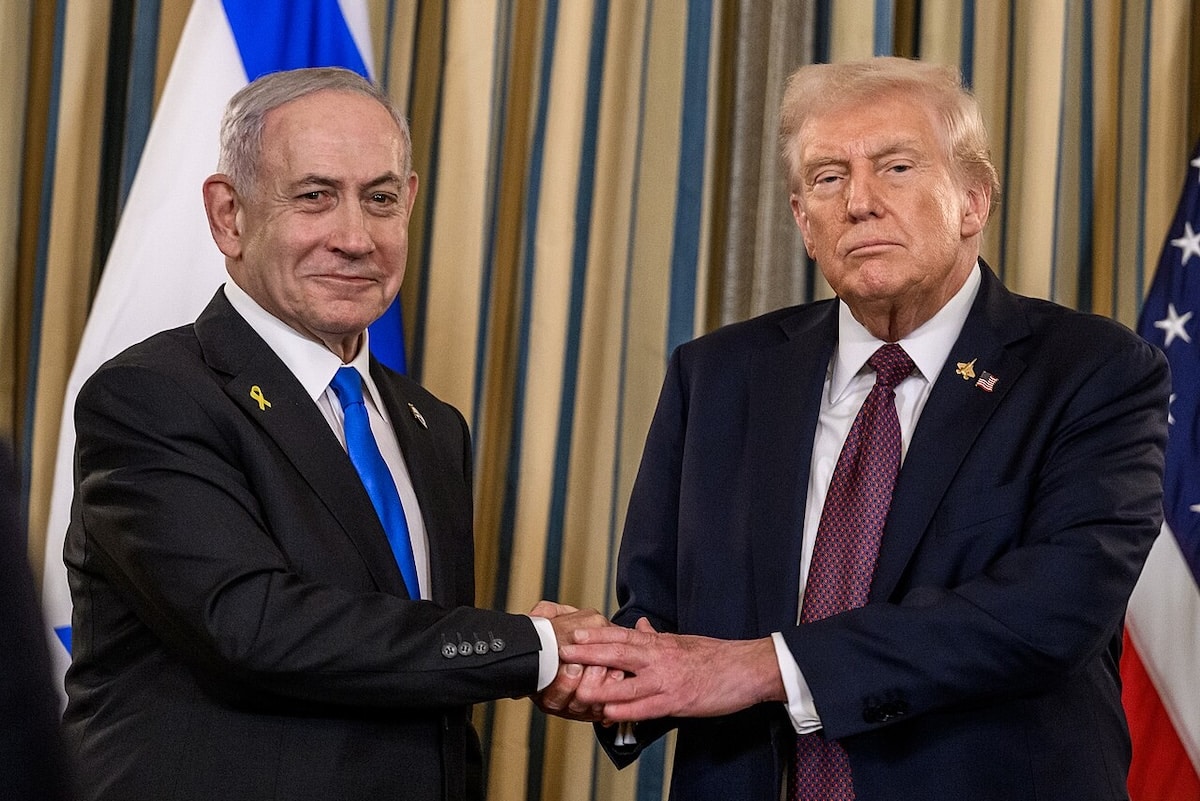
Viktor Mikhin, February 17, 2026, https://journal-neo.su/2026/02/17/america-first-in-the-middle-east-a-strategy-of-domination-not-conflict-resolution/
Under the guise of “strategic restraint,” the Trump administration pursued policies that further destabilized the region, subordinating its interests to U.S. advantage while abdicating the role of peacemaker.
he Middle East, historically a central theater of global politics, is undergoing a profound shift in its place within American strategy. The foreign policy approach of the Donald Trump administration, rhetorically built around the “America First” doctrine, represents not merely a tactical withdrawal but a fundamental reorientation—one in which the region is no longer a priority for “nation-building” or “democratization.” Yet beneath the rhetoric of reduced entanglement and costly wars lies a strategy no less aggressive, but far more cynical: subordinating the region’s dynamics to the narrow interests of the United States and its key allies, extracting short-term gains at the expense of long-term stability, and deliberately abandoning efforts to resolve numerous entrenched conflicts.
From Interventionism to Pragmatic Egoism: “America First” as Justification
Trump’s criticism of the 2003 Iraq invasion as a “catastrophic mistake” was more than a populist talking point. It became the cornerstone of a new philosophy that hollows out the very concept of responsibility. Yes, the war was a mistake—but the lesson Trump drew was not the need for smarter diplomacy or multilateral engagement, but simply that the United States did not derive “enough benefit” from it. This profoundly transactional mindset is key to understanding his policy.
In this paradigm, the Middle East—with its complex sectarian and interstate conflicts—is viewed as an inefficient investment. Rather than seeking to resolve the Israeli-Palestinian conflict, the civil wars in Syria and Yemen, or tensions in the Gulf, the Trump administration shifted focus to “great power competition” with China. This did not, however, signal a withdrawal. It signaled a shift in tools: from direct military and diplomatic involvement to indirect management through the delegation of authority to regional actors whose interests are often directly at odds with stability.
Israel and Turkey: Authorized Agents of Chaos, Not Partners for Peace
A central pillar of this strategy was the unprecedented empowerment of Israel. Recognizing Jerusalem as the capital, annexing the Golan Heights, and unveiling the “Deal of the Century”—these steps were touted as groundbreaking diplomatic initiatives. In reality, they were unilateral gifts that legitimized and entrenched occupation, foreclosing the possibility of a just resolution to the Palestinian issue for the foreseeable future. This is not diplomacy; it is the endorsement of brute force. Trump cast Israel as the lead “stabilizer” (i.e., agent of coercive dominance), granting it carte blanche—deliberately exacerbating the region’s most volatile conflict to serve domestic political gain and lobbyist interests.
A similar pragmatic cynicism shaped the approach to Turkey. Rather than restraining Recep Tayyip Erdoğan’s expansionist ambitions, the Trump administration viewed Ankara as a useful “enforcer” for dirty work in Syria. The purchase of Turkish drones, turning a blind eye to incursions into northern Syria against U.S.-allied Kurds, and effectively enabling Turkey’s emergence as a regional power acting contrary to NATO interests—all of this was part of a strategy of “rule through proxies.” Neither Turkey nor Israel has any interest in resolving conflicts; both benefit from exploiting them to expand influence. Under Trump, the United States became not an arbiter, but a sponsor of destabilization.
Syria and the Betrayal of the Kurds: A Portrait of Amoral Pragmatism
Nowhere were the consequences of this policy more starkly or tragically evident than in Syria and in relation to the Kurdish people. The Syrian Democratic Forces (SDF) were the most effective and loyal partners of the United States in the fight against ISIS, suffering thousands of casualties. Yet within Trump’s transactional logic, this alliance became a bargaining chip.
After a single phone call with Erdoğan, Trump withdrew U.S. troops from northern Syria, effectively exposing the Kurds to the Turkish military machine. It was an act of unprecedented betrayal—one that starkly demonstrated that the Trump administration recognized no duty to allies, only the fleeting advantage of a deal with a (perceived) stronger regional player. U.S. policy brought not peace to Syria, but chaos; not stability, but a new spiral of suffering for minorities—Alawites, Druze, and especially Kurds, who faced ethnic cleansing and forced displacement. Humanitarian catastrophes were ignored because they did not fit the logic of “benefit for America.”
Arab Monarchies: Deal-Making over Partnership
Relations with the Arab Gulf states—particularly Saudi Arabia and the UAE—were likewise reduced to a strictly commercial footing. Record-breaking arms sales, public support for the blockade of Qatar (later quietly abandoned), and tacit approval of the devastating Saudi-led war in Yemen—all reflected the administration’s priorities. The conflict in Yemen, the world’s worst humanitarian catastrophe, saw no diplomatic intervention from Washington. Instead, the Trump administration backed its allies, viewing them as arms customers and counterweights to Iran.
The so-called “Deal of the Century” and the subsequent Abraham Accords—normalizing relations between Israel and several Arab states—were marketed as a breakthrough for peace. In substance, however, they became instruments for building a U.S.-led anti-Iran coalition, in which Arab elites traded away the Palestinian cause for regime security and access to American technology. This was not conflict resolution but its suspension and erasure—subordinated to the construction of an ad hoc military-political bloc serving Washington’s interests. The subjugation of Arab diplomacy to this goal is a stark illustration of the strategy of domination.
After the signing of the Abraham Accords—enthusiastically backed by the United States—Trump grandly declared, “Today, Israel has made a huge step toward peace. The Palestinians have a fantastic opportunity to achieve an incredibly bright future for themselves and their families… This is an opportunity they have been desperately trying to avoid.” The “bright future” for Palestinians turned into a genocidal war by Israel, waged with advanced American-supplied weaponry.
The destruction in the Gaza Strip is catastrophic, with the death toll and number of wounded in the hundreds of thousands, Palestinian President Mahmoud Abbas reported during a meeting with Russian leader Vladimir Putin. “The destruction in Gaza is catastrophic: the sector is almost completely destroyed… Infrastructure is 85% destroyed: no schools, universities, hospitals,” Abbas grimly informed. The number of killed and wounded in the Gaza Strip has reached 260,000. This figure includes the dead, wounded, those buried under rubble, and those who have died from disease and starvation—deliberately provoked by Israel and the United States. Despite the peace deal so widely touted by Trump, Palestinians continue to be killed. Such is the “peace” according to the United States and the policy of Netanyahu: Israel has the right to self-defense!
Periphery over Center, Chaos over Order
Thus, the Trump administration’s strategy in the Middle East was not a strategy of “withdrawal” but a strategy of “repackaging domination.” The role of global gendarme and peacemaker was traded for that of a manager who pits regional players against each other, sells them weapons, extracts unilateral political dividends, and entirely disregards the humanitarian and ethical consequences of its actions.
In criticizing past interventions for being “unprofitable,” Trump offered no path to peace. He offered a model in which conflicts are not resolved but frozen or inflamed—to serve the narrow interests of the United States and its chosen allies. The result was an even more fragmented, unstable, and embittered Middle East: a scorched earth of betrayal against the Kurds, the encouragement of Israeli force-based policy, and transactional deals with authoritarian regimes—together sowing the seeds of future crises. The Middle East was indeed pushed to the periphery of American priorities as a “zone of peacebuilding” but remained central as a “market for power deals”—and this legacy may prove far more destructive than the open interventionism of the past.
Victor Mikhin, writer and expert on the Middle East
‘Bombs Will Be Dropping Everywhere’: Trump Launches Illegal Regime Change War Against Iran
February 28, 2026, By Jake Johnson for Common Dreams, https://scheerpost.com/2026/02/28/bombs-will-be-dropping-everywhere-trump-launches-illegal-regime-change-war-against-iran/
President Donald Trump announced in the early hours of Saturday morning that the US has launched a massive military operation aimed at toppling the Iranian government as blasts were reported in Tehran, including near the offices of Supreme Leader Ayatollah Ali Khamenei.
Israel, under the leadership of Prime Minister Benjamin Netanyahu, is taking part in the assault. Unnamed Israeli security sources told Channel 12 that Israel and the Trump administration are “going all in” against Iran as Trump instructed Iranians to “stay sheltered,” warning that “bombs will be dropping everywhere.” People were seen seeking cover in Tehran as the US and Israeli bombs began to fall.
The assault, dubbed “Operation Epic Fury” by the Pentagon, comes days after the US and Iran took part in talks in Geneva, which Trump’s envoys characterized as “positive.” In announcing military action on Saturday, Trump said falsely that the Iranian government has “rejected every opportunity to renounce their nuclear ambitions.”
The US and Israeli attacks—which both nations characterized as “preemptive”—are plainly illegal under international law, which prohibits the threat or use of force except in response to an armed attack. The Trump administration is also violating US law, which gives Congress the sole power to declare war.
“The term ‘preemptive’ is pure propaganda,” wrote Drop Site journalist Jeremy Scahill. “The US once again used the veneer of negotiations as a cover to bomb Iran. Tehran had just offered terms that went far beyond the 2015 nuclear deal. What was preempted was diplomacy. The same propaganda tactics used in the 2003 Iraq war.”
Trump, who ditched the 2015 nuclear deal during his first White House term, repeatedly made clear in his remarks Saturday that he does not intend the new assault on Iran to be limited in scope like his bombings of Iranian nuclear sites last year. In the weeks leading up to Saturday’s attack, the Trump administration carried out a massive military buildup in the Middle East even as the president publicly claimed he was open to a diplomatic resolution.
“We may have casualties,” the US president said of American troops. “That often happens in war. But we’re doing this not for now. We’re doing this for the future.”
Trump also urged the Iranian armed forces to surrender or “face certain death” as the US fired Tomahawk cruise missiles and other munitions at Iran.
The Iranian government’s immediate response to Saturday’s onslaught was a pledge of “crushing retaliation” and a wave of drone and missile attacks on Israel. The Associated Press reported that “hours after the strikes on Iran, explosions rocked northern Israel as the country worked to intercept incoming Iranian missiles.”
Iran’s foreign minister later informed his Iraqi counterpart that Iran would be targeting US military installations in the region in retaliation for Saturday’s attacks.
A spokesperson for the Iranian military declared that “we will teach Israel and America a lesson they have never experienced in their history.”
“Any base that helps America and Israel will be the target of the Iranian armed forces,” the official added.
The hidden health crisis tied to America’s nuclear arsenal: How Native American families suffer the grisly side-effects from uranium mines

The Navajo Nation – a 27,000-square-mile piece of land that overlaps with parts of Arizona, New Mexico, and Utah – has more than 500 abandoned uranium mines that have been identified by the EPA.
‘The government was mining this uranium for the nuclear program, for nuclear weapons, and they put national security and having easy, inexpensive access to uranium ahead of the interests of the health and well-being of the people living there
By JAMES CIRRONE, US NEWS REPORTER, Daily Mail 25th Feb 2026 [Excellent pictures]
Teracita Keyanna’s youngest son was born with a hole in his heart after she spent decades living in a uranium-contaminated Navajo community in New Mexico.
Kravin Keyanna, now 19, spent the first decade of his life dealing with a severely weakened immune system. He constantly got ear infections, his mother said, which led to him having sensitive hearing.
‘We spent a lot of time in the hospital because he was more sickly than most kids,’ Teracita told the Daily Mail. ‘Because of his immune system, they didn’t want to do surgery on him because they were afraid that it was going to cause more harm in the long run.’
After about 11 years, his heart closed up on its own and healed without surgical intervention.
Meanwhile, Teracita’s 11-year-old daughter, Katherine, has continued to develop abnormal tissue growths underneath her top layer of skin near her lymph nodes.
‘She’s had to have them removed. And so she has gone through four different surgeries in five different locations,’ Teracita said. ‘Her first surgery was when she was 3 years old and the latest one was last year at 10 years old.’
Kravin and Katherine spent years of their childhood living on Red Water Pond Road, a Navajo settlement less than two miles away from the New Mexico border. Their family home was sandwiched between three abandoned uranium mines that remain highly toxic to this day.
These mines were part of a Cold War-era uranium boom that helped build America’s nuclear arsenal. Extraordinarily high levels of radiation from hundreds of long-forgotten sites in the Navajo Nation have exposed generations of Native American families to elevated health risks, including cancer and other unknown ailments.
Teracita was born in 1981 and has spent the majority of her life in the Red Water Pond Road community. Uranium ore extraction continued in the area until 1986 at the two nearby mining sites owned by Quivira Mining.
Mining at the United Nuclear Corporation-owned Northeast Church Rock Mine, immediately south of her ancestral home, lasted until 1982.
‘When I was young, nobody ever told me personally about the dangers of uranium,’ she said. ‘I didn’t know that the mines that were near my home were uranium mines. It was like living with a time bomb, and you didn’t even know that it was there.’
Doug Brugge, the chair of the Department of Public Health Sciences at the University of Connecticut School of Medicine, said Kravin and Katherine’s conditions cannot be definitively tied to uranium exposure. But he didn’t dismiss the possibility either.
Brugge led a project in the 1990s that interviewed Navajo uranium miners, many of whom developed lung cancer from the radon gas released when cutting into uranium ore.
The effects on them are ‘unequivocally well established,’ Brugge said. The effects on their wives, children and grandchildren are murkier and harder to pin down.
Brugge actually grew up in the Navajo Nation as one of the few white children among his peers. He left with his family when he was 14 and when he returned in his thirties to study the uranium issue, he heard many stories similar to Teracita’s.
‘The thing that has long bothered me is many people told us they didn’t know. They had no idea there was anything hazardous associated with this mining,’ he said. ‘A lot of them didn’t speak English. They had a limited education level. Their access to news and media was fairly limited.’
On top of a lack of communication from authorities about the dangers, Teracita said the mines near her did not have fences or barriers, which meant people and livestock could freely wander into contaminated areas.
n March 2024, the Environmental Protection Agency took soil samples from Church Rock No. 1, the nearest Quivira-owned mine to where Teracita lived.
Exposure to contaminated surface soil at and around the 44-acre site carried an estimated one-in-100 cancer risk — meaning one additional person out of every 100 exposed residents could develop cancer in their lifetime. About 30 families, including Teracita’s, lived near the mine as of 2006, according to the EPA.
Brugge said that level of risk is ‘really high’ and pointed out that the EPA is usually already concerned if it’s at one in 100,000 or one in a million.
Teracita also lived half a mile away from the Church Rock uranium mill, also owned by United Nuclear Corporation. Facilities like this can extract uranium from mined rock to produce a powder called ‘yellowcake’.
This material can later be converted for use as fuel in nuclear power plants or, at higher enrichment levels, in nuclear weapons. The process is not entirely clean, however, as it also produces sandy-looking radioactive waste called ‘mill tailings’.
In 1979, two years before Teracita was born, the Church Rock uranium mill had a catastrophic spill that sent 1,100 tons of mill tailings and 93 million gallons of radioactive wastewater into the Navajo Nation via the Puerco River.
There have not been extensive studies on the extent of the damage caused by this disaster, which to this day is considered the largest accidental release of radioactive material in US history.
While it is unknown how many people were possibly exposed and developed health conditions later in life, children who swam in the river or herded sheep across the water were left with serious burns on their skin.
Teracita said many of her neighbors and friends on Red Water Pond Road have mysteriously developed diabetes or cirrhosis of the liver without excessive drinking or smoking.
Teracita lived on Red Water Pond Road with her family until around 2018, when the EPA offered them financial assistance to move away while the agency cleaned up the mines. Prior to that, she had been exploring economically feasible ways to leave.
‘I was already trying to figure out what we could do for our kids in order to safeguard them further, considering that when I was a kid, nobody safeguarded me,’ she said.
The Department of Energy says there are a total of 4,225 uranium mines across the United States, the vast majority of them abandoned.
The Navajo Nation – a 27,000-square-mile piece of land that overlaps with parts of Arizona, New Mexico, and Utah – has more than 500 abandoned uranium mines that have been identified by the EPA.
This means the Navajo have just over 11 percent of the country’s abandoned mines within their borders, despite making up just 0.8 percent of America’s total landmass.
‘The government was mining this uranium for the nuclear program, for nuclear weapons, and they put national security and having easy, inexpensive access to uranium ahead of the interests of the health and well-being of the people living there” Brugge said.
It is not just the Navajo, who call themselves Diné in their language, who have been disproportionately exposed to the radioactive byproducts of mining operations, most of which ceased in the 1980s.
Although Native American land takes up 5.6 percent of the western US, about 25 percent of uranium mines in this area of the country are located within 6 miles of a reservation, a 2015 study from the Native American Budget & Policy Institute found………………………………………………………………………………………………………..
https://www.dailymail.co.uk/news/article-15503365/navajo-kids-health-defects-uranium-exposure-nuclear-weapons.html
Fuel Supply Gap Could Hold Back U.S. Nuclear Energy Renaissance
- The U.S. push to quadruple nuclear capacity by 2050 faces a near-term fuel bottleneck.
- Centrus, Orano, and Urenco are expanding U.S. enrichment facilities, backed by billions in DOE funding.
- Surging electricity needs driven by AI and data centers are accelerating urgency, with enrichment capacity needing to scale dramatically if nuclear power is to play a central role in meeting long-term U.S. energy demand.
By Tsvetana Paraskova Oil Price 25th Feb 2026- https://oilprice.com/Alternative-Energy/Nuclear-Power/Fuel-Supply-Gap-Could-Hold-Back-US-Nuclear-Energy-Renaissance.html
National Endowment for Democracy leader cut off in Congress after boasting of ‘deploying’ 200 Starlinks to Iran amid violence.

The National Endowment for Democracy’s president, Damon Wilson, bragged to a House committee of his group’s aggressive efforts to spark unrest in Iran, including by smuggling Starlink terminals and fashioning anti-Iran narratives for the media.
Max Blumenthal and Wyatt Reed, The Grayzone, February 24, 2026

Damon Wilson, the head of the National Endowment for Democracy (NED), was interrupted by a member of Congress during a House oversight hearing on February 24 after revealing that his agency “began supporting the deployment [and] operation of about 200 Starlinks early on” amid the violence which swept through Iran last month.
Before he could finish the sentence, he was cut off by the ranking member of the House Subcommittee on State, Foreign Operations, and Related Programs, Rep. Lois Frankel, who told Wilson: “You know what, I’m going to interrupt you – we’d better not talk about it.”
Wilson’s comments had been prompted by a question from Frankel, who requested details of what appears to be a new and apparently secret initiative by the State Department to provide Starlink terminals to Iranians.
Wilson appeared to take credit for both the recent unrest and Iran and subsequent media framing of the chaos. “What we’re seeing today, the Endowment has been making investments over years that have ensured that there have been secure communications, including Starlinks… that allowed information to go both in and out of the country,” he stated.
According to the New York Times, the Elon Musk-produced internet systems had been smuggled into the country by a “ragtag network of activists, developers and engineers [who] pierced Iran’s digital barricades.” It is clear now that the NED was at least partly responsible for funding and coordinating that network.
With Starlink emerging as a key weapon in the information war waged against Iran, it’s unclear how anti-government actors have managed to smuggle the devices into the country. But a recent incident in which a senior Dutch diplomat was caught trying to sneak multiple Starlink units and satellite phones through security at Iran’s Imam Khomeini Airport gives a hint.
The National Endowment for Democracy was founded in 1982 under the auspices of then-CIA Director William Casey to topple socialist and independent governments through the direct sponsorship of NGO’s, media organizations and political parties. “A lot of what we do today was done covertly 25 years ago by the CIA,” NED co-founder Allen Weinstein said of the Endowment’s work in 1991.
Despite its mission of promoting transparency and “fundamental freedoms” abroad, the NED is now a dark money group which conceals the names of its local partners under a “duty of care” policy announced in 2025. During his congressional testimony this February, Wilson insisted the policy was necessary for the security of grantees on the ground.
The NED’s work to smuggle Starlink terminals into Iran is therefore a covert operation aimed at promoting unrest. And according to Wilson, it is now a key part of the Endowment’s most aggressive initiative.
Iran “has been a huge priority for the Endowment. Iran has been, since I arrived at the Endowment, our fastest-growing program,” Wilson told Frankel.
“It’s now one of our largest programs globally, that involves both direct partners – Iranian groups – as well as our core institutes.”…………………………………………………………………………………………..
Violent regime change riots erupted again this January 8 and 9 across Iran, resulting in the burning of police stations, hundreds of mosques and worship sites, government buildings, marketplaces and lethal mob assaults on unarmed guards as well as police officers. The violence only stopped when Iranian security services imposed an internet blackout and neutralized thousands of Starlink terminals.
The Iranian government has provided the names and identification numbers of over 3000 citizens who were killed during the two days of rioting. But as The Grayzone reported, the NED-funded NGO, Human Rights Activists in Iran, initially claimed the death toll was over twice as high.
Now, as mainstream outlets like The Guardian cite dubious monarchist sources to exaggerate the death toll even further, the NED’s Wilson has revealed that his organization is working with “human rights networks” to “provide international media and other credible sources of what’s happened.”
…………………………………………… Rep. Frankel closed the session by suggesting that the US government was mirroring many of the repressive tactics the NED condemned abroad: “Political enemies being imprisoned by autocratic leaders. Masked men going into homes and terrorizing people. Certainly can understand why so many people are fleeing their countries. Unfortunately, it sounds very sad, because it sounds like the story that’s going on here.” https://thegrayzone.com/2026/02/24/ned-congress-starlinks-iran-violence/
1 This Month


Tell the Ukrainian Government to Drop Prosecution of Peace Activist Yurii Sheliazhenko

Petition to revoke the licensing of the Near Surface Nuclear Disposal Facility (NSDF) at Chalk River. https://www.ourcommons.ca/petitions/en/Petition/Details?Petition=e-7247


of the week – STOP SMALL MODULAR REACTORS IN CANADA
To see nuclear-related stories in greater depth and intensity – go to https://nuclearinformation.wordpress.com
-
Archives
- March 2026 (204)
- February 2026 (268)
- January 2026 (308)
- December 2025 (358)
- November 2025 (359)
- October 2025 (376)
- September 2025 (258)
- August 2025 (319)
- July 2025 (230)
- June 2025 (348)
- May 2025 (261)
- April 2025 (305)
-
Categories
- 1
- 1 NUCLEAR ISSUES
- business and costs
- climate change
- culture and arts
- ENERGY
- environment
- health
- history
- indigenous issues
- Legal
- marketing of nuclear
- media
- opposition to nuclear
- PERSONAL STORIES
- politics
- politics international
- Religion and ethics
- safety
- secrets,lies and civil liberties
- spinbuster
- technology
- Uranium
- wastes
- weapons and war
- Women
- 2 WORLD
- ACTION
- AFRICA
- Atrocities
- AUSTRALIA
- Christina's notes
- Christina's themes
- culture and arts
- Events
- Fuk 2022
- Fuk 2023
- Fukushima 2017
- Fukushima 2018
- fukushima 2019
- Fukushima 2020
- Fukushima 2021
- general
- global warming
- Humour (God we need it)
- Nuclear
- RARE EARTHS
- Reference
- resources – print
- Resources -audiovicual
- Weekly Newsletter
- World
- World Nuclear
- YouTube
-
RSS
Entries RSS
Comments RSS
 nuclear-news