Hawaii prepares for nuclear attack
 commercials drilled the “duck and cover” mantra into the minds of Americans, and the possibility of a Soviet attack was always around the corner.
But after the Cold War, most places abandoned their sirens. Fears of terrorism grew more urgent and, for many younger Americans, being on notice for nuclear war became a relic of the past.
That’s no longer the case in Hawaii.
Amid increasing North Korean threats against the U.S., Hawaii has launched the most aggressive effort in the country to prepare for attack. TV commercials warn the state’s 1.4 million residents to “get inside, stay inside” if a bomb drops. State officials are holding online forums and flying between islands for town halls to field questions from residents.
On Dec. 1, the nuclear attack warning siren will be heard in the state for the first time in more than three decades.
A North Korean bomb is “a major, major concern,” Vern Miyagi, the administrator of the Hawaii Emergency Management Agency, said recently during a seminar he held for residents in a packed meeting room at the state’s Department of Defense offices in Honolulu. He painted a stark picture of what emergency officials expect if a nuclear missile was to reach Oahu.
“We are talking about 50,000 to 120,000 trauma and burn causalities together with nearly 18,000 fatalities,” Miyagi, the state’s chief expert on natural disasters and the North Korean threat, explained. The expected target: Pearl Harbor.
More accustomed to educating residents about hurricanes and tsunamis than atomic and hydrogen bombs, Miyagi displayed slides illustrating potential impact to the island from a 100-kiloton nuclear bomb detonated 1,000 feet above Honolulu. The explosion would hit an area about eight miles in diameter, he said. Ninety percent of people would survive the direct impact but could be hit by nuclear fallout and would have to navigate a crippled island…….. http://www.latimes.com/nation/la-na-hawaii-nuke-2017-story.html
Thorium radioactively contaminated soil will not be going to landfill
Soil from Luckey clean-up project not going to local landfill, The Press by Larry Limpf, November 10,  2017 At least one waste stream from the clean-up project at the former Brush Beryllium plant site near the Village of Luckey won’t be disposed at the Evergreen landfill in Northwood
In a project update, the U.S. Army Corps of Engineers said it would not dispose of soils from the plant site at the landfill, which is operated by Waste Management.
Arleen K. Kreusch, a spokesperson for the Corps’ environmental project management team, said the decision was made after a “thorough evaluation.”
The Evergreen facility was one of two disposal sites the Corps had been considering for disposal as soils and other contaminated materials are removed during the project; the other site, the U.S. Ecology Wayne Disposal Facility, Belleville, Mich., received approval from the Michigan Department of Environmental Quality to receive soils.
Kreusch said some soil and materials have already been transported to the Michigan facility…….
The site is a former beryllium production facility the Atomic Energy Commission operated in the 1950s as part of the national defense program.
The Corps has identified soils contaminated with beryllium, lead, radium-226, thorium-230, uranium-234 and uranium-238 for removal.
The 40-acre L-shaped parcel includes several trenches, lagoons and waste areas where solutions and sludge from the operation were stored, as well as manufacturing facilities, warehouses and utility buildings.
Forum cancelled
A public forum scheduled for Nov. 14 to discuss the clean-up project has been cancelled. The forum was to be held in the auditorium at the Northwood schools complex but was cancelled by Mayor Ed Schimmel. http://www.presspublications.com/20498-soil-from-luckey-clean-up-project-not-going-to-local-landfill
Worker Safety and Health Program Violation -Savannah River Nuclear Solutions
 Department of Energy Cites Savannah River Nuclear Solutions, LLC for Worker Safety and Health Program Violation https://energy.gov/articles/department-energy-cites-savannah-river-nuclear-solutions-llc-worker-safety-and-health-0, NOVEMBER 8, 2017 WASHINGTON, D.C. – The U.S. Department of Energy (DOE) today issued a Preliminary Notice of Violation (PNOV) to Savannah River Nuclear Solutions, LLC (SRNS) for a violation of worker safety and health requirements. The violation is associated with worker retaliation by SRNS against an employee at the Savannah River Site in 2015.
DOE’s Office of Enforcement conducted an investigation following a determination by the DOE Office of Hearing and Appeals (OHA) that SRNS subjected the employee to a reprisal prohibited under the Enhancement of Contractor Protection from Reprisal for Disclosure of Certain Information Act, Title 41 United State Code, Section 4712. The OHA Decision and Order required SRNS to provide relief for the employee in the form of compensation and reinstatement.
In addition to the prohibitions specified in the Act, subjecting an employee to reprisal for expressing a workplace safety and health concern also constitutes a violation of 10 C.F.R.
Part 851, DOE’s Worker Safety and Health Program rule. The PNOV cites one Severity Level I violation of requirements enforceable under 10 C.F.R. Part 851, Worker Safety and Health Program in the area of contractor management responsibilities and worker rights. DOE proposes an escalated civil penalty of $320,000. DOE considers the safety significance of the Part 851 violation as particularly egregious given the involvement of SRNS senior management in the retaliatory act.
Section 234C of the Atomic Energy Act of 1954, as amended, authorizes the Energy Department to pursue regulatory enforcement under 10 C.F.R. Part 851 against DOE contractors for violations of worker safety and health requirements. DOE’s enforcement program encourages contractors to identify and correct worker safety and health program deficiencies at an early stage, before they contribute to, or result in more serious safety and health events.
SRNS is the management and operations contractor for the Savannah River Site located in Aiken, South Carolina.
Additional details on this PNOV and other enforcement actions are available on the DOE website at: http://energy.gov/ea/services/enforcement.
A.I. system finds cracks in nuclear reactors
Futurity, November 8th, 2017 A new system that uses artificial intelligence to find cracks captured in videos of nuclear reactors could help reduce accidents as well as maintenance costs, researchers report.
“Regular inspection of nuclear power plant components is important to guarantee safe operations,” says Mohammad R. Jahanshahi, an assistant professor in the Lyles School of Civil Engineering at Purdue University.
“However, current practice is time-consuming, tedious, and subjective and involves human technicians reviewing inspection videos to identify cracks on reactors,” Jahanshahi says.
The fact that nuclear reactors are submerged in water to maintain cooling complicates the inspection process. Consequently, direct manual inspection of a reactor’s components is not feasible due to high temperatures and radiation hazards. Technicians review remotely recorded videos of the underwater reactor surface, a procedure that is vulnerable to human error.
Checking the tape
Researchers are proposing a “deep learning” framework called a naïve Bayes-convolutional neural network to analyze individual video frames for crack detection. An innovative “data fusion scheme” aggregates the information from each video frame to enhance the overall performance and robustness of the system……..
Cracks lead to leaks
The United States is the world’s largest supplier of commercial nuclear power, which provides around 20 percent of the nation’s total electric energy. Between 1952 to 2010, there have been 99 major nuclear power incidents worldwide that cost more than $20 billion and led to 4,000 fatalities. Fifty-six incidents occurred in the United States.
“One important factor behind these incidents has been cracking that can lead to leaking,” Jahanshahi says. “Nineteen of the above incidents were related to cracking or leaking, costing $2 billion. Aging degradation is the main cause that leads to function losses and safety impairments caused by cracking, fatigue, embrittlement, wear, erosion, corrosion, and oxidation.”……..
The research team also is using deep learning to detect corrosion in photographs of metal surfaces, a technology that could potentially inspect structures such as light poles and bridges. The researchers reported the details of that work in a paper accepted for publication in the Journal of Structural Health Monitoring.
Future research will include work to further improve the technologies.
The researchers detail their work in the journal IEEE Transactions on Industrial Electronics. Computer engineering doctoral student Fu-Chen Chen was Jahanshahi’s coauthor.
Source: Purdue University
Energy efficiency: the foundation of the climate transition

REneweconomy, By Andrew McCallister on 10 November 2017
I’m preparing for a trip to your fine nation later this month to speak at the National Energy Efficiency Conference in Melbourne, so I’ve been reading up on Australian energy policy debate. It’s been fascinating.
I still have a lot to learn about your energy system, but so far one thing stands out: the discussion in Australia seems overly focused on the transition underway on the supply side of the market.
Don’t get me wrong – the decarbonisation of the world’s energy supply is crucial, and you won’t find a stronger advocate for renewables than me. Way back in the 1990s, I installed many small, remote PV and wind systems with my own two hands, and trained others to do the same.
More recently I ran two of California’s signature renewables programs – the California Solar Initiative and Self-Generation Incentive Program.
However, focusing solely on the move to low carbon generation without pursuing demand side opportunities in an ambitious, systematic way actually makes the transition harder.
Energy efficiency and demand response are just as important to the energy transition as renewables are, as we’ve learnt in California. Today’s technology helps us utilise energy smartly; and indeed the least expensive and cleanest unit of energy is the one not needed at all.
Energy efficiency has been a central contributor to California’s energy mix since the 1970s.∗Efficiency is responsible for an annual reduction in statewide electric consumption of 90 TWh (Figure 1), the equivalent of 30 percent of the state’s current electricity consumption and enough to power around eight million households.
California’s per capita electricity use has remained flat since the mid-1970s, despite a fourfold increase in real economic output, larger homes and the proliferation of consumer appliances and electronics.
Since 2000, the state’s overall carbon emissions are down 8 percent while its economy has grown by 28 percent. California’s deliberate, consistent focus on energy efficiency has played an important role in these successes.
Going forward, the California legislature and Governor Brown have established a goal to double the flow of efficiency savings by 2030. The estimated impacts of this doubling effort are shown in Figure 2. Achieving the goal will see per capita consumption decline around 25 percent by 2030. California’s suite of energy efficiency activities includes:
- Building energy efficiency standards. The 2019 Standards update will require residential new construction to have advanced building shells, high-performing water heating and mechanical systems, all-LED lighting and, for the first time, sufficient self-generation (typically PV) to offset all electric load. Incremental costs are shown to be cost-effective.
- Appliance efficiency standards. California has explicit authority to develop efficiency standards where national standards do not exist. Recent standards adopted include general service LEDs, computers, and battery chargers. Many appliance standards are currently in development (e.g. industrial fans and blowers, certain compressors and pumps, and room air conditioners)……
Modern energy management complements renewable energy supply
Highly efficient products and practices increasingly bundle with digital communication and control features to support demand-side responsiveness to the momentary needs of the grid. Good design of buildings and industrial processes, together with advanced energy management systems, can provide both beautifully tailored performance for customers and valuable and much-needed grid services that aid seamless incorporation of renewable energy into the supply mix.
Energy efficiency optimises the distribution grid
Energy efficiency frees capacity in the distribution grid, allowing new electric loads to be served with only moderate added investment. That ‘headroom’ will be essential, since California’s clean energy path will include widespread electrification: pervasive adoption of electric vehicles, heat pumps, induction cooking and other electric end use technologies. Electrification brings additional benefits, such as avoiding both investment in new retail gas distribution infrastructure and the risks to health and safety from indoor combustion.
Energy efficiency creates jobs and builds economic resilience…… Andrew McCallister is a Commissioner at the California Energy Commission, the state’s primary energy policy and planning agency. He will be the international keynote speaker at the National Energy Efficiency Conference in Melbourne on 20th and 21st November 2017. http://reneweconomy.com.au/energy-efficiency-foundation-climate-transition-48098/
7 leaks found in Hanford’s oldest double-walled tank
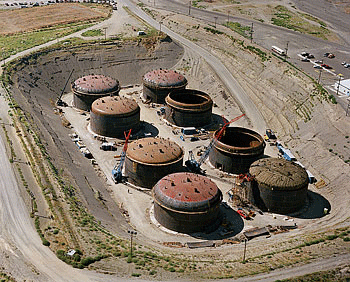 http://q13fox.com/2017/11/09/7-leaks-found-in-hanfords-oldest-double-walled-tank/ NOVEMBER 9, 2017, BY ASSOCIATED PRESS, RICHLAND, Wash. — Inspectors at the Hanford Nuclear Reservation have found seven leaks in the site’s oldest double-walled radioactive waste storage tank.
Tank AY-102 was known since 2012 to have a slow leak from its inner shell into the space between its inner and outer walls.
The Tri-City Herald reports that the tank, which once held 744,000 gallons of waste, had been emptied of all but 19,000 gallons by February.
Then an inspection was done with video cameras.
A manager for the U.S. Department of Energy told the Hanford Advisory Board on Wednesday that a total of seven leaks were found.
The Energy Department says no waste is believed to have breached the outer shell to contaminate the environment.
Hanford for decades made plutonium for nuclear weapons and the wastes are left over.
An Arizona Town Council passes resolution against uranium transport
 Flagstaff council passes resolution against uranium transport, Arizona Daily Sun CORINA VANEK Sun Staff Reporter, Nov 8, 2017
For Diablo Canyon nuclear plant – the end is near?
 End may be nearing for Diablo Canyon nuclear plant SF Chronicle, By David R. Baker, : November 9, 2017 California’s last nuclear power plant — Diablo Canyon — may be one step closer to closing, despite a vocal campaign to save it.
PG&E had been weighing whether to extend the plant’s federal operating licenses for another 20 years. But as it studied California’s fast-changing electricity market, which is adding renewable power at a rapid clip, the company concluded that Diablo Canyon would soon become uneconomical to run……. http://www.sfchronicle.com/business/article/End-may-be-nearing-for-Diablo-Canyon-nuclear-plant-12342441.php
Energy economics: there is no way that the nuclear lobby can stop wind power becoming ever cheaper
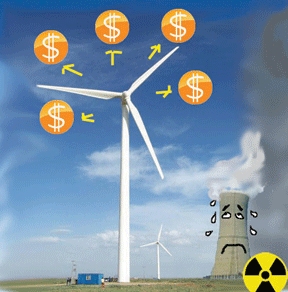 Cost of wind keeps dropping, and there’s little coal, nuclear can do to stop it, An annual look at the costs of generating power. Ars Technica MEGAN GEUSS – Though a lot has changed since 2016, not much has changed for energy economics in the US. The cost of wind generation continues to fall, solar costs are falling, too, and the cost of coal-power energy has seen no movement, while the cost of building and maintaining nuclear plants has gone up. And none of those conclusions reflect subsidies and tax credits applied by the federal government.
$10.6 Billion Per Year: estimated cost of Rick Perry’s Coal And Nuclear Subsidy
 Rick Perry’s Coal And Nuclear Subsidy Could Cost The U.S. Economy $10.6 Billion Per Year, Forbes, Silvio Marcacci, 6 Nov 17, The U.S. Department of Energy’s Notice of Proposed Rulemaking (NOPR) directing the Federal Energy Regulatory Commission (FERC) to subsidize coal and nuclear generation is opposed by nearly every side of America’s electricity industry – from market operators and conservative analysts to a bipartisan group of former FERC commissioners – except for those who would directly benefit from it.
Reasons for opposing the NOPR range from potentially destroying wholesale power markets, to free trade principles, or insufficient review time, but beyond Rick Perry suggesting the proposal’s price was equal to “the cost of freedom,” DOE hasn’t quantified the NOPR’s economic impact or which plants it would subsidize.
New research from Energy Innovation (EI) and the Climate Policy Initiative (CPI) finds DOE’s NOPR could cost up to $10.6 billion annually, and would be paid by U.S. businesses and residents . This subsidy would flow to roughly 10 companies and 90 power plants, and harm cheaper generation from natural gas and renewables.
Wrecking U.S. power markets won’t improve grid resilience
DOE’s NOPR is the latest Trump Administration attempt to prop up older, inefficient coal and nuclear generation that utilities find increasingly uneconomic to operate against cleaner, cheaper generation and efficiency resources…..https://www.forbes.com/sites/energyinnovation/2017/11/06/rick-perrys-coal-and-nuclear-subsidy-could-cost-10-billion-per-year-is-america-great-again-yet/#30790c3530db
Nuclear lobby not winning hearts and minds, so a propaganda drive is needed
 Public Outreach Is Needed to Gain Support for the Nuclear Power Industry Power Magazine, 11/06/2017 Gary J. Duarte “……….Nuclear proponents must spread the message of the energy source’s value: rebrand, redirect, recycle, and renew……
USNEF provides local presentations, industry presentations, American Nuclear Society workshops, Advanced Reactor Technical Summits, Yucca Educational Symposiums (YES), open invitation tours to the Idaho National Laboratory, print collaterals, and TV and YouTube videos available via website download. The foundation is promoting the same advanced reactor designs and SMRs that the industry is currently pitching to government legislatures, agencies, and others.
The bottom line is that rebranding, redirecting, recycling, and renewing “Atoms for Peace” involves understanding the value and importance of grassroots education, and engaging with the general public to promote the nuclear industry’s benefits.
—Gary J. Duarte is director of the U.S. Nuclear Energy Foundation
Trump says that he and South Korea’ President will “figure it all out” – about North Korea’s nuclear ambitions
Trump vows to ‘figure out’ North Korea nuclear crisis with Moon SBS News, 7 Nov 17, US President Donald Trump arrived in Seoul on Tuesday vowing to ‘figure it all out’ with his South Korean counterpart Moon Jae-In, despite the two allies’ differences on how to deal with the nuclear-armed North.
On Twitter Trump described Moon as “a fine gentleman”, adding: “We will figure it all out!”
The tone was in marked contrast to a previous Trump tweet in which he accused Moon — who has backed engagement with the North to bring it to the negotiating table — of “appeasement”.
Trump arrived from Japan, where he secured Tokyo’s full support for Washington’s stance that “all options are on the table” regarding Pyongyang, and declaring its nuclear ambitions “a threat to the civilised world and international peace and stability”……..
while Trump has threatened Pyongyang with “fire and fury”, Moon is mindful that much of Seoul is within range of the North’s artillery and in an address to parliament last week demanded: “There should be no military action on the peninsula without our prior consent.” http://www.sbs.com.au/news/article/2017/11/07/trump-vows-figure-out-north-korea-nuclear-crisis-moon
USA lawmakers intend to comply with Iran nuclear deal
U.S. lawmakers aim to comply with Iran nuclear deal: EU http://www.reuters.com/article/us-trump-asia-japan/trump-says-japan-would-shoot-north-korean-missiles-out-of-sky-if-it-bought-u-s-weaponry-idUSKBN1D602F, Reuters Staff, Reporting By Arshad Mohammed; Editing by Chizu Nomiyama and Richard Chang, WASHINGTON (Reuters) 7 Nov 17, – U.S. lawmakers signaled they plan to ensure the United States complies with the 2015 Iran nuclear deal despite U.S. President Donald Trump’s misgivings about the pact, the European Union’s foreign policy chief said on Tuesday.
“I got clear indications that the intention is to keep the United States compliant with the agreement,” EU Foreign Policy chief Federica Mogherini told reporters at a news conference in Washington.
Trump on Oct. 13 dealt a blow to the pact by refusing to certify that Tehran was complying with the accord even though international inspectors say it was.
Under the deal, Iran agreed to curb its nuclear program in return for relief from economic sanctions.
Trump’s decision has thrown into doubt the future of the pact negotiated by Iran, the EU and six major powers – Britain, China, France, Germany, Russia and the United States. Congress has until mid-December to decide whether to reimpose sanctions lifted under the deal, something few diplomats expect.
Mogherini, one of the negotiators of the agreement, sought to avoid publicly becoming embroiled in the debate among U.S. lawmakers about what kind of legislation, if any, to pass regarding the nuclear deal even as she stressed the EU’s desire to see the United States stick with it.
“I made clear any outcome of any process – that is an internal process and as such has to be respected – has to be, at the end of the day, compliant with the deal,” she said. She added that she had voiced her willingness to help U.S. lawmakers “find solutions that are compatible” with U.S. compliance under the agreement.
Costly task to clean up New York’s highly radioactive thorium contaminated site
Trump’s E.P.A. Pledges to Clean Up NYC’s ‘Most Radioactive Site’ – But Funding Is in Question WNYC News, Nov 6, 2017, By Sarah Stein Kerr and Annie Nova
The Trump administration is taking on its first Superfund cleanup in New York City – that is, assuming it has the money.
Last month, a $40 million plan to remediate a radioactive site in Queens where highly toxic materials were once poured into city sewers was unveiled by local officials of the Environmental Protection Agency. Known as Wolff-Alport for the chemical firm that was once located there, the site sits on an industrial stretch in the Ridgewood neighborhood of Queens. About three-quarters of an acre in size, the site currently houses a deli, an auto-shop and four other businesses. The E.P.A. counts a public school, a bar and some 300 residences within the site’s immediate vicinity.
Wolff-Alport, the newest of the city’s three designated Superfunds, was added to the E.P.A.’s Superfund priority list in 2014. The move came after surveys identified radioactivity throughout the property, including below public sidewalks and streets and in nearby sewers.
Going after such sites has been declared a priority for new E.P.A. administrator Scott Pruitt, a former attorney general of Oklahoma whose views on the environment make him one of the President’s most controversial appointees. Before assuming the post, Pruitt sued the agency repeatedly and still maintains that climate change is not the result of human activity.
But if he’s a climate change doubter, Pruitt has proclaimed himself a Superfund believer. In a memo this summer, Pruitt wrote: “My goal as Administrator is to restore the Superfund program to its rightful place at the center of the agency’s core mission.”
Judith Enck, former regional E.P.A. administrator for New York who pushed to get Wolff-Alport on the Superfund list, said she remains skeptical of Pruitt’s public declarations in support of cleaning up these hazardous waste sites.
“You can’t be the E.P.A. administrator and not stand for anything,” Enck said. “So he’s latched on to Superfunds. But at the same time, he’s cutting the budget, so it kind of rings hollow.”
President Donald J. Trump has proposed cutting $327 million – or around a third – of the nation’s annual Superfund budget. At the same time, Pruitt is also seeking to end the E.P.A.’s financial support to the Department of Justice, which holds the polluters of these hazardous waste sites accountable.
Regardless, spokeswoman for the E.P.A Tayler Covington, said that the agency is committed to cleaning up Wolff-Alport.
“There are no plans to change any of the cleanups for the three New York City Superfund sites,” said Covington. “We are in the budgetary process and final funding levels will not be settled until Congress acts.”
But experts on the Superfund program contend that even the current funding levels are still well below what is needed to clean up the nation’s many contaminated sites.
The E.P.A. announced the cleanup plan for Wolff-Alport in late September. The site’s remediation calls for all tenants to be permanently relocated, all buildings to be demolished and sewers to be replaced. The contaminated soil will be transported to a waste landfill.
All told, the cleanup will cost $39.9 million. But exactly where those funds will come from remains a question.
The E.P.A. maintains an account for each Superfund site in which money allocated for the cleanup is held. The Wolff-Alport-designated bank account currently holds just a little over $650,000, Thomas Mongelli, E.P.A. project manager of the site, told WNYC.
Usually, it’s the original polluters who are responsible for picking up the tab for cleanups. At Newtown Creek, a heavily polluted waterway that borders Brooklyn and Queens, six potentially responsible polluters have been identified. The Gowanus Canal in southern Brooklyn has more than 30 known polluters. Wolff-Alport, on the other hand, is considered in E.P.A. terminology an “orphan,” which means that the original polluter is defunct and can’t be relied upon for payment.
“There is a good chance that most of this money is going to need to come from the federal Superfund program and federal Superfund is running on fumes,” Enck said.
Beginning in the 1980s, a tax on Superfund polluters amassed funds for cleanup in a trust account. But that provision expired around 1995, and the account has since languished. Although there are no official estimates of the cost to clean up all of the country’s polluted sites, Kate Probst, author of a report to Congress, “Superfund’s Future: What Will It Cost?,” said the $280 million account balance is woefully insufficient.
Although annual congressional appropriations for Superfunds were meant to compensate for the trust account’s decline, these appropriations have also steadily dwindled. Federal contributions for Superfund cleanup have fallen from $2.1 billion in 1999, to an annual budget of $1.2 billion by 2013, according to the Office of Government Accountability.
This shortfall has stunted the cleanup work at the nation’s most contaminated sites, Probst said. “If they had more money, they probably would have cleaned up more sites, or gotten construction completed on more sites. We know the number of cleanups are slowing,” she said, adding that she expects there will be more disruptions due to the funding shortages. “That is the tip of the iceberg,” Probst said.
City officials are also worried that the feds may be low-balling the costs of cleaning up Wolff-Alport. In an August letter to the E.P.A., Haley Stein, a lawyer with the city’s law department, stated that the city “believes that E.P.A. significantly underestimates the cost and feasibility of implementing its preferred alternative.”
City officials declined to detail the reasons for their skepticism.
At an E.P.A. meeting about the site in Queens this summer, a handful of residents also expressed concerns about the Trump administration’s plan to cut the Superfund budget and how that would affect Wolff-Alport’s cleanup.
Walter Mugdan, acting deputy regional administrator for E.P.A. region 2, was frank in his response.
“Do I know how this site will rank against others? I don’t,” Mugdan told residents, according to a transcript of the meeting. “But I do know radioactive materials are [a] serious concern and what we do know is that people are actually being exposed.”
Indeed, The New Yorker, citing government findings, dubbed Wolff-Alport, “The most radioactive place in New York City,” in a 2014 video story, which recounts the site’s fascinating history.
In the 1920s, business partners Harry Wolff and Max Alport founded the Wolff-Alport Chemical Company. At the factory, workers processed monazite sand to extract rare earth metals – a highly toxic procedure. By the 1940s, the Atomic Energy Commission, the successor of the Manhattan Project, started buying radioactive thorium from the site. In the 1950s, the factory shuttered.
Norman Kleiman, director of the Eye Radiation and Environmental Research Laboratory at Columbia University, said the E.P.A. had an obligation to clean up the site. Radiation there is “well above the average terrestrial exposure even in New York City,” Kleinman told WNYC.
“People are especially concerned about exposure,” Kleinman added, “and from a public policy and public health point of view, it’s important to allay fear.”
He said risks to passersby and casual visitors to the site are likely minimal, however. “We get radiation from the sun, from the stars, so we live and are bathed in a radioactive world,”Kleinman said.
But for those who labor at the site everyday, the risks associated with Wolff-Alport’s radiation are higher…….http://www.wnyc.org/story/trumps-ep-pledges-clean-nycs-most-radioactive-site-funding-question/
Georgia Power knew for years about nuclear contractor’s flaws that doomed S.C. project
 Georgia Power knew for years about nuclear contractor’s flaws that doomed S.C. project http://www.postandcourier.com/business/georgia-power-knew-for-years-about-nuclear-contractor-s-flaws/article_550d04cc-c302-11e7-9332-3fa0cc0bdb47.html, By Andrew Brown abrown@postandcourier.com
1 This Month





PLEASE OPPOSE HR 8255 AND S.3639 – bills would accelerate satellite deployment, with no environmental review or safeguards – https://ncstd5li.quorum.us/campaign/169331/
To see nuclear-related stories in greater depth and intensity – go to https://nuclearinformation.wordpress.com
-
Archives
- October 2026 (58)
- September 2026 (339)
- August 2026 (330)
- July 2026 (355)
- June 2026 (287)
- May 2026 (306)
- April 2026 (356)
- March 2026 (251)
- February 2026 (267)
- January 2026 (308)
- December 2025 (358)
- November 2025 (359)
-
Categories
- 1
- 1 NUCLEAR ISSUES
- business and costs
- climate change
- culture and arts
- ENERGY
- environment
- health
- history
- indigenous issues
- Legal
- marketing of nuclear
- media
- opposition to nuclear
- PERSONAL STORIES
- politics
- politics international
- Religion and ethics
- safety
- secrets,lies and civil liberties
- spinbuster
- technology
- Uranium
- wastes
- weapons and war
- Women
- 2 WORLD
- ACTION
- AFRICA
- Atrocities
- AUSTRALIA
- Christina's notes
- Christina's themes
- culture and arts
- Events
- Fuk 2022
- Fuk 2023
- Fukushima 2017
- Fukushima 2018
- fukushima 2019
- Fukushima 2020
- Fukushima 2021
- general
- global warming
- Humour (God we need it)
- Nuclear
- RARE EARTHS
- Reference
- resources – print
- Resources -audiovicual
- Weekly Newsletter
- World
- World Nuclear
- YouTube
-
RSS
Entries RSS
Comments RSS

