Trump budget cuts renewable energy office, ups nuclear weapons spending, Reuters, Timothy Gardner, 13 Feb 18, WASHINGTON – U.S. President Donald Trump’s proposed budget cuts spending by more than 65 percent for a research office on renewable energy and efficiency, reductions a Department of Energy official said reflected the success the bureau has had with electric vehicle batteries and wind and solar technologies…..
The budget is primarily a political document and is not likely to be embraced by Congress, but it represents a starting point for the administration on negotiations. …..
the budget calls for the “termination” of the loans programs and the Advanced Research Projects Agency-Energy, while maintaining the existing loan portfolio and making sure existing awards are completed.
And it calls for a more than 19 percent boost to the fossil energy research and development office to $502 million for making advanced power systems based on fossil fuels like coal and natural gas more efficient.
A nonpartisan research institute decried the proposed cuts.
The Information Technology and Innovation Foundation said the cuts “would undercut progress toward cheaper, cleaner energy in the United States and damage the nation’s prospects for global leadership in key growth industries of the 21st century.”
The White House proposed an overall DOE 2019 budget request of $30.6 billion, a $500 million boost from current levels. That included a nearly $1.2 billion hike, compared to last year’s request, for the National Nuclear Security Administration, to help pay for a revamp of the United States nuclear weapons arsenal.
But the budget cuts funding for the nuclear energy office by $259 million below enacted 2017 level to $757 million. The department handles research and development for advanced reactor technologies.
Can U.S. nuclear strike planners and executors be prosecuted for war crimes? Short answer, yes. And the planners are more vulnerable to prosecution than world leaders, such as President Donald Trump.
A preliminary question, of course, is what would constitute an illegal nuclear strike order. It is fairly clear that any use of nuclear weapons to achieve military objectives that conventional weapons can otherwise achieve would be illegal.
The reason is that the nuclear option would violate principles of the law of war, or what’s called humanitarian law, by causing indiscriminate and disproportionate loss of life and superfluous injury, since nuclear weapons are far more catastrophic than conventional weapons. If conventional weapons could achieve the same military objectives, then any order to use nuclear weapons instead would be manifestly illegal, leading to allegations of war crimes. But heads of state like Trump are generally immune from prosecution, at least while they remain in office, even for serious violations of international law like war crimes and crimes against humanity.
However, the whole reason heads of state enjoy immunity is that the state would be unable effectively to represent itself in its dealings with other states if these individuals were stuck in foreign states’ docks. Thus high-ranking members of the U.S. Strategic Command and other planning bodies likely fall outside the scope of immunity, and the farther down the chain one goes, the less immunity applies. In turn, only heads of state and perhaps other extremely high-ranking officials would have immunity.
But where could these planners and executors be prosecuted? One option would be in U.S. domestic courts or military tribunals, especially if there is a change in administration. Another option would be foreign tribunals. Because war crimes are subject to what’s called universal jurisdiction, any nation in the world may prosecute the perpetrators of these crimes. This is not just theoretical or academic.
The practice of universal jurisdiction has spiked in recent years when it comes to serious violations of international law, such as torture, crimes against humanity and certain acts of terrorism.
Nuclear strike planners have a duty under international and domestic U.S. law to reject illegal nuclear strike orders. If they do not, they can be held liable in both domestic and foreign courts. Immunity will not shield them from prosecution.
Anthony J. Colangelo is a law professor at Southern Methodist University and a senior associate at the Nautilus Institute for Security and Sustainability. He wrote this column for The Dallas Morning News. Email:colangelo@smu.edu
The Pentagon said it wouldn’t use depleted uranium rounds against ISIS. Months later, it did — thousands of times. WP, By Thomas Gibbons-NeffFebruary 16, 2017
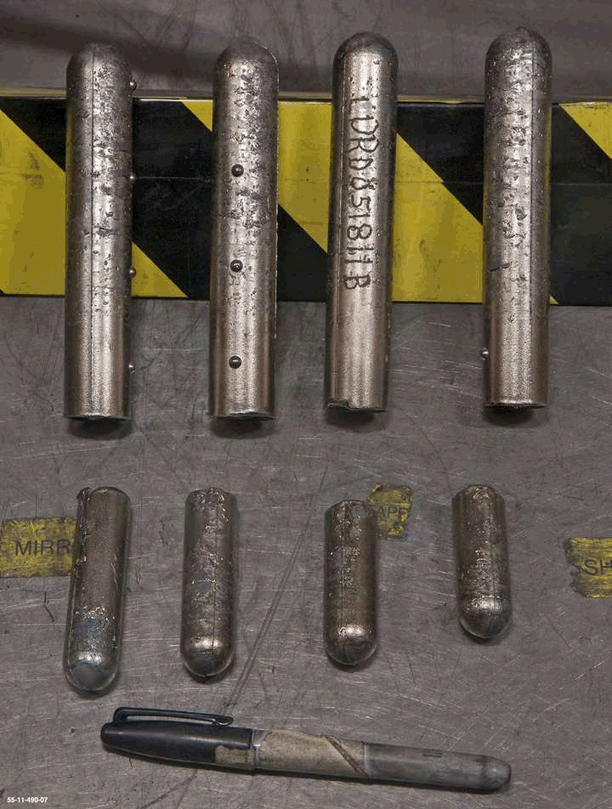
Months after the Pentagon said it wouldn’t use a controversial type of armor-piercing ammunition that has been blamed for long-term health complications, U.S. aircraft fired thousands of the rounds during two high-profile air raids in Syria in November 2015, the Pentagon acknowledged Wednesday.
The use of the ammunition, a 30mm depleted-uranium bullet called PGU-14, was first reported by a joint Air Wars-Foreign Policy investigation on Tuesday. The roughly 5,265 rounds of the munition were fired from multiple A-10 ground attack aircraft on Nov 16, 2015, and Nov. 22, 2015, in airstrikes in Syria’s eastern desert that targeted the Islamic State’s oil supply during Operation Tidal Wave II, said Maj. Josh Jacques, a U.S. Central Command spokesman.
When loaded with depleted-uranium bullets, the A-10s fired what is called a “combat-mix,” meaning the aircraft’s cannon fires five depleted-uranium rounds to one high explosive incendiary bullet.
The strikes, which involved 30mm cannon fire, rockets and guided bombs, destroyed more than 300 vehicles, mostly civilian tanker trucks, the Pentagon said at the time. The two incidents were championed by the Pentagon, and footage of trucks being destroyed was posted online. The Pentagon said that no civilians were present during the bombardment because fliers had been dropped before strafing runs warning those in their trucks to flee.
The worker tested positive for inhalation of the potential lethal nuclear isotope of plutonium – a key ingredient to the production of nuclear bombs and warheads., KGW8 News: Susannah Frame, February 13, 2018 A Hanford worker directly impacted by safety failures at an extremely dangerous demolition project at the site has granted an interview to KING 5.
The worker tested positive for inhalation of the potential lethal nuclear isotope of plutonium – a key ingredient to the production of nuclear bombs and warheads.
“I’m pissed. I’m scared, like we all are, that sooner or later it’s going to bite me and I’m going to end up with cancer,” said the contaminated worker.
For fear of retaliation, the worker does not want to be identified. Eight months ago, on June 8, the person was one of hundreds working on the demolition of Hanford’s Plutonium Finishing Plant (PFP). The workers were told to ‘take cover’ as a ‘precaution’ because monitors detected radioactive plutonium particles could be in the air.
But the event ended up not being precautionary whatsoever. The contractor in charge of the demolition, CH2M Hill, had an enormous problem on its hands.
“It was complete chaos. It was a mess,” said the worker.
Indeed, radioactive particles had escaped and spread outside the demolition zone. Hundreds of workers were eventually tested. Thirty-one of them got bad news: They had inhaled or ingested plutonium, which emits alpha radiation, the worst kind of radiation to get inside your body.
“Plutonium will go to the bones and sit there for a long, long time,” said Dr. Erica Liebelt, a toxicologist and executive director, as well as medical director, of the Washington Poison Center.
“Your risks are lung cancer, liver cancer, and bone cancer. That’s where plutonium heads in the body.” “(After being told no one was hurt) I was angry. You carry that with you for the rest of your life. It’s a cancer causer,” said the worker interviewed by KING 5.
After that event in June CH2M Hill increased safeguards and promised to do better. But six months later the job got out of control again. More plutonium began escaping outside the demolition control zone on December 15. Instead of getting to the bottom of it right away, CH2M Hill waited two days to halt the job.
Radioactive particles ended up on all kinds of items including worker’s boots, office trailers, jersey barriers, tumbleweeds.
“The response was awful. To me (waiting was) unforgivable, inexcusable. That should never have happened and this contractor ought to be on the hot seat,” said Tom Carpenter, executive director of the advocacy group Hanford Challenge.
The plutonium spread also made it onto cars. The KING 5 Investigators have found 36 cars total. Seven of them were personal vehicles, driven off the site by unsuspecting employees. The vehicles, with contamination on them, were driven into town and to their homes. One of those cars belongs to the worker who was contaminated internally six months earlier. …..
Once you have contamination that gets on private party’s cars and then gets driven off the Hanford Site it’s a big concern for us,” said Alex Smith of the Washington state Department of Ecology. Smith is the state’s top-ranking regulator for the state over Hanford.
On January 9, the Department of Ecology and the EPA sent a joint letter to U.S Department of Energy officials to communicate their great concern. For the first time in Hanford’s history, the regulators enacted a provision allowing them to halt work on a project due to a “creation of danger” to people and the environment.
President Donald Trump’s proposed $230 million cut to the budget for the federal Hanford Site nuclear cleanup will face bipartisan opposition in Congress.
By Gary Martin Review-Journal Washington Bureau, February 12, 2018, WASHINGTON — President Donald Trump renewed his commitment to restart licensing on the controversial Yucca Mountain nuclear repository in Nevada on Monday with a funding request tucked into a $4.4 trillion budget blueprint.
Trump included $120 million to restart licensing on the geologic site north of Las Vegas, as well as to establish an interim storage program to address the growing stockpile of nuclear waste produced by power plants in states across the nation.
The funds are just part of the $30.6 billion budget request for the Department of Energy for fiscal year 2019, which begins Oct. 1.
Energy Secretary Rick Perry said the $120 million would be used for the licensing application process. Application hearings must be held to hear challenges by Nevada and other stakeholders.
The Nuclear Regulatory Commission must determine whether Yucca Mountain is safe for long-term storage, and issue a license for Energy to build the repository…….
Nevada Gov. Brian Sandoval, the state’s two senators, Republican Dean Heller and Democrat Catherine Cortez Masto, and Democratic Reps Dina Titus, Jacky Rosen and Ruben Kihuen oppose the Yucca Mountain project.
Rep. Mark Amodei, R-Nev., and Nye County, where Yucca Mountain is located, and other rural Nevada counties, support continuing the licensing process.
Although the House has backed efforts to restart licensing on Yucca Mountain, the Senate did not approve funding last year.
“Despite Congress’ refusal to fund the Yucca Mountain project, the administration is once again prioritizing it,” Heller said. He claims the project poses a threat to the people of southern Nevada and could have a catastrophic impact on the tourism economy.
“I’ve made it clear why Nevada does not want to turn into the nation’s nuclear waste dump,” Heller said.
Utility Dive 5th Feb 2018, NextEra Energy declined to renew its membership in the Nuclear Energy
Institute and is now suing the trade group over access to a nuclear
industry personnel database, Personnel Access Data System (PADS). NEI has
blocked access to the resource unless NextEra pays close to $900,000.
NextEra operates eight nuclear reactors but decided to exit the group after
it advocated for a now-defunct Department of Energy proposal that would
have propped up struggling nuclear and coal generators. NextEra also has a
large portfolio of renewable and gas-fired assets that would have been hurt
by the proposal.
Sante Fe New Mexican 10th Feb 2018, New Mexico’s senators and congressmen are making a bad choice for their
constituents by lobbying to retain the production of nuclear bomb triggers,
or “pits,” at Los Alamos National Laboratory. The production of
plutonium pits is one of the most toxic industrial processes on Earth.
ASCO GU 2018: Diagnostic Radiation and Testicular Germ Cell Tumor Risk Uro Today, 18,San Francisco, CA (UroToday.com)Dr. Kevin Nead and colleagues presented their work assessing diagnostic radiation and testicular germ cell tumor risk. Dr. Nead notes that both the incidence of testicular germ cell tumors (TGCT) and use of diagnostic radiation have increased in recent decades. In a quarter of diagnostic scans in children, direct and indirect radiation dose to the testes exceeds 20 mSv, which surpasses thresholds associated with malignancy risk (~5 mSv). The objective of this study was to examine the association between exposure to diagnostic radiation and TGCT risk in a case-control study. ……. The authors concluded that exposure to diagnostic radiation below the waist, particularly among younger individuals, may increase TGCT risk. ...https://www.urotoday.com/conference-highlights/asco-gu-2018/asco-gu-2018-penile-urethral-testicular-and-adrenal-cancers/101967-asco-gu-2018-diagnostic-radiation-and-testicular-germ-cell-tumor-risk.html
A better direction for low-dose radiation research, BAS, Jan Beyea 12 Feb 18,
With bipartisan support, the US House Science, Space, and Technology Committee recently passed a bill to revitalize low-dose radiation research. The bill, which would authorize an estimated $96 million in funding, has also garnered support from researchers and groups with opposing views on the seriousness of effects of ionizing radiation in the low-dose region, defined as being below 100 millisieverts—roughly the amount of radiation from 10 CT scans.
Studies of excess cancers among survivors of the Hiroshima and Nagasaki bombings have estimated a 1 percent increase in long-term cancer risk for adults receiving a dose of 100 millisieverts (the risk is higher for children), with the risk below that level declining in proportion to the dose. However, stakeholders and researchers with different hypotheses continue to debate whether or not downward extrapolation by dose magnitude—the “linear no-threshold” model deemed most reasonable by a National Research Council committee of experts—is the best way to estimate risk. ……
The hope of many supporters of the proposed legislation, voiced by Rep. Roger Marshall, a Kansas Republican, is that it may assist “the development of nuclear energy opportunities,” in part by reducing the size of nuclear plant evacuation zones. The bill’s supporters presume that the finding of a threshold or hormesis region would demonstrate that the existing linear no-threshold model is an over-protection that, as Northwestern University radiation biologist Gayle E. Woloschak wrote in a letter of support for the bill, “may be wastefully expensive and deplete funds that could be used for other strategic goals for the nation.”
Past research by the Energy Department to upend the linear model has failed to fulfill that dream, finding health effects below 100 millisieverts from even protracted exposures. There is so much existing epidemiological data from exposed workers, patients receiving medical diagnostics, and residents living around the Soviet nuclear complex—as well as the Japanese atomic bombing survivors—that new research, whatever it shows, will need to be interpreted in the light of all the evidence.
That will likely leave stakeholders and experts debating for a long time, and the public confused.
Inherent uncertainty. New radiation research is likely to carry uncertainties, which means government policy must be conservative in its choice of the best dose-response model to use. Why is it difficult to tease out risks at low doses? Individual risks from medical diagnostics and from the (fortunately) limited releases of radioactivity at Fukushima are generally low under the linear extrapolation model. They are small compared with background disease rates, challenging epidemiological methods. The difficulty of finding effects among background cancers is actually good news for exposed individuals. However, the social risk is sufficiently large to justify keeping doses as low as reasonably achievable and balancing risks against benefits.
My colleagues and I call radiological events “reverse lotteries”: The individual risk of drawing a cancer-causing “ticket” from an event such as the Fukushima meltdowns is small, but because so many people are part of the lottery, real people do get impacted when they draw losing tickets.
Prospective risks and retrospective risks are perceived differently. If I learned that my family and I had already been exposed to a 1-in-1,000 cancer risk, I would be angry, but I would realize that the odds were highly in our favor; none of us would likely be injured. However, if you asked me to relocate to contaminated land where my children would be exposed to a 1-in-1,000 chance of cancer, I would want to stay away unless there were major benefits associated with the move, or if I thought I couldn’t afford to do otherwise. Risk tradeoffs are personal, and families can be painfully split on the best decision, as happened at Fukushima……… https://thebulletin.org/better-direction-low-dose-radiation-research11500
Vogtle Opponents Sue Georgia Regulators Over Nuclear Decision, WABE, MOLLY SAMUEL • Opponents of a nuclear power expansion in Georgia are suing over it. Environmental groups claim state regulators didn’t follow their own rules when they decided to let construction at Plant Vogtle continue.
In December, the Georgia Public Service Commission voted unanimouslyto keep work on two new nuclear reactors going, even though they’re five years behind schedule and billions of dollars over budget.
The groups Georgia Interfaith Power and Light and the Partnership for Southern Equity claim the commission rushed the decision and should have gathered more information.
“This was the wrong way to go about making a multi-billion dollar decision,” said Kurt Ebersbach, an attorney at Southern Environmental Law Center, who represents the groups.
Trump seeks clean energy cuts, $2 billion nuclear spending boost for Energy Dept. WP, By Steven Mufson and Chris MooneyFebruary 12The Trump administration’s fiscal 2019 budget might never become law, but it’s a declaration of intent, and it would reshuffle priorities at the Energy Department, boosting outlays on nuclear security and slashing spending on renewables and energy efficiency.
Overall, the administration is asking Congress for $30.6 billion for the Energy Department, a 1.3 percent increase from fiscal 2017. That includes $1.6 billion added to the department’s budget after a last-minute spending deal was reached in Congress last week.
The administration wants a 17.5 percent increase for the department’s National Nuclear Security Administration (NNSA), which safeguards the nation’s stockpile of nuclear weapons. The NNSA makes up nearly half the department’s budget, and under the 2019 proposal, it would get $15.1 billion, up from $12.8 billion in fiscal 2017……..
Russian Expert Suslov: The New U.S Nuclear Doctrine Could Lead To A Military Crisis Fraught With A Direct Military Clash Between The U.S. And Russia, MEMRI, Special Dispatch No. 7325 February 11, 2018 On February 2, 2018, the U.S Department of Defense released its Nuclear Posture Review. The new U.S. Nuclear Doctrine states that while Russia initially followed “America’s lead and made similarly sharp reductions in its strategic nuclear forces,” it retained large quantities of non-strategic nuclear weapons. “Today, Russia is modernizing these weapons as well as its other strategic systems. Even more troubling has been Russia’s adoption of military strategies and capabilities that rely on nuclear escalation for their success. These developments, coupled with Russia’s seizure of Crimea and nuclear threats against our allies, mark
Moscow’s decided return to Great Power competition,” stated the Nuclear Posture Review.[1]
Dmitry Suslov, a veteran America-watcher and program director of the Valdai Discussion Club noted in his assessment of the review, that a troubling aspect of the new U.S. nuclear doctrine is the “considerable erosion of nuclear employment terms.” Suslov stated: “The current document says that the United States allows the possibility of using nuclear weapons in response to a non-nuclear attack not only against the U.S. itself and its allies but also against its ‘partners,’ a category that can include just about anyone apart from those the US openly calls its adversaries (today these are Russia, China, Iran and North Korea) or unfriendly countries (Syria, Venezuela, etc.). Officially, the United States’ ‘strategic partners’ are Ukraine and Georgia, to name just these two. Does this mean that Washington will seriously contemplate using nuclear weapons if their security is under threat?”
Like many Russian experts Suslov regards the situation as worse than during the Cold War and urges the expert communities in both the U.S. and Russia to share their concerns with the policy makers.
Below are excerpts from Suslov’s article, titled “Militarizing The Confrontation: Risks Of The New U.S. Nuclear Posture Review,” published in the Valdai Discussion Club:[2]
‘The General Strategic Situation Is Much More Complex And Multifaceted Than During The Cold War’
“During the last four years, Russian-American confrontation has been mostly confined to the political, information and economic (sanctions) areas and has been minimal in terms of the military. The military establishments in Russia and America and their proponents among the Russian and U.S. political elite regarded each other as potential adversaries even before the current confrontation. Moscow’s 2010 military doctrine (incidentally, approved at the peak of the Russian-U.S. ‘reset’) described globalization and NATO expansion as the main military threat. NATO’s official pivot in 2014 to the open military and political containment of Russia was until recently of a predominantly declarative and political nature. In the military respect, it was rather modest since the real scale of NATO’s infrastructural expansion in the Baltic and Black Sea areas was not great. In the Middle East, too, the U.S. refrained from creating military obstacles to the Russian operation in Syria, which would have risked a direct clash between the two powers.
“However, the situation may change radically quite soon. On February 2, 2018, Washington presented its new nuclear doctrine (Nuclear Posture Review), which outlined a qualitative change in U.S. nuclear policy. ……..
“The main change in the U.S. nuclear doctrine is that the Trump administration, based on the qualitatively new realities of the great-power confrontation with Russia and China as compared with the period after the Cold War, has decided on a higher role for nuclear weapons and emphasizes them in its defense strategy, whereas the Obama and Bush administrations on the contrary sought to downplay it. ……….
Where might Trump go in a nuclear attack? BBC News, By Tara McKelveyBBC White House reporter, 11 Feb 18, “…….. US officials have made access arrangements for the president and a group of individuals deemed to be at the “top of the food chain”, according to Robert Darling, a Marine who spent part of 9/11 in the White House bunker. He has described who was allowed in.
As Darling pointed out, only a select few are allowed into a presidential bunker, turning social hierarchy into a matter of life or death. Still historians say bunker building is a necessary part of governmental business.
“You have to maintain a chain of command,” says Randy Sowell, an archivist at the Truman President Library in Independence, Missouri. “Or there’d be complete chaos.”
The construction of shelters and bunkers, whether for presidents or ordinary people, serves another purpose – they make it easier for Americans to talk about atomic or nuclear warheads and help make the unthinkable – global nuclear war – thinkable.
President Harry Truman oversaw the establishment of a federal civil defence administration in the 1950s. The overall message from the government, said Christian Appy, a history professor at the University of Massachusetts in Amherst, was that “nuclear war wasn’t necessarily an apocalypse for everyone”.
The civil defence agency helped create the idea of “nuclear citizenship”, says Appy. The US government wanted civilians to adjust to a new reality, he says, paving the way for their “acquiescence to the nuclear arms race”.
A US strategic bombing survey found about 30% of those who died immediately in the US atomic attack on Nagasaki would have been saved by fallout shelters, says Sowell, explaining the rationale behind Truman’s civil defence programme.
Officials at the agency tried to set up a nationwide shelter system. Some shelters were built for government employees and members of the public. Officials oversaw the construction of a large facility in Los Altos, California, in the 1960s, for example.
Mainly, though, private individuals built their own bunkers. Thousands were constructed, as Laura McEnaney, a history professor, discovered while researching her book on the subject. “Nuclear war,” she says, became “the responsibility of the nuclear family”.
One of them, an heiress named Marjorie Merriweather Post, built her bunkers under her estate – the Mar-a-Lago, in Florida.
In the early 1950s, Post was worried about the Korean War and its potential for escalation, and so she built underground shelters. They were dug into the earth below Mar-a-Lago’s main building, according to a US interior department surveyon historic buildings.
Trump bought the property along with the bunker in 1985. He later described the underground facility as sturdy, “anchored into the coral reef with steel and concrete”.
The ceilings are low, says Wes Blackman. The 6ft 5in former project manager had to duck while visiting the place with Trump years ago.
“It was like we were on an archaeological exploration,” he says………
Mount Weather, a 1,754-ft (534m) peak near Bluemont, Virginia, was turned into a giant bunker for the president, his advisers and others to hide in case of nuclear attack.
Members of Congress would be taken to a bunker at Greenbrier resort near White Sulphur Springs, West Virginia. The facility had a code name, Project Greek Island, and operated for decades – until its existence was revealed in the media in 1992 when the bunker was “decommissioned”.
Mount Weather is now run by the Federal Emergency Management Agency (Fema) and was “activated” after the al-Qaeda attacks in September 2001, a Fema director testified to Congress in October of that year. He didn’t provide details. …… In the autumn of 1961, construction began on another presidential bunker. This one was created for President John F Kennedy in Florida. It’s not far from Mar-a-Lago – the US Navy’s Seabees built the bunker on Peanut Island, a 10-minute journey from a Palm Beach house where Kennedy often stayed. The bunker was known as Detachment Hotel, and it cost $97,000 to construct, according to a 1973 report to Congress. …….http://www.bbc.com/news/world-us-canada-42969877
And the beneficiaries are and will be hundreds, if not thousands, of workers exposed to some of the most dangerous materials known to humans.
The workers are present workers and retirees, at the Department of Energy’s nuclear complex in Hanford, Wash. And as a result of all those factors, they’ll be more eligible for workers’ comp.
The story starts in 1942-43, says Nick Bumpaous of Plumbers and Steamfitters Local 598, located near the complex. That’s when the U.S. War Department took over the Hanford area to build the factory complex to make nuclear warheads for U.S. bombs. Hanford, like the whole Manhattan Project for developing atomic weapons, was top secret.
The feds, to their credit, realized Hanford’s workers would be in constant daily contact with uranium, plutonium and other highly radioactive materials. Who knew what would happen to them in later years due to those exposures?
“In the 1940s, the War Department got into a contract with the state legislature to have workers use Washington’s industrial insurance for workers’ comp claims if they got ill from handling the radioactive material,” Bumpaous said in a phone interview. “The feds would reimburse the state for any claims.”
The catch was when sickened workers went to their doctors, the doctors “couldn’t tell what the illnesses were” – because Hanford was secret – “so they couldn’t give you medication,” much less OK workers’ comp claims.
Common diseases among the Hanford workers include various cancers, according to a fact sheet for a later federal workers comp program for federal nuclear workers nationwide. The Steelworkers, who now represent many of those nuke workers, lobbied for and won the federal program. It began in 2001, with a second part added in 2004. But it caps lifetime benefits at $250,000, plus medical expenses.
“But you still put the burden of proof” upon the worker to show his or her toil at Hanford and exposure to the fissile materials there caused those ills, not to mention exposure to other threats, Bumpaous says.
One example: Exposure to diethyl mercury, “a silent odorless, colorless, tasteless stuff that induces neurological diseases and dementia.” In addition, “you have a whole generation of people with reactive airway disease,” he adds.
The doctors couldn’t diagnose the reasons for Hanford ills. The workers became so ill they couldn’t work and had to leave their jobs, “so they’re not getting a paycheck and they had no health insurance.” They had to navigate the bureaucracy “and their claims were denied,” Bumpaous explains. Workers’ comp denials at Hanford were 52 percent above average.
“It’s hard enough to take care of yourself when you’re battling the Department of Energy,” which now runs Hanford “and the state Department of Labor and Industry,” which runs workers’ comp, Bumpaous says.
With the burden of proof on the workers, Bumpaous got into the picture. Two years ago, he read about legislation the Fire Fighters successfully pushed elsewhere, shifting the burden of proof for certain diseases – known to be caused by Fire Fighter exposure to asbestos and other dangers on the job – from the worker to the state.
In short, if a Fire Fighter goes to the doctor with asbestosis, the doctor must presume the worker caught it from on-the-job exposure and is eligible for workers’ comp. Bumpaous wanted to create the same scenario for the Hanford workers. Workers and retirees still must go to the doctors, though.
“These brave workers continue to be exposed to some of the most hazardous substances known to man, including many chemical and radiological hazards as yet unidentified, and the safety measures intended to protect them are inadequate,” wrote David Groves in The Stand, the Washington State Labor Council’s online newspaper, which first reported the legislation.
But the Hanford workers couldn’t get workers comp because they had to “connect specific exposures to their disease — a virtually impossible task given the” top secret “circumstances at Hanford.”
Bumpaous enlisted two lawmakers to push the measure shifting the burden of proof from the workers to the state: State Rep. Larry Haler, R-Richland, and State Sen. Karen Keiser, D-Kent, a longtime pro-worker advocate, who is now state Senate President Pro Tem and chair of the state Senate’s Labor Committee. Haler’s district includes Hanford.
And that’s where the political switch comes in. When Bumpaous, Haler and Keiser first tried to get their bill, HB1723, through, it passed the House, then died in the Senate, which the GOP controlled by one vote. Republican leaders wouldn’t even let it get out of committee.
But earlier this year, Manka Dhingra, a Democratic pro-worker woman with strong union backing, won a special election for an open State Senate seat. Control switched, Keiser took over – and the legislation for the Hanford workers sailed through: 76-22 in the House and 35-14 in the Senate.
“It’s important we take care of workers who suffered due to being exposed to harmful chemicals and processes at Hanford,” Haler said. “Despite all the safety precautions, families and individuals have been devastated by illness and disease. They need help. This will help make that easier,” Haler said after HB1723 headed for Democratic Gov. Jay Inslee’s desk.
“Exposure to heavy metal and radiation has ruined people’s lives,” Keiser told the Senate before passage.
“I cannot think of a more suitable assertion for this Senate to make than putting our partisan differences aside to put people first. We are seeing people dying from dementia, cancer and lung disease who were systematically left out of workers compensation.”
“People went bankrupt paying for cancer treatments. This ordeal has been going on since the 1990s. We have seen a whole generation impacted by this tragedy. That is not right. Our Washington community cares about protecting all workers.”
Inslee is expected to sign the bill. But that’s not the end of the story for Bumpaous. “I want to see everyone get these benefits” nationwide if they worked in nuclear weapons and warhead production, he says. “That way we won’t have this type of stuff in the future.”