on the future of the West Lake Landfill — a decision that could free the St. Louis area of the seven-decade environmental burden it has borne in America’s quest for nuclear superiority.
For Pruitt, the right decision would be costly and complicated. The wrong decision, though far cheaper and most expedient, would leave in place a radioactive nightmare that would haunt the region for generations to come. The right decision is the only decision.
At issue are thousands of tons of radioactive waste left over from secret uranium refinement carried out in St. Louis during the Manhattan Project, the 1940s effort to produce America’s first nuclear bomb. Although officials at the time were well aware of the radioactive dangers, they paid little heed to where they dumped the wastes from years of uranium processing. An uncovered, unlined pit at the West Lake landfill became the dumpsite of choice, two miles northwest of St. Louis Lambert International Airport.
The landfill, uphill and less than two miles from the Missouri River, was never designed for radioactive waste and never would have met today’s federal safety guidelines. Various radioactive hot zones have been discovered in downstream watersheds, as have large cancer clusters among residents. For years, a slow-moving underground fire at an adjacent landfill is believed to be advancing toward the buried nuclear waste.
In tests conducted from 2012 to 2014, groundwater at West Lake contained unsafe levels of radioactive uranium, radium and thorium-230, along with arsenic, manganese, barium and benzene.
An exhaustive, 814-page EPA study, updated on Jan. 10, outlines the dangers and costs associated with six options Pruitt can choose from for West Lake. One option, doing nothing, is laughable. Three cheaper proposals call for partial excavation of the site at varying depths and capping the site but leaving many toxins behind. The two best options involve full excavation — one would store the waste on-site in a modern, secure containment cell, and the other would transport it offsite to a remote, federally approved storage facility.
Full excavation and removal would keep the region safest over the long term. But it’s also the most expensive option at $695 million. Capping the site would cost about $75 million but also would pose the greatest future cancer risks to farmers and residents downstream.
Pruitt has the comfort of making this decision from Washington, D.C., far from the exposure zone. We urge him to consider all who have suffered so far because of the irresponsible, lazy solutions imposed on St. Louis decades ago. If Pruitt would regard it as unacceptable for his own family to be exposed to such risks, then he must conclude that St. Louisans deserve the same consideration. This radioactive time bomb must go.
NASA revives its Cold War-era idea of using atomic rockets to create ‘drastically smaller’ craft that will get to Mars by the 2030s
NASA plans to use the same technology it discontinued using in the 1970s
NASA partnered with BWXT Nuclear Energy to develop nuclear propulsion tech
A nuclear system can cut the voyage time to Mars from six months to just four
Nuclear Thermal Propulsion project could significantly change space travel
“……..NASA says it will use technology it discontinued in the 1970s to create ‘drastically smaller’ craft capable of greater speeds than their non-nuclear rivals.
This system could cut the voyage time to Mars from six months to four and safely deliver human explorers by reducing their exposure to cosmic radiation.
NASA first hinted at the potential for nuclear thermal propulsion technologies last year, saying that they are more promising than ever.
It partnered with BWXT Nuclear Energy, based in Lynchburg, Virginia, in an $18.8 million (£13.3m) contract to refine those concepts.
The resulting Nuclear Thermal Propulsion (NTP) project could significantly change space travel, according to its creators.
This is mostly due to its ability to push a large amount of propellant out of the back of a rocket at very high speeds, resulting in a highly efficient, high-thrust engine.
‘As we push out into the solar system, nuclear propulsion may offer the only truly viable technology option to extend human reach to the surface of Mars and to worlds beyond,’ said Sonny Mitchell, nuclear thermal propulsion project manager at NASA’s Marshall Space Flight Centre, in Huntsville, Alabama.
We’re excited to be working on technologies that could open up deep space for human exploration.’
…….. getting to Mars entails a 55 million-kilometre (34 million-mile) flight, more than 100 times the distance between Earth and the Moon.
The NTP project is under the umbrella of NASA’s Game Changing Development Program, which advances space technologies that may lead to entirely new approaches for the Agency’s future space missions and provide solutions to significant national needs.
Given its experience delivering nuclear fuels for the US Navy, BWXT will help with the design and testing of promising, low-enriched uranium-based nuclear thermal engine concept and ‘Cermet’ – ceramic metallic – fuel element technolgy.
During BWXT-NASA contract, which is set to run through to September 30, 2019, BWXT will manufacture and test prototype fuel elements and also help NASA address and resolve nuclear licensing and regulatory requirements.
The project will test full-length fuel rods using a unique Marshall test facility.
………. the complexities of the technology and testing could lead to high development costs, which could be a major barrier, however, using NASA technology developed decades ago could help speed up progress, says Claudio Bruno,
Russia also has plans to reach the red planet using nuclear technologies.
Russia’s Rosatorm Corporation plans this year to test a nuclear engine for a spacecraft that can travel to Mars.
China also plans to use nuclear-powered shuttles as part of its space explortation endeavours through to 2045.
NASA also faces competition in reaching Mars from the likes of Elon Musk and his company SpaceX, which just launched its Falcon Heavy rocket, which is designed to carry humans to space.
However, SpaceX is planning on using a liquid oxygen and methane fueled engine.
…….NASA is also developing technologies that could power human settlements on Mars.
Government officials said an earthquake centered less than 10 miles from Seabrook Station Nuclear Power Plant didn’t seem to have caused any damage yesterday, but anti-nuclear activists are worried the tremors could have increased instability in already-cracking containment walls.
The 9:28 a.m. quake, which shook the ground in northern Massachusetts and southern New Hampshire but only hit 2.7 on the Richter scale, didn’t trigger any emergency procedures at Seabrook Station, Nuclear Regulatory Commission spokesman Neil Sheehan said. The station is just down the road from the earthquake’s epicenter in East Kingston.
Sheehan said workers walked through the plant yesterday in search of any signs of damage, but stressed Seabrook Station is built to withstand much stronger earthquakes.
But activists said many of the plant’s walls — including in the spent fuel pool and the reactor dome — are already weakened. And though they’re several feet thick, they’ve been damaged by water mixing with compounds in the walls’ concrete and cement, creating a gel that expands and cracks the walls.
Paul Gunter, a director at activist group Beyond Nuclear and a former member of the Clamshell Alliance that led large protests against Seabrook coming online in the 1970s, said activists have long been concerned by the power plant’s proximity to an earthquake zone. He said yesterday’s tremor was a “wake-up call.”
“Even these small earthquakes are a wake-up call to look at the broader issues of vulnerability at the plant and the inherent danger of the operation,” Gunter said. “These are legitimate reasons to question the continued operation of Seabrook Station.”
Natalie Hildt Treat, executive director of C-10, a Newburyport-based group that monitors emissions at the plant, agreed.
“You would think a measurable earthquake would put further stress on that,” she said. “Little cracks can lead to bigger cracks … it’s definitely a safety concern.”
But Seabrook Town Manager William M. Manzi III said he wasn’t concerned that the quake caused any structural damage, saying, “We’re confident that the plant will be able to withstand any seismic event.”
Plant owner NextEra Energy didn’t respond to multiple requests for comment. The company is seeking to extend its license to operate from 2030 to 2050, and Sheehan said the NRC is currently reviewing NextEra’s plans to address deterioration before it considers an extension.
“The real issue here is longer-term,” Sheehan said. “In terms of the earthquake today, we don’t believe it poses a safety issue.”
More workers tested positive for Hanford radiation, The 6 people are added to 31 who tested positive for inhaling or ingesting contamination in June, February 15, 2018 By Annette Cary / Tri-City Herald
Another spread of radioactive contamination has been confirmed at the Hanford nuclear reservation’s Plutonium Finishing Plant.
In addition, more central Hanford workers have tested positive for inhaling or ingesting radioactive contamination from demolition of the plant.
For the second time since workers were moved in January to offices away from the plant, contamination has been found on the steps of the newly assigned offices.
Most recently, a spot of radioactive contamination described as about the size of a 50-cent piece was found on the step outside an office on Feb. 8. The step has been removed.
In some cases radiation detected at Hanford is determined to have come from naturally occurring radon, but in this case it appears to be related to demolition of the heavily contaminated plant.
Demolition and the packing and hauling away of the debris has been stopped at the plant since mid-December after a spread of particles of radioactive contamination was discovered.
Most of the demolition of the Plutonium Reclamation Facility, the most contaminated portion of the plant, had just been completed when the spread was found.
Several steps have been taken since December, including bringing in new contractor management for the project, widely expanding the area where access is controlled and moving workers from offices near the plant to offices outside the control area.
Workers take shuttles to and from the plant, as needed for work assignments, from their newly assigned offices.
In response to the first discovery of a spot of contamination outside the new offices in late January, more stringent rules were instituted for checks of workers leaving radiologically contaminated demolition areas.
In response to the Feb. 8 spread, the radiological buffer around areas where radioactive material is expected to be present has been expanded. Workers have their hands and feet checked for radiation when they leave that area to board a shuttle to offices.
The number of workers known to have inhaled or ingested radioactive particles has increased to six.
Some 212 workers who requested checks had no contamination, with about 60 checks pending. Bioassays, or checks of body waste, are being done to determine if workers have radioactive contamination inside their bodies.
The amount of internal contamination is small. The largest estimated radiation dose for the six workers is 10 to 20 millirem over 50 years.
In comparison, the average person in the United States receives about 300 millirem a year annually from natural background radiation, including radon or radiation bombarding the Earth from outer space.
The six workers with positive bioassay results are in addition to 31 workers who tested positive for inhaling or ingesting radioactive contamination from Plutonium Finishing Plant demolition in June. The highest estimated dose from June was 10 millirem total over 50 years.
World Nuclear News 15th Feb 2018, Holtec International and GE Hitachi Nuclear Energy (GEH) are to collaborate
on accelerating the commercialisation of Holtec’s SMR-160 small modular
reactor (SMR). Their cooperation will initially include nuclear fuel
development and control rod drive mechanisms. Under a memorandum of
understanding, GEH, Global Nuclear Fuel (GNF), Holtec and SMR Inventec LLC
(SMR LLC) have agreed to enter into a “procompetitive collaboration” to
progress the SMR-160. GNF, a GE-led joint venture with Hitachi and Toshiba,
is primarily known as a supplier of boiling water reactor fuel. SMR LLC is
a wholly-owned subsidiary of Holtec established in 2011 to manage the
development of the SMR-160. http://www.world-nuclear-news.org/NN-Holtec-and-GEH-team-up-on-advancing-SMR-160-1502184.html
The “Versatile Fast Neutron Source”: A Misguided Nuclear Reactor Project, UCS,
ED LYMAN, SENIOR SCIENTIST | FEBRUARY 15, 2018The Union of Concerned Scientists (UCS) supports a moderate level of Department of Energy (DOE) research funding to make nuclear power safer and more secure—for example the agency’s program to develop accident tolerant fuels for nuclear reactors. Conversely, UCS does not support programs that not only would cost a lot of money, but also could make nuclear power more dangerous and less secure. That’s why the organization is troubled by a bill that was passed by the House of Representatives on February 13.
The bill in question, H.R. 4378, authorizes the secretary of energy to spend nearly $2 billion over the next seven years to build what’s called a “versatile reactor-based fast neutron source.” As its name indicates, the primary purpose of this facility would be to provide a source of high-energy neutrons to help researchers develop fuels and materials for a class of advanced nuclear reactors called fast reactors.
What is it?
What may not be clear from the name is that this facility itself would be an experimental fast reactor, likely fueled with weapon-usable plutonium.
Compared to conventional light-water reactors, fast reactors are less safe, more expensive, and more difficult to operate and repair. But the biggest problem with this technology is that it typically requires the use of such weapon-usable fuels as plutonium, increasing the risk of nuclear terrorism. Regardless, the House passed the bill with scant consideration of the risks and benefits of building it. Hopefully, the Senate will conduct a due diligence review before taking up a companion bill. Caveat emptor.
Based on what little public information there is available about the plans for this facility, it would be a fast reactor of at least 300 thermal megawatts (or about 120 MW of electricity if it is also used for power generation). This power level is the minimum necessary to achieve the desired rate of neutron production. This would make the reactor about five times larger than the last experimental fast reactor operated in the United States, the EBR-II, which shut down in 1994. One proposed design, called FASTER, would have a peak power density three times higher than the EBR-II, making it much more challenging to remove heat from the core. This design would require about 2.6 metric tons of metallic fuel containing about 500 kilograms of plutonium per year. One third of the reactor fuel would be replaced every 100 days. (The DOE also is apparently considering a different fast reactor design that would use high-assay, low-enriched uranium fuel, but this material is in short supply and a new production source would have to be established. In any case, the DOE has not yet determined if it is feasible to use low-enriched uranium.)
Cost?
The amount of funding authorized by H.R. 4378 for designing and constructing this fast reactor is less than 60 percent of its estimated cost of $3.36 billion, and the aggressive timeline mandated by the bill, which calls for full operation by the end of 2025, is significantly shorter than the optimistic 11- to 13-year schedule anticipated by its designers. By low-balling the initial authorization and construction time, H.R. 4378’s sponsors may have been trying to make it more palatable, but they are also undermining their project.
It’s also important to keep in mind that the estimated cost of $3.36 billion is just a fraction of the project’s total cost. ……….
Finally, what agency will oversee the safety and security of this risky project? The DOE. By designating this reactor as a neutron source, and building it at a DOE site, it will be exempt from licensing and oversight by the Nuclear Regulatory Commission. While NRC licensing is far from perfect, it would be far superior to DOE self-regulation.
To summarize, H.R. 4378 authorizes constructing a fast reactor without assessing the need or evaluating its costs and benefits. It compels the DOE to build an experimental fast reactor, using an experimental fuel, at a scale and power density that has never been demonstrated, on a rushed schedule, with insufficient funding.
The West risks missing a chance at peace if it continues to treat North Korea’s change of heart with cynicism Could it be that Trump’s bombast over the airwaves cut through in Pyongyang in a way that conventional diplomacy had failed to do? The Independent UK, Mary Dejevsky@IndyVoices 16 Feb 18
“”…………The mixed messages about the North Korean skaters, however, highlighted – or so it seemed to me – something else: a reluctance on the part of the foreign policy establishment, including the media, to look good news in the face, especially when it has not been expected.
How long ago was it –in fact, a bare six weeks – that Kim Jong-un and the US President were trading very public, very macho, insults, culminating in Donald Trump’s memorable boast that his nuclear button was “much bigger and more powerful” than Kim’s and, what is more, “my button works”.
Even the most hardened pessimist would have to admit that between then and now there has been something of a mood swing. Less than three weeks after the “big button” exchange, North Korea suddenly acted on overtures in Kim’s New Year address to broach talks with the South, and even participated in the Olympics. The IOC delayed its deadline for entries, permitted North Korea’s participation, and the next thing we knew was that North and South were concocting a joint ice hockey team, the North’s nonagenarian de facto head of state was on his way to Seoul, and Kim announced that his sister – his sister – would be going to the opening ceremony, too.
Far from hailing these developments as the possible start of a North-South thaw, however, the Western response seemed – to me, at least, – both fearful and curmudgeonly. Kim Jong-un was suspected of the basest of motives. Might he not be deviously stringing the South along, it was asked, just waiting to demand all sorts of impossible concessions at the last moment that would cast the Seoul government as the villain if it refused?
And was Kim not also staging a vast military parade in Pyongyang on the eve of the official Olympic opening? Well, of course, he was. No self-respecting national leader, least of all an autocrat in the mould of Kim, can be seen to be weak in front of his own people. Shows of strength have a habit of going hand in hand with diplomatic U-turns.
As the North Korean nuclear threat vanished from the headlines, however, it was only to be replaced with another menace from the North. Kim’s very presentable little sister, Kim Yo-jong, was accused of stealing the limelight, diluting the world’s attention that should have been Seoul’s, and presenting an image of the North that was scandalously at odds with the cruel and earth-scorched reality. Don’t allow yourself to be fooled, was the message.
That she was received in Seoul at the highest level and filmed handing over an invitation to President Moon Jae-in to visit Pyongyang was also somehow seen as out of order, another trick to gain diplomatic advantage. Surely it would all turn sour even before the Olympic glow over the South had faded. The North Korean threat was still there.
Far from hailing these developments as the possible start of a North-South thaw, however, the Western response seemed – to me, at least, – both fearful and curmudgeonly. Kim Jong-un was suspected of the basest of motives. Might he not be deviously stringing the South along, it was asked, just waiting to demand all sorts of impossible concessions at the last moment that would cast the Seoul government as the villain if it refused?
And was Kim not also staging a vast military parade in Pyongyang on the eve of the official Olympic opening? Well, of course, he was. No self-respecting national leader, least of all an autocrat in the mould of Kim, can be seen to be weak in front of his own people. Shows of strength have a habit of going hand in hand with diplomatic U-turns.
As the North Korean nuclear threat vanished from the headlines, however, it was only to be replaced with another menace from the North. Kim’s very presentable little sister, Kim Yo-jong, was accused of stealing the limelight, diluting the world’s attention that should have been Seoul’s, and presenting an image of the North that was scandalously at odds with the cruel and earth-scorched reality. Don’t allow yourself to be fooled, was the message.
That she was received in Seoul at the highest level and filmed handing over an invitation to President Moon Jae-in to visit Pyongyang was also somehow seen as out of order, another trick to gain diplomatic advantage. Surely it would all turn sour even before the Olympic glow over the South had faded. The North Korean threat was still there.
Nor should the use by potentates – and not just potentates – of close relatives as personal representatives and trusted go-betweens – be discounted as a ploy. Rather than being designed to detract from the South’s Olympic show, Kim Jong-yo’s trip to Seoul might rather be seen as evidence of her brother’s serious intent and esteem.
And what might have changed the equation? How about the US Secretary of State’s low-key offer of direct talks without preconditions that he made in December? Repeated in Seoul by Vice-President Mike Pence this week (once he had done cold-shouldering the North Koreans for the benefit of the US audience back home), this is what first broke the deadlock. There have been concessions on all sides.
So while the doomwatchers see the Olympic thaw as, at best, a deceptive interlude before the nuclear stand-off inevitably resumes, I would argue, for more optimism. A basis has been laid for detente; there is a real chance now to step back from the brink. The risk now is less that the North is insincere, than that suspicion and cynicism everywhere cause this chance to be missed. http://www.independent.co.uk/voices/north-korea-war-nuclear-us-uk-europe-world-peace-conflict-a8212656.html
The US is to spend billions of dollars upgrading 150 nuclear bombs positioned in Europe, although the weapons may be useless as a deterrent and a potentially catastrophic security liability, according to a new report by arms experts.
A third of the B61 bombs in Europe under joint US and Nato control are thought to be kept at Incirlik base in Turkey, 70 miles from the Syrian border, which has been the subject of serious concerns.
The threat to the base posed by Islamic State militants was considered serious enough in March 2016 to evacuate the families of military officers.During a coup attempt four months later, Turkish authorities locked down the base and cut its electricity. The Turkish commanding officer at Incirlik was arrested for his alleged role in the plot.
A report on the future of the B61 bombs by arms control advocacy group the Nuclear Threat Initiative (NTI) , and made available to the Guardian, said the 2016 events “shows just how quickly assumptions about the safety and security of US nuclear weapons stored abroad can change.”
Since then US-Turkish relations have soured further, largely over Washington’s support for Kurd forces in Syria. The national security adviser, HR McMaster, and secretary of state, Rex Tillerson, have both made trips to Turkey this week to try to heal the rift.
There have been reports that the bombs have been quietly moved out because of safety concerns, but that has not been confirmed.
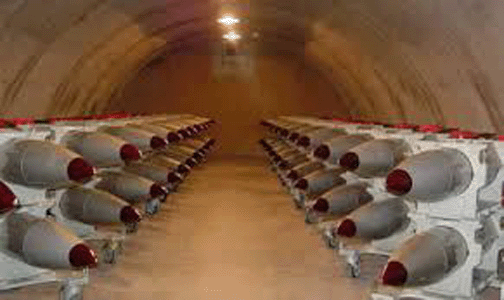
The remaining B61 bombs are stored at five other locations in four countries: Italy, the Netherlands, Belgium and Germany, according to the Federation of American Scientists, which tracks the weapons. The NTI report said it “should be assumed that they are targets for terrorism and theft”.
The bombs are the remnants of a much larger cold war nuclear arsenal in Europe, and critics have said they serve no military purpose, as the nuclear deterrent against Russia relies largely on the overwhelming US strategic missile arsenal.
Using the B61s in any conflict would involve an agreement between the US and the host country in consultation with other Nato members.
“It is hard to envision the circumstances under which a US president would initiate nuclear use for the first time in more than 70 years with a Nato [dual-capable aircraft] flown by non-US pilots delivering a US B61 bomb,” said the NTI report, titled Building a Safe, Secure and Credible Nato Nuclear Posture.
Since the cold war, the B61 has played a symbolic role, as reassurance for some Nato members of US commitment to defending Europe. They are also considered potential bargaining chips against Russia’s much greater arsenal of nearly 2,000 tactical nuclear weapons.
However, the NTI report argues they are also serious liabilities, because of the threat of terrorism or accident, and because they could become targets in the early stages of any conflict with Russia.
“Forward-deployed US nuclear weapons in Europe increase the risk of accidents, blunders, or catastrophic terrorism and invite pre-emption. Given these added risks, it is past time to revisit whether these forward-based weapons are essential for military deterrence and political reassurance” the Obama administration’s energy secretary Ernest Moniz and former Democratic senator Sam Nunn, both NTI co-chairmen, argue in the preface to the report.
The Obama administration considered withdrawing the B61s from Europe as part of the president’s nuclear disarmament initiative but the idea lost support as relations with Russia deteriorated. Instead, the administration approved a Pentagon programme to upgrade the bombs over the next decade with a tailfin assembly to make them more accurate.
The plan has been embraced by the Trump administration’s nuclear posture review, despite the fact that the estimated cost of the 460 new model bombs, the B61-12, has doubled in recent years to $10bin, a part of a huge increase of overall defence spending.
The North is increasingly close to developing a nuclear-tipped ICBM that can hit the continental US. Washington knows it cannot destroy all the country’s capabilities – so hawks are now arguing for a “bloody nose” strategy to warn Kim Jong-un off threatening the US (though he must know any attack would be suicidal). Seoul, just 35 miles from the border, would bear the brunt of any retaliation. A conflict could kill tens of thousands and potentially draw in other regional powers, including China.
“There’s a real concern that for the first time there is a US administration that could take unilateral action against North Korea without consulting the South,” says Professor Hazel Smith of the centre of Korean studies at Soas Univeristy of London. “People are pushing, virtually preparing, for a so-called ‘surgical strike’ – even though the majority of US and South Korean military planners argue that it would be risky to the point of likely catastrophe for the South, and US troops there.
“The Olympic initiative was never going to solve the nuclear question overnight, but I think it has stopped the mad escalation of the conflict that was going on.”
The task of Kim Yo-jong and the bevy of cheerleaders has been to normalise the image of a country that looks utterly abnormal to outsiders. ………
Kim has cemented his position, in part through tighter control. He purged and executed his uncle Jang Song-thaek; and he is believed to have ordered the killing of his self-exiled brother, Kim Jong-nam, a year ago. There have been repeated crackdowns on smuggled – especially South Korean – media.
On the other hand he has promised his people a return to prosperity, and though this has mostly been signalled by totemic projects such as a ski resort, there have been some broader economic shifts, such as an increase in marketisation, apparently producing modest improvements in the economy. And, in dispatching the Olympic delegation, and then inviting the South Korean president Moon Jae-in to visit him, he has shown he can reduce tensions as well as increase them.
Sending his sister was doubly inspired. A family member is a more intimate representative than a high-ranking official. And for a patriarchal culture, Kim Yo-jong and the cheerleaders are – by virtue of gender – not only charming and unthreatening but somehow morally elevated, detached from worldly, manly concerns of power (never mind that, in reality, Kim is at the heart of her brother’s regime). ……..
Is the North’s participation in Pyeongchang a first step to denuclearisation and eventual reunification? No. Events in Iraq and Libya hardened the regime’s beliefs that hanging on to WMDs is a matter of survival. The thaw may not even be a precursor to substantive reengagement with the South, or broader talks, let alone a breakthrough (although the North might freeze its programme if offered a cast-iron US security guarantee, it is hard to see that happening under Trump). But if the softening of the North’s image and approach make it harder for US hawks to strike, then Seoul – and the rest of us – should be grateful for those synchronised chants and armwaves. https://www.theguardian.com/world/2018/feb/14/what-north-koreas-week-at-the-winter-olympics-tells-us-about-the-nuclear-threat
NASA Is Bringing Back Nuclear-Powered Rockets to Get to Mars Fortune, By BLOOMBERG , 15 Feb 18, In the race to land humans on Mars, NASA is blowing the cobwebs off a technology it shelved in the 1970s — nuclear-powered rockets.
Last year, NASA partnered with BWXT Nuclear Energy Inc. for an $18.8 million contract to design a reactor and develop fuel for use in a nuclear-thermal propulsion engine for deep-space travel. While that small start is a long way from the the heady days of the Space Race of the Cold War, it marks the U.S. return to an idea that is also being pursued by Russia and China.
Unlike conventional rockets that burn fuel to create thrust, the atomic system uses the reactor to heat a propellant like liquid hydrogen, which then expands through a nozzle to power the craft……..
While the system would be a niche market in the global nuclear industry, it could be highly lucrative for the company that cracks the technology, especially for nations like the U.S., where the atomic energy sector has been in the doldrums for decades. …….
Russia’s Rosatom Corp. has said it plans this year to test a prototype nuclear engine for a spacecraft that can go to Mars. Russia so far has led research in the field and has deployed more than 30 fission reactors in space, according to the World Nuclear Association. China aims to use atomic-powered shuttles as part of its space exploration plans through 2045, according to state Xinhua News Agency.
NASA faces competition in the race to Mars from industrialists like Elon Musk, who have also vowed to get people to the red planet. Space Exploration Technologies Corp., founded by Musk, is developing a liquid oxygen and methane fueled engine. Jeff Bezos’ Blue Origin is testing an engine that uses liquid oxygen and liquefied natural gas.
NASA also has its eye on atomic technology to power human colonies once they get to Mars. The agency and the Department of Energy are developing a space-ready nuclear fission reactor, known as Kilopower, that could provide up to 10 kilowatts of power and be deployed on other planets and moons. NASA has employed radioisotope thermoelectric generators — batteries that run off the heat from radioactive materials — on previous space missions, including the Mars Curiosity rover.
……… Nuclear propulsion may be the favored option for deep space travel, but the intricacies of the technology and the testing mean that development costs could be a major barrier, said Claudio Bruno, a professor at the University of Connecticut. Using technology developed by NASA decades ago could help speed up the process, he said.Getting to Mars is no small task — it requires a 55 million-kilometer (34 million-mile) space flight, more than 100 times the distance from Earth to the Moon. NASA probably won’t send humans to orbit the planet until at least the early 2030s.
Ground testing would require a costly system that captures and scrubs exhaust to remove tiny radioactive materials, according to Purdue University’s Heister.
“Space exploration is a captivating passion that many folks have – they are not necessarily motivated by profit,” said Heister. “In our business, we joke that the best way to become a millionaire in the space propulsion industry is to start out as a billionaire.” http://fortune.com/2018/02/15/nasa-nuclear-rockets-mars/
Seattle Times 14th Feb 2018,Sorry, Hanford: Your radiation leaks aren’t as important as tax cuts.
Probably no place in America shows more acutely how incoherent politics has
become than our own Hanford nuclear reservation.
Consider this recent sequence of events at the Western Hemisphere’s most polluted spot:
First, in November, a board that oversees Hanford nuclear-waste cleanup warned
that the effort is so underfunded it has become shoddy and dangerous. More
spending for better work and expertise “is the only way to help avert a
major catastrophe.”
Then on cue, in December, plutonium particles again
contaminated dozens of workers and cars because of shoddy demolition work
at a defunct bomb factory.
Then the federal government put out the most
eye-popping cost revision I’ve ever seen. It found that the cost of
cleaning up tanks of old radioactive waste — the most serious pollution
problem at Hanford — will now run to $111 billion, an extraordinary $61
billion more than predicted just three years earlier.
VT Digger, By Mike Faher, Feb 12 2018State regulators will consider the testimony of two prominent nuclear power critics in deciding whether a cleanup company should be allowed to buy Vermont Yankee.
The Vermont Public Utility Commission has ruled that the majority of testimony offered by Ray Shadis and Arnie Gundersen is admissible. In doing so, the commission overruled most objections filed last fall by Entergy and NorthStar Group Services, the idled nuclear plant’s current and prospective owners.
In a key finding, the commission ruled that Shadis should be allowed to weigh in as an expert. Commissioners noted that Shadis – a longtime adviser to the Brattleboro-based New England Coalition – testified when Entergy bought Vermont Yankee 16 years ago.
“Mr. Shadis’ experience constitutes sufficient knowledge of matters that could assist the commission in understanding the issues before us as much today as it did in 2002, and the level of Mr. Shadis’s experience will go to the weight that we give his admitted testimony,” the commission’s Feb. 8 decision says.
President Trump’s $4.4 Trillions Budget Features Soaring Deficits 2 News 13 Feb 18
President Donald Trump is sending Congress a $4.4 trillion spending planthat provides a huge increase in defense spending while cutting taxes by $1.5 trillion over the next decade. The result is soaring budget deficits.
Trump’s first budget last year projected that the government would achieve a small surplus by 2027. But the new budget never gets to balance. It proposes $7.1 trillion in red ink over the next decade, basically doubling last year’s forecast……..
Trump last week signed a $300 billion measure to boost defense and domestic spending, negating many of the cuts in his new budget plan. …..
Meanwhile, the Trump administration wants NASA out of the International Space Station by 2025, and private businesses running the place instead.
Under the proposed budget released, U.S. government funding for the space station would cease by 2025. The government would set aside $150 million to encourage commercial development…..
Altogether, the budget seeks to increase NASA’s budget slightly to $19.6 billion.
And – the Pentagon is proposing to spend hundreds of millions more in 2019 on missile defense.
The budget calls for increasing the number of strategic missile interceptors from 44 to 64. The additional 20 interceptors would be based at Fort Greely, Alaska. Critics question the reliability of the interceptors, arguing that years of testing have yet to prove them effective against sophisticated threats.
The Pentagon also would invest more heavily in the ship-based Aegis system and the Army’s Patriot air and missile defense system. Both are designed to defend against missiles with ranges shorter than the intercontinental ballistic missile that is of greatest U.S. concern in the context of North Korea.
Trump’s proposed 2019 budget calls for slashing funding for the Environmental Protection Agency by more than one third, including ending the Climate Change Research and Partnership Programs.
The president’s budget would also make deep cuts to funding for cleaning up the nation’s most polluted sites, even as EPA Administrator Scott Pruitt says that’s one of his top priorities. Trump’s budget would allocate just $762 million for the Hazardous Substance Superfund Account, a reduction of more than 30%.
Current spending for Superfund is down to about half of what it was in the 1990s. Despite the cut, the White House says the administration plans to “accelerate” site cleanups by bringing “more private funding to the table for redevelopment.”
……Congressman Ruben J. Kihuen issued the statement after the release of President Trump’s 2019 budget proposal which supports plans for an interim storage program and the licensing of the Yucca Mountain geologic repository:
“I am disappointed that President Trump’s latest budget request dedicates $120 million to revive the long-dead nuclear waste repository at Yucca Mountain, money that would be much better spent on research and development of the renewable energy technology that we need to power our clean-energy future. Rather than pursue a realistic attempt to develop a substantive nuclear waste management program, this is a colossal waste of funding that goes directly against the will of Nevadans. I have been proud to help lead the fight against dumping nuclear waste in Nevadans’ backyards, and I will continue working to ensure this project remains dead.”
U.S. Senator Dean Heller released this statement:
“Despite Congress’ refusal to fund the Yucca Mountain project, the Administration is once again prioritizing it. Whether it’s the threat that Yucca Mountain poses to the people of southern Nevada or its potentially catastrophic effect on our tourism economy, I’ve made it clear why Nevada does not want to turn into the nation’s nuclear waste dump,” said Heller. “Under my leadership Congress has not appropriated funding for licensing activities at Yucca Mountain as requested in the last budget, and I’m going to continue to fight to make sure that this project doesn’t see the light of day.”
U.S. Senator Catherine Cortez Masto said in a statement:
“It’s a disgrace that president trump and some members of congress find it acceptable to continue throwing away tax payer money on a failed project.”
Rick Perry beefs up nuclear weapons spending over renewables in fiscal 2019 budget, Washington Examiner, by John Siciliano |
Nearly half of the agency’s budget, $15.1 billion, would be directed “to modernize and restore the nuclear security enterprise aligned with the Nuclear Posture Review and National Security Strategy,” according to a summary. That’s about $1 billion above last year’s proposal.
The Energy Department is clearly emphasizing its national security and nuclear weapons responsibilities over its energy research and development mission in fiscal 2019.
The budget proposal would give the agency’s renewable energy office a $1.3 billion haircut below the fiscal 2017 enacted levels to $696 million……..
nuclear energy gets $757 million, a $259 million boost compared to fiscal 2017 enacted levels, it emphasizes. It’s a boost from Trump’s 2018 fiscal proposal of just $703 million.
We need to revive momentum for reducing nuclear weapons, not for “modernizing” them.
By Katrina vanden Heuvel 13 Feb 18EDITOR’S NOTE: Each week we cross-post an excerpt from Katrina vanden Heuvel’s column at the WashingtonPost.com. Read the full text of Katrina’s column here.
On Friday, the Pentagon released its 2018 Nuclear Posture Review. Its debut demands more attention, because it announced a renewed round in the nuclear-arms race, one inevitably bringing us ever closer to the unthinkable—a nuclear war of catastrophic consequences.
The review clearly seeks to calm fears about President Trump’s finger on the nuclear trigger. Ignoring the many accidents and close calls during the Cold War, the review asserts that the United States has “measures and protocols” to ensure that intercontinental ballistic missiles are “safe, secure and under constant control.” Furthermore, the Pentagon says that “any U.S. decision to employ nuclear weapons would follow a deliberative process.” Despite these assurances, the review’s plans for the nuclear arsenal and nuclear strategy should rouse alarms and spark congressional hearings and public debate.
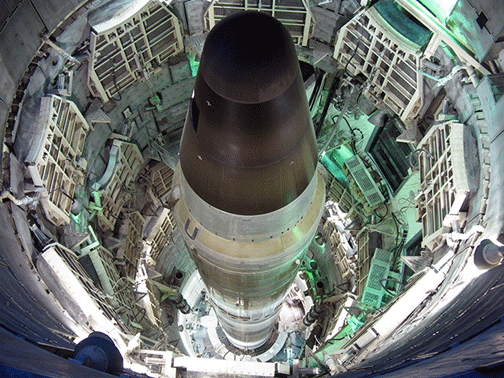
The United States has an active stockpile of more than 4,000 nuclear weapons, arrayed in the triad of land-based launch sites, nuclear submarines, and strategic bombers, including nuclear-armed ICBMs, air- and sea-launched cruise missiles, and gravity bombs. More than enough to destroy the world several times over, the arsenal’s “credibility” is not in issue. Yet the review reaffirms the Obama administration’s commitment to a new generation of missiles, nuclear submarines, strategic bombers, and nuclear bombs. It warns of a “rapid deterioration of the threat environment,” making it imperative not to “delay modernization of our nuclear forces if we are to preserve a credible nuclear deterrent.” Read the full text of Katrina’s column here.



 NASA also has its eye on atomic technology to power human colonies once they get to Mars. The agency and the Department of Energy are developing a space-ready nuclear fission reactor, known as Kilopower, that could provide up to 10 kilowatts of power and be deployed on other planets and moons. NASA has employed radioisotope thermoelectric generators — batteries that run off the heat from radioactive materials — on previous space missions, including the Mars Curiosity rover.