Feds: Russian Hackers Are Attacking U.S. Power Plants, TIME By NASH JENKINS 16 Mar 18 Officials in Washington say that Russian hackers are in the midst of a widespread attack on crucial components of U.S. infrastructure, according to a Department of Homeland Security (DHS) report released Thursday.
The targets of these attacks include the country’s electric grid, including its nuclear power system, as well as “commercial facilities, water, aviation, and critical manufacturing sectors,” the statement said.
The report is damning confirmation of what has for months been suspected: that hackers in Russia are capable of infiltrating and compromising vital systems relied on by millions of Americans. According to the new report, the attacks began at least as early as March 2016, thriving on vulnerabilities in these systems’ online operations.
………..The report cites a widely circulated investigation from Symantec released in October 2017 that linked the hacking group Dragonfly, suspected to be Russian, to a series of attacks on energy systems in the U.S. and Europe.
Bloomberg reports that victims of the attacks included a nuclear power plant located in Kansas.
New US nuclear submarines come with $128b price tag, 9 news, By Richard Wood
The total cost of the US navy’s new ballistic missile submarine fleet will be an “eye-watering” $US100 billion ($128b).
Earlier this week, Navy Secretary Richard V. Spencer said deep under the ocean remains the best best place to hide a nuclear deterrent – but it comes at a price.
The US Navy is seeking to build a fleet of 12 Colombia-class nuclear-powered ballistic missile submarines (SSBN), reports The Diplomat.
“All of sudden you’re talking about the submarines and there is a number that will make your eyes water. Columbia will be a $100 billion program for its lifetime.
“We have to do it. I think we have to have big discussions about it,” Spencer added.
Underwater has proved to date the most elusive environment for detecting an SSBN, he explained.
However, “it comes at a price,” the Navy secretary added.
Construction of the first Columbia-class sub is scheduled to start in 2021, with the US navy taking delivery from 2028.
Australian maritime warfare expert James Goldrick told nine.com.au the US is determined to keep its edge in submarine technology.
Despite recent developments in underwater detection, submarines remain difficult to pinpoint, he said.
“The sea is a very complex medium. It remains the most impenetrable environment, and I think the US is banking on this continuing.”
And Rear Admiral Goldrick said despite Russia and China unveiling new planned nuclear weapons, the US maintains an advantage in submarine technology.
Putin claims new weapons could strike ‘anywhere in the world’
“The Americans are well ahead of the Chinese. The Russians, however, have become well advanced in modernising their submarine fleet.”
The Columbia-class vessels are due to replace the US navy’s current Ohio-class SSBN fleet.
Technical details of the new vessels remain sketchy, but they are set to be the biggest sub the US navy has ever commissioned, The Diplomat reports.
Designed by General Dynamics Electric Boat, they measure 171m and have a beam of 13m.
Paul Waldon Fight To Stop Nuclear Waste Dump In Flinders Ranges SA, 15 Mar 18Today the 15th of March is another red letter day in the nuclear arena with the 56th anniversary of the death of Arthur Holly Compton, surprisingly (very surprisingly) the only one of the “Big Four” with the Manhattan project who did NOT die of cancer due to his reported time exposed to radioactivity.
However the other three Robert J Oppenheimer, Ernest Orlando Lawrence, and Enrico Fermi went to their graves, victims of cancer fueled by their exposure to radiation in a nuclear industry despite all precautions taken. The commonality of nuclear death doesn’t discriminate between engineers, scientists, physicists and the grunts at the front line, though its the grunts that fall short of compensation, acknowledgement, or appreciation of their service.
We have all heard of the death of Marie Curie, physicist and her lead lined coffin and radioactive grave site, Harry K Daghnian Jr, and Louis Slotin who both died of acute radiation sickness from exposure while serving on the Manhattan project, the death of Los Alamos chemical operator Cecil Kelley, and seven engineering crew aboard the K-19 sub from radioactive exposure, only to name but a few, however the nuclear industry spends time and money debunking the rights of people afflicted by hard to prove nuclear contamination in this dangerous industry. Nuclear fueled brigandage of the planet does NOT have a conscience.https://www.facebook.com/groups/344452605899556/
Russia Hacks U.S. Nuclear Plants, Infrastructure ‘Hundreds Of Thousands Of Times A Day’ Investors Business Daily MICHAEL LARKIN-16 Mar 18,Russian hackers are attacking critical U.S. infrastructure, including the energy grid, nuclear power plants, and airports, according to U.S. government officials.
Water processing plants are among the other targets being repeatedly tested by rolling attacks. Last year, more than a dozen power plants in seven states were breached due to Russia’s ongoing campaign of cyberattacks.
Energy Secretary Rick Perry told the House Appropriations Subcommittee Thursday cyberattacks are “literally happening hundreds of thousands of times a day. … The warfare that goes on in the cyberspace is real, it’s serious, and we must lead the world.”
Such attacks were cited as being one of the reasons the Trump administration imposed sanctions on a series of Russian organizations and individuals Thursday. In a doomsday scenario, such attacks could leave millions without water and electricity……..
An alert issued by the Department of Homeland Security and the FBI Thursday laid out in more detail what the Russians have been targeting, and how they are going about it.
“Since at least March 2016, Russian government cyber actors … targeted government entities and multiple U.S. critical infrastructure sectors, including the energy, nuclear, commercial facilities, water, aviation, and critical manufacturing sectors,” the alert said.
The techniques being employed include sending spear-phishing emails from compromised legitimate accounts, host-based exploitation and the targeting of industrial control system infrastructure………
While information theft was one of the goals, a key prize would have been gaining control of systems used by infrastructure. They could then launch attacks that could leave millions without water and power.
An even more worrying prospect would be hackers gaining control of a nuclear power plant. A sudden shutdown can trigger safety systems designed to disperse excess heat and prevent a meltdown, though safety systems themselves may be vulnerable to attack. However, the operating systems used at such plants are usually decades-old legacy controls that cannot be exploited by hackers. …….https://www.investors.com/news/russia-hackers-attacking-u-s-power-plants-infrastructure-water-plants/
The federal government is demanding that the company building a giant nuclear waste treatment plant in Washington state provide records proving that the steel used in the nearly $17 billion project meets safety standards.
The U.S. Department of Energy says in a letter obtained by the Associated Press that records needed to ensure that the structural steel used in the project is safe are either missing or of “indeterminate quality.”
“This condition is a potentially unrecoverable quality issue,” said the letter sent March 6 from the agency’s Office of River Protection in Richland to Bechtel National Inc., which is building the long-delayed plant to dispose of wastes created in the production of plutonium for nuclear weapons.
The agency gave Bechtel National 14 days to provide proof that work on the project should continue.
The plant is located on the Hanford Nuclear Reservation near Richland, which for decades made most of the plutonium for the nation’s nuclear weapons arsenal. The resulting 56 million gallons of radioactive and hazardous wastes are stored in 177 underground tanks, many of which are leaking.
The waste treatment plant is designed to turn much of that waste into glass-like logs for burial, a technically demanding process.
But construction of the giant plant, which began in 2002, has long been slowed by safety and technical issues.
Bechtel National is working on providing the records, spokeswoman Stasi West said. “We have documentation that demonstrates the nuclear-grade structural steel meets project requirements,” West said. “The safety and quality of the structural steel was never in question.”
The letter from the Office of River Protection, which is named for the Columbia River that flows through the Hanford site, did not contend that the structural steel in the Hanford Tank Waste Treatment and Immobilization Plant was defective. Rather it says that records proving the steel can perform its safety function were missing or of poor quality.
The agency directed Bechtel “to promptly investigate the facts and circumstances surrounding the procurement, receipt and acceptance of materials installed … to justify the continuation of work,” the letter said.
In a statement, the Department of Energy said it was committed to the safety of workers, the public and the environment.
“The department directed Bechtel National Inc. to gather the necessary documentation and provide it to the department,” the DOE said Friday. “When received, DOE will determine whether the documentation meets applicable quality assurance standards for the steel being used in the (plant).”
The watchdog group Hanford Challenge contended the issue was potentially a “showstopper.”
“If the structural steel and other components cannot meet rigorous safety standards for nuclear operations, the plant cannot be allowed to operate,” said Tom Carpenter, executive director of Hanford Challenge. “The contractor failed and needs to be held accountable.”
About 40,000 tons of structural steel is needed for the plant, to help prevent the release of radioactive and hazardous wastes into the environment.
“Structural steel, in conjunction with reinforced concrete structures, is integral to performing functions relied on in safety basis accident analyses,” the letter said.
The plant will use state-of-the-art vitrification technology, which involves blending the nuclear waste with glass-forming materials and heating it to 2,100 degrees Fahrenheit. The molten mixture is poured into stainless steel canisters to cool and solidify. In the glass form, the waste is stable and its radioactivity will safely dissipate over hundreds to thousands of years.
The construction site spans 65 acres and plant buildings are up to 12 stories tall. The plant is expected to be completed early in the next decade.
A team of six experts in the nuclear energy sector has been assembled to find a way to move the 3.55 million pounds of nuclear waste at the San Onofre Nuclear Generating Station.
The group includes a former chairman of the Nuclear Regulatory Commission, the independent agency in charge of all safety-related matters surrounding nuclear energy in the U.S., and a former director of policy at the U.S. Department of Energy.
The panel was put together as part of an out-of-court settlement negotiated last summer between Southern California Edison — the utility that operates SONGS — and attorneys for two San Diego-area plaintiffs who opposed a permit granted by the California Coastal Commission allowing waste to be stored on the plant’s premises.
One of the terms in the settlement called for creating a team of authorities in engineering, radiation detection and nuclear waste siting and transportation to learn if any alternative sites exist to store SONGS’ spent fuel.
“This is a very significant step; this hasn’t been done before,” Aguirre said. “There hasn’t been an owner of nuclear waste that has brought together a panel working with the community that’s focused on figuring out how to move (the waste) to a safer location.”
SONGS sits between the Pacific Ocean and one of the busiest freeways in the country — Interstate 5. About 8.4 million people live in a 50-mile radius of the plant in an area with a history of seismic activity.
Among the members of the panel is Allison Macfarlane, who chaired the Nuclear Regulatory Commission from 2012 to 2014, and Thomas Issacs, whose time at the Department of Energy included policymaking regarding waste management and security.
Speaking in general terms about nuclear waste, Macfarlane told the audience, “It is our ethical responsibility to deal with this material and not leave it for future generations.”
The other members of the panel are:
Kristopher W. Cummings, a fuel storage expert and engineer with Curtis-Wright Nuclear Division.
Gary Lanthrum, the former director of the National Transportation Program for Yucca Mountain.
Richard C. Moore, a consultant specializing in transportation of radiological materials who works for the Western Interstate Energy Board.
Josephine Piccone, a health physics and radiation control expert with regulatory compliance experience
“We believe this distinguished panel of experts will make significant contributions to a growing industry-wide effort to achieve off-site storage of nuclear fuel,” Tom Palmisano, vice president of decommissioning and chief nuclear officer at SONGS said in a letter to members of the facility’s Community Engagement Panel.
“We have a long road ahead as we undertake this difficult task but selection of these experts is an important step,” Palmisano said, adding that the panel will begin its work “in the coming weeks.”
The team of experts was assembled with input from the attorneys involved in the settlement and from Edison officials.
About 80,000 metric tons of spent fuel has accumulated at nuclear reactor sites across the country.
The Yucca Mountain repository in Nevada was supposed to accept large amounts of waste, but Nevada lawmakers, especially then-Senate Majority Leader Harry Reid, were firmly against opening the site. The Obama administration cut off funding for Yucca Mountain in 2010.
An Albuquerque-based nonprofit that advocates for nuclear disarmament filed a lawsuit this week asking a U.S. District Court judge to order the release of federal documents detailing the costs and risks of plutonium work planned at Los Alamos National Laboratory.
In its lawsuit, filed Wednesday in the federal District Court in Albuquerque, the Los Alamos Study Group accuses the National Nuclear Security Administration of improperly withholding a study that it says should be released upon request under the federal Freedom of Information Act.
While congressional staff members and some lab officials have been briefed on the document, argues the nonprofit — a longtime critic of the lab and the U.S. Department of Energy — the unclassified study has not been released to the public and has not been provided to the group, despite a request made under the public records law more than three months ago.
The National Nuclear Security Administration in November completed the roughly 400-page study comparing the potential costs, time frame and risks of creating a proposed assembly-line factory for plutonium pit production at various Energy Department sites.
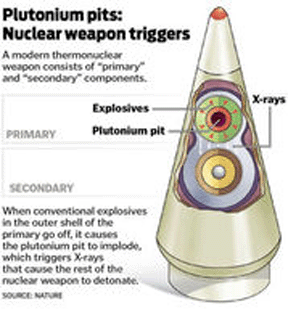
The Los Alamos lab has been producing pits — the grapefruit-size fission triggers that ignite nuclear weapons — on a smaller scale for decades, and New Mexico’s congressional delegation has been pushing to keep that work in the state as the nation’s mission to modernize its nuclear weapons arsenal ramps up.
A summary of the National Nuclear Security Administration’s study, leaked in December, shows that Los Alamos and the Savannah River Site in South Carolina are the final contenders for the pit factory, expected to cost up to $7.5 billion and take 10 to 20 years to complete.
According to the leaked material, which was reviewed by The New Mexican, the work would take longer to complete in Los Alamos and costs would be higher there.
The Los Alamos Study Group also contends the risks of pit production at Los Alamos are significant and should be disclosed to the public.
The nonprofit’s director, Greg Mello, said in a statement Thursday, “We believe [pit production] is proceeding ‘under cover of darkness’ on purely ideological grounds, and not on any defensible managerial basis. … It is a vast waste of resources, though lucrative for a few contractors.”
The organization believes the U.S. already has an excess of pits in its weapons stockpile and that future production would present a grave risk to the public while wasting public funds. The U.S. arsenal contains 23,000 pits, the group says in its suit, at least a third of which its says are viable and would last through 2063.
Los Alamos began producing plutonium pits after the Rocky Flats Plant in Colorado was shut down in the early 1990s, following a federal raid that found the plant rife with environmental contamination and nuclear safety violations.
Residents in the Rocky Flats area spent more than two decades entangled in a lawsuit with the plant’s operators after plutonium was found to have traveled to thousands of homes.
Los Alamos has had its share of nuclear safety violations, as well.
The lab’s plutonium facility, which restarted pit production in 2015 following a yearslong pause over safety concerns, was cited for a series of violations in the last year alone. Several workers were contaminated with radiation in 2017, and a small fire burned one worker. The lab was fined several million dollars for mishandling an out-of-state shipment of plutonium, and federal inspectors raised concerns recently about how the lab manages the toxic metal beryllium.
As President Donald Trump steps up efforts to engage North Korea in nuclear disarmament talks, the State Department is in the most turmoil since the president’s inauguration.
The latest upheaval came Tuesday with the sudden firing of Secretary of State Rex Tillerson, who was dismissed with few details provided by the White House. Trump picked CIA Director Mike Pompeo to be the next secretary of state.
The moves followed Trump’s abrupt announcement last week of a yet-to-be-arranged meeting with North Korean leader Kim Jong Un.
But the prospects for any diplomatic breakthrough are clouded by senior State Department vacancies, including a permanent U.S. ambassador to South Korea. The Trump administration has also yet to fill other positions critical to any talks with North Korea, including a permanent undersecretary for arms control and international security affairs, as well as a permanent assistant secretary for East Asian and Pacific Affairs.
Dozens of other key diplomatic jobs remain unfilled, including ambassadors to key U.S. allies such as Germany, Australia and Saudi Arabia.
More than two dozen ambassador posts are waiting for nominations to be put forward; nominees for more than a dozen others are waiting for confirmation.
The vacancies have strained ties with key U.S. allies. On Tuesday, Germany’s Deputy Foreign Minister Michael Roth tweeted that Tillerson’s firing won’t help.
“The dismissal of Rex #Tillerson does not make anything better,” Roth said in a tweet.
Tillerson’s departure also adds to ongoing uncertainty about Trump’s promised reorganization of the State Department. Last fall, the senior official charged with overseeing that effort stepped down after less than four months on the job amid widespread criticism from current and former American diplomats.
Rumors about friction between Trump and Tillerson began circulating last year. In October, NBC News reported that Tillerson called the president a “moron,” something Tillerson never directly denied. Tillerson continued to insist his relationship with the president was solid and brushed off rumors of strain between them.
His departure is just the latest in a high-velocity revolving door that has dogged the Trump administration. Last week chief White House economic advisor Gary Cohn resigned after a heated dispute over Trump’s announcement of steep steel and aluminum tariffs, a move Cohn opposed.
Blair Horner: Fukushima Anniversary And NY’s Subsidies Of Nuclear Power, WAMC, ByBLAIR HORNER • MAR 12, 2018 “……..The power plants in Fukushima are of the same design as some in New York State, which are located on Lake Ontario. While no one would expect the same scenario to occur, those plants have been the focus of state policies in recent years.
The plants, built in the 1960s, have exceeded their expected useful lifetimes. Generally, plants of that design and era are expected to be used for roughly 40 or so years. Yet those plants continue to operate under a deal negotiated largely outside of public view.
In the summer of 2016, negotiators from the Cuomo Administration and the plant owners agreed to a multi-billion dollar bailout of the plants – which were slated for closure. At that time, the state did not reveal the estimated costs, but subsequent analyses estimated that the costs could run anywhere from $2.9 billion to $7.6 billion over a 12-year period. The negotiation contained no new safety requirements for the plants, just a guarantee that virtually all New Yorkers would be required to pay to make the nuke plants profitable – whether they received power from the plants or not – to keep them open.
The safety records of the plants came under new scrutiny in a report issued last week by the Alliance for a Green Economy, an upstate New York nuclear watchdog organization. The report analyzed recent inspection reports and Nuclear Regulatory Commission (NRC) documents and identified three issues of concern:
The group identified regulatory violations without penalties: 18 violations of Nuclear Regulatory Commission regulations were reported between March 2017 and February 2018 for the four Upstate reactors, but no penalties or fines were assessed.
The group identified examples of weakened regulations at the request of nuclear operators. For example, at the request of one of the plant’s owners, the National Regulatory Commission changed the requirement for what constitutes an “unusual event” regarding Lake Ontario flooding. As we all know, there had been extensive flooding last year in the Lake Ontario area.
Lastly, the group identified missed deadlines for fixing known safety and maintenance issues: one plant near Oswego does not have a containment vessel likely to be able to contain the pressure and radiation released by a meltdown and installation of a required vent has been delayed; the plant’s owner is behind schedule for fixing numerous maintenance issues.
New York State should learn the lessons of the dangers of relying on nuclear power and follow the path set by California: move to shut down these aging facilities, and instead move toward greater reliance on solar, wind and geothermal power.
Those power generators have been starved of adequate support since so much of the state’s wealth is tied up in propping up the Lake Ontario plants. New York energy efficiency programs are anemic and lag far behind neighboring states and currently solar only generates about 1 percent of the power for the state. Instead of mandating that New Yorkers subsidize aging, inefficient, 20th century nuclear plants, that money should be redirected to 21st century conservation and renewable energy programs. Blair Horner is executive director of the New York Public Interest Research Group.http://wamc.org/post/blair-horner-fukushima-anniversary-and-ny-s-subsidies-nuclear-power
Dahr Jamail | Washington State’s Deep Political and Economic Alliance With the Pentagon, Truthout, March 12, 2018, By Dahr Jamail, Truthout | Report “…….what if you learned Washington State was allocating millions of dollars of its taxpayers’ money to fund an institution set up to do nothing more than lobby for a larger military presence?
Additionally, what if you found out that one of your elected representatives, who you were led to believe was a liberal Democrat, had positioned herself atop said institution, and had actively sponsored a bill aimed at allowing the military free reign to do what it wants — wherever it wants to do it — within the state, with little or no recourse for the citizens it could impact?
In supposedly “blue” Washington State, this is exactly what is happening.
“Kristine Reeves is double dipping, although it might be legal, [by] being the executive director for the Washington Military Alliance while proposing laws that advance the objectives of the WMA as a Washington State legislator,” Glen Milner, a researcher with the Ground Zero Center for Nonviolent Action, told Truthout.
“In addition, the Washington Military Alliance gets its grants from the DOD,” added Milner, who has been tracking the expanding militarism across Washington State for decades. “I suppose this is just corruption at work.”
While Reeves might be progressive on many issues, she’s clearly doing the military’s bidding, according to Milner.
And while HB 2341 failed, for now, to make it out of committee — thanks to committed grassroots efforts by citizens concerned about their state becoming a wider-scale military training area — Reeves’ efforts run far deeper than just that bill.
“Washington State residents should be concerned because the WMA sees at least some parts of the state as a ‘power projection platform’ for the military,” Milner warned Truthout.
In fact, “power projection platform” are not Milner’s words, they are Rep. Reeves’ words. The lawmaker used the exact same phrase in an email to members of Washington State’s Department of Commerce. In the January 2016 email obtained by Truthout, Rep. Reeves discussed her efforts to help generate a graphic for the deputy chief of staff at Joint Base Lewis-McCord (JBLM) in Washington, a massive military installation south of Tacoma, to show “the value of the strategic placement of JBLM and its dependence on the ‘outside the fence’ infrastructure that creates the designation of power projection platform.”
Her rough graphic shows four arrows emanating from Washington State and pointing across the Pacific toward North Korea and other locations.
A “power projection platform,” a term used by both the military and the WMA, is a hub for the combined elements of national power — political, economic, informational and military — that facilitates a country’s ability to rapidly and effectively deploy and sustain forces around the world.
Reeves is far from alone in her efforts. Jay Inslee, Washington’s so-called “green governor,” along with his Department of Commerce, appears to have been, for years, acting as a strong proponent for military activity in Washington State. By actively supporting the WMA and other similar efforts, as well as signing off on documents like the Retaining and Expanding Military Missions: Increasing Defense Spending and Investment, Inslee has sought to increase military personnel and training across Washington.
“This is all about who controls Washington State,” Milner warned. “Does our state government follow the wishes of state citizens, or the Department of Defense?”
A Truthout investigation points toward powerful forces in the state government actively collaborating with the Department of Defense.
Washington State’s Not-So-Secretive Collusion With the WMA
Founded in 2012 under then Washington Gov. Christine Gregoire, the WMA was made operational under Governor Inslee in 2014, with a $4.3 million grant from the DOD’s Office of Economic Adjustment (OEA).
The OEA has provided other grants for Washington State and counties, such as funding for Joint Land Use Studies, which are supposedly planning efforts between active military installations and their surrounding jurisdictions, state and federal agencies, and other affected stakeholders aimed at addressing compatibility around military installations and military operations. In 2016, the OEA provided a $585,000 grant to the Department of Commerce (which includes the WMA) to create a legislative report for military issues and for 2017 program funding.
“As you might expect, all of this creates nothing more than propaganda for the Department of Defense,” Milner explained. “Whenever the WMA addresses anything, the first thing mentioned is jobs, jobs, jobs — without any analysis of how the civilian sector could use huge areas of real estate in Washington State that are now military bases. The various Joint Land Use Studies and the legislative report are all propaganda with no input that might stand against military objectives.”
Documents show that, via the Washington Military Alliance, Washington’s Department of Commerce hired The Spectrum Group as their go-to beltway consulting group to assist in making all of Washington State “more compatible” with military activities.
Unfortunately, the taxpayer funded WMA/Department of Commerce reports appear to have been accepted as fact by Reeves and some other members of the legislature, as evidenced by the egregious nature of failed-HB 2341.
All of this has serious practical implications for residents of Washington State……….
Resistance
Charles Knutila is a retired Command Sergeant Major in the Army who lives on Whidbey Island in Puget Sound. Just before HB 2341 went into committee, Knutila reached out to his state representatives to express his outrage over their collaboration with the DOD.
In an email he wrote to his representatives which he provided to Truthout, Knutila wrote, “The executive director of the WMA, Representative Reeves, although a member of the House of Representatives, is functioning as a lobbyist for the Department of Defense in obtaining Economic Adjustment dollars in order to put together a lobbying organization to protect the military/industrial sectors interests.”
Knutila questioned whether a person could represent both the military and the people.
“Is Representative Reeves registered as a lobbyist?” he wrote. “Who does Representative Reeves, the house sponsor of this bill, similar to the Senate version, work for? The defense industry, the Department of Commerce, or actually the citizens of the State of Washington?”
Knutila told Truthout that he “strongly objects” to Washington’s Department of Commerce “funneling DOD dollars into a military-industrial complex lobbying group for the purpose of influencing state and local business matters.” ……..
Given that the US is, at least in theory a democracy, advocates say that what is missing in this equation is civilian opinion — especially since, ultimately, it is civilian lives that will be most affected.
“The JCPOA addresses one of the principle threats that we deal with from Iran, so if the JCPOA goes away, then we will have to have another way to deal with their nuclear weapons program,” said U.S. Army General Joseph Votel. JCPOA, or Joint Comprehensive Plan of Action, is the formal name of the accord reached with Iran in July 2015 in Vienna.
Trump has threatened to withdraw the United States from the accord between Tehran and six world powers unless Congress and European allies help“fix” it with a follow-up pact. Trump does not like the deal’s limited duration, among other things.
Votel is head of the U.S. military’s Central Command, which is responsible for the Middle East and Central Asia, including Iran. He was speaking to a Senate Armed Services Committee hearing on the same day that Trump fired Secretary of State Rex Tillerson after a series of public rifts over policy, including Iran.
Tillerson had joined Defense Secretary Jim Mattis in pressing a skeptical Trump to stick with the agreement with Iran.
“There would be some concern (in the region), I think, about how we intended to address that particular threat if it was not being addressed through the JCPOA. … Right now, I think it is in our interest” to stay in the deal, Votel said.
In anearly morning tweet, President Trump fired Secretary of State Rex Tillerson and announced that Mike Pompeo, CIA director and unofficial third Koch brother, would be taking over. In other words, a guy who believes climate change is merely an “engineering problem” is being replaced by someone who probably doesn’t think it’s even real.
Pompeo’s environmental record is pretty damning:
In a 2013 interview with C-SPAN’s Washington Journal, he argued that there’s considerable debate within the scientific community about the causes of global warming. There isn’t.
Since 2009, he has accepted more than a million dollars from the oil and gas industry while campaigning for Congress.
He was the largest recipient of Koch Industries campaign money in 2010. And soon afterward, as a newly elected Kansas representative, he hired a former Koch lawyer to be his chief of staff.
It looks like the Koch brothers, who’ve played a huge part in galvanizing the Republican Party against climate change, have Pompeo exactly where they want him.
And why is it important for our secretary of state to understand the basics of climate change? For one, climate change poses a “growing geopolitical threat” to national security — a threat that Pompeo appears quite unequipped to tackle.
“The people of New Mexico have been waiting 73 years for acknowledgment of the suffering that people have endured here after radiation they were exposed to during the Trinity Test,” said Tina Cordova of Tularosa Basin Downwinders Consortium.
The Tularosa Basin Downwinders say tens of thousands of residents near the Trinity Site were exposed to radiation during the world’s first atomic bomb test.
Now, they always want to testify in front of Congress.
Trump under pressure over chaotic approach to North Korea nuclear talks, Guardian Jon Swaine 12 Mar 18
Republicans: denuclearisation must be prerequisite for meeting
CIA director and White House spokesman contradict each otherDonald Trump faced criticism from Republican allies on Sunday after apparentlyagreeing to meet Kim Jong-unwithout demanding that North Korea start scrapping its nuclear program.North Korea talks: Trump praises own role but Washington frets over details
Senators from Trump’s own party expressed scepticism and urged him to set tougher preconditions, amid growing concerns over the administration’s chaotic approach to nuclear diplomacy.
Senator Cory Gardner of Colorado said Trump should not meet Kim until North Korea produces proof it has begun reversing its years-long pursuit of a nuclear weapon.
“What we have to hear more of is how we are going to get to those concrete, verifiable steps towards denuclearisation before this meeting occurs,” Gardner told Face the Nation on CBS.
Trump’s team has given a series of muddled statements on that precondition. No mention of it was made during an abrupt announcement on Thursday that Trump was willing to hold a summit with Kim by May, in what would be the first ever meeting of the two countries’ leaders…….
The president has offered little clarity. After tweeting about conversations with world leaders on the issue he returned to it in a rambling speech to supporters in Pennsylvania on Saturday evening, saying of North Korean denuclearisation: “They are thinking about that – who knows what’s going to happen?”
The uneven public statements followed an eccentric unveiling of Trump’s historic acceptance of Kim’s invitation. The decision was announced to journalists on the White House driveway by a South Korean official, shortly after Trump’s secretary of state, Rex Tillerson, had said direct negotiations were a distant prospect.
Having lambasted Barack Obama for what they deemed an overly conciliatory approach to Iran during nuclear talks, Republicanswere left struggling to defend Trump’s position.
……. Democrats, too, expressed concerns. “I am very worried that he’s going to go into these negotiations and be taken advantage of,” Senator Elizabeth Warren of Massachusetts said on CNN.Warren said Trump should urgently address a lack of senior diplomats who would probably be needed for successful negotiations. The US has no permanent ambassador to South Korea or assistant secretary of state for the region.
That view was echoed by Ben Rhodes, a former senior aide to Obama, who was involved in the Iran deal and said the Trump administration appeared unprepared for discussions of similar gravity.
What the president and his supporters really mean, of course, is that experts have not shown the proper deference to people who do not understand anything about the world around them. The president seems to believe that no one shows him the proper deference.
Trump and the new Know-Nothings who support him are exploiting this for short-term political gain, but in the longer run, these policies will hurt the very people who voted for Trump in the first place.
Trump is delivering what he promised: A government with no experts, Washington Post, By Tom NicholsMarch 8 Tom Nichols is a professor at the Naval War College and the Harvard Extension School and the author of “The Death of Expertise.”
President Trump kept an important campaign promise this week. Not the one about tariffs — that was incidental — but the one where he vowed to give his supporters the satisfaction of seeing him ignore experts.
The president has plunged ahead with his plans to reverse 70 years of U.S. policy, against the advice of his secretaries of defense and state. His top economic adviser, Gary Cohn — who was unfazed by Trump’s equivocation about Nazis but has found his personal red line on trade policy, apparently — also advised against the tariffs and has now walked out in defeat.
None of this really has very much to do with actual policy. By the time Trump announced the details of the steel and aluminum tariffs on Thursday, his facile public statements about how trade wars are easy to win had already made it clear that he has no actual grasp of what a trade war is, or what it could mean for the United States to start one.
But like so many Trump positions (the wall, the Muslim ban, gun control) the actual content of the policy is irrelevant. His presidential campaign, at its core, operated on a simple premise of social revenge, a notion that only Donald Trump could get even with the shadowy experts who run (and ruin) the lives of ordinary Americans. He vowed to push the eggheads out of the way — not because they are wrong, but because they are eggheads, and nobody likes eggheads……….
Since taking office, however, intelligent people in the administration have been trying to pad the sharp corners around the West Wing in an attempt to prevent these campaign promises from becoming ill-advised realities that could harm both the country and the administration. So with the chaotic point the White House has now reached, the president’s supporters are finally going to get what they want: Their rallying cry all along has been to let Trump be Trump and to ignore people who actually know what they’re doing. ………..
They [the pro Trump expert advocates] are smart enough to know that this campaign against expertise is a sham. They are leading the charge now not only because it is profitable, but also perhaps because they hope that when all this is over, the Jacobins will come for them last.
What the president and his supporters really mean, of course, is that experts have not shown the proper deference to people who do not understand anything about the world around them. The president seems to believe that no one shows him the proper deference. But others have a point, at least about workers who have been hurt by globalization. Experts do lack a certain empathy when it comes to these issues. We tend to be the people who, when asked a question by someone who’s just lost their job, point to low unemployment rates — as though that matters to a recently jobless person. We might be right, but it rankles nonetheless.
This is why the attack on experts appeals both to Trump and his voters: It scratches a deep itch of resentment that has nothing to do with intelligent policy and everything to do with feeling ignored by the people who have to make things work every day.
In the same way that the president fulminates at being told that his ideas might be flawed or wrong, a fair number of Americans now bristle when told that they have to do anything they don’t like: vaccinate their children, eat a healthy diet, put down their phones while driving. None of this is really about steel imports or fortified borders or Muslim travelers; it is about regaining a sense of empowerment.
The world is a complex place. It frightens people to think how much of their daily life is in the hands of their fellow citizens. This has been true since the beginning of the 20th century, and life in the 21st century is not going to get any less dizzying or complicated. Trump and the new Know-Nothings who support him are exploiting this for short-term political gain, but in the longer run, these policies will hurt the very people who voted for Trump in the first place.
Gary Cohn could probably explain all this to the president, if he were still around.