The U.S. military wants more plutonium triggers for nuclear warheads WP, By Paul SonneMarch 22 Email the author
The U.S. military is concerned that the government isn’t moving quickly enough to ramp up American production of the plutonium cores that trigger nuclear warheads, as the Trump administration proceeds with a $1 trillion overhaul of the nation’s nuclear force.
Questioning about production of the warhead cores is likely to figure into a testimony that Energy Secretary Rick Perry is slated to give Thursday to the Senate Armed Services Committee, a rare appearance by the top energy official at the Senate body that oversees the military.
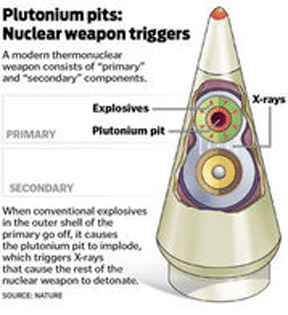
Plutonium cores are often called plutonium pits because they rest inside nuclear bombs like pits inside stone fruits.
At issue is the Pentagon’s demand that the National Nuclear Security Administration — overseen by the Department of Energy — be able to produce 80 plutonium pits a year by 2030 to sustain the military’s nuclear weapons. Roughly the size of a grapefruit, plutonium pits that trigger warheads sometimes need to be replaced as they degrade or end up destroyed during evaluation……….
Since the fall of the Soviet Union, the United States has discontinued many of the nuclear weapons capabilities the nation built up during the Cold War. The United States began to rely largely on dismantling existing nuclear weapons for plutonium pits and stockpile management, as defense spending priorities diverted to the global war against terrorism.
Now the United States is facing a reckoning as Russia and China also race to advance their nuclear arsenals and much of the infrastructure the military relies on to support its nuclear capabilities ages out. The U.S. no longer operates the full range of facilities capable of producing new nuclear weapons.
……….Now the NNSA must decide how to expand production of plutonium pits to meet the Pentagon’s requirements by 2030. Under one option being considered, less ambitious “module” buildings would be constructed at the existing Los Alamos site.
An alternative would include repurposing one of the most problematic projects the Department of Energy has ever undertaken, the Mixed Oxide Fuel Fabrication Facility in South Carolina, to make pits.
Originally designed to turn weapons grade plutonium into commercial reactor fuel, the MOX facility is billions of dollars over budget and still only partially built.
Both the Obama and Trump administrations have tried to kill the project, but Congress has declined to discontinue construction owing primarily to political support from powerful members of the South Carolina delegation. Some have suggested transforming it to produce plutonium pits.
When the US entered the nuclear age, it did so recklessly. New research suggests that the hidden cost of developing nuclear weapons were far larger than previous estimates, with radioactive fallout responsible for 340,000 to 690,000American deaths from 1951 to 1973.
From 1951 to 1963, the US tested nuclear weapons above ground in Nevada. Weapons researchers, not understanding the risks—or simply ignoring them—exposed thousands of workers to radioactive fallout. The emissions from nuclear reactions are deadly to humans in high doses, and can cause cancer even in low doses. At one point, researchers had volunteers stand underneath an airburst nuclear weapon to prove how safe it was:
The emissions, however, did not just stay at the test site, and drifted in the atmosphere. Cancer rates spiked in nearby communities, and the US government could no longer pretend that fallout was anything but a silent killer.
The cost in dollars and lives
Congress eventually paid more than $2 billion to residents of nearby areas that were particularly exposed to radiation, as well as uranium miners. But attempts to measure the full extent of the test fallout were very uncertain, since they relied on extrapolating effects from the hardest-hit communities to the national level. One national estimate found the testing caused 49,000 cancer deaths.
Those measurements, however, did not capture the full range of effects over time and geography. Meyers created a broader picture by way of a macabre insight: When cows consumed radioactive fallout spread by atmospheric winds, their milk became a key channel to transmit radiation sickness to humans. Most milk production during this time was local, with cows eating at pasture and their milk being delivered to nearby communities, giving Meyers a way to trace radioactivity across the country.
The National Cancer Institute has records of the amount of Iodine 131—a dangerous isotope released in the Nevada tests—in milk, as well as broader data about radiation exposure. By comparing this data with county-level mortality records, Meyers came across a significant finding: “Exposure to fallout through milk leads to immediate and sustained increases in the crude death rate.” What’s more, these results were sustained over time. US nuclear testing likely killed seven to 14 times more people than we had thought, mostly in the midwest and northeast.
A weapon against its own people
When the US used nuclear weapons during World War II, bombing the Japanese cities of Hiroshima and Nagasaki, conservative estimates suggest 250,000 people died in immediate aftermath. Even those horrified by the bombing didn’t realize that the US would deploy similar weapons against its own people, accidentally, and on a comparable scale.
And the cessation of nuclear testing helped save US lives—”the Partial Nuclear Test Ban Treaty might have saved between 11.7 and 24.0 million American lives,” Meyers estimates. There was also some blind luck involved in reducing the number of poisoned people: The Nevada Test Site, compared to other potential testing facilities the US government considered at the time, produced the lowest atmospheric dispersal.
The lingering effects of these tests remain, as silent and as troublesome as the isotopes themselves. Millions of Americans who were exposed to fallout likely suffer illnesses related to these tests even today, as they retire and rely on the US government to fund their health care.
“This paper reveals that there are more casualties of the Cold War than previously thought, but the extent to which society still bears the costs of the Cold War remains an open question,” Meyers concludes.
https://mainichi.jp/english/articles/20180320/p2g/00m/0dm/023000c(Mainichi Japan) TOKYO (Kyodo) — Some 200 U.S. residents filed a suit against Tokyo Electric Power Company Holdings Inc. and a U.S. firm seeking at least $1 billion to cover medical expenses related to radiation exposure suffered during the 2011 Fukushima nuclear disaster, the utility said Monday.
The lawsuit was filed last Wednesday with U.S. federal courts in the Southern District of California and the District of Columbia by participants in the U.S. forces’ Operation Tomodachi relief effort carried out in the wake of the March 11, 2011, earthquake and tsunami that crippled TEPCO’s Fukushima Daiichi nuclear plant.
Many of the plaintiffs are suing TEPCO and the U.S. company, whose name was withheld by TEPCO, for the second time after a similar suit was rejected by the federal court in California in January.
They are seeking the establishment of a compensation fund of at least $1 billion to cover medical and other costs, the utility said.
The plaintiffs claim that the nuclear accident occurred due to improper design and management of the plant by TEPCO. They are also seeking compensation for physical and psychological damage suffered as a result of the disaster, said the utility.
In Operation Tomodachi, which began two days after the natural disasters, the aircraft carrier Ronald Reagan and other U.S. military resources and personnel were deployed to deliver supplies and undertake relief efforts at the same time as three reactors at the Fukushima Daiichi complex suffered fuel meltdowns.
With Russia building floating nuclear reactors and possibly testing nuclear-powered cruise missiles, there are good reasons for this training.The Drive, BY JOSEPH TREVITHICKMARCH 20, 2018The U.S. military, along with other federal and state authorities, has been training to respond to potentially dangerous releases of radioactive material in and around the Arctic. Though there is no clear indication of a direct link between Russia’s reported tests of nuclear-powered missiles or expanding use of nuclear power in the region, it is hard not to see these exercises in connection with those developments.
Earlier in March 2018, members of the U.S. National Guards from 10 different states arrived at the Donnelly Training Area, situated near the U.S. Army’s Fort Greely in Alaska. Alaska state authorities and members of Canada’s reserve 39 Canadian Brigade Group joined the exercise, nicknamed Arctic Eagle 2018, as well.
The drills included a number of different mock crises, including an overturned fuel truck creating a hazardous material spill, the potential for attacks on the Trans Alaskan Pipeline System, and even cyber attacks. But especially notable was a scenario involving the need to locate a crashed satellite and contain the radiological material it had deposited across a wide area as it plummeted to earth. ………
t’s definitely no secret that the U.S. military has become increasing interested in preparing for potential conflicts and other contingencies above and near the Arctic Circle in recent years. As global climate change has shrunk the polar ice cap and otherwise reduced the amount of ice buildup that occurs during certain parts of the year, the region has become increasingly important economically and various countries, especially Russia, have moved to enforce their territorial claims.
“The growing concerns regarding the increased number of nations competing for Arctic resources are well justified,” U.S. Air Force General Lori Robinson, head of U.S. Northern Command, which oversees operations in the region, and the designated “Advocate for Arctic Capabilities” within the Pentagon, reiterated to members of Congress during a hearing in February 2018. “Diminishing sea ice provides opportunities for significantly expanded access to a region that had previously been inaccessible to all but a handful of northern nations.”
…….. the idea of a crashing satellite creating a radiological disaster isn’t an entirely fictional scenario. In 1978, the Soviet Union’s Kosmos 954 reconnaissance satellite, which had a nuclear reactor as its power source, crashed into Canadian territory, touching off an international incident and prompting an expensive response and clean-up operation.
….. U.S. military and other agencies practicing specifically to handle a radiological incident in the region seems even more noteworthy in light of a number of recent events. Most importantly are Russian claims that it has been testing a cruise missile with theoretically unlimited range that uses a nuclear reactor-powered propulsion system in the Arctic. Anonymous U.S. government officials have since told various media outlets that this is true, but that the weapons have been crashing, potentially spreading radioactive material and components.
…… The Russians have also been dramatically expanding their use and plans to employ small and mobile nuclear reactors to support activities in the Arctic.
……..If any of these nuclear power systems were to fail, it could potentially cause a serious radiological incident that would impact both the United States and Canada. The same procedures American military and other government personnel have been training to employ in response to a crashed satellite would undoubtedly be applicable in those situations, too.
NASA to allow nuclear power systems for next Discovery mission, Space News by Jeff Foust — WASHINGTON — Citing progress in producing plutonium-238, NASA will allow scientists proposing missions for an upcoming planetary science competition to use nuclear power sources.
In a statement issued March 17, Jim Green, director of NASA’s planetary science division, said the agency was reversing an earlier decision prohibiting the use of radioisotope power systems for spacecraft proposed for the next mission in the agency’s Discovery program.
A “long-range planning information” announcement about plans for the competition, issued Dec. 12, said that the use of such power systems would not be allowed, although missions could use radioisotope heater units, which use a very small amount of plutonium to keep spacecraft elements warm.
NASA made that decision based on projected use of existing stocks of plutonium-238 for upcoming missions, such as the Mars 2020 rover. Dragonfly, one of the two finalists for the next New Frontiers medium-class planetary science mission, also plans to use a radioisotope power system, as well as potential future missions the moon that require nuclear power to operate through the two-week lunar night.
“We have some liens against the radioisotope power,” Green said at a Feb. 21 meeting of NASA’s Planetary Science Advisory Group, citing those upcoming missions. The agency, he said, needed to balance mission demands against existing stocks of plutonium and efforts currently ramping up to produce new supplies of the isotope, which should reach a goal of 1.5 kilograms a year by around 2022. “The last thing we want to do is to select a mission and then not be ready to fly it.”
At the time of the meeting last month, though, Green said the agency was reviewing the prohibition against using nuclear power for the Discovery competition at the request of the scientific community, but didn’t offer a schedule for completing that review……. http://spacenews.com/nasa-to-allow-nuclear-power-systems-for-next-discovery-mission/
This earthquake expert dodged Russian surveillance to try to halt nuclear testing , How a scientist studying earthquakes spent his career working to prevent nuclear explosions, The Verge By Rachel Becker@RA_Becks
At 5AM on a June morning in 1974, seismologist Lynn Sykes awoke to a phone call from the Department of Defense. The voice on the other end of the line asked Sykes to be ready to leave for Moscow that evening. The DoD needed his help to negotiate a treaty that would cap the size of the US and Russia’s underground nuclear explosions.
Sykes, now a professor emeritus at Columbia University’s Lamont-Doherty Earth Observatory, was invited because of his unusual expertise. Sure, he was an expert on earthquakes. But he was also an expert on underground nuclear explosions, which — like earthquakes — can send vibrations ringing through the Earth. So the same devices that monitor and measure quakes can do double duty as secret nuclear test sensors.
But there was an ongoing debate about whether it was possible to tell the size of an underground nuclear explosion from the seismic wiggles picked up by monitoring stations. If there were no sure way to check if someone was cheating on the deal, then neither the US nor Russia wanted to stop underground tests altogether. That’s why Sykes was in Russia: to confirm that detecting underground tests was scientifically possible, and to help negotiate a treaty that would limit underground nuclear tests to 150 kilotons or less.
The negotiations were a success, and President Richard Nixon and Soviet premier Leonid Brezhnev signed the treaty about a month later. But the quest for a complete ban on nuclear testing continues. The Comprehensive Test Ban Treaty, which would ban all nuclear tests of all sizes, was finalized in 1996. But the US, China, Iran, and North Korea still need to ratify it in order for the treaty to enter into force.
This Father-Daughter Team Says It Has a Cheaper, Safer Way to Bury Nuclear Waste, Startup Deep Isolation wants to use fracking tech to drill horizontal disposal tunnels a mile below the Earth’s surface. Bloomberg By Ashlee Vance, 20 March 18Richard and Elizabeth Muller have come up with one of the more unusual father-daughter businesses in recent memory. On March 20 they announced a startup called Deep Isolation that aims to store nuclear waste much more safely and cheaply than existing methods. The key to the technology, according to the Mullers, is to take advantage of fracking techniques to place nuclear waste in 2-mile-long tunnels, much deeper than they’ve been before—a mile below the Earth’s surface, where they’ll be surrounded by shale. “We’re using a technique that’s been made cheap over the last 20 years,” says Richard, a famed physicist and climate change expert. “We could begin putting this waste underground right away.”
…….. The U.S. has about 80,000 tons of nuclear waste, mostly sitting at about 70 sites, in aboveground water pools.
……….With each passing year, the U.S. produces an additional 2,000 tons of nuclear waste, and the total is already more than Yucca Mountain was meant to hold. While President Trump has sought a modest $120 million to restart the program, Congress has made clear it’s not going to broach the subject in an election year. “It’s quite a serious problem,” says Rodney Ewing, a Stanford professor of geological sciences who specializes in nuclear security. “As a country, we seem to not be paying attention to the obvious difficulties we have with the waste.”
Nuclear waste experts have contemplated deep-drilling for half a century, mostly by proposing to bore straight down into granite and crystalline rock. But tests of these techniques haven’t gotten very far, being blocked, on occasion, by the public. These approaches have been deemed costly and possibly unsafe, because stacking containers on top of one another puts so much weight on the bottom drums. The Mullers say it’s much cheaper and safer to drill horizontal tunnels, and to do so in shale. They can fit the typical waste canisters (each 1 foot in diameter and 14 feet long) quickly and safely into shale tunnels, they say, given advances in fracking equipment. “Drilling the holes takes a couple weeks at most,” says Elizabeth.
…….. It’d be best to keep the tunnels close to existing nuclear waste sites, the Mullers say. The U.S. is so shale-rich that the waste disposal tunnels could be placed near nuclear production sites, so no hauling of waste would be required. The boreholes would also be much deeper than something like Yucca, vastly reducing the chance of radioactive waste leaking into the water supply. “The goal is to get this stuff out of the biosphere, and the farther down you go, the less things change,” Elizabeth says. “The waste will have 1 billion tons of rock on top of it and be in shale that has held methane gas and other volatiles for tens to hundreds of millions of years. Things don’t leak out.” Also, unlike at Yucca, machines could handle all the tunnel work, says Richard: “We’re cheaper because we remove a lot less dirt and don’t put people underground.”
The elder Muller first made his name dealing with radiation much farther away. As a professor at the University of California at Berkeley and senior scientist at the Lawrence Berkeley National Laboratory, Richard did that pioneering research on dark energy and cosmic radiation, including work on projects that eventually earned Nobel Prizes. After he and Elizabeth co-founded Berkeley Earth, a nonprofit that measures global temperature and climate change, he went from being one of the most prominent global warming doubters to one of the loudest voices confirming that climate change is real and caused by humans.
…….. Before the Mullers can drill any holes in shale, they have massive challenges to overcome. Stanford’s Ewing says Deep Isolation will likely struggle to persuade dozens of communities to accept having a long-term nuclear waste site nearby and to persuade the government to let commercial companies tackle the problem. The two have drafted federal legislation that could lead to private nuclear waste disposal. “The government might allow this,” says Allison Macfarlane, former chair of the U.S. Nuclear Regulatory Commission. “The real question is whether such a small startup company would have the resources to go through the licensing over such a long time period.”……..https://www.bloomberg.com/news/articles/2018-03-20/this-father-daughter-team-says-it-has-a-cheaper-safer-way-to-bury-nuclear-waste
Pipe-crawling robot will help decommission DOE nuclear facility, Radiation-measuring robots go where humans cannot Science Daily
Date:
March 20, 2018
Source:
Carnegie Mellon University
Summary:
A pair of autonomous robots will soon be driving through miles of pipes at the US Department of Energy’s former uranium enrichment plant in Piketon, Ohio, to identify uranium deposits on pipe walls.
A pair of autonomous robots developed by Carnegie Mellon University’s Robotics Institute will soon be driving through miles of pipes at the U.S. Department of Energy’s former uranium enrichment plant in Piketon, Ohio, to identify uranium deposits on pipe walls.
The CMU robot has demonstrated it can measure radiation levels more accurately from inside the pipe than is possible with external techniques. In addition to savings in labor costs, its use significantly reduces hazards to workers who otherwise must perform external measurements by hand, garbed in protective gear and using lifts or scaffolding to reach elevated pipes.
DOE officials estimate the robots could save tens of millions of dollars in completing the characterization of uranium deposits at the Portsmouth Gaseous Diffusion Plant in Piketon, and save perhaps $50 million at a similar uranium enrichment plant in Paducah, Kentucky.
…….. Shuttered since 2000, the plant began operations in 1954 and produced enriched uranium, including weapons-grade uranium. With 10.6 million square feet of floor space, it is DOE’s largest facility under roof, with three large buildings containing enrichment process equipment that span the size of 158 football fields. The process buildings contain more than 75 miles of process pipe.Finding the uranium deposits, necessary before DOE decontaminates, decommissions and demolishes the facility, is a herculean task. In the first process building, human crews over the past three years have performed more than 1.4 million measurements of process piping and components manually and are close to declaring the building “cold and dark.”
“With more than 15 miles of piping to be characterized in the next process building, there is a need to seek a smarter method,” said Rodrigo V. Rimando, Jr., director of technology development for DOE’s Office of Environmental Management……….https://www.sciencedaily.com/releases/2018/03/180320084315.htm
Cortez Masto seeks details on Yucca spending since Trump’s election, The Nevada Independent, Humberto Sanchez , March 19th, 2018 , Sen. Catherine Cortez Masto has called on Energy Secretary Rick Perry to provide details on how the White House would spend funds requested for the Yucca Mountain nuclear waste repository, as well as how money has been spent since President Donald Trump was elected.
In a letter to Perry dated Monday, Cortez Masto, an opponent of the controversial project, noted that while the president has requested $120 million in both of his fiscal year (FY) 2018 and 2019 budget blueprints, with regard to the Department of Energy (DOE), neither of the budget documents provides a detailed account of how funding will be, or has been, spent.
“The FY 2019 Budget Justification, like the FY 2018 Budget Justification, provides little meaningful information on how DOE would actually spend these funds to participate in U.S. Nuclear Regulatory Commission licensing activities for the Yucca Mountain nuclear waste repository,” the letter said. “Moreover, neither of these budget documents provide any information on DOE expenditures from the Nuclear Waste Fund for Yucca Mountain activities during FY 2017 and FY2018.”
Cortez Masto wants Perry to disclose what the unobligated balances were in DOE’s Defense Nuclear Waste Disposal and Nuclear Waste Disposal accounts at the beginning of FY 2017, which started on Oct. 1, 2016, as well as for FY 2018.
She also wants to know how much was spent from these accounts during FY 2017 and 2018 for Yucca licensing activities; pension fund and related obligations for retired Yucca Mountain workers; administration of the Nuclear Waste Fund, financial audits; investment guidance; maintenance of records and technical and scientific information, including preservation and security of geologic samples. ……..https://thenevadaindependent.com/article/cortez-masto-seeks-details-on-yucca-spending-since-trumps-election
American Foreign Policy Has A Masculinity Problem, Huffington Post, Lauren Sandler, Columnist 15 Mar 18
Foreign policy has always had a masculinity issue: gender shapes war, gender shapes intervention and gender shapes peacekeeping. In regard to military foreign policy, women and men are divided “always and everywhere,” according to a 2013 Pew Research Center study. Not only are women rarely part of diplomatic negotiations, but a statistical chasm exists where global security is concerned. From drone strikes to nuclear armament, women tend to disagree with men’s support of offensive strategies.
With few exceptions, foreign policy, especially in its highest echelons, is a man’s territory. But even in a realm governed by a formal rotation of masculine superegos, American foreign policy has never been in the hands of such a male id. Last week’s surprise announcement of a meeting by May between President Trump and North Korean leader Kim Jong Un highlights, yet again, the perils of letting fragile male egos run the world. The prospect of the summit would be comic ― a Trey Parker and Matt Stone musical number ― were millions of lives, and perhaps ultimately the planet itself, not on the line………..
Diplomacy’s masculinity problem is nothing new, though every new Republican leader seems to inject it with fresh testosterone. Consider the Bush Doctrine, which arrived under cover of so much World Trade Center smoke. It sold two wars packaged in unequivocally masculine rhetoric, using the language of strength and dominance to distract from ― in the case of the Iraq War ― a lack of evidence of weapons of mass destruction or of Iraqi involvement in the 9/11 attacks. As analysts at the Brookings Institution described Bush’s aggressive “revolution” in foreign policy, “other countries will either follow or get out of the way.” But such rhetoric, and indeed a defense of American manhood itself, led us as surely into the Spanish American War more than a century earlier, according to historian Kristin Hoganson. Stunningly little has changed since that war began, in 1898. ……..
Of course, what makes our situation even more dangerous is that it’s not just Trump who is operating from a place of defensive masculinity. “From the outside, it is easy to underestimate how much of North Korea’s threats and bizarre expressions of aggression reflect its sense of vulnerability and wounded pride,” Evan Osnos wrote in The New Yorker this week. It’s essentially a therapist’s diagnosis of the pain underlying toxic manhood.
We now find ourselves at the mercy of two insecure grown-up boys pretending to be men, who might deploy defensive machismo by any nuclear means necessary. Each is led baldly by fear of failing to be the alpha male. And it’s a zero sum game: There’s only one alpha allowed. Who is going to rule the locker room? And who, when hazed, will punish the world for it? https://www.huffingtonpost.com/entry/opinion-sandler-foreign-policy-trump
Reuters 16th March 2018, A science advocacy group urged the U.S. Nuclear Regulatory Commission on
Friday to reject a longstanding industry request to limit cyber attack protections at nuclear plants, a day after the Trump administration publicly blamed Moscow for hacking into nuclear power and other energy infrastructure.
The Nuclear Energy Institute industry group petitioned the Nuclear Regulatory Commission in June 2014 to limit the scope of the agency’s cyber-protection safeguards to only systems with a direct impact on safety. The institute said in the petition that such limits would be “less burdensome” for operators of nuclear power plants while being “adequately protective” of public health and safety.
Union of Concerned Scientists 16th March 2018,Yesterday, the Department of Homeland Security and the Federal Bureau of Investigation officially confirmed that Russian hackers have been targeting US nuclear power plants and other critical facilities since at least 2016.
Regardless, the US nuclear industry has been pressuring the Nuclear Regulatory Commission to relax its cyber security standards. Below is a statement by Edwin Lyman, a senior scientist at the Union of Concerned Scientists.
“The Department of Homeland Security alert is a stark
reminder that nuclear power plants are tempting targets for cyber
attackers. Although the systems that control the most critical safety
equipment at US nuclear plants are analog-based and largely immune to cyber
attacks, many other plant systems with important safety and security
functions are digital and could be compromised. For instance, electronic
locks, alarms, closed-circuit television cameras, and communications
equipment essential for plant security could be disabled or reprogrammed.
And some plants have equipment, such as cranes that move highly radioactive
spent fuel, that utilize computer-based control systems that could be
manipulated to cause an accident.” https://www.ucsusa.org/press/2018/russian-cyber-attacks-call-stringent-security-standards-us-nuclear-plants-plant-owners
GOP governor hopeful says his rivals are tainted by nuclear cash, BY JAMIE SELF, jself@thestate.com, March 15, 2018
A Republican running for governor says his rivals have something he lacks: a tie to the utilities responsible for a failed multi billion-dollar effort to build two nuclear reactors in Fairfield County.
Greenville real-estate lender John Warren is calling on his rivals to return campaign contributions they have received from the utilities, Cayce-based SCANA and officials tied to state-owned Santee Cooper.
“Their judgment is clouded by special interests, but I have a plan to address the V.C. Summer crisis that starts with cleaning house,” said Warren on Tuesday in a statement.
Warren’s main targets in the attack are Republican Catherine Templeton, who has received $15,000 in contributions from board members of Santee Cooper, and S.C. Gov. Henry McMaster, who received at least $115,000 in contributions from SCANA, its employees and leaders before the utility’s announcement last July that it was abandoning efforts to build two nuclear reactors at its V.C. Summer Nuclear Station.
After that announcement, McMaster became a vocal critic of SCANA, saying its customers either should get the two nuclear reactors they were promised or their money back. The governor also has called for the sale of Santee Cooper, SCANA’s junior partner in the deal, and forced the release of a damning report about the nuclear project.
……. Templeton has received at least $15,000 in campaign donations from Santee Cooper board members and their families, including $3,500 from former Santee Cooper board chairman Leighton Lord……On Day 1 as governor, Warren says he will fire the entire Santee Cooper board and push legislation to stop utilities involved in the nuclear project from continuing to charge their customers for it. He also says he would call for a forensic audit and valuation of Santee Cooper, push for the preservation of the two unfinished V.C. Summer reactors and encourage the sale of equipment on the site. Reporter Avery G. Wilks contributed.; Jamie Self: 803-771-8658, @jamiemself http://www.thestate.com/news/politics-government/article204896769.html
An independent government agency saved Americans from a massive de facto tax hike.
Energy Secretary Rick Perry had proposed a multibillion-dollar bailout of failing coal and nuclear power plants. He wanted to give these plants taxpayer-funded subsidies to keep them afloat. Luckily, the Federal Energy Regulatory Commission (FERC) made the right call and quashed the plan.
Sec. Perry’s proposal — commonly called the notice of proposed rulemaking, or NOPR — would have granted government subsidies to any power plants capable of storing 90 days’ worth of fuel supply on-site. The only electricity generators that fit this description are coal and nuclear plants. Natural gas and renewables plants don’t store their fuels on site.
The secretary’s goal was to keep nearly bankrupt coal and nuclear plants operating, so they can produce electricity in case natural disasters or cyberattacks disrupt America’s energy grid.
Fears of an electricity shortage are overblown — the power grid is already resilient. According to Sec. Perry’s own department, America’s energy grid reliability is “adequate today despite the retirement of 11 percent of the generating capacity available in 2002.”
Natural gas plants, in particular, are dependable. A recent Brattle Group study found natural gas “relatively advantageous” compared to other energy sources in terms of power grid reliability. It’s relatively easy for these plants to ramp up or slow down electricity generation in response to changing demand or emergency situations.
A DOE report released in August concluded as much. It did not find that the closure of failing coal and nuclear plants would lead to electricity shortages — even though Sec. Perry hoped for such a conclusion to justify a coal and nuclear bailout.
Extending a financial lifeline to failing coal and nuclear plants wouldn’t have been cheap. Sec. Perry’s bailout would have cost taxpayers $10.6 billion a year.
These subsidies would have helped just a handful of lucky corporations. Ninety percent of NOPR funds dedicated to nuclear energy would have been divvied up between five or fewer companies.
Regular Americans oppose this crony capitalism. Seventy-seven percent of voters in Pennsylvania, where lawmakers are trying to bail out nuclear company Exelon, agree that regulators shouldn’t offer special treatment to specific corporations.
Sec. Perry tried to strangle free-market innovation by picking winners and losers. Such cronyism would thwart the continued rise of natural gas, which is now abundant thanks to the advent of hydraulic fracturing and other drilling technologies. In 2016, America generated more electricity from natural gas than from coal for the first time.
That’s good news for the environment. Replacing coal with natural gas has helped reduced greenhouse emissions to levels not seen since 1988. It has also resulted in lower electricity prices for consumers.
The proposed coal and nuclear bailout was a terrible deal for taxpayers. FERC should be commended for refusing to funnel billions of our hard-earned dollars to prop up dying industries.
David Williams is president of the Taxpayers Protection Alliance.
The State 16th March 2018, Once ignored, small band of protesters proven right about bungled nuclear
project. Through the years, the activists’ message was simple: the nuclear
project’s costs would spiral out of control; electricity customers would
face higher bills; the reactors would produce power the state did not need;
and the untested nuclear design could slow down completion of the project.
Instead, the groups wanted utilities, including SCE&G, to spend money
making homes more energy efficient, and developing solar and wind power,
which, they say, are cheaper and better for the environment http://www.thestate.com/news/local/article205512869.html