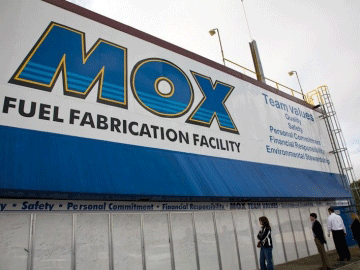
Energy Department Makes the Right Decision to Kill MOX Program https://www.ucsusa.org/press/2018/energy-department-makes-right-decision-kill-mox-program#.Wv35qjSFPGh Statement by Edwin Lyman, Union of Concerned Scientists WASHINGTON (May 14, 2018)—Late last week, the Department of Energy (DOE) submitted a report to Congress documenting that an alternative method to dispose of U.S. excess weapons plutonium would be less than half the cost of the current plan to use it as mixed oxide (MOX) fuel for nuclear reactors. By certifying that finding, Secretary of Energy Rick Perry will have the legal authority next month to stop construction of the MOX facility at the Savannah River Site in South Carolina. The Union of Concerned Scientists (UCS), which obtained the report and publicly released it, has long called for canceling the MOX program because it would make it easier for terrorists to gain access to fissile material that could be used to make a nuclear weapon.
Instead of finishing the half-built MOX facility, the Trump administration—like the Obama administration before it—proposes to dilute 34 tons of plutonium from retired U.S. nuclear weapons with an inert substance and dispose of it at the deep underground Waste Isolation Pilot Plant in New Mexico. According to the DOE report, this “dilute and dispose” process would cost at most $19.9 billion, 40 percent of $49.4 billion cost of continuing the MOX program.
Below is a statement by Edwin Lyman, a UCS senior scientist.
“Energy Secretary Perry made the right decision to terminate the misguided MOX program. Ironically, while the program was intended to reduce the risks posed by the large US stockpile of plutonium from dismantled nuclear weapons, it would make this material more vulnerable to theft. The alternative approach—dilute and dispose—will be far safer and more secure than MOX.
“While the MOX program has gone well over-budget, we now know that the dilute and dispose process will be far cheaper. According to DOE’s comprehensive report the cost of diluting and disposing of 34 metric tons of U.S. excess plutonium will be less than half the remaining cost of the MOX program. This finding allows the DOE to waive the wasteful congressional requirement that it must continue to build the MOX plant. As a bonus, the agency can begin the dilute and dispose process much sooner.
“The dilute and dispose approach will not only be cost-effective, it also will provide sustainable employment at the Savannah River Site for decades to come. The DOE report estimates that the project will require more than 400 full-time employees through its completion date in the late 2040s. Secretary Perry’s decision to kill MOX is a victory for US taxpayers, national security, and South Carolina workers.”
2 gallons of radioactive nuclear waste done. 56M gallons to go, BY ANNETTE CARY acary@tricityherald.comRICHLAND, WA 17 May 18
Researchers in Richland have done what the $17 billion vitrification plant at Hanford is intended to do — turn radioactive waste into a solid glass form.
Over about 24 hours last month researchers ran a laboratory-sized plant, dripping a radioactive waste mixture into a miniature melter inside the Pacific Northwest National Laboratory’s Radiochemical Processing Laboratory.
When they were done, they had 20 pounds of glass encasing actual Hanford waste.
……….The vitrification plant — or Waste Treatment Plant — at the Hanford nuclear reservation has been under construction since 2002, with a court-ordered deadline of 2023 to start treating some of the 56 million gallons of radioactive waste in underground tanks.
Much of the waste, which is left from the past production of plutonium for the nation’s nuclear weapons program, is planned to be vitrified, or turned into a solid glass form for disposal.
In the past about a cup of waste at a time has been vitrified — but not in a way that really mimics the system to be used at the plant.
Scientists have not been able to determine in earlier tests how the plant’s process would control the chemistry of the mixture, which determines how well waste is contained within the mixture as vitrification progresses from liquid waste to molten glass.
“This is the first time low-activity Hanford tank waste has been vitrified in a continuous process, very similar to the treatment process that will be used at Hanford, rather than as a single batch,” said Albert Kruger, a Hanford Department of Energy glass scientist.
Results of the demonstration will be used to help DOE and its tank farm contractor, Washington River Protection Solutions, make plans for operating the vitrification plant. They commissioned the tests from PNNL, an expert in the vitrification field.
…… At Hanford, DOE’s plan is to separate some low-activity radioactive waste from the site’s underground tanks, leaving high-level radioactive waste for later treatment at the vitrification plant……… Low activity radioactive waste is primarily liquid, but solids and radioactive cesium in the liquids are designated as high level radioactive waste and must be removed if the waste is treated as low activity waste…….http://www.tri-cityherald.com/news/local/hanford/article211071854.html
The real reason tech billionaires are prepping for doomsday
A misanthropic view of humanity guides the tech aristocracy — and it’s trickled into their vision of the future, Salon, JASON RHODE MAY 12, 2018,
If you pay attention to what Silicon Valley’s best and brightest are up to, you know about tech survivalism. The digital elite are preparing for the Apocalypse, and have been for a while.
Survivalism, the practice of preparing for a crackup of civilization, tends to evoke a certain picture: the woodsman in the tinfoil hat, the hysteric with the hoard of beans, the religious doomsayer. But in recent years survivalism has expanded to more affluent quarters, taking root in Silicon Valley and New York City, among technology executives, hedge-fund managers, and others in their economic cohort.
The Guardian noted that the end-of-days obsession could be traced back to a single source, a sort of ur-text of rich-guy panic: a 1999 book called “The Sovereign Individual: How to Survive and Thrive during the Collapse of the Welfare State.” It was written by James Dale Davidson, a private investment advisor, and Lord Rees-Moog, a British newspaper editor.
You can probably already guess at what the book says. More or less, it’s a pastiche of extolling the virtues of how the rich are superior, how they’re persecuted by the state, and how digital realms can and will liberate them and make them sovereign individuals. It’s a familiar trope: Ayn Rand had John Galt spewed the same list of self-serving ideas 60 years ago in “Atlas Shrugged.”
That an elite caste of people would find inspiration in these kinds of ideas is unsurprising. But there’s a more obvious reason that rich people are doomsday preppers: because that ideology mirrors their politics and their sociological views of people.
Aristocracy is the faith that a few individuals are better than the herd. Aristocracy justifies great wealth. Aristocracy says that most humans are inherently evil and will turn on each other. The mob needs strong rulers to stay sane. If authority breaks down, the rabid animals will run wild.
And the tech industry is a special subset of rich people. Our society runs on technology. Very few of us understand it, or build it personally; we rely on a select priesthood to handle that necessity. These conditions guarantee an elitist mindset. Even if Silicon Valley wasn’t wealthy, they’d still be stocking up on Krugerrands and beaver pelts. The money just gives them more space to indulge Ahab-like paranoia.
Additionally, the digerati tend to view human beings as automatons: easily exchangeable and swappable data points, resources to be exploited. If I wanted to design a system to deliberately turn out an alienated, distanced elite, I’d build Silicon Valley.
To use the language of philosophy, tech-bro survivalism is overdetermined. Imagine you’re an obscenely wealthy app magnate. Even if you’re skeptical about Armageddon, you probably already believe you’re a separate species from the rest of mankind. Letting everyone else go to hell is second nature.
……..Aristocracy is the faith that a few individuals are better than the herd. Aristocracy justifies great wealth. Aristocracy says that most humans are inherently evil and will turn on each other. The mob needs strong rulers to stay sane. If authority breaks down, the rabid animals will run wild.And the tech industry is a special subset of rich people. Our society runs on technology. Very few of us understand it, or build it personally; we rely on a select priesthood to handle that necessity. These conditions guarantee an elitist mindset. Even if Silicon Valley wasn’t wealthy, they’d still be stocking up on Krugerrands and beaver pelts. The money just gives them more space to indulge Ahab-like paranoia.
Additionally, the digerati tend to view human beings as automatons: easily exchangeable and swappable data points, resources to be exploited. If I wanted to design a system to deliberately turn out an alienated, distanced elite, I’d build Silicon Valley.
To use the language of philosophy, tech-bro survivalism is overdetermined. Imagine you’re an obscenely wealthy app magnate. Even if you’re skeptical about Armageddon, you probably already believe you’re a separate species from the rest of mankind. Letting everyone else go to hell is second nature.
…….. Tech-preppers think Doomsday will mean a war of all against all. But there’s no evidence of this.
………What are the tech-preppers really worried about? Not death by fire, quake, or ice. Not the rising seas, or the zombie plague, not the return of Christ or rogue comets. Seen clearly, the calamity that the wealthy fear is democracy returning to the United States. Every tall tale they tell involves the specter of the mob.
The tech-preppers understand, at a deep level, that their ill-gotten gains are predicated on an unjust system. Deep in the brain, where reptile impulses live, tech-bros know hoarding is wrong. Human beings — even very wealthy human beings — have a bone-deep sense of injustice. We know a freeloader.
North Korea Threatens to Call Off Summit Meeting With Trump, NYT, By Choe Sang-Hun and Mark Landler, 查看简体中文版查看繁體中文版SEOUL, South Korea — North Korea threw President Trump’s planned summit meeting with its leader, Kim Jong-un, into doubt on Wednesday, threatening to call off the landmark encounter if the United States insisted on “unilateral nuclear abandonment.”
The warning, made by the North’s disarmament negotiator, caught Trump administration officials off guard and set off an internal debate over whether Mr. Kim was merely posturing in advance of the meeting in Singapore next month or was erecting a serious new hurdle.
The abrupt change in tone began early Wednesday, when North Korea indefinitely postponed high-level talks with South Korea over the North’s sudden objection to joint military drills by the South and the United States that began last week. The North also raised the possibility of scrapping the meeting with Mr. Trump.
Then hours later, the North broadened the source of its anger and sharpened the threat to the summit with Mr. Trump.
Kim Kye-kwan, a vice foreign minister, rejected the administration’s demand that it quickly dismantle its nuclear program as Libya had done 15 years ago, singling out John R. Bolton, Mr. Trump’s new national security adviser, for condemnation.
“If the United States is trying to drive us into a corner to force our unilateral nuclear abandonment, we will no longer be interested in such dialogue and cannot but reconsider our proceeding to the D.P.R.K.-U.S. summit,” the statement said, using the abbreviation for the North’s formal name, the Democratic People’s Republic of Korea.
Telegraph 14th May 2018,The United States has told North Korea that is must start shipping nuclear
weapons, fissile material and some of its long-range missiles out of the
country within a couple of months of the June summit between Kim Jong-un,
the North Korean leader, and President Donald Trump, according to South
Korean media. https://www.telegraph.co.uk/news/2018/05/14/us-pressures-north-korea-ship-nuclear-weapons-overseas-sanctions/
Supes question Navy over cleanup fraud, SF Bay, By Scott MorrisMay 14, 2018, San Francisco elected officials Monday called for re-testing for radioactive material at an inhabited parcel of a former U.S. Navy shipyard in Hunters Point after revelations of fraudulent data by a Navy contractor.
At a meeting of the Board of Supervisors Land Use and Transportation Committee, Supervisor Malia Cohen, whose district includes the project area, as well as Supervisors Jane Kim and Sandra Lee Fewer called the credibility of the Navy’s cleanup efforts into question following the criminal conviction of two employees of a federal contractor for falsifying records. ……https://sfbay.ca/2018/05/14/supes-question-navy-over-cleanup-fraud/
Trump Abandons Nuclear Energy Project, Failed ‘Test’ Cost 38 Times More Than Russian Success, Western Journal , By Michael Bastasch , May 14, 2018
The Trump administration will abandon a nuclear energy project that was supposed to satisfy de-nuclearization treaty obligations with Russia and will instead bury diluted nuclear weapons underground.
Energy experts have long pointed to bureaucratic inefficiencies holding back nuclear energy projects, but the now-abandoned Mixed Oxide, or MOX, project illustrates just how expensive building these facilities has become.
Energy Secretary Rick Perry wrote to Congress in early May, detailing the administration’s plan to abandon the project. Perry wants to blend weapons-grade plutonium with inert substances and then bury them underground in New Mexico, according to a copy of the letter obtained by Reuters.
The federal government has already spent about $7.6 billion on the MOX project at South Carolina’s Savannah River Site, but Perry said completing the facility meant to convert nuclear weapons into fuel would cost another $48 billion.
In total, MOX is projected to cost nearly $56 billion and is still decades away from completion. Federal officials initially expected MOX to cost less than $5 billion and begin operations this year……
Legislation’s foes fear it would shift risk from shareholders to ratepayers , By Mike Hughlett Star Tribune, MAY 14, 2018
Xcel said the legislation passed Monday would give it more certainty in recovering at least $1.4 billion in maintenance costs expected over the next 17 years at its nuclear reactors in Monticello and Red Wing. Opponents of the Senate bill fear it would shift risk from Xcel’s shareholders to ratepayers.
Similar legislation is pending in the House.
By a vote of 37-29, the Senate passed a newly amended version of the bill. The amendments appear to strengthen the hand of the Minnesota Public Utilities Commission (PUC). The legislation has been criticized for weakening the PUC’s authority over Xcel’s nuclear investment decisions, and Gov. Mark Dayton has threatened to veto it for that reason.
…….. Essentially, the bill would allow Xcel to get upfront approval from the PUC for future nuclear expenses, instead of approval after those investments are made. Critics say that would give Xcel an incentive to aim high on its estimates, in case of any future cost overruns.
FAIRBANKS — An Army Corp of Engineers team is planning the formal decommissioning of the only nuclear power plant ever built in Alaska, Fort Greely’s SM-1A plant.
The SM-1A plant provided steam and electricity to the Army post near Delta Junction off and on between 1962 and 1972. It was one of eight experimental projects to test the use of small nuclear power plants at remote installations.
It’s expected to take about 10 years to plan, contract out and complete the SM-1A cleanup, according to a Baltimore-based team from the Army Corps of Engineers that came to Fort Greely for meetings last month……….
When SM-1A shut down in 1972, the Army chose to place the facility into a safe storage status instead of formally decommissioning it. The highly enriched uranium fuel and waste were shipped out of Alaska and radioactive components of the reactor were encased in cement.
The Army chose this temporary method of mothballing the facility out of hope that within a relatively short amount of time significant quantities of radioactive waste would decay to a safer nonradioactive state, according to an Army Corps of Engineers website about the SM-1A at bit.ly/2G7TjVH.
Later studies showed that the volume of radioactive waste wasn’t decreasing as expected and that a more hands-on approach was needed to clean up the plant. The increasing costs of nuclear waste disposal also motivated the Army to begin cleaning up the site.
There’s no estimate yet for the cost of decomissioning SM-1A, but such a project for a similar power plant has a budget of $66.4 million.
A nuclear deal with the Saudis is a good thing, says former GOP leader Eric Cantor
Saudi Arabia has been in negotiations with the U.S. and other countries for several years in pursuit of a nuclear energy partnership, with the stated aim of diversifying its energy base.
Riyadh has found a willing partner in the Trump administration, which has signaled far greater support for a deal than its predecessors.
Months of escalating tensions between the kingdom and its regional arch-rival Iran have raised the stakes for any future nuclear plans.
Natasha Turak | @NatashaTurak. CNBC 14 May 18 ………For around five years now, the Saudis have been in informal negotiations with the U.S. and other countries that could sell it nuclear reactors, with the stated aim of diversifying its energy base. In February, the kingdom recruited an American lobbying firm as an advisor on the legal issues surrounding developing a commercial nuclear program.
But what’s made many observers nervous is Riyadh’s refusal to accept a deal that would forbid it from enriching uranium and reprocessing plutonium — the mechanisms necessary not for nuclear energy, but for developing a weapon.
Saudis find support from Trump
Opposition from U.S. lawmakers on both sides of the political aisle has historically impeded the kingdom’s aims — Section 123 of the U.S. Atomic Energy Act of 1954 mandates that Congress review any sharing of nuclear technology with a foreign country.
Now, however, the Saudis have found a friendlier partner in the Trump administration, which has signaled far greater willingness to strike a deal than its predecessors.
A U.S. trade delegation visited the kingdom in April, led by the Washington-based Nuclear Energy Institute (NEI) and in partnership with the U.S. Departments of Commerce, Energy, and State. It brought with it 20 companies from across the U.S. nuclear supply chain, to promote “the strong interest of U.S. industry to partner in Saudi Arabia’s ambitious nuclear energy program,” according to the delegation’s press release.
……..Months of escalating tensions between Iran and its arch-rival Saudi Arabia raise the stakes for any future nuclear plans. In March, Saudi Crown Prince Mohammed bin Salman told CNBC news that if Tehran was to build a nuclear bomb, so would Riyadh.
Trump administration axes project to generate power from plutonium, Timothy Gardner, WASHINGTON (Reuters) 13 May 18 – The Trump administration plans to kill a project it says would have cost tens of billions of dollars to convert plutonium from Cold War-era nuclear bombs and burn it to generate electricity, according to a document it sent to Congress last week.
The Department of Energy submitted a document on May 10 to Senate and House of Representative committees saying that the Mixed Oxide (MOX) project at the Savannah River Site in South Carolina would cost about $48 billion more than $7.6 billion already spent on it. The United States has never built a MOX plant.
Instead of completing MOX, the administration, like the Obama administration before it, wants to blend the 34 tonnes of deadly plutonium – enough to make about 8,000 nuclear weapons – with an inert substance and bury it underground in a New Mexico’s Waste Isolation Pilot Plant (WIPP). Burying the plutonium would cost about $19.9 billion, according to the document, a copy of which was seen by Reuters.
“We are currently processing plutonium in South Carolina for shipment (to WIPP) … and intend to continue to do so,” Energy Secretary Rick Perry said in a letter sent to committee leaders.
Legislation passed in February allows the Energy Department to advance burying the plutonium if it showed that the cost would be less than half of completing MOX……..
Edwin Lyman, a physicist at science advisory group the Union of Concerned Scientists concerned about plutonium getting into the wrong hands, said Perry had made a sensible decision. “MOX was a slow-motion train wreck, and throwing good money after bad simply wasn’t an option.”
Trump adviser says US could sanction European allies if they continue nuclear deal with Iran, President Donald Trump’s national security adviser said the U.S. could impose sanctions on its European allies if they continue to deal with Iran under the nuclear deal. By ABC NEWS, May 13, 2018 National Security Adviser John Bolton also commented on “This Week” Sunday on the U.S.’s imminent move of its Israeli embassy, saying that relocating the embassy to Jerusalem will make peace “easier” because it recognizes the “reality” that Jerusalem is the capital of Israel……..https://abcnews.go.com/Politics/iran-shifting-balance-power-middle-east-cover-nuclear/story?id=55110286
Dallas, Midland and San Antonio city councils have already made resolutions prohibiting railcars from coming through their towns and exposing the citizens of their towns to this deadly radioactive waste.
The site can be seen from the air and is a beautiful target for terrorists during transit and after arrival at the site.
I believe our livelihood is in great danger of becoming destroyed by a company named Holtec International. They have applied to the Nuclear Regulatory Commission (NRC) for a 40-year license for an interim High-Level Radioactive Nuclear Waste Facility to be built between Carlsbad and Hobbs, New Mexico.
This is not the facility in Andrews. Although, now that Holtec has applied for their license, Waste Management Specialists (WCS) had placed their license request for the High-Level Radioactive Nuclear Waste on hold due to issues regarding the pending sale of their facility to Orano. However, now that the sale is complete and things have settled down, and they are watching what is going on with Holtec. Then, we fear, Orano is going to revise and reapply for a license requesting for the same as Holtec – high-level radioactive nuclear waste to be disposed of in the Andrews site, claiming it to be interim as well.
Why are we concerned and people in Midland and Odessa should be, too?
1. This is the first time anything of this gravity has ever been attempted in this country!
a. Radioactive waste has been moved around, but nothing remotely on this level of danger, nothing on this scope of magnitude and nothing on this level or for this interim duration.
b. Our deep concern is that no permanent site has even been discussed yet!!
c. By the time a “permanent” repository is found (which will probably be never) the canisters/casks will be too fragile to be moved due to deterioration from sun exposure/weathering or just time in general and the site will become a de facto permanent disposal site and another Super Fund site that New Mexico will have to try to maintain forever.
2. The Holtec site is on top of our Permian Basin oil reserves sitting directly on top of the Delaware Basin and our Olgalla Aquifer and don’t let any tell you they’re not as the old maps tell you they are.
3. This deadly waste is responsible for cancers, genetic birth defects and deaths as witnessed in the Tulrosa Basin Downwinders Claims after the atomic bomb experiments at the Los Alamos experimental site prior to the dropping of the bombs in Hiroshima and Nagasaki that ended WWII. The town of Trinity was never advised of these trials and the fallout affected the towns’ people with all kinds of different cancers that no one had ever had before.
4. This radioactive waste (even though they tell you it is in solid form and is more easily handled), is to be sent here by rail coming through Odessa. If that train wrecks on Faudree and Hwy 80 would have contained nuclear waste, it would have taken out the Odessa Country Club Golf Course and some of the richest real estate in Odessa as the land will become unusable for 25,000 years or more.
5. What’s going to happen if an accident leaves the land unable to be used for drilling for oil? The Fasken Oil Company came to Roswell to testify in front of the NRC to say that this is a bad idea and vowed to do everything they can to round up all the people in the Permian Basin Oil Industry to fight this licensing.
6. One of the Midland commissioners flew in to Roswell and brought not only Fasken Oil, but a rancher from one of the big area ranches who have been in Midland County for over 102 years who has vowed to fight this with fellow ranchers.
7. One railcar contains the same amount of plutonium as was dropped on Nagasaki.
9. Holtec wants to bring 100,000 metric tons of this high-level radioactive nuclear waste through Odessa over 20 years after they are licensed. Dallas, Midland and San Antonio city councils have already made resolutions prohibiting railcars from coming through their towns and exposing the citizens of their towns to this deadly radioactive waste. Every time a railcar passes by an area, it releases radiation. Cumulative effects could result in birth defects to a fetus as a pregnant woman is exposed to this waste by sitting on a railcar platform waiting to go to work every day as these railcars pass by.
10. The site can be seen from the air and is a beautiful target for terrorists during transit and after arrival at the site. All it would take is a suicide plane to hit this site and it would be worse than Hiroshima or Nagasaki. Holtec is talking about bringing 100,000 metric tons of spent plutonium to the site for a total of 10,000 partially buried canisters of spent fuel rods.
11. If radiation sullies our water or our oil, we might as well, just throw in the towel and move out as our property will have no value at all.
If we lose our oil or water, we lose our city.
If you do not consent to NRC licensing Holtec for this project, please voice your dissent!
The NRC Scoping Period for this Project ends May 29! You may request, no, demand that they extend the Scoping Period to more cities so more people may voice their opinions. The people along the train routes, Midland, Odessa, Albuquerque, El Paso, Dallas, etc. You may demand they extend the Scoping Period time for an additional three to six months.
This is too important for only two months of scoping and only three public hearings in only three towns!
Moving High-Level Nuclear radioactive waste across the nation to a temporary site when no permanent site has been found is unnecessary and irresponsible. The only winner in this is a private company named Holtec. The people of Eddy and Lea Counties who want this project and are being paid a pittance are not winners as they will be stuck with a Super Fund site forever.
If you would like to voice your opinion, you have until May 29 to write to the NRC at:
May Ma Office of Administration , Mail Stop: TWNF-7-A60M , U.S. Nuclear Regulatory Commission, Washington, DC 2055-0001
Japan Times, KYODO , 12 May 18 HIROSHIMA– A U.S. national park commemorating facilities related to the Manhattan Project, the secret U.S. wartime atomic bomb program, will include exhibits showing the inhumane nature of nuclear weapons, a park official said.
The plan to display the damage caused by the U.S. atomic bombings on Japan during World War II is welcome news for atomic bomb survivors who have worked to convey the horror of the weapons.
“We intend to address this issue thoroughly and respectfully,” said Kris Kirby, superintendent of the Manhattan Project National Historical Park, referring to the catastrophic humanitarian consequences of the use of nuclear weapons.
In November 2015, the U.S. government officially designated as a national park the facilities related to the Manhattan Project located in Oak Ridge, Tennessee; Los Alamos, New Mexico; and Hanford in Washington State.
The work to craft the exhibition plan for the facilities may start in 2019, and officials hope to complete it within two years.
It is not yet decided where the exhibits to highlight the inhumane aspects of the weapons will be placed, but Kirby said they would be “incredibly important elements” of the story surrounding the Manhattan Project.
…… An official of the Hiroshima Municipal Government welcomed the latest development and said, “We hope the exhibition … will be based on objective facts, and does not glorify the atomic bomb development.”
What’s Not in NNSA’s Plutonium Pit Production Decision, Santa Fe, NM –May 10, 2018 Contact Jay Coghlan, Nuclear Watch NM, 505.989.7342, c. 505.470.3154, jay@nukewatch.org Scott Kovac, Nuclear Watch NM, 505.989.7342, scott@nukewatch.org
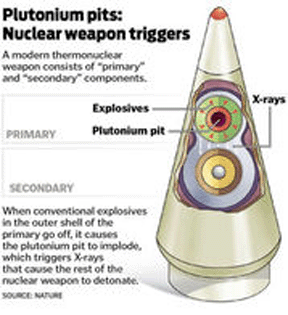
Today the National Nuclear Security Administration (NNSA) announced: To achieve DoD’s [the Defense Department] 80 pits per year requirement by 2030, NNSA’s recommended alternative repurposes the Mixed Oxide Fuel Fabrication Facility at the Savannah River Site in South Carolina to produce plutonium pits while also maximizing pit production activities at Los Alamos National Laboratory in New Mexico. This two-prong approach – with at least 50 pits per year produced at Savannah River and at least 30 pits per year at Los Alamos – is the best way to manage the cost, schedule, and risk of such a vital undertaking.
First, in Nuclear Watch’s view, this decision is in large part a political decision, designed to keep the congressional delegations of both New Mexico and South Carolina happy. New Mexico Senators Tom Udall and Martin Heinrich are adamantly against relocating plutonium pit production to South Carolina. On the other hand, South Carolina Senator Lindsay Graham was keeping the boondoggle Mixed Oxide (MOX) program on life support, and this pit production decision may help to mollify him. This could also perhaps help assuage the State of South Carolina, which is suing the Department of Energy for failing to remove plutonium from the Savannah River Site as promised.
But as important is what is NOT in NNSA’s plutonium pit production decision:
: • There is no explanation why the Department of Defense requires at least 80 pits per year, and no justification to the American taxpayer why the enormous expense of expanded production is necessary.
• NNSA avoided pointing out that expanded plutonium pit production is NOT needed to maintain the safety and reliability of the existing nuclear weapons stockpile. In fact, no production of plutonium pits for the existing stockpile has been scheduled since 2011, and none is scheduled for the future.
• NNSA did not mention that in 2006 independent experts found that pits last a least a century. Plutonium pits in the existing stockpile now average around 40 years old. The independent expert study did not find any end date for reliable pit lifetimes, indicating that plutonium pits could last far beyond just a century.
• NNSA did not mention that up to 15,000 “excess” pits are already stored at the Pantex Plant near Amarillo, TX, with up to another 5,000 in “strategic reserve.” The agency did not explain why new production is needed given that immense inventory of already existing plutonium pits.
• Related, NNSA did not explain how to dispose of all of that plutonium, given that the MOX program is an abysmal failure. Nor is it made clear where future plutonium wastes from expanded pit production will go since operations at the troubled Waste Isolation Pilot Plant are already constrained from a ruptured radioactive waste barrel, and its capacity is already overcommitted to existing radioactive wastes.
• NNSA did not make clear that expanded plutonium pit production is for a series of speculative future “Interoperable Warheads.” The first IW is meant to replace nuclear warheads for both the Air Force’s land-based and the Navy’s sub-launched ballistic missiles. The Obama Administration delayed “IW-1” because the Navy does not support it. However, the Trump Administration is restarting it, with annual funding ballooning to $448 million by 2023, and “IW-2” starting in that same year. Altogether the three planned Interoperable Warheads will cost at least $40 billion, despite the fact that the Navy doesn’t support them. 1
• NNSA’s expanded plutonium pit production decision did not mention that exact replicas of existing pits will NOT be produced. The agency has selected the W87 pit for the Interoperable Warhead, but its FY 2019 budget request repeatedly states that the pits will actually be “W87- like.” This could have serious potential consequences because any major modifications to plutonium pits cannot be full-scale tested, or alternatively could prompt the U.S. to return to nuclear weapons testing, which would have severe international proliferation consequences.
• The State of South Carolina is already suing the Department of Energy for its failure to begin removing the many tons of plutonium at the Savannah River Site (SRS). NNSA’s pit production decision will not solve that problem, even as it will likely bring more plutonium to SRS.
• The independent Defense Nuclear Facilities Safety Board has expressed strong concerns about the safety of plutonium operations at both the Los Alamos National Laboratory (LANL) LANL and SRS, particularly regarding potential nuclear criticality incidents. 2 NNSA did not address those safety concerns in its plutonium pit production decision.
• Politicians in both New Mexico and South Carolina trumpet how many jobs expanded plutonium pit production will create. Yet NNSA’s expanded plutonium pit production decision does not have any solid data on jobs produced. One indicator that job creation will be limited is that the environmental impact statement for a canceled $6 billion plutonium facility at LANL stated that it would not produce a single new Lab job because it would merely relocate existing jobs. Concerning SRS, it is doubtful that pit production could fully replace the jobs lost as the MOX program dies a slow death. In any event, there certainly won’t be any data on the greater job creation that cleanup and renewable energy programs would create. Funding for those programs is being cut or held flat, in part to help pay for nuclear weapons programs.
• Finally, the National Environmental Policy Act (NEPA) requires that major federal proposals be subject to public review and comment before a formal decision is made. NNSA’s decision does not mention its NEPA obligations at all. In 1996 plutonium pit production was capped at 20 pits per year in a nation-wide Stockpile Stewardship and Management Programmatic Environmental Impact Statement (PEIS). NNSA failed to raise that production limit in any subsequent NEPA process, despite repeated attempts. Arguably a decision to produce 80 pits or more per year requires a new or supplemental nation-wide programmatic environmental impact statement to raise the production limit, which the new dual-site decision would strongly augment. This then should be followed by whatever site-specific NEPA documents might be necessary.
Jay Coghlan, Nuclear Watch Director, commented, “NNSA has already tried four times to expand plutonium pit production, only to be defeated by citizen opposition and its own cost overruns and incompetence. But we realize that this fifth attempt is the most serious. However, we remain confident it too will fall apart, because of its enormous financial and environmental costs and the fact that expanded plutonium pit production is simply not needed for the existing nuclear weapons stockpile. We think the American public will reject new-design nuclear weapons, which is what this expanded pit production decision is really all about.