Hypocrisy relating to Nuclear Non Proliferation Treaty – US-UK Mutual Defense Agreement
 David Lowry’s Blog 29th June 2018 , Article I of the NPT starts with the following commitment on Russia, the US
and UK: “Each nuclear-weapon State Party to the Treaty undertakes not to
transfer to any recipient whatsoever nuclear weapons or other nuclear
explosive devices or control over such weapons or explosive devices
directly, or indirectly”
Extraordinarily, just two days earlier in
Washington, the US hosted a bilateral meeting with the UK to celebrate the
60th anniversary – from July 3, 1958 – of a hugely significant nuclear
defence agreement (commonly called the US–UK Mutual Defense
Agreement,(MDA) with defence spelled with an ‘s’ even in the official
UK version, hinting at the origin of its drafting).
http://drdavidlowry.blogspot.com/2018/06/naked-nuclear-hypocrisy.html
Vermont Yankee nuclear power station water cost: $6M and counting
Vermont Yankee water cost: $6M and counting, VT Digger, By Mike FaherJul 1 2018,
James Hansen – a prophet on climate change, but a crank on nuclear power
James Hansen and the whale, a tragi-comedy in four chapters, The Reality Based Community, By
“………..[James Hansen] he said :
Nuclear, especially next-generation nuclear, has tremendous potential to be part of the solution to climate change. The dangers of fossil fuels are staring us in the face. So for us to say we won’t use all the tools [such as nuclear energy] to solve the problem is crazy.
These crucial policy and technical developments were the fruit of a fairly small number of enterprising, determined and lucky individuals. They included:
- Researchers on solar: Becquerel, Willoughby Smith, Fritts, Einstein, Czochralski, the Bell Labs team of Chapin, Fuller, and Pearson. On wind: Poul La Cour and Johannes Juul in Denmark. On batteries: John Goodenough, who coming up to his 96th birthday still unprized in Stockholm, has just announced a research breakthrough on a high-density solid-state lithium battery.
- Politicians and bureaucrats: NASA in the 1960s, MITI in the 1970s; Hans-Josef Fell and Hermann Scheer, leaders of the Energiewende in Germany and instigators of the 2000 Renewable Energy Act (EEG); Jerry Brown of California; Barack Obama (through targeted ARRA funding and the bilateral deal with China that made Paris possible).
- Businessmen: Tokuji Hayakawa of Sharp in Japan; Elon Musk of Tesla; Wang Chuanfu of BYD.
This is an incomplete list, and no doubt unfair from my lack of knowledge. But it is near-certain that without these 18, and the then leaders of MITI and NASA, renewable energy and electric transport would not be where they are today.
The challenge also induced a lot of effort on enhanced geothermal, wave energy, OTEC, power kites, fuel cell cars, and other ideas that have not so far panned out. Nobody knows in advance which ideas will work out, and the failures also deserve their share of praise….. http://www.samefacts.com/2018/07/everything-else/james-hansen-and-the-whale-a-tragi-comedy-in-four-chapters/

Russia’s Putin has all the advantages in the coming summit with Trump
 In Trump’s Russia Summit, Putin Holds All the Cards New
  York Magazine, 30 June 18President Donald Trump’s scheduled summit with Russian president Vladimir Putin in Helsinki, Finland, on July 15 is being billed by the White House as an opportunity to reduce diplomatic tensions, begin repairing relations, and address a number of international issues of concern to both the U.S. and Russia, such as Iran, Syria, and Ukraine. Moscow is already managing expectations, saying they hope the meeting will rekindle a dialogue between the two governments but not to expect any “breakthroughs.”
Then again, Putin doesn’t need any breakthroughs; he’s already getting most of what he wants out of Trump, and given our president’s oft-expressed admiration for authoritarian strongmen in general and for his Russian counterpart in particular, Putin surely aims to cross a few more items off his wish list in Helsinki.
American-Russian relations at this moment are somewhat schizophrenic. On paper, Trump’s government is continuing and even going above and beyond many of the tough policies pursued by the Obama administration, including sanctions imposed in response to Russia’s invasion of Ukraine and annexation of Crimea, the sale of weapons to Ukraine to combat the ongoing Russian-backed insurgency, and the expulsion of Russian agents.
Yet no world leader has been so much a beneficiary of Trump’s “dictator envy” as Putin. The president has publicly flattered him and even congratulated him (against the advice of literally everyone) on his victory in a transparently rigged election in March. The two men’s previous contacts have been friendly and often advantageous to Putin; they even spent an hour alone together, with no other U.S. advisers or officials and only Putin’s translator present, on the sidelines of last year’s G20 meeting. Trump takes Putin at his word when he says Russia did not meddle in the 2016 election, despite mountains of evidence to the contrary, and even as Russian state TV gloats about it.
With Trump, all business is personal, and deals are made or broken on the basis of his feelings about the people he is making them with. Earlier this month, North Korean dictator Kim Jong-un — whose crimes against human rights include forced labor, torture, and murder — made such a good impression on Trump at a summit in Singapore that the president gifted him a unilateral halt to joint U.S.–South Korean war games, blindsiding both Seoul and the Pentagon. Calculated measures are for eggheads and losers; Trump’s gut trumps all. ……..
he is actively working to destabilize the European Union, encouraging key members to quit the organization and saying at a rally this week that the E.U. “was set up to take advantage of the United States, to attack our piggy bank” — an absolutely bonkers statement even if it were not based on an exaggeration of the U.S-E.U. trade deficit. Considering that Russia meddled in the Brexit referendum just as it did in our elections, it’s clear that weakening or dismantling that union is high on the Kremlin’s agenda.
Trump’s bootlickers like Secretary of State Mike Pompeo may lamely spin Trump’s antagonism toward our allies as some kind of “disruptive” “reset” in service of U.S. interests, but no administration official has made a remotely persuasive case for why chipping away at these institutions is good for America. For a revanchist Russia, on the other hand, the upsides are crystal clear. With his bad relationships with European allies fresh in his mind, it’s easy to imagine Trump letting Putin talk him into taking more steps to undercut these alliances.
Whether Putin has some kind of kompromat or other form of personal leverage over Trump (a terrifying possibility that becomes more believable the more we learn about the depth of Russia’s machinations in the 2016 campaign), or whether the two men just so happen to agree that the transatlantic liberal order is better off discarded, Putin is already getting what he paid for from this president.
Any agreement that comes out of next month’s summit, meanwhile, is overwhelmingly likely to favor Russia’s interests, if only because Putin knows exactly what he wants from Trump, whereas Trump does not seem to want anything more than for the man he admires so much to like him back. http://nymag.com/daily/intelligencer/2018/06/in-trumps-russia-summit-putin-holds-all-the-cards.html
U.S. Secretary of State Mike Pompeo urges China to enforce sanctions on North Korea
Pompeo tells China continued North Korea sanctions enforcement needed David Brunnstrom WASHINGTON (Reuters) 29 June 18 – U.S. Secretary of State Mike Pompeo has stressed to China the importance of continued enforcement of sanctions on North Korea to press it to give up its nuclear weapons, after warning of signs of backsliding by Beijing.
The State Department said Pompeo had spoken to his Chinese counterpart Wang Yi on Thursday and discussed efforts “to achieve our shared goal of the complete, verifiable, and irreversible denuclearization of the Korean Peninsula.”
Pompeo reiterated that North Korea would have a bright future if it denuclearized and emphasized “the continued importance of full enforcement of all relevant UN Security Council resolutions related to North Korea,” the department said in a statement.
It said this was especially important when it came to preventing North Korea’s illegal export of coal and imports of refined petroleum through ship-to-ship transfers prohibited by the United Nations.
……… Pompeo also spoke with South Korean Foreign Minister Kang Kyung-wha on Thursday to discuss the next steps on engagement with North Korea, the State Department said. It said they agreed on the need to maintain pressure until North Korea denuclearizes.
On Thursday, the Financial Times quoted U.S. officials as saying that Pompeo plans to travel to North Korea next week for talks, but the State Department has declined to confirm this…….https://www.reuters.com/article/us-northkorea-usa-china/pompeo-tells-china-continued-north-korea-sanctions-enforcement-needed-idUSKBN1JP2OA
Redress for nuclear industry whistleblowers in USA
 Redress for nuclear industry whistleblowers https://safety.blr.com/workplace-safety-news/safety-administration/OSHA-Occupational-Safety-and-Health-Administration/Redress-for-nuclear-industry-whistleblowers/
In a recently published fact sheet, OSHA reminds contractors, subcontractors, and licensees of the Nuclear Regulatory Commission (NRC) and contractors and subcontractors of the Department of Energy (DOE) that their employees are protected from retaliation for reporting potential violations of the Energy Reorganization Act (ERA) or the Atomic Energy Act (AEA) to their employers or to the government.
According to OSHA, retaliation comprises a wide range of actions, including firing or laying off, blacklisting, demoting, denying overtime or promotion, disciplining, denying benefits, failing to hire or rehire, intimidation, reassignment affecting promotion prospects, reducing pay or hours, and making threats.
Affected employers
Under the ERA, employees of the following employers are protected from retaliation for engaging in protected activity:
- NRC licensees and applicants for licenses, including the Tennessee Valley Authority;
- NRC contractors and subcontractors;
- Contractors and subcontractors of NRC licensees and applicants for licenses;
- Agreement state licensees and applicants for licenses from agreement states, including their contractors and subcontractors; and
- Certain DOE contractors and subcontractors.
Protected actions
Employees of the above entities may not be discharged or otherwise retaliated against because the employee:
Notified the employer of an alleged violation of the ERA or the AEA;- Refused to engage in any practice that is unlawful under the ERA or the AEA if the employee has identified the alleged illegality to the employer;
- Testified before Congress or at any federal or state proceeding regarding any provision (or proposed provision) of the ERA or the AEA;
- Commenced a proceeding, caused a proceeding to be commenced, or is about to commence or cause to be commenced a proceeding under the ERA or the AEA;
- Testified, assisted, or participated in or is about to testify, assist, or participate in a proceeding under the ERA or AEA; or
- Assisted, participated in, or is about to assist or participate in any other action to carry out the purposes of the ERA or the AEA.
Filing requirements
The major burden for an employee seeking redress for alleged illegal retaliation is that the complaint must be filed with OSHA within 180 days after the employee was notified of the action taken against her or him. Otherwise the process is relatively simple. The employee or his or her representative can file an ERA complaint with OSHA by visiting or calling his or her local OSHA office, sending a written complaint to the closest OSHA office, or filing a complaint online. No particular form is required, and complaints may be submitted in any language. Also:
- Written complaints may be filed by fax, electronic communication, hand delivery during business hours, U.S. mail (confirmation services recommended), or other third-party commercial carrier.
- The date of the postmark, fax, electronic communication, telephone call, hand delivery, delivery to a third-party commercial carrier, or in-person filing at an OSHA office is considered the date filed.
What OSHA will do
If the complaint is filed on time, OSHA will investigate it according to procedures at 29 CFR Part 24.
“If the evidence supports an employee’s complaint of retaliation, OSHA will issue an order requiring the employer to, as appropriate, put the employee back to work, pay lost wages, restore benefits, and provide other possible relief,” states OSHA. “The exact requirements will depend on the facts of the case. If the evidence does not support the employee’s complaint, OSHA will dismiss the complaint.”
After OSHA issues a decision, the employer and/or the employee may request a full hearing before an administrative law judge of the Department of Labor (DOL). The judge’s decision may be appealed to DOL’s Administrative Review Board. The employee may also file a complaint in federal court if the Department does not issue a final decision within 365 days.
DOE’s program
Also, the DOE has established regulations at 10 CFR Part 708 to protect employees of DOE contractors against reprisal by the employer for specific employee actions that largely mirror OSHA’s protected actions listed above.
Procedures for filing a complaint under Part 708 differ from OSHA’s procedures and are generally considered more difficult to navigate. For example, the complaint must be filed within 90 days of the alleged retaliation; the complaint must be filed in writing; and the complaint may not be filed if it is based on the same facts for which the employee already requested a remedy from OSHA, under Federal Acquisition whistleblower protection regulations for contract employees, or from a state government.
In July 2016, the Government Accountability Office reported on DOE’s Part 708 program and recommended improvements.
OSHA’s fact sheet is available here.

A glut of plutonium pits. Oh great! USA can make more nuclear weapons
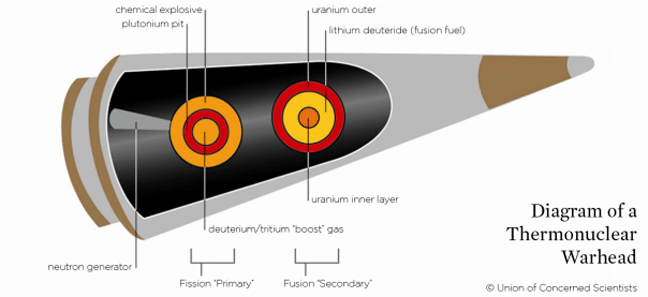
DOE considering new locations, weapons uses for some SRS plutonium https://www.aikenstandard.com/news/doe-considering-new-locations-weapons-uses-for-some-srs-plutonium/article_8707c68c-7aeb-11e8-be43-ff26df8805d9.html By Colin Demarest cdemarest@aikenstandard.com
U.S. Energy Secretary Rick Perrys claim: bailing out coal and nuclear industries so important that the cost doesn’t matter
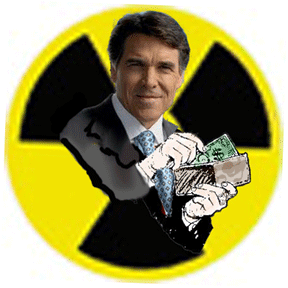 Reuters 28th June 2018 , U.S. Energy Secretary Rick Perry said on Thursday that bailing out
struggling coal and nuclear power plants is as important to national
security as keeping the military strong, and that the cost to Americans
should not be an issue.
https://uk.reuters.com/article/us-gas-conference-perry-grid/nuclear-coal-bailout-worth-any-cost-to-keep-america-free-u-s-energy-chief-idUKKBN1JO2J
Radiation from USA’s nuclear bomb tests went far and wide – now compensation is needed
Cold War Weapons Testing Made People Sick. Now, More Mountain West Residents Could Be Compensated http://boisestatepublicradio.org/post/cold-war-weapons-testing-made-people-sick-now-more-mountain-west-residents-could-be-compensated#stream/0 By RAE ELLEN BICHELL • JUN 28, 2018
Nuclear testing during the Cold War sent radioactive fallout far away from the actual test sites. Politicians are moving to expand who can be compensated by the government for getting sick after exposure to that fallout.
The tests mostly happened in Nevada but winds sent radioactive materials far and wide. Idaho Sen. Mike Crapo said one detonation in 1952 was particularly memorable to his constituents.
“Idahoans that I’ve spoken to in Emmett and elsewhere have shared their memories of waking to find their pastures and orchards covered with a fine grey-white dust that seemingly appeared out of nowhere. It looked like frost, yet it was not cold to touch,” Crapo said in a Senate Committee on the Judiciary hearing Wednesday.
In 1990 Congress created a program to compensate people who became seriously ill after radiation exposure.
According to the Department of Justice, since the programstarted more than $2 billion has been given in compensation. People like miners who worked directly with radioactive materials can get $100,000, people who were on site during nuclear tests get $75,000 and people who lived downwind of a major test site in Nevada get $50,000. So-called “downwinders” have to have lived in certain counties within Utah, Nevada and Arizona at the time of testing to be considered eligible.
“Unfortunately, the science at the time failed to recognize that radioactive fallout is not restricted by state lines,” said Crapo.
According to the National Cancer Institute, some of that fallout landed on fields across the country and especially in the Mountain West. It was consumed by animals like cows and eventually made it into milk cartons. Because of that, people who were milk-drinking children at the time are considered to have a higher risk of thyroid cancer.
Senators, including Crapo, have sponsored a bill that would expand the group of eligible “downwinders” to people who lived in parts of Idaho, Colorado, Montana, New Mexico and Guam at the time that tests were conducted.
The bill would also establish a grant program for further research into the health impacts of uranium mining and would extend the deadline for filing claims from 2022 to the late 2030s.
This story was produced by the Mountain West News Bureau, a collaboration between Wyoming Public Media, Boise State Public Radio in Idaho, Yellowstone Public Radio in Montana, KUER in Salt Lake City and KRCC and KUNC in Colorado.
Socialism is the Trump govt’s policy when it comes to coal and nuclear
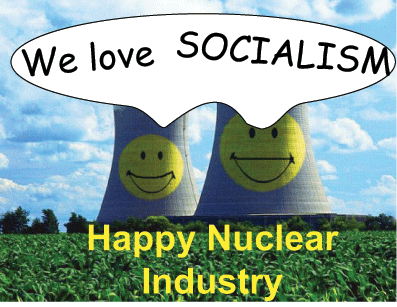 Trump administration wants welfare for coal and nuclear power, https://www.denverpost.com/2018/06/29/trump-administration-wants-welfare-for-coal-and-nuclear-power/ By TOM RIBE | Writers on the Range
The Trump administration just sent a tsunami through America’s electrical energy world when a leaked memo revealed that it had a new plan to shovel millions of dollars to the coal and nuclear power industries.
The memo, leaked to Bloomberg News and written by a member of Trump’s National Security Council, said that the nation faced a “grid emergency” because so many coal and nuclear power plants had shut down. The memo argued that the government could simply order private utility companies to buy high-cost electric power, because “national security” concerns mandated using “fuel-secure” sources to protect national security.
The memo claimed that “resources that have a secure, on-site fuel supply, including nuclear and coal fired power plants … are essential to support the nation’s defense facilities and critical energy infrastructure.” And it added that “due largely to regulatory and economic factors, too many of these fuel-secure facilities have retired prematurely.”
Prematurely? There is no shortage of electric power generation in the United States. The historic shift in this country toward cleaner, renewable energy is driven by national and international energy markets, not by tax breaks or government regulations. Countries around the world are investing in cheaper solar and wind power to address climate change and air pollution. One might think that free-market conservatives would be delighted to see competitive markets providing abundant, low-cost electricity from diverse sources to American consumers — all without interference from government. But apparently this case is different.
As for any threats to our national security, Vermont Law School professor Peter A. Bradford has pointed out: “We have no military crisis and no threats to our system reliability or resilience that require this drastic and expensive governmental intervention. The facts are being fixed around the desired end result.”
A political explanation seems like the real reason behind the administration’s determination to prop up coal. Trump’s staff has found a way to fulfill his campaign promise to rescue the dying coal industry, whose production has dropped 38 percent in the last decade. Robert Murray, CEO of Murray Energy, who gave Trump $300,000 for his inauguration, presented Energy Secretary Rick Perry with an “action plan” last March that included ending pollution controls on coal plants and stopping the rapid shift toward wind and solar energy.
Perry tried to direct federal subsidies to coal, only to be blocked last September by the Federal Energy Regulatory Commission. The leaked National Security Council memo noted that the Trump administration could use laws, such as the Federal Power Act and the Defense Production Act, to force utilities to buy high-cost power from coal and nuclear plants, though neither act has been used for these purposes before.
The memo also stated that natural gas is vulnerable to “cyber attacks” that make its supply unreliable, though record supplies of natural gas exist throughout the country. What the memo ignores is the reality that wind and solar, which make up about a quarter of power generation in this country, are abundant resources — nowhere near scarce.
Ever since horizontal drilling — fracking — transformed the oil and gas industry, this country has been producing large amounts of natural gas. Prices have dropped dramatically, and many coal-burning plants have converted to natural gas. Natural gas, however, is also a potent contributor to global climate change, and the continued flaring of methane during gas production is a significant, largely uncalculated source of pollution.
The Nuclear Information and Resource Service, a nonprofit that supports nuclear-free renewable energy, estimates that the coal and nuclear plant subsidies proposed in the memo could cost consumers up to $35 billion per year. Tim Judson, the group’s executive director, said, “Betting on old, increasingly uneconomical nuclear and coal power plants as a national security strategy is like gold-plating a Studebaker and calling it a tank. It could destroy the booming renewable energy industry, which is already employing more Americans than coal and nuclear combined.”
At a Senate hearing on June 11, Washington Democratic Sen. Maria Cantwell characterized the proposal as nothing more than “political payback” for the coal industry, and members of the Federal Energy Regulatory Commission who testified agreed that there is no “grid emergency.” Citing market interference, even the American Petroleum Institute testified against subsidizing coal and nuclear power.
Trump, who apparently developed his ideas on energy policy back in the 1970s, has shown little interest in any of the major changes to America’s energy picture since then. His effort to turn back the clock to fulfill his campaign promises to coal miners and repay political contributions could throw tens of thousands of people out of work, forfeit America’s leadership in energy technology, and worsen global warming.
America’s environmental and energy future depends upon a vigorous public pushback against this wrongheaded move.
North Korea has little incentive to “denuclearize”. Trump’s incoherent strategy leaves the world in danger
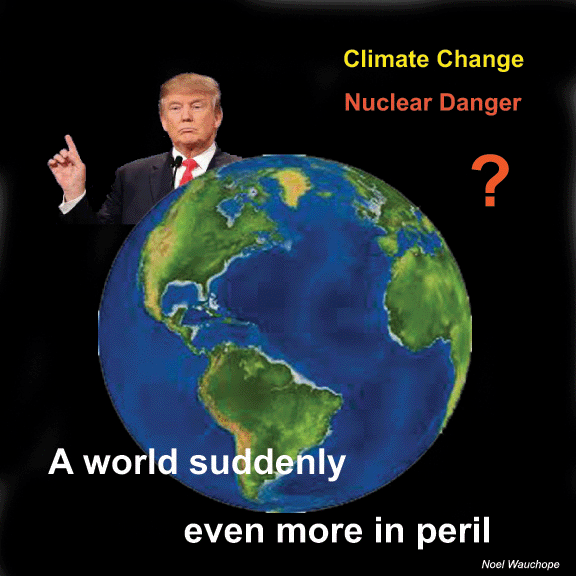
 North Korea’s nuclear facilities cannot be closed with a handshake http://www.kbzk.com/story/38534251/north-koreas-nuclear-facilities-cannot-be-closed-with-a-handshake: Jun 29, 2018 By Jonathan Cristol , Research Fellow in the Levermore Global Scholars Program at Adelphi University and Senior Fellow at the Center for Civic Engagement at Bard College. @jonathancristol.
(CNN) — On Wednesday, the North Korea watchers at 38 North released satellite imagery that shows North Korea making improvements to the Yongbyon Nuclear Scientific Research Center. While this report is unsettling, it is not at all surprising.
More unsettling than the report is the possibility that President Donald Trump believed that the North Korean nuclear threat could be solved by a handshake. In the immediate aftermath of the Singapore Summit, Trump said that, “There is no longer a Nuclear Threat from North Korea.” That statement was false, and the North Korean activity at Yongbyon proves it.
But North Korean nuclear activity is not in violation of the terms of the summit, since Trump and Kim Jong Un did not sign paperwork regarding immediate and complete denuclearization. Instead, they signed an agreement that includes a vague statement that North Korea will “work toward” denuclearization of the Korean Peninsula.
So far, the Trump administration is the only side moving in that direction — by agreeing to suspend joint military exercises with South Korea in exchange for vague promises. The improvements at Yongbyon, however, do not even violate Kim’s vague promise, which was only to stop nuclear and ballistic missile testing.
But, more importantly, Kim has little incentive to cease nuclear activity, and for that he can thank the incoherent strategy of Trump. The “maximum pressure” campaign of ever-tightening, crippling sanctions against North Korea is all but forgotten by Washington, and even Secretary of State Mike Pompeo says, “I am not going to put a timeline on [denuclearization].”
Additionally, Trump’s statements that the problem is solved gives China little incentive to apply pressure on its southern ally and gives America little leverage over China. Historically, China has been reluctant to apply too much pressure on Pyongyang for fear of a North Korean collapse that would both inundate China with refugees and potentially bring US troops to the Chinese border. It was Kim’s nuclear program that brought China into the sanctions regime. If, as the President said, the nuclear program is solved, then Washington has little recourse if China chooses to resume trading with North Korea.
CNN reports that the upgrades at Yongbyon were long-planned. These upgrades and further actions to strengthen Pyongyang’s nuclear deterrent will continue overtly in absence of an explicit agreement to stop them. And if such an agreement is reached, upgrades to the nuclear program and further research and development will likely continue in underground facilities. North Korea is not likely to give up its nuclear weapons for any reason or for any price.
Trump may think that a warm handshake and a few shared laughs will solve the North Korean problem, but Kim is not so naive. One of the world’s most brutal and repressive dictators, according to Human Rights Watch, is not going to be won over by Trump’s public remarks that he “got along great with Kim Jong Un, who wants to see wonderful things for his country” or that the two leaders share a “special bond.” Kim is going to take advantage of Trump’s pathological desire for praise and promise him the world, while continuing to develop his weapons programs.
The new developments at Yongbyon are not, on their face, cause for concern. But there are reasons to worry about the 38 North report. If Trump thinks that Kim agreed not to continue with his program, then this report (if discussed on his preferred news network) might cause Trump to return to his previous belligerent rhetoric vis-a-vis North Korea. If Trump thinks that this report makes him look weak, then he may be susceptible to John Bolton’s argument that there is a “legal case” to mount a preventive strike against North Korea.
Trump may think that the summit in Singapore prevented a war, but that is only true in the sense that it stopped him from starting one. That said, the summit does not need to be futile — it could also be the start of a genuine and serious set of arms control and limitation negotiations. These negotiations would require patience and skill without an obvious or immediate photo-op or half-clever tweet.
But since Trump is neither known for his patience nor his restraint on social media, we can expect North Korean nuclear research and facilities upgrades to continue apace.
High cancer rates in flight attendants – effect of ionising radiation
Flight Attendants Have Higher Rates Of Many Cancers, Study Says | TIME
Why are flight attendants’ rates of cancer spiking? Disrupted sleep and radiation may be to blame https://www.aol.com/article/lifestyle/2018/06/28/why-are-flight-attendants-rates-of-cancer-spiking-disrupted-sleep-and-radiation-may-be-to-blame/23470250/, ABBY HAGLAGE, Jun 28th 2018
Trumpocracy – analysed by Noam Chomsky
 The Anatomy of Trumpocracy: An Interview With Noam Chomsky C.J. Polychroniou, Truthout June 28, 2018
With its spate of right-wing rulings this week, the Supreme Court has paved the way for Donald Trump and the Republican-dominated Congress to intensify their attacks on human rights, workers and the country’s democratic institutions, dragging the US deeper into the abyss.
US political culture has long been dominated by oligarchical corporate and financial interests, militarism and jingoism, but the current Trumpocracy represents a new level of neoliberal cruelty. Indeed, the United States is turning into a pariah nation, a unique position among Western states in the second decade of the 21st century.
What factors and the forces produced this radical and dangerous shift? How did Trump manage to bring the Republican Party under his total control? Is Trumpocracy a temporary phenomenon, or the future of American politics? Is the Bernie Sanders phenomenon over? In the exclusive Truthout interview below, world-renowned scholar and public intellectual Noam Chomsky, Emeritus Professor of Linguistics at MIT and currently Laureate Professor of Linguistics at the University of Arizona, tackles these questions and offers his unique insights.
Qn. “…… how do we explain the fact that he has essentially taken over the Republican Party without any serious opposition?”
Noam Chomsky: Part of the solution to the puzzle is Obama’s performance in office. Many were seduced by the rhetoric of “hope” and “change,” and deeply disillusioned by the very early discovery that the words had little substance………
Quite apart from Obama’s disappointing policies, he and the [Democratic] Party were victims of the intense racism that is deeply rooted in large parts of American society. The visceral hatred of Obama cannot be explained in other terms.
But there is far more than that. For some time, candidates for Republican primaries who emerged from the base have been far off the traditional spectrum. The establishment was able to suppress them and gain their own candidate, but that didn’t change the basis for their support. For years, both parties have drifted to the right — the Republicans off the spectrum of normal parliamentary politics. Their dedication to wealth and corporate power is so extreme that they cannot get votes on their actual policies
…….. Trump has had overwhelming support among whites and less educated sectors, but for the most part, his mass voting base is relatively affluent and privileged. A recent Pew poll of Trump approvers found two-thirds are either college graduates, women or nonwhite, the last group apparently not many.
……. For the actual Republican constituency of wealth and corporate power, these are glory days, so why object, even if his antics sometimes cause some grimaces? The core constituency of Evangelicals is solidly in Trump’s pocket, thanks to the crumbs thrown their way. Many working people maintain the illusion that Trump cares about them and will bring back lost days of steady jobs in mining and manufacturing.
……… Trump himself seems to be having the time of his life. He’s constantly in the limelight, his loyal base worships his every move, he’s free to defy convention, to insult anyone he chooses, to disrupt the international economic and political order at will — whatever comes to mind next, knowing that he’s the biggest thug on the block and can probably get away with it — again, for a while, at least.
“….Qn: How do we explain the fact that Trump continues to cause chaos on all fronts, both domestically and internationally, and yet his popularity remains at quite high levels?
As I mentioned, Trump’s popularity among Republicans is unusually fervent and high, though not uniquely so. The affluent are doing fine. The economy is continuing the slow growth under Obama, though wages are barely rising and job security is low.
………. https://truthout.org/articles/the-anatomy-of-trumpocracy-an-interview-with-noam-chomsky/
U.S. Secretary of State Mike Pompeo confident that North Korea understands what is expected in complete denuclearization
 North Korea understands U.S. on ‘complete denuclearization’: Pompeo, Patricia Zengerle, WASHINGTON (Reuters) – U.S. Secretary of State Mike Pompeo said on Wednesday he was confident that North Korea understood the scope of the U.S. desire for complete denuclearization as the two countries negotiate after President Donald Trump’s summit with North Korean leader Kim Jong Un.
“We’ve been pretty unambiguous in our conversations about what we mean when we say complete denuclearization,” Pompeo told a Senate Appropriations subcommittee hearing on funding for the State Department.
Trump has drawn some criticism from national security analysts for an agreement that emerged from his June 12 summit with Kim that had few details on how Pyongyang would surrender its nuclear weapons and ballistic missiles…… https://www.reuters.com/article/us-usa-pompeo-senate-northkorea/n-korea-understands-u-s-on-complete-denuclearization-pompeo-idUSKBN1JN2W3
New report connects cancer increase in north St. Louis County with radioactive pollution from Coldwater Creek
Radioactive St. Louis–Government Nuclear Waste Scandal Exposed with Dawn Chapman
Radioactive waste from Coldwater Creek could have contaminated neighborhoods http://www.kmov.com/story/38525682/radioactive-waste-from-coldwater-creek-could-have-contaminated-neighborhoods By Russell Kinsaul, Reporter, NORTH ST. LOUIS COUNTY (KMOV.com) –
A new report draws a close connection between cancer and Coldwater Creek in north St. Louis County.
A two-year health assessment by the Agency for Toxic Substances and Disease Registry concluded that radioactive waste in the creek could have increased the risk of developing bone, lung, skin or breast cancer as well as leukemia for those who lived nearby or who played in the creek as children.
“Our street was right next to the creek. My parents moved there when I was two and I moved away as an adult,” said Kathryn Fults Ward.
Ward was diagnosed with leukemia in August.
“I had been healthy all my life but then boom, all of a sudden leukemia,” she said.
Ward was one of many who attended Wednesday’s public meeting at St. James United Methodist Church held by the federal agency, known as ATSDR, to explain the results of the study and answer questions.
Radioactive waste from the Manhattan Project was stored north of Lambert-St. Louis International Airport starting in 1946. Some of it was in piles that were uncovered. It’s widely believed that wind and rain carried some of the radioactive waste into nearby Coldwater Creek. Some of that waste was later moved to another location near the creek on Latty Avenue.
Those contaminated sites have been cleaned up and currently, the U.S. Army Corp of Engineers is testing for contamination along the creek and removing soil with elevated levels of radioactivity. The contamination removed during the current efforts has been below the surface and not posing a risk to the public.
“I lost my son, he was born with a brain tumor. It’s a brain tumor that occurs in 60-year-old men,” said Kim Visintine.
Visintine was one of the original members of a group of former north St. Louis County residents concerned about the frequency and types of cancers diagnosed in loved ones and former classmates they grew up with. They worried cancer could have a connection to contamination in the creek.
“So what this health assessment is for us is a validation of everything we’ve been working for since 2011,” said Visintine.
The ATSDR health assessment recommended further testing for dangerous levels of radioactive contamination in homes that flooded, along tributaries of Coldwater Creek and areas where likely contaminated soil was taken from near the creek was used at construction sites.
The agency is also recommending those who lived or played near the creek to talk to their doctor about their potential exposure.
Another public meeting will be held Thursday from 5 p.m. to 8 p.m. at St. James United Methodist Church at 315 Graham Road in Florissant.
1 This Month





PLEASE OPPOSE HR 8255 AND S.3639 – bills would accelerate satellite deployment, with no environmental review or safeguards – https://ncstd5li.quorum.us/campaign/169331/
To see nuclear-related stories in greater depth and intensity – go to https://nuclearinformation.wordpress.com
-
Archives
- October 2026 (29)
- September 2026 (339)
- August 2026 (330)
- July 2026 (355)
- June 2026 (287)
- May 2026 (306)
- April 2026 (356)
- March 2026 (251)
- February 2026 (267)
- January 2026 (308)
- December 2025 (358)
- November 2025 (359)
-
Categories
- 1
- 1 NUCLEAR ISSUES
- business and costs
- climate change
- culture and arts
- ENERGY
- environment
- health
- history
- indigenous issues
- Legal
- marketing of nuclear
- media
- opposition to nuclear
- PERSONAL STORIES
- politics
- politics international
- Religion and ethics
- safety
- secrets,lies and civil liberties
- spinbuster
- technology
- Uranium
- wastes
- weapons and war
- Women
- 2 WORLD
- ACTION
- AFRICA
- Atrocities
- AUSTRALIA
- Christina's notes
- Christina's themes
- culture and arts
- Events
- Fuk 2022
- Fuk 2023
- Fukushima 2017
- Fukushima 2018
- fukushima 2019
- Fukushima 2020
- Fukushima 2021
- general
- global warming
- Humour (God we need it)
- Nuclear
- RARE EARTHS
- Reference
- resources – print
- Resources -audiovicual
- Weekly Newsletter
- World
- World Nuclear
- YouTube
-
RSS
Entries RSS
Comments RSS

