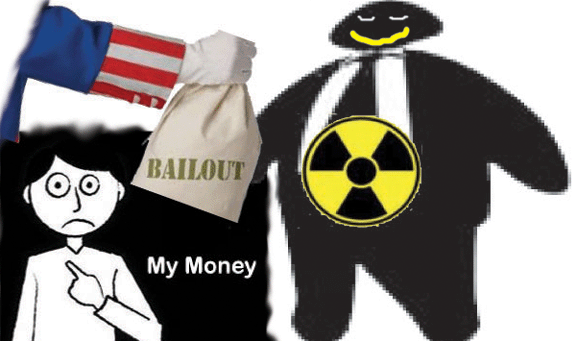
Taxpayers could end up paying for longterm safety of nuclear wastes, closed down Plymouth nuclear power plant
 Holtec and SNC-Lavalin presumably make money if the decommissioning can be done for less than $1 billion. What the public and the regulators need to watch now is how well it is done — no cutting corners, no substandard materials, no shoddy work. We need to know that the oceanfront site in Plymouth will be safe for generations to come with no health risk to people in Southeastern Massachusetts. If that isn’t the case when Holtec leaves, it is taxpayers who will have to pick up the tab to make things right. We don’t want that to happen.
OUR OPINION: Keep a watchful eye on decommissioning of Plymouth nuclear plant Metro West Daily News 9 Aug 18
First the good news: In 10 years, the Pilgrim nuclear power plant in Plymouth could be gone.
Now the bad news: Well, there really isn’t any, if everything goes exactly as planned and if someplace in New Mexico decides it wants to house some of the nation’s most incredibly dangerous nuclear leftovers.
Those are pretty big ifs, as is everything about decommissioning a nuclear power plant. And it is a very long shot that there won’t be 60 or so big tanks sitting upright on the plant site in 2028. They will be filled with rods containing the spent nuclear fuel that powered the plant. That spent fuel will be intensely radioactive for many thousands of years.
………. Entergy announced last week (Wednesday, Aug. 1) that it was selling Pilgrim to Holtec International of Florida. Holtec and a Canadian company, SNC-Lavalin Group of Montreal, had set up a joint venture company, Comprehensive Decommissioning International, to take on the decommissioning of nuclear facilities. Holtec and SNC-Lavalin are both substantial players in the fields of engineering, construction, manufacturing and project management, and have experience with nuclear operations. Entergy plans to shut down Pilgrim next June. It will then remove the last of the fuel rods before finalizing the sale to Holtec in 2020. The state and the federal government must approve the sale.
Under federal rules, the operators of the Pilgrim plant have set aside $1 billion over the life of the plant for decommissioning. As announced by Entergy, Holtec will get that billion dollars, the 1,500 acres and the operating license for the nuclear plant. Holtec and SNC-Lavalin get all the headaches that will come with decommissioning. None of the companies involved made public the financial terms of the sale. Holtec will end up owning the spent fuel rods.
Holtec and SNC-Lavalin could wait up to 60 years for radiation to decline before completing demolition and removal of the plant and equipment. The companies instead say they will employ new technologies for “accelerated decommissioning” and have everything gone in eight year. The goal is to make the land available for unrestricted use with the exception of any area needed for storage of the spent fuel. If all that happens on schedule, it will be very good news for Plymouth and surrounding communities and for the people downwind on Cape Cod who feel they would probably get most of the fallout if anything went seriously wrong.
Thousands of spent fuel rods, still highly radioactive and lethally dangerous, are stored at nuclear power plants throughout the country. There are roughly 140 million pounds of them stored in pools of water or in vertical tanks, called dry casks, made with tons of steel and concrete and liners of lead and other materials to absorb radiation. It will take 60 or so of these dry casks to store all the spent fuel from Pilgrim. The federal government long wanted to store spent fuel rods under a Nevada mountain. Opposition from that state, and questions about the geologic stability of the site, scuttled that plan. Holtec, which manufactures dry casks, is pushing for a license to operate a subterranean storage facility in New Mexico. If the Nuclear Regulatory Commission approves, and New Mexico and local communities agree, spent fuel from Holtec projects would get priority at the site. All the spent fuel from Pilgrim could be gone to New Mexico in a decade, if that happens. Please don’t bet the farm, the ranch or the house on it.
……… Holtec and SNC-Lavalin presumably make money if the decommissioning can be done for less than $1 billion. What the public and the regulators need to watch now is how well it is done — no cutting corners, no substandard materials, no shoddy work. We need to know that the oceanfront site in Plymouth will be safe for generations to come with no health risk to people in Southeastern Massachusetts. If that isn’t the case when Holtec leaves, it is taxpayers who will have to pick up the tab to make things right. We don’t want that to happen. http://www.metrowestdailynews.com/opinion/20180809
St Louis residents near radioactive wastes – high cancer risks – says Agency for Toxic Substances and Disease Registry
CBS News 7th Aug 2018 , The federal government confirms some people in the St. Louis area may have
a higher risk of getting cancer. A recent health report found some
residents who grew up in areas contaminated by radioactive waste decades
ago may have increased risk for bone and lung cancers, among other types of
the disease.
The assessment was conducted by the Agency for Toxic
Substances and Disease Registry, a branch of the U.S. Centers for Disease
Control and Prevention. As CBS News correspondent Anna Werner reports, the
situation is not unique to St. Louis because it’s connected to America’s
development of its nuclear weapons program decades ago. Radioactive wastes
persist in soils, and many believe that’s why they or a loved one developed
cancer. Now for the first time, federal health officials agree, on the
record, that’s a real possibility.
https://www.cbsnews.com/news/radioactive-waste-cancer-federal-health-officials-acknowledge-possible-link/
New York environmentalists and state politicians want to opt out of nuclear subsidy program
 Environmental groups, state politicians want to opt out of nuclear subsidy program http://www.wxxinews.org/post/environmental-groups-state-politicians-want-opt-out-nuclear-subsidy-program, By PAYNE HORNING, 9 Aug 18
After U.S. Energy Secretary Rick Perry came to Oswego County last week to praise the state’s support of nuclear power plants, several environmental groups and New York politicians sent a letter to state leaders saying the opposite.
The idea of using public dollars to keep financially struggling nuclear power plants afloat because they don’t emit carbon dioxide was never popular among some environmental groups that consider the facilities dangerous and dirty because of the radiation and nuclear waste they create. So when the New York Public Service Commission (PSC) voted two years ago to bail them with about $8 billion in fees on consumer’s energy bills, they left the door open to a potential compromise.
Then-chair of the PSC Audrey Zibelman said they would look at letting customers opt into a program to buy 100 percent of their energy from clean, renewable sources instead of paying into the system that supports the nuclear subsidies. Jessica Azulay with the Alliance for a Green Economy says it’s time for the state to make good on that promise.
“What this letter does that we filed with the governor and the chair of the Public Service Commission is to try to win the right for consumers to decide that they no longer want to pay this extra money toward nuclear energy and they want to instead adopt 100 percent renewable energy,” Azulay said. “We think that this is a really common sense approach – maybe a first step – in reversing the nuclear subsidies by allowing people to vote with their dollars and really create the pathway for renewable energy to accelerate in New York and phase out the nuclear reactors.”
To date, the nuclear subsidies have cost New York ratepayers about $650 million. A spokesperson for the PSC says the price would be even greater had the plants been allowed to shut down because they could have been replaced with fossil fuels that would have emitted carbon dioxide, setting back the state’s goals to lower carbon dioxide emissions 40 percent by 2030.
Julian Assange was asked to testify before Senate, but he first needs immunity from prosecution
 Assange should secure immunity before taking risk of testifying to Senate – whistleblower Kiriakou https://www.rt.com/usa/435543-assange-senate-testimony-kiriakou/
“If Assange is offered immunity by the committee, he then could not be charged with the crime because anything he said before the committee could not be used against him,” Kiriakou stressed, recalling how in 1987 former marine Oliver North was granted congressional immunity in exchange for his testimony on the Iran-Contra affair.
The Department of Justice then filed multiple felony charges against North, and he was arrested. But the Supreme Court later dismissed the charges, citing his immunity. Kiriakou believes the same measure can shield Assange, who has spent the last six years living in the Ecuadorian embassy in London fearing extradition to the US.
The WikiLeaks founder was earlier requested to give a closed interview to the staff of the Senate Select Intelligence Committee as part of the investigation into alleged Russian interference in the 2016 presidential election – an accusation Moscow flatly denies.
In October, 2017, WikiLeaks published the cache of emails belonging to Hillary Clinton’s campaign chair John Podesta, whose account the US Intelligence Community claims was hacked by ‘Russian operatives.’
Kiriakou reminded viewers that while many view Assange as a journalist and publisher, American lawmakers generally have a much more negative perception of the whistleblower. “On the Senate Intelligence Committee almost nobody believes that,” he said, explaining why the potential trip to the US can be risky for Assange.
Over the years, US politicians and intelligence officers have branded Assange a “traitor” and an “enemy of the state” for publishing classified materials on the wars in Iraq and Afghanistan, as well as leaking US diplomatic cables. Last year, the then-head of the CIA Mike Pompeo, who now serves as the secretary of state, labeled WikiLeaks a “non-state hostile intelligence service.”
The animosity harbored towards Assange suggests that the US Senate has “ulterior motives” for summoning him, human rights activist Peter Tatchell believes.
“I believe they want to snare him into somehow admitting or implying that he got information from Russian sources. That seems to be the focus of their attention,” the activist said, adding that the US authorities might use the interview to collect new evidence to prosecute Assange in the future.
Former MI5 officer Annie Machon, meanwhile, argues that it may be “difficult” for Assange to agree to a closed interview with US officials on such a sensitive subject. She believes he “always has got to be very careful about how they approach this, how it might be perceived, and what might be the outcome.” But crucially, the very nature of the hearing goes against the principles of WikiLeaks which Assange has staunchly defended.
“The whole ethos of WikiLeaks is to be open and transparent, and to bring the information out for the public’s good,” she said.
Radioactive lthorium discovered in barrels near mobile home park in Bellflower
As Thorium 232 decays, it releases radiation and forms decay products. The decay process continues until a stable, nonradioactive decay product is formed.
Studies of workers have shown that inhaling thorium dust will cause an increased risk of developing lung disease, including lung cancer, or pancreatic cancer……https://www.presstelegram.com/2018/07/31/hazardous-materials-incident-prompts-evacuation-of-bellflower-trailer-park/
Renewables produced more electricity than nuclear for the first five months of 2018
US Renewables Are Closing In on Nuclear Generation, GT, Renewables produced more electricity than nuclear for the first five months of 2018. AUGUST 09, 2018
“..After decades of stalled nuclear plant development and the recent surge of increasingly cheap wind and solar deployments, the newcomers are pulling ahead. In the first five months of 2018, renewables produced 20.17 percent of U.S. electricity and nuclear produced 20.14 percent, according to Energy Information Administration data compiled by Ken Bossong of the Sun Day Campaign.
A similar record was hit in the first three months of 2017.
In the two most recent months included in the data set, April and May, renewables outproduced nuclear by more than 10 percent. …… Renewables out-generate nuclear in more than half of states, according to an analysis of EIA data by the Sun Day Campaign.
Sun Day has a very clear stake in this race: Its mission is to promote sustainable energy and help “phase out the use of nuclear power.”..
Volunteer activists credited with getting compensation for former nuclear workers
https://triblive.com/local/valleynewsdispatch/13956792-74/volunteer-activists-credited-with-getting-compensation-for-former-nuclear-workers MARY ANN THOMAS | Thursday, Aug. 9, 2018
Potassium iodide tablets for residents near Pennsylvania’s nuclear power stations
Pa. distributing KI tablets to people near nuclear power plants, abc 27 news, By: Myles Snyder Aug 09, 2018 HARRISBURG, Pa. (WHTM) – The state Department of Health is distributing free potassium iodide tablets on Thursday to people who live or work within 10 miles of the state’s five nuclear power plants.
Companies doing business with Iran will be barred from the United States – Donald Trump
 Trump says firms doing business in Iran to be barred from U.S. as sanctions hit, Babak Dehghanpisheh, Peter Graff, BEIRUT/LONDON (Reuters) 7 Aug 18, – Companies doing business with Iran will be barred from the United States, President Donald Trump said on Tuesday, as new U.S. sanctions took effect despite pleas from Washington’s allies.
Iran dismissed a last-minute offer from the Trump administration for talks, saying it could not negotiate while Washington had reneged on a 2015 deal to lift sanctions in return for curbs on Iran’s nuclear program.
Trump decided this year to pull out of the agreement, ignoring pleas from the other world powers that had co-sponsored the deal, including Washington’s main European allies Britain, France and Germany, as well as Russia and China.
European countries, hoping to persuade Tehran to continue to respect the deal, have promised to try to lessen the blow of sanctions and to urge their firms not to pull out. But that has proven difficult: European companies have quit Iran, arguing that they cannot risk their U.S. business……..https://www.reuters.com/article/us-iran-nuclear/new-trump-sanctions-on-iran-take-effect-despite-pleas-from-allies-idUSKBN1KS13I
Study into cancer risks in New Mexico
Trinity site cancer study expected to finish in 2019, Santa Fe New Mexican, By Russell Contreras | Associated Press, 6 Aug 18
North Korea finding fault with USA’s diplomat Mike Pompeo
North Korea’s Pompeo Problem Exposes Widening Rift Over Talks, Bloomberg By Bill Faries, August 7, 2018,
- Top U.S. diplomat rebuked after two latest trips to Asia
- U.S. told it will ‘get nothing’ from its pressure campaign
North Korea appears to have a Pompeo problem.
The widening gulf between Secretary of State Michael Pompeo’s description of nuclear talks with North Korea and Pyongyang’s criticism of his efforts is adding further confusion to the status of negotiations intended to lead to the denuclearization of the Korean peninsula.
Twice in recent weeks North Korean officials and state media have rebutted the top U.S. diplomat’s characterization of events and suggested the administration has a myopic focus on denuclearization while ignoring issues such as bringing about a final resolution of the Korean War. Even as President Donald Trump and North Korean leader Kim Jong Un exchange optimistic messages about their push for peace, Pompeo has increasingly become a target of public disparagement from Pyongyang.
Over 120 organisations working to get rid of New York’s subsidies to nuclear power
 More than 120 groups push NY to lift broad nuclear subsidies. by Associated Press & CNYCentral , August 7th 2018 ALBANY, N.Y. — Some 130 environmental groups are taking aim at New York’s nuclear subsidies.
Will Holtec buy Indian Point Nuclear Power Plant next?
Could Indian Point be next nuclear power plant up for sale? Lohud,
Entergy will sell nuclear power plants in Massachusetts and Michigan to a New Jersey firm that’s promised to knock years off a lengthy shutdown process, a move that hints at the company’s plans for Indian Point.
Entergy announced last week that it has agreed to sell the Pilgrim Nuclear Power Station in Plymouth, Mass., and the Palisades Power Plant in Covert, Mich., to Holtec International, for what will be the company’s first decommissioning venture.
The announcement, coupled with Entergy’s decision to sell its Vermont Yankee plant to NorthStar Groups Services, a New York-based industrial demolition firm, is the latest indication that Indian Point could be sold once it powers down.
Decommissioning of nuclear power plants typically extends for decades.
But in recent years, as more than a dozen nuclear power plants have announced plans to close, firms like Holtec and NorthStar have jumped into decommissioning, promising quick turnarounds.
n the case of Pilgrim, Holtec would begin decommissioning in 2020 and wrap up the work in eight years, Entergy officials say.
Palisades is slated to shut down in the spring of 2022 when the timetable for its dismantling would be announced. In both cases, spent nuclear fuel will be moved into cement casks on the site within three years of the shutdown, Entergy says.
“Transferring our Pilgrim and Palisades plants to Holtec, with its vast experience and innovative use of technology will lead to their decommissioning faster than if they were to remain under Entergy’s ownership,” said Leo Denault, Entergy’s chairman and CEO.
While these will be Holtec’s first decommissionings, the company has years of experience with dry cask storage on nuclear power plant sites, including Indian Point. The work will be carried out by Comprehensive Decommissioning International, a newly-formed Holtec subsidiary based in Camden, New Jersey.
Storing nuclear waste
Holtec currently has an application pending before the NRC to operate the nation’s first interim storage facility for nuclear waste in the New Mexico desert.
When Indian Point is shut down, some 4,000 spent fuel assemblies will be stored in 125 steel-reinforced cement casks on the property, according to a state consultant’s report. ……..https://www.lohud.com/story/news/2018/08/06/could-indian-point-next-entergy-power-plant-up-sale/915308002/
Major Hiroshima-Nagasaki Commemorations at U.S. Warhead Facilities Across the USA

Major Hiroshima-Nagasaki Commemorations at U.S. Warhead Facilities Across the Nation Protest Trump’s Risky Nuclear Posture and Budget; Advocate Disarmament http://www.huntingtonnews.net/158411, August 5, 2018 –
U.S. Dept of Labor looks for nuclear workers eligible for compensation for radiation-caused illnesses
Government seeking nuclear workers who had radiation-caused cancers or their survivors https://triblive.com/local/valleynewsdispatch/13940878-74/government-seeking-nuclear-workers-who-had-radiation-caused-cancers-or-their-survivors, MARY ANN THOMAS | Sunday, Aug. 5, 2018
1 This Month





PLEASE OPPOSE HR 8255 AND S.3639 – bills would accelerate satellite deployment, with no environmental review or safeguards – https://ncstd5li.quorum.us/campaign/169331/
To see nuclear-related stories in greater depth and intensity – go to https://nuclearinformation.wordpress.com
-
Archives
- October 2026 (29)
- September 2026 (339)
- August 2026 (330)
- July 2026 (355)
- June 2026 (287)
- May 2026 (306)
- April 2026 (356)
- March 2026 (251)
- February 2026 (267)
- January 2026 (308)
- December 2025 (358)
- November 2025 (359)
-
Categories
- 1
- 1 NUCLEAR ISSUES
- business and costs
- climate change
- culture and arts
- ENERGY
- environment
- health
- history
- indigenous issues
- Legal
- marketing of nuclear
- media
- opposition to nuclear
- PERSONAL STORIES
- politics
- politics international
- Religion and ethics
- safety
- secrets,lies and civil liberties
- spinbuster
- technology
- Uranium
- wastes
- weapons and war
- Women
- 2 WORLD
- ACTION
- AFRICA
- Atrocities
- AUSTRALIA
- Christina's notes
- Christina's themes
- culture and arts
- Events
- Fuk 2022
- Fuk 2023
- Fukushima 2017
- Fukushima 2018
- fukushima 2019
- Fukushima 2020
- Fukushima 2021
- general
- global warming
- Humour (God we need it)
- Nuclear
- RARE EARTHS
- Reference
- resources – print
- Resources -audiovicual
- Weekly Newsletter
- World
- World Nuclear
- YouTube
-
RSS
Entries RSS
Comments RSS

