A group of senators recently sent a letter to the Nuclear Regulatory
Commission (NRC) expressing concern over a draft proposed rule on nuclear
power plant decommissioning that has been presented to the commissioners
for review.
The rule includes proposed changes to emergency preparedness,
physical security, cyber security, funding assurance, financial protection
requirements and environmental considerations, among other issues.
Sens. Edward J. Markey (D-MA), Bernie Sanders (I-VT), Kirsten Gillibrand (D-NY),
and Kamala Harris (D-CA) said in their letter to NRC Chair Kristine L.
Svinicki that the rule would limit the general public’s opportunity to
participate in the decommissioning process.
They also wrote that the rule does not adequately address concerns about the long-term storage of spent
nuclear fuel and reduces financial protections, especially in case of an
accident, which increases financial risk for taxpayers and communities.
“By failing to propose a comprehensive set of decommissioning and cleanup
regulations, by automatically approving facilities’ exemptions from
safety, security and emergency planning regulations, and by continuing to
rubber-stamp the industry’s post-shutdown decommissioning activities
report, as currently drafted, this proposed regulation would abdicate the
NRC’s responsibility to ensure the safety of these plants,” the
senators wrote.
“This is more an absence of rulemaking than a rule that
will affirmatively guide plants and communities through the decommissioning
process.”
Bond Buyer 9th Aug 2018, A $2.2 billion jump over eight months in the estimated cost to complete two
nuclear reactors in Georgia could spell doom for the project. The actual
increase won’t be final until the project’s budget is revised, and it
will require that the private and public utility owners vote on whether to
continue the work at Plant Vogtle. The project is about 67% complete,
according to the latest estimate. https://www.bondbuyer.com/news/costs-rise-for-unfinished-georgias-nuclear-reactors
Transportation Eyed for State Role Nuclear watchdogs concur that the federal government doesn’t need New Mexico’s approval to award a license. But the state could do more to stop the project’s progress if leaders want to.
The cities of Albuquerque and Las Cruces, as well as Bernalillo County, have voted to formally oppose Holtec’s project.
A proposed nuclear storage project in Utah, for example, received a license but never accepted waste after opponents there raised questions about transportation, as well as other concerns.
New Mexico’s attorney general thinks the state can do little to stop Holtec International’s application to temporarily store high-level waste from commercial nuclear reactors, but that doesn’t deter critics of the project.
A state lawmaker and an environmentalist, who oppose the project to store the toxic trash in New Mexico before it is buried forever at Nevada’s Yucca Mountain or another site, said they believe the state—and not just the federal Nuclear Regulatory Commission—can exert some influence over the Holtec project’s future.
New Mexico Attorney General Hector Balderas (D) recently assessed the state’s role in regulating Holtec’s plan to store the radioactive materials in rural southeast New Mexico near the the Waste Isolation Pilot Plant (WIPP). An Energy Department facility that stores a different type of nuclear waste generated from weapons production, WIPP was subject to some state reviews before opening in 1999.
Holtec has an application before the NRC for a temporary place to keep nuclear waste from commercial power plants throughout the U.S. while the federal government develops permanent storage deep underground. There’s no timeline for permanent storage, as work on Yucca Mountain has long been stalled and has been met with
Intense opposition from Nevada lawmakers.
The plan to consolidate used fuel in New Mexico has drawn support for its potential economic impact and criticism for a range of health of safety concerns. Candidates running in November to replace Gov. Susana Martinez (R) have had conflicting views on the project.
But of all the factors that the NRC considers when awarding a license for temporary storage, “state approval is not among them,” said the attorney general’s July 19 letter, released to Bloomberg Environment under New Mexico’s public-records law.
Federal Law Governs Project
State Sen. Jeff Steinborn (D), who requested the attorney general’s opinion, told Bloomberg Environment the answers are “troubling.” Steinborn chairs a legislative committee on radioactive materials that has held hearings on Camden, N.J.-based Holtec’s proposal.
Steinborn said he’s “basically opposed” to the project given unanswered questions on the impacts to the state. He wants New Mexico to take an active role in the license review process and said the state can’t “put its head in the sand.”
Prior litigation shows the NRC can license the temporary storage facilities, said the attorney general’s letter, signed by Assistant Attorney General John Kreienkamp. Federal law pre-empts state laws when it came to nuclear waste regulation, he wrote.
The NRC, though, does provide protection against Holtec abandoning the site by requiring licensees to plan for and financially back eventual decommissioning. State tort law may help if people were injured or sickened by Holtec’s operations, the opinion said. ………
Transportation Eyed for State Role
Nuclear watchdogs concur that the federal government doesn’t need New Mexico’s approval to award a license. But the state could do more to stop the project’s progress if leaders want to, Don Hancock, director of the nuclear waste safety program and administrator at the Albuquerque environmental group Southwest Research and Information Center, told Bloomberg Environment.
Hancock, who opposes the proposal, said Holtec would need New Mexico’s cooperation elsewhere, such as help with moving nuclear waste through the state. A proposed nuclear storage project in Utah, for example, received a license but never accepted waste after opponents there raised questions about transportation, as well as other concerns.
“They do have mechanisms to do it outside the licensing process,” Hancock said of New Mexico officials.
The cities of Albuquerque and Las Cruces, as well as Bernalillo County, have voted to formally oppose Holtec’s project. Gubernatorial candidate Michelle Lujan Grisham (D) has spoken against it, while challenger Steve Pearce (R) said it could boost the state economically……..
states have limited authority to regulate projects such as what Holtec is proposing compared to other kinds of hazardous waste, Geoffrey Fettus, senior attorney at the nonprofit Natural Resources Defense Council, told Bloomberg Environment. Fettus was an assistant attorney general in New Mexico in the 1990s and works on nuclear waste issues.
The Natural Resources Defense Council has recommended giving states more power.
The NRC is starting to review the environmental impacts of the Holtec proposal. The public can request a separate hearing on the plan through Sept. 14, which would put Holtec’s application in front of judges from the commission’s Atomic Safety and Licensing Board Panel.https://www.bna.com/holtec-nuclear-waste-n73014481533/
Incident involving transfer of waste canister at San Onofre nuclear plant prompts additional training measures, LA Times, By ROB NIKOLEWSKI, AUG 12, 2018
A contractor responsible for transferring canisters of spent nuclear fuel at the site of the shuttered San Onofre Nuclear Generating Station has been cited for “performance errors” and was directed to “take corrective actions, including additional training” for its workers, Southern California Edison officials said.
The contractor, Holtec International, was cited for the incident that occurred earlier this month when a canister got caught on an inner ring as it was being lowered into a Cavity Enclosure Container at a newly constructed “dry storage” facility on the site of the plant that is in the process of being decommissioned, Edison said in a statement last week. The transfers have been placed on hold.
Since February, operators of the San Diego County plant have been transferring 73 canisters of spent fuel from what is called “wet storage” to the new dry storage installation. Used up fuel is thermally hot and to cool it, nuclear operators place the fuel in a metal rack and submerge it in a deep wet storage pool.
So far, 29 of the 73 canisters have been transferred to the new storage facility. Edison expects to complete the transfer by the middle of next year.
Edison’s announcement came one day after a man identifying himself as an industrial safety worker associated with the federal government’s Occupational Safety and Health Administration startled those attending a public meeting in Oceanside hosted by the SONGS Community Engagement Panel by describing a litany of safety shortcomings associated with the transfer process.
David Fritch said on Aug. 3 one of the canisters being lowered into the cavity enclosure “could have fallen 18 feet.”
In remarks during the Community Engagement Panel’s public comments period, Fritch said similar problems have occurred before “but it wasn’t shared with the crew that was working. We’re under-manned. We don’t have the proper personnel to get things done safely.”
Fritch, who said he’s been on the site for about three months, said some workers are “under-trained” and that many experienced supervisors “are often sent away” and replaced by new supervisors who “don’t understand it as well.”
Fritch’s remarks were captured on video from the livestream of the panel’s quarterly meeting.
……….Critics of Edison pounced on the disclosure, saying it points to larger issues surrounding the plant near San Clemente that is home to 3.55 million pounds of spent fuel at a site hugging the Pacific Ocean and near the busy 5 Freeway. The area also has a history of seismic activity and 8.4 million people living within a 50-mile radius.
The incident “confirms every fear we’ve had about what’s going on at San Onofre and what measures they’re taking to ensure the public’s safety,” said Charles Langley, executive director of the San Diego advocacy group Public Watchdogs, who has worried the walls of the canisters are not thick enough and could crack.
……..The utility also ran into a problem in March during the transfer of spent fuel at the site. Work was delayed 10 days after workers discovered a piece of shim — essentially, a pin 4 inches by a half-inch — came loose while a canister was being loaded.
Edison received assurance from Holtec and an independent engineering firm that the canister’s integrity was sound.
Nuclear rod shipment planned from Illinois to Michigan http://www.whig.com/article/20180811/AP/308119945#//The Associated Press Aug. 11, 2018 PORT HURON, Mich. (AP)— The owner of a northern Illinois nuclear plant wants to ship about 45 pounds of highly radioactive nuclear fuel rods through Michigan on their way to a Canadian testing facility.
Excelon Generation tells the Detroit Free Press that the rods will be packed inside a 24-ton, heavily shielded shipping cask for shipment from the LaSalle County Nuclear Generating Station near Marseilles, Illinois.
The company has asked the federal Nuclear Regulatory Commission for highway route approval to Port Huron, Michigan. Commission spokeswoman Viktoria Mitlyng says the shipment’s route and timing are kept secret for security reasons.
Kevin Kamps of the environmental group Beyond Nuclear calls the transport casks “woefully inadequate for real-world accidents or attacks.”
The Canadian Nuclear Safety Commission says it hasn’t received an application for allowing the shipment.
Daily Mail 10th Aug 2018 , A federal judge on Thursday rejected a request to bar the public from a
Colorado wildlife refuge that was once part of a nuclear weapons plant.
Environmentalists and community activists had asked the judge to issue a
preliminary injunction that would prohibit opening Rocky Flats National
Wildlife Refuge northwest of Denver while the courts hear their lawsuit
claiming the government did not study public safety closely enough.
Activists honor Catholic archbishop, who was a prophetic voice for peace, on anniversary of atomic bombingby Leonard Eiger Silverdale, Washington:Activists blockaded the West Coast nuclear submarine base that would likely carry out a nuclear strike against the Democratic People’s Republic of Korea (North Korea) should President Donald Trump give the order.
Activists with Ground Zero Center for Nonviolent Action held a vigil at the Naval Base Kitsap-Bangor Main Gate beginning on the evening of August 5th and continuing into the morning of August 6th, the anniversary of the atomic bombing of Hiroshima. Approximately sixty activists were present at the morning vigil, and twelve participated in a nonviolent direct action in which participants blockaded the base at the peak of the morning shift change by carrying a banner onto the roadway of the main entrance gate.
The banner read, “Trident is the Auschwitz of Puget Sound – Raymond Hunthausen.”
The activists stopped traffic entering the base for ten minutes before being removed from the roadway by Washington State Patrol Officers, cited for being in the roadway illegally, and released on the scene.
The twelve activists cited are Phil Davis, Bremerton, WA; Susan Delaney, Bothell, WA; Lisa Johnson, Silverdale, WA; Mack Johnson, Silverdale, WA; Ann Kittredge, Quilcene, WA; James Knight, Altadena, CA; Brenda McMillan, Port Townsend, WA; Elizabeth Murray, Poulsbo, WA; George Rodkey, Tacoma, WA; Ryan Scott Rosenboom, Bothell, WA; Michael Siptroth, Belfair, WA; and Jade Takushi.
Raymond Hunthausen, retired archbishop of Seattle, died on July 22nd at age 96. Frank Fromherz, author of the the soon to be released book, “A Disarming Spirit: The Life of Archbishop Raymond Hunthausen,” said of Hunthausen:
“It was in the early 1980s that Archbishop Hunthausen denounced the Trident nuclear submarine fleet harbored in his archdiocese, famously calling it ‘the Auschwitz of Puget Sound.’ His opposition inspired Catholics worldwide, but gained him powerful opponents in the U.S. government during the era of President Reagan’s military buildup. Catholic peace activist Jim Douglass, a native of British Columbia, introduced Archbishop Hunthausen to the practice of contemplative nonviolent direct action.”
Douglass once described his longtime friend as ‘a holy prophet of nonviolence in the nuclear age.’ In what would become a truly historic address on June 12, 1981 at Pacific Lutheran University in Tacoma, Hunthausen spoke these prophetic words: ‘Our security as people of faith lies not in demonic weapons, which threaten all life on earth. Our security is in a loving, caring God. We must dismantle our weapons of terror and place our reliance on God.’”
Eight of the US Navy’s fourteen Trident ballistic missile submarines are based at the Bangor Trident base, which is just 20 miles west of Seattle. It is home to the largest concentration of deployed nuclear weapons in the US. The W76 and W88 warheads at Bangor are equal respectively to 100 kilotons and 455 kilotons of TNT in destructive force (the bomb dropped on Hirosima was between 13 and 18 kilotons). The Trident bases at Bangor and Kings Bay, Georgia, when combined, represent just over half of all warheads deployed by the United States.
While the US has been calling for the complete denuclearization of North Korea, it continues to modernize and upgrade its nuclear weapons and delivery systems, among them the Trident system. It has declared, along with some other nuclear weapon states, that it will never sign the Treaty on the Prohibition of Nuclear Weapons (TPNW), also known as the Ban Treaty.
Monday morning’s action was the culmination of a weekend commemorating the atomic bombings of Hiroshima and Nagasaki, and calling for the abolition of all nuclear weapons. Activities included keynote presentations by former CIA officer and peace activist Ray McGovern, and Backbone Campaign executive director Bill Moyer. Activists at Ground Zero Center also welcomed participants of the Interfaith Peace Walk and held a waterborne protest, “Boats by Bangor,” on Hood Canal by the Bangor base waterfront where Trident submarines are prepared for their patrols.
The Ground Zero Center for Nonviolent Action was founded in 1977. The center is on 3.8 acres adjoining the Trident submarine base at Bangor, Washington. We offer the opportunity to explore the roots of violence and injustice in our world and to experience the transforming power of love through nonviolent direct action. We resist all nuclear weapons, especially the Trident ballistic missile system.
Rick Perry Rejects Facts in Favor of Coal and Nuclear Bailouts, Union of Concerned Scientists, JEREMY RICHARDSON, SENIOR ENERGY ANALYST | AUGUST 9, 2018
As is typical with this administration, substance and science and evidence are inconsequential compared to ideology, and their attempts to bail out money-losing coal and nuclear plants are no exception. Here’s a quick take on how we got here and what to expect next…….
LET’S SEE WHAT STICKS…
THE ADMINISTRATION DIDN’T EXACTLY HIT THE GROUND RUNNING AFTER THE 2016 ELECTION—NO ONE BOTHERED TO SHOW UP AT THE DEPARTMENT OF ENERGY UNTIL AFTER THANKSGIVING OF 2016, EVEN THOUGH CAREER STAFF WERE READILY AVAILABLE AND PREPARED TO BRIEF THE INCOMING ADMINISTRATION ON THE IMPORTANT WORK OF THE AGENCY. BUT BY THE SPRING, IT HAD BECOME CLEAR THAT ENERGY SECRETARY RICK PERRY WOULD BE THE FRONT-MAN IN LEADING THE CHARGE FOR A FEDERAL BAILOUT OF COAL AND NUCLEAR PLANTS. HIS SHIFTING RHETORIC AND POOR JUSTIFICATIONS FOR USING CONSUMERS’ MONEY TO PROP UP UNECONOMIC COAL PLANTS SUGGESTS THAT HE AND HIS INNER CIRCLE ARE DESPERATE TO FIND AN ARGUMENT THAT STICKS AND SURVIVES LEGAL CHALLENGES.
JULY 2017: A LEAKED VERSION OF THE DRAFT GRID STUDY SUGGESTS THAT DOE CAREER STAFF WERE PUTTING TOGETHER AN UNBIASED REPORT IN SPITE OF TREMENDOUS POLITICAL PRESSURE.
AUGUST 2017: THE FINAL GRID STUDY CONCLUDES THAT CLOSURE OF COAL AND NUCLEAR PLANTS DO NOT THREATEN RESILIENCE AND RELIABILITY, NOT EXACTLY THE CONCLUSION PERRY WAS LOOKING FOR. THE STUDY FINDS THAT THE GRID IS OPERATING RELIABLY WITH HIGH LEVELS OF RENEWABLES AND THAT LOW NATURAL GAS PRICES WERE LARGELY TO BLAME FOR RECENT PLANT RETIREMENTS. BUT, IN A HINT OF THINGS TO COME, IT DOES SUGGEST EXPLORING THE IDEA OF “UTILIZING EXISTING FEDERAL AUTHORITIES UNDER THE FEDERAL POWER ACT … TO ENSURE SYSTEM RELIABILITY AND RESILIENCE” AND HAVING STATES USE REGULATORY AUTHORITY “TO SUPPORT SPECIFIC AT-RISK PLANTS THAT CONTRIBUTE TO SYSTEM RESILIENCE.”
SEPTEMBER 2017: PERRY PUSHES FORWARD. UNDETERRED BY THE CONCLUSIONS OF THE STUDY HE REQUESTED AND EVIDENTLY UNINTERESTED IN FURTHER RESEARCH, PERRY ASKS THE FEDERAL ENERGY REGULATORY COMMISSION (FERC) TO GUARANTEE PROFITS FOR COAL AND NUCLEAR PLANTS UNDER THE GUISE OF ENSURING A RELIABLE AND RESILIENT GRID.
MAY 2018: AN INTERNAL MEMO LEAKS ON MAY 31. IT REVEALS THE ADMINISTRATION’S PLANS TO USE EMERGENCY POWERS, UNDER THE KOREAN WAR-ERA DEFENSE PRODUCTION ACT AND THE FEDERAL POWER ACT, IN ORDER TO BAIL OUT THE MONEY-LOSING COAL AND NUCLEAR PLANTS, WHICH TOOK FERC BY SURPRISE. THE NEW RATIONALE IS THAT THESE PLANTS ARE VITAL FOR NATIONAL SECURITY AND THAT WITHOUT THEM, THE ELECTRICITY SYSTEM WOULD SOMEHOW BE MORE VULNERABLE TO CYBERATTACKS.
JUNE 2018: THE LEAK PROMPTS THE WHITE HOUSE TO RELEASE A STATEMENT ON JUNE 1 DIRECTING PERRY TO “TAKE IMMEDIATE STEPS TO KEEP BOTH COAL AND NUCLEAR PLANTS RUNNING” ON THE BASIS OF NATIONAL SECURITY.
IN SHORT, THE ADMINISTRATION IS PROPOSING TO USE EMERGENCY AUTHORITIES TO FORCE GRID OPERATORS AND CONSUMERS TO BUY ELECTRICITY FROM UNECONOMIC COAL AND NUCLEAR PLANTS. LET’S BREAK DOWN THE ARGUMENTS ONE BY ONE. …….
Led by Secretary Perry, the administration continues to make false and misleading arguments about the purported need for keeping uneconomic plants from retiring early—and this issue will be with us as long as the current president is in office. ……
Courthouse News 8th Aug 2018 , Southern California residents packed a California State Lands Commission
meeting Tuesday night to protest the plan to demolish the shuttered San
Onofre Nuclear Generating Station.
The SONGS nuclear power plant closed in
2012 after reactor coolant leaked from an 11-month-old steam generator,
leaking 82 gallons of radioactive coolant a day. Edison alerted the public
to a “possible leak” on Jan. 31, 2012, and on Feb. 17, 2012, responded
to a Nuclear Regulatory Commission report about the leak with confirmation
a “barely measurable” amount of radioactivity was released into the
atmosphere.
The California Coastal Commission issued a permit to SONGS
operator Southern California Edison to store spent nuclear waste in
canisters buried under the beach next to the shuttered power plant. This
year, Edison began burying the spent nuclear waste on the beach and is a
third of the way through burying the 70-plus canisters.
But to complete the entire decommissioning process – including tearing down the twin
buildings which used to house energy operations – the California Coastal
Commission needs to approve a final permit. That permit will not be taken
up by the Coastal Commission until a recently released 706-page
environmental impact report by the California State Lands Commission –
which assesses the environmental impacts of tearing down SONGS – gets
approved.
It outlines the components and structures proposed to be taken
down in a way to reduce radioactivity and impacts on the environment. Among
significant “unavoidable impacts” outlined in the EIR, however, are
potential release of radiological materials and impacts on air quality. The
majority of speakers from a group of more than 100 people at Tuesday’s
meeting said those “unavoidable impacts” are unacceptable. https://www.courthousenews.com/southern-california-residents-protest-nuclear-plant-demolition-plans/
Factcheck: How global warming has increased US wildfires , Carbon Brief , 9 Aug 18
In the midst of record or near-record heatwaves across the northern hemisphere this summer, deadly wildfires have swept through many regions, such as the western US, Europe and Siberia. This has focused a great deal of public attention on the role that climate change plays in wildfires.
Recently, somecommentatorshave tried to dismiss recent increases in the areas burnt by fires in the US, claiming that fires were much worse in the early part of the century. To do this, they are ignoring clear guidance by scientists that the data should not be used to make comparisons with earlier periods.
The US National Interagency Fire Center (NIFC), which maintains the database in question, tells Carbon Brief that people should not “put any stock” in numbers prior to 1960 and that comparing the modern fire area to earlier estimates is “not accurate or appropriate”.
Here, Carbon Brief takes a look at the links between climate change and wildfires, both in the US and across the globe. As with any environmental issue, there are many different contributing factors, but it is clear that in the western US climate change has made – and will continue to make – fires larger and more destructive.
As one scientist tells Carbon Brief: “There is no question whatsoever that climate plays a role in the increase in fires.”
A water leak at Oyster Creek Generating Station has forced the nation’s oldest nuclear power plant to operate at reduced capacity as it nears the final month before closure, federal officials said…….
Oyster Creek is the oldest operating commercial nuclear power plant in the nation, according to the NRC and is slated to completely stop generating electricity Sept. 17.
About a decade ago, New Jersey officials informed Exelon that it would need to add costly cooling towers in order to continue operating for the next 20 years, Sheehan said. The state and the company reached an agreement that the company didn’t have to add the towers if it agreed to close after just 10 years………
Exelon estimated that cost to restore the site to its original state would cost near $1.4 billion.
Holtec International must obtain permission from the NRC before it can take over Exelon’s license for Oyster Creek. The NRC is hosting a public meeting about the license transfer at 11555 Rockville Pike in Rockville, Maryland at 1 p.m. on Aug. 15.
Nobody has ever disposed of a nuclear-powered aircraft carrier before. Turns out it’s not easy. By Kyle Mizokami Aug 10, 2018
Six years after decommissioning USS Enterprise, the world’s first nuclear-powered aircraft carrier, the U.S. Navy is still figuring out how to safely dismantle the ship. The General Accounting Office estimates the cost of taking apart the vessel and sending the reactors to a nuclear waste storage facility at up to $1.5 billion, or about one-eighth the cost of a brand-new aircraft carrier.
The USS Enterprise was commissioned in 1961 to be the centerpiece of a nuclear-powered carrier task force, Task Force One, that could sail around the world without refueling. The fleet was a symbol of the Navy’s global reach and its nuclear future. During its 51 years in operation, the Enterprise served in the Cuban Missile Crisis blockade, the Vietnam War, and the wars in Afghanistan and Iraq.
The Navy decommissioned Enterprise in 2012 (don’t worry, the third carrier of the new Gerald R. Ford class will be named Enterprise, so the name will live on) and removed the fuel from the eight Westinghouse A2W nuclear reactors in 2013. The plan was to scrap the ship and remove the reactors, transporting them by barge from Puget Sound Naval Base down the Washington Coast and up the Columbia River, then trucking them to the Department of Energy’s Hanford Site for permanent storage.
However, after decommissioning the cost of disposing of the 93,000-ton ship soared from an estimated $500-$750 million to more than a billion dollars. This caused the Navy to put a pause on disposal while it sought out cheaper options. Today the stripped-down hull of the Enterprisesits in Newport News, Virginia awaiting its fate.
Now, according to a new General Accounting Office report (PDF), the Navy has two options. The first is to have the Navy manage the job but let the commercial industry do the non-nuclear work. The Navy would allow industry to scrap the non-nuclear parts of the ship but preserve a 27,000-ton propulsion space containing the reactors. The propulsion space would then be transported to Puget Sound Naval Base, where the reactors would be removed and sent to Hanford. This is the most expensive option, costing a minimum of $1.05 billion up to $1.55 billion and taking 10 years to complete, starting in 2034.
The second option: let commercial industry do everything, with a reactor storage location to be determined. This would cost $750 million to $1.4 billion and would take 5 years to complete, starting in 2024. In either event, most of the ship gets turned into razor blades and flatware. (By comparison, a squadron of 10 F-35C Joint Strike Fighters costs $1.22 billion, and a brand new Burke-class guided missile destroyer costs $1.7 billion.)
The GAO report paints the commercial option as faster and cheaper, though there are a number of unknowns. Nobody knows where the hull will be dismantled under the commercial plan, nor where the reactors would be sent. Although the Navy believes disposing of the reactors will be fairly straightforward, no one has dismantled a nuclear-powered carrier before.
Compounding the issue is a “not my problem” intergovernmental dispute. The Naval Nuclear Propulsion Program, the arm of the Navy concerned with nuclear power, says the federal Nuclear Regulatory Commission could oversee a commercial effort. But the NRC says Navy nuclear reactors are not its job. It’s not clear exactly why NNPP doesn’t want the job, although it currently has a backlog of 10 submarine reactors and two cruiser reactor to deal with (which is probably why a Navy effort won’t start until 2034). Ultimately, according to the GAO, it may take Congress to make a decision.
Whatever the Navy ends up doing, this will only be the first of many nuclear-powered carrier disposals. USS Nimitz is set to retire within the next ten years, and there are ten ships in the class. These will age out every four or five years for the next forty years, and each has two reactors. The Navy must get Enterprise’s teardown right, because the orders are going to start stacking up.
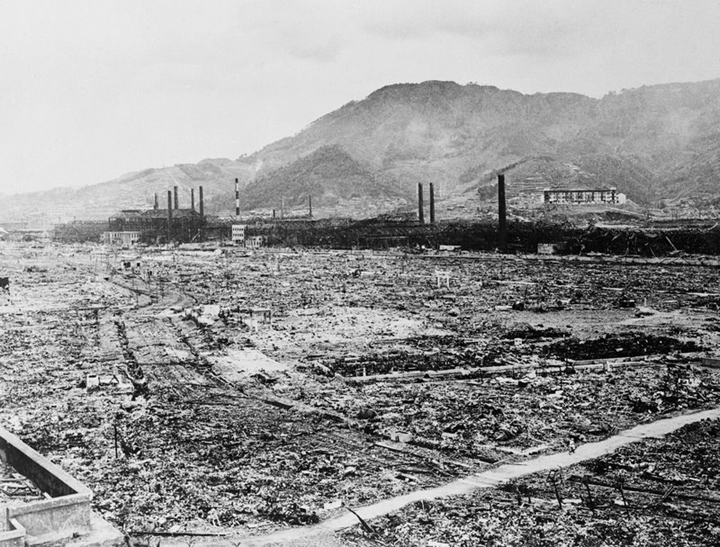
“Well, let’s see here. The reserve fuel tank pump was broken before take-off, and we knew it, so we were supposed to call off the mission then. Next, we failed to rendezvous over Yakushima with one of the crucial planes in the mission. At the primary target of Kokura we encountered cloud cover and flak. Now we are so dangerously low on fuel that there’s a good chance we’re going to lose the bomb and our lives by ditching in the Pacific. If we carry out the mission at the secondary target, and survive, there’s a good chance we’ll be court-martialed for not following orders to abort the mission if troubles like these arose. Hmmm. Let’s just spare Nagasaki, get back to base safely, and hope this war is over soon before we have to drop the second bomb.”
Unfortunately, the commanding officers of Bockscar, the plane that dropped the bomb on Nagasaki, were eager to not look like failures after the “success” of the Enola Gay over Hiroshima three days earlier. The full story is told in the article “The harrowing story of the Nagasaki bombing mission“ (Bulletin of Atomic Scientists, August 4, 2015). After encountering the many troubles listed above, the plane went to the secondary target, Nagasaki, and the pilot determined to drop the bomb by radar through the cloud cover, against specific orders to drop it only with a clear view of the target. “Fortunately,” there was an opening in the clouds over the Urakami district, which was not the intended target over the center of the city. They hastily decided to drop the bomb there, then headed toward Okinawa for an emergency landing. They approached Okinawa with empty fuel tanks, expecting they would have to ditch in the ocean and die. The crew was literally willing to die rather than return as “failures” compared to their colleagues who had flown on the Enola Gay. In this regard, they were much like the fictional Major T.J. King Kong in Dr. Strangelove who carried out a suicide mission in order to start WWIII.
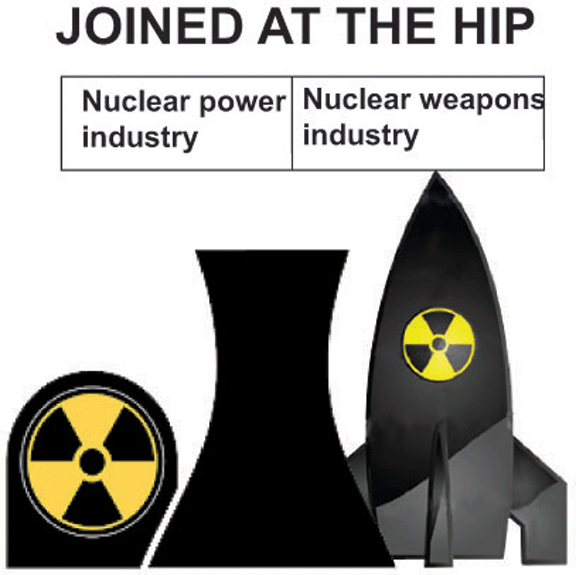
For years, the nuclear industry insisted that civilian nuclear power had nothing to do with weapons programs. That was then. Now, in a desperate attempt to keep no-longer-competitive nuclear plants from being shuttered, the industry claims there really has been a connection all along, and electricity customers should pay a premium to keep it going. It is one claim too many.
In its latest public effort, the nuclear industry got several dozen retired generals and admirals, former State, Defense and Energy Department officials, three former chairmen of the Nuclear Regulatory Commission, and a sprinkling of former senators, governors, industrialists and other worthies to sign a June 26, 2018, letter to Energy Secretary Rick Perry attesting to the connection between U.S. nuclear power plants and national security. The letter urged him to weigh in with federal and state rate-setting bodies to raise customers’ electricity bills to keep U.S. nuclear plants from shutting down, however much that will cost.
The letter didn’t, of course, put it in such crass terms. It talks about taking “concrete steps” to ensure electricity markets valued the nuclear plants’ “national security attributes”— a vague enough formulation to ease getting signatories. Most of them, as one of the signers (former Virginia Senator John Warner) himself put it , “are not intimately familiar with the ins and outs of the financial side of the power grid.” They do, however, apparently believe that they see the big picture—”the national security attributes of nuclear power”—more clearly than the parochial federal and state officials who set electric rates.
But are they any clearer on nuclear power’s national-security attributes than they are on the financial side of the industry?
The letter talks about “robust” nuclear power plants offering “a level of protection against natural and adversarial threats.” Leaving aside that “a level of protection” doesn’t mean much, the implied claim is dubious. It’s not well known but nuclear plant safety is critically dependent on the reliability of the electrical grid to which it is connected. In severe natural situations (ice storms, hurricanes, tornadoes, earthquakes), and even more so in adversarial ones, the transmission lines connecting nuclear plants to the electrical grid may fail or be destroyed. The earthquake that triggered the Fukushima accident first destroyed transmission towers and broke the link with the electrical grid. In these circumstances a nuclear plant must be shut down, as would any other electric generating plant. The difference, however, is that the nuclear plant becomes a serious liability because its safety cooling systems would have to operate indefinitely on its emergency diesel reserves—a highly undesirable state of affairs. There have been grid failures in the United States that have put several nuclear plants into emergency mode. In this context, it’s fair to ask whether nuclear plants increase the resilience of our electrical grid or burden it.
Another claim is that the Navy “benefits from a strong civil nuclear sector.” Maybe so. But in that event, as John Cochrane, an economist with the Hoover Institution, pointed out in connection with a similar appeal to subsidies, “If national security is at risk, let Defense ask for money.” The writers and signatories of the Perry letter know that nuclear power subsidies wouldn’t stand a chance set against the priorities of the Department of Defense. They know it would be an easier touch to stick the country’s ratepayers with the added bill. There is an element of insensitivity in this, as most of the ratepayers are in rather more difficult financial circumstances than the comfortably pensioned signatories. It has not occurred to them to ask that industry should earn less out of patriotism. But, of course, they didn’t write the letter.
“The nuclear industry is an important career destination for military veterans.” True, and retired Navy officers and seamen have had a useful effect on making plants run better and more safely. But should customers pay more on their bills to provide second careers to retired military and naval personnel at plants that are not needed?
The claim in the letter that deserves the most attention is the insidious argument that the United States needs to be a major exporter of nuclear technology in order to retain “influence over nonproliferation.” The worldwide spread of nuclear technology is, of course, what makes proliferation an urgent problem. The whole point of the body of the Perry letter is that there is a close connection between U.S. nuclear power and our nuclear weapons programs. Why should we think that this connection is not present in other countries? Wouldn’t that suggest sharing less, rather than more, of this technology?
Nuclear power has not succeeded in escaping its origin. It was born in the federal government, was suckled by the government, and has always relied on government support and protection. The industry preferred a system of federal regulation that gave the public essentially no say in the deployment of nuclear plants. It was an easy path for the industry to get its way, but only for a time. The crutch that seemed to make it unnecessary to react to public and market feedback also held back improvements. Now that nuclear plants are threatened with shutdowns, the industry can only think of more federal and state subsidies. In this latest effort, the industry wraps itself in the flag to urge Washington to find a way to stick ratepayers with the tab. It should be ignored.
Victor Gilinsky served on the U.S. Nuclear Regulatory Commission under Presidents Gerald Ford, Jimmy Carter, and Ronald Reagan. He is program adviser for the Nonproliferation Policy Education Center. Henry Sokolski is executive director of the Nonproliferation Policy Education Center and the author of Underestimated: Our Not So Peaceful Nuclear Future. He served as deputy for nonproliferation policy in the office of the U.S. secretary of defense from 1989 to 1993.
San Onofre Beach as PERMANENT Nuclear Waste Dump, Wilder Utopia BY THE OUTPOST AUGUST 7, 2018According to a former Nuclear Regulatory Commission Chief, the beach in front of San Onofre Nuclear Generating Station could become a permanent nuclear waste dump. Learn why Edison’s program of storing deadly nuclear waste on the beach is not a “temporary” plan. And cartoonist Jerry Collamer weighs in.
Former NRC Chief Says San Onofre’s Nuclear Waste May Never Be Moved
Greg Jaczko was the head of the Nuclear Regulatory Commission in 2012 when Edison shut down San Onofre because of a radioactive leak. He said plans to move the waste elsewhere may never materialize.
Southern California Edison spokeswoman Maureen Brown said the company has now transferred more than 26 canisters, about one-third of the still highly radioactive spent nuclear fuel remaining in cooling ponds at San Onofre, into dry cask storage on site. The canisters are loaded with spent fuel rods, moved across the site and lowered into vertical casks set in concrete. Only the 74 concrete lids are visible, lined up right next to a seawall.
“According to our outer planetary research team, this was once a delightfully pleasant population of coastal inhabitants, living an upscale beach life when the BIG ONE hit, dislodging those highly radiated canisters, releasing their deadly radioactive contaminates into the air. As the ol’ saying goes, “the rest is history.” But, that was 2,000 years ago, making confirmation of the research impossible. Other rumors say the dinosaurs caused it.” – Divined by Jerry Collamer
At a community engagement meeting arranged by Edison, Chief Nuclear Officer Tom Palmisano said the plan is to move the nuclear waste elsewhere once it has cooled to safer, interim storage, possibly in Texas or New Mexico.
“Our commitment is to support any reasonable and safe way to move fuel out of San Onofre, whether it’s a permanent repository, one of these two projects, or something not yet on the horizon,” Palmisano said.
But Jaczko said don’t count on it.
“Because, quite frankly, once they get loaded, I don’t see them ever taking those canisters out of there,” Jaczko said. “Realistically, they are not going to move them out, so those permits will be extended, the operational period will be extended on indefinitely and you will have a de facto burial site there.”
The problem of what to do with nuclear waste is a national one because the federal government has not agreed on a long-term storage site, Jaczko said.
“There’s a tendency to want to make the problem go away, emotionally and mentally, and when you bury things, it’s easier mentally to not worry about them,” Jaczko said. “Very quickly, people came to this conclusion that the way you solve this problem is you find a place where you can bury and forget: it’s literally called ‘bury and forget.’ You bury the waste and you forget about it.”
Sea Level Rise
Tom English is a retired electrical engineer who has advised the U.S. government and industry on nuclear waste disposal. He lives in Carlsbad, 25 miles south of San Onofre. Moving spent fuel rods out of cooling ponds and into dry storage casks is a good idea, English said, but not if the bottom of those casks are just feet above mean high tide levels.
“If you are involved with high-level nuclear waste disposal, the first thing you think of is to keep it away from water, because the water allows the radionuclides to spread through the environment, causing all sorts of havoc, wrecking ecosystems, cancer, etc.,” English said.
Edison plans to complete the transfer of the remaining spent fuel rods into dry casks by next year. Then the company hopes to dismantle the spent fuel pools and most of the remaining structures on the site. But not the spent fuel storage. That has a permit from the California Coastal Commission to remain until 2035.
“You have to recognize that this is not a short-term solution,” Jaczko said. “Whatever is going to be done with this spent fuel is probably what’s going to happen with this fuel for decades, if not centuries. So you have to think about this as a long-term solution.”