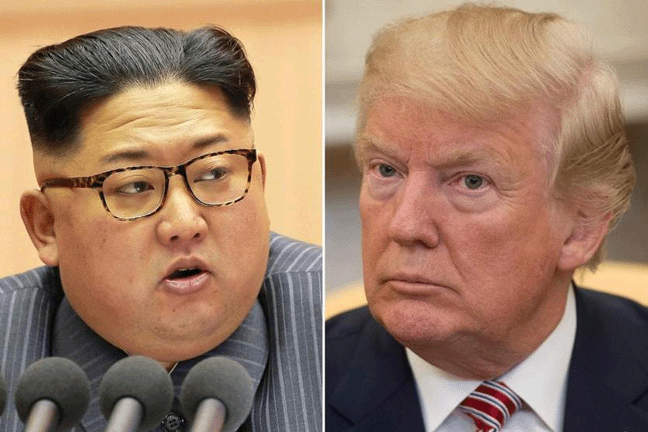
Kim and Trump Back at Square 1: If U.S. Keeps Sanctions, North Will Keep Nuclear Program, NYT, By David E. Sanger, Jan. 1, 2019
Nearly two years into his presidency and more than six months after his historic summit meeting with Kim Jong-un of North Korea, President Trump finds himself essentially back where he was at the beginning in achieving the ambitious goal of getting Mr. Kim to relinquish his nuclear arsenal.
That was the essential message of Mr. Kim’s annual New Year’s televised speech, where he reiterated that international sanctions must be lifted before North Korea will give up a single weapon, dismantle a single missile site or stop producing nuclear material.
The list of recent North Korean demands was a clear indicator of how the summit meeting in Singapore last June altered the optics of the relationship more than the reality. Those demands were very familiar from past confrontations: that all joint military training between the United States and South Korea be stopped, that American nuclear and military capability within easy reach of the North be withdrawn, and that a peace treaty ending the Korean War be completed.
“It’s fair to say that not much has changed, although we now have more clarity regarding North Korea’s bottom line,’’ Evans J.R. Revere, a veteran American diplomat and former president of the Korea Society, wrote in an email.
“Pyongyang refused to accept the United States’ definition of ‘denuclearization’ in Singapore,’’ he wrote. To the United States, that means the North gives up its entire nuclear arsenal; in the North’s view, it includes a reciprocal pullback of any American ability to threaten it with nuclear weapons. “The two competing visions of denuclearization have not changed since then.”
o Mr. Trump and Mike Pompeo, the secretary of state, who is supposed to turn Mr. Trump’s enthusiasms into diplomatic achievements, dispute such conclusions. They note that the tone of one of the world’s fiercest armed standoffs has improved. It has, and both leaders say they want to meet again.
……….By some measures there has been modest progress. It has been 13 months since the North tested a nuclear weapon or a long-range missile, a change that Mr. Trump and Mr. Pompeo cite as the first fruits of what some officials now concede will be a long diplomatic push.
Relations between the two Koreas are warming, though there is considerable evidence that Mr. Kim sees his outreach to President Moon Jae-in of South Korea as a way to split the United States from its longtime ally.
But Mr. Trump’s strategic goal, from the moment he vowed to “solve” the North Korea problem rather than repeat the mistakes of past presidents, has been to end the North Korean nuclear and missile threat, not suspend it in place.
Mr. Trump dispatched his first secretary of state, Rex W. Tillerson, to Seoul in March 2017 to declare that a mere nuclear freeze would not be enough. Back then, Mr. Tillerson declared there would be no negotiations, and certainly no lifting of sanctions, until the North’s dismantling had begun. A nuclear freeze would essentially enshrine “a comprehensive set of capabilities,” he argued.
The decision Mr. Trump must make now is whether to backtrack on the objective of zero North Korean nuclear weapons even if that means accepting the North as a nuclear-armed state, as the United States has done with Pakistan, India and Israel. https://www.nytimes.com/2019/01/01/world/asia/kim-trump-nuclear.html
January 5, 2019
Posted by Christina Macpherson |
North Korea, politics international, USA |
Leave a comment
|
 Fragmenting nuclear arms controls leave world in a more dangerous place https://www.theguardian.com/world/2019/jan/03/fragmenting-nuclear-arms-controls-leave-world-in-a-more-dangerous-place Andrew Roth in Moscow 3 Jan 2019
US could withdraw from a second treaty while Vladimir Putin’s Russia promises a new generation of nuclear weapons Fragmenting nuclear arms controls leave world in a more dangerous place https://www.theguardian.com/world/2019/jan/03/fragmenting-nuclear-arms-controls-leave-world-in-a-more-dangerous-place Andrew Roth in Moscow 3 Jan 2019
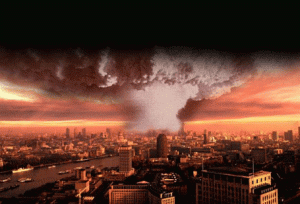
US could withdraw from a second treaty while Vladimir Putin’s Russia promises a new generation of nuclear weapons The decision on whether or not to destroy the world came down to a humble Soviet duty officer early one morning in 1983. Stanislav Petrov was told by his computer that the United States had launched at least five intercontinental ballistic missiles at the Soviet Union, and that they would strike in just 25 minutes.Rather than send the alarm up the chain of command, the lieutenant colonel did nothing and averted a nuclear clash over what turned out to be a systems malfunction. For his troubles, Petrov was reprimanded for failing to keep careful notes during the incident and left the service the following year.
He died at 77 just last year, on the cusp of the collapse of the architecture that has governed nuclear arms control for the last two generations. Potential nuclear clashes may seem the stuff of Cold War lore, but the framework to prevent them is recent and increasingly endangered.
 Led by National Security Advisor John Bolton, the United States in 2018 said it would leave the Intermediate-Range Nuclear Forces Treaty, the 1987 nuclear arms control treaty largely credited with keeping nuclear weapons out of Europe. That came after years of complaints about Russia testing a ground-based cruise missile that violated the treaty. Led by National Security Advisor John Bolton, the United States in 2018 said it would leave the Intermediate-Range Nuclear Forces Treaty, the 1987 nuclear arms control treaty largely credited with keeping nuclear weapons out of Europe. That came after years of complaints about Russia testing a ground-based cruise missile that violated the treaty.
The next pillar to fall could be the New Start treaty, signed by Barack Obama and Dmitri Medvedev in 2010, which reduced strategic missile launchers by half. That treaty will expire in 2021 unless it is extended, and President Trump has called it a “bad deal” in a telephone call with Vladimir Putin.
Russia’s foreign minister has said he believes the United States is “preparing the soil to dismantle this deal.”
Putin also threatened the United States with a new line of nuclear-capable weapons earlier this year, blaming the United States’ decision to exit the 1972 anti-ballistic missile treaty for a new arms race. His state of the nation speech, usually a staid affair, was accompanied by a low-resolution animation of a nuclear-powered cruise missile sailing from the Atlantic Ocean, around Cape Horn and then northward toward California.
“You didn’t listen to our country then,” Putin said of the US leaving the ABM in 2001. “Listen to us now.”
Taken together, these treaties are the bulk of the nuclear arms control framework that the United States and Russia inherited from the Cold War or have developed since. Experts from both sides note that the treaties weren’t perfect but warn that brokering deals is far more difficult than breaking them. The probability of an arms buildup is growing.
“The INF decision and failure to get into real discussions about extending New START has us sleepwalking into a new nuclear arms race,” said Richard Burt, a former ambassador who served as chief negotiator for the United States on the Strategic Arms Reduction Treaty, during an Atlantic Council event earlier this year.
Viktor Yesin, the former chief of staff of the Russian Federation Strategic Missile Force, said that the US decision to exit the INF was largely with an eye to military developments in China and other countries not bound by the treaty. But the decision could lead to deployments of missiles in Europe, he said, unless the United States and Russia take steps to avoid it.
Only “political measures” could avert “the worst outcome for Russia and Europe in the development of a ‘missile crisis,’ which will unavoidably arise after the United States exits the INF,” he said.
Those warnings appear to be apt. A leaked memo published by the Washington Post showed that Bolton had ordered the Pentagon to “develop and deploy ground-launched missiles at the earliest possible date.” The order was tabled only after European allies intervened to prevent an immediate US pullout from the INF. Washington has issued Moscow a 60-day ultimatum, after which it will exit the treaty. Russia, which has not admitted to violating the treaty, has signalled it won’t change its behaviour.
The driving force behind the pullout is seen as Bolton, who has spoken fervently against similar arms control treaties and presided over the demolition of both the anti-ballistic missile treaty in 2001 and now the INF.
Determined individuals can change the course of history. In 1983, Petrov’s decision not to alert his superiors came down to a “funny feeling in my gut.” Now, Bolton appears resolved to finally see a United States released from the bonds of missile treaties and nuclear arms control.
|
|
January 5, 2019
Posted by Christina Macpherson |
politics international, Russia, USA, weapons and war |
Leave a comment
 High-Paying Jobs in Nuclear Power Aren’t Looking So Safe Anymore
A wave of plant closings has workers—even highly trained engineers—on edge, THE WALL STREET JOURNAL, Erin Ailworth, Dec. 28, 2018 “………As large employers, these plants are often economic anchors for the smaller, sometimes rural communities in which they were built. When they disappear, so too can a significant portion of the tax base—a big blow for many. Each plant shuttered equals hundreds of jobs lost; combined, the nine slated to retire employ more than 7,000.
After a plant closes, those employees are left playing musical chairs, hoping to land a spot at another nuclear plant even as that job pool shrinks. Federal labor data for nuclear and other electric power generation shows the number of workers has dropped to about 63,000 in October from roughly 158,000 in 1990. At least 3,000 of those jobs vanished since the start of 2013………
Federal forecasts show that employment among nuclear power reactor operators, who tend to have a high school or equivalent education, is expected to fall by just over 10% from 2016 to 2026. Meanwhile, the Nuclear Energy Institute, a trade association, estimates that of 100,000 nuclear workers—including those with jobs outside power plants—it expects about 23,000 people to retire from or quit the industry over the next five years.
……. The latest nuclear job losses occurred at Oyster Creek, a 49-year-old plant owned by Exelon Corp. in New Jersey, that went offline in September. Next to go will be Entergy Corp.’s Pilgrim nuclear plant in Massachusetts, which is scheduled to shut down in May. Three Mile Island’s shuttering is slated for September 2019.
Christopher Crane, chief executive of Exelon, said his company is doing what it can to absorb workers displaced by Oyster Creek’s retirement, even as it works to avoid further closures by lobbying for policies that recognize nuclear power as a carbon-free resource akin to solar and wind farms.
…….. The last nuclear plant built in the U.S. came into full service in 2016. More recent nuclear projects have had huge cost overruns and delays.
The Trump administration, meanwhile, repeatedly has promised to help the struggling nuclear industry, but so far its efforts haven’t panned out.
Employees at the James A. FitzPatrick nuclear plant in central New York state worry about their future. https://www.wsj.com/articles/high-paying-jobs-in-nuclear-power-arent-looking-so-safe-anymore-11545993000
January 5, 2019
Posted by Christina Macpherson |
employment, USA |
Leave a comment
 https://www.seattletimes.com/opinion/dont-let-feds-change-the-rules-for-cleaning-up-hanford-nuclear-waste/, January 2, 2019
The public can comment on the U.S. Department of Energy’s proposed changes to Hanford nuclear waste cleanup rules until Jan. 9, Tom Carpenter
After almost 30 years of a program to clean up dangerous defense waste at the Hanford nuclear site in southeastern Washington, the Department of Energy now wants to change the rules to make the job easier and save money. If approved, the proposal poses new dangers to the health and safety of people and the environment — not just in southeastern Washington, but at nuclear sites around the country.
In 1943, the U.S. government built the massive complex at Hanford to manufacture plutonium for nuclear weapons. When defense production ceased in 1986, its nine reactors had produced enough material for 60,000 atomic bombs. What remains is North America’s most contaminated site — more than half a billion gallons of nuclear waste and toxic chemicals stored in leaking tanks and dumped into the ground.
The most dangerous material is classified as “high-level waste.” The U.S. government has long recognized that because it poses such an extraordinary risk to human health and the environment, it requires special handling. A report prepared for the Atomic Energy Commission in 1957 called for disposal of high-level nuclear waste in a “deep underground formation, where it would remain isolated from human beings” for hundreds of thousands of years. That recommendation became law in 1982 when Congress passed the Nuclear Waste Policy Act.
Responsibility for the mess at Hanford falls to the U.S. Department of Energy. The plan includes mixing 56 million gallons of high-level waste with molten glass so it can be safely transferred to a permanent underground disposal site.
The cleanup effort began in 1989. It has not gone well. More than $45 billion has been spent, but no high-level waste has been processed. Hanford workers have received more than $1 billion in compensation for exposure to radiation and toxic chemicals. Companies working on the cleanup have pleaded guilty to criminal charges and paid hundreds of millions of dollars in fines and settlements. Radioactive waste is leaking into the groundwater and flowing toward the Columbia River.
Not to worry! The Energy Department has come up with an alternate approach for dealing with high-level nuclear waste — give it a new name and leave it where it is.
This past summer, the agency announced its intention to reclassify high-level nuclear waste in 16 partially emptied tanks as low-level waste and cover what remains with grout. Now DOE is going big, and proposing to give itself the authority to relabel waste as it sees fit anywhere in the nation.
Even under ideal conditions, the waste will slowly leach through the grout and into the surrounding soil. That assumes it doesn’t fail catastrophically due to fractures caused by changes in temperature, stress, or imperfections — all possible, even likely.
The danger extends beyond Hanford. Once the Energy Department grants itself the authority to redesignate dangerous nuclear material, it can do the same with hundreds of millions of gallons of high-level waste stored in 161 other tanks or simply dumped into the ground at Hanford. It sets a dangerous precedent that will place millions of people at risk — not just downwind and downriver from Hanford, but near facilities in South Carolina, Idaho and upstate New York, where millions more gallons of high-level waste are stored.
Why consider such an unsound plan? Money. By absolving itself of its legal obligation to handle high-level waste safely, the Energy Department expects to save $40 billion.
The proposal is not only irresponsible and dangerous, it violates the law and flies in the face of longstanding legal precedent. “High-level radioactive waste” was clearly defined by the Atomic Energy Commission in 1970 and the courts have repeatedly turned back attempts to reclassify it. In 2003, for example, the U.S. District Court in Idaho confirmed that what’s in tanks at Hanford is, in fact, high-level waste and made clear that the Energy Department cannot simply come up with an alternative way to treat it just because it is “too expensive or too difficult.”
Although it is profoundly shortsighted, deeply irresponsible and clearly illegal, this proposal isn’t surprising — it is entirely consistent with the Department of Energy’s history of cutting corners at Hanford and saddling future generations with a problem that requires our urgent attention today.
The Energy Department is taking public comments on this proposal through Jan. 9. Clearly, this plan must be rejected.
January 5, 2019
Posted by Christina Macpherson |
USA, wastes |
Leave a comment

 ‘The existential threat of our time’: Pelosi elevates climate change on Day One, Politico, By ANTHONY ADRAGNA and ZACK COLMAN , 01/03/2019
Democrats put climate change back on the forefront of their governing agenda Thursday, portraying the issue as an “existential threat” even as the caucus remains split over how forcefully to respond.
Speaker Nancy Pelosi brought up the issue in her opening address while touting a new select panel to come up with ideas on how to solve it, and the Energy and Commerce Committee announced that climate change would be the subject of its very first hearing this year……..
Progressives, led in part by Rep. Alexandria Ocasio-Cortez (D-N.Y.), are tugging the caucus into a more urgent posture that they say best reflects what scientists have called for to avert climate change. The Intergovernmental Panel on Climate Change warned last year that the world has 12 years to put policies in place to avoid irreversible, catastrophic effects of climate change. ……..https://www.politico.com/story/2019/01/03/nancy-pelosi-climate-change-congress-1059148
January 5, 2019
Posted by Christina Macpherson |
climate change, politics, USA |
Leave a comment

Bill Gates shelves nuclear reactor in China, citing U.S. policy, Axios, Amy Harder, Dec 30
TerraPower, a nuclear-energy company founded by Bill Gates, is unlikely to follow through on building a demonstration reactor in China, due largely to the Trump administration’s crackdown on the country.
Why it matters: This is a blow to America’s attempts to commercialize advanced, smaller scale nuclear technology and, separately, further evidence of soured relations between the U.S. and China under President Trump.
Driving the news: In a year-end blog post covering various topics published Saturday night, Gates said of TerraPower: “We had hoped to build a pilot project in China, but recent policy changes here in the U.S. have made that unlikely.”
Details: The Trump administration, led by the Energy Department, announced in October that it was implementing measures to “prevent China’s illegal diversion of U.S. civil nuclear technology for military or other unauthorized purposes.”
- Those measures have made it nearly impossible for TerraPower’s project to go forward, according to multiple people familiar with the development.
- TerraPower had pursued plans to build a pilot reactor in China because that country has two things America doesn’t — growing electricity demand and a long-term strategic energy plan — a top TerraPower executive told me last year.
- Morning Consult and, separately, an analyst for the think tank International Institute for Strategic Studies, covered the impacts of the October policy change shortly after it occurred, with brief mentions of the likely negative impact on TerraPower………
What’s next: “We may be able to build it [the reactor] in the United States if the funding and regulatory changes that I mentioned earlier happen,” Gates said in his post, although he didn’t specify which funding or regulations.
Meanwhile, the Energy Department just announced it plans to buy some of the power from new advanced reactors being pursued by NuScale, another advanced nuclear company, for here in the United States. https://www.axios.com/bill-gates-nuclear-reactor-china-terrapower-be4c792c-6f76-4723-bf63-d8f9fb527dc1.html
January 1, 2019
Posted by Christina Macpherson |
business and costs, China, politics, USA |
2 Comments
|
 Four arrests at Pentagon during Holy Innocents witness Four arrests at Pentagon during Holy Innocents witness
The Nuclear Resister – Nonviolent Resistance for a Peaceful and Nuclear-Free Future December 28, 2018 from Art Laffin, Dorothy Day Catholic Worker From December 27-28, about 20 members from the Atlantic and Southern Life communities, and other peacemaking friends, gathered for a retreat at St. Stephen and the Incarnation Church in Washington, D.C., and a nonviolent witness at the Pentagon to commemorate the Massacre of the Holy Innocents – past and present. ……..
Braving a heavy steady rain, the community gathered early the next morning at the Pentagon’s southeast entrance with signs and banners. ……… A litany was offered (see below) interspersed with the refrain: “War Hurts Children—Help Us End War.” And a prayer and blessing was given by Janice, one of the four about to risk arrest.
Carrying copies of the “Treaty on the Prohibition of Nuclear Weapons” with the intention of delivering it to a Pentagon official and requesting that the U.S. ratify it, four members of the community made their way to the police check point closest to the building where they encountered Pentagon police. They were told by the officers that they must leave or face arrest. While the first several paragraphs of the Treaty were read, a Pentagon worker passed by and said “Thank you for keeping us honest.” After arrest warnings were given they were placed under arrest. As the four were being escorted to police vehicles, the rest of the community, from a distance sang “The Cry of Ramah!” The witness concluded with everyone singing “Vine and Fig Tree” as the community processed down the escalator and into the Pentagon metro station lobby…….
|
|
January 1, 2019
Posted by Christina Macpherson |
opposition to nuclear, Religion and ethics, USA |
Leave a comment
 Since 1980, the Nuclear Resister has provided comprehensive reporting on arrests for anti-nuclear civil resistance in the United States, with an emphasis on providing support for the women and men jailed for these actions. In 1990, we expanded our work to include reporting on anti-war arrests in North America, plus overseas anti-nuclear and anti-war resistance with the same emphasis on prisoner support.
Through the publication of a newsletter every three months, and other education and outreach, the Nuclear Resister serves to network this nonviolent resistance movement while acting as a clearinghouse for information about contemporary nonviolent resistance to war and the nuclear threat. We believe that in any significant movement for social change, many committed individuals are imprisoned. Behind bars, they are physically isolated from their supporters and their own resistance activity is limited. Broader awareness of their actions and support for the imprisoned activist are essential to the movement for a peaceful, nuclear-free future.
The Nuclear Resister provides the names and jail addresses of currently imprisoned anti-nuclear and anti-war activists. People are encouraged to provide active support by writing letters to those behind bars and in other ways requested by the prisoners.
Since 1980, Jack and Felice Cohen-Joppa have been co-coordinators of the Nuclear Resister and co-editors of the newsletter. Hundreds of people have helped over the years by distributing newsletters, helping staff a Nuclear Resister booth at various events, doing artwork and writing articles for the newsletter, helping at mailing parties, providing information about actions and legal updates, sending photos, helping with the website and blog, and writing letters of support to imprisoned activists. http://www.nukeresister.org/about-us/
January 1, 2019
Posted by Christina Macpherson |
opposition to nuclear, USA |
Leave a comment
|
 SC utility watchdog wants regulators to declare SCE&G lied about nuclear project, The State, BY TOM BARTON AND AVERY G. WILKS, DECEMBER 28, 2018, COLUMBIA, S.C. SC utility watchdog wants regulators to declare SCE&G lied about nuclear project, The State, BY TOM BARTON AND AVERY G. WILKS, DECEMBER 28, 2018, COLUMBIA, S.C.
South Carolina’s utility watchdog has asked the S.C. Public Service Commission reconsider its decision not to rule that SCE&G intentionally misled regulators years ago about its doomed nuclear plant construction project.
The S.C. Office of Regulatory Staff filed a petition late Friday asking the PSC for an explicit finding that SCE&G imprudently moved ahead with construction of the V.C. Summer Nuclear Station expansion in March 2015 despite warnings about the project’s cost and flaws.
Earlier this month, the PSC issued a ruling allowing Virginia-based Dominion Energy to buy SCE&G’s parent company, SCANA, and slash SCE&G’s nuclear-bloated electric rates by about $22 a month. But after some internal debate, the PSC stopped short of calling out SCE&G for withholding important information to win rate-hike cases and keep the foundering project alive.
Regulatory Staff wrote Friday “it is beyond dispute that SCE&G failed to disclose any iteration of the Bechtel Report to ORS or the Commission.” The agency said the “Commission cannot side-step the issue of prudence or imprudence” but instead must “make a clear finding” that SCE&G could have acted to anticipate, avoid or minimize nuclear construction costs.
Regulatory Staff Director Nanette Edwards said such a finding is needed “to restore public trust and hold the utility accountable.”
A SCANA spokesman said the utility would need to review the petition and would not comment Friday night.
“The commission’s thoughtful, well-reasoned order speaks for itself,” Dominion Energy spokesman Ryan Frazier said.
Ratepayers have paid more than $2 billion in higher power bills for the unfinished reactors in Fairfield County. And SCE&G’s roughly 730,000 customers will pay another $2.3 billion for the failed project over the next 20 years under the approved Dominion deal.
Regulatory Staff also want the PSC to clarify that Dominion must track and pass down to customers all of its savings from the recent federal tax cuts. It also is pushing the PSC to lower slightly how much profit Dominion can earn while paying down the nuclear debt, and return close to $400 million previously collected from customers for costs that are now disallowed.
Regulatory Staff wrote that it wants the PSC to impose conditions requiring a review prior to any possible expansion by Dominion’s of the Atlantic Coast Pipeline into South Carolina.
……… The PSC has 20 days to grant or refuse Regulatory Staff’s request. https://www.thestate.com/news/politics-government/article223663510.html |
|
December 31, 2018
Posted by Christina Macpherson |
secrets,lies and civil liberties, USA |
Leave a comment
Regulators File Complaint Against Maker Of Nuclear Fuel Cask https://www.wamc.org/post/regulators-file-complaint-against-maker-nuclear-fuel-cask By PAT BRADLEY • DEC 29, 2018 The Nuclear Regulatory Commission has filed a complaint against the manufacturer of casks used at the closed Vermont Yankee nuclear power plant.
NRC spokesman Neil Sheehan tells the Brattleboro Reformer that Holtec International adopted a new design for its steel and concrete casks without a written evaluation, violating federal safety regulations. Officials say the company made changes after it discovered a loose bolt at San Onofre nuclear power plant in California.
Holtec said Friday that the NRC has confirmed the safety of the canisters. It says it doesn’t agree with the severity level of the apparent violation.
The casks are used at other nuclear plants to store spent fuel.
Last month, regulators approved the sale of Vermont Yankee to NorthStar. The company plans to start decommissioning the plant no later than 2021.
December 31, 2018
Posted by Christina Macpherson |
safety, USA |
Leave a comment
 Inside the hurried effort to find a buyer for Santee Cooper, Herald Sun, BY AVERY G. WILKS, DECEMBER 30, 2018 , COLUMBIA, SC
A day before state regulators approved Dominion Energy’s bid to buy SCANA Corp., representatives from at least six firms gathered in a secret meeting in North Charleston to discuss a possible solution to the other half of South Carolina’s $9 billion nuclear construction fiasco.
The gathering revolved around the possible sale of Santee Cooper, the state-owned utility that racked up more than $4 billion in debt before abandoning a joint effort with SCANA to expand a nuclear power plant in Fairfield County.
ICF International — a Virginia-based firm hired by the General Assembly — hosted the invitation-only meeting as part of a hurried, ongoing effort to solicit and study bids from some of the largest names in the utility industry.
There to ask questions about Santee Cooper’s assets and operations — and to scout out the competition — were two dozen legal and financial experts representing Charlotte-based Duke Energy, Florida-based NextEra Energy, Virginia-based Dominion, Greenville-based Pacolet Milliken Enterprises, New York-based LS Power and South Carolina’s electric cooperatives — who together buy three-fifths of Santee Cooper’s electricity.
SCANA’s chapter of the V.C. Summer Nuclear Station debacle is winding down with the Cayce-based company’s impending sale to Dominion. But 17 months after the project’s collapse, the buzz surrounding Santee Cooper’s future is only now ramping up.
This summer, S.C. lawmakers slashed the nuclear-bloated electric rates for customers of SCANA’s electric subsidiary, SCE&G. That $22-a-month rate cut was made permanent by state regulators earlier this month.
Now, the nearly 2 million S.C. residents who get their power from Santee Cooper — either directly or through one of the state’s 20 electric co-ops — are wondering whether they will get a rate cut, too. That will be one of the biggest questions facing the General Assembly when it reconvenes in Columbia in January.
……….. The presentation on Santee Cooper’s assets and operations, and a question-and-answer period were scheduled to last all day. But with each of the bidders hesitant to ask a question that could tip their hands, the event wrapped up about lunchtime instead, sources said.
ICF declined to comment through a public relations agency.
State Rep. Murrell Smith, the Sumter Republican who co-chairs the Legislature’s Santee Cooper sale study committee, told The State in a recent interview he is confident in the timeline set for the process.
ICF told Smith’s committee there would be enough time for “meaningful and thorough bids,” particularly since potential buyers have known for more than a year that Santee Cooper could be on the auction block, he said.
Those bids are due Jan. 14. https://www.heraldsun.com/news/state/south-carolina/article223631625.html
December 31, 2018
Posted by Christina Macpherson |
business and costs, USA |
1 Comment
|
America’s Mad Scientists Wanted to Use Nuclear Power to Create Tunnels in a Shocking Way,
In the 1970s, Los Alamos National Laboratory explored a science-fiction approach to tunneling: using nuclear power to literally melt holes through rock and turn the melted rock into tunnel lining. National Interest by Steve Weintz 30 Dec 18, Digging out deep underground complexes or undersea bases could be expedited the Atomic way, in an alternate universe where the wildest ideas of the 1950s, 60s and 70s came to pass. Although our own timeline relies on mega-engineering for transportation, energy and architectural infrastructure, for the past half-century we’ve mostly relied on conventional power sources and design principles……..
in the 1970s, Los Alamos National Laboratory explored a science-fiction approach to tunneling: using nuclear power to literally melt holes through rock and turn the melted rock into tunnel lining. One product of the lab’s research was a patent for a nuclear subterrene—a machine which could theoretically move through rock the way a submarine moves through water. ……..
|
|
December 31, 2018
Posted by Christina Macpherson |
technology, USA |
1 Comment
 Connecticut commits to nuclear power, ending debate over Millstone’s future, By STEPHEN SINGER, HARTFORD COURANT | DEC 28, 2018 “……….
The state’s portfolio of energy used by utilities and sold to consumers and businesses will include power from Millstone and the Seabrook Station nuclear power plant in New Hampshire……….
December 30, 2018
Posted by Christina Macpherson |
opposition to nuclear, USA |
Leave a comment

 FBI and CIA’s ‘Duty To Warn’ Victims of Israeli Nuclear Smuggling https://original.antiwar.com/smith-grant/2018/12/26/fbi-and-cias-duty-to-warn-victims-of-israeli-nuclear-smuggling/
$500 million Pennsylvania NUMEC toxic cleanup restarts by Grant Smith December 27, 2018 In 2015 the intelligence community acknowledged that it had a “duty to warn” U.S. persons of impending threats of “serious bodily injury.” The objective of that “duty” – which has many loopholes – is to compel intelligence agencies to warn individuals or organizations of threats so they can take evasive measures. It affirms a moral obligation intelligence agencies have to those funding – willingly or not – their operations. The duty to warn demands they no longer stand idly by – or worse attempt to exploit credible threats to Americans – as leverage or for other, secret intelligence purposes.Last fall the US Army Corps of Engineers announced it was finally ready to resume a $500 million toxic waste cleanup of the Nuclear Materials and Equipment Corporation (NUMEC) dump. An earlier attempt at the Pennsylvania site to excavate was stopped after the discovery of unexpected materials. NUMEC’s plant sites in Apollo and Parks Township have long been the subject of litigation over wrongful mass deaths and illnesses caused by toxic pollution.
NUMEC was launched and managed by Zalman Shapiro, a nuclear chemist credited with solving engineering issues for naval nuclear propulsion in the 1950s. His partner, David Luzer Lowenthal was a smuggler with murky ties to Israeli intelligence and industrialist. Luzer organized the emergence of NUMEC from a complicated merger and acquired facilities for NUMEC in a defunct steel mill in the middle of Apollo, Pennsylvania. The Zionist Organization of America, originally chartered to “do any and all things that may be necessary” to support Israel, supplied three of NUMEC’s executives. Zalman Shapiro, Pittsburgh region president of ZOA, Morton Chatkin and Ivan J. Novick who became ZOA’s national president.
Officially NUMEC was a startup supplier of highly-enriched fuel for the US Navy. But two Central Intelligence Agency officials claimed NUMEC’s true purpose was to amass and divert US government-owned highly enriched uranium into Israel’s nuclear weapons program. 300 kilograms of highly enriched uranium disappeared from NUMEC between 1957-1978, with most of it gone by 1966. Material stolen from NUMEC would have been the most likely source for Israel’s ability to ready nuclear weapons for use during the 1967 Six-Day War.
CIA Tel Aviv Station Chief John Hadden, who performed field operations to sample the environment around Dimona for highly enriched uranium – material Israel was incapable of producing on its own – claimed NUMEC was “an Israeli operation from the beginning.” CIA Directorate of Science and Technology Deputy Director Carl Duckett testified that “NUMEC material had been diverted by the Israelis and used in fabricating weapons.” There were other telltale signs.
Inside NUMEC’s underfunded, ramshackle facilities an Israeli scientist, Baruch Cinai, learned to handle samples of plutonium, a skill subsequently useful to plutonium production at Israel’s Dimona facility. Israeli covert operatives Raphael Eitan, Avraham Bendor and Ephraim Beigun all visited the facility at Shapiro’s invitation in 1968 undercover as various Israeli energy specialists, in the company of Avraham Hermoni, chief of Israel’s nuclear weapons development program. The FBI’s investigation of NUMEC-related activities ultimately shook loose eyewitness testimony that Shapiro was collaborating in the illicit diversion of highly enriched uranium from NUMEC’s U.S.-government owned stockpile to Israel. Under increasing pressure, NUMEC’s regulator, the Atomic Energy Commission, subsequently engineered NUMEC’s corporate buyout and the exit of its management team to save face, after many years of denial and providing easily refuted excuses for NUMECs extreme and inexplicable material “losses.”
That NUMEC was a front operation, following in the footsteps of Israel’s 1940s-era conventional weapons smuggling operations from the US such as Martech, Service Airways, and the Sonneborn Institute, is well-known by the FBI and CIA. Both have released extensive archives of intelligence reports and surveillance photographs of Israeli conventional weapons smuggling from the United States through overseas networks. But both FBI and CIA have fought attempts at full disclosure of clandestine Israeli nuclear weapons related activities in the US, ostensibly because such smuggling has been unpunished and unabated. It is also US policy, under penalty of prosecution, that no federal agency may admit that Israel has nuclear weapons or release information about its program.
A February 2015 lawsuit seeking all of the CIA’s “thousands” of files about NUMEC was ended when the presiding judge refused to allow adding the US Department of Justice – which has worn many hats in the NUMEC affair – as an additional defendant. However some CIA documents were released during the court battle, revealing how the CIA had refused to cooperate with two separate FBI investigations of NUMEC, preferring to cover up damning information obtained from clandestine CIA operations in Israel confirming the diversion.
Documents grudgingly released by the FBI so far reveal the intelligence community likely knows that cost-cutting at NUMEC to achieve its smuggling aims was what made it such a toxic polluter. On May 5, 1969, Shapiro discussed a major toxic spill caused by such shortcuts, most likely with David Lowenthal, since the acquisition of other US companies was also part of the conversation. Shapiro ordered NUMEC workers – who often worked with no protective gear of any kind – to dampen down the spill with picks and shovels to avoid the spread of toxic dust and rain runoff carrying away the waste. Shapiro’s call was wiretapped by the FBI.
The full phone call summary reveals how Shapiro – who commuted every day from Pittsburgh – considered NUMEC workers as mostly replaceable and expendable.
“It’s not only a bad spill but ‘actually they are operating outside compliance.’ They had the drums all together. They have about 200 drums and estimate that about six a day will corrode through. The trouble lay with a fluoride which was put in to help the decay, and this was not checked. CENSORED said they are also about $230,000 over on their construction costs for the scrap plant. Z [Zalman Shapiro] said if they could get other people, there would be a lot of firing.”
NUMEC workers and town residents, exposed to radiation levels hundreds of times higher than health standards allowed, continue to suffer fallout and death from NUMEC. In addition to residents, the US Army Corps of Engineer contractors restarting the cleanup could benefit greatly from knowing what material is likely present – as well as what is not – at the site. Residents and the cleanup crew would also benefit from knowing of any intelligence on the potential threat that materials stolen decades ago might be returned or buried under cover of the cleanup at the site for crews to “find.”
Legal precedents suggest such toxic exposure as occurs at NUMEC could amount to “oppression, fraud, or malice” and be sufficient for victims to recover damages from polluters. However, neither the CIA nor the FBI have met their current obligations under “duty to warn” to officially alert the victims of NUMEC and contractors precisely what dangers they are still facing as the cleanup recommences.
Such overdue disclosures could also allow NUMEC’s victims to pursue claims against the perpetrator and beneficiary of the fraud and pollution – the Israeli government. Evidence stored away in FBI and CIA files could fully reveal ZOA’s NUMEC involvement. If ZOA did more than unwittingly provide key members of management, ZOA’s $40 – plus million in current assets could go a long way toward compensating the long-suffering Pennsylvania victims of Israeli nuclear smuggling and partially shift the burden of paying to clean up after NUMEC away from American taxpayers.
Grant F. Smith is the author of the book Divert! NUMEC, Zalman Shapiro and the diversion of US weapons-grade uranium into the Israeli nuclear weapons program. He is director of the Institute for Research: Middle Eastern Policy in Washington, D.C. and plaintiff in the 2015 lawsuit calling on the CIA to release all NUMEC-related files.
December 29, 2018
Posted by Christina Macpherson |
Israel, secrets,lies and civil liberties, USA |
Leave a comment