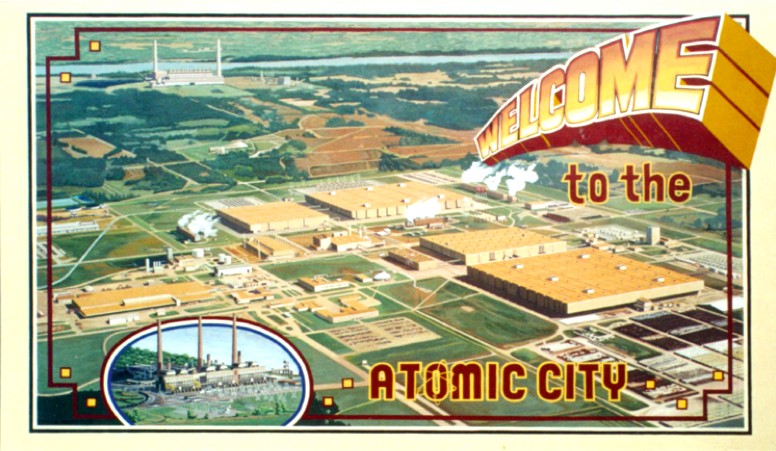
What happens if we can’t clean up the mistakes of our nuclear past?At Washington’s Hanford nuclear site, failing infrastructure and make-do plans as the West prepares for a new round of radioactivity. Crosscut, by Heather Hansman, High Country News / January 7, 2019The Hanford nuclear complex in eastern Washington lies in a green-gold sagebrush steppe, so big you can’t see the edges of it and shimmery in the summer heat. The only landmarks are low-slung buildings on the horizon and ancient sand dunes scrubbed bare when the glaciers melted. There’s almost no trace that this is the biggest nuclear waste dump in the country. The scale of nuclear waste is like that: sprawling out into the metaphysical distance, too big for the human mind to hold.
That’s what John Price tells me. He’s the tri-party agreement section manager with the Washington Department of Ecology, which regulates Hanford, the site of the country’s first plutonium production plant. (The other two parties are the U.S. Department of Energy and the Environmental Protection Agency.) On a sweltering June evening, we stand on the edge of the site’s central plateau, wind buffeting our faces as we stare at the bony frame of the future vitrification plant. If you were to pull a shot glass full of liquid out of one of the tanks buried near us, it would kill everyone within 100 yards instantly. And the danger would not disappear: Plutonium, one of the components of that poisonous soup, has a half-life of 24,100 years. The plant is supposed to start processing the most toxic waste in 2036. But construction has stalled, and most of the waste sits in underground tanks, some of which have begun to fail. “Suppose all these things are starting to fall apart faster than we can clean them up,” Price says. “It becomes a really interesting moral question.”
Over the ridge north of us, the Columbia River curves around the site, appearing motionless until you get close and see how much water is pushing past the banks. Over the past year, a series of accidents has put the spotlight on Hanford, its aging infrastructure and the lack of a long-term solution. In May 2017, part of the Plutonium Uranium Extraction Facility, which holds rail cars full of solid waste, collapsed. Later that year, workers tearing down the Plutonium Finishing Plant were contaminated with plutonium and americium particles when an open-air demolition went wrong. In December, others inhaled radioactive dust at the same site, halting work indefinitely. Then, in June of this year, the Department of Energy (DOE), which is responsible for the site, released a proposal to reclassify some of the high-level waste as less toxic, with what’s called a “Waste Incidental to Reprocessing” evaluation, so they could clean it up sooner and more cheaply.
“There’s a lot more work to do than there is money to get it accomplished,” Price said. “We’ve really come to a fork in the road.”
Across the country, big energy companies are considering a move from coal to nuclear-fueled plants even as sites like Hanford remain mired in many-decades-long cleanups of radioactive landscapes. As the possibility of more waste looms, Hanford has become a flashpoint for people who fear that there’s no safe way to deal with our nuclear legacy. In this era of climate change and large-scale environmental degradation, the site raises the question: Can we ever clean up the mistakes of our past?
……… The Government Accountability Office estimates cleaning up Hanford could total more than $100 billion. Since 1989, when Hanford was first designated as a Superfund site, 889 buildings have been demolished, 18.5 million tons of debris have been put in controlled landfills, and 20 billion gallons of groundwater have been treated. With three decades of work, the scope of the problem has been greatly reduced, but the really toxic stuff is still on site.
The groundwater beneath Hanford is never going to be clean enough to drink, thanks to a cocktail of chemicals: strontium-90, which deteriorates marrow in the bones of humans and animals and takes 300 years to break down; hexavalent chromium, which mutates salmon eggs; and technetium-99, which dissolves like salt in water and has a half-life of 211,000 years.
The 586 square miles of sage still hold the 324 Building, home to highly radioactive nuclear containment chambers called hot cells, less than 1,000 feet from the Columbia and right across from the town of Richland, where many of the Hanford workers live. In the central plateau, where the ghostly vitrification plant stands, the Waste Encapsulation Storage Facility holds 1,936 radioactive cesium and strontium capsules currently kept in a glorified swimming pool. If an earthquake were to crack the pool, or the water supply were to run dry, those isotopes, physically hot and linked to bone cancer, would spread quickly.
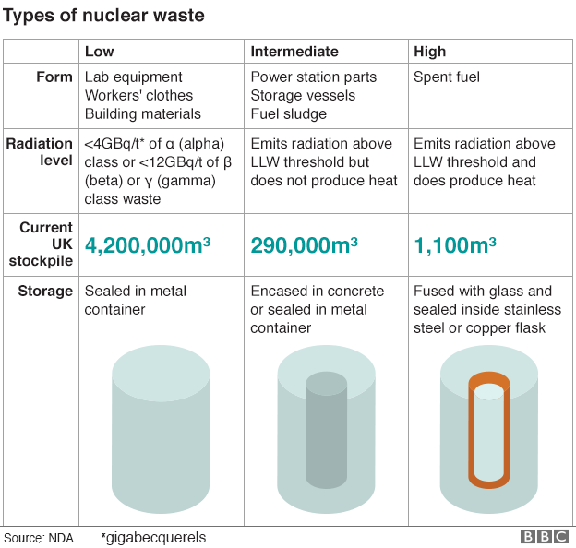
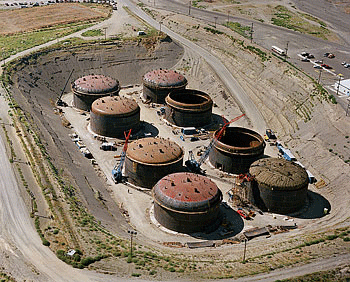
The knotty heart of the cleanup is the tank farm, on the central plateau, where 56 million gallons of high-level waste — the official term for the long-lived radioactive material leftover from plutonium production — sit in 177 underground tanks. Each tank holds a unique mixture of sludge, solid, supernate liquid and crusty salt cake — a witch’s brew of 1,800 different chemicals that are buzzing, off-gassing and breaking down. Sixty-seven of the 149 carbon-steel single-shell tanks and one of the newer 28 double shells have leaked, but the Energy Department refuses to build new ones, and every year the time frame for cleanup gets longer.
………The Department of Energy spends billions of dollars on the cleanup each year; it has a $2.4 billion budget this year. But those billions are barely enough to keep the wheels on, and the Government Accountability Office estimates that the last 15 percent of the cleanup could be as expensive as the first 85 percent, which has already taken 30 years. Maintaining the tanks alone costs $300 million a year, and the minimum amount needed to keep things safe increases as time goes on and infrastructure ages. There currently isn’t enough federal funding to meet cleanup benchmarks, and no money has been allocated for accidents like the tunnel collapse that contaminated workers.
At the current rate of funding and cleanup, the DOE’s Richland office, which manages most of the site, falls another year behind schedule every two years, and the Office of River Protection, which oversees the tank waste, slips back a year every three. Last year, President Donald Trump proposed slashing the budget for Hanford cleanup by $230 million. …….
Cleaning up the tank farm requires moving the waste out of the single-shell tanks, which are each as wide across as a tennis court and can hold up to a million gallons of waste, and into the sturdier double-shell tanks. From there, it will — theoretically — be vitrified, or turned into glass, at the as-yet-unbuilt vitrification plant and then sent to the stalled-out proposed federal nuclear repository at Yucca Mountain in Nevada, or to another long-term storage facility. Every step is excruciatingly complex. The massive tanks were designed to hold radioactive materials, not release them, so any material in these tanks has to come out through a pipe just 12 inches around. Challenges like this have forced Hanford managers to invent every step of the cleanup process, from how to sample the contents to how to keep video cameras from burning up in the radioactive heat inside. It’s a constant guessing game, where the questions of how to store the waste and neuter its effects change endlessly. That’s why in June, the Energy Department proposed reclassifying the remaining high-level waste in the C section of the tank farm as low-activity waste, and then filling the tanks with grout to stabilize the remaining 66,000 gallons of waste, so it could be kept onsite permanently. The department thinks that it would be safe enough to close the door on the tank cleanup once the grout is in, except for long-term monitoring.
According to the tri-party agreement that governs the cleanup, the Energy Department is currently required to get 99 percent of the waste out of the tanks and vitrify it, but Sherri Ross of the department says the definition of high-level waste overlooks the fact that much of the waste is no longer very toxic. They’ve taken 1.7 million gallons of waste out of the C Farm tanks, or about 96 percent. Of the residual that’s left, the bulk of the material has less than a 30-year half-life, so it’s already become half as radioactive. …….
High-level waste was never supposed to stay on site permanently. The waste from the tanks is intended to be vitrified, turned into glass rods, then sent to a federal repository, where it would sit, isolated, forever.
But that repository doesn’t exist yet, and it’s possible that it never will……..We’ve made stuff that will be dangerous for millennia and we deal with it in two-year congressional cycles,” said William Kinsella, a North Carolina State University professor whose research includes nuclear weapons cleanup. “We don’t want to make hasty decisions, but it’s a chokepoint for nuclear constipation.”
That has created expensive and dangerous blockages throughout the nuclear waste management system. Without a place to send waste, the cleanup at Hanford has no real endgame. Because of the long-term impossibility, the Hanford Advisory Board — a coalition of tribal members, community volunteers and government workers who advise the agencies that manage the site — is constantly worried that the funds might dry up while the tanks are still full. The fear of slashed funding, and the cleanup’s long delay, is part of what drove the Department of Energy to consider grouting.
But the proposal worries watchdog groups, who are concerned about shortsighted cost-saving measures that could put surrounding communities at lasting risk by keeping 700,000 gallons of waste that’s currently classified as high-level, and that might ultimately leak to the river on site. “What the DOE is proposing is to make the Hanford site a high-level waste repository in all but name,” said Tom Carpenter, executive director of the Hanford Challenge, an environmental advocacy group. “That does not belong in an agriculture zone in a major river system in an earthquake zone.”……
they’ll look at how the closed system is going to perform over the long term. Their model goes to 1,000 years, but they’ll also consider what might happen in 10,000 years, and model out to the half-life of plutonium, 24,000 years. They plan to use what they call “institutional controls” — signs, gates and infrastructure — to keep people away from the waste for 100 years. ……
… low-probability but high-risk odds have created an environment that University of Washington professor Shannon Cram calls “the politics of impossibility.” How do you navigate a situation where safety is impossible to promise? The people in charge of caring for Hanford are trying to prevent unknown future problems, and fix past generations’ mistakes. But in the face of a budget crunch and an overwhelming cleanup, it’s nearly impossible to know what’s right.
Cram, who has studied the long-term public health effects of Hanford, says it’s likely that Hanford will never be completely clean, and that, if some waste is always going to remain in the ground, the real challenge is deciding what an acceptable level of exposure is.
“I think it’s really misleading to call it cleanup,” Cram says. “It’s not clean, it’s contained and monitored.” Cram remains concerned about the possibility of disaster being passed on to future generations. “The brewing threat doesn’t get enough attention, because a lot of it is looming in the future,” she says. “We basically as a country have to learn how to have the appropriate amount of fear.”
……..if we fail, this wastepile and more like it will remain our legacy, sitting in overlooked corners like the empty eastern Washington plains, for longer than humanity can comprehend — or even remember. https://crosscut.com/2019/01/what-happens-if-we-cant-clean-mistakes-our-nuclear-past