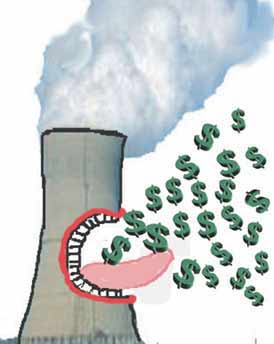
The Department of Energy needs better financial oversight of the subcontractors hired at sites like Hanford, concluded a Government Accounting Office report released Tuesday.
It found issues with a lack of audits covering costs charged to the federal government and conflicts of interest — citing a Hanford nuclear reservation civil case as an example of what could allegedly go wrong.
Most of the $30 billion DOE budget goes to contractors, most of which spend money on subcontracts, the GAO said.
“Yet (the Department of) Energy has not clarified which subcontracts should be audited and what an audit should entail,” said the report.
March 16, 2019
Posted by Christina Macpherson |
business and costs, politics, USA |
Leave a comment
Bloomberg, By Sabrina Valle March 15, 2019,
- Minister says he wants Brazil open to uranium mining companies
- Government also supports construction of new nuclear plants
Brazil’s energy minister said the country plans to sign an accord next week with President Donald J. Trump that could pave the way for U.S. companies to explore the Latin American country for uranium and invest in new nuclear-power plants.
Bento Albuquerque, a former admiral who once ran the Brazilian Navy’s atomic program, met with U.S. Energy Secretary Rick Perry in Houston this week and discussed creating a bilateral forum on energy cooperation that would include nuclear projects. That’s expected to be part of a memorandum signed by Brazilian President Jair Bolsonaro on his first trip to the White House next week, Albuquerque said Thursday in an interview.
March 16, 2019
Posted by Christina Macpherson |
Brazil, marketing, USA |
Leave a comment
Riding the Wild Bull of Nuclear Power, Counter Punch, by EVAGGELOS VALLIANATOS, 15 Mar 19,
From atomic theory to nukes“…….Jaczko’s three-and-a-half years tenure as the chairman of NRC was stormy. The nuclear industry and its supporters in Congress could not stand him. The idea of reform or regulation was an anathema. In fact, the industry was so successful in its propaganda it had convinced Americans nuclear power was safe: don’t expect any accident at the nuclear power plants.
The other commissioners and senior staff looked at Jaczko with suspicion and mistrust. Here was a young man, younger than most of them, being their boss and constantly probing them to protect public health and the environment.
Running Jaczko out of town
Even the Fukushima tragedy made no difference. Jaczko was convinced NRC was a hopeless case, being a subsidiary of the nuclear industry.
“I eventually got run out of town because I saw things up close that I was not meant to see: an agency overwhelmed by the industry it is supposed to regulate and a political system determined to keep it that way,” he wrote.
The Fukushima “cataclysm” finally convinced him that “nuclear power is a failed technology.” Keep using it and it will bring “catastrophe in this country or somewhere else in the world,” he wrote.
I sympathize with the mental anguish and humiliations Jaczko suffered for trying to improve the safety of a dangerous technology. And shame on the Obama administration for missing a rare opportunity to get the country out of the nightmare embedded in nuclear power.
Jaczko had the courage to insist things had to improve at NRC and the nuclear power plants. He knows what he is talking about. Like other dangerous technologies, nukes have no place in a civilized society.
I love Jaczko’s book: Confessions of a Rogue Nuclear Regulator. It’s a passionate and personal account of what happens to honest bureaucrats trying to use science and the government in the public interest. It’s also a riveting true story, well-written, insightful, very timely, and extremely important. In addition, the book is a warning from the horse’s mouth: nuclear power plants will continue melting down; they are ticking time bombs. And in the words of Jaczko: “Nuclear power… is large and bulky and will lumber into extinction.” https://www.counterpunch.org/2019/03/15/riding-the-wild-bull-of-nuclear-power/
March 16, 2019
Posted by Christina Macpherson |
safety, USA |
Leave a comment
PSEG DISPUTES NEW ESTIMATE OF NUCLEAR PROFITS, AWAITS ANSWER ON STATE SUBSIDIES, NJ Spotlight, TOM JOHNSON | MARCH 15, 2019
Independent market monitor concludes that South Jersey plants, for which company is seeking $300 million in annual state aid, will net big profits over the next few years.
Coal and nuclear plants increased their profits last year, a finding in a new report that might undercut efforts to win subsidies for New Jersey’s three nuclear power plants.
In its annual State of the Market Report for the regional transmission organization PJM, the independent market monitor concluded that energy prices are not too low in the nation’s largest power grid, which includes New Jersey. Net revenues increased for all types of power plants, significantly so for coal and nuclear units, in 2018, according to the report.
The assessment differs sharply from what PSEG Nuclear has argued to legislators and state regulators in seeking up to $300 million in annual ratepayer subsidies to avert the closing of its three nuclear units in South Jersey. Without the subsidies, PSEG executives have said the plants will close, possibly beginning this fall with its Hope Creek unit.
The report, prepared by Joseph Bowring, the market monitor, used publicly available data, to assess the competitiveness of the energy market and to address, the economic viability of nuclear units within the PJM. Bowring also is an intervenor in the nuclear subsidy case before the New Jersey Board of Public Utilities.
Of 18 nuclear plants in the region only three are operating with shortfalls, and these are scheduled to close, according to the report. (Two of the three plants are in Ohio; the other is Three Mile Island in Pennsylvania.)
Proof the plants ‘do not need’ to be subsidized
On the other hand, PSEG’s plants would net a surplus over each of the next three years, ranging about $50 million annually for Hope Creek, and around $100 million a year for the two Salem units, according to the report.
“This is confirmation that the plants do not need to be subsidized,’’ said John Shelk, president and CEO of the Electric Power Supply Association, a trade group of power companies that has opposed the subsidies……..
The report also downplayed the prospect of increased retirement of coal and nuclear plants. “The level of retirements does not pose a reliability issue in PJM and does not imply a fuel security issue,’’ according to the report.
The state is expected to make a decision on whether to give the nuclear units a subsidy by mid-April. However, that may not end the debate over the future of nuclear power in New Jersey, according to one analyst.
“Regardless of what happens over the next three years, there’s more to this issue over the long term,’’ said Paul Patterson, an energy analyst at Glenrock Associates. “You are looking at efforts to reduce energy consumption and increase the use of renewables by 50 percent in 10 years. You have to wonder what this means for nuclear power.’’ https://www.njspotlight.com/stories/19/03/14/pseg-disputes-new-assessment-of-nuclear-profits-awaits-answer-on-state-subsidies/
March 16, 2019
Posted by Christina Macpherson |
politics, USA |
Leave a comment
Nevada wants plutonium removed from state pending appeal https://www.kolotv.com/content/news/Nevada-wants-plutonium-removed-from-state-pending-appeal-507042751.html, 13 Mar 19,
RENO, Nev. (AP) – Nevada wants a federal appeals court to order the U.S. government to remove weapon-grade plutonium the Department of Energy secretly trucked to a site near Las Vegas until the court decides whether the clandestine move was illegal.
The extraordinary request comes in an increasingly aggressive legal battle over the highly radioactive material the state says poses a danger to Nevadans’ health and safety.
A federal judge in Reno has denied a similar motion for a temporary injunction pending the outcome of an appeal before the 9th Circuit Court of Appeals.
She ruled the matter was moot given the plutonium already had been shipped and DOE says no further shipments are planned.
Nevada’s lawyers said in a new filing late Monday the government can’t be trusted. They say removal of the plutonium is the only way to protect Nevada’s rights.
March 14, 2019
Posted by Christina Macpherson |
legal, USA |
Leave a comment
 New regulations coming for US nuclear plants 8 years after Fukushima disaster , Washington Examiner, by John Siciliano March 12, 2019
,
Federal regulators are marking the eight-year anniversary of the horrendous tsunami and nuclear power plant disaster that rocked Fukushima, Japan, by issuing major new regulations this spring to harden the U.S. power plant fleet against multiple threats that could lead to similar disasters in the United States.
The new rules seek to codify individual actions taken by power plant operators at the behest of the federal Nuclear Regulatory Commission in the wake of the March 11, 2011, disaster…….
The forthcoming post-Fukushima regulation, called the “Mitigation of Beyond-Design-Basis Events rule,” is slated to go into effect this spring, giving utilities and power plant operators a little more than two years to comply with new safety procedures to guard against an incident such as an earthquake, or other event, that could cause a radiation leak and environmental disaster.
The regulation is considered a “major rule” because its cost will exceed $100 million, according to the draft rule’s impact analysis.
The rule will require commercial reactors to do three things that include physically modifying the plants to protect reactor cores while adding new planning and monitoring practices.
First, power plant owners must put in place the resources and implement the procedures required to keep a reactor’s core cool in the event a power plant’s emergency electricity supply is knocked out. Similar procedures and resources must be adopted to keep fuel rod pools, where a power plant stores its radioactive waste, full of water, following any event that knocks out all of a plant’s emergency power supplies.
The inability to keep the reactor cores cool at Daiichi, once power was knocked out and emergency power packs drained, resulted in the meltdowns in Japan.
Second, the power plants must install equipment that can reliably measure the water levels at the pools used to house and cool a power plant’s spent fuel rods.
Fuel rods are used to generate heat and electricity at a nuclear power plant. When they are used up, but still highly radioactive, they have to be stored underwater until a permanent waste facility is built to house them indefinitely. No national site has been built to house commercial waste from any power plant, so most of the waste is stored locally at the power plant.
Third, the rule requires the power plants to “reserve the resources” required to protect the core and spent fuel pools from external hazards that may breach the plant’s walls and containment areas. ……..https://www.washingtonexaminer.com/policy/energy/new-regulations-coming-for-us-nuclear-plants-8-years-after-fukushima-disaster
March 14, 2019
Posted by Christina Macpherson |
safety, USA |
Leave a comment
Trump Budget Would Cut Spending for Nearly Every Agency Except Pentagon, Truthout, Lindsay Koshgarian, March 12, 2019 The budget request President Trump released on Monday represents a conservative vision taken to the extreme. It would shoot military spending skyward while dismantling domestic programs piece by piece, with few exceptions.
The budget peels back many of the promises the president made either on the campaign trail or in tweets. For instance, the president has stated an intention to pull back from military interventions in Syria, Afghanistan and elsewhere — but his budget insists on an even bigger military budget. And the cash flow to the Pentagon, combined with ongoing tax cuts for the rich, puts the lie to the idea that Republicans care about deficits and balanced budgets.
The budget calls for $750 billion in military spending, a nearly 5 percent increase over 2019 spending. And it calls for a 9 percent cut in all other discretionary spending, which covers nearly everything else — including priorities like education, affordable housing, environmental protection, scientific and medical research, public health, and diplomacy, among others — taking it from $597 billion in 2019 to $543 billion in 2020. The proposal also calls for additional cuts to Medicare, Medicaid and Social Security…….. https://truthout.org/articles/trump-budget-would-cut-spending-for-nearly-every-agency-except-pentagon/
March 14, 2019
Posted by Christina Macpherson |
politics, USA |
1 Comment
F-35 opponents shift focus to nuclear risks, Vt Digger , By Mike Dougherty, Mar 12 2019A new citizens group is raising alarms about the nuclear capacity of the F-35 fighter jet.
Representatives from Citizens Against Nuclear Bombers in Vermont want officials to reverse the decision to base F-35s at the Burlington Air Guard base, saying the fleet’s nuclear capacity poses safety risks for Vermonters.
The group’s leaders include Ben & Jerry’s co-founder Ben Cohen, 2018 gubernatorial primary candidate James Ehlers and retired Air Force Col. Rosanne Greco, all of whom were involved in previous campaigns to reverse the project based on public health concerns and the potential use of nuclear weapons.
They say a 2018 Department of Defense documentproves that the U.S. military intends to use F-35s to deploy nuclear bombs if the need arises, making Burlington a potential target for the country’s enemies……. https://vtdigger.org/2019/03/12/f-35-opponents-shift-focus-nuclear-risks/
March 14, 2019
Posted by Christina Macpherson |
USA, weapons and war |
Leave a comment
Pennsylvania Nuclear Bailout Bill Draws Fire From Ratepayer, Natural Gas and Enviro Groups
The latest state policy effort to support nuclear power faces opposition on costs, market impacts and lack of clean energy guarantees. Greentech Media,
JEFF ST. JOHN MARCH 12, 2019 Pennsylvania legislators have introduced a bill to shore up two money-losing nuclear power plants that would otherwise close by 2021, by folding them into the state’s 2004 alternative energy portfolio standard for wind, solar and a handful of other energy technologies.
But the long-awaited proposal is facing pushback from ratepayer advocates, natural-gas producers and environmental groups that say it’s a flawed approach…….
Opponents, including the AARP and other consumer advocates, have rallied against the bill, claiming it would add more costs than its sponsors have recognized by unnecessarily subsidizing the state’s still-profitable nuclear plants — a move that the state’s natural gas industry and energy analysts say will undermine the state’s competitive electricity market.
Environmental groups are opposed to a bill that lacks broader efforts to increase the state’s share of clean energy….
critics of the Pennsylvania bill, which was leaked in draft form two weeks ago, say that its flaws outweigh its potential benefits. An independent economic analysis of the bill found it could increase ratepayer costs by as much as $900 million per year, or roughly $5 per month for a typical household bill, compared to the author’s projections, raising the ire of ratepayer advocates.
Opponents have also questioned the wisdom of relenting to pressure from Exelon, owner of the Three Mile Island reactor, and FirstEnergy, owner of the Beaver Valley Nuclear Power Station, which have both announced plans to close the plants by 2021. While the Three Mile Island plant is losing money, Beaver Valley is still profitable. But parent company FirstEnergy Solutions, which filed for bankruptcy protection last year, has threatened to close the plant, along with money-losing coal and nuclear plants in Ohio, absent some form of state intervention.
At the same time, the bill could also extend financial support to the three nuclear power plants that have no plans to close and are projected to remain profitable through 2021, a feature that’s drawn criticism from ratepayer groups that call it an unnecessary subsidy.
Meanwhile, Pennsylvania’s significant natural-gas industry opposes the bill on the grounds that it would increase the share of the state’s energy subject to out-of-market subsidies from its current 18 percent-by-2021 goal, to more than half of the state’s total generation mix — a move they say could undermine its participation in the energy markets of mid-Atlantic grid operator PJM.
Finally, the bill’s impacts may not be enough to save the money-losing Three Mile Island plant, according to a November report by PJM’s independent marketing monitor. Stu Bresler, PJM’s senior vice president of operations and markets, told The Inquirer that the bill will likely result in “upward pressure” on some market prices, but that these pressures may not be enough to save any particular unprofitable power plant from closure.https://www.greentechmedia.com/articles/read/pennsylvania-nuclear-bailout-bill-draws-fire#gs.0sasyx
March 14, 2019
Posted by Christina Macpherson |
politics, USA |
Leave a comment
Adults won’t take climate change seriously. So we, the youth, are forced to strike. Bulletin of the Atomic Scientists By Maddy Fernands, Isra Hirsi, Haven Coleman, Alexandria Villaseñor, March 7, 2019 Editor’s note: The authors are the lead organizers of US Youth Climate Strike, part of a global student movement inspired by 16-year-old climate activist Greta Thunberg’s weekly school strikes in Sweden and other European countries.
We, the youth of America, are fed up with decades of inaction on climate change. On Friday, March 15, young people like us across the United States will strike from school. We strike to bring attention to the millions of our generation who will most suffer the consequences of increased global temperatures, rising seas, and extreme weather. But this isn’t a message only to America. It’s a message from the world, to the world, as students in dozens of countries on every continent will be striking together for the first time.
For decades, the fossil fuel industry has pumped greenhouse gas emissions into our atmosphere. Thirty years ago, climate scientist James Hansen warned Congress about climate change. Now, according to the most recent Intergovernmental Panel on Climate Change report on global temperature rise, we have only 11 years to prevent even worse effects of climate change. And that is why we strike.
We strike to support the Green New Deal. Outrage has swept across the United States over the proposed legislation. Some balk at the cost of transitioning the country to renewable energy, while others recognize its far greater benefit to society as a whole. The Green New Deal is an investment in our future—and the future of generations beyond us—that will provide jobs, critical new infrastructure and most importantly, the drastic reduction in greenhouse gas emissions essential to limit global warming. And that is why we strike.
To many people, the Green New Deal seems like a radical, dangerous idea. That same sentiment was felt in 1933, when Franklin D. Roosevelt proposed the New Deal—a drastic piece of legislation credited with ending the Great Depression that threatened (and cost) many lives in this country…….
The alarming symptoms of Climate Denialism—a serious condition affecting both the hallways of government and the general population—mark our current historical crossroads of make-it-or-break-it action on climate change. Although there are many reasons for this affliction—such as difficulty grasping the abstract concept of a globally changed climate, or paralysis in the face of overwhelming environmental catastrophe—the primary mode of Climate Denialism contagion involves lies spouted by politicians, large corporations, and interest groups. People in power, like Senator McConnell and the Koch brothers, have used money and power to strategically shift the narrative on climate change and spread lies that allow themselves and other fossil fuel industry beneficiaries to keep the fortunes they’ve built on burning fossil fuels and degrading the environment. …….
We strike because our world leaders haven’t acknowledged, prioritized, or properly addressed the climate crisis. We strike because marginalized communities across our nation—especially communities of color and low income communities—are already disproportionately impacted by climate change. We strike because if the societal order is disrupted by our refusal to attend school, then influential adults will be forced to take note, face the urgency of the climate crisis, and enact change. With our future at stake, we call for radical legislative action—now—to combat climate change and its countless detrimental effects on the American people. We strike for the Green New Deal, for a fair and just transition to a 100 percent renewable economy, and to stop creation of new fossil fuel infrastructure. We strike because we believe the climate crisis should be called what it really is: A national emergency, because we are running out of time. https://thebulletin.org/2019/03/adults-wont-take-climate-change-seriously-so-we-the-youth-are-forced-to-strike/?utm_source=Bulletin%20Newsletter&utm_medium=iContact%20email&utm_campaign=ClimateStrikeOpEd_03072019
March 12, 2019
Posted by Christina Macpherson |
climate change, USA |
Leave a comment
 A top US diplomat just laid out the new approach to North Korea. It’s doomed.
Stephen Biegun told a Washington audience that “we are not going to do denuclearization incrementally.”Vox, By Alex Ward@AlexWardVoxalex.ward@vox.com Mar 11, 2019, The top US diplomat tasked with negotiating with North Korea just laid out a denuclearization plan that’s destined to fail.
above – John Bolton
In his first public comments since President Donald Trump and North Korean leader Kim Jong Un met in Vietnam last month, Stephen Biegun, the US special representative for North Korea, told a Washington audience Monday that the administration wants Pyongyang to give up all of its weapons of mass destruction before anything else.
“We are not going to do denuclearization incrementally,” the envoy said at the Carnegie Endowment for International Peace’s nuclear conference. “The foundation of US policy is denuclearization.”
But it’s not just nuclear weapons: The Trump administration also wants the complete removal of chemical and biological weapons from North Korea, Biegun said, meaning the US wants Pyongyang only to have conventional weapons by the end of the process.
Let’s be extremely clear about what this means: If the US maintains this position, any chance for the US to convince North Korea to part with its nuclear arsenal is gone.
Pyongyang for years has said that the only way it would consider giving up its nuclear weapons is through a step-by-step process where both sides offer reciprocal, commensurate concessions. By resolving smaller disagreements, like lifting sanctions in exchange for the closure of an important nuclear facility, over time the US and North Korea would eventually arrive at the grand prize: the end of Pyongyang’s nuclear program.
But Biegun said the US won’t do that. Instead, the Trump administration wants to see North Korea dismantle its nuclear arsenal before it offers any economic or diplomatic benefits. That’s just not going to work, experts say.
The US has hardened its position on North Korea………..
March 12, 2019
Posted by Christina Macpherson |
North Korea, politics international, USA |
1 Comment
Melting Ice Sheets Could Reveal Top Secret US Cold War Nuclear Base https://www.iflscience.com/environment/melting-ice-sheets-could-reveal-top-secret-us-cold-war-nuclear-base/ 11 Mar 19, Among the many Bond villain–esque plans dreamed up during the Cold War, few come stranger than “Project Iceworm,” the shady US program to build a network of top secret nuclear missile launch sites beneath the Danish territory of Greenland. The largest and most impressive of the US bases was Camp Century, a warren of tunnels and labs under northwest Greenland’s ice sheet that was powered by its own portable nuclear reactor.
After just eight years of operation, Camp Century was decommissioned in 1967 due to engineering woes and a political scandal centered on whether Denmark had actually given the US full permission to house nuclear materials in their territory.
As the Cold War ended, the base was largely forgotten, not least because it was hoped to remain “preserved for eternity” under a blanket of snow and ice. However, with climate change knocking at the door, it looks like a different kind of thaw could reveal all.
A study published in 2016 used simulations to show that the ice above and around Camp Century could thaw by 2090 under a “business-as-usual” climate change scenario. Not only would this unearth the once-secret abandoned military base, but it also holds the potential to let loose the huge amounts of chemical and nuclear waste left at the site. These pollutants could leech into the surrounding surface water and spark a plethora of problems for the island’s human population and ecosystem.
Another study, published last year in the journal Global Environmental Politics, took a further look at the situation at Camp Century, arguing it has the potential to fire up some long-frozen geopolitical tensions. It’s not very clear how much Denmark knew about the US’ plans in Greenland. While they agreed the US could have the Thule Air Base in northwest Greenland, the issue of nuclear weapons in Danish territory was a big no-no. To make matters even thornier, Greenland has since transitioned to a self-governing overseas administrative division of Denmark.
If the climatic scenario predicted does hit, as anticipated, who will be responsible for the clean-up of toxic chemicals and radioactive materials?
As the study argues, Camp Century is not the only problem. This scenario serves as just one example of how climate change could trigger a huge number of unforeseen consequences in international politics, especially when it comes to overseas military bases.
“The case could be the proverbial canary in the coal mine for future politics surrounding overseas military bases,” according to study author Jeff Colgan.
“Climate change can create knock-on environmental problems associated with a military base’s infrastructure or waste that disrupt the international politics that govern the base,” he wrote in the study. “Any cleanup costs or compensation related to the knock-on environmental problems create an unfunded liability for the host country, the country operating the base, or both.”
This is just another unexpected fallout of the climate issue we’re facing that needs to be dealt with sooner rather than later.
March 12, 2019
Posted by Christina Macpherson |
ARCTIC, climate change, Reference, USA, weapons and war |
Leave a comment
 Defense News, By: Aaron Mehta 11 Mar 19, WASHINGTON — The National Nuclear Security Administration will receive an 8.3 percent increase over its current budget, with an eye on completing production of a new low-yield nuclear missile this upcoming fiscal year.
The NNSA, a semiautonomous agency within the Department of Energy that has oversight on America’s nuclear weapons stockpile, is requiring $16.5 billion in the fiscal 2020 budget, up $1.3 billion from its FY19 total. Weapons-related activities would see an allocation of $12.4 billion, an 11.8 percent increase over how much funding went to that mission in FY19. NNSA’s proposed budget comprises 52 percent of the DOE’s total budget request……..
The agency has five major modernization programs underway: life extensions of the B61-12 gravity bomb; W80-4 warhead design for the Air Force’s long-range standoff weapon; W88 Alteration 370 for the Trident II ballistic missile; and the W87-1 Modification Program for intercontinental ballistic missile warheads. The fifth program is the W76-2 modification, perhaps the most controversial.
A low-yield nuclear warhead that the Trump administration first introduced as a requirement with the Nuclear Posture Review at the start of 2018, the W76-2 is moving along quickly. In January, the NNSA announced production had begun on the first unit; the budget documents released March 11 state that the system “completes development and production” in FY20……..https://www.defensenews.com/smr/federal-budget/2019/03/11/trump-budget-increases-nuclear-weapons-agency-funding-amidst-new-production/
March 12, 2019
Posted by Christina Macpherson |
USA, weapons and war |
Leave a comment
Nuclear ‘cruise control’ can stop a spiraling new arms race, The Hill, BY ANDREW C. WEBER, 03/11/19 The genius of the mortally wounded Intermediate-Range Nuclear Forces (
INF) Treaty was that it sharply reduced the risk of nuclear war. It made Europe more secure by eliminating an entire class of surprise-attack nuclear weapons designed for use on its territory. We are
now on a glide path to repeat the existential nightmare that such weapons created.Russia and the United States once again are investing heavily in sea-, air- and ground-launched nuclear cruise missiles, and talking cavalierly about using them in “limited,” “low-yield” nuclear attacks. What makes this type of nuclear weapon so dangerous is that it can be launched without warning in decapitating sneak attacks.
These cruise missiles also can be armed with conventional explosives, and there is no way to distinguish nuclear from non-nuclear ones when they are in flight. Such ambiguity erases the line between conventional and nuclear weapons, and increases the likelihood of accidental Armageddon. This is precisely why, in 1987, Ronald Reagan and Mikhail Gorbachev urgently made progress in eliminating them.
We can, and must, seek to repeat their historic achievement today. We need to remember that arms control is not a pollyannaish exercise, but rather a potent tool of hard national security……….
Recently, Russia’s top arms control diplomat said Russia stands ready for talks on a possible successor to the INF Treaty. “We are ready for dialogue,” said Deputy Foreign Minister Sergei Ryabkov. “If the U.S. is interested, it should spell out its proposal.”
Since it appears nobody has done so, let’s spell it out. Our next agreement should focus less on overall numbers and, instead, seek to cap and eliminate the single most dangerous and destabilizing class of nuclear weapons: all nuclear-tipped cruise missiles of any range. We should start “cruise control” negotiations bilaterally between the United States and Russia, and leave room for other countries that have not yet deployed such systems — including China, India and Pakistan — to join now or later.
For three years, my colleagues and I have been laying the groundwork for such an ambitious global effort to cap and eliminate nuclear cruise missiles. In private talks with current and former senior officials from the United Kingdom, Russia, China, Germany, Japan and other key countries, we have found broad support and enthusiasm for this approach. ……… https://thehill.com/opinion/national-security/433075-nuclear-cruise-control-can-stop-a-spiraling-new-arms-race
March 12, 2019
Posted by Christina Macpherson |
politics international, Russia, USA, weapons and war |
Leave a comment