ime to be serious about it; and honest. Only “Lifetime- total system” accounting – counts
Are these tiny, ‘inherently safe’ nuclear reactors the path to a carbon-free future? by Andrew Maykuth, March 16, 2019

Are these NuScale nuclear power stations REALLY tiny?

“……the industry sees the future not in building gargantuan plants, but in small modular reactors, or SMRs — factory-built units with fewer parts, designed to be installed underground with passive cooling systems that the industry says are “inherently safe.”
……..Among U.S. developers, NuScale Power of Corvallis, Ore., has surpassed its competitors — including Holtec International of Camden — to advance its design closer to the finish line. Supported with $275 million in U.S. Energy Department grants, NuScale has invested about $800 million to design a 75-foot-tall cylindrical reactor that the Nuclear Regulatory Commission is expected to approve next year. NuScale aims to begin producing power at its first plant in 2026.
……. not everyone is sold on their promise.
“SMRs seem to be a fad, as far as I can tell,” said Edwin Lyman, a senior scientist with the Union of Concerned Scientists, who wrote a widely cited paper questioning the economics of small reactors. “There’s very really little substance to its motivation, other than the private sector can’t afford ordinary sized reactors.”
…… Inside a Small Modular Reactor
Small modular reactors are factory-built, contain fewer mechanical parts, and are designed to be installed underground with passive cooling systems that are “inherently safe,” the industry says.
SMR designers say the plants will need fewer operators, and because the design is safer, they have also asked the NRC to reduce the 10-mile emergency planning zones now required for larger commercial reactors to an area confined to the plant site. Critics such as the Union of Concerned Scientists have opposed the request, saying the plants and their accumulated on-site spent fuel still pose a significant risk.
“They argue the reactors are so safe that terrorists won’t be able to effectively cause a massive radiological contamination event, and I beg to differ,” said Lyman.
The initial markets for SMRs are expected to be primarily overseas, where electricity costs are higher and nuclear energy can compete, NuScale says. Some water-starved Middle Eastern countries have expressed interest because some units can be configured to produce steam, rather than electricity, to power a nearby water desalinization plant.
Antidote to climate change
The industry is also positioning carbon-free nuclear plants as an antidote to climate change……
many environmental advocates fiercely oppose any expansion of nuclear energy’s role, including skeptics who cite safety issues exposed by the accident 40 years ago this month at Three Mile Island Unit 2 in Pennsylvania, which put the brakes on the industry’s growth in the 1980s. In the last 20 years, just one new commercial plant has begun operations in the United States, and only two are currently under construction.
Lyman said the industry would need to produce “hundreds or thousands” of units in order to cut costs and reduce the need for government assistance. ……
Nuclear power’s cost is at the heart of a debate that officially launched in Pennsylvania last week with the introduction of a proposal to give the nuclear industry $500 million in annual subsidies, paid by electric customers. Nuclear operators have threatened to shut down several Pennsylvania reactors because they are unable to compete in low-price electricity markets awash in cheap power from natural gas plants.
Exelon Generation says it will shut down Three Mile Island Unit 2, located next to the partly dismantled Unit 1, unless state lawmakers come to the rescue by June. …….
Dozens of companies are working to develop new nuclear reactors, including so-called Generation IV reactors that are cooled with such materials as molten salts, inert gases, or even liquid metals.
Several companies have focused on developing SMR designs. Holtec International, a private company in Camden whose core business is managing spent fuel at nuclear reactors and decommissioning old reactors, has developed a 160-megawatt reactor design it calls the SMR-160. The project’s status is unclear, and Holtec did not respond to written questions.
“I haven’t seen evidence of it really advancing,” said Lyman, of the Union of Concerned Scientists.
Westinghouse and BWX Technologies Inc., which both have long histories of building reactors, abandoned their SMR projects.
NuScale in September chose BWXT to build its SMR. BWXT, which built many of the small reactors used to power U.S. Navy ships and submarines, plans to subcontract component manufacturing to Precision Custom Components of York, Pa.
Mundy said by outsourcing the manufacturing to existing plants, NuScale can keep costs down compared with building a new factory. NuScale’s majority owner is the giant contractor Fluor Corp………
Lyman said that he is worried that multiple modular reactors would fail in NuScale plant, but that the NRC will accept more risk because it is under pressure to not impede the licensing process.
March 18, 2019
Posted by Christina Macpherson |
Small Modular Nuclear Reactors, USA |
1 Comment
FROM JOSEPH FARAH’S G2 BULLETIN
DEMS PROPOSE U.S. GIVE UP FIRST-STRIKE NUCLEAR OPTION https://www.wnd.com/2019/03/dems-propose-u-s-give-up-first-strike-nuclear-option/ Plan would pledge to use nukes only in response to attack
18 Mar 19, Democrats are proposing in Congress that the United States give up the option for a nuclear first strike – for any reason, reports Joseph Farah’s G2 Bulletin.
The policy for decades deliberately has been one of “calculated ambiguity.” It stemmed from a Cold War era in which the U.S. and NATO faced “numerically superior” Soviet and Warsaw Pact conventional forces in Europe, explains a document prepared by the Congressional Research Service.
“At the time, the United States not only developed plans to use nuclear weapons on the battlefield to disrupt or defeat attacking tanks and troops, but it also hoped that the risk of a nuclear response would deter the Soviet Union from initiating a conventional attack. This is not because the United States believed it could defeat the Soviet Union in a nuclear war, but because it hoped the Soviet Union would know that the use of these weapons would likely escalate to all-out nuclear war, with both sides suffering massive destruction.”
That policy of ambiguity has been continued, with even the Obama administration promising that the U.S. “would only consider the use of nuclear weapons in extreme circumstances,” far short of a promise never to use them first.
Democrats now are demanding to change that.
Sen. Elizabeth Warren, D-Mas., and Rep. Adam Smith, D-Wash., have proposed legislation, S. 272 and H.R. 921, that would adopt the statement: “It is the policy of the United States to not use nuclear weapons first.”
Other members of Congress are divided,” the report from the CRS explained, with Sen. Deb Fischer, R-Neb., warning the Democrats’ plan “betrays a naïve and disturbed world view.”
Read more at https://www.wnd.com/2019/03/dems-propose-u-s-give-up-first-strike-nuclear-option/#6cgKvfB7PXt22tiR.99
The Trump administration already had rejected the idea, in its 2018 Nuclear Posture Review, which said the weapons contribute to “deterrence of nuclear and non-nuclear attack; assurance of allies and partners; achievement of U.S. objectives if deterrence fails; and the capacity to hedge against an uncertain future.”
For the rest of this report, and more, please go to Joseph Farah’s G2 Bulletin.
March 18, 2019
Posted by Christina Macpherson |
politics, USA, weapons and war |
Leave a comment

P
utting his money where his mouth is. Your Money, 18 Mar 2019, Jack Derwin Digital Journalist, Oscar-winning actor and Hollywood heartthrob Leonardo DiCaprio has long been an environmental activist, but he’s now turning to the world of finance to help tackle his chosen cause.
DiCaprio has announced he will become a senior adviser to a new $150 million environmental unit at fund manager Princeville Capital that invests directly into tech companies fighting global warming.
Taking to Twitter, it appears he is willing to put his money where his mouth is, becoming an investor himself.
“What I like about Leo’s fund if you are predisposed to wanting to improve the climate or stop climate change, this is a fund that invests in companies that are trying to mitigate the effects of climate change,” The Motley Fool head of investment Scott Phillips told Your Money Live.
The major difference between DiCaprio’s fund and other ethical funds is rather than divesting from big polluters, his is actively investing in potential future solutions…….. https://www.yourmoney.com.au/wealth/investment/leonardo-dicaprio-climate-change/
March 18, 2019
Posted by Christina Macpherson |
climate change, USA |
Leave a comment
 Deadly, Historic Midwest Flooding Threatens Ericson Dam, Nuclear Plant in Nebraska, By Pam Wright and Ron Brackett, weather.com 15 Mar 19,
- New evacuations were ordered overnight in Minnesota and Wisconsin.
- A Nebraska farmer was killed trying to rescue a stranded motorist.
- A Nebraska nuclear plant is threatened.
- A ‘compromised’ dam forced evacuations along the Niobrara River.
- A third of the 24,000 residents in Norfolk, Nebraska, were ordered to evacuate Thursday.
- Flooding in parts of the Midwest has left one man dead threatens a Nebraska dam and nuclear power plant as heavy rains mixed with a melting snowpack swell waterways to historic levels……..
- In Nebraska, a utility company was placing sandbags around a threatened nuclear power plant Thursday as the Missouri River continued to rise, the Omaha World-Journal reports.
Mark Becker, spokesman for the Nebraska Public Power District, told the newspaper that should the river hit the level of 45.5 feet as projected by the National Weather Services this weekend, the Cooper Nuclear Station, which accounts for 35 percent of NPPD’s power, will have to be shut down………… https://weather.com/news/news/2019-03-14-flooding-severe-tornadoes-nebraska-iowa-texas
March 16, 2019
Posted by Christina Macpherson |
climate change, USA |
Leave a comment
 Nuclear industry pushing for fewer inspections at plants
The board of the agency charged with enforcing regulations on commercially operated nuclear plants is dominated by Trump appointees. NBC News, March 16, 2019, By Associated Press
WASHINGTON — The nuclear power industry is pushing the Nuclear Regulatory Commission to cut back on inspections at nuclear power plants and throttle back what it tells the public about plant problems. The agency, whose board is dominated by Trump appointees, is listening.
Commission staffers are weighing some of the industry’s requests as part of a sweeping review of how the agency enforces regulations governing the country’s 98 commercially operating nuclear plants. Recommendations are due to the five-member NRC board in June.
Annie Caputo, a former nuclear-energy lobbyist now serving as one of four board members appointed or reappointed by President Donald Trump, told an industry meeting this week that she was “open to self-assessments” by nuclear plant operators, who are proposing that self-reporting by operators take the place of some NRC inspections. …….
the prospect of the Trump administration’s regulation-cutting mission reaching the NRC alarms some independent industry watchdogs, who say the words “nuclear safety” and “deregulation” don’t go together……..
“For an industry that is increasingly under financial decline … to take regulatory authority away from the NRC puts us on a collision course,” said Paul Gunter, of the anti-nuclear group Beyond Nuclear. With what? “With a nuclear accident,” Gunter said………..
Trump has said he wants to help both the coal and nuclear power industries. So far, it’s the more politically influential coal industry that’s gotten significant action on the regulatory rollbacks that it sought from the Environmental Protection Agency and other agencies.
In January, Trump appointees to the NRC disappointed environmental groups by voting down a staff proposal that nuclear plants be required to substantially — and expensively — harden themselves against major floods and other natural disasters. The proposal was meant to be a main NRC response to the Fukushima nuclear plant disaster after Japan’s 9.0 earthquake and tsunami in 2011……… https://www.nbcnews.com/politics/politics-news/nuclear-industry-pushing-fewer-inspections-plants-n983671
March 16, 2019
Posted by Christina Macpherson |
safety, USA |
Leave a comment
 US senators seek probe of Trump admin nuclear energy talks with Saudi Arabia https://www.middleeastmonitor.com/20190315-us-senators-seek-probe-of-trump-admin-nuclear-energy-talks-with-saudi-arabia/A Democratic US senator and his Republican counterpart on Friday asked Congress’ investigative arm to probe Trump administration talks with Saudi Arabia over sharing nuclear power technology, Reuters
 reports.
In the latest effort by lawmakers to shed light on the potential deal, Democratic Senator Bob Menendez and Republican Senator Marco Rubio asked the Government Accountability Office, or GAO, to investigate the talks as soon as possible. They also asked the GAO to review executive branch negotiations with Saudi Arabia on nuclear energy since 2009, when Democrat Barack Obama was president.
Rubio and Menendez, members of the Senate Foreign Relations Committee, want to ensure any agreement “includes rigorous nonproliferation safeguards and other conditions to prevent nuclear cooperation with Saudi Arabia from undermining or threatening regional or international security,” said their letter to the GAO, a copy of which was seen by Reuters.
Saudi Arabia, which is seeking to build at least two nuclear power plants, has been in talks with the United States for years on importing technology.
The OPEC member, which is also in talks with countries including Russia, China and France, has at times resisted US standards on sharing nuclear technology that prevent uranium enrichment and spent fuel repossessing.
Both of those techniques are potential paths to clandestinely making fissile material for nuclear weapons.
Nonproliferation experts worry that if Saudi Arabia is not held to such a “gold standard,” in what is known as a 123 agreement, it could risk a nuclear arms race in the Middle East. The United Arab Emirates, which recently built reactors, could renegotiate its nonproliferation agreements if Saudi Arabia is allowed to bypass the standards.
Concerns in Congress rose last year after Saudi Crown Prince Mohammed bin Salman told CBS News his kingdom would develop nuclear weapons if archrival Iran did. The killing of journalist and US resident Jamal Khashoggi in a Saudi consulate in Istanbul last year has also sparked backlash against any deal.
US Energy Secretary Rick Perry has had quiet talks with Saudi officials, including his friend, Energy Minister Khalid al-Falih, on nuclear power.
The Department of Energy and the National Security Council did not immediately respond to requests for comment.
The senators said the negotiations are occurring in a “very opaque manner” and that the Trump administration is not keeping their committee informed.
Perry has said he told Saudi Arabia it is important for the kingdom to be seen around the world as strong on nonproliferation. He also said that part of the talks center on making sure any nuclear inspections would not be intrusive for sensitive areas in the kingdom.
Perry told the Financial Times this week that talks with Saudi Arabia were at a pace “closer to one mile an hour than to Mach 1.2.”
Last month, Democratic House members alleged in a report that top White House aides ignored warnings they could be breaking the law as they worked with former U.S. officials in a group called IP3 International to advance a multibillion-dollar plan to build nuclear reactors in the Middle East, including Saudi Arabia.
March 16, 2019
Posted by Christina Macpherson |
politics, USA |
Leave a comment
The Air Force is now arming its fleet of B-52 Bombers with prototype nuclear-armed cruise missiles to prepare the aircraft for the possibility of launching the Long Range Stand Off (LRSO) weapon. National Interest,
Through a $250 million deal, the Air Force will work with B-52 manufacturer Boeing to build missile carriage hardware and software, and “test” LRSO integration.
The Air Force has been working with industry on prototyping and design work on the emerging Long Range Stand-Off weapon nuclear-armed cruise missile, set to enter into a new phase of construction by 2022, service officials said. Raytheon and Lockheed, are now working on a $900 million Technology Maturation and Risk Reduction deal for the LRSO……… https://nationalinterest.org/blog/buzz/b-52-bomber-getting-ready-carry-nuclear-armed-cruise-missiles-47582
March 16, 2019
Posted by Christina Macpherson |
USA, weapons and war |
Leave a comment
Thyroid cancer caused by low-level radiation has a different “mutational signal” than most thyroid cancer, Goldenberg said. He and his colleagues used molecular research that had been pioneered after the Chernobyl nuclear disaster to find that genetic marker.
************************************************************
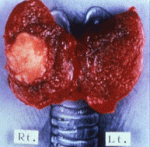 Three Mile Island and thyroid cancer: Debates continue over health issues after nuclear plant accident
Penn Live By Brett Sholtis/PA Post, 15 Mar 19
On March 28, 1979, Chris Achenbach-Kimmel was a 14-year-old freshman at Cedar Cliff High School in Camp Hill, Cumberland County. Fourteen miles away, on the Susquehanna River, staff at Three Mile Island Nuclear Generating Station were trying to contain the damage from an accident at one of its reactors.
“I just remember being in class, and just getting the news, and wondering, what does this mean?”……
Her mother kept her and her siblings inside as much as possible. TV news reports echoed through the house as her mother waited for an “all clear” from authorities. ……
For Achenbach-Kimmel, the accident became merely one more high school memory. She graduated in 1982 and went on to a career in occupational therapy.
It wasn’t until her thyroid cancer diagnosis in 2010 that she thought again about Three Mile Island.
“I think as soon as I got over the initial shock, it’s like, oh my gosh, I wonder if these two things are related,” said Achenbach-Kimmel, now a 54-year-old academic fieldwork coordinator at the Elizabethtown College occupational therapy department.
Her doctor wasn’t surprised when Achenbach-Kimmel mentioned TMI.
“She said, ‘oh yeah, we see an increased incidence in the area compared to what my colleagues see around the country.’”
Pennsylvania has had one of the highest thyroid cancer rates in recent years, according to Centers for Disease Control.
For those who grew up in central Pennsylvania, Chris’s story is a common one. People blame TMI for their illnesses, and some doctors accept it could have been the case.
Yet, the nuclear industry’s position has been that there has been no conclusive link between the accident and adverse health effects…….
Dr. David Goldenberg, a surgeon and thyroid researcher, launched the Penn State College of Medicine Study after years of hearing his patients bring up the nuclear plant accident.
…… thyroid cancer caused by low-level radiation has a different “mutational signal” than most thyroid cancer, Goldenberg said. He and his colleagues used molecular research that had been pioneered after the Chernobyl nuclear disaster to find that genetic marker.
The scientists screened out many thyroid cancer patients, limiting their study to 44 people who were born in counties around Three Mile Island, were present during the accident and were treated at Penn State Hershey Medical Center.
“We found a shift, which absolutely can be attributed to exposure to radiation, during the correct time frame of the Three Mile Island accident,” he said, adding that this does not prove that TMI caused the cancer. It just shows a correlation.
Goldenberg is quick to point out the study’s limitations, emphasizing that he’s working on a larger follow-up study. Still, it has put him in the middle of a 40-year-old debate: Did the accident at TMI release more radiation than the government says? Did it harm people? https://www.pennlive.com/news/2019/03/three-mile-island-and-thyroid-cancer-study-ignites-debate-over-health-issues-after-nuclear-plant-accident.html
March 16, 2019
Posted by Christina Macpherson |
health, USA |
Leave a comment
https://www.scirp.org/journal/PaperInformation.aspx?PaperID=54828#.VuSFAXQrkCs.twitter Full-Text HTML  Download as PDF (Size:336KB) PP. 76-89 [multiple references supplied]
ABSTRACT
Radioactive fallout after the March 2011 Fukushima nuclear meltdown entered the U.S. environment within days; levels of radioactivity were particularly elevated in the five western states bordering on the Pacific Ocean. The particular sensitivity of the fetus to radiation exposure, and the ability of radioisotopes to attach to cells, tissues, and DNA raise the question of whether fetuses/newborns with birth defects with the greater exposures suffered elevated harm during the period after the meltdown. We compare rates of five congenital anomalies for 2010 and 2011 births from April-November. The increase of 13.00% in the five western states is significantly greater than the 3.77% decrease for all other U.S. states combined (CI 0.030 – 0.205, p < 0.008). Consistent patterns of elevated increases are observed in the west (20 of 21 comparisons, 6 of which are statistically significant/borderline significant), by state, type of birth defect, month of birth, and month of conception. While these five anomalies are relatively uncommon (about 7500 cases per year in the U.S.), sometimes making statistical significance difficult to achieve, the consistency of the results lend strength to the analysis, and suggest fetal harm from Fukushima may have occurred in western U.S. states.
March 16, 2019
Posted by Christina Macpherson |
children, Reference, USA |
Leave a comment
WIPP workers trapped underground during power outage
Adrian C Hedden, Carlsbad Current-ArgusPublished 1:14 p.m. MT March 13, 2019 A group of 36 miners at the Waste Isolation Pilot Plant were trapped underground in an elevator for about three hours, Tuesday due to a power outage during heavy wind and storms.
The facility also ceased operations Wednesday due to an ongoing threat of heavy, damaging winds.
Tornadoes were confirmed Tuesday night in the Dexter and Loving areas.
Bobby St. John, spokesman for Nuclear Waste Partnership said an initial investigation showed WIPP’s utility provider lost power due to the “extreme weather.”……..
Work stoppage a safety measure
James Mason, acting public affairs manager with the U.S. Department of Energy’s Carlsbad Field Office said pausing WIPP operations on Wednesday was meant to ensure worker safety for commutes to and from the facility during the ongoing heavy winds.
The National Weather Service predicted winds in the area could reach up to 80 mph.
“The decision not to work today was based the prediction of 80 mph wind gusts,” Mason said. “With the community out there, with high-profile traffic, it’s a safety measure.”…….https://www.currentargus.com/story/news/local/2019/03/13/wipp-workers-trapped-underground-during-power-outage-tornado/3151570002/
March 16, 2019
Posted by Christina Macpherson |
climate change, USA |
Leave a comment
The Department of Energy needs better financial oversight of the subcontractors hired at sites like Hanford, concluded a Government Accounting Office report released Tuesday.
It found issues with a lack of audits covering costs charged to the federal government and conflicts of interest — citing a Hanford nuclear reservation civil case as an example of what could allegedly go wrong.
Most of the $30 billion DOE budget goes to contractors, most of which spend money on subcontracts, the GAO said.
“Yet (the Department of) Energy has not clarified which subcontracts should be audited and what an audit should entail,” said the report.
March 16, 2019
Posted by Christina Macpherson |
business and costs, politics, USA |
Leave a comment
Bloomberg, By Sabrina Valle March 15, 2019,
- Minister says he wants Brazil open to uranium mining companies
- Government also supports construction of new nuclear plants
Brazil’s energy minister said the country plans to sign an accord next week with President Donald J. Trump that could pave the way for U.S. companies to explore the Latin American country for uranium and invest in new nuclear-power plants.
Bento Albuquerque, a former admiral who once ran the Brazilian Navy’s atomic program, met with U.S. Energy Secretary Rick Perry in Houston this week and discussed creating a bilateral forum on energy cooperation that would include nuclear projects. That’s expected to be part of a memorandum signed by Brazilian President Jair Bolsonaro on his first trip to the White House next week, Albuquerque said Thursday in an interview.
March 16, 2019
Posted by Christina Macpherson |
Brazil, marketing, USA |
Leave a comment
Riding the Wild Bull of Nuclear Power, Counter Punch, by EVAGGELOS VALLIANATOS, 15 Mar 19,
From atomic theory to nukes“…….Jaczko’s three-and-a-half years tenure as the chairman of NRC was stormy. The nuclear industry and its supporters in Congress could not stand him. The idea of reform or regulation was an anathema. In fact, the industry was so successful in its propaganda it had convinced Americans nuclear power was safe: don’t expect any accident at the nuclear power plants.
The other commissioners and senior staff looked at Jaczko with suspicion and mistrust. Here was a young man, younger than most of them, being their boss and constantly probing them to protect public health and the environment.
Running Jaczko out of town
Even the Fukushima tragedy made no difference. Jaczko was convinced NRC was a hopeless case, being a subsidiary of the nuclear industry.
“I eventually got run out of town because I saw things up close that I was not meant to see: an agency overwhelmed by the industry it is supposed to regulate and a political system determined to keep it that way,” he wrote.
The Fukushima “cataclysm” finally convinced him that “nuclear power is a failed technology.” Keep using it and it will bring “catastrophe in this country or somewhere else in the world,” he wrote.
I sympathize with the mental anguish and humiliations Jaczko suffered for trying to improve the safety of a dangerous technology. And shame on the Obama administration for missing a rare opportunity to get the country out of the nightmare embedded in nuclear power.
Jaczko had the courage to insist things had to improve at NRC and the nuclear power plants. He knows what he is talking about. Like other dangerous technologies, nukes have no place in a civilized society.
I love Jaczko’s book: Confessions of a Rogue Nuclear Regulator. It’s a passionate and personal account of what happens to honest bureaucrats trying to use science and the government in the public interest. It’s also a riveting true story, well-written, insightful, very timely, and extremely important. In addition, the book is a warning from the horse’s mouth: nuclear power plants will continue melting down; they are ticking time bombs. And in the words of Jaczko: “Nuclear power… is large and bulky and will lumber into extinction.” https://www.counterpunch.org/2019/03/15/riding-the-wild-bull-of-nuclear-power/
March 16, 2019
Posted by Christina Macpherson |
safety, USA |
Leave a comment
PSEG DISPUTES NEW ESTIMATE OF NUCLEAR PROFITS, AWAITS ANSWER ON STATE SUBSIDIES, NJ Spotlight, TOM JOHNSON | MARCH 15, 2019
Independent market monitor concludes that South Jersey plants, for which company is seeking $300 million in annual state aid, will net big profits over the next few years.
Coal and nuclear plants increased their profits last year, a finding in a new report that might undercut efforts to win subsidies for New Jersey’s three nuclear power plants.
In its annual State of the Market Report for the regional transmission organization PJM, the independent market monitor concluded that energy prices are not too low in the nation’s largest power grid, which includes New Jersey. Net revenues increased for all types of power plants, significantly so for coal and nuclear units, in 2018, according to the report.
The assessment differs sharply from what PSEG Nuclear has argued to legislators and state regulators in seeking up to $300 million in annual ratepayer subsidies to avert the closing of its three nuclear units in South Jersey. Without the subsidies, PSEG executives have said the plants will close, possibly beginning this fall with its Hope Creek unit.
The report, prepared by Joseph Bowring, the market monitor, used publicly available data, to assess the competitiveness of the energy market and to address, the economic viability of nuclear units within the PJM. Bowring also is an intervenor in the nuclear subsidy case before the New Jersey Board of Public Utilities.
Of 18 nuclear plants in the region only three are operating with shortfalls, and these are scheduled to close, according to the report. (Two of the three plants are in Ohio; the other is Three Mile Island in Pennsylvania.)
Proof the plants ‘do not need’ to be subsidized
On the other hand, PSEG’s plants would net a surplus over each of the next three years, ranging about $50 million annually for Hope Creek, and around $100 million a year for the two Salem units, according to the report.
“This is confirmation that the plants do not need to be subsidized,’’ said John Shelk, president and CEO of the Electric Power Supply Association, a trade group of power companies that has opposed the subsidies……..
The report also downplayed the prospect of increased retirement of coal and nuclear plants. “The level of retirements does not pose a reliability issue in PJM and does not imply a fuel security issue,’’ according to the report.
The state is expected to make a decision on whether to give the nuclear units a subsidy by mid-April. However, that may not end the debate over the future of nuclear power in New Jersey, according to one analyst.
“Regardless of what happens over the next three years, there’s more to this issue over the long term,’’ said Paul Patterson, an energy analyst at Glenrock Associates. “You are looking at efforts to reduce energy consumption and increase the use of renewables by 50 percent in 10 years. You have to wonder what this means for nuclear power.’’ https://www.njspotlight.com/stories/19/03/14/pseg-disputes-new-assessment-of-nuclear-profits-awaits-answer-on-state-subsidies/
March 16, 2019
Posted by Christina Macpherson |
politics, USA |
Leave a comment
Nevada wants plutonium removed from state pending appeal https://www.kolotv.com/content/news/Nevada-wants-plutonium-removed-from-state-pending-appeal-507042751.html, 13 Mar 19,
RENO, Nev. (AP) – Nevada wants a federal appeals court to order the U.S. government to remove weapon-grade plutonium the Department of Energy secretly trucked to a site near Las Vegas until the court decides whether the clandestine move was illegal.
The extraordinary request comes in an increasingly aggressive legal battle over the highly radioactive material the state says poses a danger to Nevadans’ health and safety.
A federal judge in Reno has denied a similar motion for a temporary injunction pending the outcome of an appeal before the 9th Circuit Court of Appeals.
She ruled the matter was moot given the plutonium already had been shipped and DOE says no further shipments are planned.
Nevada’s lawyers said in a new filing late Monday the government can’t be trusted. They say removal of the plutonium is the only way to protect Nevada’s rights.
March 14, 2019
Posted by Christina Macpherson |
legal, USA |
Leave a comment