

nuclear-news

The News That Matters about the Nuclear Industry Fukushima Chernobyl Mayak Three Mile Island Atomic Testing Radiation Isotope

Chicago to go 100% renewable energy by 2035

February 16, 2019 Posted by | renewable, USA | Leave a comment

Lockheed Martin Sued for Fraud over Washington Nuclear Site

 https://www.insurancejournal.com/news/west/2019/02/15/518025.htm

February 15, 2019 The U.S. Justice Department is accusing Lockheed Martin Corp. of using false records and making false statements to bill the Energy Department for tens of millions of dollars in unauthorized profits and fees at the Hanford Nuclear Reservation in Washington.

The federal civil lawsuit was filed last week in U.S. District Court in Eastern Washington.

The Seattle Times says the lawsuit also accuses Lockheed Martin of using federal money to pay millions of dollars in kickbacks.

Hanford is located near Richland, Washington, and for decades made plutonium for nuclear weapons. The site is now involved in a massive cleanup effort that costs more than $2 billion per year.

The lawsuit covers the period from 2010 to 2015.

Lockheed Martin denied the allegations and said it will defend itself vigorously.

February 16, 2019 Posted by | legal, USA | Leave a comment

The massive costs of USA’s stranded canisters of nuclear wastes

These dumpsters of old nuclear waste are costing taxpayers a fortune https://www.bostonglobe.com/metro/2019/01/31/these-dumpsters-old-nuclear-waste-are-costing-you-billions/lw7aIpcWOhmn3ThjeqEnVP/story.html

They were supposed to be hauled away decades ago. They’re still here.

By Joshua Miller GLOBE STAFF  JANUARY 31, 2019

ROWE — The nuclear plant deep in the woods of this Western Massachusetts town stopped producing power 27 years ago when George H.W. Bush was still president. It was dismantled, piece by piece. Buried piping was excavated. Tainted soil was removed. But nestled amid steep hills and farmhouses set on winding roads, something important was left behind.

Under constant armed guard, 16 canisters of highly radioactive waste are entombed in reinforced concrete behind layers of fencing. These 13-foot-tall cylinders may not be much to look at, but they are among the most expensive dumpsters in the country, monuments to government inaction.

Lawyers for Rowe’s defunct plant and long-dismantled reactors in
Maine and Connecticut are poised to march into a federal courtroom in coming weeks and, for the fourth time in recent years, extract a huge sum of taxpayer money to cover ongoing security and maintenance costs. Taxpayers have already ponied up $500 million as a result of lawsuits filed by the plants’ owners, and they are poised to pay $100 million more this time.

Nationally, the US government’s failure to keep its vow to dispose of spent nuclear fuel and other high-level waste is proving staggeringly expensive. So far, the government has paid out more than $7 billion in damages for violating its legal pledge to begin hauling away nuclear waste by 1998.

And costs are expected to soar as more of the nation’s aging reactors close permanently: Pilgrim Nuclear Power Station in Plymouth, for instance, is slated to go offline by June. Eventually, the remaining staff may have the sole job of safeguarding the radioactive detritus.

By the Department of Energy’s own optimistic estimates, the government will be forced to cough up a whopping $28 billion more in taxpayer funds as a result of litigation in coming years.

Long before the 35-day partial government shutdown crippled Washington, the dug-in debate over where to dump the nation’s civilian nuclear waste set the radioactive standard for government dysfunction. For more than 60 years, government officials have tried to solve the problem, but plan after plan has collapsed amidst nationwide cries of “Not in my backyard!” So far, all officials have to show for the work is an enormous $10 billion-plus hole in Nevada that will probably never be used.

Instead of consolidating waste in one place, it has left material that is toxic for thousands of years at scores of current and former civilian nuclear plants. Neighbors fear the waste will stay permanently, siphoning money from other needs, thwarting redevelopment, and eventually posing a safety risk.

Senator Edward J. Markey, a longtime nuclear skeptic, said lingering nuclear waste tends to focus the attention of nearby cities and towns on a simple question: “When is this problem going to be solved? Or am I going to have a nuclear waste site in my community for the rest of my family’s life?”

The promise of nuclear power burned bright in 1960 when the Yankee Atomic Electric Co. first fired up its reactor in Rowe. But, even then, proponents of the new power source knew they were creating a problem: the super-hot, super-radioactive uranium fuel rods left over from generating power. Most plants dumped them in deep pools of water, but that was only a temporary solution

By the early 1980s, as waste accumulated, Congress made this pledge: The Department of Energy would haul away nuclear plants’ spent fuel and other high-level waste starting by 1998 and the owners would pick up the tab, in part through a fee in customers’ electric bills.

The law was supposed to jump-start a scientific process to choose the best repository for waste. But not-in-my-backyard politics repeatedly got in the way. Who, after all, wants a national nuclear waste dump buried nearby forever?

Congress later zeroed in on a remote desert site called Yucca Mountain in Nevada, about 75 miles from Las Vegas.

But Nevada didn’t want the nation’s spent nuclear fuel either, and the state’s top politician, senator Harry Reid, the majority leader from 2007 to 2015, strongly opposed the plan. After the United States spent more than $10 billion drilling down into and studying the site, the Obama administration effectively killed Yucca around 2010. Congress has not restarted funding for the effort.

Proposals to create a consolidated repository to store the waste for an interim period in New Mexico and West Texas are moving forward. But those, too, face huge hurdles.

Meanwhile, electric ratepayers from New England, home to seven current and former nuclear power plants, have paid what is now an estimated $3 billion with interest into the fund to dispose of nuclear waste.

But the account has not brought its intended benefit.

Even with strong support for a permanent fix from the nuclear power industry, environmentalists, and local officials, Congress has remained deadlocked on a final resting place for spent fuel and other highly radioactive waste.

So nuclear plants continue to keep the waste on hand. And they continue to get reimbursed for payroll, security, supplies, and more, because the courts have found the government is in partial breach of its contract to haul away the waste.

In a twist, the government’s payments can’t come from that nuclear waste fund, a federal court ruled. Instead, it is taken from a separate pool of taxpayer dollars for court judgments and settlements of lawsuits against the government.

The latest suit from Yankee Rowe and the two other fully shuttered New England plants in Wiscasset, Maine, and Haddam, Conn., is set to soon go to trial and cost taxpayers more than $100 million.

And it probably won’t be the last lawsuit. Company officials say each plant spends about $10 million a year safeguarding its waste and maintaining corporate structures solely for that task.

Meanwhile, soon-to-close Pilgrim is getting ready to follow in Yankee Rowe’s footsteps, moving its remaining spent fuel from cooling pools to huge concrete cylinders, known as dry cask storage, by 2022.

So far, across the country, there haven’t been any serious accidents with the casks, according to the Nuclear Regulatory Commission. But as the time frame for their use stretches out indefinitely, no one can be sure how long before the waste poses a threat.

The uncertainty also is forcing plant operators to plan for longer-term issues including climate change and rising sea levels. Officials at Pilgrim, which is oceanfront property, said last year that the plant will move its current cylinders to higher ground and place new ones there, too.

The NRC believes the casks should be safe for years to come, licensing their use for up to 40 years at a time.

The agency has ruled that, with proper inspection and maintenance, casks could last more than 100 years before the waste would have to be transferred to a new steel canister and concrete shell.

But Allison M. Macfarlane, a former NRC chairwoman, said there’s no guarantee the infrastructure will be in place to monitor them for safety.

“That assumes our institutions are robust and will last hundreds of years and I think that’s a poor assumption based on no evidence whatsoever,” Macfarlane said in the midst of the partial federal shutdown.

That is why, experts insist, a permanent subterranean repository like the one planned for Yucca Mountain is the only real solution.

“You should really put it underground where the risk is much lower and you don’t have to worry about institutional failures,” said MIT researcher Charles W. Forsberg, a chemical and nuclear engineer.

In the meantime, communities that host closed and closing nuclear plants face yet another cost: prime real estate that’s potentially locked up for generations.

State Senator Viriato M. deMacedo of Plymouth said, “We have a mile of oceanfront property where that plant is. Once it closes, it will never be able to be used as long as those spent fuel rods are there.”

Some still hope that politicians will find a final graveyard for the nuclear waste, and the bucolic valley where Yankee Rowe stood and the beach where Pilgrim stands are redeveloped.

But, after three generations of failed efforts to permanently dispose of the waste, another vision is more likely. Plymouth, where the Pilgrims made the West’s first permanent mark in New England, could be home to its last: 61 gigantic casks of nuclear waste forever overlooking the sea.


February 16, 2019 Posted by | USA, wastes | Leave a comment

Focus now on Pennsylvania, in the nuclear industry’s battle to get tax-payer funding

Pennsylvania Is Newest Nuclear Subsidy Battleground, Power Magazine, 02/14/2019 | Sonal Patel, Pennsylvania, the nation’s second-largest nuclear power-producing state, is now definitively a battleground for nuclear power subsidies. 

Last week, in two memos that were circulated in the state House and Senate, seven lawmakers signaled they would soon introduce legislation that would update a 2004 state law—the Alternative Energy Portfolio Standards (AEPS)—to include nuclear power. The law currently requires that 18% of electricity sold should come from renewable sources by 2021, including at least 0.5% of solar photovoltaic power. …….

The memo specifically cites concerns about Beaver Valley and Three Mile Island, which, barring legislative remedy, will shut down soon because they cannot compete with cheaper sources of generation in PJM Interconnection’s wholesale electricity market.

FirstEnergy Solutions Banks on Reforms

FENOC, a subsidiary of FirstEnergy Solutions (FES) that sought bankruptcy protection in March 2018, last year notified PJM Interconnection it would shutter Beaver Valley in 2021 (as well as two Ohio plants, the single-unit 908-MW PWR at the Davis-Besse Nuclear Power Station in Oak Harbor by 2020, and the single-unit 1,268-MW BWR at the the Perry Nuclear Power Plant in Perry in 2021). At the time, a company executive said, “Though the plants have taken aggressive measures to cut costs, the market challenges facing these units are beyond their control.”…….

Pennsylvania Could Be Newest Victory for Exelon

Meanwhile, Exelon in May 2017 announced it would shutter Three Mile Island in September 2019 unless policy reforms are enacted in Pennsylvania. Industry observers, however, point out that the gambit is similar to one employed in Illinois to help enact the Future Energy Jobs Act in December 2016 (it went into effect in June 2017), keeping Exelon’s Clinton and Quad Cities plants running. Exelon also strongly backed New York’s Clean Energy Standard, a measure that became effective in April 2017, to preserve the at-risk Nine Mile Point, FitzPatrick, and Ginna reactors in upstate New York. And in 2018, New Jersey also enacted zero-emission credits (ZECs) to bolster profitability of the Hope Creek plant, which is owned by PSEG, and Salem, whose output Exelon owns jointly with PSEG. 

As financial documents Exelon filed on Feb. 8 show, the New York and Illinois ZEC measures have proven beneficial for the company, whose 32.7 GW generation portfolio comprises a 20.3 GW nuclear fleet—the largest in the nation. In 2017, Exelon recorded ZEC revenues from New York and Illinois of $343 million. For the full year of 2018, Exelon Generation recorded a net income of $370 million, while adjusted operating earnings for 2018 soared to $1.3 billion (its net income was $2.7 billion in 2017, and adjusted operating earnings were $989 million).

The company noted that 2018 adjusted operating earnings reflect “the favorable impacts of New York and Illinois ZEC revenue (including the impact of ZECs generated in Illinois from June 1, 2017 through Dec. 31, 2017), increased capacity prices, tax savings related to the [2017 Tax Cuts and Jobs Act], realized gains on nuclear decommissioning trust (NDT) funds and decreased nuclear outage days, all of which were partially offset by lower realized energy prices and the absence of earnings from Exelon Generation Texas Power due to its deconsolidation in the fourth quarter of 2017.”……..

Widening ZEC Horizons

If Pennsylvania backs nuclear subsidies, it will become the fifth state in the U.S. to do so on a statewide basis. Along with Illinois, New York, and New Jersey, in 2017, Connecticut also enacted legislation to allow Dominion’s Millstone nuclear plant to become eligible for a state procurement process for ZECs, upon certification of financial need. ……..

The nation’s 98 licensed nuclear power reactors at 59 sites in the U.S. generate about 20% of the nation’s power. However, the nuclear sector is facing severe financial pressure from cheaper power produced by natural gas plants, growing supplies of renewables, and stagnant electricity demand. Between 2013 and 2018, seven U.S. reactors were permanently shuttered, and 12 others are planned for closure through the mid-2020s. Dismal economics have stymied plans to build up to 30 new U.S. reactors, which were announced over the past 10 years. Only two reactors are under construction today—at Plant Vogtle in Georgia, which continues to face major challenges.   https://www.powermag.com/pennsylvania-is-newest-nuclear-subsidy-battleground/?pagenum=1

February 16, 2019 Posted by | politics, USA | Leave a comment

USA’s nuclear command, control and communications network (NC3) is vulnerable to electronic attacks and interference.

Report: Updating the military’s nuclear communications systems a complex and expensive challenge, Space News, by Sandra Erwin — February 14, 2019 Early warning and communications satellites that support the NC3 system are vulnerable to electronic attacks and interference.WASHINGTON — A new report released on Thursday on Capitol Hill makes the case for billions of dollars in investments in the nation’s nuclear command, control and communications network known as NC3.

The report was co-produced by the Air Force Association’s Mitchell Institute and the MITRE Corporation. It cautions that while the United States is investing in a new generation of nuclear missiles, submarines and bombers, it will lack a “credible nuclear deterrent if it does not also possess a nuclear command and control system that provides ‘no fail’ communications to nuclear forces in a future environment that will include unique threats and challenges.”

MITRE senior vice president William LaPlante, one of the authors of the report, said the NC3 system today works fine but it needs to transition to a new architecture so it can be integrated with the cutting-edge nuclear platforms that the Pentagon is developing such as the Columbia-class ballistic missile submarine and the B-21 stealth bomber. The problem essentially is that these are 21st century weapon systems whereas NC3 still uses technology from the 1970s.

The NC3 system includes warning satellites and radars; communications satellites, aircraft, and ground stations; fixed and mobile command posts; and the control centers for nuclear systems.

The report says the early warning and communications satellites that support the NC3 system are vulnerable to electronic attacks and interference. Satellite constellations such as the Space Based Infrared System and the Defense Support System are the basic tactical warning systems of the NC3 enterprise. The 1970s-vintage DSP satellites will be out of service in a few years. The newer SBIRS satellites are more advanced but the Pentagon worries that they could be targeted with counterspace weapons.

When SBIRS was conceived, the thinking was that satellites in higher geosynchronous orbits were off limits to attack. “Today, however, space, even in the geosynchronous realm, is no longer a sanctuary,” the report cautions. “Space congestion increasingly puts U.S. national security space assets at risk and has the potential to create radio interference for data transmitted to and from these assets. But most disturbing and profound is the end of space as a sanctuary domain — space is likely to be a battleground.”

The same concerns apply to communications satellites. ……. https://spacenews.com/report-updating-the-militarys-nuclear-communications-systems-a-complex-and-expensive-challenge/

February 16, 2019 Posted by | safety, USA | Leave a comment

Dangers in Pilgrim nuclear waste shutdown – dry waste casks becoming stranded for decades?

The Future Of Pilgrim Nuclear Power Station: Radioactive Waste And Many Questions By Sarah Mizes-Tan WGBH, 

Built in 1972 on the shores of Cape Cod Bay, Pilgrim Nuclear Power Station has been the subject of controversy and concern for decades. Now it’s scheduled to close in the next few months. This is part three of a three-part series on the plant as it heads towards permanent shutdown in mid-2019. Read parts one andtwo.

Pilgrim Nuclear Power Station is nearly 50 years old. It’s moving toward a permanent shutdown in four months, but there are still concerns about safety. When a nuclear power plant closes, it leaves radioactive waste, and a lot of unanswered questions……..

As the plant ages, nuclear opponents are increasingly worried that an accident similar to the one in this drill could lead to a nuclear meltdown. Harwich resident Diane Turco, a longtime critic of the plant, is concerned that the consequences of a nuclear explosion would have far-reaching effects. She has overlaid an image of the radioactive plume generated after the 2011 Fukushima Daiichi plant explosion on a map of New England.

“We superimposed that data over Pilgrim, and you can see where it goes,” she said.

The plume she points to would stretch from Long Island to Maine. And though the plant is closing soon, the risk for a nuclear meltdown still remains, even after it’s stopped generating power. One morning, Turco visited the plant to point out what she’s really worried about: the dry cask storage units, a cluster of concrete cylinders sitting next to the plant.

“We should not be able to be here. If somebody had bad intent, there’s the dry casks right there,” she said.

She’s worried that the casks, which contain radioactive material from the reactor, are too easily accessible and unprotected. An attack on the casks could result in a nuclear explosion.

“You could jump over here and be over there in two minutes,” she said. She pointed out a lack of security surveillance of the road passing by the storage casks.

To add to existing concerns, Entergy is now looking to sell the power plant to Holtec, a company that specializes in nuclear decommissioning — basically, shutting nuclear power plants down. It’s the same company that manufactured the dry cask storage cylinders that Turco pointed out. The company claims that it can decommission Pilgrim Nuclear in less time and for less money than Entergy is able to……https://www.wgbh.org/news/local-news/2019/02/12/the-future-of-pilgrim-nuclear-power-station-radioactive-waste-and-many-questions

February 16, 2019 Posted by | USA, wastes | Leave a comment

Nuclear modernisation in America – should go along with maintaining arms control treaty

February 16, 2019 Posted by | politics, USA, weapons and war | Leave a comment

Legality of Holtec’s Interim Spent Fuel Repository Application Called Into Question

— Gina G. Scala, Sandpaper, Feb 13, 2019, Opponents of an interim spent nuclear fuel repository proposed by Holtec International, the Camden-based company seeking to jump start the Oyster Creek Nuclear Generating Station decommissioning should a license transfer be granted by the feds, say the company is putting the cart before the horse when it comes to seeking approval for the southeast New Mexico site. In fact, Caroline Reiser, a fellow with Emory Law School’s Turner Environment Law Clinic who appeared on behalf of Beyond Nuclear at an Atomic Safety and Licensing Board legal proceeding last month, called the application illegal.

“This adjudicatory body does not have the authority to review a license application that is based on an illegal premise,” she said during the first day of a two-day legal proceeding on the application. “Although Holtec presents it as an alternative, the mere inclusion of the Department of Energy as an option to be responsible for spent nuclear fuel transported to and stored at the proposed facility is illegal.”

Citing the Nuclear Waste Policy Act, Reiser said the federal government cannot take title to privately produced spent nuclear fuel until a final repository is operational.

“The law is clear,” she said. “There is no dispute that no final repository is operational, let alone even licensed; thus Holtec’s application is based on an illegal presumption, and application should be dismissed.”

Indeed, the DOE unceremoniously rejected its own plans for a federal repository at Yucca Mountain in Nevada almost a decade ago. It was the same site the DOE selected in 2002 as its long-term solution for housing spent nuclear fuel from the nation’s commercial nuclear power plants as well as U.S. Navy reactors.

“The interim repositories are viewed as a storage bridge until a permanent repository is opened,” Neil Sheehan, Nuclear Regulatory Commission public information officer for Region 1, said recently. “At this point, it is not clear when, or if, that will occur.”

He said the federal agency isn’t actively reviewing the Yucca Mountain application because more funding to do so is needed.

“We need to conduct a hearing on the proposal,” Sheehan said.

In the meantime, Reiser said Holtec’s application attempts to skirt the issue of who may legally own nuclear waste it proposes to store.

“The Nuclear Waste Policy Act is Congress’ comprehensive scheme for the interim storage and permanent disposal of high-level radioactive waste generated by civilian nuclear power plants,” she said. “It is the result of brilliant and wise balancing on the part of Congress that establishes distinct responsibilities for the federal government and private generators regarding spent fuel with the ultimate goal that nuclear waste will end up underground in a permanent repository.”………..

Holtec and its opponents had until Feb. 11 to provide additional information for consideration. There is no time frame for a decision from the ASBL on the proceedings.

Three administrative judges from the NRC’s Atomic Safety and Licensing Board presided over the session. The board may hold adjudicative hearings on major licensing actions by the NRC, but is independent of the NRC staff. A board’s rulings may be appealed to the commission, a five-member board that sets NRC policy.

gscala@thesandpaper.net  https://thesandpaper.villagesoup.com/p/legality-of-holtecs-interim-spent-fuel-repository-application-called-into-question/1800897

February 16, 2019 Posted by | USA, wastes | Leave a comment

Nuclear Waste Handling Bill Under Scrutiny

 https://www.kxnet.com/news/minot-news/nuclear-waste-handling-bill-under-scrutiny/1776201036, By: Jim Olson  Feb 12, 2019   ND – A state Senate committee will continue discussions this week on a bill that spells out North Dakota’s regulation of nuclear waste storage.

February 16, 2019 Posted by | USA, wastes | Leave a comment

Nuclear industry lobbies for tax-payer subsidies to try to make “new nukes” a commercially viable export industry

U.S. Nuclear Energy Industry Asks Washington For Help In International Expansion, Oil Price, 

It seems U.S. nuclear plant builders feel left out of an international race that could be very profitable.

“There is competition around the globe, and we want to be part of it,” Bloomberg quoted the chief executive of Exelon Corp., Chris Crane, as saying.

The help that the industry is seeking from the government involves “financial assistance” to make their products more competitive with other companies that are already receiving financial support from the governments, notably Russian and Chinese companies, but also French reactor builders. All these are also on an international expansion drive.

“The United States needs to maintain a leadership position,” Exelon’s Crane told media…… The U.S. nuclear industry is hard pressed to find new markets as local power plants age and become uncompetitive with renewable energy installations, following the path of coal-powered plants. Since the domestic market seems to be saturated with nuclear plants, the only viable option is expanding abroad.

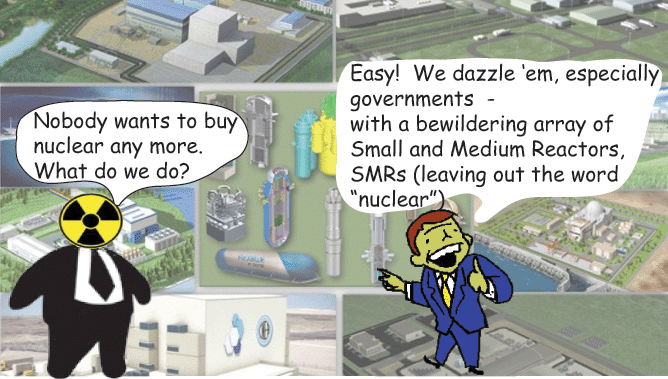
Also, approval for new reactor technology would come in handy. The industry is working on next-generation reactors as well as smaller, modular nuclear reactor technology–but these need to be approved at the highest level before joining the competition. https://oilprice.com/Latest-Energy-News/World-News/US-Nuclear-Energy-Industry-Asks-White-House-for-Help-In-International-Expansio.html

February 14, 2019 Posted by | politics, USA | Leave a comment

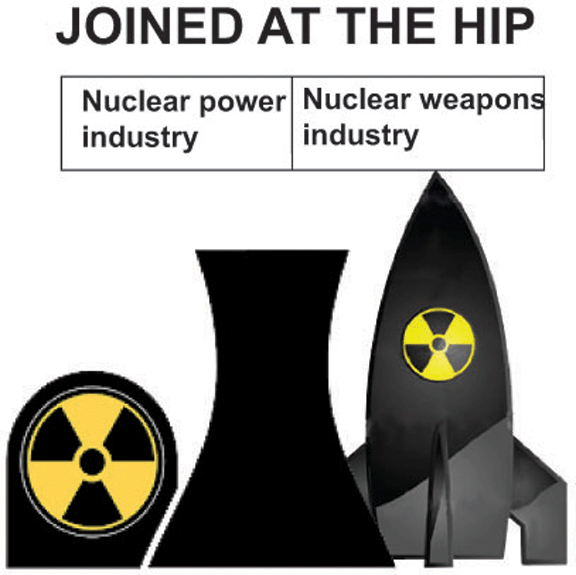
The danger of ‘dual use’ nuclear facilities – for both military and commercial purposes

Nuclear watchdogs warn against blurring energy, military uses at Ohio fuel plantNuclear watchdogs warn against blurring energy, military uses at Ohio fuel plant,  Energy News,  BY Kathiann M. Kowalski, 13 Feb 19, 

Combining the capability to make fuel for nuclear reactors and material for weapons undercuts nonproliferation efforts, critics say.

A planned nuclear fuel plant in Ohio could help enable the nation’s next wave of carbon-free electricity, a fleet of small reactors providing continuous power to the grid.

The U.S. Department of Energy fuel facility would be unique in part because it could also produce material for use in nuclear weapons. That crosses a potentially dangerous line, nuclear watchdog groups say — one that could undercut efforts to prevent the spread of nuclear weapons.

The Department of Energy announced plans last month to contract with Centrus Energy Corp.’s American Centrifuge Operating subsidiary to reopen a nuclear fuel plant in Piketon, Ohio, about 70 miles south of Columbus where Appalachia’s foothills start rising from sprawling farmland.

The new project would likely resemble an earlier pilot program there that ended in 2015, but with various updates and technical fixes. It would also require U.S.-only sources, in lieu of some foreign components and technology.

Dual uses envisioned

DOE is proposing the company as the sole source for the work, and the agency’s notice suggests the demonstration project’s fuel could be used for both civilian and military purposes.

On the civilian side, the project’s fuel would be used for research and development of next-generation nuclear reactors. Designs for those smaller reactors call for fuel known as HALEU, which stands for high assay low-enriched uranium.

HALEU can have between 5 and 20 percent of uranium’s U-235 isotope. That’s the form that undergoes fission readily. In contrast, most U.S. commercial reactors use fuel with 3 to 5 percent U-235. Natural uranium is about 99 percent U-238.

On the defense side, HALEU could be used for small mobile reactorsto power on-the-go military operations. Beyond that, DOE’s requirement for U.S.-only technology could also let the plant’s fuel be used to make tritium. That radioactive isotope of hydrogen is used innuclear weapons.

Foreign policy fears

The possible crossover uses for the Piketon plant’s fuel could conflict with the country’s positions on nuclear nonproliferation.

The United States signed the Nuclear Non-Proliferation Treaty in1968 in hopes of curbing the risk of global nuclear war. The treaty recognizes the rights of countries to use nuclear power for peaceful purposes but forbids countries that didn’t already have nuclear weapons from building or obtaining them. Supplemental treaties apply to transfers of goods and technology and other matters.

Those treaties account for the “U.S.-only” requirement for any facility or technology that would produce nuclear fuel that could be used for the country’s nuclear weapons program. But critics see a problem in blurring the lines of civilian and military uses of Piketon’s fuel.

“Our entire nonproliferation endeavor where our reactors are concerned has been to prevent our civilian programs from being used in support of military bomb-making programs,” said Peter Bradford, a former member of the Nuclear Regulatory Commission who later taught at Vermont Law School. “One of the pillars of that undertaking has been to keep them separate in the U.S.”

An exception has been the irradiation of rods in a light-water reactorat the Tennessee Valley Authority, using “U.S.-only” fuel. Tritium is then extracted from those rods at DOE’s Savannah River Site.

A dual use for the Piketon plant would expand the fuel supply for those or similar operations. But it would also add another site blending civilian and military uses of nuclear technology…………

Conceptually, I think that is a very bad image for the U.S. to project at this point when the U.S. is trying to dissuade other countries from building their own facilities,” said Edwin Lyman, acting director of the Union of Concerned Scientists’ Nuclear Safety Project. ……

“The proposed demonstration is very good news for the entire U.S. nuclear industry,” said Centrus Energy spokesperson Jeremy Derryberry. “If America wants to be competitive in supplying the next generation of nuclear reactors around the world, we need an assured, American source of high-assay low-enriched uranium to power those reactors. We stand ready to work with the department to get the proposed project underway as  quickly as possible.” The Nuclear Energy Institute likewise hailed the news. …….

However, Piketon isn’t the only option for supplying smaller, new nuclear reactors. “There is actually an enrichment facility in the United States in New Mexico that would be capable of supplying any civilian nuclear power plant,” said Lyman at the Union of Concerned Scientists……..

That “midnight-hour resurrection” of production at Piketon raises “a lot of questions about not only the viability of the project, but the need for it, and the consequences of getting it restarted at this point after this has been shut down for three years,” Lyman said.

“The plan and the intent have been to clean the Piketon plant up and to deal with all the radioactive contamination there,” Judson said. “This is a step in the wrong direction.” https://energynews.us/2019/02/13/midwest/nuclear-watchdogs-warn-against-blurring-energy-military-uses-at-ohio-fuel-plant/


February 14, 2019 Posted by | politics, USA, weapons and war | Leave a comment

Record USA national debt – topping $22 trillion, and nuclear industry STILL wants tax-payer handouts !

National debt hits new milestone, topping $22 trillionabc 22 now, by MARTIN CRUTSINGER, AP Economics WriterWednesday, February 13th 2019 WASHINGTON (AP) — The national debt has passed a new milestone, topping $22 trillion for the first time.

The Treasury Department‘s daily statement showed Tuesday that total outstanding public debt stands at $22.01 trillion. It stood at $19.95 trillion when President Donald Trump took office on Jan. 20, 2017.

The debt figure has been accelerating since the passage of Trump’s $1.5 trillion tax cut in December 2017 and action by Congress last year to increase spending on domestic and military programs.

The national debt is the total of the annual budget deficits. The Congressional Budget Office projects that this year’s deficit will be $897 billion — a 15.1 percent increase over last year’s imbalance of $779 billion. In the coming years, the CBO forecasts that the deficit will keep rising, top $1 trillion annually beginning in 2022 and never drop below $1 trillion through 2029. Much of the increase will come from mounting costs to fund Social Security and Medicare as the vast generation of baby boomers continue to retire.

The Trump administration contends that its tax cuts will eventually pay for themselves by generating faster economic growth. That projection is disputed by many economists…….https://abc22now.com/news/nation-world/national-debt-hits-new-milestone-topping-22-trillion

February 14, 2019 Posted by | business and costs, politics, USA | Leave a comment

Nuclear energy developers want Trump administration to subsidise their business, in hopes of exporting “new nukes”

CEOs Ask Trump to Help Them Sell Nuclear Power Plants Abroad, Bloomberg, By Jennifer A Dlouhy,  Ari Natter, and Jennifer Jacobs, February 13, 2019,   Executives say they compete with China, Russia and France,  Thriving nuclear development key to U.S. security, they say

U.S. nuclear energy developers on Tuesday met with President Donald Trump and asked for help winning contracts to build power plants in the Middle East and elsewhere overseas……..

……..The push comes as developers seek U.S. government approval of next-generation advanced and small modular nuclear reactors — and the administration’s help in selling their products to the world. The International Atomic Energy Agency predicts that some 554 gigawatts of nuclear electric generating capacity will come online by 2030, a 42 percent increase over current levels.

The White House meeting included representatives from a range of nuclear developers, including NuScale Power LLCTerraPower LLCWestinghouse Electric Co. LLC and General Electric Co, as well as suppliers Centrus Energy Corp. and Lightbridge Corp. and other companies. It was initiated by Jack Keane, a retired Army general and the co-founder of IP3 International, a company that has advocated American nuclear power development in the Middle East, according to two people familiar with the session.

The executives sought to enlist Trump in their bid to make U.S. nuclear power more competitive globally, such as with financing assistance to vie against subsidized companies. Russia, China and France are also seeking to build nuclear plants overseas……….

The developers argued that U.S. national security would be jeopardized if the country cedes its role as a chief developer of civilian nuclear power plants. As the domestic nuclear fleet ages — and the prospects for building a new wave of plants diminish — exporting the technology globally is a way to ensure a robust and thriving U.S. brain trust on nuclear power.

……..One possibility: A directive laying out U.S. nuclear power development as a chief national security goal.

Also on the table: Efforts to secure agreements to share U.S. nuclear technology with Middle East nations, including Jordan and Saudi Arabia. While negotiations for a so-called 123 agreement with Saudi Arabia were damaged after the killing of columnist Jamal Khashoggi at the Saudi consulate in Istanbul, an agreement with Jordan is also a possibility.

Some nuclear executives also expressed concerns about a raft of policies designed to boost their competitors generating renewable power. The industry representatives meeting with Trump promised to come back in a few months with more concrete ideas.

Separately Tuesday, a bipartisan group of senators introduced legislation that would require any nuclear sharing agreement between Saudi Arabia and the U.S. meet the so-called “gold standard” barring enrichment and reprocessing of uranium.

The White House has vowed to help the nuclear power industry, which is struggling to compete with electricity from cheaper natural gas and renewables, but the administration so far hasn’t been able to formulate a plan to do so.

IP3 International is backed by several prominent national security figures, including Keane, whom Trump has considered as a possible defense secretary.

Michael Flynn, Trump’s former national security adviser who pleaded guilty to making false and fraudulent statements to the FBI, has been linked to IP3 and was accused of failing to disclose private travel and meetings tied to a plan by Russia and Saudi Arabia to build nuclear plants while seeking a government security clearance.

Representatives of IP3 did not respond to a request seeking comment. A NuScale representative referred questions about the meeting to the U.S. Nuclear Infrastructure Council, which didn’t immediately respond to a request for comment. A spokeswoman for the White House declined to comment.

— With assistance by Alyza Sebenius https://www.bloomberg.com/news/articles/2019-02-12/trump-said-to-meet-with-nuclear-developers-looking-globally

February 14, 2019 Posted by | politics, USA | Leave a comment

Byron nuclear plant could close in three years, two decades earlier than its planned retirement 

 RRStar.com By Georgette Braun , 13 Feb 19,  Staff writer , BYRON — Exelon’s Byron nuclear generating station could close as early as mid-2022 because of financial risk, some two decades earlier than its planned retirement.

The company said in a Feb. 8 filing with the Securities and Exchange Commission that the Byron plant and two others — Braidwood and Dresden — are showing “increased signs of economic distress which could lead to an early retirement in a market that does not currently compensate them for their unique contribution to grid resiliency and their ability to produce large amounts of energy without carbon and air pollution.”

Crain’s Chicago Business said the earliest the Byron plant could close would be mid-2022, the same for Braidwood, and as early as 2021 for Dresden.  https://www.rrstar.com/news/20190213/byron-nuclear-plant-could-close-in-three-years-two-decades-earlier-than-its-planned-retirement

February 14, 2019 Posted by | business and costs, USA | Leave a comment

Californian company’s plan for deep burial of nuclear wastes , close to the point of production

Compelo 12 th Feb 2019 , California-based Deep Isolation claims to have the answer to the world’s
spent nuclear fuel problem, with more than 30 countries playing host to a
growing stockpile of radioactive waste. Based out of California, the
company has developed technology it claims can solve a problem its CEO
Elizabeth Muller argues is second only to climate change in terms of its
environmental severity. Capitalising on advances in drilling technology,
the solution involves storing the spent nuclear fuel in corrosion-resistant
canisters and placing them in drillholes deep beneath the earth at sites
near where the waste was produced so as to minimise costs.
https://www.compelo.com/energy/news/deep-isolation-spent-nuclear-fuel/

February 14, 2019 Posted by | USA, wastes | Leave a comment