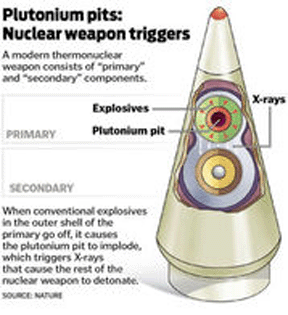
 No plutonium pit at SRS, https://www.augustachronicle.com/opinion/20190220/letter-no-plutonium-pit-at-srs By Cassandra Fralix, Lexington, S.C. With the demise of the MOX fuel plant, good riddance, since there wasn’t a buyer for this dangerous material. There is only one option for the more radioactive plutonium waste, and that is long-term storage.
Long-term for Pu-239 is a half-life of 24,100 years. No one can predict what the state of the country will be in five years, much less 24,000, so who will monitor this dangerous material?
The horrible legacy of plutonium waste is one we are living with because of the development of nuclear weapons and nuclear power. Now, we have the Department of Energy’s plan to use Savannah River Site’s plutonium for nuclear weapons purposes. Plutonium, being radioactive and “pyrophoric,” is very difficult to handle, as the workers at SRS can testify to, and Savannah River Site, a Superfund site, continues a never-ending cleanup.
To return Savannah River Site to a weapons manufacturer is a testament to man’s lack of concern for God’s creation – human and environmental. We have seen the warnings from the increase of cancer rates at Rocky Flats, Colo., a plutonium pit producer – available in the Final Summary Report on the Historical Public Exposures Studies on Rocky Flats – to Fukushima, Japan, where the focus now is on the plutonium plant, so much more toxic than that of most other elements used in nuclear processing.
We must put people over profits and stop this maniacal race to our destruction. Say no to plutonium pit production at SRS!
February 23, 2019
Posted by Christina Macpherson |
- plutonium, USA, weapons and war |
Leave a comment
Nuclear energy is not the same as clean energy https://chicago.suntimes.com/opinion/illinois-clean-energy-policy-nuclear-energy/ Gail Snyder, board president, Nuclear Energy Information Service , 21 Feb 19, “…… While legislation advancing renewable energy and energy efficiency is to be applauded, the $2.3 billion bailout to three privately owned Exelon nuclear energy facilities should be evaluated for its costs and the impact on expanding renewable energy. Of course, legislators should do so promptly, as it seems Exelon did so well with their last bailout that they are going to come back for another.

As energy legislation hits Springfield again, the public will be inundated with the terms “clean,” “renewable,” “green,” “low carbon,” “carbon neutral,” “carbon free,” “non-carbon,” and “net-zero emissions.” These terms will be used interchangeably, which only serves to confuse this fact: Nuclear waste and radioactive releases are not part of the calculus when the nuclear industry and others try to sell nuclear energy as “clean.” It is not.
Legislation that speaks only to “clean” as it relates to managing carbon emissions, without considering the 10,000 tons of nuclear waste in Illinois (the most nuclear waste of any state) is misleading. Also, consideration of the entire nuclear fuel cycle and storage of nuclear waste is carbon- intensive, which is not part of the “clean” calculus either.
We would also like to see Illinois legislators ‘step in’ again on energy policy, but this time with both the “carbon footprint” and the “nuclear footprint” included.
February 23, 2019
Posted by Christina Macpherson |
politics, spinbuster, USA |
Leave a comment
The Rift Between the U.S. and Europe Brings Nuclear Risks, TIME, By SIMON SHUSTER/MUNICH February 21, 2019
“…………The loss of trust between the U.S. and Europe was especially palpable at this year’s Munich summit, a traditional show of mutual reassurance among NATO allies. In her speech to the summit, German Chancellor Angela Merkel complained that the U.S. decision to scrap the INF treaty was made without consulting Europe, even though the treaty concerns Europe’s security most of all. “We sit there in the middle with the result,” Merkel said. Minutes later, when Vice President Mike Pence delivered a greeting from his boss, President Donald Trump, the room full of European diplomats responded with stony silence.
Their chief concern at the summit, at least when it comes to nuclear security, was the U.S. move in May to pull out of the deal with Iran. That deal took nearly a decade to negotiate, and it committed the Islamic Republic in 2015 to halt its nuclear-weapons program. Yet despite U.S. intelligence agencies reporting the deal was working, the Trump Administration scrapped it, imposing new sanctions against Iran and pressuring European allies to do the same. Germany, France and the U.K. have so far refused. ……
February 23, 2019
Posted by Christina Macpherson |
EUROPE, politics international, USA |
Leave a comment
Closing nuclear facility on table as US-NKorea summit nears, BY ERIC TALMADGE News and Observer, ASSOCIATED PRESS, FEBRUARY 22, 2019 TOKYO
The future of a key North Korean nuclear facility is on the table as leader Kim Jong Un and President Donald Trump prepare to meet in Vietnam next week.
The Yongbyon Nuclear Scientific Research Center, the heart of the North’s nuclear development and research, is Kim’s biggest carrot as he tries to win security guarantees and free his country from the U.S.-backed trade sanctions that are hobbling its economy.
The North Korean leader has suggested he’s ready to talk about closing the facility, capping the amount of fissile material it produces or possibly allowing international inspections. Trump, meanwhile, says he is going into the summit in no hurry to push the North to denuclearize, as long as Kim isn’t conducting nuclear or missile tests.
But time may be of the essence.
As talks drag on, North Korea is believed to have produced enough weapons-grade nuclear fuel to make an estimated half a dozen or so more bombs in 2018 alone.
Here’s the latest on what’s going on at Yongbyon and why it’s so important:
HEDGED BETS
The North has taken steps to disable or dismantle some nuclear and missile facilities since the first Trump-Kim summit last June in Singapore but it has also been hedging its bets.
Using open-source satellite imagery of the Yongbyon complex, a team of experts led by Siegfried Hecker, a former director of the Los Alamos National Laboratory who has visited the Yongbyon facility several times, estimate the North made enough weapons-grade material to boost its stockpile from an estimated 30 nuclear weapons at the end of 2017 to 35-37 by the end of last year.
“North Korea unsurprisingly continued to operate and, in some cases, expand the nuclear weapons complex infrastructure,” they wrote in a report published this month by the Stanford Center for International Security and Cooperation.
The authors note that Kim isn’t violating any agreements with Trump or shocking any military strategists by building up the North’s stockpile — that’s to be expected in an arms negotiation process. But the stepped up activity underscores how important it is for Washington to push for a deal on Yongbyon……..https://www.newsobserver.com/news/business/article226619924.html
February 23, 2019
Posted by Christina Macpherson |
North Korea, politics international, USA, weapons and war |
Leave a comment

Zarif decries ‘US hypocrisy’ over planned nuclear sale to Saudis
Neither human rights or a burgeoning nuclear programme are a real concern for the US, Iran’s foreign minister  says. Aljazeera, 21 Feb 19, Iranian Foreign Minister Mohammad Javad Zarif accused the US of hypocrisy for allegedly attempting to sell nuclear technology to Saudi Arabia while Washington tries to wreck Iran’s nuclear programme.
Zarif’s comment on Twitter on Wednesday came after reports the administration of President Donald Trump is trying to bypass US Congress to advance the sale of nuclear power plants to Saudi Arabia.
“Day by day it becomes clearer to the world what was always clear to us: neither human rights nor a nuclear program have been the real concern of the US,” Zarif wrote.
“First a dismembered journalist; now illicit sale of nuclear technology to Saudi Arabia fully expose #USHypocrisy,” Zarif added, referring to the killing of Saudi writer Jamal Khashoggi at the hands of Saudi agents, and the new report by a US congressional committee on the planned technology sale. …….
Mohammad Ali Shabani, Iran Pulse Editor at Al-Monitor, said he doubted the US would sell uranium-enrichment technology to Saudi Arabia and, therefore, Riyadh would not have the capability to develop a nuclear weapon.
“However, the sidestepping of America’s own laws to facilitate sales of nuclear power plants puts the Trump administration’s broader credibility under question,” Shabani told Al Jazeera.
‘Terrorist attack’
Tensions between Washington and Tehran – bitter foes since Iran’s 1979 revolution – have intensified since Trump withdrew the US from the Joint Comprehensive Plan of Action (JCPOA), better known as the Iran nuclear deal, under which it scaled back its uranium enrichment programme and promised not to pursue nuclear weapons.
In exchange for the deal signed in 2015 in Vienna with six world powers – the US, UK, France, Germany, Russia, China and the European Union – international sanctions were lifted allowing Iran to sell its oil and gas worldwide.
Trump reimposed sanctions with the aim of slashing Iranian oil sales and choking its economy in order to curb its ballistic missile programme and activities in the Middle East, especially in the conflicts in Syria and Yemen.
Iranian President Hassan Rouhani said on Wednesday Iran-US relations are at a new low and sanctions imposed by the Trump administration targeting Tehran’s oil and banking sectors amounted to “a terrorist attack”.
“The struggle between Iran and America is currently at a maximum. America has employed all its power against us,” Rouhani was quoted as saying in a cabinet meeting by the state broadcaster IRIB.
“The US pressures on firms and banks to halt business with Iran is 100 percent a terrorist act,” he said.
The International Atomic Energy Agency (IAEA) has repeatedly confirmed Tehran has been meeting its nuclear commitments fully.
‘Khashoggi cover-up’
The Trump administration has faced additional congressional opposition due to concerns about the role of Saudi Crown Prince Mohammed bin Salman (MBS) in the murder of Jamal Khashoggi……. https://www.aljazeera.com/news/2019/02/zarif-decries-hypocrisy-planned-nuclear-sale-saudis-190220100506949.html
February 21, 2019
Posted by Christina Macpherson |
Iran, politics international, Saudi Arabia, USA |
Leave a comment
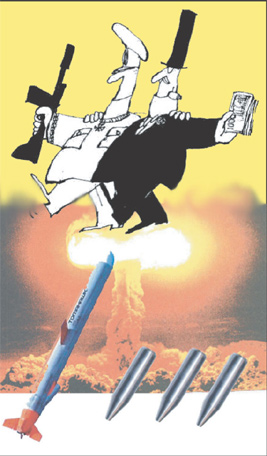 The Arms Trade Is Intensifying Under Trump, Peter Castagno, Truthout, February 20, 2019 The revolving door between public officials and defense contractors has long distorted U.S. foreign policy to serve war profiteers at the expense of the public interest and basic humanitarian norms. From U.S. weaponry ending up in the hands of ISIS, to supplying arms fueling civil conflict and therefore contributing to the world’s worst humanitarian catastrophe in Yemen, the lack of oversight on arms deals has enabled human rights atrocities. The Arms Trade Is Intensifying Under Trump, Peter Castagno, Truthout, February 20, 2019 The revolving door between public officials and defense contractors has long distorted U.S. foreign policy to serve war profiteers at the expense of the public interest and basic humanitarian norms. From U.S. weaponry ending up in the hands of ISIS, to supplying arms fueling civil conflict and therefore contributing to the world’s worst humanitarian catastrophe in Yemen, the lack of oversight on arms deals has enabled human rights atrocities.The global arms trade is experiencing its greatest boom since the Cold War, fueled by horrific wars in the Middle East and revitalized power rivalries among China, Russia and the United States. In their most recent report, the Stockholm International Peace Research Institute revealed a 44 percent increase in arms sales from 2002 to 2017. The United States is the world’s biggest arms exporter by far, holding 34 percent of total market share — a 58 percent lead on Russia, its closest competitor. From 2017 to 2018, U.S. arms sales to foreign governments increased 33 percent, in part due to the Trump administration’s diminished legal restraints on supplying foreign militias…..
Before entering the White House, Trump asserted his belief in a “lifetime restriction” on top defense officials working for private defense contractors after their public service. Two years later, the Project on Government Oversight released a detailed analysis of the defense sector, revealing 645 instances of federal employees working for the 20 largest Pentagon contractors in fiscal year 2016, the latest year with complete data. Of the 645 instances of former public servants transitioning to work for private defense corporations, 90 percent were hired to work as lobbyists, where they seek to influence public policy to benefit their private employers.
Trump Cabinet Conflicts
After the resignation of Gen. James Mattis, Deputy Secretary of Defense Patrick Shanahan filled the post as interim head of the Defense Department. Before joining the Trump administration, Shanahan spent three decades working for Boeing — a blatant conflict of interest for the person responsible for overseeing federal contracts with private defense contractors. Col. Lawrence Wilkerson, Colin Powell’s former chief of staff, called Shanahan “a living, breathing product of the military-industrial complex,” and asserted that “this revolving door keeps the national security elite very small, and very wealthy, and increasing its wealth as it goes up the chain.”
One egregious example of that revolving door is Heather Wilson, who has been secretary of the Air Force since 2017. In 2015, Lockheed Martin paid a $4.7 million settlement to the Department of Justice after the revelation it had used taxpayer funds to hire lobbyists for a $2.4 billion contract. One of the lobbyists was former New Mexico Representative Wilson, ranked as one of the “most corrupt members of Congress” by the nonprofit government watchdog group Citizens for Responsibility and Ethics in Washington. Wilson was later confirmed as Air Force secretary in the Senate by a 76-22 vote.
Mark T. Esper, the secretary of the Army, worked as vice president of government relations for Raytheon before joining the Trump administration in 2017. The Hill recognized Esper as one of Washington’s most powerful corporate lobbyists in 2015 and 2016, where he fought to influence acquisition policy and other areas of defense bills. Esper’s undersecretary, Ryan McCarthy, is a former Lockheed executive.
Armament Industry’s Influence on Foreign Policy
The Trump administration’s commitment to advancing arms sales is not only apparent in the legion of officials with severe conflicts of interests occupying the cabinet, but also through directives in official arms export policy. The State Department’s updated Conventional Arms Transfer (CAT) Policy Implementation Plan was released in November 2018 and detailed loosened restrictions on the sale of drones and other weapons, new financing options for countries who can’t afford U.S. weaponry, and aims to put pressure on diplomats to put arms deals at the forefront of their mission. Rachel Stohl, an arms trade expert with the Stimson Center, described the updated policy, saying, “If you read between the lines, it could be a green light for the U.S. to sell more with less restraint.”
A glaring example of the arms industry’s influence on State Department policy is demonstrated by a September 20, 2018, report from The Wall Street Journal. According to the report, Secretary of State Mike Pompeo was convinced to continue support for the Saudi campaign in Yemen for the sake of a $2 billion arms deal with U.S.-based defense contractor Raytheon. The State Department’s legislative affairs staff, who influenced Pompeo’s decision, is led by Assistant Secretary of State Charles Faulkner, a former Raytheon lobbyist……..
A real debate on the arms trade is nearly absent from public conversation because the industry can only thrive in secrecy and duplicity………
After Trump pulled out of the Joint Comprehensive Plan of Action, commonly known as the Iran nuclear deal, defense companies enjoyed an immediate boost to their stock. This is because demand in the arms trade surges alongside geopolitical instability. Heightened volatility encourages higher arms sales, and the dissemination of weapons to despotic regimes increases volatility, creating a vicious cycle further entrenched by a revolving door of defense contractors who influence public policy to benefit private weapons manufacturers……… https://truthout.org/articles/the-arms-trade-is-intensifying-under-trump/
|
|
|
February 21, 2019
Posted by Christina Macpherson |
business and costs, USA, weapons and war |
Leave a comment
White House climate change panel to include man who touted emissions, Guardian, Emily Holden in Washington, 21 Feb 2019
William Happer, a physicist who has suggested higher levels of carbon dioxide are beneficial, would be on committee, The White House is planning to assess how climate change impacts national security and will involve a prominent doubter of the scientific consensus that manmade warming is putting the US at risk.
Donald Trump’s staff have drafted an executive order to establish a Presidential Committee on Climate Security, according to reports from
the Washington Post and
New York Times. It would include senior aide William Happer, a Princeton physicist who has suggested – in conflict with the vast majority of climate scientists – that higher levels of carbon dioxide are beneficial.
A recent assessment from the national intelligence director, Daniel Coats, called climate change a significant security risk, the Post noted……
Donald Trump’s staff have drafted an executive order to establish a Presidential Committee on Climate Security, according to reports from the Washington Post and New York Times. It would include senior aide William Happer, a Princeton physicist who has suggested – in conflict with the vast majority of climate scientists – that higher levels of carbon dioxide are beneficial.
A recent assessment from the national intelligence director, Daniel Coats, called climate change a significant security risk, the Post noted…….Donald Trump’s staff have drafted an executive order to establish a Presidential Committee on Climate Security, according to reports from the Washington Post and New York Times. It would include senior aide William Happer, a Princeton physicist who has suggested – in conflict with the vast majority of climate scientists – that higher levels of carbon dioxide are beneficial.
A recent assessment from the national intelligence director, Daniel Coats, called climate change a significant security risk, the Post noted.
…….In 2017, Happer told the Scientist that climate change research has become a “cult movement” https://www.theguardian.com/environment/2019/feb/20/white-house-climate-change-national-security-panel
February 21, 2019
Posted by Christina Macpherson |
climate change, USA |
Leave a comment
U.S. Nuclear Has A Tough Road Ahead https://oilprice.com/Alternative-Energy/Nuclear-Power/US-Nuclear-Has-A-Tough-Road-Ahead.html By Tim Daiss – Feb 19, 2019, The United States nuclear industry is in a tough spot. It’s unpopular with the public due to high-profile disasters like 1979’s Three Mile Island meltdown, and its bottom line has been hit hard by the rise of ultra-cheap domestic shale oil and gas as well as a nearly plateaued post-recession demand for electricity. Some states, including New York, New Jersey, and Illinois have approved financial packages to revive their failing nuclear industries, and now Pennsylvania could be the next if they can push past a plague of doubt.Pennsylvania is a hard sell for nuclear support as the home of the United States’ most famous nuclear disaster at the Three Mile Island site in Dauphin County 40 years ago. The nuclear industry has continued to function, however, in Pennsylvania in the intervening decades–in fact, it’s the second biggest nuclear power state in the country–it hasn’t been until the recent surge of cheap domestic fossil fuels thanks to the boom of production in the Permian Basin that the sector has hit a rough patch that they are unable to surmount on their own.
Even the notorious Three Mile Island plant itself remains in operation today. It has survived four decades of being synonymous with everything that’s wrong with nuclear in the United States, until now. The Chicago-based owner of the plant, Exelon Corp., has announced that the plant will finally be closing its door on September 30th of this year unless the state of Pennsylvania can pull it out of its financial hole. The Three Mile plant would soon be followed by Beaver Valley nuclear power plant in western Pennsylvania and two nuclear plants in Ohio, which Ohio-based owner FirstEnergy Corp. said they will close within the next three years if Pennsylvania can’t pass a financial package to save them.
In light of this newfound hardship, over the past few years industry leaders in Pennsylvania have been working diligently to rouse support for a financial package like those approved in other nearby states to keep the floundering industry afloat. While nuclear support packages have been approved in New York, New Jersey, and Illinois, the path has not been laid clear for Pennsylvania to follow–those already-approved initiatives have been mired in legal appeals debate between federal energy regulatory authorities, and general outcry against a rise in electricity prices for consumers.
The already-socially-sticky-situation is only made more politically complex by the ongoing litigation surrounding nuclear bailout packages, making the decision to push any such financial package in Pennsylvania a particularly precarious one. “Anything that Pennsylvania does is going to be subject to a degree of policy and legal uncertainty,” said University of Pennsylvania’s Christina Simeone, director of policy and external affairs at the Kleinman Center for Energy Policy.
Further complicating the issue, the contentious and divisive topic of nuclear energy’s future has recently entered the national spotlight with a new fervor thanks to the Democratic party’s newly unveiled Green New Deal. Although the official bill itself makes no mention at all of nuclear (a striking omission in and of itself), a fact sheet released alongside the bill, made public by Representative Alexandria Ocasio-Cortez, states outright and in no uncertain terms that the Democrats’ Green New Deal “will not include investing in new nuclear power plants.”
The debates on the national stage as well as on a state level, such as what’s happening in Pennsylvania, are indicative of a larger issue: in a world with rising temperatures and populations and declining reserves of traditional fossil fuels, is the United States willing to follow in the footsteps of other world powers and make politically unpopular moves in order to confront our new energy reality? So far, in Pennsylvania at least, the answer seems to be a resounding “we don’t know.” By Haley Zaremba for Oilprice.com
February 21, 2019
Posted by Christina Macpherson |
business and costs, politics, USA |
Leave a comment
Contractor used Masters and NASCAR tickets in failed nuclear plant kickback scheme, Nick Bromberg
Yahoo Sports, Feb 21, 2019, A contractor involved with a failed nuclear power plant construction project allegedly made some nice cash in a kickback scheme that involved tickets to sporting events. And, like most alleged illegal kickback schemes, the contractor got caught.
According to a court filing in a lawsuit filed by the United States Government, Wise Services Inc. submitted nearly 500 fake invoices during construction of a Savannah River nuclear facility. The South Carolina project was ended in 2018 and won’t be finished.
The government said in the suit that the kickbacks for the submission of fake invoices to project manager CB&I AREVA MOX Services LLC included tickets to the Masters, NASCAR races and college football events. And even Yeti coolers!…..https://sports.yahoo.com/contractor-used-masters-nascar-tickets-failed-nuclear-plant-kickback-scheme-164311675.html
February 21, 2019
Posted by Christina Macpherson |
secrets,lies and civil liberties, USA |
Leave a comment
 Penn Live, Feb 19 By Eric Epstein, Maureen Mulligan and David Hughes, guest contributors
It is the duty of state legislators to draft laws that respond to the needs of the districts that they represent. Some electric utility companies that own low or unprofitable nuclear plants want Pennsylvania lawmakers to enact legislation that will provide subsidies to utilities that own and operate uneconomical nuclear power plants.
Proponents of a nuclear bailout tax frequently argue that these subsidies are necessary for grid reliability and to meet statewide greenhouse gas emissions goals, and that plant closures would create economic hardships in the communities where they operate. While these are all important priorities, the measures the nuclear power industry is proposing would not produce the proclaimed results.
PJM Interconnection, the regional power grid operator responsible for grid reliability for 65 million customers in 21 states including Pennsylvania and the mid-Atlantic region, has published multiple studies making it clear that closing these plants would not affect grid reliability. The lights will continue to shine if uneconomical nuclear power plants retire, thanks in part to increased solar and wind generation coming online throughout the state.
An analysis by the Nuclear Information and Resource Service (NIRS) provides evidence that “continuing to operate these plants does nothing to reduce greenhouse gas emissions from current levels.” In fact, more cost-effective, economically productive and environmentally benign options are available.
As multiple studies have proved, despite the mythology, nuclear power is not a carbon-free source of energy. Greenhouse gases are emitted in all stages of the life cycle of a nuclear reactor: construction, operation, fuel production, dismantling and waste disposal. In addition, nuclear plants routinely vent some of the deadliest gases known to exist.
And, of course, there is the issue of what to do with the dangerous radioactive waste. Nuclear power is an old and expensive technology. Subsidizing aging, unprofitable reactors on the verge of retirement anyway diverts large financial resources from investments in new technologies and infrastructure and slows renewable energy growth that is driving down emissions without seeking a handout.
The analysis by NIRS highlights that potential job losses can be addressed without making electricity ratepayers pay more to bail out the owners of these uneconomical plants. In fact, the increased energy costs to manufacturers — some of the biggest energy users in the commonwealth — as a result of a nuclear bailout could lead to job losses and lack of economic growth in the state that are the same or worse than a plant closure. …….https://www.pennlive.com/opinion/2019/02/bailout-tax-profitable-corporations-need-to-come-clean-on-nuclear-energy-opinion.html
February 21, 2019
Posted by Christina Macpherson |
business and costs, politics, USA |
Leave a comment
Contact: Mimi Kennedy (315) 246-7333; Harvey Wasserman (614) 738-3646 – solartopia@gmail.com; Myla Reson (310) 663-7660 – myla.reson@gmail.com
Dear Gov. Newsom,
We join hundreds of other Californians, including Sen. Ben Allen and San Luis Obispo Mayor Heidi Harmon, who are calling, writing, faxing and e-mailing, asking that you take action at Diablo Canyon to protect our safety and economic future. Under PG&E’s current bankruptcy and criminal proceedings, your position gives you wide ranging powers to act.
Diablo Unit One is now shut for refueling. We feel that given the evidence of embrittlement, it is very important to halt the loading of new fuel into the reactor until the public resolution of seven critical issues:
- Diablo One was last tested for EMBRITTLEMENT in 2003; it can now be easily tested while Unit One is shut.
- Diablo One’s key components must be tested for CRACKING, easily done now with ultra-sound.
- PG&E has DEFERRED ITS MAINTENANCE at Diablo since at least 2010.
- Nuclear Regulatory Commission site inspector Michael Peck, among many others, has doubts that Diablo can withstand a credible earthquake.
- Serious questions remain about how PG&E intends to handle Diablo’s RADIOACTIVE WASTES.
- US Rep. Salud Carbajal has joined many others in questioning the COMPETENCE of the bankrupt, criminally-convicted PG&E to manage these two very large reactors in his home district.
- Studies show Diablo’s POWER IS NOT NEEDED, and in fact impedes the use of renewables here in California.
We ask that BEFORE DIABLO ONE REFUELS you subject these and other critical issues to open public scrutiny. The decision on Diablo’s future must be made by you in conjunction with the Legislature, the CPUC, state agencies, the courts and the public.
We thank you very much for giving this your serious consideration. We feel this is an exciting and crucial opportunity for you to continue your groundbreaking leadership in bringing more safety, responsibility, and wise energy policy to all Californians. Let us keep showing the way to a safer (and more sustainable) energy future.
Signatories (partial list):………
Separate petitions, resolutions & other supporting letters & documents are from: ……. http://solartopia.org/hollywood-stars-grassroots-activists-state-senator-mayor-major-organizations-ask-gov-newsom-to-fully-inspect-aged-diablo-canyon-nuclear-unit-one-before-it-re-fuels/
February 19, 2019
Posted by Christina Macpherson |
safety, USA |
Leave a comment
 Dept. of Justice 14th Feb 2019
 The Department of Justice

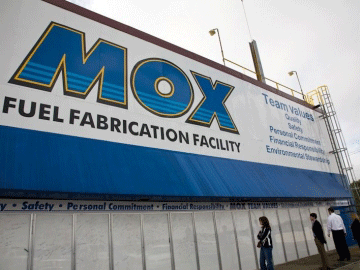
announced today that the United States has filed suit against CB&I AREVA MOX Services LLC (MOX Services) and Wise Services Inc. under the False Claims Act and the Anti-Kickback Act in connection with a contract between MOX Services and the National Nuclear Security
Administration relating to the design and operation of the MOX Fuel
Fabrication Facility (MFFF) at the NNSA Savannah River Site in Aiken, South
Carolina.
MOX Services is a South Carolina Limited Liability Corporation with headquarters in Aiken, South Carolina. Wise Services, which subcontracted with MOX Services, is an Ohio corporation with headquarters in Dayton, Ohio. Under the MOX Contract, MOX Services agreed to design, build, operate (and ultimately decommission) the MFFF.
The MFFF is designed to transform weapons-grade plutonium into mixed oxide fuel rods that may be irradiated in commercial nuclear power plants.
In performing the MOX Contract, MOX Services entered into a series of subcontracts with Wise Services between 2008 and 2016. Each of these subcontracts provided for
Wise Services to supply labor, materials, equipment, and supervision for unplanned construction activities (e.g. general labor, plumbing, electrical, carpentry) deemed necessary to support MOX Services’ efforts at the MFFF.
The government’s complaint alleges that Wise Services falsely claimed reimbursement under its subcontracts with MOX Services for construction materials that did not exist, and that in turn MOX Services knowingly submitted $6.4 million in claims to NNSA for the fraudulent charges submitted by Wise Services. The complaint further alleges that Wise Services’ Senior Site Representative Phillip Thompson paid kickbacks to MOX Services officials with responsibility for the subcontracts to improperly obtain favorable treatment from MOX Services. On Feb. 27, 2017, Mr. Thompson entered a guilty plea on charges of conspiring to commit theft of government funds.
https://www.justice.gov/opa/pr/united-states-files-false-claims-act-lawsuit-connection-mox-fuel-fabrication-facility
February 18, 2019
Posted by Christina Macpherson |
secrets,lies and civil liberties, USA |
Leave a comment
My Turn: The madness of the nuclear first-use option, https://www.concordmonitor.com/No-first-use-of-nuclear-weapons-23490452 By RAY PERKINS Jr. For the Monitor, 2/15/2019 It seems Mike Moffett (Monitor Opinion, Feb. 11,) “ ‘No first use’ policy increases likelihood of war”) not only needs some historical refreshment, he also ignores the legal and moral dimensions of nuclear weapons use and the problems of our first-use option as opposed to a wiser no-first-use policy.
Some history: Moffett says that “first use” ended World War II. That was hardly the principal cause of Japan’s surrender.
Most historians now attribute the end to the Soviet entry on Aug. 8. That immoral and illegal first use was also unnecessary. I’ve made the case in this paper many times, but I’ll merely quote Gen. Dwight Eisenhower, the supreme allied commander): “Japan was ready to surrender, and there was no need to use that awful thing.” Virtually all the top military leaders agreed.
But apart from its illegal and immoral despicability “common to Dark Age barbarians” (as Adm. William Leahy put it), that first use alienated our Soviet ally and started a long and dangerous Cold War.
What Moffett doesn’t say is that the first-use option, while not necessitating first use, does require preparation and willingness to do it. In a time of crisis, Nation X, knowing that Enemy Y has the first-use option and fearing imminent first use from Y, may pre-empt with the strike first – better to use ’em than lose ’em. This is equally dangerous with nukes kept on “hair trigger” alert, which first-use nuke nations do (but not the no-first-use nations: India, China and North Korea). It’s a recipe for an accidental nuclear launch.
–We’ve long held first use, even during the 1980s when the Soviets (and China) espoused a no-first-use policy. It was a main driver of the dangerous and often nearly catastrophic super power arms race. There were hundreds of nuclear accidents and near misses, some after the Cold War ended, as we now know from Eric Schlosser’s shocking 2014 book, Command and Control. By pure luck we survived decades of military inattention to nuclear safety and our (still ongoing) deference to the “we’re falling behind” cries of the dollar-seeking military-industrial-complex. (We are the world’s No.1 arms merchant, with many undemocratic customers.) For some frighteningly close calls see my review of Schlosser’s book: bit.ly/2SCQUO5.
First use has also been used by every president since Harry Truman as a threat to force concessions, as Daniel Ellsberg (nuke adviser to the Pentagon and several presidents in the 1960s and ’70s) has pointed out, with many examples in his recent Doomsday Machine.
Moffett also says Ronald Reagan showed “wisdom” by retaining the first-use option. Eventually Reagan wised up, but not until Mikhail Gorbachev (Nobel Peace Prize, 1990) came along in the mid-1980s. Earlier Reagan had little understanding of nukes. In fact he and his vice president, George H.W. Bush, were both insisting that a nuclear war was survivable and winnable.
By 1986, Reagan and Gorbachev, at their first summit, nearly agreed to the abolition of all nukes. But Reagan’s “Star Wars” (a proposed anti-ballistic missile system then outlawed by treaty and thought to be “pie in the sky”) killed the deal. But in 1987 we fortunately got the INF Treaty destroying 3,000 medium-range missiles – a treaty the United States is threatening to leave.
Moffett said our local leftists should “leave defense policy to national security and military experts.”
Surely Moffett knows that many such experts are today advocating exactly what the “local leftists” are – urging our state Legislature to urge Congress and the president to adopt no first use and halt funds for new low-yield nukes. They include: Gen. Lee Butler (Air Force), commander of Strategic Air Command (1984-1991) and first of the Strategic Command (1991-1994); Gen. James Cartwright (USMC), commander of the Strategic Command (2004-07) and vice chair of the Joint Chiefs of Staff (2007-2011); Secretary of State George Shultz (under Reagan); and Secretary of Defense William Perry (under Bill Clinton).
There are moral problems with nukes and even with nuclear deterrence of any form. Even deterrence (with no first use) requires the preparation for possible use and a willingness to use nukes “if necessary.” As such, all nuclear deterrence runs the risk of nuclear war and the killing of millions of innocent human beings or worse, given the possibility of nuclear winter. As science knows, but apparently not the Pentagon, even a small nuclear exchange – for example, India versus Pakistan, each firing 50 low-yield weapons – could bring on a 10-year nuclear winter and global famine killing over a billion people (2014 study by Physicians for Social Responsibility). Such a risk is morally unacceptable – a concern central to creating the Nuclear Non-Proliferation Treaty in 1968 – now with 189 parties and as important as ever.
The Non-Proliferation Treaty (Art. 6) requires a swift end to the nuclear arms race and the bringing to conclusion a treaty for “general and complete disarmament under strict and effective international control.” In 1996 the World Court rendered an opinion on the legality of nuclear weapons, saying: “The threat or use of nuclear weapons would generally be contrary to the rules of international law applicable in armed conflict.”
Meeting our treaty obligations will be a very long and difficult journey. But we must recover the progress that slowed soon after the end of the Cold War and recently threatens to stop – or worse.
In the meantime, the United States can encourage the non-proliferation treaty’s many non-nuke parties to show that the United States is still serious about its treaty obligations. We N.H. folks – as many other states are doing – can and should take the small but positive steps to support our state government to urge Congress and the president to adopt a no-first-use pledge, and to decline funding for any new costly and “more usable” low-yield nukes.
(Ray Perkins Jr. of Concord is professor of philosophy, emeritus, at Plymouth State University and vice chairman of the Bertrand Russell Society board of directors.)
February 16, 2019
Posted by Christina Macpherson |
Reference, USA, weapons and war |
1 Comment
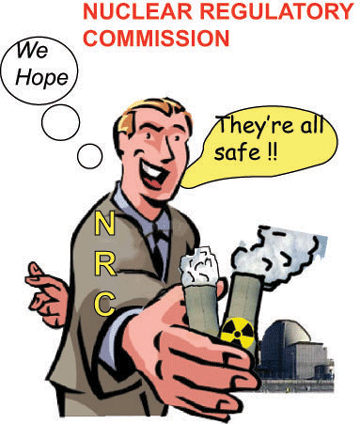
WASHINGTON —The Nuclear Regulatory Commission’s (NRC) Republican majority, in a 3-2 vote, approved a stripped-down version of a rule originally intended to protect U.S. nuclear plants against extreme natural events, such as the massive earthquake and tsunami that triggered meltdowns at the Fukushima Daiichi nuclear plant in Japan in March 2011.
The commission majority struck a provision from the draft final rule the NRC staff recommended in December 2016 requiring plant owners to protect their facilities from the real-world hazards they face today instead of “design-basis” hazards that were estimated using now-obsolete information and methodologies when the plants were built decades ago.
The commission majority’s act will leave unresolved how the NRC will address new information showing that plants may experience bigger floods and earthquakes than they are now required to withstand. It is possible that the commission will not require all plant owners whose facilities face greater hazards to make structural upgrades.
“Nearly eight years after the Fukushima accident, the NRC continues to disregard a critical lesson: Nuclear plants must be protected against the most severe natural disasters they could face today—not those estimated 40 years ago,” said Dr. Edwin Lyman, senior scientist and acting director of the Nuclear Safety Project at the Union of Concerned Scientists.
After Fukushima, an NRC task force recommended that the NRC “order licensees to reevaluate the seismic and flooding hazards at their sites … and if necessary, update their design basis and SSCs [structures, systems and components] important to safety to protect against the updated hazards.”
To date, the NRC has only implemented the first part of the recommendation: Owners have reevaluated seismic and flooding hazards. What they found is not reassuring. For instance, the flooding reevaluations revealed that roughly two-thirds of U.S nuclear plants face hazards beyond what they were originally designed to handle, including higher flood levels from extreme precipitation, upstream dam failure and storm surge. The reevaluated flood height for local intense precipitation for the Palisades plant in Michigan, for example, was more than 25 feet higher than the level considered in the plant’s original design. Similar concerns were identified in many seismic risk evaluations.
Despite these findings, the NRC failed to implement the second part of the task force recommendation to require plant owners to strengthen their defenses against greater hazards. The rule that was approved today was originally intended to close that gap. The commission majority’s action today removed that requirement and will simply maintain the uncertain—and inadequate—status quo.
“The NRC must require plant owners to upgrade their facilities based on the best current information, the most realistic analyses, and the potentially devastating impacts of increased flooding from climate change,” said Dr. Lyman. “Failing to do so will leave some nuclear plants dangerously unprepared and needlessly invite disaster.”
February 16, 2019
Posted by Christina Macpherson |
climate change, safety, USA |
Leave a comment






 nuclear-news