nuclear-news

The News That Matters about the Nuclear Industry Fukushima Chernobyl Mayak Three Mile Island Atomic Testing Radiation Isotope

  • Home
  • 1 This Month
  • ACTION !
  • Disclaimer
  • Links
  • PAGES on NUCLEAR ISSUES

Nuclear Energy Leadership Bill introduced in USA House

Bipartisan House Members Introduce Nuclear Energy Leadership Act, Bill set for referral to the chamber’s energy, science committees, Morning Consult,   BY JACQUELINE TOTH, June 18, 2019 

House members have introduced an identical companion to the Senate’s premier nuclear legislation, opening the bill up for conversation in the chamber.

Reps. Elaine Luria (D-Va.) and Denver Riggleman (R-Va.) co-sponsored the Nuclear Energy Leadership Act, along with Reps. Rob Wittman (R-Va.) and Conor Lamb (D-Pa.), who chairs the Energy Subcommittee of the House Science, Space and Technology Committee — to which parts of the bill will likely be referred.

The House introduction shows enthusiasm for advanced nuclear energy in both chambers and will allow for discussion to move forward on NELA simultaneously in both the House and Senate, said Ryan Fitzpatrick, deputy director of the Clean Energy Program at the think tank Third Way. “Getting that conversation moving is a good thing for a timely process towards an actual passage.”

Among other directives in the measure, the Energy Department would have to create a national strategy for nuclear energy, demonstrate advanced nuclear reactor concepts and make an initial supply of high-assay low-enriched uranium fuel available, which is required by some new reactors.

Much of the nuclear industry is hoping for the bill’s enactment as a third win for the sector, which celebrated passage of two advanced nuclear energy measures last Congress. “The three pieces of the legislation together really will help push forth the advanced reactor industry,” said Everett Redmond, senior technical advisor for new reactor and advanced technology at the Nuclear Energy Institute trade group.

The bill has powerhouse support in the Senate, where it was introduced by Energy and Natural Resources Chairman Lisa Murkowski (R-Alaska) and has 17 co-sponsors to date, including committee ranking member Joe Manchin (D-W.Va.), Senate Appropriations Energy and Water Development Chairman Lamar Alexander (R-Tenn.) and Sen. Cory Booker (D-N.J.).

Luria said Tuesday that she had learned about the measure before it was introduced in the Senate………https://morningconsult.com/2019/06/18/bipartisan-house-members-introduce-nuclear-energy-leadership-act/

June 20, 2019 Posted by Christina Macpherson | politics, USA | Leave a comment

USA’s National Nuclear Security Administration finds 3 problems with modernising nuclear arsenal

Government watchdog finds 3 issues disrupting US nuclear modernization efforts, Defense News By: Kelsey Reichmann 20 June 19, WASHINGTON — The U.S. agency responsible for making explosive materials used in nuclear weapons is facing challenges that could impact the country’s planned modernization of its nuclear arsenal, according to a report by the Government Accountability Office.

The National Nuclear Security Administration, a semiautonomous agency within the Energy Department, is facing three main challenges, according to the report: a dwindling supply of explosive materials, aging and deteriorating infrastructure, and difficulty in recruiting and training qualified staff.

This report comes amid congressional debate over the cost of modernizing the U.S. nuclear arsenal, an effort driven by President Donald Trump.

NNSA’s supply of materials, which are “highly specialized” with specific chemical and physical characteristics, are in low supply, the report says. Furthermore, the NNSA is lacking the knowledge base to produce the materials, as the recipes to make them were not well-documented, or the processes themselves infrequently practiced, the report notes.

Challenges in obtaining materials is not a new issue for the NNSA, the watchdog notes. The agency experienced a similar situation with a material known as “Fogbank,” and the GAO reported in March 2009 that the NNSA lacked the knowledge to manufacture the material — leaving the process for Fogbank “dormant for about 25 years.”

Fogbank is used in the production of the W76-1, a warhead for the Navy’s Trident ballistic missile. Under the Trump administration’s plans for a new low-yield nuclear weapon, the U.S. is making a W76-2 variant, which entered production earlier this year.

The GAO notes that when the NNSA is actually able to replicate formulas for materials, procuring those materials has proved challenging, given the irregular and small order specifications to contractors.

But the GAO identifies aging infrastructure as the greatest risk to the NSSA.

“The NNSA 2019 Master Asset Plan states that 40 percent of the explosives infrastructure of NNSA’s sites is insufficient to meet mission needs, which can lead to contamination of explosive products or limit the use of facilities,” the report says. It notes that contamination has already occurred from rust falling off rafters and grass blowing through cracks in the walls, contaminating batches of explosives.

Aging facilities must receive updates to modern safety standards to protect employees, the GAO says. The Los Alamos High Explosives Chemistry Laboratory, for example, was built in the 1950s and has struggled to adopt to modern instrumentation, according to the report……..https://www.defensenews.com/global/the-americas/2019/06/19/government-watchdog-finds-3-issues-disrupting-us-nuclear-modernization-efforts/

June 20, 2019 Posted by Christina Macpherson | USA, weapons and war | Leave a comment

US Defense Dept published Doctrine on Nuclear Operations, then removed it

Secrecy News. DoD Doctrine on Nuclear Operations Published, Taken Offline https://fas.org/blogs/secrecy/2019/06/nuclear-operations/ Jun.19, 2019,   Steven Aftergood

The Joint Chiefs of Staff briefly published and then removed from public access a new edition of their official doctrine on the use of nuclear weapons. But a public copy was preserved. See Joint Publication 3-72, Nuclear Operations, June 11, 2019.

The document presents an unclassified, mostly familiar overview of nuclear strategy, force structure, planning, targeting, command and control, and operations.

“Using nuclear weapons could create conditions for decisive results and the restoration of strategic stability,” according to one Strangelovian passage in the publication. “Specifically, the use of a nuclear weapon will fundamentally change the scope of a battle and create conditions that affect how commanders will prevail in conflict.”

The document might have gone unremarked, but after publishing it last week the Joint Chiefs deleted it from their public website. A notice there states that it (JP 3-72) is now only “available through JEL+” (the Joint Electronic Library), which is a restricted access site. A local copy remains publicly available on the FAS website.

June 20, 2019 Posted by Christina Macpherson | secrets,lies and civil liberties, USA | Leave a comment

Appeals Court Hears Argument On Nuclear Plant Decision

Appeals Court Hears Argument On Nuclear Plant Decision,Wabe.org, EMMA HURT • JUN 18, 2019  THE GEORGIA COURT OF APPEALS HEARD ARGUMENTS TUESDAY ABOUT WHETHER A STATE DECISION TO CONTINUE EXPANDING PLANT VOGTLE BROKE ANY REGULATORY RULES. A FULTON COUNTY SUPERIOR COURT JUDGE DISMISSED THE CASE ON TECHNICAL GROUNDS IN DECEMBER, AND APPELLANTS ARE REQUESTING RECONSIDERATION OF THAT DISMISSAL.Georgia Power is expanding Plant Vogtle, a nuclear power plant near Waynesboro, Ga. It’s the only nuclear power plant under construction in the country.

The Public Service Commission, which regulates Georgia Power, has to review Plant Vogtle’s ongoing costs during semiannual Vogtle Construction Monitoring (VCM) reports. Back in 2017, during VCM 17 the Commission had a big decision to make: should Georgia Power continue construction, even though its contractor was going bankrupt from building it?

The commission decided yes, the higher costs and longer schedule were acceptable enough for the project to continue.

The advocacy groups in court, including Georgia Watch and Georgia Interfaith Power and Light are trying to challenge the decision, saying it was more than just checking expenses.

“This didn’t limit itself to simply approving expenditures that had accrued and been spent,” John Salter, the advocates’ lawyer, said…

…Now the court will decide by the end of the year if the advocates have the grounds to challenge that 2017 decision. https://www.wabe.org/appeals-court-hears-argument-on-nuclear-plant-decision/

June 20, 2019 Posted by Christina Macpherson | Legal, USA | Leave a comment

Trump weakens radioactive waste regulations

Trump weakens radioactive waste regulations  http://njtoday.net/2019/06/19/trump-weakens-radioactive-waste-regulations/

by Staff Report • June 19, 2019  The Trump administration announced a change in the interpretation of current regulations that would allow some of that radioactive waste to be disposed of under less stringent conditions.

Trump administation officials want to reclassify ‘high-level radioactive waste’ without a oversight to make it cheaper to get rid of spent fuel at several nuclear weapons facilities.DOE is asserting the power to unilaterally reclassify high-level radioactive waste from Cold War-era reprocessing of spent fuel for nuclear weapons.

The U.S. Department of Energy (DOE) published a notice on June 5, saying that it now interprets the statutory term “high-level radioactive waste” as set forth in the Atomic Energy Act of 1954 and the Nuclear Waste Policy Act of 1982 in a way so that some substances may be reclassified and may be disposed of in accordance with weaker radiological standards.

DOE currently needs to submit re-classification determinations to the U.S. Nuclear Regulatory Commission for review.

The agency proposed the new interpretation in October 2018, and has received a total of 5,555 comments from members of the public, environmental groups, Native American tribes, government officials, and the Nuclear Regulatory Commission.

The agency also published a notice stating that it will be drafting a plan to dispose up to 10,000 gallons of stabilized recycle wastewater from the Savannah River Defense Waste Processing Facility at a commercial low-level radioactive waste disposal facility located outside South Carolina.

It was not clear where that radioactive waste would go, but officials indicated that is would head to a facility located in Texas or Utah.

DOE currently holds approximately 90 million gallons of such radioactive waste in underground storage tanks at three facilities (Hanford Site in Washington State; Savannah River Site in South Carolina; and the Idaho National Laboratory) and is in the process of cleaning up those sites.

Those efforts have been plagued by ballooning costs and significant delays driven in large part by the stringent controls for high-level radioactive waste and Trump officials believe the weaker standards will save money.

Critics are alarmed that radioactive waste is a threat to health and environmental, but the Republican administration appears unconcerned about matters of public safety.

The move drew condemnation from Washington Gov. Jay Inslee and Attorney General Bob Ferguson, who called it “reckless and dangerous” in a joint statement.

Critics argue the policy will allow federal regulators to abandon cleanup obligations at the state’s Hanford Site, which currently cost an estimated $2.5 billion a year.

The federal government reprocessed spent nuclear fuel from the 1940s through the Cold War to develop bombs.

Most of that development happened in Washington State — which was one of multiple facilities involved in the process of building the atomic bomb dropped on Nagasaki, Japan — and the South Carolina site.

The Idaho National Laboratory was tapped for nuclear research and development and is reported to have 9 million gallons of high-level radioactive waste on site.

The new policy has also proven controversial among.

“The Trump administration is moving to fundamentally alter more than 50 years of national consensus on how the most toxic and radioactive waste in the world is managed and ultimately disposed of,” said Geoff Fettus, an attorney at the Natural Resources Defense Council. “No matter what they call it, this waste needs a permanent, well-protected disposal option to guard it for generations to come.”

High-level radioactive waste requires disposal in a deep geological repository, such as Yucca Mountain. The nation’s sole operational deep geological repository, the Waste Isolation Pilot Plant in New Mexico closed in 2014 after a radiation leak. It has since reopened.

June 20, 2019 Posted by Christina Macpherson | USA, wastes | Leave a comment

Sad to see U.S. progessive politician Alexandria Ocasio-Cortez sucked in by the nuclear lobby?

Say It Ain’t So, #Ocasio! (#AOC)   https://www.fairewinds.org/demystify/say-it-aint-so-ocasio-aoc?fbclid=IwAR1J2uPjFoiyDMFfHBT7Ucb6I-MmxZbu4rQ2VrYDzg5reSSvc3M6Yqb0Oc0.by Arnie Gundersen

Since early 2019 we’ve been hearing about the Green New Deal, a program that did not initially include nuclear power. Then suddenly, after an extensive lobbying effort by the atomic power industry, we heard: Ocasio-Cortez: Green New Deal ‘Leaves the Door Open’ on Nuclear.

How Green are the atomic power reactors proposed by the nuclear power industry?  Fairewinds has produced a two minute animation showing that carbon reduction via atomic power reactors is a nuclear industry marketing ploy.

Let’s look at the history of atomic power and the way governments and the atomic weapons and power industries have worked together to promote nuclear power. Nuclear physicists  discovered the nuclear chain reaction in 1938, and power has been produced using the atom since the 1940’s beginning with the Manhattan Project for the creation of the atomic bomb. Splitting the atom and creating nuclear weapons and power are old technologies that began more than 80 years ago! During that 80-year timespan, Americans and ratepayers in other capitalist countries were told  that using nuclear power as a source of electricity would be “too cheap to meter” if taxpayers would only subsidize more research.

Now we see impending financial collapse of almost all of the US nuclear power plants due to green energy! Solar, wind, wave, battery storage, and even newer technologies have proved that electricity can be created anywhere in the world in a manner that creates jobs, saves billions of dollars, and makes the air we breathe, the food we eat, and the water we drink much safer for all of us.

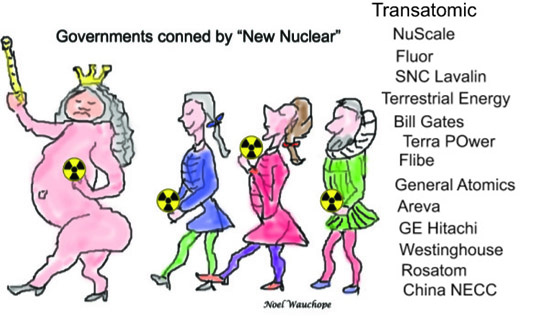
Instead of admitting nukes cannot compete with renewable energy, the atomic industrial complex is now proposing dozens of new designs that it claims on paper will compete in timeliness to successfully impact the growing climate crisis, including atomic reactors utilizing thorium and molten salt and new designs like Small Modular Reactors (SMRs), Micro-reactors, Traveling Wave, etc. Once again, the atomic power industry, which is the handmaiden to the nuclear weapons manufacturers, is sending lobbyists to convince your Congressional representatives that the atomic future will be different than the past. Lobbyists now claim that society will be so much better off when taxpayer funds bail out the aged, dangerous, and non-performing nukes and if the atomic power and weapons lobbies are given even more research subsidies.

Since the early 1960s there have been 250 applications to the Nuclear Regulatory Commission (NRC) and its precursor the Atomic Energy Commission (AEC) to generate electricity for profit using atomic power reactors. None of these 250 proposed atomic reactors  have been built on time or within budget. You did not misread; truly, every single proposed nuke went millions and then billions of dollars over budget and have started generating electricity years later if at all.

If a baseball player was at bat 250 times and struck out 250 times, would he still be playing baseball? Yet, the atomic lobbyists marketing nuclear power want us to pay them for more chances to use our money and strike out one more time.

Renewables, storage and conservation already have a well-proven track-record of lower costs, more jobs, and environmental compatibility than any of these newly imagined nukes will ever have – I say newly imagined because I have spent my career life as a nuclear engineer. When I first began my career, I drank the Kool-Aid and believed that nuclear power reactors were the solution to the world’s energy shortages and that atomic power created from the same technology as the atomic bomb was as safe as the nuke power industry claimed. As the 5 commercial meltdowns during the last 40-years have proved, especially the 3 major meltdowns that included explosions at Fukushima, nuclear power is simply not a safe method of generating electricity. The impact of the devastation from three simultaneous meltdowns at Fukushima Daiichi to the social culture, environmental legacy, personal health, and financial welfare of Japan in 2011 is not a legacy that should be passed onto future generations.

Why then is the US Congress, including AOC – one of the brightest members of this new Congress and the creator of the Green New Deal (#GND) – “leaving the door open” for the  same old atomic power marketing ploys? For more than 80-years, we have witnessed the economic failure, ratepayer bailouts, subsidized atomic meltdown insurance, and actual catastrophic meltdowns.

When will they ever learn?

June 17, 2019 Posted by Christina Macpherson | election USA 2020, politics | 1 Comment

Nuclear power is far from “emissions free”

Nuclear energy not emissions-free, too lethal https://www.toledoblade.com/opinion/letters-to-the-editor/2019/06/15/nuclear-energy-not-emissions-free-dangerous/stories/20   Nuclear power is not a panacea for climate change and doesn’t deserve bailouts like House Bill 6. It is a catastrophically dangerous, dirty, expensive, deteriorating technology that is not “clean”, “indispensable”, “carbon-free”, or “renewable.”

Gregory Jazcko, former Nuclear Regulatory Commission chairman, warned, “I oversaw the U.S. nuclear power industry. Now I think it should be banned. The danger from climate change no longer outweighs the risks of nuclear accidents.”

Perry and Davis Besse cost a whopping $8.7 billion to build and billions more in maintenance, repairs, and subsidies. Grid operator PJM has determined that closing Perry and Davis-Besse would not destabilize the grid.

The nuclear power life cycle produces copious carbon and other greenhouse gases from uranium mining, milling, refining, conversion, and enrichment; fuel fabrication; transportation; reactor construction, maintenance, decommissioning; and radioactive waste management.

While nuclear generated electricity is low in carbon, it has never been zero emissions. Reactors emit methane, a greenhouse gas, and radioactive Carbon-14, with a 5,700-year half-life. The scientific and medical communities have determined that there is no safe dose of radiation exposure.

Ingested or inhaled radioactive strontium-90 and cesium-137 replace calcium and potassium respectively, irradiating bones and muscles for decades. Carcinogenic radioactive iodine-131 is absorbed by the thyroid which is why potassium iodide is provided to residents near reactors. Cobalt-60 is a liver, kidney, and bone carcinogen. Specks of inhaled plutonium-239, with a half-life of 24,000 years, can cause lung cancer. Miles of buried, inaccessible, deteriorating pipes have leaked tritium, which is radioactive hydrogen; no technology can remove it from contaminated water.

Over 32 years, disasters occurred at Three Mile Island, Chernobyl, and Fukushima. The U.S. has 23 Fukushima-type reactors at 16 sites. The NRC and other researchers postulate a 50 percent chance of another catastrophic accident in approximately the next 20 years.

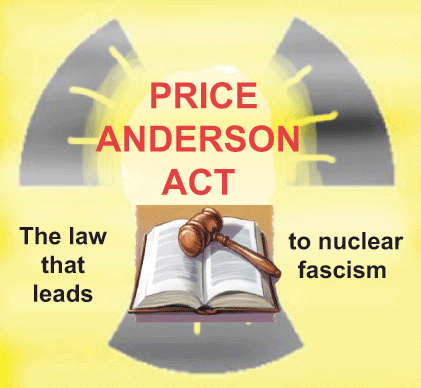
To limit utility liability, Congress passed the 1957 Price Anderson Act which caps accident compensation at $12.6 billion; a 1982 NRC study calculated a severe accident could cause 50,000 fatalities and $314 billion in property damage which is $720 billion today.

A 1,000-megawatt reactor contains as much long-lived radiation as 1,000 Hiroshima-sized bombs from which humans and the environment must be protected forever, but the NRC admits that no engineered structure can last the time required to isolate these wastes and that leakage will occur.

Early warnings to resolve radioactive waste before licensing new reactors were ignored. There are 88,000 tons of irradiated fuel “temporarily” stored in problematic pools and casks at 75 environmentally unsuitable reactor sites in 33 states because no permanent repository exists.

In 2012, Ohio was 13th in the U.S. for wind capacity and investment; this virtually ceased due to a 2014 law which mandated the country’s most restrictive wind turbine setbacks and severely impeded Ohio’s 2008 renewable energy and efficiency standards. HB 6 will finish the job.

Even conservative voters prefer solar, wind, and efficiency and oppose fees to keep old nuclear plants operating. Conservative groups testified against HB 6, as corporate welfare and a glorified slush fund.

Ohio needs to strengthen renewable energy and efficiency standards, stop throwing good money after bad, close Perry and Davis Besse as scheduled, and retrain workers in renewable energy jobs.

The writer is past chairman, Ohio Sierra Club Nuclear-Free Committee, of Willoughby Hills, Ohio.

June 17, 2019 Posted by Christina Macpherson | climate change, USA | Leave a comment

U.S. Rep. Tulsi Gabbard from Hawaii wants the U.S, government to provide unclassified report on Runit nuclear waste dome

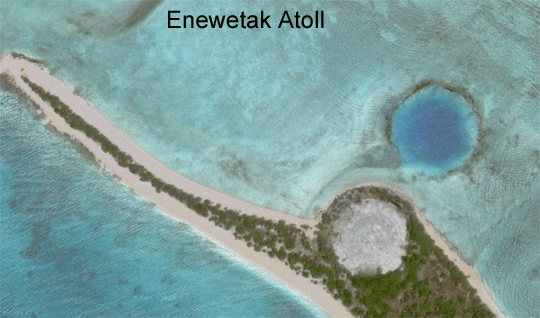
Gabbard Seeks Report On Pacific Nuclear Waste Dome, Runit Dome in the Marshall Islands is reportedly leaking nuclear waste. https://www.civilbeat.org/beat/gabbard-seeks-report-on-pacific-nuclear-waste-dome/    By Anita Hofschneider  16 June 19, U.S. Rep. Tulsi Gabbard from Hawaii wants the federal government to provide more information on a dome holding radioactive nuclear waste leftover from U.S. nuclear testing in the Marshall Islands.Gabbard proposed an amendment that has been added to the 2020 National Defense Authorization Act, according to a press release from her office.

It would “require the Department of Energy, the Environmental Protection Agency, and the Department of Defense to provide an unclassified public report on the current state of the Runit Dome nuclear waste facility,” the press release said.

The dome was created to hold 111,000 cubic yards of nuclear waste and was supposed to be a temporary structure, the Guardian reported in 2015. Leaders of the Republic of the Marshall Islands have expressed concerns about leaks.

If Gabbard’s amendment becomes law, the report would describe the condition of the dome and its potential environmental and public health impacts.

“The U.S. government is responsible for this storage site and must ensure the protection of the people and our environment from the toxic waste stored there,” Gabbard said in the press release.

June 17, 2019 Posted by Christina Macpherson | environment, OCEANIA, USA, wastes | Leave a comment

Nevada Gov. Steve Sisolak restates opposition to Yucca Mountain restart plan

Nevada Gov. Steve Sisolak restates opposition to Yucca Mountain restart plan   https://www.nevadaappeal.com/news/government/nevada-gov-steve-sisolak-restates-opposition-to-yucca-mountain-restart-plan/# June 12, 2019   Geoff Dornan   gdornan@nevadaappeal.com   In a sharply worded letter to the chairman and ranking member of the House Energy and Commerce Committee, Gov. Steve Sisolak has again stated his and Nevada’s complete opposition to any plans to restart the licensing of Yucca Mountain.

“My position and that of the state of Nevada remains identical to the position of Nevada’s past five governments,” the letter says. “I am totally opposed to any legislative effort to restart the Yucca Mountain project.”

He said this latest piece of legislation, “would seriously weaken Nevada’s current due process rights to challenge documented safety concerns and adverse environmental impacts in the legally-mandated licensing proceeding.”

The result, he said, will be to waste billions of additional ratepayer and taxpayer dollars in an attempt to, “force an unsafe site on an unwilling state.”

“The proposed legislation only exacerbates the erosion of trust and confidence caused by the federal government’s recent secret shipments of weapons-grade plutonium into our state,” Sisolak wrote.

He said he intends to keep his promise to Nevadans not one ounce of nuclear waste will be delivered to Yucca Mountain while he’s governor.

The letter was sent to committee Chairman Frank Pallone, D-New Jersey, and Ranking member Greg Walden, R-

In written testimony prepared for that hearing, Bob Halstead, director of Nevada’s Agency for Nuclear Projects, reiterated Nevada’s long standing conclusion Yucca Mountain is unsuitable because of its geology and hydrology, its proximity to military aircraft training and testing (Nellis Air Force Base) and its distance from existing railroads.

“The proposed repository emplacement drifts would be located in fractured rock above the water table and would inevitably leak dangerous radionuclides into the groundwater where they would be transported to an aquifer,” Halstead wrote.

He said that aquifer provides water for drinking, agriculture, food processing and Native American religious ceremonies.

Halstead also charged the proposed legislation, “fails to honestly address the cost of Yucca Mountain.” He said Nevada’s estimate for future costs of the dump are “at least $100 billion in 2019 dollars.”

June 17, 2019 Posted by Christina Macpherson | politics, USA, wastes | Leave a comment

In USA Catholic priests, some in gaol, some facing gaol – for dramatic opposition to nuclear weapons

Why we brought hammers to a nuclear fight,  https://www.newsobserver.com/opinion/article231300873.html, BY PATRICK O’NEILL,  JUNE 16, 2019,  On April 4, 2018, the 50th anniversary of the Rev. Martin Luther King’s assassination, I joined six other Catholic pacifists in an attempt to symbolically enflesh the prophet Isaiah’s command to “beat swords into plowshares” (Is. 2:4).

After cutting a lock, we entered Naval Station Kings Bay in St. Marys, GA with hammers, baby bottles of blood and crime scene tape to expose the horrific D-5 nuclear weapons aboard the Trident submarines that imperil life as we know it on Planet Earth.

Kings Bay is home port to six Trident submarines. Each Trident can carry 24 D-5 missiles, each of which can carry up to eight 100-kiloton nuclear warheads. Trident is the most insidious and evil weapon of mass destruction ever constructed.

Once inside Kings Bay, in an attempt to smash an idol, I hammered and poured blood on a cement statue of a D-5 at a missile shrine display. The government charged the seven of us with three felonies (depredation of government property, destruction of government property, conspiracy) and misdemeanor trespass.

Three of our group — Fr. Steve Kelly, S.J., Elizabeth McAlister (widow of the late Catholic anti-war prophet, Philip Berrigan), and Catholic Worker Mark Colville, remain incarcerated in the Glynn County Jail in Brunswick, GA. McAlister turned 79 and Kelly turned 70 while incarcerated.

The others, Martha Hennessy (granddaughter of Catholic Worker Movement founder, Dorothy Day), Clare Grady, Carmen Trotta, and I, have been out under a cash bond and on house arrest with a curfew and electronic ankle monitors for more than a year. Kelly, McAlister and Colville refused the bond conditions.

For more than a year the case has been tied up in pretrial motions. We are expecting to go to trial this summer. If convicted, the seven of us will likely go to prison.

Efficacy was not my motivation for joining this group. My faith led me to address the sinfulness of nuclear weapons. We live in a world where nuclear weapons on perpetual hair-trigger alert have become “normal.”

We used high drama as a wake-up call to hopefully get people thinking about the fate of the earth and human survival. Never before has our world been more at risk of the prospect of nuclear war. The Doomsday Clock, maintained by The Bulletin of the Atomic Scientists, stands at two minutes to midnight.

President Donald Trump frequently engages in chest-thumping, and he bragged that he has the “biggest button,” a reference to nuclear weapons. Trump alone, under the vested power of the executive branch, can decide to use nuclear weapons under any circumstances.

Trump backs nuclear weapons expansion, and he has vowed to pull the U.S. out of the 1987 Intermediate-range Nuclear Forces (INF) treaty that was signed by Ronald Reagan and Mikhail Gorbachev. INF led to nearly 2,700 short- and medium-range missiles being eliminated, and an end to a dangerous standoff between U.S. and Soviet nukes in Europe. In addition, in July, 2017, an overwhelming majority of the world’s nations — but not the United States — voted to adopt the Treaty on the Prohibition of Nuclear Weapons — a landmark international agreement that establishes a pathway to nuclear disarmament.

The seven Kings Bay defendants are parents of 20 children. We want to assure a nuclear-free world for the generations to come. Humans must turn away from war-making, and find ways to embrace nonviolent solutions to international conflicts. I don’t relish a prison sentence, but I consider it a small price to pay if we peacemakers can help prevent the use of nuclear weapons.

We should take to heart the warning of Dr. King: “The choice today is no longer between violence and nonviolence. It is either nonviolence or nonexistence.”

(Patrick O’Neill and his wife, Mary Rider, cofounded the Fr. Charlie Mulholland Catholic Worker House in Garner, an intentional community that provides hospitality to women and children in crisis.)

June 17, 2019 Posted by Christina Macpherson | opposition to nuclear, USA | Leave a comment

U.S. military intelligence agency increases accusations against Russia about nuclear testing

U.S. military intelligence steps up accusation against Russia over nuclear testing, WP,    By Paul Sonne,  14 June 19 The U.S. military intelligence agency stepped up its accusations against Russia over low-yield nuclear testing on Thursday, saying that the country has conducted nuclear weapons tests that resulted in nuclear yield.

The new statement from the Defense Intelligence Agency amounted to a more direct accusation against Russia, compared to hedged comments about Russian nuclear testing that DIA Director Lt. Gen. Robert P. Ashley Jr. made in a speech in Washington in late May.

“The U.S. Government, including the Intelligence Community, has assessed that Russia has conducted nuclear weapons tests that have created nuclear yield,” the DIA statement released Thursday said. The agency didn’t give any details about the alleged tests or release any evidence backing the accusation.

Previously, the agency’s director said that Russia “probably” was not adhering to the “zero-yield” standard the United States applies for nuclear testing. He suggested that Russia was probably conducting tests with explosions above a subcritical yield as part of its development of a suite of more-sophisticated nuclear weapons.

Russia has vehemently rejected Washington’s accusations, with Russian Foreign Minister Sergei Lavrov describing them as delusional.

“We consider claims that Russia may be conducting very low-yield nuclear tests as a crude provocation,” Russia’s Foreign Ministry said in a statement after the DIA first aired the allegations. “This accusation is absolutely groundless and is no more than another attempt to smear Russia’s image.”

DIA’s latest accusation came a day after Under Secretary of State for Arms Control and International Security Andrea L. Thompson met with Russian Deputy Foreign Minister Sergei Ryabkov in Prague to discuss arms control.

The meeting didn’t result in any significant decisions. After the meeting, Thompson said in a message on Twitter that she raised a range of issues on which the United States would like to engage in a more constructive dialogue with Russia. …… https://www.washingtonpost.com/world/national-security/us-military-intelligence-steps-up-accusation-against-russia-over-nuclear-testing/2019/06/13/2dadf2e2-8e26-11e9-b162-8f6f41ec3c04_story.html?utm_term=.9b2400d2dfbe

June 15, 2019 Posted by Christina Macpherson | politics international, Russia, USA, weapons and war | Leave a comment

The continuing and ever-increasing costs of America’s nuclear wastes

Americans Are Paying More Than Ever to Store Deadly Nuclear Waste as Plants Shut Down  https://www.bloomberg.com/news/articles/2019-06-14/u-s-bill-to-store-nuke-waste-poised-to-balloon-to-35-5-billion, By Will Wade June 14, 2019, The Maine Yankee nuclear power plant hasn’t produced a single watt of energy in more than two decades, but it cost U.S. taxpayers about $35 million this year.Almost 40 years after Congress decided the U.S., and not private companies, would be responsible for storing radioactive waste, the cost of that effort has grown to $7.5 billion, and it’s about to get even pricier.

With no place of its own to keep the waste, the government now says it expects to pay $35.5 billion to private companies as more and more nuclear plants close down, unable to compete with cheaper natural gas and renewables. Storing spent fuel at an operating plant with staff and technology on hand can cost $300,000 a year. The price tag for a closed facility: More than $8 million, according to the Nuclear Energy Institute.

The U.S. Energy Department “has been clinging to unrealistic expectations,” said Rodney McCulllum, senior director for decommissioning and used fuel at the institute, an industry trade group. “The industry was never supposed to have this problem.”

Higher and Higher

DOE’s estimates of its nuclear-waste storage liabilities increase every year

The issue has been long-discussed. Initially, the plan was to store the radioactive waste deep underground at Yucca Mountain in Nevada, starting in 1998. But the project faced strong opposition from environmental groups, state residents and Democratic Senator Harry Reid of Nevada, who served as the U.S. Senate majority leader.

After years of legal challenges, President Barack Obama cut funding for the project in 2009. Since then, there have been few realistic alternatives. Lawmakers in Washington held a hearing Thursday to evaluate bills aimed at how best to handle the waste.

In the meantime, the U.S. has no permanent place of its own to store radioactive material that will remain deadly for several thousand years.

About 80,000 metric tons of nuclear waste have been stored at 72 private locations across the U.S., or enough to cover a football field to a depth of 20 meters (66 feet), according to the Government Accountability Office. While most are at operating plants, incorporated into the plant’s daily activities, 17 are at closed facilities, with seven at sites — including Maine — where the plant itself has been demolished.

In those cases, only the storage casks remain, and keeping them monitored and protected as they get older can be an expensive operation.

After a legal battle with the U.S., the Maine Yankee plant and two sister facilities in Connecticut and Massachusetts — responsible for 123 casks of nuclear waste — were awarded $103 million from a U.S. Treasury Department fund in February, covering their expenses from 2013 through 2016.

“We only remain in business because the federal government has not met its obligation to remove the fuel,” said Eric Howes, director of public and government affairs at Maine Yankee. “Our only purpose is to store the fuel.”

Meanwhile, the growing number of shuttered plants, along with the aging of existing facilities, means these costs are about to surge. Once a storage site hits the 20-year mark it has to be relicensed. Older ones require more thorough inspections and additional paperwork, including submitting a so-called aging management plan.

About 30 of these licenses have been renewed, and that figure will more than double by the end of next year, according to the NEI. Some sites have more than one license.

“As we shut down more plants, the costs of used-fuel storage is going to go up,” McCulllum said by telephone.

A Shrinking Fleet

U.S. nuclear reactors are losing ground

Most of the waste involves spent fuel rods, and some sites include casks with radioactive components from reactors that have been torn down. Even though the government is legally responsible for storage expenses, it doesn’t make it easy for companies to recover the costs. The Yankee companies have had to file four lawsuits over the years, and the Energy Department sometimes pushes back.

In the most recent case, the agency challenged about $1 million in legal fees and administrative costs that it successfully argued weren’t related to fuel-storage expenses.

“They’ve contested every step of the way,” Howes, the Yankee spokesman, said.

June 15, 2019 Posted by Christina Macpherson | USA, wastes | Leave a comment

Oyster Creek Nuclear Station’s nuclear waste, and opposition to the Holtec plan

What about the nuclear waste left behind at Oyster Creek?   https://www.app.com/story/opinion/columnists/2019/06/14/nuclear-waste-oyster-creek-yucca-mountain-holtec/1454375001/

Janet Tauro  June 14, 2019 After decades of warning that the continued operation of the nation’s nuclear plants would leave behind mountains of atomic waste that would remain highly radioactive for tens of thousands of years, the day of reckoning has arrived.

As older nuclear plants around the country close for economic and age-related reasons, we are moving away from the age of nuclear generation to the age of handling and storing nuclear waste.

Private companies are emerging, like Camden-based Holtec International, which apparently view dinosaur nuclear plants and atomic waste as a good business opportunity. They are buying shuttered nuclear reactors, and the purchase includes hefty decommissioning funds.

The Oyster Creek Nuclear Generating Station in Lacey is one of those dinosaurs whose day is done, but its toxic legacy of over 1.2 million pounds of highly radioactive waste lives on.

Its decommissioning fund, generated through surcharges on ratepayer bills, contains about $980 million.  The fund would be transferred from Exelon Corp. to Holtec International if the pending sale is approved by federal officials.

Congress has taken notice. Bills are pending for transportation of nuke waste to consolidated interim storage (CIS) facilities. Discussions also have been revived about a central repository at Yucca Mountain. One proposed CIS facility would be owned and operated by Holtec in New Mexico. Holtec’s board of directors includes former Republican Congressman James Saxton and South Jersey Democratic party leader George Norcross III. The other CIS is in Texas.

New Mexico Gov. Michelle Lujan Grisham reportedly opposes the proposed Holtec project.

Holtec has put together a complex, layered limited liability corporate structure to take it through the Oyster Creek decommissioning, which would happen on an accelerated time frame. The speedy timetable seems attractive for redevelopment of the site. But, is haste safe? Will safety corners be cut to get the job done quickly? With limited liability in place, who will take care of emergency response and planning if there is a mishap? Who will be financially responsible?

Holtec has proposed removing the radioactive waste from the elevated fuel pool within three and a half years rather than the usual five, packing it into concrete casks, and eventually shipping it offsite to the company’s proposed storage facility thousands of miles away.

Holtec has been cited by the Nuclear Regulatory Commission for safety problems at the San Onofre nuclear plant in California. In New Jersey, a state task force is reportedly investigating economic development awards to the company. It might be prudent for the NRC to delay a license transfer until any investigation and cask safety considerations are fully vetted and completed.

A permanent solution to nuclear waste storage has never been found and is unlikely to occur in the near future. We are left with choosing a least=bad option, which could be hardened on-site storage to higher ground, away from rising seas and worsening storm surges until a permanent repository is established. Moving the waste by truck, barge and rail thousands of miles out west to a temporary facility from which it would have to be moved again doubles the risk of a catastrophic accident.

On-site storage includes a berm around storage casks, concealing them from possible terrorist attack, which makes sense and increases public safety. The current plan at Oyster Creek calls for about 30 casks to be lined up like bowling pins near Route 9.

Maximizing safety must be a congressional focus, particularly since the NRC has allowed Exelon, or any future owner of Oyster Creek, to discontinue emergency planning around the plant once the fuel pool is emptied. Exelon tested its warning sirens for the last time only two weeks ago.

Local, state, and federal representatives should determine whether the emergency planning reductions include disbanding the plant’s fire brigade, leaving a nuclear fire to local volunteer fire departments unequipped and untrained to handle such a catastrophe. If that’s the case, Lacey’s elected representatives should use every ounce of their authority and power to reverse it.

Congress should also scrutinize whether it is a national security risk for any private company to be in possession of vast quantities of nuclear materials, rather than the federal government.

The unadulterated, unfortunate truth is that a permanent solution for storage of deadly, highly radioactive nuclear waste does not exist. It never did during the past half century it was being produced and generating corporate profits.

Janet Tauro is New Jersey board chair for Clean Water Action.

June 15, 2019 Posted by Christina Macpherson | politics, USA, wastes | Leave a comment

Multibillion dollar plutonium pit factory – jobs, jobs – yeah – but is it safe, or even necessary?

Atomic bomb factory could produce more than 1,000 jobs for SC. But how safe is it?   https://www.charlotteobserver.com/news/state/south-carolina/article231568153.html, BY SAMMY FRETWELL. JUNE 14, 2019     Anti-nuclear activists fired away Friday at what they said is a dangerous and little known plan to produce deadly atomic weapons components at the Savannah River Site near Aiken.

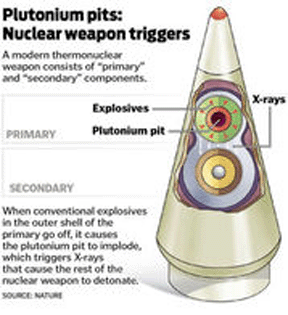
The federal government has proposed a multibillion dollar plutonium pit factory that could create as many as 1,700 jobs as part of an effort to make fresh plutonium, a major ingredient in atomic bombs.

But the proposed factory is raising concerns about its risk to the environment and the public, in addition to how it would be viewed by world leaders. Critics say the government may use the pits in a new type of nuclear weapon, instead of only replenishing the existing stockpile with fresh plutonium.

Savannah River Site Watch, a nuclear watchdog organization that tracks SRS, planned a public meeting Friday night in Aiken County to brief people on the government’s plan at SRS, a 310-square-mile complex in western South Carolina.

“We don’t think people are really aware of what is going on: that this new mission is fraught with risk that could come to SRS,’’ Savannah River Site Watch director Tom Clements told The State.

Nuclear watchdog groups from New Mexico and California joined SRS Watch for the forum in Aiken County, where many SRS workers live. Before the Friday meeting, the groups held a news conference to voice concerns. The U.S. Department of Energy plans its own forum on the proposal June 27 in North Augusta.

The Energy Department is proposing to convert its failed and unfinished mixed oxide fuel plant at SRS for use as a plutonium pit plant. The cost to convert the plant could be up to $5 billion, nuclear watchdogs said.

Federal records show the new SRS plant would produce at least 50 pits for nuclear weapons each year. A federal site in Los Alamos, N.M., would produce another 30 pits, according to the government’s plan. Part of the reason for needing more pits is to refresh the nation’s aging stockpile of atomic weapons, federal officials have said.

Officials with the U.S. Department of Energy were not immediately available Friday for comment, but a public notice this week said the pits it wants to replace were made from 1978-89. Most plutonium cores were produced at the Rocky Flats, Colo., nuclear site decades ago, but that site has since closed.

“Today, the United States’ capability to produce plutonium pits is limited,’’ according to a DOE public notice. The notice said producing 80 pits per year, beginning in 2030, would “mitigate the risk of plutonium aging.’’

“The security policies of the United States require the maintenance of a safe, secure and reliable nuclear weapons stockpile,’’ the public notice said.

Pro-nuclear groups say the pit plant is a good replacement for the MOX facility. Not only will it provide jobs, but it will help keep the United States safe, they say.

“We are 100 percent supportive,’’ said Jim Marra, director of Citizens for Nuclear Technology Awareness. ‘’From a national defense standpoint, it is vitally important. Quite frankly, there’s no better place to do it, at least part of it, than Savannah River Site. The expertise in dealing with plutonium, and the existing work now going on with plutonium, is huge.’’

Clements and Jay Coghlan, who directs Nuclear Watch New Mexico, don’t see it that way.

“It will be a great waste of taxpayer’s money,’’ Coghlan said. “There also is a long history of chronic safety problems and environmental or waste problems associated with pit production.’’

Clements said plutonium, one of the most dangerous parts of a nuclear weapon, is toxic and a potential threat to the environment. Workers would be exposed to plutonium at SRS, and the public could be exposed to plutonium if an accident occurs, he said.

SRS was a vital cog in Cold War weapons production. Built in the early 1950s, it produced materials, such as tritium, that were used for nuclear weapons. It has been largely in a cleanup mode and looking for new missions since the early 1990s. More than 10,000 people work there.

One of the biggest questions raised by pit project critics is whether the pits are needed as badly as the DOE contends.

Existing plutonium pits, essentially the cores of nuclear bombs, have a longer shelf life than the government has recently said they have, said Marylia Kelley, executive director of Tri-Valley CARES in California. She said past government studies have shown that. One study shows that plutonium pits can last 85- 100 years, about 25-40 years longer than previously thought.

But the government today is working on a new type of nuclear weapon the pits could be used in — and nuclear proliferation is a bad idea, critics say.

“If you don’t design new nuclear weapons, you will need to do very few pits every year,’’ Kelley said. “This enterprise is not necessary, and I would argue that we need a very robust discussion here.’’

She said if the U.S. develops a new weapon and tests it, other countries may do the same, potentially leading to an escalation of nuclear arms.

Marra said he’s not opposed to plutonium pits being used for new weapons.

“’If that includes new weapons systems, I think that’s the right thing to do,’’ he said. “Our adversaries are not standing still in this regard. China and Russia are continuing to modernize their nuclear weapons, and we all know about North Korea.’’

Plans to develop the plutonium pit factory are not final. A bill in the U.S. House of Representatives, discussed recently in a key committee, would derail the plan.

The Department of Energy plans to conduct an environmental impact statement on how the plant would affect the environment and human health. The current proposal isn’t the first time the DOE has brought up the matter of a new pit plant. The agency proposed a pit factory more than 17 years ago, but the plan never went anywhere.

Reach Fretwell at 803-771-8537. @sfretwell83
June 15, 2019 Posted by Christina Macpherson | USA, weapons and war | Leave a comment

Shelby Surdyk, Alaska’s nuclear disarmament youth campaigner

From NYC to Sitka, this Alaskan is taking on nuclear disarmament https://www.ktoo.org/2019/06/13/alaskans-chip-away-at-nuclear-disarmament/  

By Sheli DeLaney, KRNN,  June 13, 2019   On Wednesday’s Juneau Afternoon, the Treaty on the Non-Proliferation of Nuclear Weaponswas a topic of discussion as host Sheli DeLaney sat down with nuclear disarmament advocate Shelby Surdyk.Nuclear disarmament became Surdyk’s cause when she was in high school in Skagway and met a new teacher who had previously taught at the U.S. military base on Kwajalein Island in the Marshall Islands. The central Pacific Ocean nation was the site of U.S. nuclear testing between 1946 and 1958.

The teacher educated students about the history and impact that nuclear weapons testing had on the Marshallese people, and their story left a lasting impression on Surdyk.

“I think that once you become connected to people whose lives have been touched by nuclear weapons testing, it’s a path you can’t turn back from,” she said.

Today, Surdyk is the project manager for HOPE: Alaska’s Youth Congress for the Global Elimination of Nuclear Weapons, a five-day conference for high school students to be held in Sitka in April 2020. The idea for the youth congress was introduced by Veterans for Peace, an organization that opposes the proliferation of nuclear weapons as part of their philosophy.

Surdyk recently attended the 2019 NPT PrepCom, a conference held at the United Nations headquarters in New York City this spring. She will be speaking about her experience over a brown-bag lunch hosted by Veterans for Peace this Friday at noon at the Juneau Arts and Culture Center.

June 15, 2019 Posted by Christina Macpherson | opposition to nuclear, PERSONAL STORIES, USA | Leave a comment

« Previous Entries     Next Entries »

1 This Month

26 September – International Day for the Total Elimination of Nuclear Weapons

PLEASE OPPOSE HR 8255 AND S.3639 – bills would accelerate satellite deployment, with no environmental review or safeguards – https://ncstd5li.quorum.us/campaign/169331/

​To see nuclear-related stories in greater depth and intensity – go to https://nuclearinformation.wordpress.com

  • Categories

    • 1
      • Arclight's Vision
    • 1 NUCLEAR ISSUES
      • business and costs
        • employment
        • marketing
      • climate change
      • culture and arts
      • ENERGY
        • renewable
          • decentralised
          • energy storage
      • environment
        • oceans
        • water
      • health
        • children
        • psychology – mental health
        • radiation
        • social effects
        • women
      • history
      • indigenous issues
      • Legal
        • deaths by radiation
        • legal
      • marketing of nuclear
      • media
        • investigative journalism
        • Wikileaks
      • opposition to nuclear
      • PERSONAL STORIES
      • politics
        • psychology and culture
          • Trump – personality
        • public opinion
        • USA election 2024
        • USA elections 2016
      • politics international
      • Religion and ethics
      • safety
        • incidents
      • secrets,lies and civil liberties
        • civil liberties
      • spinbuster
        • Education
      • technology
        • reprocessing
        • Small Modular Nuclear Reactors
        • space travel
      • Uranium
      • wastes
        • – plutonium
        • decommission reactor
      • weapons and war
        • Atrocities
        • depleted uranium
      • Women
    • 2 WORLD
      • ANTARCTICA
      • ARCTIC
      • ASIA
        • Burma
        • China
        • India
        • Indonesia
        • Japan
          • – Fukushima 2011
          • Fukushima 2012
          • Fukushima 2013
          • Fukushima 2014
          • Fukushima 2015
          • Fukushima 2016
          • Fukushima continuing
        • Malaysia
        • Mongolia
        • North Korea
        • Pakistan
        • South Korea
        • Taiwan
        • Turkey
        • Vietnam
      • EUROPE
        • Belarus
        • Bulgaria
        • Denmark
        • Finland
        • France
        • Germany
        • Greece
        • Ireland
        • Italy
        • Kazakhstan
        • Kyrgyzstan
        • Russia
        • Spain
        • Sweden
        • Switzerland
        • UK
        • Ukraine
      • MIDDLE EAST
        • Afghanistan
        • Egypt
        • Gaza
        • Iran
        • Iraq
        • Israel
        • Jordan
        • Libya
        • Saudi Arabia
        • Syria
        • Turkey
        • United Arab Emirates
      • NORTH AMERICA
        • Canada
        • USA
          • election USA 2020
      • OCEANIA
        • New Zealand
        • Philippines
      • SOUTH AMERICA
        • Brazil
    • ACTION
    • AFRICA
      • Kenya
      • Malawi
      • Mali
      • Namibia
      • Niger
      • Nigeria
      • Somalia
      • South Africa
    • Atrocities
    • AUSTRALIA
    • Christina's notes
    • Christina's themes
    • culture and arts
    • Events
    • Fuk 2022
    • Fuk 2023
    • Fukushima 2017
    • Fukushima 2018
    • fukushima 2019
    • Fukushima 2020
    • Fukushima 2021
    • general
    • global warming
    • Humour (God we need it)
    • Nuclear
    • RARE EARTHS
      • thorium
    • Reference
      • Reference archives
    • resources – print
    • Resources -audiovicual
    • Weekly Newsletter
    • World
    • World Nuclear
    • YouTube
  • Pages

    • 1 This Month
    • ACTION !
    • Disclaimer
    • Links
    • PAGES on NUCLEAR ISSUES
      • audio-visual news
      • Anti Nuclear, Clean Energy Movement
        • Anti Nuclear movement – a success story
          • – 2013 – the struggle for a nuclear-free, liveable world
          • – 2013: the battle to expose nuclear lies about ionising radiation
            • Speakers at Fukushima Symposium March 2013
            • Symposium 2013 Ian Fairlie
      • Civil Liberties
        • – Civil liberties – China and USA
      • Climate change
      • Climate Change
      • Economics
        • – Employment
        • – Marketing nuclear power
        • – Marketing Nuclear Power Internationally
        • nuclear ‘renaissance’?
        • Nuclear energy – the sick man of the corporate world
      • Energy
        • – Solar energy
      • Environment
        • – Nuclear Power and the Tragedy of the Commons
        • – Water
      • Health
        • Birth Defects in the Chernobyl Radiation Affected Region.
      • History
        • Nuclear History – the forgotten disasters
      • Indigenous issues
      • Ionising radiation
        • – Ionising radiation – medical
        • Fukushima FACT SHEET
      • Media
        • Nuclear Power and Media 2012
      • Nuclear Power and the Consumer Society – theme for December 2012
      • Peace and nuclear disarmament
        • Peace on a Nuclear Free Earth
      • Politics
        • – Politics USA
      • Public opinion
      • Religion and ethics
        • -Ethics of nuclear power
      • Resources – print
      • Safety
      • Secrets and lies
        • – NUCLEAR LIES – theme for January 2012
        • – Nuclear Secrets and Lies
      • Spinbuster
        • 2013 nuclear spin – all about FEAR -theme for June
        • Spinbuster 1
      • Technology
        • TECHNOLOGY Challenges
      • Wastes
        • NUCLEAR WASTES – theme for October 2012
        • – Plutonium
      • Weapons and war
      • Women
  • Archives

    • September 2026 (313)
    • August 2026 (330)
    • July 2026 (355)
    • June 2026 (287)
    • May 2026 (306)
    • April 2026 (356)
    • March 2026 (251)
    • February 2026 (267)
    • January 2026 (308)
    • December 2025 (358)
    • November 2025 (359)
    • October 2025 (375)
  • Categories

    • 1
      • Arclight's Vision
    • 1 NUCLEAR ISSUES
      • business and costs
        • employment
        • marketing
      • climate change
      • culture and arts
      • ENERGY
        • renewable
          • decentralised
          • energy storage
      • environment
        • oceans
        • water
      • health
        • children
        • psychology – mental health
        • radiation
        • social effects
        • women
      • history
      • indigenous issues
      • Legal
        • deaths by radiation
        • legal
      • marketing of nuclear
      • media
        • investigative journalism
        • Wikileaks
      • opposition to nuclear
      • PERSONAL STORIES
      • politics
        • psychology and culture
          • Trump – personality
        • public opinion
        • USA election 2024
        • USA elections 2016
      • politics international
      • Religion and ethics
      • safety
        • incidents
      • secrets,lies and civil liberties
        • civil liberties
      • spinbuster
        • Education
      • technology
        • reprocessing
        • Small Modular Nuclear Reactors
        • space travel
      • Uranium
      • wastes
        • – plutonium
        • decommission reactor
      • weapons and war
        • Atrocities
        • depleted uranium
      • Women
    • 2 WORLD
      • ANTARCTICA
      • ARCTIC
      • ASIA
        • Burma
        • China
        • India
        • Indonesia
        • Japan
          • – Fukushima 2011
          • Fukushima 2012
          • Fukushima 2013
          • Fukushima 2014
          • Fukushima 2015
          • Fukushima 2016
          • Fukushima continuing
        • Malaysia
        • Mongolia
        • North Korea
        • Pakistan
        • South Korea
        • Taiwan
        • Turkey
        • Vietnam
      • EUROPE
        • Belarus
        • Bulgaria
        • Denmark
        • Finland
        • France
        • Germany
        • Greece
        • Ireland
        • Italy
        • Kazakhstan
        • Kyrgyzstan
        • Russia
        • Spain
        • Sweden
        • Switzerland
        • UK
        • Ukraine
      • MIDDLE EAST
        • Afghanistan
        • Egypt
        • Gaza
        • Iran
        • Iraq
        • Israel
        • Jordan
        • Libya
        • Saudi Arabia
        • Syria
        • Turkey
        • United Arab Emirates
      • NORTH AMERICA
        • Canada
        • USA
          • election USA 2020
      • OCEANIA
        • New Zealand
        • Philippines
      • SOUTH AMERICA
        • Brazil
    • ACTION
    • AFRICA
      • Kenya
      • Malawi
      • Mali
      • Namibia
      • Niger
      • Nigeria
      • Somalia
      • South Africa
    • Atrocities
    • AUSTRALIA
    • Christina's notes
    • Christina's themes
    • culture and arts
    • Events
    • Fuk 2022
    • Fuk 2023
    • Fukushima 2017
    • Fukushima 2018
    • fukushima 2019
    • Fukushima 2020
    • Fukushima 2021
    • general
    • global warming
    • Humour (God we need it)
    • Nuclear
    • RARE EARTHS
      • thorium
    • Reference
      • Reference archives
    • resources – print
    • Resources -audiovicual
    • Weekly Newsletter
    • World
    • World Nuclear
    • YouTube
  • RSS

    Entries RSS
    Comments RSS

Site info

nuclear-news
Create a free website or blog at WordPress.com.
Privacy & Cookies: This site uses cookies. By continuing to use this website, you agree to their use.
To find out more, including how to control cookies, see here: Cookie Policy
  • Subscribe Subscribed
    nuclear-news
    Join 2,062 other subscribers

    Have a WordPress.com account? Log in now.

  • nuclear-news
    View site in Reader
    Manage subscriptionsSign upLog in
    Report this content
    Collapse this bar
Loading Comments...