The young are stepping up to the climate challenge – The Sunrise Movement
 Adults failed to take climate action. Meet the young activists stepping up, Some are calling climate change this generation’s civil rights movement. These are the young activists leading the charge, Guardian, by Adrian Horton, Dream McClinton and Lauren Aratani, 4 Mar 19,
Despite being barely two years old, the Sunrise Movement has outpaced established environmental groups in the push to radically reshape the political landscape around climate change. Closely allied with new congresswoman Alexandria Ocasio-Cortez, the youth-led Sunrise Movement has helped set out a sweepingly ambitious plan to address climate change in the form of the Green New Deal.
The movement comprises a small core team of young organizers, supported by a larger group of several hundred volunteers. The group’s elevation of the Green New Deal has clearly riled Trump, who has falsely but repeatedly claimed that the plan would result in the banning of cars, air travel and even cows.
The Guardian spoke to Sunrise members on how the organization has shaken the political and environmental establishment in the US…….. https://www.theguardian.com/environment/2019/mar/04/can-they-save-us-meet-the-climate-kids-fighting-to-fix-the-planet
Despite U.S. Congress’s concerns, Trump is still pushing for sale of nuclear technology to Saudi Arabia
 Team Trump Keeps Pushing Deal to Send Nuclear Tech to Saudis
Congress raised ‘grave concerns’ about the Trump administration’s past attempts to send nuclear technology to the Saudis. But Team Trump isn’t done trying. The Daily Beast, Erin Banco, Betsy Woodruff 03.04.19 The Trump administration is still actively working to make a deal to send U.S. nuclear technology to Saudi Arabia, according to two U.S. officials and two professional staffers at federal agencies with direct knowledge of those conversations. American energy businesses are still hoping to cash in on Riyadh’s push for energy diversification,
Texas-based Uranium Energy Corporation strongly lobbying Trump administration, and demonising Canadian company Uranium One
The Nuclear Energy Industry Goes MAGA to Win Over Trump
A U.S. uranium company set up shop at CPAC and started spreading Clinton scare stories. The Daily Beast, Lachlan Markay, 03.03.19 A leading U.S. uranium producer is confident that President Donald Trump is going to crack down on its foreign competitors. But in the spirit of not taking any chances, the company rented space at the annual Conservative Political Action Conference, enlisted a top Trumpworld public relations executive, and invoked a well-worn Trump attack line on his 2016 campaign opponent to try to nail down a policy win.
Bankrupt Pacific Gas and Electric wants to restart Diablo Canyon Nuclear Station,without prior inspection

 What Deadly Disaster Is the Criminal, Bankrupt PG&E So Desperately Hiding at Its Diablo Canyon Nukes, https://readersupportednews.org/opinion2/277-75/55293-rsn-what-deadly-disaster-is-the-criminal-bankrupt-pgae-so-desperately-hiding-at-its-diablo-canyon-nukes
By Harvey Wasserman, Reader Supported News, 3 Mar 19,  s the bankrupt federal felon Pacific Gas & Electric desperately hiding something very deadly at its Diablo Canyon Power Plant? Will we know by March 7, when the company wants to restart Unit One, which is currently shut for refueling? Will YOU sign our petition asking Governor Gavin Newsom and other officials to inspect that reactor before it can restart?
In 2010, PG&E blew up a neighborhood in San Bruno, killing eight people.
In 2018, it helped burn down much of northern California, killing more than eighty people. The company has now admitted its culpability in starting that infamous Camp Fire and has questioned its own ability to continue to operate.
On February 6, it incinerated five buildings in San Francisco.
The company is bankrupt. It has been convicted of numerous federal felonies. It actually has a probation officer.
But the real terror comes at its Diablo Canyon nuclear reactors, nine miles west of San Luis Obispo on the central California coast.
The reactors are embrittled. They may be cracked. As with the gas pipes in San Bruno and the power poles in northern California, PG&E’s maintenance at these huge reactors has been systematically neglected.
But the company does NOT want the public to inspect them. WHY?
Right now, Diablo Unit One is shut for refueling. Critical inspections for embrittlement, cracking and deferred maintenance could be easily and cheaply done. Public discussions could also be held on vulnerability to earthquakes, waste management, and corporate competence.
The public does not need Diablo’s power, which often overloads the grid, forcing the shutdown of cleaner, safer wind and solar capacity. Reopening a cracked reactor would turn the fuel assemblies on-site into high-level radioactive waste, converting a multi-million-dollar asset into a huge fiscal liability.
Diablo Unit One is in particular danger because it was designed in the 1960s. Its original blueprints did not account for the dozen earthquake faults since discovered nearby. Copper used in key welds is now known to be inferior. Older reactors like those at Diablo are susceptible to embrittlement and cracking, which could be catastrophic.
In 1991 the Yankee Rowe Reactor in Massachusetts was forced to shut because of embrittlement. It was younger then than Diablo One is now.
Because PG&E is in bankruptcy and on federal probation, the state has extraordinary power right now. Normally such issues are pre-empted by the feds.
But at this time the governor, state agencies, the California Public Utilities Commission, and the courts have the right to demand these inspections. Certainly the public has a legitimate expectation to be protected.
The downwind consequences of a major accident are beyond comprehension. Diablo is less than 200 miles upwind from Los Angeles. A radioactive cloud from a likely disaster would threaten the lives of millions. Damage to property and the natural ecology, including some of the world’s most productive farmland, would be essentially impossible to calculate.
US Representative Salud Carbajal (D-San Luis Obispo) has already questioned PG&E’s competence to run these two huge reactors. A number of Hollywood stars, along with State Senator Ben Allen (D-Santa Monica), San Luis Obispo Mayor Heidi Harmon, and numerous towns and party organizations, have already joined with more than a thousand grassroots activists to ask the governor to require these critical tests and to subject the findings to public scrutiny.
Given PG&E’s bankruptcy and criminal convictions, and the extreme vulnerability of reactors as old as those at Diablo Canyon, we must seriously wonder why the company would now ask to be exempt from a simple set of inspections.
To protect the health, safety, economy and ecology of our state, the governor, regulatory agencies, CPUC, and the courts must step in to demand these aged reactors be immediately subjected to painstaking public scrutiny.
There is no good reason not to do this, and no excuse for PG&E to be asking for an exemption from a simple, long-overdue inspection.
The last thing California can afford is a radioactive replay of what has happened with that pipeline explosion in San Bruno or those catastrophic fires in what’s left of the northern forests.
Next month marks the 40th anniversary of the accident at Three Mile Island, and the release of The China Syndrome, which told a terrifying tale we also do not want to see repeated.
You can sign our petition asking Governor Newsom and our public officials to step in at Diablo Canyon NOW, before it is once again too late.
No way to get rid of spent nuclear fuel (but they still keep making it anyway!)
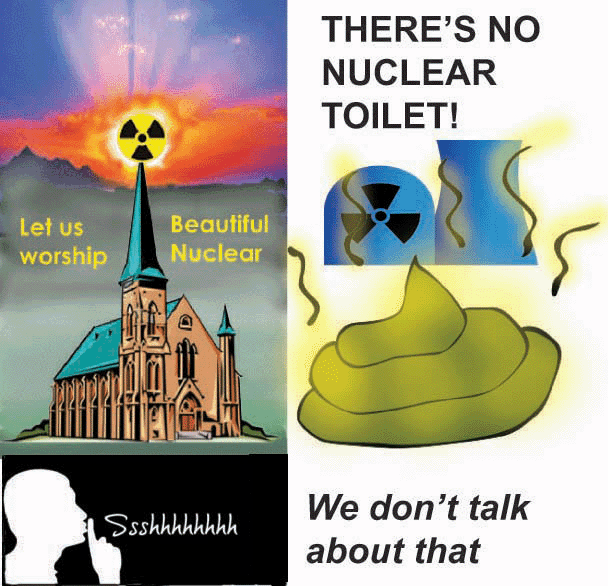
U.S. still has no place for spent nuclear fuel, so Maine Yankee’s owner gets millions
The award will help pay for the roughly $10 million per year to maintain the repository at the closed nuclear plant in Wiscasset. PressHerald, BY TUX TURKEL STAFF WRITER 3 Mar 19, For the fourth time since 1998, a federal judge has awarded the owners of three closed nuclear power plants, including Maine Yankee, millions of dollars for the federal government’s failure to remove spent nuclear fuel.
According to Connecticut Yankee Atomic Power Co., Yankee Atomic Electric Co., and Maine Yankee Atomic Power Co., the owners won a partial summary judgment last week totaling $103.2 million. Maine Yankee’s share is $34.4 million.
The award will help offset the roughly $10 million per year cost of operating an interim spent fuel storage site on plant property in Wiscasset. It will indirectly benefit ratepayers, who otherwise foot the bill. The actual financial impact hasn’t been determined, but is expected to be minimal.
In 2016, for instance, Maine Yankee was awarded about $24.6 million. Roughly $3.6 million of the total award was returned to utilities, including Central Maine Power. The balance, $21 million, went to operate the spent fuel storage site…….
Wayne Norton, president of the three companies urged Congress to authorize funding for a pilot program to remove and consolidate spent nuclear fuel and high-level waste from closed reactor sites, and to complete a review for a permanent repository at Yucca Mountain in Nevada.
Maine Yankee operated from 1972 to 1996. Although activists fought for years to close the plant, it was the company’s board that ultimately voted to pull the plug rather than fix expensive, safety-related problems.
Yankee, in Rowe, Massachusetts, closed in 1992. Connecticut Yankee shut down in 1996.
By law, the federal government is charged with coming up with a long-term solution for disposing of radioactive waste from nuclear reactors. It was supposed to begin removing waste in 1998. Facing ongoing public and political opposition, that process hasn’t happened.
Plans to build a permanent waste repository in the Nevada desert were scrapped in 2009 by President Obama. The Trump administration has sent mixed signals about whether it supports reviving Yucca Mountain.
 For the foreseeable future, highly radioactive fuel rods are being stored in 60 airtight steel canisters and housed in concrete casks in Wiscasset. Another four canisters hold radioactive steel from the decommissioning process. Maintaining them costs roughly $10 million a year, according to Maine Yankee.
The current award is for a period from 2013 to 2016, and the three companies are seeking an additional $1.2 million in costs. The federal government has 60 days to appeal the award.
Tux Turkel can be contacted at 791-6462 or at:
tturkel@pressherald.com https://www.pressherald.com/2019/02/25/judge-awards-34-million-to-offset-costs-of-storing-spent-fuel-rods-in-wiscasset/
USA and South Korea cancel big war games – in a conciliatory gesture to North Korea
 US, S. Korea officially call off annual military exercises amid nuclear talks with N. Korea, By KIM GAMEL | STARS AND STRIPES March 2, 2019
SEOUL, South Korea — The United States and South Korea canceled key war games in favor of low-profile drills, the allies said Sunday, in a major concession to North Korea days after its nuclear summit with President Donald Trump collapsed without agreement.
The springtime exercises known as Key Resolve and Foal Eagle, along with their autumn counterpart Ulchi Freedom Guardian, have long been the lynchpin of the alliance between Seoul and Washington.
The drills, which include computer simulations and live-fire bombing runs, also have been a touchstone for tensions as the North considers them a rehearsal for an invasion.
The decision to cancel Key Resolve and Foal Eagle had been widely expected after Trump reiterated his own antipathy for the drills, which he has called “very expensive” and “provocative.”
Rebranding exercises
A rebranded “combined command post exercise” will be held from Monday to March 12, according to a separate statement issued Sunday by the top U.S. and South Korean commanders on the divided peninsula.
Commanders and other military officials insisted they can maintain a strong defensive posture with scaled-back training…… https://www.stripes.com/news/pacific/us-s-korea-officially-call-off-annual-military-exercises-amid-nuclear-talks-with-n-korea-1.571119
Trump’s son-in-law, Jared Kushner, helping Saudi Crown Prince towards getting nuclear weapons?

There are too many unanswered questions about the White House’s role in advancing Saudi ambitions. By Nicholas Kristof, March 2, 2019
Jared Kushner slipped quietly into Saudi Arabia this week for a meeting with Crown Prince Mohammed bin Salman, so the question I’m trying to get the White House to answer is this: Did they discuss American help for a Saudi nuclear program?
Of all the harebrained and unscrupulous dealings of the Trump administration in the last two years, one of the most shocking is a Trump plan to sell nuclear reactors to Saudi Arabia that could be used to make nuclear weapons.
Even as President Trump is trying to denuclearize North Korea and Iran, he may be helping to nuclearize Saudi Arabia. This is abominable policy tainted by a gargantuan conflict of interest involving Kushner.
Kushner’s family real estate business had been teetering because of a disastrously overpriced acquisition he made of a particular Manhattan property called 666 Fifth Avenue, but last August a company called Brookfield Asset Management rescued the Kushners by taking a 99-year lease of the troubled property — and paying the whole sum of about $1.1 billion up front.
Alarm bells should go off: Brookfield also owns Westinghouse Electric, the nuclear services business trying to sell reactors to Saudi Arabia.
Saudi swamp, meet American swamp.
It may be conflicts like these, along with even murkier ones, that led American intelligence officials to refuse a top-secret security clearance for Kushner. The Times reported Thursday that Trump overruled them to grant Kushner the clearance.
This nuclear reactor mess began around the time of Trump’s election, when a group of retired U.S. national security officials put together a plan to enrich themselves by selling nuclear power plants to Saudi Arabia. The officials included Michael Flynn, Trump’s national security adviser, and they initially developed a “plan for 40 nuclear power plants” in Saudi Arabia, according to a report from the House Oversight and Reform Committee. The plan is now to start with just a couple of plants.
As recently as Feb. 12, Trump met in the White House with backers of the project and was supportive, Reuters reported.
These are civilian nuclear power plants, and Saudi Arabia claims it wants them for electricity. But the Saudis insist on producing their own nuclear fuel, rather than buying it more cheaply abroad. Producing fuel is a standard way for rogue countries to divert fuel for secret nuclear weapons programs, and the Saudi resistance to safeguards against proliferation bolsters suspicions that the real goal is warheads.
Trump may be vigilant (destructively so) about Iran’s nuclear plants, but in the Saudi case his response seems to be: There’s money to be made! When Israeli Prime Minister Benjamin Netanyahu raised objections to the transfer last year, Axios reported, “Trump and his advisers told Netanyahu that, if the U.S. does not sell the Saudis nuclear reactors, other countries like Russia or France will.”
Trump seems to believe that the Saudis have us over a barrel: If we don’t help them with nuclear technology, someone else will. That misunderstands the U.S.-Saudi relationship. The Saudis depend on us for their security, and the blunt truth is that we hold all the cards in this relationship, not them.
Why on earth would America put Prince Mohammed on a path to acquiring nuclear weapons? He is already arguably the most destabilizing leader in an unstable region, for he has invaded Yemen, kidnapped Lebanon’s prime minister, started a feud with Qatar, and, according to American intelligence officials, ordered the murder of the Washington Post columnist Jamal Khashoggi.
The prince has also imprisoned and brutally tortured women’s rights activists, including one who I’m hoping will win the Nobel Peace Prize, Loujain al-Hathloul. As Representative Brad Sherman, a California Democrat, has noted, “A country that can’t be trusted with a bone saw shouldn’t be trusted with nuclear weapons.”
There’s another element of Trump’s Saudi policy that is simply repulsive: the fawning courtship of a foreign prince who has created in Yemen the world’s worst humanitarian crisis, murdered a journalist and tortured women’s rights activists. The White House genuflections are such that Prince Mohammed had a point when, according to The Intercept, he bragged that he had Kushner in his “pocket.”
No one knows whether Prince Muhammed will manage to succeed his father and become the next king, for there is opposition and the Saudi economic transformation he boasts of is running into difficulties. Trump and Kushner seem to be irresponsibly trying to boost the prince’s prospects, increasing the risk that an unstable hothead will mismanage the kingdom for the next 50 years. Perhaps with nuclear weapons.
Cold War-like arms race is likely to follow the collapse of a historic nuclear treaty
Key points:
- The landmark INF treaty was integral to ending the Cold War
- Short and intermediate range missiles were banned because of the short flight time
- Analyst say it’s unlikely to be renegotiated within the six-month notice period
Last week, Russian President Vladimir Putin said Russia was ready for a Cuban Missile-style crisis if the US wanted one, referring to the 1962 standoff that brought the world to the edge of nuclear war.
Decades later, tensions between the two nations are heating up again.
Mr Putin warned that Moscow would retaliate if the US placed new missiles closer to Russia, telling local media that Moscow could deploy hypersonic missiles on ships and submarines outside US territorial waters.
The comments were made after the Trump administration announced it would officially abandon a historic nuclear pact that had kept nuclear missiles out of Europe for three decades.
Here’s a look at what the treaty is, what may come next, and why analysts believe its demise could lead to a 21st-century arms race.
The Intermediate-Range Nuclear Forces Treaty (INF) bans the US and the Russian Federation, previously the Soviet Union, from developing, testing and possessing short- and intermediate-range missiles that could be launched from the ground, as opposed to the sea or sky.
The treaty — signed by former US president Ronald Reagan and Soviet leader Mikhail Gorbachev in December 1987 — declared that “nuclear war cannot be won and must never be fought” and took seven years to negotiate.
Both sides agreed to destroy a total of 2,692 short-, medium- and intermediate-range missiles with a range between 500 and 5,500 kilometres that were stationed in, or aimed at Europe.
The treaty is credited with helping to ending the Cold War.
Maria Rublee, a former US intelligence officer and nuclear politics expert at Monash University, told the ABC these missiles were seen as a “hair trigger for nuclear war” due to how quickly they could strike a target.
“You don’t have time to talk, to pick up the phone, the red hotline, to say what’s going on and ask if this is a mistake.”
Washington and its North Atlantic Treaty Organisation (NATO) allies claim Moscow has been violating the terms of the treaty by developing missiles within the range for years, but Russia has repeatedly denied the allegations.
Earlier this month the Trump administration declared it would suspend US obligations under the treaty, with the intention of withdrawing because of Russia’s alleged non-compliance.
The day after the announcement, Russia also said it would withdraw from the treaty, and accused the US of fabricating the allegations so it could develop new missiles.
The treaty is not dead just yet — both parties must give six months notice before they can officially withdraw — but Dr Rublee said the chances of the treaty being revived were low, although there was some hope.
“[The first step] is not going to come from the Trump administration and it’s not going to come from Russia,” she said.
“It would need to come from NATO because the countries most at risk are European countries.”…….. https://www.abc.net.au/news/2019-03-03/collapse-of-treaty-could-lead-to-new-arms-race/10845950
It was easy enough to build U.S army’s nuclear stations – but difficult to get rid of them
Kerr: Army planning to demolish Fort Belvoir’s nuclear plant Inside Nova, BY DAVID KERR 3 Mar 19″……
 nuclear core was removed. …..
U.S. army wants risky small modular nuclear reactors
The Army wants mobile nuclear reactors for FOBs, but some scientists say that’s ‘naive’, Army Times The Army wants to bring back mobile nuclear reactors to power forward bases and is asking industry how to make that happen.
A collection of scientists that closely monitor nuclear issues thinks that the concept is “naive,” dangerous and describes the chances for the current technology to accomplish what the Pentagon wants as “vanishingly small.”
In January, the Pentagon’s Strategic Capabilities Office posted a request for information on the government website fbo.gov asking for information from industry on how companies might provide a less than 40-ton small mobile nuclear reactor design, capable of operating for three years or more and putting out 1 to 10 megawatts of power.
Dubbed “Project Dilithium,” a nod to the fictional dilithium crystal, a fuel source that powered warp drives in the Star Trek films and television series…….
But Edwin Lyman, acting director of the Nuclear Safety Project at the Union of Concerned Scientists, noted that the Army’s own study showed the devices would “not be expected to survive a direct kinetic attack.”
Lyman acknowledges the Army’s need to save fuel, reduce convoys and transports and minimize attacks on those elements of the force. But, he also argues that adding reactors to the battlefield could create more problems than it solves.
In a lengthy response to the program posted on the Bulletin of Atomic Scientists website, Lyman outlines the scientific, safety and policy problems with developing and deploying a small mobile nuclear reactor.
 But he closes with his analysis that the nuclear ambitions of the ground forces are part of a “patient, decade-long effort by nuclear lobbyists” aimed at gaining the interest of both the Pentagon and Congress to be “the savior small nuclear reactor vendors need: deep-pocketed and unbeholden to return-seeking investors.”
He implores defense officials to “pull the plug on this misguided effort.” ……….
The Army Nuclear Power Program, which ran from 1954 to 1977, developed eight small nuclear reactors. Those reactors ranged in power production from 1 to 10 megawatts.
How five of the eight reactors were used:
- The PM-1 reactor was used in Sundance, Wyoming, from 1962 to 1968.
- The PM-2A was used at Camp Century, Greenland, from 1961 to 1964.
- The PM-3A was used at McMurdo Base, Antarctica, from 1962 to 1972.
- The ML-1 was used in developmental testing from 1962 to 1966.
- The MH-1A Panama Canal Zone from 1965 to 1977.
Lyman notes a major failure with one of the original eight designs in 1961 when a core meltdown and explosion of the ML-1 reactor in Idaho killed three operators.
The three deployed to Antarctica, Greenland and Alaska proved “unreliable and expensive to operate,” Lyman wrote.
The idea was resurrected by the National Defense Authorization Act for FY 2014, in which Congress asked for a report on a “small modular reactor” to power forward or remote operating bases.
A Defense Science Board task force then published a detailed report in 2016 outlining the power requirements that could be met with such hardware. Last year, the Army’s deputy chief of staff, G-4, published a 148-page study on the use of mobile nuclear power plants for ground operations, adopting the recommendations of the 2016 Defense Science Board and further advocating, as the board did, that the Army manage ground nuclear reactor programs and pursue existing or near-to-maturity technologies.
Last year’s Army G-4 report outlined a dozen existing locations that officials think could have power provided by the type of mobile reactor they’re seeking:
- Thule, Greenland
- Kwajalein Atoll
- Guantanamo Bay, Cuba
- Diego Garcia
- Guam (for both a naval and Air Force facility on the island)
- Ascension Island
- Fort Buchanan, Puerto Rico
- Bagram Air Base, Afghanistan
- Camp Buehring, Kuwait
- Fort Greely, Alaska
- Lajes Field, Azores……… https://www.armytimes.com/news/your-army/2019/03/01/the-army-wants-mobile-nuclear-reactors-for-fobs-but-some-scientists-say-thats-naive/
Is it safe to keep ageing nuclear stations running until 2054?
Peach Bottom, other U.S. nuclear power plants could be running until 2054. Is it safe? The Inquirer, by Andrew Maykuth, The Peach Bottom plant, 60 miles west of Philadelphia near the Maryland border, is operating under a 20-year extension from its original 40-year license, like many of America’s aging fleet of nuclear reactors. Last year it became one of the first plants to apply for what the Nuclear Regulatory Commission calls a “Subsequent License Renewal” — that would permit the reactors to run through 2053 and 2054, when they turn 80 years old.
skeptics say that nuclear plant owners, ever alert to degradation from a harsh operating environment, will be challenged to keep geriatric power plants operating into their seventh and eighth decades. Market forces, driven by competition from inexpensive natural gas plants and renewable power, are not working in nuclear energy’s favor.
“There is this rush of license-renewal applications for the 60-to-80-year period that are pushing beyond our knowledge of the impact of aging,” said Paul Gunter, director of the reactor oversight project for Beyond Nuclear, an antinuclear group that has challenged Peach Bottom’s license extension.
Edwin Lyman, senior scientist with the Union of Concerned Scientists, which is wary of nuclear power, said reactor owners will be required to conduct more frequent inspections, maintenance, and repairs of aging reactors while facing increasing pressure to keep costs low. “It’s not clear to me that can be done at the same time compatibly,” he said………
Critics say they’re particularly worried about cracking, embrittlement, and corrosion of critical plant components in place for 60 years that can’t be inspected, such as hidden electric cables, structural concrete, and the reactor vessel itself, which contains the uranium fuel that creates heat that is converted into electricity.
The NRC rejected a suggestion that it should order a closer post-mortem of older nuclear power plants that are being decommissioned to measure the effect of prolonged operations, said Gunter of Beyond Nuclear. He suggested that Exelon should be forced to conduct an “autopsy” on the decommissioned reactor vessel at Oyster Creek, which is the same make and design as the Peach Bottom units.
“It would behoove the public health and safety for the cost of doing the autopsy to be borne by the operator that wants to extend the operation of a plant with the same design,” Gunter said. “We’re questioning the licensing process as if it’s some kind of crystal ball that they can manage aging.” …….
The NRC will also not consider changes in conditions since the plants were originally licensed, such as an increase in population density, or the effects of climate change, said Lyman of the Union of Concerned Scientists.
“All you can look at is whether there is an appropriate aging management program for those components that can’t be replaced, and you have to justify why they aren’t going to fall apart by the end of the extended period,” he said.
Lyman also questioned Peach Bottom’s method of storing spent fuel in a water pool, citing a 2016 study he coauthored that estimated if a catastrophic earthquake caused the pool to drain, the densely packed fuel assemblies could overheat and catch fire, spreading radioactive material into the atmosphere.
“A spent fuel fire at Peach Bottom could force Boston to relocate, not to mention Philadelphia — that’s how bad it could be,” said Lyman. https://www.philly.com/business/energy/aging-nuclear-power-plants-safe-three-mile-island-peach-bottom-us-future-20190228.html
Major presidential candidate in USA running on climate action policy
Think Progress 1st March 2019 , For the first time in history, a major presidential candidate is putting
climate change center stage in their campaign. Washington Gov. Jay Inslee
(D) announced on Friday he will seek to challenge President Donald Trump in
2020. “This is our moment, our climate, our mission — together, we can
defeat climate change. That’s why I’m running for president,” Inslee
said on Twitter. In a video announcing his presidential campaign, he called
climate change “the most urgent challenge of our time,” adding,
“we’re the first generation to feel the sting of climate change. And
we’re the last that can do something about it.”
USA officials worried about Saudi Arabia’s nuclear plans
 Middle East Monitor 2nd March 2019 , Doubts have been raised about Saudi Arabia’s plans for its nuclear
capabilities, which it maintains are for peaceful purposes, to meet its
population’s energy needs. However a US body charged with looking in to
Saudi’s nuclear plans has warned that “many whistleblowers have warned
against conflicts of interest that could fall within the scope of the
Federal Criminal Law.” The Committee on Oversight and Reform issued the
warning after President Donald Trump announced he intended to sell
“sensitive nuclear technology” to Saudi Arabia to benefit US companies.
https://www.middleeastmonitor.com/20190302-us-officials-question-saudis-nuclear-plans/
A BIG boondoggle – Nuclear And Emerging Technologies For Space

Nuclear In Space — The NETS Meeting, Forbes 28 Feb 19 James Conca The NETS meeting is wrapping up today at the  Pacific Northwest National Laboratory in Richland, Washington. The Nuclear And Emerging Technologies For Space is an annual gathering of people from NASA, National Laboratories, industry, and academia to discuss space nuclear power and propulsion as well as new and emerging technologies that make further space exploration possible…….
Destructive power of nuclear explosions documented as never before
 Nuclear explosions: Preserving images of terrifying, swift power, CBS News 3333 Mar 19, The force of nuclear weapons has to be seen to be believed. Now, thanks to a project headed by Gregg Spriggs at Lawrence Livermore National Laboratory in California, the public can see the destructive power of atomic blasts as never before.Starting in 1945 the United States conducted 210 above-ground nuclear tests, all of them documented on film, from as many angles as possible. Nuclear explosions: Preserving images of terrifying, swift power, CBS News 3333 Mar 19, The force of nuclear weapons has to be seen to be believed. Now, thanks to a project headed by Gregg Spriggs at Lawrence Livermore National Laboratory in California, the public can see the destructive power of atomic blasts as never before.Starting in 1945 the United States conducted 210 above-ground nuclear tests, all of them documented on film, from as many angles as possible.
That ended in 1963 when, for the good of the planet, the U.S. and the Soviet Union agreed to stop testing in the atmosphere. Unlike most of us, Spriggs understands the physics that produces these spectacular images – fireballs that can spread two miles across, and reach temperatures of 10 to 15 million degrees kelvin. At the outer edge of the fireball is a shockwave; what the fireball doesn’t vaporize, the shockwave crushes. “When it starts off, it’s moving at Mach 100, a hundred times the speed of sound,” Spriggs said, showing correspondent David Martin footage of one test’s shockwave. And then there is the mushroom-shaped cloud, which climbs into the sky, spewing radiation. “That’s directly tied to the nuclear fallout which is very, very sensitive to the cloud height,” he said. Using a computer to measure the cloud from one blast, Spriggs discovered the original calculations made 50 years ago were off by a full mile. “Instead of 35,000 feet, it was something like 40,000 feet, and it was because of the way they measured it,” Spriggs said. That made him wonder if calculations from all the other blasts were wrong as well. It was more than just academic curiosity; those calculations are used to predict the performance (what Spriggs called the yield) of today’s nuclear weapons. “If you measure the shockwave radius and you’re off by one percent, you will be off by five percent in the yield,” he said. So, Spriggs set out to re-analyze and then release to the public the estimated 9,000 rolls of unclassified film that had been shot. He found most of them in the archives at Los Alamos National Laboratory in New Mexico, birthplace of the atom bomb. ……… What do you hope the public gets out of watching this?” “I hope they appreciate just how horrific these weapons are,” Spriggs replied. “This is something that can kill millions of people in the blink of an eye.” Spriggs is one of the few nuclear weapons designers old enough to have actually witnessed a nuclear explosion – a high-altitude nighttime blast over the Pacific……..https://www.cbsnews.com/news/nuclear-explosions-lawrence-livermore-national-laboratory-film-preservation/ |
|
1 This Month

of the week– Nuclear Reactor Information Task Force

14 May – online event From Bombs to Data Centres: the Face of Nuclear Colonialism
To see nuclear-related stories in greater depth and intensity – go to https://nuclearinformation.wordpress.com
-
Archives
- May 2026 (92)
- April 2026 (356)
- March 2026 (251)
- February 2026 (268)
- January 2026 (308)
- December 2025 (358)
- November 2025 (359)
- October 2025 (376)
- September 2025 (257)
- August 2025 (319)
- July 2025 (230)
- June 2025 (348)
-
Categories
- 1
- 1 NUCLEAR ISSUES
- business and costs
- climate change
- culture and arts
- ENERGY
- environment
- health
- history
- indigenous issues
- Legal
- marketing of nuclear
- media
- opposition to nuclear
- PERSONAL STORIES
- politics
- politics international
- Religion and ethics
- safety
- secrets,lies and civil liberties
- spinbuster
- technology
- Uranium
- wastes
- weapons and war
- Women
- 2 WORLD
- ACTION
- AFRICA
- Atrocities
- AUSTRALIA
- Christina's notes
- Christina's themes
- culture and arts
- Events
- Fuk 2022
- Fuk 2023
- Fukushima 2017
- Fukushima 2018
- fukushima 2019
- Fukushima 2020
- Fukushima 2021
- general
- global warming
- Humour (God we need it)
- Nuclear
- RARE EARTHS
- Reference
- resources – print
- Resources -audiovicual
- Weekly Newsletter
- World
- World Nuclear
- YouTube
-
RSS
Entries RSS
Comments RSS
 nuclear-news