Research group finds that ending the USA-Russia arms pact will bring about a nuclear weapons race
 Treaty’s End Would Likely Start New U.S. vs. Russia Nuclear Arms Race, Study Finds https://www.haaretz.com/us-news/treaty-s-end-would-likely-start-new-u-s-vs-russia-nuclear-arms-race-study-finds-1.7074395 1 Apr 19, The study, produced by the CNA Corp non-profit research group and seen by Reuters, is the most comprehensive public examination to date of the consequences of New START’s demise . Treaty’s End Would Likely Start New U.S. vs. Russia Nuclear Arms Race, Study Finds https://www.haaretz.com/us-news/treaty-s-end-would-likely-start-new-u-s-vs-russia-nuclear-arms-race-study-finds-1.7074395 1 Apr 19, The study, produced by the CNA Corp non-profit research group and seen by Reuters, is the most comprehensive public examination to date of the consequences of New START’s demise .
The demise of the only U.S.-Russia arms control pact limiting deployed nuclear weapons would make it harder for each to gauge the other’s intentions, giving both incentives to expand their arsenals, according to a study to be released on Monday. The expiration of the New START accord also may undermine faith in the Nuclear Non-Proliferation Treaty, which calls on nuclear states such as the United States and Russia to work toward nuclear disarmament, as well as influence China’s nuclear posture, historically one of restraint.
The study, produced by the CNA Corp non-profit research group and seen by Reuters, is the most comprehensive public examination to date of the consequences of New START’s demise. It argues for extending the 2011 treaty, which expires in February 2021 but can be extended for five years if both sides agree.
The Trump administration is deliberating whether to extend the pact, which President Donald Trump has reviled as a bad deal and his national security adviser, John Bolton, has long opposed. Russia has said it is prepared to extend New START but wants to discuss what it regards as U.S. violations first.
The State Department did not immediately respond to a request for comment on the administration’s deliberations. Trump has said Washington will withdraw from another arms pact, the 1987 Intermediate-range Nuclear Forces Treaty, this summer unless Moscow ends its alleged violations, compounding tense ties. Russia denies violating the INF treaty. The New START treaty required the United States and Russia to cut their deployed strategic nuclear warheads to no more than 1,550, the lowest level in decades, and limit delivery systems – land- and submarine-based missiles and nuclear-capable bombers. It also includes extensive transparency measures requiring each side to allow the other to carry out 10 inspections of strategic nuclear bases each year; give 48 hours notice before new missiles covered by the treaty leave their factories; and provide notifications before ballistic missile launches. Both sides must also exchange data declaring their deployed strategic nuclear warheads, delivery vehicles and launchers, as well as breakdowns of how many of each are located at individual bases. All of that would end if the treaty expires. “Neither country would have the same degree of confidence in its ability to assess the other’s precise warhead levels,” CNA’s Vince Manzo wrote in the study. “Worst-case planning is also more likely as a result. “Increased opacity between U.S. and Russian strategic nuclear forces would unfold within the broader context of growing mistrust and diverging perceptions about strategy, intentions, and perceptions,” he added. Without the data, the United States would have to reassign its overworked satellites, possibly devoting more surveillance to Russia and less to China, Iran and North Korea. Another casualty of the treaty’s expiration could be global nonproliferation, making non-nuclear states doubt the United States and Russia will keep working toward nuclear disarmament under the NPT, the study said. While it was impossible to predict how China – estimated to have about 280 nuclear warheads – would react to New START’s expiry, the study cites factors that could make Beijing expand its capability. Without a treaty limiting U.S. and Russian nuclear forces, China could overestimate their arsenals. Unconstrained U.S. and Russian forces could also strengthen voices in China that view a large arsenal as symbolically important, as well as those already advocating for more nuclear weapons. The study recommends steps for the United States and Russia to mitigate the risks from the treaty’s expiration, including voluntarily sticking to its limits and continuing to exchange data. It also recommends Washington propose annual exchanges of nuclear weapons information and dialogue with Beijing. |
|
Three Mile Island nuclear accident exposed residents to far more radiation than officials claimed
MELTDOWN AT THREE MILE ISLAND” (1999 DOCUMENTARY)
Residents around TMI exposed to far more radiation than officials claimed
Researchers under gag order couldn’t investigate true health impacts after Three Mile Island nuclear disaster
Residents around Three Mile Island were exposed to much more radiation from the nuclear disaster than was claimed by officials, a fact that was kept from researchers and the public for years.
After the Three Mile Island reactor core melted and radioactivity was released to the surrounding population, researchers were not allowed to investigate health impacts of higher doses because the TMI Public Health Fund, established to pay for public health research related to the disaster, was under a research gag order issued by a court. If a researcher wanted to conduct a study using money from this Fund, they had to obey two main parameters set forth by Federal Judge Sylvia Rambo, who was in charge of the Fund.*
- Those studying the health impact of Three Mile Island radiation emissions were prohibited from assessing “worst case estimates” of radiation releases unless such estimates would lead to a conclusion of insignificant amount of harm — that being “less than 0.01 health effects”.
- If a researcher wanted to claim more harm or investigate a worst-case scenario, an expert selected by nuclear industry insurers would have to “concur on the nature and scope of the [dosimetry] projects.”
We don’t know how much radiation was released because monitors were non-functional
Data from radiation monitors from the time were unreliable. The Kemeny Commission concluded “An exceptional percentage (well over half) of health physics and monitoring instruments were not functional at the time of the accident . . .” (from Beyea) Without properly functioning monitoring equipment, dose reconstruction — the method used to figure out how much radiation people were exposed to — is at best unreliable, at worst, deceptive.
Luckily, biology doesn’t lie
Biological data show some residents’ exposures were much higher — 60–90 rads — than officials or industry admitted at the time. To arrive at these doses, researchers (see the Wing study, below) used meteorological data to establish where the radiation plumes traveled that were released from TMI. Researchers then drew blood from people in these plume pathways who complained of symptoms associated with higher radiation exposure: vomiting, diarrhea, skin reddening (erythema). Using a chromosome test initially established in the 1960s and honed during examination of Chernobyl liquidators, researchers determined that the public in these plumes received 600-900 milligrays of radiation exposure — thousands of times higher than annual natural background doses; and very much higher than research paid for by the Fund could ever have assessed. Where mechanical dosimeters failed, residents’ blood did not.
Increases of disease with no cause
Studies conducted by three universities (Columbia, Pittsburgh, North Carolina Chapel Hill) on the impacts of the Three Mile Island disaster show breast, lung, leukemia and general cancer increases, some associated with proximity to the reactors, some in the pathways of the radioactive plumes. However, because of the proscriptive court order governing the TMI Public Health Fund, the two studies that were funded by it (Hatch, et al. from Columbia and Talbott, et al. from Pittsburgh) were unable to associate the disease increases in their studies to radiation exposure. These two investigators were forced to conclude “Radiation emissions, as modeled mathematically, did not account for the observed increase.” (emphasis added) Their compromised study conclusions help to prop up the continuing mirage that TMI did not damage health.
Independent research pointed to radiation as culprit
Only the research paper by Wing, et al., University of North Carolina Chapel Hill, was able to associate the cancer increases of lung and leukemia to radiation from Three Mile Island. These researchers had obtained independent funding, allowing them to not only investigate health outcomes, but to correlate them with radiation exposure, rather than rely on court-ordered restraints and industry-collected data. Lending further credibility to their research, Wing et al., examined bioindicators in the blood of residents. (See above).
Health studies need to focus on health outcomes, not dose
As demonstrated by the TMI Health Fund debacle, the starting point for any health study should NOT have been an assumption of dose, but an examination of disease increases in the surrounding community after TMI’s radiation releases. Assumptions, codified in the Fund, that doses were too low to cause health impacts were proved wrong by blood examinations. Yet, Judge Rambo decided, against this blood evidence, that higher doses from TMI were not worthy of study because they didn’t happen. This placed the researchers taking Fund money in a position of compromising their scientific integrity, and allowed the TMI Public Health Fund to serve as an instrument of obfuscation, rather than information.
Recent research points to continued concern
Current research has found that thyroid cancers in members of the TMI community carry a biological mark specific to radiation exposure, are more aggressive and appear earlier, than thyroid cancers outside of the TMI community. Although research is ongoing, these studies reveal that radiation from TMI may be implicated in thyroid disease – a correlation never admitted to by officials or industry.
Compromised science still with us
Despite the evidence in human blood, lived experience of the exposed, recognition of faulty monitors, and increases of cancers, the constant false narrative that TMI caused no harm remains. The faulty science that plagues the residents around TMI also pervades other radiation studies assessing health impact, including those following explosions at Chernobyl and Fukushima. We are still all impacted by this scientific and legal failing surrounding TMI, which makes it much harder to assess radiation’s impact on human health.
*“Radiation doses were calculated under an order from the court governing the TMI Public Health Fund. This order prohibited ‘upper limit or worst case estimates of releases of radioactivity or population doses . . . [unless] such estimates would lead to a mathematical projection of less than 0.01 health effects’. The order also specified that ‘a technical analyst . . . designated by counsel for the Pools [nuclear industry insurers] concur on the nature and scope of the [dosimetry] projects’” from Wing, 1997.
Cindy Folkers is the radiation and health specialist at Beyond Nuclear.
Concerns in USA Congress as the Trump administration OKs nuclear energy transfers to Saudi Arabia
|
Trump administration OKs nuclear energy transfers to Saudi Arabia, sparking new battle with Congress
CNBC, MAR 29 2019 Tom DiChristopher@TDICHRISTOPHER
|
|
Trump budget for fiscal year 2020 to sepnd up big on nuclear weapons
 Trump Budget Boosts Nuclear Efforts Arms Control Association, By Kingston Reif April 2019, Consistent with the recommendations of the 2018 Nuclear Posture Review (NPR), the Trump administration’s fiscal year 2020 budget request would continue plans to expand U.S. nuclear weapon capabilities.
The ultimate fate of the request, submitted to Congress March 11, remains uncertain as Democrats, particularly in the House, have signaled strong opposition to several controversial funding proposals. Their concerns include administration plans to develop two additional low-yield nuclear weapons and two conventionally armed, ground-launched missiles currently prohibited by the 1987 Intermediate-Range Nuclear Forces (INF) Treaty.
The budget submission illustrates the rising cost of the nuclear mission and the challenge those expenses may pose to the administration’s other national security priorities.
A Congressional Budget Office report in February estimates that the United States will spend $494 billion on nuclear weapons from fiscal years 2019 through 2028. That is an increase of $94 billion, or 23 percent, from the CBO’s previous 10-year estimate of $400 billion, which was published in January 2017. (See ACT, March 2019.)
The Trump administration’s budget proposal contains increases for several Defense and Energy department nuclear weapons systems. The request does not change the planned development timelines for these programs.
The largest increase sought is for the nuclear weapons account of the Energy Department’s semiautonomous National Nuclear Security Administration (NNSA). The budget request calls for $12.4 billion, an increase of $1.3 billion above the fiscal year 2019 appropriation and $530 million above the projection in the fiscal year 2019 budget request.
The request includes funds for the continued development of two missile systems with ranges prohibited by the INF Treaty, but despite numerous queries by Arms Control Today and other outlets, the Pentagon has yet to divulge the amount.
Defense Department officials told a group of reporters March 13 that the Pentagon is planning to test a ground-launched cruise missile and a ballistic missile by the end of this year.
The announcement came just over a month after the Trump administration announced on Feb. 2 that it would withdraw from the treaty on Aug. 2 unless Russia corrects alleged compliance violations with the agreement. (See ACT, March 2019.)
The budget request for nuclear weapons programs is part of the overall $750 billion request for national defense. That figure includes the Defense Department’s regular budget activities and the Energy Department’s nuclear weapons programs.
New Nuclear Capabilities
The budget request would finish development of a small number of low-yield nuclear warheads for submarine-launched ballistic missiles (SLBMs) and begin studies of a new fleet of sea-launched cruise missiles (SLCMs)…….. https://www.armscontrol.org/act/2019-04/news/trump-budget-boosts-nuclear-efforts
Earthquake dangers near nuclear materials store at Nevada National Security Site
Las Vegas Review Journal 29th March 2019 A defense safety board is concerned the Department of Energy has failed to
address a vulnerability to earthquake hazards at a Nevada National Security
Site facility where nuclear materials are stored — including a recent
shipment of weapons-grade plutonium. The Defense Nuclear Facilities Safety
Board outlined its concerns to Energy Secretary Rick Perry and issued a
report that pointed out the safety risks to workers and the “offsite
public” due to seismic hazards to structures at the Device Assembly
Facility at the Nevada security site, located about 90 miles north of Las
Vegas.
Denver-based Professional Case Management suing federal govt over delaying process in nuclear workers’ access to care
 Denver company sues over changes to nuclear workers’ access to care https://kdvr.com/2019/03/30/denver-company-sues-over-changes-to-nuclear-workers-access-to-care/ MARCH 30, 2019, BY ALEX ROSE DENVER — Janet Cook worked in the lab at Rocky Flats for 17 years and is now dealing with a laundry list of health problems.
“I see doctors two, three times a week, most the time. That’s my job now, going to the doctor,” Cook said. “There’s like 62 diseases that I have. It’s unreal.”
She lost her hearing, part of her vision, had multiple surgeries and strokes, and is now worried about how she is going to pay for it all.
In 2001, the Energy Employees Occupational Illness Compensation Program Act went into effect, allowing compensation for nuclear workers facing certain health issues. Cook has been filing claims through a division of the Department of Labor since that time, but says the process was long, stressful and lacked communication.
Cook reached out to Denver-based Professional Case Management to help with in-home health care. They provide services for nuclear workers and founded the Cold War Patriots, which advocates for workers.
Oftentimes, they didn’t know that the work they were doing was so dangerous and [so] harmful to their health,” said PCM president Greg Austin.
PCM is now suing the federal government over rule changes set to take effect April 9, saying they violate constitutional rights, among other legal issues.
“Under the new rules, there’s a lengthy, roughly 36-step process that involves filling out forms, mailing them back and forth, before that care can start,” Austin said.
“Program that takes years to get compensation, they want us to die before they pay us?” Cook said.
The Problem Solvers reached out to the Department of Labor for comment about why the rule changes were necessary and was referred to OSHA, but have yet to hear back.
Austin says the process could take former workers more than 60 days just to file a claim.
A judge will hear arguments in federal court in Denver on April 4 to determine whether the rule changes should stay or go.
Trump administration and Israel helping Saudi Arabia towards getting nuclear weapons
Concerns over Saudi plan to build nuclear plants after US deal | Al Jazeera English
Trump Admin Complementing Israeli Effort to Give Nuclear Weapons to Saudi Arabia https://www.mintpressnews.com/israel-saudi-arabia-nuclear-weapons-2/256761/
Already seven of the 10 countries in the world with the highest military budgets are in the Middle East. The development of nuclear weapons in Saudi Arabia has many speculating that it could mark the beginning of an even more dangerous era for the war-torn region. March 29th, 2019, By Alan Macleod
WASHINGTON — U.S. President Donald Trump’s energy secretary, Rick Perry, has secretly approved the sale of nuclear power technology and assistance to Saudi Arabia, Reuters revealed this week. Saudi Arabia is reportedly attempting to construct at least two nuclear power plants as part of its effort to diversify its energy sector and its economy as a whole. As part of this plan it has accepted bids from Russia, South Korea and the U.S. for the lucrative contract. Perry’s approval is known as a Part 810 authorization, which allows energy companies to begin the process of planning and starting preliminary work in anticipation of the closing of a formal deal in the future.
While the Saudi proposals are presented as civilian and do not mention nuclear weaponry, U.S. approval and sale of nuclear technology has been seen by many as a prelude to the development of a Saudi nuclear weapon, which could potentially spark anuclear arms race in the region. Riyadh has long coveted atomic weaponry and has considered developing its own in its quest to maintain military dominance in the region. “If Iran develops a nuclear weapon, that will be unacceptable to us and we will have to follow suit” Prince Turki al-Faisal, former Saudi ambassador to the United States, told the Guardian in 2011, noting that the kingdom may feel “compelled” to pursue the option in the future, if tensions with Iran remain high.
In reality, Iran does not have, nor is it trying to acquire, nuclear weapons technology (something quietly conceded by both the Israeli intelligence agency Mossad and the CIA), and has lived up to its commitments to the International Atomic Energy Agency. However, any such move from Saudi Arabia might provoke a response in kind from Iran, its chief adversary in the region and would sound a death knell for the hopes of the establishment of a nuclear weapons-free zone in the Middle East. The United States has long accused Iran of trying to develop nuclear weapons technology and has placed sanctions on the country.
The Israeli connection
An important nuclear player in the region is Israel, one of the few nations in the world that has not signed the nuclear non-proliferation treaty. Israel is estimated to possess 100 to 200 nuclear weapons and has taken a strongly adversarial position towards Iran. In 2015, Prime Minister Benjamin Netanyahu appeared before a joint session of Congress with a cartoon image of a bomb to give a speech denouncing Iran and warning of an Iranian military threat. Israel has been key in pushing the United States into a more confrontational stance on Iran through a continuous public-relations drive to present the country as a menace.
Last year Mint Press News reported that the Israeli government had begun selling Saudi Arabia nuclear weapons secrets. Ami Dor-on, a senior official and nuclear specialist at the organization Israel’s Homeland Security, blew the whistle on the clandestine practice. The Israeli actions were the latest evidence of a growing cooperation between the two nations. However, the prospect of a nuclear Saudi Arabia has many concerned.
The threat of a nuclear Saudi Arabia
For some time, Saudi Arabia has been making its presence felt in the Middle East, leading to the destabilization of the entire region. In 2011 Saudi tanks rolled into Bahrain to crush the Arab Spring uprising in the island country, and it continues to be a primary driver of the war in Yemen, labeled by some as genocide. At least 22 million people are in need of humanitarian assistance as a result of the Saudi bombardment of the country.
Riyadh also continues to fund various jihadist groups in Syria and is one of the largest financiers of terrorism in the world. Before his election, Trump claimed Saudi Arabia was behind the 9/11 attacks and the White House more recently insisted it would hold the kingdom responsible for the murder of Washington Post columnist Jamal Khashoggi. However, as with unabated American support for the Saudi war in Yemen, these proclamations have fallen short.
The Saudi armed services are already a formidable force. Saudi Arabia spends the third most of any country in the world on the military, behind only the U.S. and China, according to the Stockholm International Peace Research Institute. The Saudi military’s size is estimated at nearly a quarter-million active personnel, who are equipped with the most advanced weapons available.
Already seven of the 10 countries in the world with the highest military burden are in the Middle East. The development of nuclear weapons in Saudi Arabia has many speculating that it could mark the beginning of an even more dangerous era for the war-torn region.
Top Photo | U.S. President Donald Trump boards Air Force One for Israe from Saudi Arabial, the next stop in his international tour, at King Khalid International Airport, Monday, May 22, 2017, in Riyadh. (AP/Evan Vucci)
Alan MacLeod is an academic and writer for Fairness and Accuracy in Reporting. His book, Bad News From Venezuela: Twenty Years of Fake News and Misreporting was published in April.
U.S. Energy Secretary, Rick Perry, approved 6 secret nuclear technology companies’ sales to Saudi Arabia
|
U.S. approved secret nuclear power work for Saudi Arabia
The Trump administration has quietly pursued a wider deal on sharing U.S. nuclear power technology with Saudi Arabia, which aims to build at least two nuclear power plants. Several countries including the United States, South Korea and Russia are in competition for that deal, and the winners are expected to be announced later this year by Saudi Arabia. Perry’s approvals, known as Part 810 authorizations, allow companies to do preliminary work on nuclear power ahead of any deal but not ship equipment that would go into a plant, a source with knowledge of the agreements said on condition of anonymity. The approvals were first reported by the Daily Beast. The Department of Energy’s National Nuclear Security Administration (NNSA) said in the document that the companies had requested that the Trump administration keep the approvals secret. “In this case, each of the companies which received a specific authorization for (Saudi Arabia) have provided us written request that their authorization be withheld from public release,” the NNSA said in the document. In the past, the Energy Department made previous Part 810 authorizations available for the public to read at its headquarters. …….. Last month, Democratic House members alleged in a report that top White House aides ignored warnings they could be breaking the law as they worked with former U.S. officials in a group called IP3 International to advance a multibillion-dollar plan to build nuclear reactors in the Middle East, including Saudi Arabia. https://www.reuters.com/article/us-usa-saudi-nuclear/us-approved-secret-nuclear-power-work-for-saudi-arabia-idUSKCN1R82MG |
|
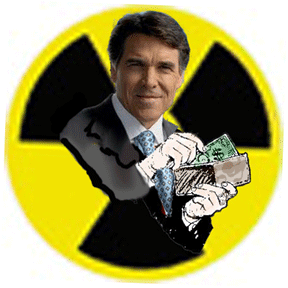
Unanswered qestions about the decommissioning of Pilgrim Nuclear Plant
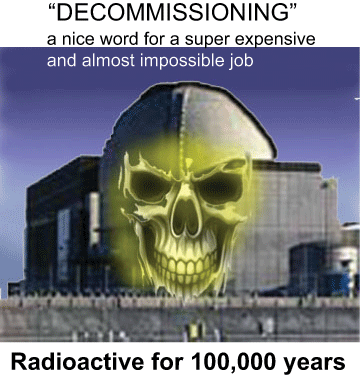 With Pilgrim Nuclear Plant Set To Retire, There Are Questions About Decommissioning Trust Fund WBUR,March 27, 2019, Miriam Wasser
As Plymouth’s Pilgrim Nuclear Power Station prepares to shut down for good, questions are emerging about its nuclear decommissioning trust fund. This is money set aside for “decommissioning” the plant — removing the spent fuel and making the land safe for eventual unrestricted use.The trust fund is like a 401(k) for retired nuclear plants; ratepayers contribute money into a conservatively managed account that accrues interest over time. Pilgrim’s fund was worth about $1.05 billion in October 2018. It cannot be accessed until the plant permanently shuts down.
The big questions about the trust fund: What can plant owners spend the money on? And will there be enough to cover the cost of decommissioning?
Surprisingly, the federal Nuclear Regulatory Commission (NRC) has no specific regulations on how plant owners can spend trust fund money, only guidelines.
Also surprising: A plant owner also needs an exemption from the NRC to use the money for “spent fuel management” and “site restoration” — the bulk of the decommissioning work — but not for paying the host community what essentially amounts to property taxes.
This all came to light at recent public meetings in Plymouth about Pilgrim, which is supposed to shut down by June 1. The state-appointed Nuclear Decommissioning Citizens Advisory Panel (NDCAP) questioned a representative of Holtec International, the New Jersey-based company that wants to buy Pilgrim from its current owners, Entergy Nuclear Operators, about the company’s  finances. …….
Everybody who’s a resident of Plymouth, including all of our town meeting members, should understand that the intention of both Entergy and Holtec is to take ratepayer money to pay their taxes,” said NDCAP Chairman Sean Mullin. ……. https://www.wbur.org/earthwhile/2019/03/27/pilgrim-decommissioning-trust-fund-pilot-taxes-plymouth
Nuclear Resisters – in Ireland, Belgium, California, and DesMoines on St Patrick’s Day
** Two U.S. Veterans for Peace released after 12 days in Irish prison for peace action at Shannon Airport
————————————————————
Two members of U.S. Veterans For Peace – Tarak Kauff and Ken Mayers – were arrested on March 17, St. Patrick’s Day after cutting the fence and entering the airfield at Shannon Airport in Ireland to inspect and investigate a plane on contract to the U.S. military. They carried a large banner that said “U.S. Veterans Say: Respect Irish Neutrality – U.S. War Machine Out of Shannon Airport”. The men were refused bail by Ennis District Court on March 18 and jailed at the Limerick Prison, charged with trespass and causing criminal damage. At a preliminary hearing on March 28, the men were granted bail and released on March 29 pending trial. Their passports were taken and they were ordered to stay away from airports. They may not be able to leave Ireland before their trial. Shannon Airport is used for refueling troop and equipment transport planes bound for Middle East wars.
Read more here (https://nukeresister.us6.list-manage.com/track/click?u=5e793916f1979bfc73458af19&id=81d2ae10b5&e=e8c4dedfda) .
Members of European Parliament among 16 arrested at Belgian air base where U.S. nuclear weapons are stored
————————————————————
Three Green Party politicians from Luxembourg, England and France were arrested with four Agir pour la Paix activists on February 20 after climbing a fence to enter a military base in Belgium where U.S. nuclear weapons are stored. After entering the Kleine Brogel base, they blocked the runway used by F-16 fighter jets. The Members of European Parliament – Molly Scott Cato, Tilly Metz and Michele Rivasi – held a banner that read, “Europe Free of Nuclear Weapons”. The group was soon detained and taken into custody. Nine supporters standing outside the base were also arrested, and authorities erased photos and videos from their cameras and phones.
Read more here (https://nukeresister.us6.list-manage.com/track/click?u=5e793916f1979bfc73458af19&id=bac6bd3950&e=e8c4dedfda) .
————————————————————
Eleven nuclear resisters arrested during blockade of Lockheed Martin, California
————————————————————
Eleven nuclear resisters with the Pacific Life Community were arrested on March 18 during a blockade of the main gate of Lockheed Martin in Sunnyvale, California. The group held a banner across the road reading, “Lockheed Weapons Terrorize the World”. They carried with them copies of the Treaty on the Prohibition of Nuclear Weapons to inform Lockheed workers and management that when the treaty is ratified, building nuclear weapons and their delivery systems will be in violation of international humanitarian law.
Read more here (https://nukeresister.us6.list-manage.com/track/click?u=5e793916f1979bfc73458af19&id=a7997992be&e=e8c4dedfda) .
Eight arrested during St. Patrick’s Day blockade of Des Moines drone command center
————————————————————
Veterans for Peace and Catholic Workers from across the Midwest converged on the Iowa Air National Guard Drone Command Center in Des Moines on March 17, St. Patrick’s Day. After a rally, protesters walked onto the base. Eight activists blocked the main entrance gate, holding a banner with a message from St. Patrick: “In Christ There is No Killing”. The blockaders were arrested and taken to the Polk County Jail. One of them bailed out, and the other seven spent the night in jail before pleading guilty on Monday morning. They were fined $100-$1000 and then set free.
Read more here (https://nukeresister.us6.list-manage.com/track/click?u=5e793916f1979bfc73458af19&id=5efb6d6624&e=e8c4dedfda) .

USA Dept of Energy just keeps on giving finds to the nuclear industry
Department of Energy Further Advances Nuclear Energy Technology through Industry Awards of $19 Million,, Office of Nuclear Energy, MARCH 27, 2019 WASHINGTON, D.C. – The U.S. Department of Energy (DOE) today announced funding selectees for multiple domestic advanced nuclear technology projects. Four projects in two states will receive varying amounts for a total of approximately $19 million in funding. The projects are cost-shared and will allow industry-led teams, including participants from federal agencies, public and private laboratories, institutions of higher education, and other domestic entities, to advance the state of U.S. commercial nuclear capability.
Nuclear Bailouts – A Radioactive Cost to Taxpayers
https://www.cagw.org/thewastewatcher/nuclear-bailouts-radioactive-cost-taxpayers March 29, 2019 – 10:11 — Allen  Johnson
On March 22, 2019, the Trump Administration took another step to act on the president’s campaign promise to financially support coal and nuclear power.
The Department of Energy announced that it would be providing a $3.7 billion loan guarantee to the Vogtle Electric Generation Plant located in near Waynesboro Georgia. That brings the total government financing on this project to $12 billion.
President Obama allocated an $8.3 billion loan to complete the Vogtle facility back in 2010 with the goal of constructing of the first new nuclear plant in the U.S. in 30 years. However, since President Obama’s initial loan, cost increases and delays (in part due to a contractor’s bankruptcy) have left the plant unfinished. Yet, taxpayers will now be forced to throw further good taxpayer money after bad.
Our March 22, 2019, blog highlighted how state-level bailout plans for failing nuclear power generation plants are gaining steam in several states, with the administration’s encouragement. The saga at Vogtle Electric underscores the hefty risk taxpayers would incur as bailouts continue across the country. For an administration keen on cutting wasteful government spending, an additional $3.9 billion loan undercuts that commitment and could be the first step toward a larger grid-intervention policy that will cost taxpayers dearly.
A July 19, 2018, report by the Brattle Group estimated it will cost taxpayers $34 billion over two years if every coal and nuclear plant in the country were bailed out as the administration originally proposed. That is a steep price to pay when those funds could be used for more practical measures like strengthening the nation’s energy grid, investing in cyber-protection technologies, or upgrading general infrastructure to bolster the nation’s natural gas supply.
To bailout a power plant that a private corporation has failed to keep within budget and on schedule brings this flawed policy to a new level. The latest announcement from Secretary Perry signals unnecessary political interference in energy markets. A corporation that cannot manage its projects properly doesn’t deserve a federal bailout by taxpayers. Taxpayer dollars are intended to serve the public, not support corporate irresponsibility.
$77 billion for U.S. Strategic Command for its NC3 – part of $494 billion nuclear weapons update
STRATCOM to design blueprint for nuclear command, control and communications, Space News,
The NC3 system includes terrestrial and space-based sensors that monitor the globe for threats, and a communications architecture that connects the nation’s decision makers to nuclear forces under any conditions. It is a classified system designed in the 1960s and 1970s during the height of the Cold War and is projected to stay in service for years to come. The technology is aging, however, and needs to be modernized so it can connect to the next generation of nuclear platforms the Pentagon is developing and expects to start deploying in the mid to late 2020s: the B-21 stealth bomber, the Columbia-class strategic ballistic missile submarine and the Ground Based Strategic Deterrent intercontinental ballistic missiles.
NUCLEAR WARNING: Radioactive contamination from Fukushima drifts to America
RADIOACTIVE contamination from Japan’s Fukushima Daichi nuclear power plant has drifted as far as America, experts claim. By EMILY FERGUSON EXPRESS UK, Mar 28, 2019
When a tsunami and 9.0-magnitude quake hit the Japanese nuclear plant’s reactors in March 2011, meltdowns were triggered at three of the plant’s six reactors. This resulted in radiation leaking into the air, soil and ocean – forcing 160,000 residents to flee. Radioactive contamination has reached as far north as a remote Alaskan island, scientists from the University of Alaska Fairbanks Sea Grant programme announced on Wednesday.
Water tests collected from seawater last year near St. Lawrence Island in the Bering Strait revealed a slight increase in levels of radioactive cesium-137 attributable to the Fukushima disaster.
But scientists say the levels need to be more than 3,000-times higher to pose a safety concern……..
n September last year the Japanese government acknowledge for the first that that a work at the nuclear power plant died from radiation exposure.
The worker, a man in his 50s, had spent his career working at nuclear plants around Japan and worked at the Fukushima Daiichi plant at least twice after the meltdowns at the station.
He was diagnosed with lung cancer in February 2016, an official said.
The Health, Labour and Welfare Ministry had previously ruled exposure to radiation caused the illnesses of four workers at the plant. https://www.express.co.uk/news/world/1106867/ukushima-disaster-latest-japan-nuclear-radiation-found-america
1 This Month

of the week– Nuclear Reactor Information Task Force

14 May – online event From Bombs to Data Centres: the Face of Nuclear Colonialism
To see nuclear-related stories in greater depth and intensity – go to https://nuclearinformation.wordpress.com
-
Archives
- May 2026 (91)
- April 2026 (356)
- March 2026 (251)
- February 2026 (268)
- January 2026 (308)
- December 2025 (358)
- November 2025 (359)
- October 2025 (376)
- September 2025 (257)
- August 2025 (319)
- July 2025 (230)
- June 2025 (348)
-
Categories
- 1
- 1 NUCLEAR ISSUES
- business and costs
- climate change
- culture and arts
- ENERGY
- environment
- health
- history
- indigenous issues
- Legal
- marketing of nuclear
- media
- opposition to nuclear
- PERSONAL STORIES
- politics
- politics international
- Religion and ethics
- safety
- secrets,lies and civil liberties
- spinbuster
- technology
- Uranium
- wastes
- weapons and war
- Women
- 2 WORLD
- ACTION
- AFRICA
- Atrocities
- AUSTRALIA
- Christina's notes
- Christina's themes
- culture and arts
- Events
- Fuk 2022
- Fuk 2023
- Fukushima 2017
- Fukushima 2018
- fukushima 2019
- Fukushima 2020
- Fukushima 2021
- general
- global warming
- Humour (God we need it)
- Nuclear
- RARE EARTHS
- Reference
- resources – print
- Resources -audiovicual
- Weekly Newsletter
- World
- World Nuclear
- YouTube
-
RSS
Entries RSS
Comments RSS
 nuclear-news