Trump picks another lackey of the coal and nuclear industries as US Energy Secretary
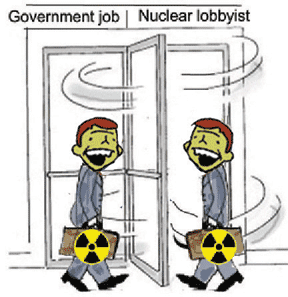
Dan Brouillette, 57, a former lobbyist at Ford Motor Co and Louisiana state energy regulator, would replace Rick Perry, who has said he is stepping down on Dec. 1.
Perry became known as one of the “three amigos” in a side-channel Ukraine policy led by Trump’s personal lawyer, Rudy Giuliani, that has been at the center of the Trump impeachment probe. But Perry has said he was not involved in any conversations where former Vice President Joe Biden was brought up…….
If, as expected, he is confirmed by the Senate Energy Committee and then by the full Senate, Brouillette will work to carry out Trump’s “energy dominance” agenda of boosting U.S. production of oil and natural gas.
Brouillette told Republican senators from Wyoming and Louisiana that he supports technology on curbing climate change by capturing and storing underground carbon dioxide from coal and natural gas facilities, adding that fossil fuels would power a large portion of global energy needs for the next 40 to 50 years…….
Brouillette also said he wants to support development of advanced nuclear power plants, hopefully one day bringing microreactors that provide relatively small amounts of power to remote places like rural Louisiana, where he was born, to Alaska. ……
Democratic senators not on the Energy Committee, including Ed Markey and Tim Kaine, sent Brouillette a letter on Wednesday asking whether he supported nonproliferation standards in any deal on sharing U.S. nuclear power technology with Saudi Arabia, a question he will likely continue to face if he is confirmed.
Reporting by Timothy Gardner; Editing by Peter Cooney and Tom Brown https://www.reuters.com/article/us-usa-trump-energy/trump-energy-pick-to-face-questions-on-coal-nuclear-power-idUSKBN1XO1OH
Before he’s even in the job, USA’s new Energy Secretary Dan Brouillette is busily promoting SMRs for his REAL bosses, the nuclear industryg
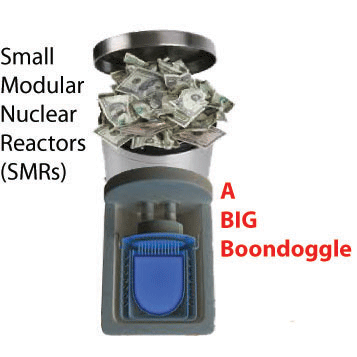 Could tiny nuclear reactors power Alaska villages?
“We want to get to a place where we can develop small micro-reactors, one to five megawatts,” Dan Brouillette said Thursday at his confirmation hearing in the U.S. Senate Energy Committee. …..
Brouillette is now the deputy secretary. He told Murkowski there’s reason to be optimistic about the development of reactors that are a fraction of the size of those in use today. ….. https://www.alaskapublic.org/2019/11/14/energy-secretary-nominee-says-tiny-nuclear-reactors-could-power-alaska-villages/
US- North Korea negotiations may be revived
|
US-North Korea nuclear talks may stir back to life, SMH, 15 Nov 19, Seoul: North Korea is unhappy the United States has proposed a resumption of stalled nuclear negotiations next month through a third party.It comes as the two countries approach an end-of-year deadline set by North Korean leader Kim Jong-un for the Trump administration to offer an acceptable deal to salvage the talks, and as the US President faces an impeachment inquiry at home.
In a statement released by state media, new North Korean negotiator Kim Myong-gil didn’t clearly say whether the North would accept the supposed US offer. Kim Myong-gil said Stephen Biegun, Trump’s special envoy for North Korea, proposed via an unspecified third country to hold another round of talks in December. “I cannot understand why he spreads the so-called idea of DPRK-US relations through the third party, not thinking of candidly making direct contact with me, his dialogue partner, if he has any suggestions or any idea over the DPRK-US dialogue,” Kim Myong-gil said of Biegun. “His behaviour only amplifies doubts about the US.” He said North Korea had no interest in talks if they were aimed at buying time without discussing solutions. He said the North wasn’t willing to make a deal over “matters of secondary importance”, such as possible US offers to formally declare an end to the 1950-53 Korean War, which was halted by a ceasefire, not a peace treaty, or establish a liaison office between the countries. If the negotiated solution of issues is possible, we are ready to meet with the US at any place and any time,” said Kim Myong-gil, who called for Washington to present a fundamental solution for discarding its “hostile policy” towards North Korea. “If the US still seeks a sinister aim of appeasing us in a bid to pass the time limit – the end of this year – with ease as it did during the DPRK-US working-level negotiations in Sweden early in October, we have no willingness to have such negotiations,” he said, using the abbreviation of North Korea’s official name, the Democratic People’s Republic of Korea…… In a separate statement attributed to another senior official, North Korea demanded that the US scrap a planned military drill with South Korea to keep the momentum alive for dialogue. Responding to comments by US Defence Secretary Mark Esper, who said Washington could possibly modify its military activities with Seoul to make room for diplomacy, North Korean official Kim Yong-chol said he would like to consider Esper’s remarks as US intention to “drop out of the joint military drill or completely stop it.” ……..https://www.smh.com.au/world/asia/us-north-korea-nuclear-talks-may-stir-back-to-life-20191115-p53ayr.html |
|
Messianic Rick Perry preaches nuclear to sceptical Europeans
 Messianic Perry preaches nuclear to sceptical Europeans, By Frédéric Simon | EURACTIV.com Oct 26, 2019 Small nuclear reactors can help “vulnerable nations take control of their destinies,” the US energy secretary said in Brussels today (21 October), claiming that small off-grid nuclear plants can bring electricity to poor nations and “disperse the darkness” around the globe…….
Today’s remarks, made in Brussels at the first EU-US high-level forum on small modular reactors, were again chiefly aimed at Eastern European countries, which have repeatedly complained about Russian interference in national politics, using gas as a lever.
Nuclear is a divise topic in Europe. While countries like France opted for it decades ago, others like Germany and Austria are strongly opposed.
“Nuclear energy is neither safe and sustainable nor cost-effective,” said German State Secretary for Energy, Andreas Feicht, during a recent meeting of EU energy ministers, firmly rejecting suggestions that EU money might be used to extend the lifetime of existing nuclear plants.
Today’s remarks, made in Brussels at the first EU-US high-level forum on small modular reactors, were again chiefly aimed at Eastern European countries, which have repeatedly complained about Russian interference in national politics, using gas as a lever.
Nuclear is a divise topic in Europe. While countries like France opted for it decades ago, others like Germany and Austria are strongly opposed.
“Nuclear energy is neither safe and sustainable nor cost-effective,” said German State Secretary for Energy, Andreas Feicht, during a recent meeting of EU energy ministers, firmly rejecting suggestions that EU money might be used to extend the lifetime of existing nuclear plants……
USA universities in the money as they help develop nuclear weapons

UNIVERSITIES ACROSS AMERICA PROFIT FROM DEVELOPING NUCLEAR WEAPONS. IT’S UNCONSCIONABLE, https://www.newsweek.com/universities-funding-nuclear-weapons-research-1471572 BEATRICE FIHN ON 11/13/19 Americans like a good comeback story, but the recent revitalization of the nuclear arms race is not one to be cheered. President Trump plans to charge the American taxpayer nearly $100,000 a minute to expand the nation’s nuclear weapons capabilities.Other nuclear-armed countries are doing the same.
A new generation of nuclear weapons requires a new generation of workers to develop and maintain these weapons of mass destruction. The National Nuclear Security Administration reported to Congress that 40 percent of its workforce will be eligible to retire in the next five years.The U.S. government and its contractors have turned to the nation’s universities to provide this human capital. A new report documents formal ties between nearly 50 college campuses and the nuclear weapons complex.
The extent to which universities have joined this endeavor is surprising. Supporting weapons of mass destruction does not show up in any university mission statements. In fact, it’s often the opposite: universities like to talk about bringing the benefits of knowledge to a global community.
The dangers posed by nuclear weapons are clear. Yet universities still choose to support them anyway. Students and faculty now face a choice. They can become the next generation of weapons scientists. Or they can refuse to be complicit in this scheme, denying research partnerships or internships at nuclear weapons labs.Currently, universities across the country receive millions and in some cases billions of dollars to support nuclear weapons development. Universities directly manage nuclear weapons labs, form institutional agreements with these labs and related production sites, pursue research partnerships with nuclear weapons scientists, and provide targeted workforce development for these facilities.
Many of the universities with more extensive connections to nuclear weapons are household names: the University of California, Texas A&M University, Johns Hopkins University, and the University of New Mexico. Others, such as local technical and vocational schools, are less well-known.
Nuclear weapons are weapons of mass destruction, just like chemical and biological weapons. They carry devastating humanitarian and environmental consequences that do not stop at national borders. Thousands still suffer from the bombs dropped on Hiroshima and Nagasaki. Thousands more suffer from the effects of nuclear weapons testing in the 20th century, including in the U.S.
One Centers for Disease Control and Prevention study estimated that radioactive fallout from nuclear tests would kill an additional 11,000 Americans due to an increase in fatal cancers. The United States has paid more than $2.3 billion in compensation to individuals affected by nuclear test fallout. Those most affected by tests around the world have been the already marginalized: indigenous and colonized peoples, women and children.
Some see value in the nuclear weapons complex because it supplies thousands of jobs. These boosters fail to acknowledge the studies that demonstrate how defense spending produces fewer jobs per dollar than investment in other areas, like education, health care or infrastructure. The business of nuclear weapons does not provide jobs; it takes them away.
Our choice today is between a future without nuclear weapons or no future at all. Seventy-nine nations (and counting) have signed the 2017 United Nations Treaty on the Prohibition of Nuclear Weapons; American states and cities are voting to urge the US to join them. Universities that support nuclear weapons make the wrong choice and their communities should refuse to be complicit.
Students, faculty, alumni, and community members — who often fund these schools through their tax dollars — can also take concrete action to help their universities join the right side of history.
They can push for transparency around any ties to the nuclear weapons complex, install ethical review processes for basic or dual-purpose research funded by the complex, and prohibit classified research. They can ask University administrations to stop direct management of nuclear weapons production sites and dissolve research contracts solely related to nuclear weapons production.
University communities and administrations together can lobby the federal government to flip its funding priorities, so that nonproliferation and disarmament verification research receive more funding than weapons activities.
A society can—and should—actively debate the extent to which universities are to serve explicitly national interests. But there should be no debate when it comes to supporting weapons of mass destruction. American academia must stop enabling mass murder.
Beatrice Fihn is the Executive Director of the International Campaign to Abolish Nuclear Weapons (ICAN), the 2017 Nobel Peace Prize-winners.
A long-term continuing resolution -damaging to America’s nuclear weapons development
|
Here’s how a CR could hurt America’s nuclear weapons modernization. https://www.defensenews.com/smr/nuclear-arsenal/2019/11/12/heres-how-a-cr-could-hurt-americas-nuclear-weapons-modernization/
By: Aaron Mehta WASHINGTON — A long-term continuing resolution will result in delays for modernizing America’s nuclear warheads, while putting at risk an already challenging plan to build plutonium pits needed for the next generation of U.S. intercontinental ballistic missiles, nuclear officials are warning.
The National Nuclear Security Administration is a semiautonomous agency under the Department of Energy that handles the manufacturing and maintenance of America’s nuclear warheads. Like other government agencies, NNSA would be limited to fiscal 2019 funding limits under a continuing resolution, and it would be unable to start new contracts. The current continuing resolution, or CR, is set to end Nov. 21, but there is little expectation that regular budgeting will then resume. Congress is debating the merits of pushing the CR through December, but analysts are concerned the CR could extend into next year. “We are in a situation right now where we have single-point failures throughout our enterprise,” Lisa Gordon-Hagerty, the NNSA administrator, said during a Defense Writers Group breakfast earlier this month. “It’s necessary for us, for the NNSA and for the nuclear security enterprise to receive consistent and robust funding to modernize our infrastructure as well as continue ongoing operations.” “We’re looking at where we can move funding insofar as CRs will allow us to do so,” she added. “We’re working very closely with OMB and the administration to see what we can do to continue our important programs to modernize the infrastructure as well as the stockpile and our workforce initiatives and our endeavors.” Gordon-Hagerty did not go into detail about specific CR-related worries, but according to an NNSA source, the agency has identified three main areas of concern under a longer CR. The first is, broadly, keeping the warhead modernization efforts on schedule. Two of those modernization programs — the B61-12 gravity bomb and W88 submarine-launched ballistic missile warhead — already face program delays thanks to an issue with a commercial part that has to be redesigned. Gordon-Hagerty said a CR should not impact that particular issue, as the funding for a solution is coming from a realignment of other warhead modernization programs. But a delay to one program caused by a CR “does affect all of the other modernization programs and all of the other work that we have ongoing throughout our nuclear security enterprise,” she said. The second major area of concern is the surplus plutonium disposition program, which is supposed to dispose of 34 metric tons of excess plutonium at a South Carolina facility. That program emerged as the successor to the controversial MOX program, and has faced opposition from South Carolina Sen. Lindsey Graham. Construction on that facility could be delayed under a CR. The NNSA source said that the agency requested extra funding for the surplus plutonium disposition program through the budget anomaly process, but was not given the resources it requested. The third area of concern is a 10-year plan to develop a native plutonium pit in the United States. The NNSA has been charged with producing 80 plutonium pits a year by 2030, a target that Gordon-Hagerty acknowledged is a tight window for the agency to hit, even with stable funding. “We are again rebalancing, looking at our budget across the entire enterprise to see what it is we need to do to meet the scope and schedule of that 2030,” she said. “Am I confident we can get there? Yes. Is it fraught with — probably a bad way of saying it — land mines? It is.” Construction costs Construction featuring prominently on this list should not be a huge surprise; NNSA officials are quick to point out in public events that they are still using some buildings that date back to the Manhattan Project. According to Gordon-Hagerty, more than 50 percent of NNSA facilities are more than 40 years old, and over a third of those are about 70 years of age. The looming CR extension comes as the agency launches a number of construction projects, and a CR could lead to major delays in standing up those facilities. While that’s an issue for every agency under a CR, the NNSA is concerned that the specialty construction talent needed to build those facilities may not available if a contract is frozen and then picked up again later. There could also be high-dollar costs. Responding to a lawsuit by environmental groups trying to halt the construction of the Y-12 facility in Tennessee, NNSA said a six- to 12-month delay in construction at that location could result in almost $1 billion in extra costs for taxpayers and the agency may have to lay off 1,000 construction personnel. Those numbers, first reported by the Exchange Monitor, likely have resonance with other potential delays at construction sites caused by a CR — meaning construction delays at one or more sites could quickly become costly for an agency whose facilities and construction needs have traditionally been underfunded. “It’s been on schedule and on budget for the last six years. It will be finished in 2025 for approximately $6.5 billion,” Gordon-Hagerty said of the Y-12 facility. “If that funding somehow fails to materialize, then we’ve got over 1,000 crafts [personnel] working at the site right now. Crafts personnel are hard to come by, especially those that are qualified. So if they see a question about funding or funding gets pulled back, they’re going to find positions elsewhere.”
|
|

The United States’ Nuclear and Non-Nuclear Weapons Are Dangerously Entangled
|
New evidence from the Yom Kippur War shows how such knots can lead to nuclear annihilation.
BY JAMES M. ACTON, NICK BLANCHETTE
NOVEMBER 12, 2019, In October 1973, an unreliable radiation detector could have caused the end of the world. The setting was the Yom Kippur War between Israel and a coalition of Arab states, and the superpowers found themselves being sucked into the conflict. In the war’s febrile final days, the United States detected what appeared to be radiation from a Soviet freighter headed for Egypt and concluded—almost certainly incorrectly—that Moscow was transferring nuclear warheads to Cairo. Partly in response, on Oct. 24, Washington placed its nuclear forces on a global alert for only the fourth time in history—a step it has taken only twice since. The U.S. alert prompted the Soviet Union to reportedly issue a preliminary order to begin the alerting of its own nuclear forces. This chain of events, which could have culminated in a nuclear war, provides a timely warning. The United States’ ability to detect and track nuclear warheads has improved immeasurably over the last 46 years, making an exact replay of 1973 unlikely. However, growing entanglement between nuclear and nonnuclear weapons is exacerbating closely related dangers. In particular, nuclear-armed states are relying ever more heavily on dual-use weapons, which can accommodate nuclear or nonnuclear warheads, thus exacerbating the risk that one side might wrongly conclude that another had deployed nuclear weapons. In a crisis or conflict, the result could be an escalation spiral that, unlike in 1973, spins all the way to nuclear devastation. ……(subscribers only) https://foreignpolicy.com/2019/11/12/the-united-states-nuclear-and-non-nuclear-weapons-are-dangerously-entangled/
|
|
Jared Kushner’s, Donald Trump’s secretive meetings with Saudi Arabia, Putin, Kim Jong Un
 JARED KUSHNER, DONALD TRUMP BROKE THE LAW BY MEETING SAUDIS, PUTIN, KIM OFF THE RECORD: WATCHDOGS https://www.newsweek.com/jared-kushner-donald-trump-broke-law-saudis-putin-kim-1418596
In a lawsuit filed Tuesday against Trump and the executive office of the president, the watchdog Citizens for Responsibility and Ethics in Washington (CREW) alleged that White House officials including the president and Kushner seem to have violated the Presidential Records Act and the Federal Records Act by intentionally neglecting to create and keep records of meetings with Putin and Kim, among other foreign officials.
“There are a lot of questions surrounding Jared Kushner and the extent to which he, like the president, has an agenda that also serves his own personal and family business interests,” CREW’s chief FOIA counsel Anne Weismann told Newsweek on Tuesday.
The suit cites news reports that Trump had at least five different meetings with Putin with no notetaker in the room, meaning an official record of the meeting does not exist. Trump also confiscated a State Department interpreter’s notes after meeting with Putin in Germany, and had a private meeting with Kim in Vietnam with two interpreters but no record was produced, according to the suit.
In addition, the suit raises a recent meeting Kushner had with top Saudi officials that did not include State Department officials, and from which no record was created.
“The absence of records in these circumstances when the President and his top advisers are exercising core constitutional and statutory powers causes real, incalculable harm to our national security and the ability of our government to effectively conduct foreign policy,” the suit states, “Because the documentary record of this administration’s foreign policy regarding Russia, North Korea, and Saudi Arabia will be unavailable to policy makers and forever lost to history.”
Weismann said Kushner—whom Trump tasked with creating a supposedly soon-to-be-released Middle East peace plan—is meeting with very sophisticated and possibly adversarial foreign leaders and “that alone raises concerns.”
“He may be compromising American interests in ways that we don’t know about,” Weismann said. “Even if he’s not acting to pursue his business or financial interests, he doesn’t come to the job with experience in foreign relations.”
The White House did not immediately respond to a request for comment from Newsweek on Tuesday.
Co-plaintiffs in the suit are the National Security Archive and the Society for Historians of American Foreign Relations, which has nearly 1,000 members.
“The problem goes beyond improperly shredding records, to the deliberate failure to create the records in the first place,” stated Tom Blanton, director of the archive, which has sued past presidents who failed to keep records.
Neglecting to make and preserve records “undermines the principle of government accountability that is the very bedrock of democracy,” the historians society president Barbara Keys stated.
In framing Julian Assange, The FBI tried to make Iceland a complicit
The FBI tried to make Iceland a complicit ally in framing Julian Assange https://independentaustralia.net/life/life-display/the-fbi-tried-to-make-iceland-a-complicit-ally-in-framing-julian-assange,13277
By Sara Chessa | 5 November 2019 Former Icelandic Interior Minister tells Independent Australia how he blocked U.S. interference in 2011 in order to defend WikiLeaks and its publisher Julian Assange. Sara Chessa reports.
Former Icelandic Interior Minister tells Independent Australia how he blocked U.S. interference in 2011 in order to defend WikiLeaks and its publisher Julian Assange. Sara Chessa reports.
A MINISTER OF THE INTERIOR wakes up one summer morning and finds out that a plane full of United States Federal Bureau of Investigation (FBI) agents has landed in his country, aiming to carry out police investigations without proper permission from the authorities.
How many statesmen would have the strength to say, “No, you can’t do this”, to the United States? Former Icelandic Interior Minister Ögmundur Jónasson, in fact, did this — and for the sake of investigative journalism. He understood that something wrong with the sudden FBI mission in Reykjavik, and that this had to do with the whistleblowing website WikiLeaks and its publisher Julian Assange. Continue reading
Georgia Power and the ballooning costs of Nuclear Plant Vogtle
 Plant Vogtle Expansion in the Spotlight: billion$ more at risk
In the 19th VCM, approved last February, the Commission decided to combine the next two reporting periods, which SACE and others opposed, and as predicted, Georgia Power has since spent a lot on the mismanaged nuclear project. The Company is now asking for verification and approval of $1.248 billion in expenditures. And that’s just for Georgia Power’s 45.7% share of the costs incurred during the reporting period from July 2018 to June 2019 for the two new AP1000 reactors under construction at Plant Vogtle near Waynesboro, along the Savannah River.
The continuing saga is like a broken record in each of these VCM proceedings, and it remains mostly the same upon reading Georgia Power’s report and the witnesses’ written testimony, which will be discussed before the Commission on Tuesday.
The project (again) isn’t meeting the productivity goals and appears to be falling further behind schedule, but Georgia Power remains confident (again) that they will somehow have Unit 3 online by November 2021 and Unit 4 by November 2022. Remember, these reactors were supposed to both be operational by April 2017!
And (again) Georgia Power provides itself an out, pointing (again) to a multitude of potential “challenges” in the months ahead that could impact the schedule and most importantly ultimate costs to the utility customers. Because of consistent delays and mismanagement, the currently-projected total cost of this project has more than doubled from the original $14.1 billion estimate to over $28 billion.
Georgia Power customers concerned about their utility bills should let the Commission know that not only are they worried about how the proposed rate hike will affect their bills, but are also very concerned about what happens when the other shoe drops – when Plant Vogtle’s final budget-busting price tag gets rolled into customer’s electricity rates.
Unable to attend the November 12 hearing? Watch online starting at 9am ET via the PSC’s livestream feed and contact the PSC with your concerns.
Entire world wants nuclear weapons-free Middle East — except for USA and Israel
US and Israel were lone votes against UN resolutions opposing space arms race, nuclear Middle East, Cuba embargo, The United States and Israel were the only countries that voted against UN General Assembly draft resolutions calling for a nuclear weapons-free Middle East, measures to stop an arms race in outer space, and an end to the blockade of Cuba. THE GRAYZONE, By Ben Norton, 11 Nov 19,
Important breakthroughs have arrived at the United Nations seeking to prevent an arms race in outer space and create a nuclear weapons-free Middle East. There are just two main obstacles: the United States and Israel.
While Washington and corporate media outlets portray China and Russia as aggressive warmongering rogue states, their votes at the UN show which nations are actually expanding dangerous militarism into new frontiers.
China and Russia joined dozens of other countries in sponsoring resolutions at the UN General Assembly (UNGA) that sought to prevent armed conflict in space. Most of the international community supported these historic peace measures. The only consistent outliers were the US and Israel.
Beijing and Moscow have been leading global efforts to stop the use of weapons in space. Meanwhile, Washington has unilaterally blocked the international consensus on preventing the deadly space race.
Moreover, as nearly all UN member states have united in calling for a Middle East free of nuclear weapons, the US and Israel have singlehandedly undermined their peace efforts.
This roguish behavior predates the election of President Donald Trump.
At the UNGA on November 7, almost every country in the world also voted to end the US embargo against Cuba. This was the 28th year in row that the international community united in calling for the American noose to be taken off the neck of the Cuban people.
While 187 member states supported the resolution demanding an end to the blockade, the US, Israel, and Brazil’s far-right government were the lone nations to oppose it. American allies Colombia and Ukraine abstained.
Washington’s UN votes show who truly is a rogue state.
Entire world wants nuclear weapons-free Middle East — except for USA and Israel
The UNGA’s First Committee, which oversees disarmament and international security, voted on November 1 to overwhelmingly approve a draft resolution entitled “Establishment of a nuclear-weapon-free zone in the region of the Middle East.”
A staggering 172 countries voted in support of this resolution. Only two nations voted against it: the US and Israel. Just two more countries abstained: the United Kingdom and Cameroon.
At the same meeting, the First Committee approved a draft resolution on “The risk of nuclear proliferation in the Middle East,” which called for the region to abide by the Treaty on the Non-Proliferation of Nuclear Weapons (NPT).
Given Israel is the only country in the Middle East with nuclear weapons, the UNGA resolution called on Tel Aviv to join the NPT (Israel has long refused to sign the treaty), and demanded that Israeli nuclear facilities be overseen by International Atomic Energy Agency (IAEA) safeguards.
The draft resolution was also overwhelmingly approved, with 151 votes in support and a mere six votes against — from the US, Israel, and Canada, along with the tiny island nations of Palau, Micronesia, and the Marshall Islands, which function as vassals of Washington at the UN.
American and Israeli votes against resolutions to prevent an arms race in outer space…….https://thegrayzone.com/2019/11/08/us-israel-un-resolutions-space-arms-race-nuclear/
Leak shuts down V.C. Summer nuclear plant
|
Leak shuts down V.C. Summer nuclear plant, The State , BY SAMMY FRETWELL, NOVEMBER 09, 2019 Dominion Energy has shut down the V.C. Summer nuclear reactor in Fairfield County after the utility found a “small leak’’ in the atomic power plant’s coolant system, a spokeswoman said Saturday afternoon.
Leaking material has not escaped into the environment, the company said. Dominion didn’t have to shut down the reactor, but it chose to do so while it addresses the leak, spokeswoman Rhonda O’Banion said in an email. O’Banion said there is no danger to the public. The utility said plant operators had been monitoring a small leak for several weeks, before finally deciding to shutter the plant so the leak could be fixed. The company declined to say how long the power plant might be shut down, noting that when the unit will “return to service is market sensitive information.’’……https://www.thestate.com/news/local/environment/article237204218.html |
|
Lawmakers right to hold off on nuclear waste bill
Lawmakers right to hold off on nuclear waste bill https://www.powelltribune.com/stories/lawmakers-right-to-hold-off-on-nuclear-waste-bill,22189, November 7, 2019 , By CJ Baker
Offer people enough money and they’ll put up with quite a bit.
So if the State of Wyoming was offered, say, billions of dollars a year, you might find some folks willing to hold their nose and let the federal government store a bit of nuclear waste in an isolated corner of the state.
But with the feds apparently offering relative peanuts to stash their waste in Wyoming, we’re pleased that state lawmakers are backing off the idea.
On Tuesday, the Legislature’s Joint Minerals, Business & Economic Development Committee decided not to sponsor a bill that would have called on the governor’s office to try negotiating a nuclear waste deal with the feds.
Lawmakers started exploring the idea of temporarily storing spent nuclear fuel rods back in July. Things got off on the wrong foot right away, as the Joint Management Council opted to look into the concept using an unannounced vote held by email; the discussion only became public when WyoFile, a nonprofit news service, learned of and wrote about it.
We wrote in this space back in July that, while the lack of transparency was frustrating, the idea was worth exploring. However, the price has to be right. State Sen. Jim Anderson, a Republican from Casper, told WyoFile in July that Wyoming could receive as much as $1 billion a year for storing the country’s nuclear waste. That could go a long way toward relieving some of Wyoming’s budget woes.
But when the Spent Fuel Rods Subcommittee actually heard testimony on the subject in September, federal officials suggested the state might only receive $10 million a year — and a chunk of that would go to local governments, according to reporting by the Casper Star-Tribune.
Further, it was suggested that Wyoming might have a fight on its hands to even get that funding, possibly needing Congress to pass legislation and potentially facing multiple lawsuits.
On top of that, the idea drew nearly unanimous opposition from dozens of members of the public who weighed in at the meeting and via online comments.
“Keep that crap out of my state,” was one representative remark from a Casper resident.
While we believe that nuclear waste could be safely transported to and stored in Wyoming, it’s almost certain that, regardless of whatever precautions are taken and assurances given, many residents will remain wary and fearful of the idea. That means accepting spent fuel rods at a new facility here would require ramrodding legislation through the Wyoming Legislature and Congress over the top of some staunch opposition.
There’s also little question that the move would create some bad PR for Wyoming — the “toxic waste dump” jokes basically write themselves — which is a concern for a state that relies on tourism.
All of that is to say that we were a bit dumbfounded to hear that going to all that trouble would net a mere pittance in revenue.
In an interview with the Casper Star-Tribune last month, Sen. Anderson acknowledged the U.S. Department of Energy hasn’t offered enough cash.
“… if they stick to that $10 million figure, we’re not even going to pursue it,” he said.
However, Anderson suggested to the Star-Tribune that the state could negotiate a much better rate that would get closer to the $1 billion mark.
Under the legislation drafted by the Minerals, Business & Economic Development Committee, Gov. Mark Gordon would have been called upon to strike a deal with the Department of Energy. But the committee announced Tuesday that they wouldn’t sponsor the bill, the Star-Tribune reported, with Anderson saying that the governor could open negotiations on his own.
However, a spokesman for Gordon told the Star-Tribune that the governor “remains uncertain that this proposal is the best way to generate revenue for the state.” And the governor told the Wyoming Tribune Eagle last week that, while open to hearing more about nuclear waste storage, “I don’t think it’s the best industry for Wyoming.”
We share Gov. Gordon’s uncertainty and don’t see any reason to move forward at this time — particularly because it seems awfully unrealistic to think the Department of Energy will agree to pay 100 times its initial offer. And when it comes to stashing nuclear waste in the ground, we can’t afford to take a pie-in-the-sky approach.
Nuclear medicine has radiation dangers – a reminder to clinicians
 Clinicians Get Real on Radiation: ‘Don’t Do Dumb Things’
Awareness of surroundings and others in the room are key to proper cath-lab radiation safety, a VIVA “roundtable” concluded. TCTMD,
By L.A. McKeown November 07, 2019 S VEGAS, NV—Keeping cath lab staff as well as patients safe and within acceptable levels of radiation is a priority that operators can and should be doing on a daily basis, experts here agreed.
The most crucial message for clinicians is that “they are primarily responsible not only for their own personal safety and the patient’s safety, but of everyone in the room,” Mark Bates, MD, DSc (West Virginia University School of Medicine, Morgantown), told TCTMD. He co-moderated a roundtable at VIVA 2019 on radiation protection strategies that provided a glimpse of how the future might look.
“I think 10 years from now we’re going to be in a position where a lot of procedures in the vasculature are going to be done with minimal radiation exposure as we optimize the existing technology, as well as some of the new laser- or light-augmented three-dimensional imaging,” he added…….
he encouraged operators to be aware of their trainees and monitor them for excess radiation exposure.
“As experienced interventionists, we see anatomy that we know is going to be a challenge,” he explained, “[but] we watch our trainees move through the algorithm and change to different wires and different catheters much slower than what we’re used to doing because they need to learn how to do it. Not only are they taking on radiation, but the patients are taking on a lot of extra radiation, too. I think we need to control the time that we allow trainees to perform certain aspects of the procedure.”……
Communication, Visualization, and Behavior Change
Gray noted that while you may have adequate shielding in your cath lab, it won’t help if you don’t use it correctly. A side drape, for example, that gets in your way and is pushed aside out of annoyance may make a difference in exposure levels for everyone in the room.
“That’s really the dumbest thing you could do, so don’t do dumb things,” he said. Gray added that understanding the effects of scatter on yourself may be a simple as looking at your hands for loss of hair on the fingers and wrists. At his institution Geiger counters are used when X-ray badges indicate elevated radiation exposures for individual operators. “So, you have an auditory signal that’s telling you that you’re on the pedal,” he said, adding that it may help in situations where staff are reaching over the table and may not even realize they are being exposed…….. https://www.tctmd.com/news/clinicians-get-real-radiation-dont-do-dumb-things
1 This Month
26 September – International Day for the Total Elimination of Nuclear Weapons





PLEASE OPPOSE HR 8255 AND S.3639 – bills would accelerate satellite deployment, with no environmental review or safeguards – https://ncstd5li.quorum.us/campaign/169331/
To see nuclear-related stories in greater depth and intensity – go to https://nuclearinformation.wordpress.com
-
Archives
- September 2026 (305)
- August 2026 (330)
- July 2026 (355)
- June 2026 (287)
- May 2026 (306)
- April 2026 (356)
- March 2026 (251)
- February 2026 (267)
- January 2026 (308)
- December 2025 (358)
- November 2025 (359)
- October 2025 (375)
-
Categories
- 1
- 1 NUCLEAR ISSUES
- business and costs
- climate change
- culture and arts
- ENERGY
- environment
- health
- history
- indigenous issues
- Legal
- marketing of nuclear
- media
- opposition to nuclear
- PERSONAL STORIES
- politics
- politics international
- Religion and ethics
- safety
- secrets,lies and civil liberties
- spinbuster
- technology
- Uranium
- wastes
- weapons and war
- Women
- 2 WORLD
- ACTION
- AFRICA
- Atrocities
- AUSTRALIA
- Christina's notes
- Christina's themes
- culture and arts
- Events
- Fuk 2022
- Fuk 2023
- Fukushima 2017
- Fukushima 2018
- fukushima 2019
- Fukushima 2020
- Fukushima 2021
- general
- global warming
- Humour (God we need it)
- Nuclear
- RARE EARTHS
- Reference
- resources – print
- Resources -audiovicual
- Weekly Newsletter
- World
- World Nuclear
- YouTube
-
RSS
Entries RSS
Comments RSS

