Ohio: the nuclear industry’s violent assault on democracy

Ohio’s GOP secretary of state has now asked the Ohio Supreme Court NOT to provide a federal judge with answers about key procedural questions surrounding the state’s referendum process.
The short-term issue is about a billion-dollar bailout for two nuke reactors and two coal burners.
Long-term it asks whether targeted violence perpetrated by paid thugs will now define our election process. And whether the public referendum will remain a workable part of our democracy.
The battle starts with House Bill 6, the now-infamous billion-dollar nuke bailout approved by the corrupt, gerrymandered Ohio legislature in late July.
HB6 forces all Ohio ratepayers to subsidize two crumbling nukes on Lake Erie, along with two decrepit coal burners, one of them in Indiana. It helps underwrite ten small solar farms, but undercuts much larger subsidies for other wind and solar facilities.
The Perry reactor east of Cleveland, and Davis-Besse near Toledo, are among the world’s most dangerous, decrepit reactors. Both were set to shut because they cannot compete with wind and solar, as well as fracked gas.
But Akron-based FirstEnergy spent millions to “persuade” the legislature to hand them a billion dollars to keep their uncompetitive, uninsured and essentially unregulated reactors on line.
When the bailout passed, a statewide group called Ohioans Against Corporate Bailouts turned in a petition for a repeal referendum on the 2020 ballot. The law allows 90 days for referendum sponsors to gather signatures to get on the ballot. In this case 265,711 would be required.
Ohio’s Attorney General David Yost sat on the request for 19 days, then rejected it. OACB filed a second application, which the AG sat on for another 19 days before approving it.
That left the petitioners just 52 days to gather signatures.
But signature gatherers were immediately attacked with violent threats and bribery offers. In the field, they (and potential signatories) were physically assaulted by “blockers” hired by the nuclear industry. Sworn testimony about these attacks was filmed at a public gathering in Columbus and can be seen here:
https://freepress.org/article/free-press-second-saturday-petition-blockers-threaten-our-democracy
Bailout opponents then went to federal court to ask that the 38 days consumed by the AG be restored to the petition campaign, which came up short at the 90-day deadline. A federal judge asked for guidance from the Ohio Supreme Court and submitted five questions for the Justices to answer.
And here things have leapt to another level. Frank LaRose, the Ohio Secretary of State, has now asked the Ohio Supreme Court NOT to respond to the federal judge’s queries.
In other words: the Republican attorney general killed nearly half the allotted signature gathering time for the repeal of this bailout. A federal judge has asked to hear from the state Supreme Court. And now Ohio’s Republican secretary of state has asked that Court NOT to comply, in a direct attempt to prevent Ohioans from voting on whether they’re to be forced to pay a billion dollar subsidy for two lethal, money losing atomic reactors.
This shocking combination of overt threats, bribery and outright physical violence, combined with judicial stall tactics by elected Ohio officials, breaks new ground in the assault on democracy itself in the American heartland.
The issue cuts to the core of the 2020 election. Donald Trump has met personally with at least one principal lobbyist for FirstEnergy, the prime beneficiary of the bailout. At least one of his associates lobbied at least five legislators in its behalf.
But a statewide referendum for repeal could be catastrophic for the GOP. Polls show more than 60% of Ohioans opposed. That includes much of the normally corporate statewide media. Many big industrial organizations have joined the fossil fuel industry here in fighting it.
If the referendum does get on the 2020 ballot, it will clearly energize a strong progressive voter turnout. Outraged ratepayers could very easily make the difference in a closely divided swing state. So for Trump and his minions, killing a vote on this billion-dollar rip-off is vital.
Their assault must be seen as part of a larger attack on democracy itself. The right to referendum has been established in numerous states for a century or more. That physical violence, choreographed bribery and official legal manipulation would now be used to kill it bodes badly for our future.
From the rise in violent white supremacist bigotry, to unaccountable police murders, to Charlottesville, to the recent attack on Code Pink’s Medea Benjamin to the concerted Republican assault on paper ballots and fair, inclusive voting practices, it’s clear the GOP intends to gut democracy in 2020 and beyond.
This all-out utility and official attack on the referendum process in Ohio has put a billion-dollar price tag on two nukes capable of doing trillions in damage to human health and the eco-systems of the Great Lakes region.
But it also signals a broader war against both democracy and truth, one we must all take very, very seriously.
—————-
Attorney Bob Fitrakis, Ph.D., is publisher of the Columbus Free Press. He’s co-author
A call for John Hopkins University to stop helping nuclear weapons industry

Hopkins must take a stand against its nuclear weapons production, https://www.jhunewsletter.com/article/2019/11/hopkins-must-take-a-stand-against-its-nuclear-weapons-production
By THE EDITORIAL BOARD | November 21, 2019 After years of protests from students, the University continues to invest in fossil fuel companies. It has an exclusivity contract with PepsiCo, a company that uses suppliers who violate child labor laws, going against ethical and sustainable business practices. Most recently, the University was slow to end contracts with Immigration and Customs Enforcement, the government agency that is responsible for separating families at the U.S.-Mexico border.
The University’s involvement in these contracts has been well publicized and heavily criticized by students and professors alike. Adding to this list of questionable practices is a partnership that is less well-known, but just as problematic: a contract with the U.S. government to take part in nuclear weapons research.
On Nov. 13, the International Campaign to Abolish Nuclear Weapons (ICAN) published a report stating that 49 U.S. universities are complicit in the production of nuclear weapons. The group calls on students and faculty to “demand their universities stop helping to build weapons of mass destruction.”
The report is scathing. It repeatedly mentions Hopkins, highlighting its involvement in creating nuclear weapons for the U.S. ICAN notes that Hopkins receives twice as much funding as any other university from the Department of Defense (DOD) largely because of the work of its renowned Applied Physics Laboratory (APL). Created in 1942 for weapons development in World War II, the APL has since served as a technical resource for the U.S. government, developing numerous technologies for air and missile defense, naval warfare, computer security and space science.
In 2017, the APL received a seven year contract with the DOD for $93 million to continue the Air Force Nuclear Weapons Center’s strategic partnership. This contributes to the multi-year contract with the agency that is now worth more than $7 billion.
The research involved in this deal is largely classified. On the surface, this seems to contradict the University’s policy against classified research. However, the APL is exempt from this policy, as it is the only part of the University listed as a “non-academic division.”
The University continues to brand itself as an ethical research institution. However, its direct involvement with the development of weapons of mass destruction is contradictory to these actions.
We believe that Hopkins should remove itself from all contracts associated with nuclear weapons. Instead, the APL should focus on research that does not have the same devastating and inhumane implications that nuclear weapons do.
Those who support the University’s work with nuclear weapons may argue that Hopkins receives a high monetary benefit from their partnership with the Department of Defense. They may also claim that Hopkins, which is just one of nearly 50 universities conducting research, can’t make any difference on its own. Even if Hopkins ends the contracts, why would other schools do the same?
These arguments are valid, and we understand the concerns that are associated with terminating the contracts. It is true that Hopkins receives a hefty sum for its involvement with the DOD. According to ICAN, “the funding ceiling for its ongoing contract was extended beyond $7 billion” in 2019.
There is also a turning tide against nuclear weapons development across the world. The Treaty on the Prohibition of Nuclear Weapons, introduced to the United Nations in 2017, bans the development and use of nuclear weapons by signatories. So far, 122 countries have signed on, though the U.S. and most western countries have not. If Hopkins and other reputable institutions take a stand against nuclear weapons development, it will send a sign to the world at large that we want to move on from using these weapons of mass destruction.
Large scale change starts small, and it starts with us. We encourage students to take a stand for what they believe in. As with any other issue, there are multiple ways to tell Hopkins that it’s time for a change. On their website, ICAN outlines three ways that students can speak out. They recommend publicizing the issue, demanding transparency from universities and calling on them to end their work with nuclear weapons.
We know that there’s no guarantee that Hopkins will end its contracts and stop working on nuclear weapons development. But by speaking out, we can initiate the change. Activists who are part of sustainability and pro-peace groups can protest against nuclear weapons production. Students who are majoring in STEM fields can take a stand against working at the associated departments at the APL, and should be aware of the larger implications of any research they are involved in. All students can tell Hopkins that we demand an explanation and that we take issue with the greater mission behind the research.
The University’s mission statement, in part, mentions that its goal is “To educate its students and cultivate their capacity for lifelong learning, to foster independent and original research, and to bring the benefits of discovery to the world.” We hope that the University will refocus its attention on these goals. If Hopkins turns away from nuclear weapons research, other institutions may follow in our path. Making the world a safer place is the best way to bring the benefits of our discovery to everyone.
What possible excuse is there for such monstrous, nation-destroying weaponry?
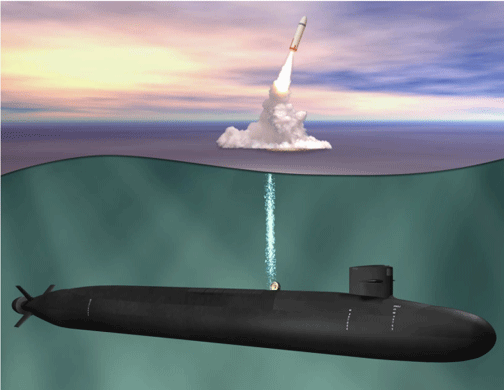 The U.S. Submarine That Could Bring Nuclear Doomsday With It, One sub to end a country. National Interest by Sebastien Roblin– 22 Nov 19 The U.S. Submarine That Could Bring Nuclear Doomsday With It, One sub to end a country. National Interest by Sebastien Roblin– 22 Nov 19
Key Point: The Ohio-class could pull it off. “…… The most deadly of the real-life kaiju prowling the oceans today are the fourteen Ohio-class ballistic-missile submarines, which carry upwards of half of the United States’ nuclear arsenal onboard. If you do the math, the Ohio-class boats may be the most destructive weapon system created by humankind. Each of the 170-meter-long vessels can carry twenty-four Trident II submarine-launched ballistic missiles (SLBMs) which can be fired from underwater to strike at targets more than seven thousand miles away depending on the load. As a Trident II reenters the atmosphere at speeds of up to Mach 24, it splits into up to eight independent reentry vehicles, each with a 100- or 475-kiloton nuclear warhead. In short, a full salvo from an Ohio-class submarine—which can be launched in less than one minute—could unleash up to 192 nuclear warheads to wipe twenty-four cities off the map. This is a nightmarish weapon of the apocalypse. The closest competitor to the Ohio-class submarine is the Russia’s sole remaining Typhoon-class submarine, a larger vessel with twenty ballistic-missile launch tubes. However, China, Russia, India, England and France all operate multiple ballistic-missile submarines with varying missile armaments—and even a few such submarines would suffice to annihilate the major cities in a developed nation………..
the New START treaty which came into effect in 2011 imposes additional limits on the number of deployed nuclear weapons. The current plan is to keep twelve Ohio-class subs active at time with twenty Trident IIs each, while two more boomers remain in overhaul, keeping a total of 240 missiles active at a time with 1,090 warheads between them. Don’t worry, restless hawks: that’s still enough to destroy the world several times over! ………. https://nationalinterest.org/blog/buzz/us-submarine-could-bring-nuclear-doomsday-it-98332
What possible excuse is there for such monstrous, nation-destroying weaponry?
|
|
France’s company EDF selling out of USA nuclear plants, Exelon to buy.
EDF Will Bail on Three Nuclear Plants, Exelon Holds the Bag, Power Mag 11/21/2019 | Aaron Larson Exelon Generation said EDF Group—a French integrated electricity company—is exercising a put option to sell its 49.99% interest in the R.E. Ginna, Nine Mile Point, and Calvert Cliffs nuclear energy facilities. The two companies will now begin negotiations for Exelon to acquire full ownership of the plants.
EDF’s involvement in the facilities was through the Constellation Energy Nuclear Group (CENG), a joint venture between it and Constellation Energy, which was negotiated in 2009. Exelon acquired its majority stake in the plants as part of a merger with Constellation Energy, a deal that closed in March 2012.
EDF said the disposal of CENG shares is part of a previously announced non-core-asset disposal plan. The put option could have been exercised by EDF anytime between Jan. 1, 2016, and June 30, 2022. A transaction price will follow from the determination of the fair market value of CENG shares pursuant to the contractual provisions of the put option agreement, EDF said.
…….. The facilities consist of the single-unit 576-MW R.E. Ginna Nuclear Power Plant (Figure 1) and the dual-unit 1,907-MW Nine Mile Point Nuclear Station, which are both in upstate New York, and the dual-unit 1,756-MW Calvert Cliffs Nuclear Power Plant in Maryland. The upstate New York plants were under economic pressure and faced possible closure a few years ago, but subsidies approved by the state have kept the units financially viable.
John Hopkins University prominent in helping the nuclear weapons industry
 Johns Hopkins University among schools furthering nuclear weapons, BALTIMORE SUN |NOV 20, 2019 When choosing a university, students should be weighing class sizes, major options or even the dining hall food quality. But what they shouldn’t have to consider is if their dream school helps to build nuclear weapons.
A new report reveals that nearly 50 U.S. colleges and universities contribute to building and maintaining U.S. nuclear weapons, in direct contradiction to their mission statements and often without the knowledge of their students and faculty. Three local universities are among these schools of mass destruction: Johns Hopkins University in Baltimore and George Washington University and Georgetown University in Washington, D.C.
Johns Hopkins’ Applied Physics Laboratory is a Defense Department-affiliated research center that works on nuclear weapons, which helped Johns Hopkins receive $828 million in research and development grants from the Defense Department for Fiscal Year 2017 — more than twice as much any other American university. The laboratory renewed a seven-year contract in 2017 to continue a strategic partnership with the Air Force Nuclear Weapons Center.
The laboratory operates away from the prying eyes of most students and faculty in a 453-acre, off-campus location. While Johns Hopkins generally exempts classified research, there is a blanket exemption policy for classified research at the Applied Physics Laboratory.
George Washington University maintains a Stockpile Stewardship Academic Alliance Center of Excellence, receiving $12.5 million in grants over five years for research relevant to the nation’s nuclear stockpile.
Georgetown University is a university partner of Lawrence Livermore National Laboratory. While the details of the partnership are not public, Lawrence Livermore receives 86% of its funding from the U.S. National Nuclear Security Administration Weapons Activities Appropriations for the design, engineering and evaluation of nuclear warheads.
College students should learn how to make the world a better place, not how to develop the tools to end it. Universities themselves make this point in their mission statements. Johns Hopkins sums up its mission as “knowledge for the world.” The mission of George Washington University is to “educate individuals in liberal arts, languages, sciences, learned professions, and other courses and subjects of study, and to conduct scholarly research and publish the findings of such research.” Georgetown University’s website states that at the core of its Jesuit tradition are “transcendent values, including the integration of learning, faith and service; care for the whole person; character and conviction; religious truth and interfaith understanding; and a commitment to building a more just world.”
It is time for these universities to live up to their own moral objectives.
As a first step, universities must provide more clarity about their work to support U.S. nuclear weapons so that students and faculty can make informed choices about where they would like to invest their intellectual capital. Johns Hopkins should reconsider whether permitting classified research at the Applied Physics Laboratory is in line with its “commitment to openness in documentation and dissemination of research results.”
George Washington University should shut down its “Stockpile Stewardship Academic Alliance Center of Excellence,” unless it receives a legally-binding guarantee that none of the basic research the center conducts will be applied to maintaining and expanding the U.S. nuclear weapons arsenal.
Georgetown may continue to partner with Lawrence Livermore on the minority of the laboratory’s research that contributes to “building a more just world.” But it must explicitly reject research for the laboratory’s main objective — building and maintaining nuclear weapons.
Universities can play a key role to equip the next generation of leaders with the knowledge and skills to make the world better a place. Nuclear weapons don’t belong there.
Alicia Sanders-Zakre (alicia@icanw.org) is policy and research coordinator of ICAN, Winners of the 2017 Nobel Peace Prize. https://www.baltimoresun.com/opinion/op-ed/bs-ed-op-1121-universities-nuclear-weapons-20191120-m77eyfshsngizdmsbl64z3mm7a-story.html
Holtec’s proposed nuclear storage facility of little benefit to New Mexico
“There is no guarantee that high-level nuclear waste can be safely transported to and through New Mexico.”
“There is no guarantee that this site will truly be ‘interim’ and won’t become the permanent dumping ground for our nation’s nuclear waste.”
“I’ve never understood what the rationale was for transporting this nuclear waste for these many miles all the way down to New Mexico. I don’t have an answer as to why it can’t be stored close to where it was created,”
“We really have to think about our land use, to think about being able to build other kinds of businesses that don’t end up spoiling the land and air,”

|
Not much benefit to the state’: Legislators scrutinize details of Holtec’s proposed nuclear storage facility, New Mexico Political Report, By Kendra Chamberlain 20 Nov 19, “……. The firm Holtec International, which specializes in spent nuclear fuel storage, has applied for a license from the federal Nuclear Regulatory Commission to construct and operate the facility in southeastern New Mexico. The proposal, which is still moving through the licensing application process established by the NRC for consolidated interim storage, would house up to 120,000 metric tons of high-level waste at capacity — more nuclear waste than currently exists in the country.
During his presentation to the committee, Mayer pitched the project as an economic boon to the state that would not affect oil and gas activity in the area and assured committee members the facility would not threaten water resources in the area. But legislators at the meeting weren’t completely sold on the project. “I’m reminded of how [much] of a long-term legacy this project is creating for fellow New Mexicans,” said state Sen. Jeff Steinborn, D-Las Cruces. “We’re dealing with something that our successors’ successors’ successors will be dealing with, with not much benefit to the state and a very significant upfront cost.” Continue reading |
US presidential candidate Deval Patrick’s ignorance about nuclear weapons
 Deval Patrick: the latest presidential candidate to be uninformed on nuclear weapons, Bulletin of the Atomic Scientists, By John Krzyzaniak, November 20, 2019 Deval Patrick, the former governor of Massachusetts, became the latest latecomer to the 2020 presidential campaign when he entered the fray last week. At the time of this writing, he does not have very many clear policy positions, or even a campaign website. But anyone running for president—even someone who’s still on the honeymoon period of his announcement—should expect to be asked tough policy questions, especially on important issues like nuclear weapons. Was Patrick prepared? Well, not really………. Deval Patrick: the latest presidential candidate to be uninformed on nuclear weapons, Bulletin of the Atomic Scientists, By John Krzyzaniak, November 20, 2019 Deval Patrick, the former governor of Massachusetts, became the latest latecomer to the 2020 presidential campaign when he entered the fray last week. At the time of this writing, he does not have very many clear policy positions, or even a campaign website. But anyone running for president—even someone who’s still on the honeymoon period of his announcement—should expect to be asked tough policy questions, especially on important issues like nuclear weapons. Was Patrick prepared? Well, not really……….
Overall, Patrick is woefully uninformed about what is a hugely important—dare I say existential—issue. But he’s not alone: A whole slew of 2020 candidates have either pleaded ignorance on certain nuclear policies or given answers that were borderline incomprehensible. In 2016 things were hardly different. In a debate with Hillary Clinton, then-candidate Donald Trump made two contradictory statements on this issue in almost the same breath, saying both that he would “certainly not do a first strike” and that he “can’t take anything off the table.” The next Democratic presidential debate is on Wednesday evening. If we’ve learned anything from the debates, it’s that disproportionate attention to one or two issues, such as healthcare or immigration, has driven candidates to put serious thought into their own stance on those issues. If the moderators can carve out 10 minutes for a question or three on America’s nuclear weapons policies, it would mark a welcome change. https://thebulletin.org/2019/11/deval-patrick-the-latest-presidential-candidate-to-be-uninformed-on-nuclear-weapons/ |
|
If You Can’t Do Nuclear, Try (Concentrating) Solar Power Instead
|
If You Can’t Do Nuclear, Try (Concentrating) Solar Power Instead, https://cleantechnica.com/2019/11/19/concentrating-solar-power-breakthrough/ Some great news for concentrating solar power fans sailed in over the transom this morning. Mega wealthy person and famed US investor Bill Gates may be chasing the nuclear unicorn with his startup Terrapower, but meanwhile his other startup Heliogen — his secret one! — has just burst out of stealth mode with a new concentrating solar power breakthrough in its pocket.
A Concentrating Solar Power Breakthrough Grows In Lancaster, CAWhile TerraPower has been pitching nukes, the Heliogen research team has been hammering away in deepest secrecy at its research facility in Lancaster, California, with the aim of developing a concentrating solar power system that can deliver temperatures of more than 1,000 degrees Celsius.
Reading between the lines of Heliogen’s first ever press release, that puts the new solar system in direct competition with fossil fuels for high-heat industrial processes including cement and steel production. If all goes according to plan, the new system will also breathe new, lower-carbon life into the petrochemical industry. That’s great news for ExxonMobil and other petroleum (and natural gas) stakeholders, though it’s not so great news for the “keep it in the ground” approach to averting climate global disaster. The Concentrating Solar Power SolutionA typical concentrating solar power system works by collecting sunlight from arrays of specialized mirrors called heliostats (so Heliogen, get it?), and focusing the energy on a central point, where it heats molten salt or another medium, which then gets put to use. Boiling water for steam to run a generator is one such example. If that sounds complicated, it is. Concentrating solar power has had its critics in past years, mainly due to its relatively high cost and complexity. Nevertheless, the Department of Energy has been a big supporter of the technology here in the US, and it has been catching on elsewhere around the globe as the technology improves and costs come down. The Energy Department has also been zeroing in on research that leads to new record-setting heat levels, just as Heliogen is claiming. Here’s Heliogen on that topic: “Previous commercial concentrating solar thermal systems have been designed to reach temperatures of up to only 565 degrees Celsius – useful for power generation, but insufficient for many industrial processes. Many of these processes require much higher temperatures, which have traditionally been reached through the burning of fossil fuels.” That’s nothing. Heliogen is looking at temperatures up to 1,500 degrees. If you’re thinking what Heliogen is thinking, run right out and buy yourself a cigar. Among other uses, the technology could be deployed to “split” hydrogen from water. Hydrogen is a zero emission fuel but the primary source of hydrogen today is fossil natural gas, so the prospect of switching to water as a feedstock is a big deal. In terms of staving off catastrophic climate change, devoting energy to water-splitting systems makes sense only if the energy comes from renewable resources like solar, so if you hear the sound of popping in the distance, that would be renewable hydrogen fans breaking out the bubbly in celebration. How Does It Work?So far so good, but the devil is in the details. Other teams are pursuing high heat solar power systems. What puts Heliogen ahead of the rest of the concentrating solar power pack? The company isn’t saying much, except that it has something to do with an “advanced computer vision software to hyper-accurately align a large array of mirrors to reflect sunlight to a single target.” So far that sounds like a typical concentrating solar power system, with an extra punch provided by maneuvering the array of heliostats with extreme accuracy, enabling them to reflect more sunlight than other systems. There is probably a lot more to the picture, but that’s all Heliogen is giving out for now. Come to think of it, though, Heliogen has something in common with another company that has a concentrating solar power research site in Lancaster, California, called Edisun Microgrids. The thing in common is visionary innovator Bill Gross, who is listed as the CEO of Edisun, and who is also the CEO and co-founder of Heliogen. Gross has several other solar startups under his belt, but let’s zero in on Edisun. Last spring the Energy Department included Edisun in a group of research teams aiming to bring down the cost of concentrating solar power. Here’s the rundown from the Energy Department: “Traditional cost reduction strategies have focused on developing larger heliostats with more mirror surface area on each unit, making the mirrors even more susceptible to wind. This project will pair smaller mirrors that can more precisely track the sun with an inexpensive novel gear train as the foundation of the heliostat.” Stay tuned as CleanTechnica checks in with Heliogen for more details on its technology. Whatever Happened To TerraPower?Meanwhile, speaking of arrays, Heliogen has an impressive array of researchers, partners, and investors behind it, but Bill Gates sticks out in terms of name recognition so let’s hear what he has to say (via Heliogen’s press release): “…If we’re going to get to zero-carbon emissions overall, we have a lot of inventing to do. I’m pleased to have been an early backer of Bill Gross’s novel solar concentration technology. Its capacity to achieve the high temperatures required for these processes is a promising development in the quest to one day replace fossil fuel.” So, where does that leave TerraPower? The nuclear industry still has potential for growth in some parts of the world. TerraPower initially had China in its sights, although that avenue has reportedly been closed, at least temporarily, due to the President* Trump’s trade policies. Here in the US the prospects for finding news sites for nuclear power plants are zero to none within the foreseeable future, despite an assist from President* Trump’s so-named Affordable Clean Energy plan. Nevertheless, there are still 98 nuclear power plants in the US. Some of them could potentially house new technology as their licenses come up for renewal. As of last year the Energy Department was still cheerleading for TerraPower’s molten salt nuclear technology, and TerraPower continues to soldier on with R&D. The company has been working on a lab expansion and last September it also passed an important milestone in its work with the Energy Department’s Idaho National Laboratory. Since some concentrating solar systems also use molten salt as a medium, it’s also possible that some of TerraPower’s R&D could transfer to the concentrating solar power field, even if the nuclear thing doesn’t work out so well. |
|
|
Desperate times for the nuclear industry – could Australia be its saviour?
the number one goal of the nuclear lobby is to remove Australia’s national and state laws that prohibit the nuclear industry.
the campaign by the global nuclear industry, particularly the American industry, to kickstart another “nuclear renaissance”, before it’s too late.

Australia is the great ‘white’ hope for the global nuclear industry, Independent Australia, By Noel Wauchope | 19 November 2019, The global nuclear industry is in crisis but that doesn’t stop the pro-nuclear lobby from peddling exorbitantly expensive nuclear as a “green alternative”. Noel Wauchope reports.
The global nuclear industry is in crisis. Well, in the Western world, anyway. It is hard to get a clear picture of Russia and China, who appear to be happy putting developing nations into debt, as they market their nuclear reactors overseas with very generous loans — it helps to have stte-owned companies funding this effort.
But when it comes to Western democracies, where the industry is supposed to be commercially viable, there’s trouble. The latest news from S&P Global Ratings has made it plain: nuclear power can survive only with massive tax-payer support. Existing large nuclear reactors need subsidies to continue, while the expense of building new ones has scared off investors.
So, for the nuclear lobby, ultimate survival seems to depend on developing and mass marketing “Generation IV” small and medium reactors (SMRs). …..
for the U.S. marketers, Australia, as a politically stable English-speaking ally, is a particularly desirable target. Australia’s geographic situation has advantages. One is the possibility of making Australia a hub for taking in radioactive wastes from South-East Asian countries. That’s a long-term goal of the global nuclear lobby. …..
In particular, small nuclear reactors are marketed for submarines. That’s especially important now, as a new type of non-nuclear submarine – the Air Independent Propulsion (AIP) submarine, faster and much cheaper – could be making nuclear submarines obsolete. The Australian nuclear lobby is very keen on nuclear submarines: they are now promoting SMRs with propagandists such as Heiko Timmers, from Australian National University. This is an additional reason why Australia is the great white hope.
I use the word “white” advisedly here because Australia has a remarkable history of distrust and opposition to this industry form Indigenous Australians…..
The hunt for a national waste dump site is one problematic side of the nuclear lobby’s push for Australia. While accepted international policy on nuclear waste storage is that the site should be as near as possible to the point of production, the Australian Government’s plan is to set up a temporary site for nuclear waste, some 1700 km from its production at Lucas Heights. The other equally problematic issue is how to gain political and public support for the industry, which is currently banned by both Federal and state laws. SMR companies like NuScale are loath to spend money on winning hearts and minds in Australia while nuclear prohibition laws remain.
 Ziggy Switkowski, a long-time promoter of the nuclear industry, has now renewed this campaign — although he covers himself well, in case it all goes bad, noting that nuclear energy for Australia could be a “catastrophic failure“. ……
his submission (No. 41) to the current Federal Inquiry into nuclear power sets out only one aim, that
‘… all obstacles … be removed to the consideration of nuclear power as part of the national energy strategy debate.’
So the Environmental Protection and Biodiversity Conservation Act (EPBC Act) should be changed, according to Switkowski. In an article in The Australian, NSW State Liberal MP Taylor Martin suggested that the Federal and state laws be changed to prohibit existing forms of nuclear power technology but to allow small modular reactors.
Switkowski makes it clear that the number one goal of the nuclear lobby is to remove Australia’s national and state laws that prohibit the nuclear industry. And, from reading many pro-nuclear submissions to the Federal Inquiry, this emerges as their most significant aim.
It does not appear that the Australian public is currently all agog about nuclear power. So, it does seem a great coincidence that so many of their representatives in parliaments – Federal, Victorian, New South Wales, South Australia and members of a new party in Western Australia – are now advocating nuclear inquiries, leading to the repeal of nuclear prohibition laws.
We can only conclude that this new, seemingly coincidental push to overturn Australia’s nuclear prohibition laws, is in concert with the push for a national nuclear waste dump in rural South Australia — part of the campaign by the global nuclear industry, particularly the American industry, to kickstart another “nuclear renaissance”, before it’s too late.
Despite its relatively small population, Australia does “punch above its weight” in terms of its international reputation and as a commercial market. The repeal of Australia’s laws banning the nuclear industry would be a very significant symbol for much-needed new credibility for the pro-nuclear lobby. It would open the door for a clever publicity drive, no doubt using “action on climate change” as the rationale for developing nuclear power.
In the meantime, Australia has abundant natural resources for sun, wind and wave energy, and could become a leader in the South-East Asian region for developing and exporting renewable energy — a much quicker and more credible way to combat global warming. https://independentaustralia.net/politics/politics-display/australia-is-the-great-white-hope-for-the-global-nuclear-industry,13326
As negotiation deadline nears, tension between Kim Jong Un and Donald Trump
Trump, Kim at odds as deadline looms in nuclear talks, Glen Carey and Jihye Lee, Bloomberg, November 18, 2019
The bonhomie between President Donald Trump and North Korean leader Kim Jong Un is nearing a key deadline showing new signs of strain.
Trump urged Kim over the weekend to “act quickly” to get a nuclear deal done, suggesting the two leaders could meet again “soon.” His comments came hours after North Korea ruled out nuclear talks without a policy change by the U.S. and reported on a military drill observed by Kim himself.
Veteran North Korea nuclear adviser, Kim Kye Gwan, told Trump that Pyongyang will no longer give him “things to boast about,” the state’s official KCNA news agency on Monday quoted him as saying. He added North Korea is no longer interested in talks that the U.S. “uses to buy time.”
Trump and Kim Jong Un, who have previously displayed what Pyongyang calls “mysteriously wonderful chemistry,” appear to be going in different directions as the clock ticks down. Kim has given Trump until the end of the year to ease up on sanctions or risk him taking a “new path,” meaning a possible escalation of military tensions during the U.S. presidential campaign…….
After more than a year of talks and three Trump-Kim meetings, the two sides remain divided on issues from sanctions relief to disarmament. Even though North Korea hasn’t taken any major steps to give up its weapons, Kim has won concessions from Trump that include canceling some U.S.-South Korean joint military drills that have drawn Pyongyang’s anger.
North Korea hasn’t explained what Kim intends to do on his “new path,” although the regime has often referred to his decision to halt tests of nuclear bombs and intercontinental ballistic missiles two years ago. In May, North Korea resumed tests of shorter-range ballistic missiles.,,,,,,,
The North Korea warning about U.S. nuclear talks came despite the U.S.’s decision to suspend another round of military drills with South Korea. Defense Secretary Mark Esper said on the sidelines of a regional security conference that Washington and Seoul had “jointly decided to postpone this month’s combined flying training event” after “close consultation and careful consideration.”
Pyongyang last week blamed U.S.-South Korean military drills “as a main factor of screwing up tensions.”
The emerging potential new nuclear industry political scam
 Does Nuclear Power Slow Or Speed Climate Change? Forbes, Amory B. Lovins 17 Nov 19,
 2. Through generally regulated utility tariffs, customers paid for the plants’ construction and financing, including a just and reasonable return on capital.
3. Customers paid over decades for the plants’ operation, including major repairs, power upratings, and safety upgrades.
4. Many customers reimbursed owners for “stranded-asset costs” totaling upwards of $70 billion to support the owner-demanded transition to competitive wholesale markets.
5. Over the past few years, when reactors generating 2 percent of U.S. electricity proved unable to compete in those wholesale markets (though most of their owners kept their finances secret and kept reporting profits to investors), the owners persuaded state legislators in Illinois, New York, New Jersey, Connecticut, and Ohio to vote billions of dollars a year for new multi-year operating subsidies.
6. Exelon, the nation’s largest nuclear operator and the leading player in the previous two steps, successfully sought Federal regulatory approval for greater capacity payments from power pools whose auctions found nuclear power uncompetitive and whose own rules were thrown off-balance by the new state subsidies. And now, as the annual logrolling season of “tax extenders” rolls around in Congress:
7. For the third year, Exelon is advancing a “Nuclear Powers America Act” to create a new federal investment tax credit on nuclear fuel and maintenance expenses to “help level the playing fuel with other clean energy sources”—whose temporary tax credits are meanwhile being phased down or out. This follows a longstanding pattern of giving different kinds of subsidies to renewables than to nuclear, then “leveling the playing field” by trying to duplicate renewables’ specific forms of subsidies with new ones for nuclear, but never the reverse.
This saga of selling the same hay seven times—and those clever lawyers aren’t done yet—doesn’t include many additional federal and state subsidies. It also doesn’t include an emerging potential scam that could end up with ratepayers’ and federal taxpayers’ getting stuck with vast decommissioning and waste-management liabilities. This emerging pattern has an LLC buy a closed reactor. Absent oversight or rules to stop misbehavior, the LLC could then choose to strip the accumulated customer-funded multi-billion-dollar cash decommissioning fund, not finish the job, and walk away, leaving the parent company whole and electricity customers or taxpayers holding the bag. Watch this space.
Exelon’s proposed “nuclear investment tax credit” has ingenious new features:
– By redefining normal accounting categories so fuel becomes a capital investment, it repays utilities for an “investment” that’s really just a normal operating cost—thus trying to make nuclear operating costs look small by shifting much of them to taxpayers.
The nuclear operating costs it covers have no counterpart for renewables (fuel, nuclear waste management, protection against catastrophic releases of radioactivity), or almost none (operation & maintenance costs), so a tax credit for them would specifically advantage nuclear against renewables.
– Nuclear owners may be able to double-dip, collecting the new federal subsidy and new state subsidies for the same plants and thus turning dead dinosaurs into juicy cash cows.
– There’s virtually no “means test”: the new federal subsidy would apply to about 95% of US operating reactors, including those that the industry claims are currently profitable.
– The proposed legislation, obscurely written in tax-law jargon, appears to be a 30% tax credit (phasing down to 26% in 2024, 22% in 2025, and a permanent 10% in and after 2026), and to cost ~$22–26 billion over the first decade, or ~$33 billion counting the crowding-out of cheaper competitors. Every billion dollars thus bilked from taxpayers is unavailable to provide more electrical services and save more carbon by cheaper means.
– By further distorting the delicate balance between federal, regional, and state regulation, the subsidy seems tailored to weaken or destroy the efficient regional power markets where renewables beat nuclear power. The goal is thus to pay nuclear power for values it doesn’t deliver, while blocking its most potent competitors from continuing to provide the values they do deliver.
– Unlike renewable credits that have helped to mature important new technologies, the nuclear credit would elicit no new production, capacity, or innovation. It would simply transfer tens of billions of dollars to the owners of uncompetitive nuclear assets bought decades ago—if they apply for license extension by 2026, as nearly all have done.
This covert attack on renewables is logical because renewables are now the supply-side competitor nuclear must beat but can’t. The nuclear industry is reluctant to admit that renewables are a legitimate competitor, since this would contradict its claims that renewables can’t supply reliable power. Renewables, unlike nuclear power, are also widely popular. Nuclear advocates therefore tend to blame their woes instead on cheap natural gas. However, new and often even existing combined-cycle gas-fired power plants no longer have a business case: a September 2019 study found that at least 90% of the 88 proposed US gas-fired plants are pre-stranded assets. ………https://www.forbes.com/sites/amorylovins/2019/11/18/does-nuclear-power-slow-or-speed-climate-change/#5b47c988506b
20% drop in patient’s radiation dose achieved by U.S. radiologists
|
The report, published Monday, Nov. 18, by the National Council on Radiation Protection and Measurements, showed doses dropped by 15% to 20% among U.S. patients between 2006 and 2016. Per person, the estimated average dose fell from 2.92 millisievert (mSv) in 2006 to 2.16 mSv in 2016. “We are pleased, but not surprised, that despite a steadily increasing and aging population, the medical radiation dose Americans receive is going down,” Continue reading |

NRC likely to extend licence for Westinghouse nuclear fuel factory, despite its history of spills and leaks
 Nuclear safety regulators take heat for downplaying threat from atomic fuel plant, The State BY SAMMY FRETWELL, 17 Nov 19, Federal nuclear safety regulators drew criticism Thursday night for concluding that an aging atomic fuel plant could operate another 40 years without having much impact on the environment of eastern Richland County.The 50-year-old Westinghouse nuclear fuel factory, located between Interstate 77 and Congaree National Park, has had a recent history of missteps, including spills and leaks that have focused attention on the facility and it’s safety culture. Nuclear safety regulators take heat for downplaying threat from atomic fuel plant, The State BY SAMMY FRETWELL, 17 Nov 19, Federal nuclear safety regulators drew criticism Thursday night for concluding that an aging atomic fuel plant could operate another 40 years without having much impact on the environment of eastern Richland County.The 50-year-old Westinghouse nuclear fuel factory, located between Interstate 77 and Congaree National Park, has had a recent history of missteps, including spills and leaks that have focused attention on the facility and it’s safety culture.
But as its troubles have surfaced, the company has sought federal permission for a new operating permit. A recent Nuclear Regulatory Commission report said the facility will continue to have leaks if its permit is renewed, yet those problems won’t have much affect on the surrounding landscape. The study said the plant was safe enough to operate if it receives a new 40 year license because pollution will be monitored and cleaned up before it leaves the property. Those speaking at a public hearing Thursday — mostly environmentalists — said they can’t understand why the NRC thinks a plant with a multitude of problems will operate safely for the next four decades. They called on the agency to conduct a more detailed study known as an environmental impact statement. If the NRC does approve a new license, it should be for less than 40 years, those speaking at the meeting said. “There have been releases to the environment, there are ongoing impacts to the environment and there are likely to be future impacts to the environment,’’ Congaree Riverkeeper Bill Stangler said, adding that the NRC has plenty of time to study the matter because the current license doesn’t expire until 2027…… The NRC’s environmental assessment, which was the subject of the meeting, will help the agency decide whether to issue the 40-year license so the plant can continue operating. A twin report that focuses on safety inside the plant is still under way. It also will be considered by the NRC in making a licensing decision, likely in April. ….. Despite its’ economic impact on the Columbia area, Westinghouse has failed to prevent extensive groundwater contamination since opening 50 years ago. Toxins such as nitrate, uranium and Technetium 99 have fouled groundwater, some of which is moving toward the Congaree River…… not everyone was satisfied that the NRC has done its job or comfortable with the agency’s assurances. Tom Clements, a nuclear safety watchdog from Columbia, said the NRC didn’t study the Westinghouse plant thoroughly enough to justify a new license. The agency’s environmental assessment left out key information and downplayed the threat of expected spills and leaks in the future, he said. One issue is the source of Technetium 99, a radioactive pollutant discovered in groundwater, he said. The NRC doesn’t have a clear picture of where the nuclear material is coming from. Clements said Westinghouse should have to operate for one year without major incidents before a license should be granted. The license should be for 10 years, instead of 40, if it needs approval, he said. The Westinghouse plant has had groundwater contamination dating to the 1980s, and through the years, the plant has been cited by the NRC over nuclear safety mistakes. But issues since 2016 have refocused attention on the facility, which is nestled in a wooded, rural area along the Congaree River of eastern Richland County. https://www.thestate.com/news/local/environment/article237369084.html |
|
49 USA universities get lots of money for helping to develop nuclear weapons
 ‘Schools of Mass Destruction’: Report Details 49 US Universities Abetting Nuclear Weapons Complex https://www.commondreams.org/news/2019/11/13/schools-mass-destruction-report-details-49-us-universities-abetting-nuclear-weapons “Why would an institution of higher learning support weapons that cause terrible humanitarian consequences?”
That’s according to a new report released Wednesday by the International Campaign to Abolish Nuclear Weapons (ICAN), “Schools of Mass Destruction: American Universities in the U.S. Nuclear Weapons Complex.” The report calls out 49 educational institutions, describes their direct and indirect involvement, and recommends steps the universities, students, and faculty can take to address the issue.
The report names prestigious universities including Stanford, Georgetown, and MIT. The cited universities have reportedly engaged in four different avenues of complicity in nuclear weapons production, defying their own mission statements and international law.
In return, the report says, “universities receive funding, access to research facilities, and specific career opportunities for students.”
The complicity, according to ICAN, falls into one of four categories: direct management, institutional partnerships, research programs and partnerships, and workforce development programs.
From the report’s profiles on Georgetown University and the University of Nevada – Reno:
In return, the report says, “universities receive funding, access to research facilities, and specific career opportunities for students.”
The complicity, according to ICAN, falls into one of four categories: direct management, institutional partnerships, research programs and partnerships, and workforce development programs.
From the report’s profiles on Georgetown University and the University of Nevada – Reno:
- Georgetown is listed as a university partner on the website of Lawrence Livermore National Laboratory. According to administration at Georgetown, the university has a formal agreement with the laboratory and collaborates in the areas of neuroscience, physics and cancer, with the lab hosting graduate students for summer internships. The Lawrence Livermore lab provides design and engineering for several nuclear warhead types and conducts simulated experiments to evaluate warheads.
- The University of Nevada – Reno developed a new Graduate Certificate in Nuclear Packaging in partnership with the Department of Energy. A Nevada National Security Site engineer was the first to complete the program. The Nevada National Security Site is the location of nearly 1,000 tests of nuclear weapons in past decades, leading to serious health impacts for nearby residents and participating military personnel. Currently, staff at the site conduct simulated experiments to test the reliability and performance of nuclear weapons. The site also hosts “subcritical experiments” that allow for the evaluation of nuclear weapons materials under certain conditions, but do not cause a “self-sustaining nuclear chain reaction.”
Those universities are not the “most complicit.” That dubious honor goes to the University of California, Texas A&M University, Johns Hopkins University, and University of New Mexico. In a Twitter thread, ICAN highlighted those schools’ involvement:
#1 The state of California supports a ban of #nuclearweaponshttp://bit.ly/2pbn7OT,but the @UofCalifornia has continuously managed the primary #nuclearweapons labs for the US since WWII. When will UC stop supporting weapons that pose a catastrophic threat to our existence?
#2 @TAMU administration has publicly stated its “commitment to the #nuclearweapons industry.”http://bit.ly/2CyVbau Why would an institution of higher learning support weapons that cause terrible humanitarian consequences?#3 @JohnsHopkins’ applied physics lab is directly involved in #nuclearweapons production. It receives more than twice as much funding from the US @DeptofDefense than any other U.S. university. @JHUPress @JHUNewsLetter
#4 More than 3,800 New Mexicans have suffered serious illness or death as a result of US nuclear weapons tests http://bit.ly/33IL4vS So why does the @UNM University of New Mexico wants its faculty and students to collaborate with #nuclearweapons lab scientists?The report comes as Trump administration policies have given rise to fears of a new arms race. As the report notes,
In the United States, the Trump administration has expanded plans to upgrade the nation’s nuclear weapons arsenal. Over the next ten years, the Congressional Budget Office estimates U.S. taxpayers will pay nearly $500 billion to maintain and modernize its country’s nuclear weapons arsenal, or almost $100,000 per minute.
Also noted in the publication is the administration’s withdrawal earlier this year from the Intermediate-Range Nuclear Forces Treaty with Russia and its 2018 Nuclear Posture Review (NPR), which calls for “diversifying” the country’s nuclear arsenal.
That gives greater urgency to the call for the schools to sever their partnerships—and the clear support for the United Nations Treaty on the Prohibition of Nuclear Weapons, ICAN says, should be seen as an opportunity for action.
U.S. universities must reconsider connections to the nuclear weapons complex due to the devastating humanitarian and environmental impacts of nuclear weapons and because current U.S. policies make their use more likely,” says the report.
A first step is for schools to be more transparent about their involvement in the nuclear weapons complex but that’s not enough. “Universities would not willingly participate today in research enabling the production of chemical and biological weapons. Nuclear weapons are morally equivalent to these other weapons of mass destruction.”
Students and faculty can take action as well. ICAN suggests sharing the report to increase awareness, demanding the institutions make their research transparent, and calling on the schools to become part of the effort to ban nuclear weapons by dropping their involvement.
Indigenous opposition grows against proposal for grand nuclear waste dump in New Mexico
 Some fear the “interim” storage facility could become a de facto permanent storage facility
transport of high-level radioactive waste across the state  could also lead to potentially dangerous nuclear releases, leaving impacted communities responsible for emergency responses.
 the proposal fits into a wider pattern of negligence and environmental racism on behalf of the federal government towards one of the United States’ poorest majority-minority states.
|
Nuclear Colonialism: Indigenous opposition grows against proposal for nation’s largest nuclear storage facility in NM Political Report By Kendra Chamberlain 14 Nov 19, A proposal for New Mexico to house one of the world’s largest nuclear waste storage facilities has drawn opposition from nearly every indigenous nation in the state. Nuclear Issues Study Group co-founder and Diné organizer Leona Morgan told state legislators last week the project, if approved, would perpetuate a legacy of nuclear colonialism against New Mexico’s indigenous communities and people of color.Holtec International, a private company specializing in spent nuclear fuel storage and management, applied for a license from the federal Nuclear Regulatory Commission to construct and operate the facility in southeastern New Mexico. The proposal, which has been in the works since 2011, would see high-level waste generated at nuclear power plants across the country transported to New Mexico for storage at the proposed facility along the Lea-Eddy county line between Hobbs and Carlsbad. Continue reading |
1 This Month
26 September – International Day for the Total Elimination of Nuclear Weapons





PLEASE OPPOSE HR 8255 AND S.3639 – bills would accelerate satellite deployment, with no environmental review or safeguards – https://ncstd5li.quorum.us/campaign/169331/
To see nuclear-related stories in greater depth and intensity – go to https://nuclearinformation.wordpress.com
-
Archives
- September 2026 (305)
- August 2026 (330)
- July 2026 (355)
- June 2026 (287)
- May 2026 (306)
- April 2026 (356)
- March 2026 (251)
- February 2026 (267)
- January 2026 (308)
- December 2025 (358)
- November 2025 (359)
- October 2025 (375)
-
Categories
- 1
- 1 NUCLEAR ISSUES
- business and costs
- climate change
- culture and arts
- ENERGY
- environment
- health
- history
- indigenous issues
- Legal
- marketing of nuclear
- media
- opposition to nuclear
- PERSONAL STORIES
- politics
- politics international
- Religion and ethics
- safety
- secrets,lies and civil liberties
- spinbuster
- technology
- Uranium
- wastes
- weapons and war
- Women
- 2 WORLD
- ACTION
- AFRICA
- Atrocities
- AUSTRALIA
- Christina's notes
- Christina's themes
- culture and arts
- Events
- Fuk 2022
- Fuk 2023
- Fukushima 2017
- Fukushima 2018
- fukushima 2019
- Fukushima 2020
- Fukushima 2021
- general
- global warming
- Humour (God we need it)
- Nuclear
- RARE EARTHS
- Reference
- resources – print
- Resources -audiovicual
- Weekly Newsletter
- World
- World Nuclear
- YouTube
-
RSS
Entries RSS
Comments RSS

