U.S. Nuclear Regulatory Commission weakens some regulations in view of COVID-19
Nuclear regulators ease some power reactor regs in response to COVID-19, By Matthew Bandyk Utility Dive, March 31, 2020,
- In response to the COVID-19 pandemic and its strain on available nuclear plant personnel, the U.S. Nuclear Regulatory Commission is allowing power reactor operators to apply for temporary exemptions from regulations limiting the amount of hours workers can stay on the job, according to a letter released by the agency on Monday.
- In addition, the NRC staff is also working on a separate memorandum that will guide nuclear plants as to which labor and time-intensive tasks they can temporarily waive, such as many of the inspections during refueling outages………
The nuclear industry and the impact of coronavirus
|
Nuclear industry’s response to Covid-19 outbreak, Power Technology, 1 Apr,20 “……..Impact of coronavirus on the nuclear industry’s operations The nuclear industry is assessing measures to safeguard their workforce and implementing business continuity plans to ensure continuous functioning of key aspects of their businesses. The nuclear industry already has a robust safety culture in place worldwide. Based on the guidance and directives put into practice across various countries and regions, actions have been taken. Since the time that coronavirus was first detected in China’s Wuhan region, before becoming a global pandemic, companies worldwide had time to execute business continuity plans and take the necessary steps for the dealing with the impact of the virus. Measures have been taken to screen workers and isolate those who show virus symptoms through temperature checks to detect fever, which is among the common Covid-19 symptom. Few countries have advised their staff to work remotely and not on-site, hence aiding with social distancing measures. For example, in the US, officials have recommended they may isolate or quarantine crucial nuclear power plant (NPP) technicians and allow them to live onsite to decrease their proximity with others in case this is needed. Many operators are getting hold of supplies of food, beds along with other essentials items required to support their staff for this purpose. Key NPP staff could be required to stay in assigned accommodation and commute to and from the nuclear facility in separate transportation. To safeguard the health of workers in regions where the occurrence of coronavirus may rise considerably, actions such as changing shift patterns are being assessed. Companies are also limiting or dropping their non-essential business travel plans and making use of conference video and audio calls for carrying out business meetings. France’s regulator, Nuclear Safety Authority (ASN), is avoiding direct physical contact to stop the spread of the coronavirus and is prioritizing control of operating facilities. A number of inspectors from the UK’s regulator, Office for Nuclear Regulation (ONR), will go ahead with travel plans to sites where needed but will restrict most of its business operations via phone, email and Skype. Currently, NPP operations are continuing in many countries. The US Nuclear Regulatory Commission (US NRC) has stated that it may close down any of the country’s 60 NPP if they cannot be aptly staffed. Few nuclear facilities have temporarily shut down their operations to avoid the spread of the coronavirus and secure their workforce. In the UK, authorities have idled a nuclear fuel reprocessing site located at Sellafield after 8% of its 11,500 workforce were asked to self-isolate or quarantine to avoid the spread of the coronavirus infection. This step came after a staff member was tested Covid-19 positive a few weeks earlier, and will eventually lead to a controlled shutdown of the site’s Magnox facility, expected to close down permanently this year. The EDF-owned Hinkley Point C (HPC) NPP in the UK, has also reduced its workforce by more than half and will further decrease its staff members as work in progress is finished. Rosatom’s overseas NPP construction projects have also progressed under the recommendations and guidelines of the disease control services as well as governments of the corresponding countries where construction work is going on. Work was suspended on few nuclear reactors which are under construction in China following the coronavirus outbreak. Now as work is slowly restarting in the country, countermeasures have been taken for all staff members returning to nuclear site. France, the most nuclear dependent country in the world, announced scaling down of staff at its Flameville NPP, operated by EDF, the country’s major nuclear operator. EDF stated that it is decreasing staff at the NPP from 800 to 100, because of the high regional Covid-19 infection rates. Three workers at the EDF’s Fessenheim NPP, Belleville NPP, and Cattenom NPP have already been tested positive for the coronavirus. French grid operator Réseau de Transport d’Électricité (RTE) presumes that nuclear availability will stay 3.6 Gigawatt (GW) below 2015 to 2019 average, in addition to a national fall in nuclear power demand. EDF has withdrawn its 2020 nuclear power generation target amidst an expected drop in its output this year due to the coronavirus outbreak. Orano, an integrated nuclear energy company, has also withdrawn its financial year (FY) outlook for 2020. When it comes to nuclear reactor operations, the Ascó I NPP in Tarragona and Almaraz I NPP in Cáceres, Spain, have notified about rescheduling or delaying of their outages for nuclear fuel loading. In Germany, NPP operators are stepping up precautionary measures to stop the spread of coronavirus. For instance, RWE, is involved in disinfecting radiation meters which are normally used by staffs quite often. The company has also shut down visitor centres and called off its scheduled group visits to decrease the risk of Covid-19 infections. The Finnish state-owned energy company Fortum Oyj’s Loviisa NPP is also undertaking precautionary measures to help stop the spread of the coronavirus. The company is adhering to the Covid-19 recommendations and guidelines put forward by the World Health Organization (WHO) and national authorities. External visitors are also prohibited at the NPP until further notice. MiningKazatomprom, Kazakhstan’s state-owned uranium production company, with a total uranium production volume (100% basis) of 22,808t of elemental uranium (tU) in 2019 has made announcement of drawing on its current uranium inventory if its mining activities are affected. The company’s uranium mining sites are located in remote areas of the country and so far the coronavirus outbreak has not yet affected its operations. However, considering the remoteness of these mining sites, the company needs to take precautionary measures if in case any outbreak occurs. The Canadian uranium company, Cameco, has also temporarily idled production of its Cigar Lake uranium mine located in northern Saskatchewan, Canada, as a response to the Covid-19 pandemic. This will reduce the staff members working on-site from around 300 to 35, hence leading to physical distancing and heightened safety precautionary measures. In addition, Cameco’s joint venture (JV) partner, Orano Canada, has also shut down operations at its McClean Lake uranium mill, which processes ore from the Cigar lake mine…… https://www.power-technology.com/comment/nuclear-industry-covid-19/ |
|
|
Trump repeatedly reverses his decisions – but if he pressed the nuclear button, there’s no reversing
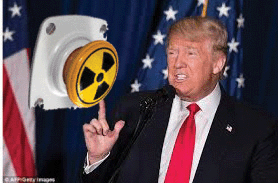 The Coronavirus Teaches Us Not to Let Trump Press the Nuclear Button BY TOM Z. COLLINA, DEFENSE ONE, POLICY DIRECTOR, PLOUGHSHARES FUND 1 Apr 20, Some of the president’s poor decisions on COVID-19, like proposing to reopen the nation by Easter, have been reversed. But a presidential decision to start nuclear war cannot be.
President Trump has swung from calling the coronavirus pandemic “totally under control” to a “national emergency” and back. Trump’s latest idea that the nation could be “opened up and just raring to go by Easter” did not stand up to scrutiny. Amazingly, we are months into this crisis and the president is still struggling to get it right.
But what if the president needs to get a decision right the very first time, no do-overs? And what if the wrong decision could lead to a disaster even worse than COVID-19?
Chillingly, that is where we find ourselves on another underappreciated but even more catastrophic threat: —nuclear war. Instead of a relatively slow-moving pandemic, this crisis could have involved strategic warning of a massive Russian nuclear attack. The president would have not weeks but just minutes to decide if the attack was real and, if so, whether to launch U.S. nuclear weapons before the attack arrives. If he decides to launch, there is no going back. No mulligans.
What would the president do? Judging by the coronavirus experience, Trump would likely be uninformed about the specifics of the threat and so would fall back on his gut instincts, assume he knows best, and proceed with dangerous over-confidence. But unlike the current crisis, he would only have time to consult with a few advisors, under intense time pressure, and only if he chooses to. The president has the sole authority to order the launch of U.S. nuclear weapons with no oversight from Congress, the Secretary of Defense, or anyone else …….
It is a deeply troubling reality that if early warning systems show a massive nuclear attack on the way, the president might decide to launch an immediate retaliation and has the absolute authority to do so. This would be a catastrophically bad decision for a number of important reasons, none of which may be obvious to an uninformed president.
First and foremost, the president might not know that the attack is probably a false alarm. There have been multiple false alarms like this in the United States and Russia, and the rise of sophisticated cyberattacks make this danger even worse…..
We need to limit the president’s unchecked and unnecessary authority to launch. Trump’s reckless mistakes on COVID-19 are a call to action: we cannot allow the president to make a unilateral decision to start nuclear war.https://www.defenseone.com/ideas/2020/04/coronavirus-teaches-us-not-let-trump-press-nuclear-button/164280/
Trump doesn’t ‘get it’ -climate change as the next great engine for the next pandemic
 With the Coronavirus, It’s Again Trump vs. Mother Nature, The president’s failure to understand his limits is very costly. NYT, By Thomas L. Friedman, March 31, 2020
- Today’s news quiz: What do these data points have in common?Jan. 22: President Trump is asked by CNBC: “Are there worries about a pandemic at this point?” Trump answers: “No. Not at all. And we’re, we have it totally under control. It’s one person coming in from China. … It’s — going to be just fine.”
Jan. 31: Moving to counter the spreading coronavirus outbreak, Trump bars entry by most foreign nationals who had recently visited China…….
Nov. 26, 2018: CNN reports that Trump “dismissed a study produced by his own administration … and more than 300 leading climate scientists, warning of the potentially catastrophic impact of climate change.” Asked why, Trump told reporters, “I don’t believe it.” Asked if he read it, Trump said, “some.”
March 30, 2020: This newspaper reports that Trump completed plans to scrap Obama-era automobile fuel efficiency standards that limited climate-warming tailpipe pollution — a move that will “allow cars on
American roads to emit nearly a billion tons more carbon dioxide over the lifetime of the vehicles.”
What’s the common theme? We have a president who is enamored with markets but ignorant of Mother Nature, and we have paid a steep, steep price for that — and will pay an even bigger price when it comes to climate change, if Trump remains in charge……..
there is one huge difference between the coronavirus and climate change: Climate change doesn’t “peak” — and then flatten out and then maybe dissipate or be permanently prevented by vaccine — so normal life resumes.
No, when the Greenland and Antarctic ice melts, it’s gone, and we humans will have to contend with the implications of sea level rise, mass movements of populations and various kinds of extreme weather — wetter wets, hotter hots and drier dries — forever.
There is no herd immunity to climate change. There are only endless impacts on the herd.
Thinking about climate change, even in the middle of this pandemic, is actually useful in a number of ways. For starters, they follow similar natural laws and have common mitigation strategies………
Finally, epidemiologists will tell you that climate change may well be the next great engine for the next pandemic — only this virus could easily be carried by mosquitoes, which, because of warmer temperatures in the global north, are able to migrate up from places they’ve never migrated from before.
For all these reasons, as we invest in infrastructure to stimulate our economy out of this corona crisis, we should be doing it to make our society more resilient against both pandemics and climate change. ……
Now that we have tasted Mother Nature’s wrath in the form of both Covid-19 and climate change, let’s get her on our side. She’s as happy to help as to destroy. Let’s use chemistry, biology and physics, not to mention sun and wind, to create the vaccines and power systems that immunize us from viruses and weather extremes — and not double down on bad habits that will only make us sick again. https://www.nytimes.com/2020/03/31/opinion/covid-trump-climate-change.html
The Russian point of view on nuclear arms control
|
Russia’s View on Nuclear Arms Control: An Interview With Ambassador Anatoly Antonov, Arms Control Association April 2020Arms Control Today conducted a written interview in early March with Anatoly Antonov, Russian ambassador to the United States on issues including the current status of U.S.-Russian strategic security talks, the future of New START, talks on intermediate-range missile systems, engaging China in arms control, and President Vladimir Putin’s proposal for a summit of the leaders of the five permanent members of the UN Security Council……..
Amb. Anatoly Antonov: Russia and the United States are the largest nuclear weapons powers and permanent members of the UN Security Council. They bear a special responsibility for preserving world peace and security. That is why it is crucial to maintain the bilateral strategic stability dialogue at any given circumstance, regardless of political situation. It goes without saying that such engagement should be conducted on a regular basis. ……. As for the consultations in January, our reaction can be described as “cautious optimism.” On the bright side is the fact that the meeting did take place, even though it exposed serious disagreements between our countries on a number of topics. ….. There is no doubt that the Russian-U.S. bilateral arms control agenda remains relevant. We are open to discussing within the strategic dialogue the issue of the newest and prospective weapons that do not fall under New START. ……. https://www.armscontrol.org/act/2020-04/interviews/russias-view-nuclear-arms-control-interview-ambassador-anatoly-antonov |
|
Different federal laws complicate legal case about radiation exposure and teenager’s brain cancer
The appellate panel must decide how two different federal laws should intersect. Law.com By Raychel Lean | April 01, 2020 A federal wrongful death lawsuit alleging exposure to radiation from nuclear materials caused a South Florida teenager’s brain cancer had its moment before the U.S. Court of Appeals for the Eleventh Circuit on Wednesday as attorneys debated whether Florida’s four-year statute of limitations should apply.
The appellate panel must decide how two different federal laws should intersect. While 42 U.S.C. § 9658 preempts state time limits for lawsuits involving nuclear incidents, the Price-Anderson Act adopts state law as “the rules for decision.”
The question arose after Palm Beach County resident Cynthia Santiago sued in the Southern District of Florida in 2014, five years after she was diagnosed with a brain tumor at 13. When she died about two years later, her parents Joselyn and Steve Santiago became personal representatives.
The complaint blamed Connecticut-based aircraft maker United Technologies Corp., alleging its Palm Beach County engineering facility released radioactive materials, heavy metals and semi-volatiles in The Acreage, where several children were also reportedly diagnosed with brain tumors. …… https://www.law.com/dailybusinessreview/2020/04/01/clock-ticking-for-florida-family-alleging-radiation-exposure-caused-teens-cancer/?slreturn=20200301190656
The court has yet to rule.
Nuclear Regulatory Commissions plans for lengthy lifetimes for U.S. nuclear power plants
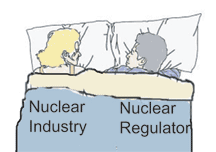 THE BIG PICTURE (Infographic): U.S. Nuclear Lifetimes, [ Excellent graph and table on original] https://www.powermag.com/the-big-picture-infographic-u-s-nuclear-lifetimes/ Mar 31, 2020. by Sonal Patel The U.S. has 96 licensed-to-operate nuclear power reactors and two reactors under construction. But the average age of the nation’s 96 licensed nuclear units is about 39 years old. That has been of some concern to the nuclear industry, which has provided roughly a fifth of the nation’s power since the 1990s. About 88 of the 96 reactors have already renewed their operating license once, extending their lifetimes from 40 to 60 years, but the majority of these will be “nearing the end of that 20-year extension by 2029 and will be seeking to renew their license a second time, for another 20-year period,” the Nuclear Energy Institute (NEI) has said.In December 2019, marking a major milestone, the Nuclear Regulatory Commission (NRC) granted the first-ever subsequent license renewal (SLR) applications to Turkey Point 3 and 4, and then to Peach Bottom 2 and 3 in March 2020, extending these reactors’ operating licenses from 60 to 80 years. THE BIG PICTURE (Infographic): U.S. Nuclear Lifetimes, [ Excellent graph and table on original] https://www.powermag.com/the-big-picture-infographic-u-s-nuclear-lifetimes/ Mar 31, 2020. by Sonal Patel The U.S. has 96 licensed-to-operate nuclear power reactors and two reactors under construction. But the average age of the nation’s 96 licensed nuclear units is about 39 years old. That has been of some concern to the nuclear industry, which has provided roughly a fifth of the nation’s power since the 1990s. About 88 of the 96 reactors have already renewed their operating license once, extending their lifetimes from 40 to 60 years, but the majority of these will be “nearing the end of that 20-year extension by 2029 and will be seeking to renew their license a second time, for another 20-year period,” the Nuclear Energy Institute (NEI) has said.In December 2019, marking a major milestone, the Nuclear Regulatory Commission (NRC) granted the first-ever subsequent license renewal (SLR) applications to Turkey Point 3 and 4, and then to Peach Bottom 2 and 3 in March 2020, extending these reactors’ operating licenses from 60 to 80 years.
More SLRs are expected this June for Surry 1 and 2. Meanwhile, owing to market conditions, technical issues, political pressure, and financial stresses, nine reactors have retired before their licenses expired since 2013, and an additional six units are slated to retire by 2026. The NEI suggests that half the nation’s nuclear fleet will need to obtain SLRs by 2040 to continue operating or be forced to retire. Sources: NRC, POWER |
|
Montgomery County officials not happy with Exelon’s Limerick Nuclear Power Plant plans for addressing Covid19
A parking lot has been designated for the new contractors that have been hired as the annual refuel of the reactor maintenance project is underway.
Dr. Valerie A. Arkoosh, chair of the Montgomery County Board of Commissioners, says back on March 16, Exelon, the company that runs the Limerick nuclear plant, gave them a lackluster social distancing plan.
She said, “We learned of plans to bring approximately 1,800 workers into our region from around the United States. We asked Exelon to postpone this refuel until a time when the disease burden from COVID-19 was lower.” …….. https://6abc.com/limerick-plant-exelon-corporation-covid19-cases/6067085/
Coronavirus: USA Nuclear Sites Could Run Out of Critical Supplies
 Coronavirus and the states: Plastic bag bans on hold; nuclear plants run low on gloves, masks, wipes. Missoula, BY MATT VASILOGAMBROS, 30 Mar 20
“…… Nuclear Sites Could Run Out of Critical Supplies. Nuclear sites across the country might soon run out of gloves, masks and wipes. The U.S. Energy Department said the priority was to supply those items to health care workers and others on the frontline of the coronavirus epidemic.
That means thousands of nuclear power plant workers across the country may not have the protection needed to do their jobs. Nuclear Energy Institute CEO Maria Korsnick anticipated the shortage as early as last week, when she asked U.S. Energy Secretary Dan Brouillette for supplies and testing kits.
To be sure, not every plant expects to run out of masks. The Tennessee Valley Authority this week donated more than 50,000 masks to state emergency responders, according to spokeswoman Melinda Hunter.
Still, the TVA has worked to adapt to the crisis, including reducing power at some plants. One of its plants, Sequoyah, downsized its refueling crew from 1,000 to 800. No TVA worker had tested positive for COVID-19 as of Thursday.
Regulators also have been scrambling to adapt. The U.S. Nuclear Regulatory Commission will allow plants to operate with fewer workers on duty for longer hours, said Scott Burnell, a spokesman for the agency, in an email.
Environmental activists say now is not the time to cut corners and risk a nuclear accident. “An accident with a major release of radiation or the threat of it during this time of pandemic and social isolation would be a double whammy,” said Don Safer, a member of the board of the Tennessee Environmental Council, which advocates for renewable energy. “A major evacuation now would be chaos.”….. https://missoulacurrent.com/government/2020/03/states-coronavirus/
U.S. Nuclear Regulatory Commission (NRC) may exempt some nuclear stations from work-hour controls
NRC to Consider COVID-19 Exemptions for Nuclear Plant Work-Hour Controls https://www.powermag.com/nrc-to-consider-covid-19-exemptions-for-nuclear-plant-work-hour-controls– Sonal Patel , POWER senior associate editor (@sonalcpatel, @POWERmagazine). 30 Mar 20,
The Nuclear Regulatory Commission (NRC) on March 28 told industry that it is prepared to grant requests from individual nuclear generators for exemptions from work-hour controls specified in its rules to help provide more flexibility to the sector as it grapples with workforce issues related to the COVID-19 public health emergency.
The objective of the exemptions from Title 10 of the Code of Federal Regulations (10 CFR 26.205(d)(1)-(7)) is to ensure that the “control of work hours and management of worker fatigue do not unduly limit licensee flexibility in using personnel resources to most effectively manage the impacts of the COVID-19 [public health emergency (PHE)] on maintaining the safe operation of these facilities,” NRC Director of Nuclear Reactor Regulation Ho Nieh wrote in letters sent to the Nuclear Energy Institute (NEI), Entergy Nuclear, and Florida Power and Light over the weekend.
Nieh wrote that the exemptions will apply narrowly—only to nuclear plants whose staffing levels are affected by the pandemic. Licensees must also show they can no longer meet the work-hour controls outlined in the rules, and they can institute site-specific administrative controls for pandemic fatigue-management for personnel as outlined in the rules.
Alternative fatigue-management controls, for example, should ensure employees do not work more than 16 work-hours in any 24-hour period and not more than 86 work-hours in any 7-day period, excluding shift turnover; a minimum 10-hour break is provided between successive work periods; 12 hour shifts are limited to not more than 14 consecutive days; and a minimum of six days off are provided in any 30-day period.
Nuclear licensees that cannot meet the rule’s requirements should notify the NRC in writing, including by email, no less than 24 hours before they would be out of compliance with the rules, Nieh said. The NRC plans to consider requests on a case-by-case basis and, if approved, provide exemptions for a period of 60 days. “If the COVID-19 PHE condition does not improve before expiration of the exemption, then the NRC may consider an additional exemption period,” he added.
(This story is being updated; check back later for more details.)
—
USA nuclear industry uses coronavirus to gouge $billions of tax-payer money
|
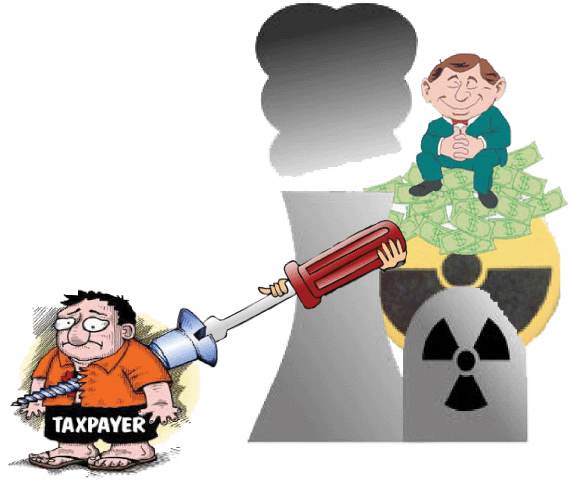
Out of control?, While industry looks for handouts, NRC gives nod to reduced safety oversight, https://wordpress.com/read/feeds/72759838/posts/2643325963By Linda Pentz Gunter 29 Mar 20, It was no surprise really, when the first to line up with outstretched palms as Congress debated and formulated its now passed $2 trillion coronavirus-prompted emergency relief bill, were nuclear corporations.The sinking nuclear power industry spotted an economic lifeline and couldn’t wait to make a grab for it. The Nuclear Energy Institute, the lobbying arm of the nuclear power industry, rushed off a letter to congressional leaders asking for a 30% tax credit and waivers for existing regulatory fees. One of NEI’s apparently needy recipients is the financial fiasco known as Vogtle 3 and 4, the new nuclear power plant construction project in Georgia, which is already more than five years behind schedule and is projected to cost $28 billion, double the original predicted price. The two new Georgia reactors aren’t needed, and their continued slow progress is by no means a matter of national security right now — or at all. But the NEI would like to see a nice fat grant go to Georgia Power to continue construction there, even though the company has already received two federal loan guarantees totaling $12 billion. In addition, the company is also gouging ratepayers in advance to cover the costs for the two reactors through the state’s Construction Work in Progress law, with no guarantee that they will ever reach completion. Before long, the nuclear weapons manufacturers got in on the act as well. Wrote the group, Code Pink: “Boeing has the audacity to demand a $60 billion taxpayer bailout for their shareholders and CEO.” Boeing is responsible for the Minuteman Intercontinental Ballistic Missiles, to be replaced this year with the misleadingly named Ground Based Strategic Deterrent. Boeing has also already received a $26.7 million contract from the U.S. Navy for Trident II D5 ballistic missile maintenance, rebuilding and technical services. Astonishingly, it was ultra conservative senator, Ted Cruz, who was one of those who pushed back against the corporate bailouts for the likes of Boeing and GE, manufacturer of the ill-fated Fukushima nuclear power plants and similar boiling water reactors in the US that are meltdowns waiting to happen. Cruz tweeted that “some are pushing for a special carve-out just for Boeing & GE. That would be WRONG. Millions are losing jobs; we don’t need bailouts or corporate welfare — those companies should participate in the same liquidity programs as everyone else.” But Boeing apparently got its wish. A $17 billion federal loan package contained in the stimulus bill passed by both the House and Senate and signed by President Trump on March 27, “was crafted largely for the company’s benefit,” according to reporting in the Washington Post. Boeing may also be able to dip its fingers into the “$58 billion the Senate package is providing in loans for cargo and passenger airlines, as well as the $425 billion in loans it is allocating to help firms, states and cities hurt by the current downturn,” wrote the Washington Post, even though, as Code Pink pointed out, alluding to the two 737 MAX disasters, Boeing is responsible for “defective civilian planes that plummet from the sky in mid-flight.” Boeing shares soared more than 24% on the day the Senate bill passed. The US is already spending $35.1 billion a year on its nuclear weapons arsenal. As the timely graph below [on original] from ICAN points out, this money could be redirected to a wealth of essential needs that would help quell the novel coronavirus in the US. … It’s not yet clear what portion of the stimulus money might go to the nuclear power industry, but the renewable energy sector took a hit. According to the San Diego Union Tribune, “the renewable energy industry had asked for — but did not get — extensions of deadlines related to construction or completion of solar and wind projects, without which they could lose access to time-sensitive tax credits. Industry associations were hopeful they’d be included in any later relief package.” There is also a $400 billion slush fund in the present legislation which can be used for loans and loan guarantees for large companies. Watch for the nuclear power industry to line up for a share of that in addition to its earlier pitch for a $23 billion bailout, which Lukas Ross, senior policy analyst with Friends of the Earth, called “a new low bar,,” and an attempt to use the coronavirus crisis “to try and brazenly grab more cash.” Meanwhile, the US Nuclear Regulatory Commission (NRC), in its usual fashion, has used the opportunity presented by the corona crisis to relax its already somnific safety oversight even more, and will allow nuclear power plant operators to defer safety maintenance, inspections and fitness for duty requirements during the outbreak. “Regulations to ensure safety should be strengthened at a time like this — not weakened,” Kevin Kamps, radioactive waste specialist at Beyond Nuclear, told Power Magazine. “It means operating nuclear plants without basic safety inspections.” One measure would be to allow workers to put in longer shifts than safety regulations allow, a measure that would place unnecessary additional “stress and strain on workers that need to be fully attentive and alert in sensitive jobs,” Kamps told the Carolina Public Press. He recommended powering down reactors instead, particularly given the current reduction in demand. But if the coronavirus pandemic causes higher than usual absenteeism among vital nuclear plant personnel, the NRC has a plan for that. Under normal circumstances, operating with too few control room staff is a safety violation. But under the coronavirus conditions, this would be exempted, or forgiven by the NRC, creating an added safety risk. During a recent NRC and industry telephone meeting on the topic, Beyond Nuclear’s director of reactor oversight, Paul Gunter, asked whether the NRC had supplied its reactor site personnel with sufficient protective equipment, masks, and respirators, as per the Centers for Disease Control guidelines. “They blew it off, Gunter said. “They claimed it was a matter for OSHA.” Industry representatives on the call remained silent on the matter. Gunter added that Kamps’s suggestion to power down reactors in regions where the demand was reduced and excess generating capacity was already high, could allow for resting the remaining workforce and keeping them healthy and ready to replace workers at still operating plants where personnel have been hit hardest by reactor operator shortages and extended security shifts. “We should be planning on how to keep stable and safety-compliant electricity going,” Gunter said. “One way would be to create a protected pool of sequestered nuclear utility workers. But that is not happening. The industry is dictating to the regulator what the agenda will be.” So, business as usual. |
|
Vogtle nuclear power plant construction – “Essential workers”, as the company wants to build in a hurry
 Coronavirus could disrupt normal refueling practices for
  nuclear facilities as staffing concerns grow, Utility Dive, By Iulia Gheorghiu , March 26, 2020
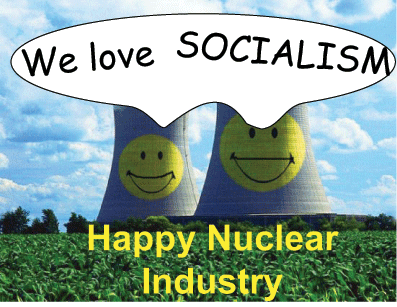
“………Nuclear construction
Various states have included construction work in the categories of essential work when issuing directives to keep people at home.
With pandemic plans in place, Southern Company construction is continuing on the Vogtle units in Georgia. Vogtle construction has not encountered major changes from the novel coronavirus, CEO Tom Fanning told Bloomberg.
Southern announced a non-manual worker for the construction of Vogtle units 3 and 4 was being tested for coronavirus two weeks ago.
“I completely understand that [Southern] wants to finish as soon as possible,” Buongiorno said, given the delays and cost overruns of the construction. (Professor Jacopo Buongiorno, director of the Massachusetts Institute of Technology’s Center for Advanced Nuclear Energy Systems.)…https://www.utilitydive.com/news/coronavirus-could-disrupt-normal-refueling-practices-for-nuclear-facilities/574920/
Nuclear stations having difficulties with staffing; one station has workers positive for Covid19
 Coronavirus could disrupt normal refueling practices for nuclear facilities as staffing concerns grow, Utility Dive, By Iulia Gheorghiu March 26, 2020, The nuclear sector has sprung into action to screen employees for signs of the novel coronavirus and prepare for potential disruptions to their typical refueling practices in light of pandemic-related travel restrictions……..
Pandemic plan for Nuclear Power Plant could make employees isolate at the reactor
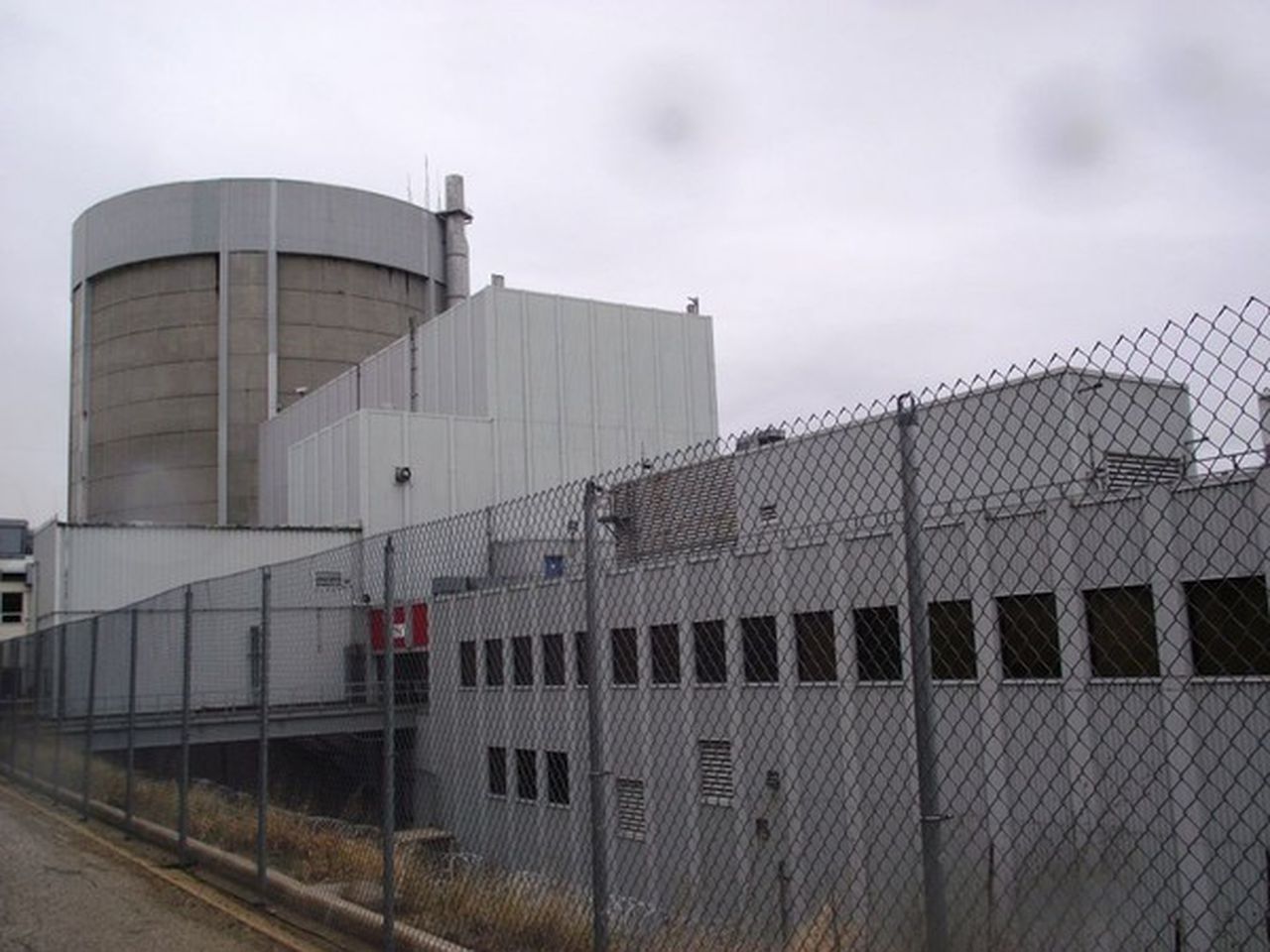
Nuclear plant could ‘sequester’ employees to live on-site under pandemic plan By Brad Devereaux | bdeverea@mlive.com-27 Mar 20, COVERT, MI — The company that owns Palisades nuclear plant has a private pandemic plan that includes a contingency to sequester employees live at the site temporarily, though that scenario is unlikely, a company spokeswoman said……
Entergy owns the nuclear plant situated on the Lake Michigan shoreline about 7 miles south of South Haven…..
Sequester means employees would reside on site, Gent said. The company declined to release its full plans to MLive because they contain business-sensitive information, she said….
The Nuclear Regulatory Commission, which inspects to ensure safety at plants across the country, said resident inspectors are ready to respond immediately should there be developing safety issues amid the coronavirus outbreak. Resident inspectors will make regular visits to operating nuclear power reactor sites and will remotely monitor plant data systems, meetings and other information. Back-up inspectors are available from regional offices or headquarters should they be necessary to maintain oversight, the NRC said…..
In 2017, Entergy announced that it planned to close Palisades in the spring of 2022.
In Aug. 2018, Entergy announced it had agreed to sell the subsidiaries that own Palisades and the Pilgrim Nuclear Power Station in Plymouth, Massachusetts, after their shutdowns and reactor defuelings, to a Holtec International subsidiary for prompt decommissioning.
The nuclear industry’s 2007 NEI Pandemic Licensing Plan still accepted, but not really safe
 Nuclear Power Safety and the COVID-19 Pandemic https://allthingsnuclear.org/elyman/nuclear-power-safety-and-the-covid-19-pandemic ED LYMAN, ACTING DIRECTOR, NUCLEAR SAFETY PROJECT; SENIOR SCIENTIST, GLOBAL SECURITY PROGRAM | MARCH 26, 2020, With the world facing overwhelming and immediate threats from the novel coronavirus (COVID-19) pandemic, the risks of nuclear power are probably far from the thoughts of most people. But there is no escaping the fact that nuclear plants, which provide about 20 percent of the U.S. electricity supply, require highly-trained staff to operate them safely and to protect them from terrorist attacks. Nuclear Power Safety and the COVID-19 Pandemic https://allthingsnuclear.org/elyman/nuclear-power-safety-and-the-covid-19-pandemic ED LYMAN, ACTING DIRECTOR, NUCLEAR SAFETY PROJECT; SENIOR SCIENTIST, GLOBAL SECURITY PROGRAM | MARCH 26, 2020, With the world facing overwhelming and immediate threats from the novel coronavirus (COVID-19) pandemic, the risks of nuclear power are probably far from the thoughts of most people. But there is no escaping the fact that nuclear plants, which provide about 20 percent of the U.S. electricity supply, require highly-trained staff to operate them safely and to protect them from terrorist attacks.They also need periodic maintenance to ensure that critical safety systems remain in good working order. And, they must be closely supervised by the Nuclear Regulatory Commission (NRC) to ensure that plant owners are effectively implementing nuclear safety and security requirements. However, the NRC does not generally oversee the health and safety of plant workers unless it is related to radiation exposure, so it is largely up to the plant owners themselves to implement protective measures against COVID-19 to ensure they have a functioning workforce. Reports about potential coronavirus cases among the workforce at Plant Vogtle in Georgia and allegations of a lack of enforcement of social distancing protocols there raise concerns about the adequacy of the industry’s response to the COVID-19 pandemic. During crises such as the current pandemic, ensuring that nuclear power plants operate safely and reliably is even more critical. Tens of millions of Americans live within 50 miles of operating nuclear power plants. A reactor accident or terrorist attack could release a large amount of radioactive material into the environment, potentially exposing many people to high levels of radiation. As the world saw after the 1986 Chernobyl and 2011 Fukushima accidents, such an event at a U.S. nuclear plant might force people from their homes for months or longer and contaminate food and water supplies—the last thing Americans need to deal with right now. Compounding the impacts of such a disaster with the social and economic disruptions caused by spread of the virus would further strain an already fragile health care system and economy. Thus it is incumbent on the NRC to make sure that the pandemic does not compromise nuclear safety and security—and if it does, to take whatever actions, including ordering plant shutdowns, are necessary. However, the NRC will likely face tremendous pressure from nuclear plant owners, some of whom are financially strapped, to keep their plants running and generating revenue. The NRC should have developed a policy long ago to address these questions, but like the rest of the U.S. government, it is now playing catch-up fast. Short-staffing nuclear plantsA key question the NRC may soon face is how it should react if a nuclear plant is unable to maintain the required numbers of licensed control room operators and security personnel per shift. For example, a single control room at a two-unit plant must be staffed with three operators and two senior operators. Also, there must be at least ten armed responders on each shift to protect the plant from radiological sabotage attacks—and the actual number most plants have committed to providing is likely higher. There are also regulations governing work hours and fatigue management that were put into place partly to address excessive overtime issues that arose after the 9/11 attacks. Licensees could apply for waivers from work hour restrictions if the number of available personnel were to decline, but those extensions would be limited due to the potential for fatigue. If a plant is unable to meet any of these requirements, it generally must shut down unless the NRC provides an exemption from the regulations or relief from license commitments. NRC can allow reactors to operate while in violation of their legally binding license commitments by granting a “notice of enforcement discretion.” The radiological risk to public health and safety will generally increase when the plant is operating outside of approved license limits. In evaluating whether to issue a notice of enforcement discretion, the NRC uses a standard that there should be “no significant increase” in radiological risk after reactor owners have implemented compensatory measures. This standard is nominally the same during a pandemic or other national emergency as at any other time. But difficult choices may be necessary if nuclear plant shutdowns were to jeopardize the availability of electricity during such an emergency, which is unlikely given that most regions of the country have supply well in excess of their reserve margins and COVID-19 is suppressing demand. In any event, such considerations are beyond the scope of NRC’s authority to ensure radiological safety and security. The industry’s proposal: increase riskThese issues are not new. In 2006, the NRC held a workshop to consider the impacts of a pandemic flu outbreak on safety. A number of difficult policy questions were discussed, including the potential need to sequester workers early in an outbreak and the effect of high rates of absenteeism. But little was done to resolve these questions. In 2007 the Nuclear Energy Institute (NEI), the nuclear industry’s main trade organization in Washington, submitted a draft “Pandemic Licensing Plan” to the NRC for review. The plan recognized “the potential for an influenza pandemic to reduce nuclear plant staffing below the levels necessary to maintain full compliance with all NRC regulatory requirements,” described “the regulatory actions necessary to permit continued operation with reduced staffing levels for approximately four to six weeks” and recommended, “NRC enforcement discretion as the most efficient and effective licensing response to a pandemic.” In justifying this approach, NEI argued that “regulatory relief to permit rescheduling of selected activities and deferral of most administrative and programmatic requirements would balance the risk from continued operation with the risk from regional blackouts and grid instability.” At the time, the NRC did not buy NEI’s argument for broad and pre-approved enforcement discretion that would increase radiological risk during a pandemic, responding that “the NRC staff finds that without bounding entry conditions and more specific technical bases for the proposed regulatory relief, NEI’s approach still presents significant challenges that may prevent meaningful overall progress in pandemic preparation. For instance, the plan contains only limited justification concerning the public health and safety need for nuclear power plants to remain on-line during a pandemic; likewise, the plan does not adequately explain why increased safety and security risk may be offset by considerations of need for electric power. Moreover, the plan continues to raise other significant legal and policy issues that would need to be resolved.” The situation today: too little, too lateAlthough the NRC and NEI continued to discuss these issues more than a decade ago, there is no indication that their differences were ever resolved. Concern about an influenza pandemic was overshadowed by the Fukushima accident. Today, the NRC is in a different place. Three of the four sitting commissioners are Republicans who embody the spirit of the pro-industry, anti-regulation Trump administration. It would be shocking to see the NRC staff criticize an NEI proposal in 2020 the way it did back in 2008. In an NRC public meeting on March 20 to discuss regulatory issues related to the coronavirus pandemic, an NEI representative referred to the 2007 NEI Pandemic Licensing Plan as the basis for the industry’s regulatory contingency approach, and no one from the NRC raised the staff’s previous concerns about the plan. The NRC staff said that the agency was planning to issue a memorandum to provide guidance on enforcement issues, but did not address the standards it would be using to approve enforcement discretion—and in particular, whether it now accepted NEI’s argument that a net increase in radiological risk would be appropriate to reduce the unlikely risks to the electrical grid. The NRC assured me today that its risk standards for granting enforcement discretion have not changed and that if they deemed any plant unsafe they could and would issue an order to shut it down. More details should be available when it releases its Enforcement Guidance Memorandum later this week. However, there may be extreme circumstances where the NRC may have to make difficult decisions that would involve the balancing of radiological risk and electricity supply risk. If so, the NRC will need to consult not only with other government agencies responsible for grid security and infrastructure protection but also with the public. Such discussions should begin now. Hopefully, it is not yet too late to come up with a satisfactory answer. |
|
|
1 This Month
26 September – International Day for the Total Elimination of Nuclear Weapons





PLEASE OPPOSE HR 8255 AND S.3639 – bills would accelerate satellite deployment, with no environmental review or safeguards – https://ncstd5li.quorum.us/campaign/169331/
To see nuclear-related stories in greater depth and intensity – go to https://nuclearinformation.wordpress.com
-
Archives
- September 2026 (291)
- August 2026 (330)
- July 2026 (355)
- June 2026 (287)
- May 2026 (306)
- April 2026 (356)
- March 2026 (251)
- February 2026 (267)
- January 2026 (308)
- December 2025 (358)
- November 2025 (359)
- October 2025 (375)
-
Categories
- 1
- 1 NUCLEAR ISSUES
- business and costs
- climate change
- culture and arts
- ENERGY
- environment
- health
- history
- indigenous issues
- Legal
- marketing of nuclear
- media
- opposition to nuclear
- PERSONAL STORIES
- politics
- politics international
- Religion and ethics
- safety
- secrets,lies and civil liberties
- spinbuster
- technology
- Uranium
- wastes
- weapons and war
- Women
- 2 WORLD
- ACTION
- AFRICA
- Atrocities
- AUSTRALIA
- Christina's notes
- Christina's themes
- culture and arts
- Events
- Fuk 2022
- Fuk 2023
- Fukushima 2017
- Fukushima 2018
- fukushima 2019
- Fukushima 2020
- Fukushima 2021
- general
- global warming
- Humour (God we need it)
- Nuclear
- RARE EARTHS
- Reference
- resources – print
- Resources -audiovicual
- Weekly Newsletter
- World
- World Nuclear
- YouTube
-
RSS
Entries RSS
Comments RSS

